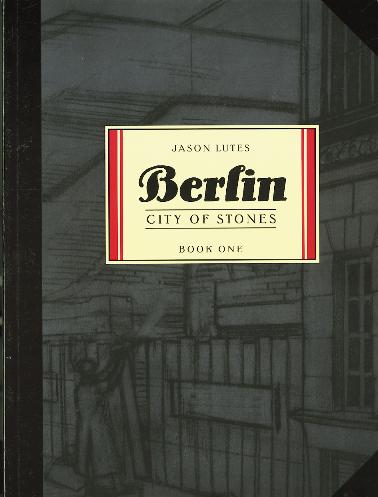
Those street-fighting years: A Review of Jason Lutes’ “Berlin”

Pothik Ghosh

Jason Lutes, Berlin (Book 1): City of Stones, Drawn & Quarterly, Montreal (2001, Reprinted 2009) &Berlin (Book 2): City of Smoke, Drawn & Quarterly, Montreal (2008) 

Jason Lutes begins at the beginning. The encounter between a man and a woman in a railway carriage with which the first book of his graphic-novel trilogy opens is an archetype. And yet the manner in which it unfolds into the larger narrative of Berlin – the third part of which is yet to appear and which is currently made up of City of Stones and City of Smoke respectively – serves to brush it against its own banal grain. One does not, however, need to get to the middle of Lutes’ yarn about Berlin in the twilight years of the Weimar Republic to figure that such a stock opening has not been forced upon the artist by an imagination overwhelmed and exhausted by the stereotypes of mass culture.

The encounter between key protagonists, journalist Kurt Severing and art student Marthe Mueller, in the compartment of a Berlin-bound train in the September of 1928, is not simply meant to be a first meeting between a man and a woman. It is, more importantly, an encounter set up by Lutes between words (journalist Severing) and images (artist Mueller). An encounter that presages a relationship fraught with both intimacy and conflict. This duality and tension, which marks the consequent entwinement of the protagonists’ lives and loves, do not merely characterise the historical specificity of their times. It is, simultaneously, a conceit that Lutes deploys to stake out his artistic approach, credo even, vis-à-vis the so-called graphic-novel form.

For Lutes then, the comic book, by virtue of being a montage of words and images, has much greater affinity in terms of artistic effect and political purposeBerlin to the audio-visual experience of cinema than the culture of print to which comics have traditionally belonged. For him, not unlike the other contemporary graphic-novel greats such as Art Spiegelman, Alan Moore and Joe Sacco, words and images are not, as they traditionally have been in comics, discrete entities illustrating each other. Rather, they are envisaged as a singular, mutually illuminating complex whose dynamic makes possible ideas and occurrences that become the constituent units of the larger narrative. And Berlin is a perfect exemplar of Lutes’ vision steeped, self-admittedly, in the politics and aesthetics of avant-garde European cinema that has been summed up rather well by Jean-Luc Godard when he distinguished such cinema as a means of expression from television as a means of transmission.

It is precisely this cinematic function of expression that is constitutive of Lutes’ Berlin and is embodied by it as a sort of defining aesthetic for the graphic-novel genre. His engagement, through Marthe Mueller and her co-students of the Berlin Art Academy, with Expressionism, and through it, with western art as a whole, indicates precisely this obsession of his. And while he makes Marthe reject Expressionism, together with all other reigning currents of institutionalised art, it is only to once again bring to fore the clarity of the founding impulse of Expressionism that its frozen form obscures. Berlin is, therefore, clearly a manifesto of artistic freedom and commitment.

The free rein that an artist can give to his/her subjectivity, thanks to Expressionism, or at any rate its founding impulse, enables Lutes to set his gaze free from the constraints of reality as it is given. And that is both the aesthetic medium and political message called Berlin. Lutes’ Berlin, therefore, is not a city-novel in the traditional sense. Neither in its images nor in its words does it illustrate, evoke or invoke the ‘real’ and definitive geography of Berlin of the inter-war years. That, if and when it happens at all, is merely incidental. It does not even seek to transfigure the landscape of the city in a highly eccentric and expressionistic manner akin to the defamiliarising geographies produced by such “city novelists” as Joyce (Dublin), Dos-Passos (New York) or Alfred Doblin (Berlin).

Berlin, for Lutes, is the emotions and ideas of a politics that is constitutive of an epoch called the Weimar Republic, in whose womb gestated the embryo of Hitlerite National Socialism. One could, however, argue that Lutes, considering he is an American in his late thirties who has been to Berlin for all of three days, could do no better than produce such a “research-based” city novel devoid of personal and personalised lived experience. But that Lutes chose to do so of his own free will shows it was a conscious decision that could have come only from the kind of aesthetic and political programme stated above.

Berlin is, therefore, first of all a story about the rise of Nazism, and the unforgivable surrender of a self-serving Weimar political class, mostly made up of dishonest Social Democrats inhabiting their delusive ivory-towers. And it is told, not so much by examining what happened in the top echelons of Weimar polity, but by laying bare what went on in the everyday lives and relationships of people in the historically invisible streets, homes, factories, newspaper offices, trains, schools, restaurants, and nightclubs of the city.

This political epoch called Berlin – which begins a year before the 1929 May Day massacre of German Communist cadre by the Weimar armed forces controlled by a Social Democratic government (City of Stones) and culminating in the National Socialists getting a thumping majority in the Reichstag elections of 1930 (City of Smoke) – is not merely a matter of documentary detailing for Lutes. The how and why of events is, for him, no less important than the what of them. Not surprisingly, the artist in him is not satisfied with merely compelling the reader to confront individual characters and the events they comprise. He constantly gets behind the vanishing point of ‘reality’ in an attempt to show how the incidents and, more importantly the characters, that constitute such reality have been shaped through and by their histories, which are both unique and general.

Cinematic techniques such as flashbacks that transport the reader to the end of World War I and the days after the Treaty of Versailles, especially with regard to the particularities of everyday lives of individuals, are spliced on to panels depicting interactions and relationships among various characters in 1928 to render their seemingly opaque individual psychological responses to each other and the world around historically transparent.

Berlin2Such filmic techniques also come in handy for Lutes to underscore the often contingent nature of decisions that people made while choosing their political side. For instance, the seeds of worker Gudrun Braun’s induction into the KPD (Communist Party of Germany) and her eventual death in the May Day massacre is sown in a serendipitous encounter between her and David, a young Jewish boy, whom she chances upon selling the KPD paper in heavy rain and who gives her a copy of the paper in return for the good turn she does him by lending him her umbrella.

Even the persistent Nazi-Communist conflicts of Weimar Germany – which would eventually give Europe its long fascist night and which began with the assassination of Rosa Luxemburg and Karl Liebknecht in 1919 to which the two parts of the trilogy continually refer – are snatched away from the abstractions of political history to be restored to the flesh-and-blood humanness of everyday contingencies amid which they actually took shape.  Gudrun’s nascent Communist sympathies impel her Jew- and Red-hating husband Otto to throw her out of their house. It is this that not only leads to Gudrun’s complete radicalisation and Otto’s inexorable Nazification but also puts their daughter and son in those two mutually opposed political-ideological camps.  Thus in Lutes’ imagination the Nazi-Communist divide loses its clinical separation to become a much more real and messy phenomenon that leave husband and wife, and brother and sister baying for each other’s blood.

Lutes’ approach towards freedom through commitment, which has made an artistic feat such as Berlin possible, is precisely what he finds was lacking in the intellectuals and artists of Weimar Berlin and which he clearly shows was responsible for the eventual capitulation of German society to Hitler and his murderous thugs.

The inability of German artists such as Marthe and her friends to push beyond the disinterested and pornographic gaze with which they indifferently fix the goings-on, violent or otherwise, among the unwashed masses divided into the National Socialist and Communist camps becomes as much a symptom of their artistic stagnation as the cause behind the rise of the fascist monster. The excitement and fun which Marthe’s friend Anna derives from rooting for David (in City of Stones), whom she watches being chased by a bunch of racist German goons from the window of her flat without knowing or even bothering to know what their respective politics might be is both quite galling and telling. When Marthe asks her, “Why do you think they were chasing him?”, she replies, “Maybe they’re Sozis and he’s a little Nationalist. I was just rooting for him because it was three to one….” Their debates and discussions on art, in such circumstances, come across as a fatal farce.

Comic 2

And Weimar intellectuals captured by Lutes in the figure of Kurt Severing and his journalist-friends, precisely because they are relatively more serious, appear even more disingenuous and pathetic. Severing’s business with words, which are completely alienated from the real experiences and happenings on the Berlin streets, underscores the hypocrisy and meaninglessness of Social Democratic pacifism to which he subscribes. When his old friend Irwin Immenthaler, who has joined the Communists, says (in City of Stones), “Couldn’t stay above the fray any longer. And you? Maintaining hopes of overcoming the opposition with a tide of typing paper?”; Severing replies, “The tide has become more of a trickle lately. But I still value my own judgement over any decrees handed down from Munich or Moscow, if that’s what you mean.”

That Severing’s words – which are as disengaged as his life, and as alienating and irresponsible as his relationships – amount to nothing dawns on him towards the end of City of Smoke. He wonders: “This machine (typewriter) is a kind of devil, feeding my pride by giving my words substance. It promises to order my thoughts, declare their rationality and significance, promises value and weight, meaning hardened by iron and hammered into paper. Even that impact (tak!) is a promise: that my words will strike like a fist. It lies. I would throw it out of the window if I could lift the fucking thing. How much time do I have left in this life? How much – How much of it have I wasted?” And the soliloquy ends with him emptying all his typewritten manuscripts into a bonfire lit by a couple of poor souls just outside his apartment.

comic 3

In Lutes’ Berlin, ideological objectivity is a sickening alibi for intellectual indifference and political timidity. The alternative lifestyle of artists and intellectuals, particularly in matters of sexuality, fails to rise above hedonism and self-conscious display of modishness to emerge as an effective force of dissidence and anti-Nazi resistance. Such lifestyle, its radical deviance notwithstanding, is thereby left open to the predatory thought police of a Nazi future that is imminent.

Comic 1

The side Lutes is on, as far as Weimar Berlin is concerned, could not have been more apparent – Luxemburg and Libeknecht are, clearly, his heroes. He shows how the Nazi way was paved by those “above-the-fray” Social Democrats, who not only refused to strengthen the militant anti-Nazi struggle of the Communists but often worked to detract from it. And yet the Communists too draw a sharp rap on their knuckles from him. Berlin insinuates, not at all incorrectly, that for German Communists, notwithstanding their commitment and spirit of sacrifice, many modes of anti-conservative critique and anti-fascist dissent engendered by certain specific experiences, practices and ways of life of some democratic sections of Weimar society remained below the radar. Not surprisingly, Communist politics, in spite of its radical anti-Nazi tenor, remained for most such people a predetermined and alien phenomenon they avoided like plague.

Lutes seeks to make amends on that score by attempting to enrich the Communist historical account of its glorious anti-Nazi resistance by including, through an act of creative imagination, the challenges posed to the reactionary ethos of Nazism by such phenomena as clubs and gatherings of lesbians and bisexuals. He even counterposes an internationalism of real experience, manifest in the fleeting relationship between an African-American Jazz artiste and a German stripper, to the noble, though doctrinally stringent, internationalism of the card-holding Communists.

What, however, renders Lutes’ vision most interesting and pertinent is its universality that stretches beyond the confines of time and space within which he situates his parable. The persistent advance of revanchist political forces the world over, and especially in south Asia, thanks to the aid or moral justification being extended to them by effete and self-serving politics of a liberal vintage proves that Lutes’ tale is, without doubt, a cautionary parable for all times.

South Asia and the Lessons of the Spanish Revolution

Saurobijay Sarkar

The Spanish Revolution, which spanned the years between 1935 and 1939, will remain a historic event, glorious for the heroic sacrifice of the Communists and other left-wing parties, the struggle of the International Brigade against Fascism. There is, of course, another side to it. And that is the story of some contradictions that dogged the anti-fascist movement. A story that has, for most parts, been left untold. For a more truthful and unbiased assessment of the role of the Communist International (Comintern) and the international Communist movement all available information needs to be thrown open.

The Popular Front policy, scripted by the Comintern secretary-general George Dimitrov and endorsed by Josef Stalin, was preceded by the “third period”, or the ultra-left period of the Comintern.  The Popular Front thesis was in sharp contrast to the new colonial, or shall we say deionization, thesis at the Sixth Congress (1928) of the Comintern –“Revolutionary Movement in the Colonies and Semi-colonies”. Introduced by Otto Kuusinen, under Stalin’s diktat, the thesis said the colonial bourgeoisie in India had gone over to imperialism and had no progressive role left to play. This was a drift from Lenin’s Theses on the National and Colonial Questions at the Second Congress of Comintern (1920). But we need to remember that Lenin correctly insisted on the temporary alliance with sections of the national bourgeoisie in colonies, while at the same time emphasizing on the independence of the proletariat. The Popular Front (PF) policy in Spain crossed the border of this temporary alliance, when Spanish Communists under the directive of the Comintern, which had by then became an instrumentality for Soviet Foreign policy, advocated the formation of a government with a section of the bourgeoisie, and thus subordinated proletarian independence to “democracy”. Moreover, the thesis of stagiest revolution, which states that in a backward country proletarian revolution cannot succeed, played a key role here.

One of the major blunders of the Comintern in its third period was Stalin’s theorization of Social Fascism. Social Democrats in Germany and elsewhere were identified as chief enemies. Comintern-affiliates among communist parties (called ‘sections’ of Comintern) in Germany and elsewhere initially participated in programmes jointly with the Nazis. It was left to Trotsky to advocate, in contrast to the Stalin-Dimitrov line, a United Front with the Social Democratic and other left parties instead. In 1931, he gave a call for the united front of Left Parties, including the Socialists, to defeat Fascism.

The theory of Social Fascism objectively helped Hitler in crushing the Left and democratic parties in Germany. A sharp rightward turn became inevitable when the Comintern advocated total unity against Fascism, and joined hands with major imperialist countries like Great Britain and the US. The only major imperialist power on the other side was Japan which did not embark on the Fascist path .The Popular Front was, in practice, an electoral coalition of the Communist Party, not only with the Socialist formations, but also with liberal-bourgeois parties. Dimitrov laid only one condition – opposition to Hitler and Fascism – thereby made PF the broadest possible formation

The PF experience in Spain deserves an examination all its own. It consisted of the Socialist Party (PSOE), Communist Party (PCE), Esquerra Party and the Republican Union Party. Groups from the far Right formed the National Front that supported Hitler’s Germany. Apart from the Socialist and the Communist party there were other left-wing groups – namely the Anarchists and Partido Obrero de Unificación Marxista (POUM). CNT, the trade union of the Anarchists, had the deepest penetration in some places, while the POUM was close to Trotsky and the Fourth International, and its leader Andre Nin was an ex- Trotskyist. These groups initially did not join the PF, as the radical mood within the Spanish Society was on an upswing, thanks to a mounting capitalist crisis and Fascist aggression, what with worker’s and peasants councils being formed in many places.

Trotsky’s United Front (UF) – rather alliance of the Left – had many takers. The objective ground for such support grew when the dominant section of the Spanish bourgeoisie went over to the Franco’s camp in 1935. The republicans constituted a very weak section of the bourgeoisie. Hence it was not simply a question of an alliance with the bourgeoisie. The point was to confine the entire struggle of the proletariat to the struggle of democracy, i.e. form a bourgeois republic. The Comintern’s position was further based on its assertion that in a less developed country such as Spain, a working class revolution was not possible. This completely ignored the Russian experience of 1917, where in spite of the dominance of feudalism in the countryside, a socialist revolution had occurred in November.

One of the key tasks assigned to the revolutionaries the world over was to save the Soviet Union. But how? On one hand, it was envisaged as a matter of simply posing the question of bourgeois democracy in a country where the possibility of revolution was ripening. On the other, the emphasis was on adequate preparation for a workers’ and peasants’ revolt that would defeat Fascism and capitalism and thus help Soviet Union? And it was precisely this difference that formed the basis of the debate between Stalin and Trotsky. Trotsky, in spite of being expelled from the Comintern in 1927, still considered himself a part of it and advised his followers to do the same, at least till 1933. After that, he came to the conclusion that the Third International had drifted away from Lenin’s thoughts. Intra-Comintern democracy was suppressed. However, Comintern archives reveal that there was resentment. (Dimitrov’s doubts about Stalin’s portrayal of Nikolai Bukharin directly hint at concoction and distortion of facts about a man whom Lenin had described as the best young Bolshevik. That suggests Dimitrov had noted his reservations against Stalin on the question of Bukharin.)

The Spanish people voted on Sunday, February 16, 1936. Out of a possible 13.5-million voters, over 9,870,000 participated in the 1936 general election. And 4,654,116 people (34.3%) voted for the Popular Front, whereas the National Front obtained only 4,503,505 (33.2%), leaving the remaining 526,615 (5.4%) of the votes for the centrist parties. The Popular Front, with 263 seats out of the 473 in the Cortes, formed the new government.

Anarchists and Poumists initially did not join the government, but rather concentrated on organizing independent worker and peasant militias. Although the Popular Front government was a Communist-Socialist alliance with weaker sections of the Spanish bourgeoisie, there was discontent inside both the Socialist and the Parties. Like almost every front, the PF too had inner contradictions. However, pressured by the Left, the PF government introduced some reforms — namely release of left-wing prisoners and limited agrarian transformation.

In September 1936, President Azaña appointed the left-wing socialist, Francisco Largo Caballero, as prime minister. Largo Caballero also took over the important role of war minister. He brought into his government two left-wing radicals, Angel Galarza (minister of the interior) and Alvarez del Vavo (minister of foreign affairs). He also included four Anarchists, Juan Garcia Oliver (justice), Juan Lopez Sanchez (commerce), Fredrica Montseny (health) and Juan Peiro (industry). That apart, two right-wing socialists, Juan Negrin (finance) and Indalecio Prieto (navy and air) were also inducted into the cabinet. Largo Caballero also gave two ministries to the Communist Party (PCE): Jesus Hernandez (education) and Vicente Uribe (agriculture).

After taking power Largo Caballero concentrated on winning the war, shelving social revolutionary imperatives. Playing to the gallery of foreign imperialist governments, he announced that his administration was “not fighting for socialism but for democracy and constitutional rule”.

And Caballero introduced changes that upset the left in Spain. This included conscription, the reintroduction of ranks and insignia into the militia, and the abolition of workers’ and soldiers’ councils. He also constituted a new police force, the National Republican Guard. He also agreed to hand over the control of the Carabineros to the finance minister.

At that time, official Communists – Stalinists — were an insignificant force compared to the Socialists. Even the POUM and the Anarchists, especially the latter, were stronger in some places than them. And that was the real reason behind their policy for not going far beyond “democracy”. Had the Comintern been alive to this task, the rank and file of the Socialists and other parties could have been encouraged to fight ahead. Anarchists fought heroically, but suffered from misconceptions about Marxism. At the decisive moment, they also joined the Popular Front. POUM, instead of appealing to the advanced workers, also joined the Popular Front. The contradiction between the rank and file, and the leaders remained alive. Moreover, as the name of Trotsky was once associated with the POUM, the Comintern and its Spanish section demanded suppression of the Trotskyites.

The Popular Front, thanks to such contradictions within, was no workers’ government as it did not go against the class interests of the bourgeoisie. It was trapped between a Fascist Franco on one hand, and the workers and peasants on the other. Hence when Franco and his right-wing party initiated a counterrevolutionary military uprising in 1936 to overthrow the moderate Popular Front government, and crush the workers and peasant’s movement that evolved out of the crisis, the government initially refused to supply arms fearing that it might lead to a workers’ revolution. But Spanish workers and peasants were advanced in their consciousness and did not keep silent. In several regions, land was collectivized, factories were occupied. A huge portion of Spain was coming under worker’s control. One of the finest examples was Barcelona, where CNT, the Anarchist union, and the POUM occupied the telephone exchange and many workplaces by putting armed workers in control. The Anarchists and the POUM fought heroically against the fascists but were slaughtered. The Comintern was unnerved by such uprisings because it was going beyond the limits of “democracy”. The government arrested numerous Anarchist activists, tortured and murdered some, and finally disarmed the workers. This gave Franco more breathing space. Incidentally, the French Popular Front Government also refused to supply arms to the anti-Fascist militants during the Spanish Civil War, obviously to keep the Comintern’s Stalinist leadership in good humour.

As the civil war was in progress, the Comintern under Stalin realized it was not possible to stop the Fascists simply through an electoral “Popular Front”. The realization came too late. It is only then Stalin began supplying arms to the Spanish republican government, whereas the right-wing under Franco had been receiving arms from Italy and Germany for long. The Spanish Communists, who were still not a very significant force, began to wield increasing influence due to the Soviet arms supply.

In 1937 an incident similar to the one in Barcelona took place in Catalonia. Like Madrid, Catalonia workers and peasants rose in revolt and set up armed militias under the leadership of the Anarchists and the POUM. They fought bravely against the Fascists. Thus, side by side with the official governments of Madrid and Catalonia there had arisen organs predominantly worker-controlled, through which the masses organized the struggle against Fascism. In the main, the military, economic and political struggle was proceeding independently of the government and, indeed, in spite of it. It was a classic example of dual power, similar to what had been seen in Russia after February, 1917.

The pro-Stalin Spanish Communists spread all sorts of provocative rumors about the POUM organizing an insurrection under Trotsky’s influence to essentially help Fascism. Throughout the world, Trotsky and the POUM were pictured as Fascist agents. The truth, however, was that the POUM had already joined the Popular Front government by rejecting Trotsky’s ideas. But that had clearly not prevented the outfit from organizing militias to fight Fascism. However, finally the Popular Front government, where Spanish Communists were now playing a major role, crushed the Catalonia workers and peasants, and arrested and murdered lots of Anarchists and POUM activists. POUM leader Andre Nin was captured, tortured and later murdered by GPU — Stalin’s secret police. This was consistent with the pattern that had earlier been discerned in China, where in 1927 thousands of Communists were massacred as a result of Comintern’s policy at the hands of Kuomintang, or in Germany where Fascists came to power because of the Comintern’s blunder. If those had been devastating mistakes in the Comintern policy, in Spain it was an act of counterrevolution. Of course, Spanish Communists and Republicans later fought along with the International Brigade against Fascism and lots of Communists were murdered. But that cannot erase the fact that it was because of the Comintern’s misplaced policy that Franco eluded defeat. In 1939, Franco overthrew the PF government and grabbed power.

There are, clearly, many lessons to be learnt from Spain. While Spanish Communists, along with the Anarchists and the POUM, fought a dogged battle against Fascists in the later stages, the treacherous policy of subordinating working class revolution to republican democracy hampered the anti-fascist movement a lot. The victory of revolution in Spain could have ushered a sea change in whole of Europe and could have helped in creating an international socialist confederation. But the Comintern, which already became a tool in the hands of the Soviet official bureaucracy, which was armed with the theory of “Socialism in one country”, was only interested in keeping its own regime stable by indulging in all sorts of maneuvers. Ultimately, the Red brigade of Soviet Russia did succeed in defeating Fascism. But it was at a terrible cost.

While pointing out important contributions of Trotsky and the Trotskyists in the context of World War II and Fascism, we need to point out their mistakes too. Trotsky, although he maintained that the Stalinist parties would under pressure from the masses go further than they wanted, outlined two sorts of possibilities. Either a political revolution in Soviet Russia would be victorious or a Fascist reaction would triumph. Ultimately, neither of the two happened. Soviet Russia became victorious militarily, although at terrible cost, thus further strengthening the Soviet bureaucracy.

The Spanish experience receives less attention among official Communists for whom Trotsky is an anathema. That is unpardonable.

What is the significance of the Spanish experience today? It is the task of the Marxists to draw lessons from the past and apply those in the concrete objectives conditions today. In this context, let’s take the example of India — the biggest country in south and south-east Asia – and Nepal, probably the smallest, but where a powerful revolutionary movement has overthrown the monarchy, but where revolution is not complete and there is a probability that it will be lost.

The Left movement in India

It will not be wise to compare the Indian situation with the one in Spain. In Spain 1936-1939, a revolutionary mood prevailed among the workers and peasants. Workers’ and peasants’ councils were formed in several places such as Madrid, Catalonia and Barcelona. At issue there was the subjective factor — a powerful revolutionary party armed with revolutionary theory. The Anarchists and the POUM cadre, although they did fight heroically, unfortunately fell for the idea of Popular Front and yet could not escape its cynical repression. Such militant mood is evidently absent in India, where the Congress, the key party of the big bourgeoisie, has been returned to lead the central government in the recent parliamentary elections. The debacle of the so-called Left in the parliamentary arena, what with its seats in the Lok Sabha dropping from 61 to 24, is a much discussed topic. These parties, although Marxist in name, symbolize right-wing Social Democracy. The reason for the debacle must be attributed to their reformist-cum-reactionary politics. In states such as West Bengal, where they are in power, they have clearly sought to implement the neo-liberal policy to grab the fertile land of peasants and give it to industrialists like Tata, Salem and so on. That has stoked the embers of a dormant militant heritage in the state, leading to the emergence of a powerful mass movement in places such as Nandigram, Singur and elsewhere. The effect of the people’s anger was felt in the ballot box, where the ‘Left’ lost most of its seats. As for the states where they are not in power, the ‘Left’ parties such as the CPI and the CPI (M) are sometimes involved in local struggles but they essentially limit themselves to the parliamentary arena by collaborating with different wings of the bourgeoisie. After the last Lok Sabha elections they went with the Congress, while this time around they fought the polls in tandem with parties such as the TDP, AIADMK, Janata Dal (Secular) and the BSP, which have been driving the implementation of neo-liberal policies in their respective states. The CPI (M) has been theorizing that the present stage is the stage of capitalist development, where multinationals and corporate bodies need to be invited to increase productivity. This stage, according to the largest Indian Communist party, will be followed by the stage of struggle for socialism. It has, therefore, formulated its own new theory of two stages, which is just a pretext for covering up for its bankrupt politics. Leaders of CPI and CPI (M) have clearly become direct agents of capitalism.

Some would want to ascribe the bankruptcy of such parties and their current electoral debacle to their Stalinist origin. But this simple and direct correlation is unscientific. The Spanish Communist Party, under instructions from Moscow, had committed heinous crimes by murdering the activists of POUM and the Anarchists, thus weakening the anti-Fascist movement. Yet, at a later stage it carried out an armed struggle against the Fascists. At least, during the period the Spanish Civil War, the Communist parties, even when they were taking directives from Moscow, sincerely believed in revolution. It was their erroneous belief in the theory of two-stage revolution that put them on the side of counterrevolution at the decisive moment. Today, the leaders as well as the rank and file of the CPI and CPI (M) have become so paralyzed, thanks to their practice of the policy of direct collaboration with the bourgeoisie, that they have no power left in them to as much as think about revolution.

Along with the political degeneration, personal degeneration and corruption prevailed at every layer of the party hierarchy: from top to bottom.

But still the theory of Popular Front and Spanish experience has its significance in the theoretical discourse of the Left. The undivided Communist Party of India, following the Comintern line, opposed the Quit India movement in 1942.

The Spanish situation repeated itself in India in the sense that some CPI members even handed over the freedom fighters by terming them as Fascist agents, to the British colonial administration. The CPI, albeit it corrected this mistake of its later, never really engaged in a thorough-going criticism of its stand. Throughout their history, both the CPI and the CPI (M) maintained that revolution in India will be a democratic revolution, where a section of the national bourgeoisie will play a progressive role. Their alliance with the bourgeoisie, their claim that the fall of Soviet Union was the collapse of a model ‘Socialist’ state and things like that ought to be attributed to the degeneration of these parties. The major responsibility for all that must, however, be placed on their leadership, which consciously abandoned its organically acquired role of leading the toiling masses of the country, and succumbed to the temptations of Parliamentary politics. Instead of tactically envisaging Parliament as a site for raising questions that would articulate a critique of the system and thus, in turn, sharpen class consciousness of the people, they have shamelessly involved themselves in hobnobbing with other bourgeoisie parties for some space in the bourgeois power structure. The Popular Front policy has, in such circumstances, come to be no more than a justification for such leaders.

That, however, has done little by way of disabusing other non-CPI, non-CPI (M) radical communist and left parties in India – which are clearly not tainted by parliamentarism and which are into organizing workers, agricultural laborers and peasants against the barbaric onslaughts of the New Economic Policy – of the utterly mistaken idea of a two-stage revolution as also the belief that a proletarian revolution could not succeed in a backward country. Most of those parties originated from the Naxalbari peasant uprising and derive their ideological sustenance and vision from what is called the Mao Tse Tung thought. Inspired by Mao’s thesis of New Democracy, they believe the Indian revolution will be new democratic in nature, whereby a section of the national bourgeoisie will be their ally. This erroneous idea has sometimes forced these otherwise honest revolutionaries to strike alliances with one or the other section of the kulaks or rich peasantry. Needless to say that such an erroneous programmatic line, notwithstanding their consistent opposition to the CPI and CPI (M) and the doggedness of their struggles, runs the risk of derailing the revolution at its decisive moment.

It may well happen that just like in China the revolution here might, under decisive pressure from the proletariat and the peasantry, succeed. But that is highly improbable because during the Chinese revolution the Soviet Union was a model for honest revolutionaries, something that is lacking in today’s world. We will look at the Chinese case in detail when we analyze the revolutionary process in Nepal later. For now it will suffice to point out a key difference between the Spanish and the Chinese examples. In Spain, the Popular Front, of which the Spanish Communist Party was an important constituent, directly crushed the uprisings of the workers and peasants, and tortured and murdered Anarchist and POUM activists and leaders under the instruction of the GPU, thereby weakening the anti-Fascist movement and derailing the revolutionary process. In China, no such incident occurred. The Comintern, on the pretext of containing Fascist aggression, was able to directly control and manipulate the politics of the Spanish Communist Party. In China, the Comintern tried to establish its control and force its line on the CPC but that did not eventually happen. Even after the anti-Japan national liberation movement was victorious, thanks to the sacrifice of communist leaders and activists and the tactical alliance the CCP had struck with the Kuomintang (KMT), the Comintern advised the CPC to start a dialogue with the KMT for building a democratic republic. CPC did initially accept that line and started the dialogue, which broke down later when Chiang Kai Shek refused to engage. Thanks to the powerful peasant army, the CPC was able to defeat Chiang Kai Shek and capture power.

But if we peruse the writings on New Democracy by Mao Tse Tung, we will realize that even his conception of New Democracy could not rid itself of the stagiest theory of revolution, wherein democratic revolution has to triumph first before a successful socialist revolution can follow. Although in China, under peculiar objective conditions the revolution marched forward, the theory of this stagiest revolution played a detrimental role in the revolutionary movements of several countries, the most notable of which is Indonesia. Although today’s objective conditions in India differ both from China’s and Spain’s, the idea of stagiest revolution prevails in the theoretical discourse of the radical Left in India. This is related to the characterization of the Indian state as semi-colonial, which has consequently led to attempts at artificially relating the Indian situation to that of China in 1949.

Considering that significant sections of Indian capitalists such as the Tatas, Ambanis and so on have become founts of monopoly capitalism and given that India has consistently struck aggressively imperialistic stances vis-à-vis neighboring countries such as Sri Lanka, Nepal, Bangladesh and Pakistan, is it not time to wonder whether India is actually semi-imperialist, instead of the traditional characterization of it being semi-colonial? Is this not the time to go back and study the Russian experience to take guidelines from Lenin’s The April Theses?


The Revolutionary Process in Nepal

Nepal is a classic example of a semi-colonial, or even colonial, country and is, indeed, the poorest country in south Asia. The monarchy ruled the country in direct collaboration with imperialism before it was overthrown by the powerful revolutionary movement. Nepal has been a stronghold of Maoist movement for a long time. The turning point came in 1996 – after the CPN (UML) had betrayed the working people’s cause to merely become a constitutionalist party – when an insurrection was launched by the Communist Party of Nepal (Maoist). (It has recently renamed itself as the United Communist Party of Nepal (Maoist)). Starting off small, the Maoist movement was able to strengthen and grow by relying on and leading the mostly poor Nepali peasants to fight and overthrow the forces of government, then represented by an absolute monarchy, in the countryside. Heavy clashes between the Nepali Maoists and an army loyal to the monarchist government resulted in more than 10,000 casualties. The former call this a “Peoples War” – a revolutionary war of the people that seeks to overthrow the old system. It would, at this juncture, be useless to raise questions about the heavy bloodshed that this war entailed, and whether or not that could have been avoided. But what is clear is that the heroic armed struggle of the Maoists against the feudal and imperialist oppression earned them the branding “terrorist” from US imperialism and its strategic partner, the expansionist Indian ruling class. As opposed to the CPN (UML), which like the CPI (M) drowned itself in parliamentary politics by collaborating with the Nepali Congress, a representative of the weak Nepali bourgeoisie and a collaborator with the monarchy, the Nepali Maoists concentrated their political-organizational work in the rural areas, rapidly expanding their base. On the verge of the anti-monarchy uprising in 2006, they controlled approximately 75-80% of the country. Their power centre was in villages such as Rolpha and Rukum, and the movement spread from there. But the Maoists’ aim, from the very beginning, has been the establishment of a new democratic state as opposed to a socialist one. In 1996 itself, the CPN (M) declared:

“We are fully conscious that this war to break the shackles of thousands of years of slavery and to establish a New Democratic state will be an uphill battle, full of twists and turns and of a protracted nature.”

Now what is New Democracy? In his 1940 article, ‘New Democratic Constitutional Government’, Mao writes: “What is constitutional government? It is democratic government. I agree with what our old Comrade Wu has just said. What kind of democratic government do we need today? New-democratic government, the constitutional government of New Democracy. Not the old outmoded, European-American type of so-called democracy which is bourgeois dictatorship, nor as yet the Soviet type of democracy which is the dictatorship of the proletariat.”

He again writes:

“What is new-democratic constitutional government? It is the joint dictatorship of several revolutionary classes over the traitors and reactionaries. Someone once said, “If there is food, let everyone share it.” I think this can serve to illustrate New Democracy. Just as everyone should share what food there is, so there should be no monopoly of power by a single party, group or class. This idea was well expressed by Dr Sun Yat-sen in the Manifesto of the First National Congress of the Kuomintang: ‘The so-called democratic system in modern states is usually monopolized by the bourgeoisie and has become simply an instrument for oppressing the common people. On the other hand, the Kuomintang’s Principle of Democracy means a democratic system shared by all the common people and not privately owned by the few.’.”

So that is the theoretical foundation of a New Democratic government. Although in practice CPC disobeyed the imposing guidelines of Stalin and the Comintern, in essence Mao’s line was not fundamentally different from that of Stalin’s. He raised the idea of joint dictatorship of a bloc of four classes to establish a New Democratic government.

It is true that unlike Russia, China was a colony or semi-colony where the national liberation movement played a great role in jump-starting the revolutionary process. In the ‘Draft Thesis on Colonial Question’, Lenin insisted on a temporary alliance with the bourgeoisie in the course of struggle. In the struggle against Japanese Imperialism, the CPC correctly forged a united front even with the reactionary Kuomintang. But none of that was a joint dictatorship of several “revolutionary classes or the block of four classes”? What does it mean? What program can a New Democratic government deliver if the proletariat and sections of the National bourgeoisie are in the same government? The relevance of this question needs to be understood on the ground of backwardness, not on the ground of colonialism or semi-colonialism. The question of  colonialism leads to a revolutionary movement for national Independence, but the question of socialist government or New Democratic government needs to be understood in the context of a society’s backwardness, where the usefulness of the concept of dictatorship of the proletariat or early Soviet-type democracy needs to be understood.

If we take the example of Russia, we can see Lenin opposed such an alliance or entering into a provisional government with the bourgeoisie, not simply in February 1917, when Russia was on the verge of a civil war, but as early as in 1906 too. Though Lenin characterized Russia as an imperialist state, Russia was strongly under the control of feudalism and hence a backward state. China, which was clearly a more backward state than Russia, had a fairly evolved working class in cities such as Shanghai and Canton. In the initial stages up to 1927, the CPC organized a large section of the urban proletariat to fight against imperialist oppression. In 1927, thanks to the policy of working inside Chiang Kai Shek’s KMT, thousands of workers and Communists were massacred in the city of Shanghai. Subsequent adventurist uprisings cost more lives, and as a result the urban population became passive. This objective condition forced the CPC to turn to the villages to implement the policy of agrarian revolution and there was no alternative to that then. But later, the CPC never considered the significance of independent assertion of the proletariat and virtually considered them as a supportive population of the rural guerilla warfare policy. But as discussed earlier, this conception of a bloc of four classes, or the illusion of a democratic government which is essentially a distortion of even Lenin’s theorization of the dictatorship of the proletariat  and the peasantry prior to April 1917, worked as a detrimental counterrevolutionary theory in the revolutionary process of several countries such as Indonesia.

In China, in spite of this theory, the revolution transcended the limits of New Democracy, i.e. the bloc of four classes, because of the pressure of the masses, the presence of a powerful peasant army and the existence of Soviet Russia as a model ‘Socialist’ state. The victorious Chinese revolution of 1949 was a somewhat distorted playing out of Trotsky’s idea of permanent revolution. For, even though the working class did not consciously start the uprising, the powerful peasant army captured the cities with the help of the urban populace and drove away Chiang Kai Shek, and the bourgeoisie and feudal landlords.  A remnant of the bourgeoisie was, however, still there. But that was not of much significance. The nature of the revolution is determined by how the class configuration of power changes. In that context, the socialist revolution can be said to have triumphed in Russia in November 1917 as political power passed to the proletariat and its ally, the poor peasantry, from the weak bourgeoisie. In 1949 China similar thing happened, but in a different manner. That difference hinged on the conscious intervention, or not, of the working class. Several people confuse the nature of socialist or permanent revolution with the immediate implantation of socialism. This is not quite a correct way of envisaging a working-class revolution. Even in the advanced capitalist countries, where probably there is no debate regarding the characteristic of the revolution, there will be a period of transition to socialism. But this period will be much shorter than in the backward countries. Moreover, the questions of international revolution and international socialism need to be discussed. Like China, in Russia too, the Bolshevik Party did not nationalize all the industries for the first one year because of objective difficulties. That did not alter the nature of the revolution. The classical concept of Marx’s two-stage revolution, which Marx himself questioned in his later phase, was entirely rejected by Lenin who broke with it in The April Theses, albeit on the pretext of an imperialist war. Trotsky, however, predicted in his Results and Prospects in 1905 that the Russian Revolution will not be contained within the democratic boundary, it will end in a socialist revolution.

But Trotsky’s position was derived chiefly from his Petrograd experience, where he had correctly assessed that it was not possible for the weak bourgeoisie to carry out a democratic revolution even as an ally of the working class and the peasantry can have a revolutionary role only when it is in alliance with the proletariat, and not by itself independently. Lenin in 1906 had, however, insisted on the assertion of the working class in the revolution and believed that the peasantry could have independent revolutionary role. Hence he insisted on the democratic dictatorship of the proletariat and the peasantry. In 1917 April, during the ongoing imperialist war, he wrote the famous The April Theses, which outlined the need to raise the banner of socialist revolution even in a backward country. This shows how, in spite of the differences in opinion, the earlier two positions merged together at the decisive moment. It is true that Lenin did not generalize this idea in the case of other backward countries, namely colonial and semi-colonial countries. But then even Trotsky did not generalize his idea of the permanent revolution at that time. In fact, he favored, up to 1927, a democratic dictatorship of the proletariat and the peasantry in China. It was only after 1927 that he began applying the concept of permanent revolution to China. The Comintern, under Stalin’s leadership, followed a zigzag path. In the ultra-left period they favored an adventurism uprising in China and elsewhere, which finished off all revolutionary possibilities. Later, in the context of Fascism, they fall prey to the theory of Popular Front. Considering the devastating situation in the 1930s, a diplomatic tie-up was probably needed with Britain and the US, but the Popular Front policy was something more than that. It brought the international revolution to a grinding halt.

Let us now come back to the situation in Nepal. The CPN (M), although it controlled large swathes of rural territory to become a significant force in the politics of Nepal, did not concentrate on the urban population, which constitutes a small, though important, 12% of the Nepalese population. Here we need to look at the pattern of industrial growth and development of the urban proletariat in Nepal, which despite its weakness can still be compared with that of Soviet Russia in 1917 and that of China in 1949. It is discussed earlier that Nepal is a classic example of semi-colony, or colony, of India and the US.

Until the 1980s, modern industry was almost non-existent; only 0.66% of Nepal’s GDP was derived from industry in 1964-65. Since then, industrial development has been given emphasis in economic planning. Manufacturing as a percentage of total GDP at current factor cost rose from 4.2% in 1980 to 6.1% in 1990 to 9.2% in 1995 to an estimated 22% in 2000. However, manufacturing is a sector that has been hit particularly hard by the Maoist insurgency and the intensification of violence since 2001. The CIA estimates that the industrial production growth rate for 1999-2000 was 8.7%. However, this had dropped to less than 1% for 2001-02 according to IMF estimates.  Major industries in Nepal include tourism, carpets, textiles, small rice jute, sugar, and oilseed mills; cigarettes, cement and brick factories. Aside from small-scale food processing (rice, wheat and oil mills), light industry, largely concentrated in south-eastern Nepal, includes the production of jute goods, refined sugar, cigarettes, matches, spun cotton and synthetic fabrics, wool, footwear, tanned leather, and tea. The carpet, garment and spinning industries are the three largest industrial employers, followed by structural clay products, sugar and jute processing. Sugar production was 49,227 tons in 1995, jute goods, 20, 1870 tons; and soap, 23,477 tons. That year, 14.7 million meters of synthetic textiles and 5.06 million meters of cotton textiles were produced. Industrial production from agricultural inputs included 20,800 tons of vegetable ghee, 16.76 million liters of beer and liquor, 9 billion cigarettes, and 2,351 tons of tea.

Heavy industry includes a steel-rolling mill, established in 1965, which uses imported materials to produce stainless steel. During the 1980s, the government gave priority to industries such as lumber, plywood, paper, cement, and bricks and tiles, which make use of domestic raw materials and reduce the need for imports. Production by heavy industries in 1995 included 326,839 tons of cement and 95,118 tons of steel rods.

That is a snapshot of the Nepalese economy. It is even much more backward than India, where development of capitalism has reached the monopoly stage despite its comparative backwardness vi-s-a-vis other developed capitalist economies. Nevertheless, Nepal has a developed section of urban population and proletariat, which has gone on strikes many times and has revolted against the oppression of imperialism and the national bourgeoisie.

However, in April 2006 the stage was set in Nepal for a revolution that could have not only done away with the centuries-old monarchy, but also swept capitalism aside, laying the foundations of a socialist society.

In April 2006, contrary to the perspectives of Prachanda, the revolutionary movement –the Loktantra Andolan concentrated in Kathmandu, the largest city of Nepal. The students and workers of Kathmandu came out on the streets demanding an end to the oppression and tyranny of the ruling class. Due to its traditional organisational weakness CPN (M) was not able to dominate the movement at this time.

The CPN-UML called for a strike, and the movement grew well beyond the expectations of the leadership of the party. The movement began by making the most basic of demands. They quickly began to challenge the system and rallied in front of the royal palace determined to overthrow the monarchy.

Just before the demonstration reached the palace, the leadership of the CPN (UML) intervened and called the strike off, because the King had agreed to call a new parliament. Once again the movement was derailed. The opportunity of overthrowing the monarchy and capitalism was lost due to the lack of a revolutionary leadership.

After many incidents, the peace process got started between the Maoists and the Seven Party alliance (SPA), including UML and Nepali Congress. What was the role of the Maoists in this transition? Apart from their organisational weakness in the cities, they have not given a call to overthrow the monarchy by popular uprising. This call could have dissociated the rank and file of UML from their treacherous leadership. What was the reason for this position, which was essentially a retreat from their early demand for the establishment of Peoples Republic of Nepal?  This was because the Prachanda Path is no different from Mao’s conception of New Democracy, which has earlier been discussed. There are, however, some characteristics that distinguish, at least at a normative level, the CPN (M) from other Maoist parties such as the Communist Party of India (Maoist) or the Shining Path of Peru. The CPN (M) has, for instance, talked about uprising in rural areas as well as insurrection in cities. The party, especially Baburam Bhattarai has criticised Stalin for his propensity to impose diktats and has declared: “Our system will not be a Stalinist monolithic system”. It needs to be, however, mentioned that Bhattarai is critical of Trotsky’s “intellectual self indulgence” too. The CPN (M)’s perspective of multi-party democracy is, therefore, clearly not akin to socialist democracy with multiple left parties, as was the case in Soviet Russia during 1917 to 1921. Rather, it is a form of new democracy, which envisages an alliance with a section of the national bourgeoisie.

Maos’ peasant army, thanks to the peculiar constellation of objective and subjective conditions, marched into cities and drove the capitalists and the landlords away to capture power. Similarly, it would have been easier for the CPN (M) to overthrow the monarchy with minimal bloodshed, while breaking away a section of the army to its side, if it had considerable influence in the cities of Nepal. Even now, when it continues to suffer from the lack of such influence in urban areas, the CPN (M)’s peasant army can victoriously enter Nepali cities if the party manages to break a section of the UML rank and file by issuing an appeal for mass insurrection to the urban population of Nepal, particularly its working class.

The chances that this could result in unprecedented bloodshed, sparking armed external interventions by India, China and the US – countries which seek to control Nepalese affairs to conserve and perpetuate their respective vested interests in the country – are great. All that, coupled with the absence of the example of a model ‘socialist’ state – much like what Soviet Union was for China during its period of revolutionary upheaval – and the complex and complicated question of building socialism in a highly backward society such as Nepal, are considered pertinent reasons by many (including some among the committed Indian revolutionaries too) for not advocating capture of power by revolutionary class forces in that country. Hence each of these reasons must be examined carefully and systematically before arriving at any definitive conclusion, one way or the other.

The question of external intervention is a very legitimate question. But it would be hard to predict exactly how much bloodshed there would be for the revolution to succeed. And that is mostly on account of the fact that as inter-imperialist contradiction has acquired a new dimension now than in 1917. But if we were to see in this threat of external intervention a reason for not envisaging capture of power by working-class forces in Nepal, it would be a fait accompli for no revolution anywhere.

The absence of an example of a model ‘socialist’ state is also a legitimate question, but what happened in case of Russia in 1917? Nobody was there to help her and 10 different imperialist countries had surrounded it to choke off the revolution. The difference between Russia and Nepal is one of size. But that cannot be an argument because by that logic there cannot be any revolution in small countries in today’s world. The next, and the most important, question is the building of socialism in Nepal. As we have earlier discussed, this can certainly not be accomplished by immediately implanting socialism in the soil of Nepal. Rather, the key, determining question in that context is one of completing the revolution to abolish the monarchy and capitalism, too. This line has never figured in the CPN (M) agenda. And now the party has even retreated from its original position. It is, of course, true that the revolution, even if the Nepali Maoists were to complete it, would not survive if that revolution does not spread to India and elsewhere. That said, a successful revolution in Nepal could give tremendous impetus to forces of revolution in other neighbouring countries.

All the objections stated above against advocating a complete seizure of power by Maoists in Nepal are, willy-nilly, rooted in the concept of revolution by stages. And this theory will continue to keep even the honest revolutionaries in this part of the world in its thrall unless and until the Nepalese revolution succeeds.

There is no doubt that this entire process has provoked lots of debate in the rank and leadership of the CPN (M). But finally, thanks to the peace process and the consequent Constituent Assembly elections, the Maoists have emerged as the single-largest party in the country’s parliamentary polity. Their long-standing struggle against the monarchy, clearly, delivered an overwhelming majority to them in the Constituent Assembly polls, and yet that was not enough for them to gain an absolute majority, necessary to form a government on their own. They were compelled to appeal to the UML to form an alliance government. The latter, as is its wont, insisted on taking the Nepali Congress too on board. Ultimately, a coalition government was formed and Prachanda became the prime Minister. It is basically due to the pressure of the Maoists the monarchy has been removed from the palace. But that amounts to no more than a formal abolition of the monarchy. The ongoing peace process also meant the Maoists gave up arms.

But none of that could ensure the Maoist-led government would not be short-lived. In a dispute with the army chief regarding the question of integration of the CPN (M)’s People’s Liberation Army (PLA) with the Royal army, Prachanda had to resign as President Ram Baron Yadav of Nepali Congress overruled his decision. The UML, meanwhile, once again showed its true counter-revolutionary colours by withdrawing support from the government at such a decisive moment. The army chief, whose removal had been sought by Prachanda, continues in his position clearly due to the support given by the Indian ruling class, which is part of an unholy nexus comprising the Nepalese bourgeoisie, its representative party, the Nepali Congress, and their close collaborator, the CPN (UML). Maoists now sit in the Opposition. This situation is merely a repetition of Nepal’s recent history.

The Jana Andolan of the 1990s in Nepal forced the King to move from an absolute monarchy to a parliamentary monarchy and a multi-party system. It was in this system of parliamentary monarchy, which was an outcome of a popular mass movement that the CPN (UML) leadership settled for a role and a share in the power and exploits of the government. After the collapse of the Congress government, the CPN (UML) formed a minority government. CPN (UML)’s Manmohan Adhikari became the prime minister while the King remained in command as the highest authority of the state. The government lasted for all of nine months.

The parliamentary system with the King at its head could not solve a single problem of the masses, who continued to suffer. It was at that point that the CPN(M) started its people’s war, which has culminated in the official abolition of monarchy in Nepal. But, unfortunately, the country once again has a government formed by parties that are collaborating with the political structure of monarchy that is still extant in the country. The condition of the masses is all set to worsen even further. In the past five years, textile industries have shut down. That has, in turn, affected the hospitality industry. The problems of agriculture, too, remain unresolved. Nepalese women are the most oppressed and many of them are sold to India as the prostitutes.

So which way will Nepal go now? We need to wait and observe the process, while at the same time should come out with a clear-cut class agenda. A large section of the Nepalese masses have rallied under the flag of the CPN (M), which they see as the only revolutionary party. Masses continue to clamour for change even now. But it will not be wise at this moment to once again take up arms and re-start the armed struggle as the masses will probably be tired and upset after so many zigzags and upsets. The CPN (M) needs to mobilise the masses by sitting in Opposition and by organising strikes and other forms of mass movement against any sort of oppression in both urban and rural areas. But before that they need to have a clear-cut perspective. For, any attempt to put in place a short-term perspective that is oriented towards acquiring a majority in Parliament would, in the absence of a clear-cut socialist perspective will be self-defeating. As the conflict with the Nepali ruling elite and Indian expansionism grows, the CPN (M)’s influence is likely to increase and country may once again head towards a civil war. That also needs to be taken into consideration.

There is a popular speech by a CPN (M) leader in which he says: “The revolution cannot be replicated, it needs to be developed”. This is absolutely indisputable. But then a revolution cannot be developed in an ad hoc manner. It must proceed by learning from past experiences in both the national and the international arenas. Both the Spanish and Nepalese revolutionary processes indicate that revolutionary moments do not appear again and again. Once the opportunity is lost, it may take long time for a similar moment to reappear. In the case of Spain, the presence of a so-called Socialist state adversely affected the process of Spanish revolution, whereas at the same time its existence acted as an inspiration for Chinese, Cuban and Vietnamese revolutions. The role of the CPSU in China, Cuba and Yugoslavia was doubtless detrimental. But at least its presence inspired millions of people throughout the world. Today, there is no such model and moreover the revolutionary opportunity in April, 2006 was lost. That has certainly been a severe setback for the revolutionary process behind. But there is hope. In Venezuela and elsewhere in Latin America, masses are on the move. In Greece, France and in some other places in Europe, the students and the working class have once again begun flexing their revolutionary muscles against the powerful capitalist class. Clearly, all is not over. What is needed is a power revolutionary party armed with a rigorous revolutionary theory.

Some of the best revolutionary elements can, in Nepal, be found among the rank and file, and sometimes even in the top ranks of the CPN (M) leadership. A major chunk of the UML ranks must also be won over. But what is more important is to have a clear-cut perspective. A lot depends on the objective conditions, particularly on how the international revolution spreads in the subcontinent. But without a clear theoretical perspective nothing is achievable. There is a need to question the rigid framework of the theory of two-stage revolution. In the arena of practice, international solidarity and consolidation needs to be forged to muster support for the Nepalese revolution and against the interventionist nature of the US, India and China. Last but not least, pressure must be mounted on the CPN (M) leadership to advance the revolution in Nepal.

Bibliography:

Homage to Catalonia – George Orwell
The Lessons of Spain – Leon Trotsky
New Democratic Constitutional Government –  Mao Tse Tung
http://www.spartacus.schoolnet.co.uk/2WWspain.htm
http://www.marxist.com/victory-nepalese-maoists-elections.htm

Habib Tanvir is dead

Bhopal, Jun 8 (PTI) Noted playwright and theatre director Habib Tanvir died at a hospital here today after a brief illness. He was 85.

The theatre legend was admitted to the National Hospital here three weeks back after he complained of breathing problems and was put on a ventilator, family sources said.

His daughter Nageen was at his bedside when the end came.

Born on September 1, 1923 at Raipur, Habib began his career as a journalist and went on to become a highly renowned playwright.

Known for his plays like Agra Bazar and Charandas Chor, Tanvir founded the Naya theatre company here in 1959. He also scripted many films and acted in a few of them.

He was awarded the Sangeet Natak Akademi Award in 1969 and Padma Shri in 1983. (Courtesy: PTI)

Petition: Stop Crackdown on Dalit Workers’ Struggle for Housing in Punjab

Please sign the following petition

To
Shri Manmohan Singh,
Hon’ble Prime Minister,

Sub: Intervention sought in the mass arrest of rural poor and dalit workers in Punjab

Dear Sir,

We are writing to seek your urgent intervention in the mass arrests of dalit agricultural labourers in Mansa, Sangrur and Bathinda districts of Punjab. Since 21 May, over 1300 agricultural labourers and labour leaders, including 511 women and 42 children, have been locked up in different jails of Punjab. Almost all the activists and leaders of the Mazdoor Muktio Morcha and the CPI(ML) (Liberation) in Punjab have been jailed, and even the most peaceful protests and ordinary political activities by these groups is facing a crackdown. Some of the senior activists have been isolated from the others and confined along with hardened criminals and are being harassed within the jail. This includes Jasbir Kaur Nat, a National Council Member of the AIPWA, who is held in Naba jail , in violation of her rights as a political prisoner.

The arrests have happened in the course of a struggle for NREGA job cards and homestead plots promised by the SAD-BJP State Government. The SAD-BJP Government launched this offensive immediately following the Lok Sabha elections, where the results reflected the disenchantment of the rural poor with the government.

In Punjab, where agriculture is highly mechanised, rural poor often get very few days of employment a month – whereby the rural poor had pinned their hopes for survival on the extension of NREGA to all rural districts in the country. Consequently, the failure of the administration to provide NREGA job cards, and the fact that the Punjab Govt. returned 350 crores of NREGA funds unused to the Centre, became a major issue.

The Akali-BJP Government had moreover reneged on its promise to provide homestead plots (5 marla plots for every rural poor family). It was in protest against this denial of basic rights of livelihood and housing, that agricultural labourers of Mansa district, led by the Mazdoor Mukti Morcha and CPI(ML), occupied a portion of panchayat/commons land allotted to be leased to workers. Under the Land Consolidation Act 1961, one-third of panchayat land is meant for agricultural workers on lease for cultivation – and it was this land that the agricultural workers used to build their hutments, until such a time that the Government would keep its promise to allot house plots.

Naturally, for women from dalit labouring background, the issue of both NREGA job cards and land is a very important one, and so they participated in very large numbers in the agitation.

This movement for land and work began prior to the elections and continued even during the elections. The Akali-BJP Government, it seems, has waited till the elections were over, to begin an all-out crackdown. The agricultural workers had begun a peaceful dharna on 17 May and held a massive Rally on 19 May, which put enough pressure on local officials to effect an agreement to ensure job cards within one month and house plots to all within three months. The very next day, local upper caste land owners began a road-roko protest demanding eviction of the poor from the panchayat land, and, one cue, on 21 May, labour leaders, including even the General Secretary of the All India Central Council of Trade Unions (AICCTU), Comrade Swapan Mukherjee, were arrested. On 22 May, over 1000 workers including a very large number of women and children were arrested and jailed – from the dharna site, from their homes, and from the office of the Mazdoor Mukti Morcha and CPI(ML). Young children have been separated from their jailed mothers and sent to junvenile and delinquent homes without informing the parents on where their children have been confined.

The ostensible excuse for the arrests was the need to vacate the so-called “illegal occupation” of the panchayat land – but the arrests have continued even after the forcible eviction of the poor from that land, and the demolition of their makeshift homes.

In Punjab, when rich farmers habitually occupy common land, land allotted for waste disposal, etc. the government never lifts a finger against them. It is a shame that the same government, having blatantly broken its promises of housing and livelihood, has unleashed severe repression when poor rural workers are demanding fulfilment of the government’s own promise.

Even today, activists of the AIPWA, Mazdoor Mukti Morcha and CPI(ML) outside jails are being threatened with arrest at the slightest sign of any peaceful protest or ordinary political activity like party meetings. Activists who have not been jailed are being held under virtual house arrest, without any warrant and in complete violation of their fundamental rights, as the offices and homes are being encircled by the police and ordinary movement hampered. This unspoken emergency has a dimension of class and caste bias – since it is the organisations of the rural workers and dalits which are being targeted and prevented from functioning.

We demand your Government’s urgent intervention to ensure an end to the repression, harassment and witch-hunt being unleashed on the rural poor by the Punjab Government, immediate and unconditional release of all arrested activists and leaders of the AIPWA, Mazdoor Mukti Morcha and CPI(ML), and fulfilment of the basic and inalienable demands of agricultural labourers for land, housing and jobs.

Sincerely,

The Undersigned

Sign the Petition

Chávez’s Gift to Obama: What’s to be Made of What Is To Be Done?

Lars T. Lih

Hugo Chávez, President of Venezuela, has just announced on Venezuelan television that the next time he meets with President Barack Obama, he will give the American head of state a short book written in 1902 by one Lenin, entitled What Is to Be Done? (Chto delat’?).

A surprising announcement. The last time Chávez showed his willingness to fill out Obama’s reading list, he gave him a topical book on the situation in Latin America. But what topical interest can be found in a book over a century old, written under the drastically alien circumstances of tsarist Russia? Besides, many of us will remember being taught about this book in a poli sci or history class. Isn’t What Is to Be Done? a ‘blueprint for Soviet tyranny’? Isn’t this the book in which Lenin expressed his contempt for workers – or, in any event, his worry that the workers would never be sufficiently revolutionary? These worries, so we are told, led Lenin to advocate a party of ‘professional revolutionaries’ from the intelligentsia that would replace a genuine democratic mass movement. All in all, isn’t What Is to Be Done? something of an embarrassment for the Left – a book much better forgotten than thrust into the hands of world leaders?

I am not privy to Chávez’s thoughts on the matter. But, having recently spent several years of my life re-translating What Is to Be Done? into English and recreating the historical context for Lenin’s book, I feel qualified to clear up some of the confusions and misconceptions that surround the book. In preparation for my study Lenin Rediscovered, I read every piece of writing mentioned by Lenin in What Is to Be Done? – and since Lenin was intensely polemical, I had a lot of ground to cover. I had to become well versed, not only in the intricacies of the infighting among the Russian revolutionaries, but also in the ways in which the Western European workers parties inspired Lenin and his comrades. I had to get a sense of the exact political conjuncture in Russia in the few months in late 1901 and early 1902 during which Lenin hastily penned his treatise.

A blueprint for Soviet tyranny? On the contrary, What Is to Be Done? represents a heritage that had to be rejected before Soviet tyranny could be established. An expression of elitist ‘worry about workers’? On the contrary, Lenin goes way overboard in his sanguine optimism about the workers’ revolutionary fervor. Lenin’s organizational suggestions are all about reconciling the contradictory imperatives of avoiding arrest in the underground while simultaneously creating extensive roots in the Russian worker community. As for topicality – well, we shall see.

At the turn of the twentieth century, tsarist Russia was run by a religiously-sanctioned elite that was hostile even to the idea of political freedom – that is, freedom of speech, of press, of assembly, of autonomous organization. The tsarist regime showed itself unable and unwilling to adjust to the challenges imposed by a world that was rapidly globalizing and putting pressure on Russia in terms of military rivalry, economic performance and the subversive political ideals wafting in from the west. To prove how incompetent they were, the tsarist government got itself involved in a war with Japan and bungled it big-time. More and more social groups in Russia were losing patience with the tsar’s pretentions – not only such tradiLenin Rediscoveredtional troublemakers as the intellectuals or the national minorities, but also groups that the government had always assumed to be highly loyal, such as the peasants and even many opposition-minded landowners and businessmen. The industrial workers in particular were rapidly being politicized, thus becoming the most dangerous opposition force.

All this inchoate and uncoordinated discontent could explode if the right spark fell in the right place-which is why Lenin and his friends called their underground newspaper The Spark (Iskra). The ultimate aim of their newspaper was to make the anti-tsarist revolution happen. An underground newspaper published abroad could hardly provide directly leadership to the many discontented groups throughout the Russian empire. What it could do was make people aware that they were not alone, that discontent everywhere was growing, that tsarism was becoming desperate, and that one group at least-the industrial workers – was increasingly ready to take to the streets, not only for their own sectional economic interests, but to obtain political freedom for all of Russia. Once society as a whole was imbued with this awareness, tsardom was doomed. Such was the reasoning of Lenin and his friends. Today, of course, any such strategy would have to be adapted to forms of communication not dreamt of in 1902.

But this strategy leads to a paradox. Lenin, the committed Marxist socialist, the future head of the Soviet one-party state, making political freedom in Russia his most urgent priority? Strange as it may seem – and ignored as it by most Western historians – this is exactly the case. Lenin made political freedom his top priority precisely because he was a dogmatic Marxist socialist. Like many other Russians of his generation-both the intelligentsia and the workers – Lenin was inspired by the stirring example of the massive and powerful German Social Democratic Party (SPD). The SPD was a mass, worker-based party, officially committed to a Marxist brand of socialism, showing radical opposition to the German establishment, and growing in numbers and influence all the time.

The outlook of the German party was based on the core Marxist proposition that socialism can only be introduced by the workers themselves, and so the main activity of the party consisted of a ceaseless round of propaganda and agitation, both aimed at spreading the socialist word among the workers. Russian Social Democrats were green with envy at the massive Social Democratic press, the noisy and crowded rallies, the eloquent denunciations by elected socialist deputies in parliament. But in order to emulate the German socialists, they needed something that didn’t exist in Russia: political freedom.

Strange but true: the central aim of Lenin’s political career, at least up to the outbreak of war in 1914, was obtaining political freedom for Russia by revolutionary overthrow of the tsar. In a short book written around the time of What Is to Be Done? in which he explained the platform of Russian Social Democracy to a popular audience, Lenin entitled one section ‘What Do the Social Democrats Want?’ and answered his own question thusly: ‘Russian Social Democrats, before anything else, aim at achieving political freedom’ (Lenin’s emphasis). As Lenin further explained in a newspaper article, ‘without political freedom, all forms of worker representation will remain pitiful frauds, the proletariat will remain as before in prison, without the light, air and space needed to conduct the struggle for its full liberation.’

Lenin’s commitment to this goal was no secret to his political rivals. One of the first reviews of What Is to Be Done? appeared in the underground journal of anti-tsarist liberals. The anonymous author (possibly the liberal party’s most famous leader, Paul Miliukov) explained why Lenin opposed the so-called ‘economists’ within the Russian socialist movement:

‘The Russian proletariat- said the advocates of [economism] – had not yet matured enough to understand specific political demands; all that it was capable of now was the struggle for its economic needs. The Russian worker did not yet feel any need for political freedom. [But] in a country that has a despotic regime such as our Russian one, in a country where such elementary democratic rights as the right of free speech, assembly and so on, do not exist, where each worker strike is accounted a political crime and workers are forced by bullets and whips to return to work – in such a country, no party can restrict itself to the narrow framework of an exclusively economic struggle. And Mr. Lenin justly protests against such a program.’

Lenin’s Mensheviks critics even accused Lenin of going overboard about political freedom and thereby increasing the danger of letting the workers be politically exploited by the bourgeois liberals.

In order to make his strategy plausible, Lenin had to make a strong case that the Russian workers were champing at the bit to fight the tsar and demand political freedom. And in fact, at the very time Lenin was writing What Is to Be Done?, the growing militancy of the workers was evident to everyone – not least to the tsarist authorities, who even tried setting up their own loyal worker movement in order to combat more revolutionary-minded organizations. If Lenin really expressed the views attributed to him in standard textbooks – pessimism, even despair, about the revolutionary mood of the workers – no one would have taken him seriously. As it was, in the words of the anonymous liberal reviewer, ‘this book is being read with passion, and will continue to be read, by our revolutionary youth’.

For many readers, all of this will seem literally unbelievable, like arguing that Adolf Hitler was a philo-semite. We are talking about the Lenin, aren’t we, the one who founded a state noted for its lack of political freedom and its oppression of workers as well as all other groups? Yes, it’s the same Lenin alright – which means thatWhat Is to Be Done? does not provide a ready-made explanation for the evolution of the Soviet system. Indeed, an accurate reading of Lenin’s 1902 book makes developments after 1917 harder to explain.

This is not the place to tackle the necessary explanations. But here’s a suggestion. The same exalted estimate of worker creativity and revolutionary fervour found in his writings of 1902 lead Lenin in 1917 to believe that the dire economic crisis of that year could be easily solved simply by letting the workers smash the repressive state and forcing the capitalists to do their proper job. The result was an accelerated leap into complete economic collapse, and this in turn necessitated some dictatorial back-pedalling.

I merely throw this out, but I believe that this kind of explanation is superior to the typical B-movie script in which Lenin rubs his hands, Boris Karloff-style, and cries ‘At last-my chance to take political freedom away from the workers, as I have always dreamed!’

Lenin’s organizational suggestions only make sense in the context of the aims that I have just outlined: spreading the word under repressive conditions. Thus Lenin’s central organizational value was not conspiracy, but konspiratsiia. The aim of a conspiracy (zagovor in Russian) is to be invisible until the proper time. The Russian word konspiratsiia – one that had been used in Russian socialist circles for over a decade – means the fine art of avoiding arrest, while spreading the word as widely as possible. The konspiratsiia underground was an underground of a new type, worked out bit by bit by local Russian praktiki who dreamt of applying the logic of the German SPD under the inhospitable conditions of tsarist repression. Lenin’s organizational plan was not an original creation out of his own head, but rather a codification of the logic inherent in the konspiratsiiaunderground improvised by local activists.

This applies in particular to Lenin’s most notable terminological innovation, the ‘professional revolutionary’. In my new translation, I render Lenin’s term as ‘revolutionary by trade’, which brings out the underlying metaphor better. But the essential point is that the professional revolutionary was a functional necessity of akonspiratsiia underground, and thus all Russian underground parties adopted the term and relied heavily on the type, that is, on activists devoted full-time to underground activity and ready to move from place to place so that local organizations did not fall into demoralizing isolation. The concept of ‘professional revolutionary’ has nothing to do with the intelligentsia vs. the workers. The reliance on professional revolutionaries is precisely what does not separate Lenin’s Bolsheviks from other underground factions.

A famous line from Lenin’s What Is to Be Done? is: ‘give us an organization of revolutionaries – and we will turn Russia around!’. This is a reference to Archimedes’s lever, a device able to give almost infinite power under the right circumstances to a single person: ‘Give me a place to stand and I can move the earth!’. In Lenin’s application, a properly organized party was the place to stand, but the lever itself was the cascading revolutionary awareness that would amplify the message of a small group of activists and turn it into a revolutionary onslaught against the autocracy. Lenin focused on organization because everything else – the enthusiasm of the masses, the universal hatred of the autocracy – was at hand.

How topical are the suggestions found in Lenin’s 1902 book? Let the reader judge. The situation Lenin faced was something like this: there existed a potentially wide social consensus in opposition against a religiously-sanctioned regime noted both for its hostility to political freedom and its growing inability to respond to paramount social needs in a globalizing world. Some of the potential opposition groups have a greater capacity than others to combine militant activity on the streets with focused political aims that can unite the opposition. There also exist committed group of activists with international contacts, ready to go underground to spread the word.

These are the parameters of the problem as Lenin saw it. Of course, any solutions to similar problems today cannot follow the details of the one Lenin came up with. But they can emulate the creative communication strategies and the focused organizational improvisations that made Lenin’s book such a hit, not only for the Russian undergrounders in 1902, but for the likes of Hugo Chávez.


Lars T. Lih
 lives in Montreal, Canada. His book Lenin Rediscovered was published by Brill in 2006 and republished in 2008 in paperback by Haymarket Books.

Sri Lankan History and the Struggle of the Eelam Tamils

Sam Mayfield, Toward Freedom

This video offers a brief history of Sri Lanka and the Eelam struggle according to Thozhar Thiagu, activist and General Secretary of the Tamil National Liberation Movement in Tamil Nadu, India. I met with Thiagu at his office and at his home in Chennai, Tamil Nadu in February 2009. The struggle for Tamils in Sri Lanka continues despite the alleged end of the war in May 2009. Tens of thousands of civilians were killed in the final weeks of war. Hundreds of thousands of civilians are displaced without food, shelter or medical supplies. Seeking refuge from government bombardment of their homeland in the north and eastern provinces, thousands of Tamils have fled from Sri Lanka since the mid 1980’s.

On Reading the Indian ‘Muslim’ Mind: An Incomplete Conversation

Neshat Quaiser

Following is the text of a conversation contained in a total of twelve letters exchanged electronically in January- February 2005 between Neshat Quaiser, Ahmad and Satish Saberwal. Out of twelve letters – seven by Quaiser, two by Ahmad and three are by Saberwal. The text ultimately turns out to be Quaiser’s response in major part to some of the issues raised by Ahmad and Saberwal. Ahmad’s e-mail spellings have been changed to normal and his full name is not given for his unwillingness. Certain explanations have been added in Quaiser’s responses.


Neshat Quaiser (to Ahmad)

I am glad you got the book. Bi Amma’s incident I just shared with you, something that I recently encountered, was a horrible experience telling what kind of scholarship is this that somebody is pursuing a PhD on Indian Muslim nationalism after completing an M. Phil on the related area from JNU, and has not even heard of Bi Amma’s name.


Ahmad

1. …I do not understand why Khalidi is so concerned with ‘collapse’ of Hyderabad’s glory…
2. By the way, as I am reading more of Moududi, my boredom is only growing. By now, I am sick of him and his scholastic nonsense.


Neshat Quaiser (to Ahmad)

1. Khalidi’s concern with the collapse of what once Hyderabad was is very significant with far reaching implications. You in fact responded to your own question when you said “my region has no glory and whatever it has it should, I desire, collapse sooner the better” (this has other dimensions but I would not go into them now). Let me respond to the main question. I begin with a statement oft-repeated in different forms, that his concern signifies a mindset, which plagues many, who write or speak on the Muslim question or the status of Muslims. But this thinking however emanates from a particular location in history – the Muslim high caste elite location. By Muslim, to these writers, is meant – for several centuries – Islamic and a ten to fifteen percent of the total Muslim population at any given point of time representing the ‘high culture’ and being the sole repository of Islamic glory. It is in fact a constant lamentation for the loss of our glorious pastthat pervades the minds and writings of these writers and is projected as the universal Muslim truth. This loss is viewed not as natural – caused by certain processes of historical nature – but something that has beenforced upon usThey – the British and Hindus – have usurped our power. We Muslims were the rulers till the other day, we were the Malik; now see, what status we have been reduced to. [It is important to note that here they and us are not in the sense in which Said employed them and which is so widely used or misused nowadays].

In the year 1973, I had presented a short essay in a conference on Urdu fiction organised by Khuda Bakhsh Oriental Public Library, Patna on Quratula’in Hyder’s novel Aag Ka Darya (published in1978 in a renowned Urdu literary journal Asari Adab and because of disagreement the editor did not publish certain portions of the article without my knowledge). I had written that contrary to the established view, the author would have written this novel any way even if the Partition had not taken place. I was talking about the thoroughly relished location of her social self that produced her writings. She did not consider this location as unearnedinheritance but as her preordained location. So, the location was given to her to preserve it. That location was not inhabited only by the Partition. The Partition was just a link but not the first or the last link as is generally viewed. I wrote that the gradual but steady loss of her location that she experienced, which could not be saved even by the Giver, made her write this novel. Her loss was like that of Solzhenitsyn’s part loss. But Solzhenitsyn’s part is Quratula’in’s whole.

You see how location represents a powerful idea. And you know how ideas are capable of constituting battlegrounds.

Needles to say these Muslim authors’ concern emanates from the same location. Such a mindset if reflected in academic writings would inevitably take the form of, what I wrote elsewhere, a serious theoretical astigmatism.

Religious location, communalism and these Muslims: Now let us see how this concern or mindset of these Muslims with location gets reflected in other forms. Let us take the example of a vociferous opposition to communalism and communal riot by these Muslims or these authors on the Muslim question. As a popular Urdu poet – with the claims over the location or belonging to the location – against the backdrop of Gujarat, Hindutva and communally charged atmosphere, said: Rajdhani dithi ham ne, Rajdhani chahiye. Do you see how the location is asserting? That is – we gave you or you usurped our Rajdhani – Darussaltanat, the Darul Khilafa Dehli symbol of the Mughal empire, the Muslim seat of power- in 1858 and thereafter – that is also after 1947. That is – we had given you the Capital, our seat of power; we want it back, nothing less than that. This could also be a bargaining point as well reminding that this seat of power was our and how dare you treat us in the manner we are being treated – you scum, you were our subject – you must keep this in mind; and remember this is being said on the strength of all Muslims, eighty five percent of whom were not part of that Muslim rule. Curiously, Hindus have replaced the British without any problem – but there is a history behind this replacement though. You see how the immediate is transported to the past. So it is the battleground of the past where the battle must be fought out. First settle the old issue; you guys took our land in the wake of 1793, in active collusion with the white invaders; you colluded with them as you considered us aliens/enemy and preferred the British over us following the dictum – an enemy’s enemy is our friend. And then you colluded with the white men for the final collapse of even the notional but nevertheless accepted seat of power with a significant symbolic importance to the extent of rallying round the forces against the Company Bahadur. It is a different matter that the process of the ever shrinking power of the Mughal emperor/empire began much earlier – since 1712, if this is the cut off point – and aggravated by the early nineteenth century. A  popular Persian saying captured this process: Badshah Shah Alam, Az Dehli Ta Palam. But this was a very thorny reality for these Muslims with a pre-ordained location. You need an enemy to survive, is the dictum.

Now, are these Muslims really concerned with communal riots? Hasn’t the aggressive Hindutva communalism provided them with an opportunity to make their presence felt more prominently and make assertions to recover some of the lost location in whatever forms possible?

Religion and communalism have emerged as the umbrella locations reproducing and strengthening caste, class divisions and prejudices. Religion has become an equaliser. Earlier some of us for a long time had a very neatly drawn position on communalism. We believed that communalism is a tool in the hands of the ruling classes in order to make the oppressed and exploited classes fight each other in the name of religion, in order to divert their attention from basic economic and political issues, and once socialism is established communalism would also disappear like other feudal-capitalist super-structural aspects. This is what we as student and cultural activists believed in, which definitely had a grain of truth. This deferring however could enable us neither to grasp the phenomenon of communalism nor to combat it.

In the given situation, religion however has emerged as an equaliser in the sense that across the Muslim/Islamic religious spectrum the Hindutva forces targeted everybody. Everybody, with or without thelocation, is treated equally as Muslim/Islamic. Now the ascriptive religious status is the umbrella location, as Indian nationalism was during the colonial period. As a result, even the well to do Muslims with or without location are targeted during the communal violence. In such a situation how to view these Muslims?

We find that in the process, even communalism has helped push under the carpet the locations of the location-less people.

This situation has produced two things:

Firstly, the location of religion has assumed the role of a battleground for assertion of the religious identity for more power where the conflicting religions are engaged in fighting their battle. And this in turn is made out to be a battle of survival concealing internal differentiations of all types within the warring religious groupings and marks the danger of social solidarities taking place on lines that would reinforce the existing modes of domination. Muslims with location have got new strengths – all Muslims – for whom they now speak afresh (about thirty years ago it was popularly believed that, contrary to the census figures, about fifteen to twenty crores Muslim lived in India, arguing that the communal state functionaries including the enumerators, who were controlled by the communal forces at the grassroots levels, did not record the number of Indian Muslims correctly including the number of Urdu speaking people; and that there is a basis for such thinking is corroborated by my personal experience too). Like the textual religion, communalism has created a new homogenous community of Muslims that does not otherwise exist in reality, but on the surface, this image has been successfully reproduced. Those who speak for the Muslims do so from a vantage position of thelocation. The voice of the location-less people has been hijacked and re-presented to benefit others.

Secondly, what is disturbing is the location-less speaking the language of their Muslim detractors. There are others who do not belong to the location yet they speak from the vantage position of that location, which in turn further strengthen the cause of the Muslim caste/class elite. This has created an incorporated location, a lure for homogeneity. Is it a case of victims internalising the categories of their own oppressor? Or, is it a tactical move on the part of the location-less people?

2. What you wrote of Moududi may be just a momentary reaction. But, what about Moududi? Was he also speaking on behalf of the Muslims and in the same way as these Muslim authors, whom we referred to? Moududi in fact spoke for (universal) Islamism. That is: 1. Islam contained in the Quran; 2. Islam presented, re-presented and represented in Hadeeses, Tafseers, and Shariahs. On the other hand, you have: a) Islam as presented, re-presented and represented in everyday life situations by regular and irregular armies of Moulvis, Mullas, Pesh Imams, Safeers, Khateebs, Alims, Fazils, Peers, Faqeers, Mureeds et cetera; and b) Islam as practiced with conformity or non-conformity. Moududi armed with 1 and 2 grappled with (a) and (b) in addition to Eesais, Yehudis, Hindus, Kafirs, Mushriks, and Mulhids (not sure of Munafiqs). His Islam was universal in case of (1) and dispersed universal in case of (2).

But as we know he did influence a whole lot of people and changed or attempted to change the course of social and political action including policymaking. Importantly, Moududi was not confined only to the domain of religion or the government’s religious policies but was intervening in all other domains too. To elaborate I give two examples (paraphrased for economy) from my Ph.D. dissertation (1991):

1). By 1970 peasant activities had compelled even the Jamaet e Islami to include the demands such as ceiling of lands, exemption of revenue in case of small peasant proprietors, in its election manifesto, which in essence went against Moududi’s Islamic views on land question and zamindari.

2). The struggle between the Islamists and secularists continues in one or the other form even today. Since the inception of Pakistan the Jamaet-e-Islami and its ideologue Maulana Maudoodi have been vigorously campaigning for the establishment of an Islamic state in Pakistan. Ayub Khan, who came to power in 1958, had said: “the essential conflict was between the Ulama and the educated classes… They, i.e. the Ulama, had gradually built for themselves a strong political position opposed to that of the Western educated groups in the society”.

Ayub debunked the demand for an Islamic constitution. I am not treating here Ayub as enemy’s-enemy-is-friend, for Ayub himself represented dominant classes. It is interesting to note that Moududi had constantly been at loggerheads with the Governments of Pakistan – served prison terms and was even awarded sentence to death for writing against Qadianis, which was later commuted to life imprisonment. This goes against the popular image and representation of Pakistani ruling governments’ as always being an upholder and promoter of Islamic fundamentalism. Interestingly, Moududi began his theological-political career with Jamiat-ul Ulama-e Hind of Hussain Ahmad Madani.

I must confess, never before in my life I wrote such a long letter in one go.
Ahmad (to Neshat Quaiser)

Thanks for your detailed response. I liked it very much in that it also echoes my own voice. Your analytical crux, if I can synoptically condense it, is the primacy of class politics. If I remember my past conversation with you correctly, your story of Muslim politics in modern India begins with the Permanent Settlement Act that permanently unsettled the landed gentry from whose raw womb or glory thereof follows, in the ultimate analysis as it were, even the current predicament of reactionary politics.

This analysis, I firmly believe, could be a necessary good beginning but not a sufficient comprehension or the final conceptual salvo. Allow me to accuse you of ‘secular Marxist orthodoxy’ (and I hope you would bear with my frankness even though it may not be well placed)! This analysis is insufficient on two counts:

Following the Marxist explanation, we as scholars [sic] would be left with nothing but to simply fill up futuristic scholarly vacuums Marx had already predicted in his grand story [Braudel’s point]. It is a drama already scripted and we would be no more than puppets whose strings would be controlled by the master positions of class behind the stage [very similar to the monotheistic cosmological dramas indeed].

From this follows the locational argument you have made throughout. Again, the argument of location is necessary but never, I say never, a sufficient, explanation. The proletariat, or subaltern if you like, does not, even in Marx’s own explanation, destroys everything belonging to the bourgeoisie. It builds on the latter’s heritage. I admire many things that the feudal/bourgeoisie classes have given, AMU [Aligarh Muslim University] (not as it exists in practice, though), Taj Mahal, liberty, scientific prose, novel, Urdu Ghazal, English, railways, OUP, and yes, email [CIA’s invention]. And why not, above all, the notion and space for subjectivity. Sahir was off the mark when he attacked Shakil on the Taj Mahal. Granted that every genuine lover could not afford to build a Taj, does it in any case, diminish Shahjahan’s progressive role in making beauty, love [and its corporeality, as against the mystical] an object of celebration?

An example of this folly is also in Aijaz Ahmed’s [In Theory]. Location does not determine everything. From the same US academia, there emerge people like, say Iqbal Ahmad, Chomsky as well as Fukuyama and Huntington. Me and my brother not only share class locations but, ironically, also parents. Yet, against Marx’s foretold drama, we do not think alike [forgive me for this personal ex]. The Persian poetry expresses it far better than I can do:

ma wa majnu ham sabaq boodem dar diwan-e-ishq
oo ba sehra  raft  wo  ma dar koocha  ruswa shudam

That said, yes, I agree with you that Khalidi’s urge is that of, to quote clever Marx, a descending class, and perhaps of the people of North Bihar from that descending class. The latter did not have any Nizams to be nostalgic about. Khalidi has plenty of it.

I too probably did not write such a long email. And yes, if my frankness is uncivil, please let me know. I guess I am probably taking an undue benefit of your frankness to me.
Neshat Quaiser (to Ahmad)

Thanks for the response. Burden of your argument about ‘location’ pertains to my parenthetic entry – inclusive one – in the following sentence in my letter: You in fact responded to your own question when you said “my region has no glory and whatever it has it should, I desire, collapse sooner the better”. This has other dimensions – you are contradicting yourself – if you can admire “many things that the feudal/bourgeoisie classes have given” then why should you not admire the objects of glory in your region, why should they collapse? Obviously, I did not go into this aspect but just hinted towards it in the end of the section 1: “Or, is it a tactical move on the part of location-less people?”

However, the question of location has much deeper meanings including the problematic of what I called elsewhere, locational determinism. Yes, location does not determine everything but if it is privileged as a natural (like biological) site to validate one’s existence then there is problem.

I should like to respond to your point about Marx, but later, as I am busy in finishing an essay on the post-colonial law. But briefly – Braudel produced a new idiom for historiography, which was not necessarily antithetical for the Marxists, and culture was never outside Marx’s philosophical domain. You seem to have a very simplistic understanding of Marx. Marx can’t be dismissed in such a simplistic and sloppy manner.  There are people who have been under the terror of the global academic power structure of the current reigning ideology. However, certain quite mechanistic presentation of Marx by certain official orthodoxies has certainly vulgarised Marx. A creative Marxism is entirely different from that of a mechanical and rigid system of explanatory propositions, which is not informed but lapses into reductionism and epistemological absolutism. Kosambi was right when he said, “Marxism is not a substitute for thinking, but a tool of analysis.” There is a need to recover Marx from the mire.

The Persian couplet that you quoted is not correctly written. Moreover, it does not denote dichotomy or binary opposition but dynamics of the two domains – and the question of location has something to do with this – location not only and necessarily in terms of simple space and time but also and more importantly here in terms of location of a particular state of mind. The couplet, if I am not wrong, should read as:

ma wa majnu ham sabaq boodeem dar diwan-e ishq
oo ba sahra raft,  man dar kuchaha ruswa shudam


Neshat Quaiser (to Ahmad)

This is in continuation of my letter 2. The Marx question and the question of ‘secular Marxist orthodoxy’, I would not address directly at the moment. However, what follows is something related. You wrote:

“I admire many things that the feudal/bourgeoisie classes have given, AMU (not as it exists in practice, though], Taj Mahal, liberty, scientific prose, novel, Urdu Ghazal, English, railways, OUP, and yes, email [CIA’s invention]. And why not, above all, notion and space for subjectivity”.

Let us first arrange your objects of admiration in separate categories:
1. AMU, English, railway, liberty, scientific prose, OUP, novel and ‘above all notion and space for subjectivity’,
2. Taj Mahal,
3. Urdu,
4. Ghazal,and
5. E-mail

You clubbed everything together – AMU, Taj Mahal, liberty, and curiously ‘notion and space for subjectivity’ – with an accent on bourgeois, European, colonial contribution without going into their different historical origins and experiences.

Your argument flows from the same ‘grand story’ that you denounce or much debated grand narratives – modernism, Marxism, fascism etc., all put together. The tension is palpable. Your admiration is all right, but how we look at AMU, English, railway, liberty, scientific etc. is the question. The admiration either for the objects of pure utility or the aesthetic are socially/historically constituted as well.

Let us see few things that this ‘admiration’ can do:

For example, I know you can add more objects of admiration in the categories 2, 3, and 4 but importantly at the time of writing the mail only three objects came to your mind while nine objects came to your mind in the category 1, including “e-mail” which I put in a separate category. I arranged them into categories, though you mentioned them casually or arbitrarily or unmindfully as they came to your mind. We should be able to see a principle of preferential ordering even in this casual listing of the objects of admiration in an e-mail.

Secondly, admirably/uncritically accepting bourgeois/colonial ‘contributions’ strengthen the theory that

“Some institutions of European origin … the sovereign national state, for example… Formally representative political institutions… economic systems…  European ideologies, such as Marxist communism or Christianity are… Europe’s exports to the world… we have examples of the process by which European gradually became World civilisation”. (General Editor’s Preface to The Short Oxford History of the Modern World).

You talked of liberty, scientific etc in a quite Eurocentric manner – and in the manner of loyal Mohammedans of Taj-e Bartania always going gaga over Barakat-e Sarkar-e Inglishia. Your uncritical admiration perhaps is the result of the terror created by the West in posing a rather very difficult situation for a comfortablelocation within the western academia, and one is forced to submit to this terror if one has to get her/his existence validated and get the seal of approval. These categories, that you mentioned, acquired westerndimensions during the colonial period; however, it is high time that one should also think in terms of the non-‘modern’/western sources of these categories.

In addition, you seem to be subscribing a widely prevalent view that ‘colonialism itself was a cultural project’ and empire was all about ‘cultural interactions’, for interaction between the coloniser and the colonised was  ‘dialogic’ in character.

Now let us probe the act of admiring the Taj Mahal. It is absolutely human and humane to admire the aesthetics of the Taj. The aesthetic could be both universal and particular or the two can produce a merger as well (but aesthetics could be quite grotesque as well – though here I am not talking about the aesthetics of the grotesque). It goes in the name of Shahjahan alone, for it is he who ordered its construction, opened the mouth of imperial treasury amassed from the people. What role he played in its conception is not precisely known. Architects, craftsmen and labourers produced it but did not have the luxury of ordering its construction. You too like a normal school child, have been fed with the ideology of imperial historiography and seem to be subscribing to the tendency of the imperial historians of attributing everything to the emperors, thus forcibly appropriating all the credits, say of building the Taj. So, when a school child is asked: who built the Taj Mahal? The expected answer is: Shahjahan. So, your reference to Sahir Ludhianvi and Shakil Badayuni is quite naïve and trivialises the whole complex question of aesthetics. But there are other much more serious problems – the problem is when it is claimed – it is ours, our Badshahi zamana, we ruled, which in fact produce inverted subjects – this is what I was telling earlier. It all creates awe, falsely implicates even the low caste disenfranchised people in something that is not committed by them – gives a false sense of belonging to a site where one was never located. I would characterise this whole thing as a middle class derivative feudalism and a Muslim middle class Mughal obsession, treating the Mughal rule as ours (as the Muslim rule), so the Taj is admired for it is ours, we gave, we made, others have not made any thing as magnificent as the Taj, so because of us India is known. Hence, it is not admired for its aesthetic value and as commonly shared human experience but for political reasons by high caste middle and upper middle class Muslims who located themselves in a rather comfortable location of the past glory after 1756 with arestorational agenda. That is why the aesthetic become grotesque.

Then you strangely said ‘above all notion and space for subjectivity’, you are saying that these are given by the West to the ignorant Indian – they are western contributions to the world. It is bizarre, pathetic and horrifying to know that you have such ideas. What did you mean by subjectivity? Is it in the sense of imposition of normative structures of the society on individual’s freedom? If so, the West’s record has not been very bright till very recently in this regard and you think in the West there is a complete space for subjectivity totally free from the state and societal normative structure even now – you are highly mistaken and being naive to put it very mildly. Multiple notions of and spaces for subjectivity existed in all societies – even in the west there has never been one notion of subjectivity – within the western philosophical tradition, the question of subjectivity has been dealt with differently. Much of today’s western notion space of subjectivity and individual freedom is the product of the ideology of capitalism and utilitarian rationality.

You also talked of the “e-mail” and its being an invention of CIA – the satire can’t be missed. What you actually are saying is that the Marxist, secularist and Muslim mindset views everything western from the conspiracy theory angle – this is a serious issue and I put it separately as it forms part of a different category from that of the colonial contribution – Barakat-e Sarkar-e Inglishia. Better I don’t say anything on this – perhaps it does not deserve any attention at this level. On Urdu and Ghazal I would respond some other time.

Now a few words on what you termed as my ‘analytical crux’ – the primacy of class politics and ‘secular Marxist orthodoxy’. This has something to do with the question of essentialism. Let us first see the Muslim field.

There are broadly two areas around which the Muslim question in India is debated:

1. The Global western-Christian-American-Zionist and Communal-Hindutva attack on Islam/Muslims (exogenous factors – in this case Communal-Hindutva also becomes exogenous);
2. The above is entangled with specific Indian trappings, like castes among Muslims, reinforcing ascriptive social and economic hierarchies (endogenous factors).

But it is the first – the exogenous factor that dominates the debate for it is safe and does not disturb the existing internal differentiations.

However, the debate on caste social hierarchies among the Muslims is of late struggling to occupy a conspicuous place. It is important to note that with the unleashing of the process of Mandalisation, the Muslim society too is in turmoil. In the beginning, the high caste Muslims dominated the scene demanding reservation in jobs for Muslims in general. But the movement for and of Muslim OBC and Dalits has of late gained momentum with some results. They argue that as a result of reservation for Muslims in general, according to their percentage of population, it is the high caste Muslims who stand to benefit. And it is this view that seems to have triumphed at the moment. This has created both confusion and clarity. Despite clarity on the part of the votaries of reservation for Muslim OBC and Dalits there is a deep sense of dilemma on the question of the dicey relationship between the text (Koran/Islam) and the context (lived social practices and relationships). Whatever the situation, one thing is clear that mobilisation on caste lines in fact is further reinforcing caste hierarchies instead of striking at the caste system within the Muslims. This, despite its emancipatory promises, seems to be the common dilemma with the policy of protective discrimination particularly among the Muslims where the caste system does not have clear-cut religious sanctions. So, should the ‘tactical essentialism’ or ‘strategic essentialism’ be the organising principles, as it has been argued in case of the black movement?
Satish Saberwal (to Neshat Quaiser)

Dear Neshat, many thanks. When I complied with Mushir’s suggestion that I be associated with ATWS, I had hoped that I’d get to overhear some of the conversations – like the one in your letter. In point of fact, over the last three years, this is the first occasion this has happened!   So I’m very grateful to you.

I think your letter is one more illustration of your high courage. (I recall your saying in an intervention, I think, in the Dec. 2002 seminar that you are not a Muslim!  This kind of independence must put you to considerable social pressure, so I hold your stance in high respect.)

What you say about the Muslim articulation being largely an elite formulation is fair enough. I’ll have to check the following out on detail but, going by memory, Ralph Russell writes somewhere that he wishes to say something that no one is willing to say:   that a large part of Muslims’ difficulties in India has arisen from the belief of UP Muslim elite that they have a historic right to rule the country – and their anger at being denied it.

Personally I feel the need to get away from the contemporary and to understand the long term context. Right now I’m half way through Marshall Hodgson’s Venture of Islam (3 volumes) – I’m into the second volume. I think there is not much gain in blaming UP elite or anybody else. They too have been creatures of their own past – which they did not understand properly, for lack of a sociologically sensitive perspective on history.

You say that “religion …has emerged as an equaliser” – my formulation rather is that the sense of threat, and the experience of violence, are powerful cements for the social entities at stake, fostering the corresponding identities. This would be a gut reaction; we don’t have to find special motives to explain it. In the social sciences in India, we have ignored the consequences of violence completely.    This is connected with our neglect of social psychology as a form of social enquiry.

What you say on Moududi is very interesting but I do not know enough about him to respond at all.

Have I given you copies of my “Integration and separation” and “Anxieties, identities…” texts? I continue to think of, and write a bit on, these themes – one day I’ll do a book!    If you find the time to read any of this, perhaps we can meet and discuss my approach.
Neshat Quaiser (to Satish Saberwal)

Dear Sir, Thanks. This is in response to your letter. I would agree with Ralph Russell (not completely though).

Yes, I did say that I am not a Muslim – not a practising Muslim (I do not remember the exact context though, but yes, it does put me under considerable pressure to say publicly things such as ‘I did not ask to be born, or that I am not a practicing Muslim or that the Quranic verses were intensely researched over a period before the final compilation into the written form and that Hadis have generated multiple traditions of interpretation of the Islamic thought, which is good in a sense, and several other similar things’). What I meant was that I am not a practising Muslim but a strong cultural Muslim. I cannot say that I am completely divested of my Muslim upbringing and by choice retain certain aspects of the ‘culture’ which is considered to be Muslim. My metaphors mostly are of Semitic/Islamic/Muslim/Indo-Islamic origin and it is there that I am at home – that seems to be my natural habitat. What does this mean? Does it render me non-Indian or anti-Indian? But this whole Semitic/Islamic/Muslim is located in India, which makes a great difference. Yet I am not, say, a Hindu in terms of historical metaphorical imagination – I am not saying about culture. And yet I am comfortable with certain, say, Hindu or Buddhist metaphors which have come to me through or mediated by language, literature, family, (my) social surrounding – where I grew and was trained in the art (and perhaps science) of doing social life; they are part of my imagination and form an epistemological unity with the former. What does this signify – hybrid;ity synthesis; composite; commonality; shared culture; commonly shared human (/class/cultural) experiences; common and shared social space?  Then, does my Semitic/Islamic/Muslim and Hindu or Buddhist represent an undifferentiated Muslim imagination? These are very dicey questions but we confront them in everyday life in one form or the other. Then, am I a prisoner of socialisation or ‘habitus’ (Bourdieu’s)? Or have I unlearnt many things? Or is it possible to unlearn?  I think I should stop here for the time being.

Yes, I do agree with you that blame game would not lead us nywhere. But I am a bit puzzled when you say: “They (UP Muslim elite) too have been creatures of their own past – which they did not understand properly…”. Yes, it is true, but do you mean that the Master was victim of the logic of his location or the social class, which in turn dictated his relation with the Slave? (The Master-Slave reference here is not out of place, you would agree).

I agree with the importance of the long-term context to understand the contemporary. In your own Roots ofCrisis you have taken such a perspective but your heavy (perhaps one-sided) reliance on the enlightenment value of equality and individualism may be little problematic (not the postmodernist angle).

A sense of threat and the experience of violence are definitely powerful cements and it is not good to find special motives, but there is a ‘But’ at least in the aftermath. You are right that we have ignored the consequences of violence completely (but I am not competent to say about the social psychology aspect), and importantly not just the big physical violence but also various other (everyday) forms of violence.

I think I have not got copies of “Integration and separation” and “Anxieties, identities…” and would like to read them.
Satish Saberwal (to Neshat Quaiser)

What you say about talking heretically is interesting. Gradually I’ve come to realize that many people I know need reassurance; so I choose my moments for being rude and provocative with some care! I try rather to work out more sustainable, replicable, habits of thought and working and relating.  We are in midst of an enormous social transformation, and our everyday routines need careful renovation.

When you say that you’re “at home” in a Muslim cultural setting, I agree. I was once talking to a dancer, whose mother had been an actress in a theatre company. She said she used to run around the “stage” everywhere as a child, so “stage” is home for her, she has no stage-fright ever. This was my standard metaphor when I talked about “communalism” in class, and how persons growing up in different traditions feel at home in the one they grow up in. You’ll see in the texts I’m sending you separately, that I think this intuitive sense of being different is itself a variable, responding to the groups and forces active in history.

Re: master and slave.   Without the 20th century apparatus from social sciences, including psychology, it has been common to take a reified view of identities – as if these were “God”-given, rather than products of historical circumstances.  The whole caste system is illustrative.   Likewise, the self-image, expectations, and perceptions of the late 19th century UP Muslim elite (and lots of others).

Violence:  I agree.   Indeed I recognise three levels:  symbolic (play music outside mosque), social (competitive conversions), and physical. In the hardening of Muslim and Hindu identities, it is the symbolic and the social kinds of violence that prepared minds for physical violence.
Ahmad (to Neshat Quaiser)

Thanks for sending Saberwal’s comment on your mail to me and sorry for the delay. As you say (in the previous mail) your response was not directly to the issues I raised. So I am still waiting for it.

As for the present letter, I largely agree with your point. It is well formulated and beautifully put. However, I have a question: perhaps a silly one. Since the late 70s onwards Muslims have been crying to the world that they are ‘Muslim’. While in Germany and UK, Iqbal discovered that he was a Muslim. The Dutch found themselves to be ‘Dutch’ not in Holland but while they were in Indonesia. The British found their Britishness in the US. And I found that I was a ‘Bihari’ (In Aligarh, I was told that if a UP man wanted to call one ‘sister-fucker’, they used the term Bihari) while outside of Bihar; in Delhi, to be precise.

What is the condition or ground – not territorial but perhaps conceptual-philosophical one – which impels you to say, in a reverse way, that you are not a Muslim?  Let me correct myself, it is not a silly question!
Neshat Quaiser (to Ahmad)

My response to your letter was not direct though, but I said: “I would not address directly …” directly in Italics. My reply did respond to some of the questions directly in a sense. However, still Marx’s question demands to be attacked more directly. But I am a bit hesitant.

Your response is to my reply to Prof. Saberwal and your question “what is the condition or ground -not territorial but perhaps conceptual-philosophical one – which impels you say, in a reverse way, that you are not a Muslim?” indeed is not a silly one. Certain things have been said in my reply but I would like to address the issue afresh – in a few days.
Neshat Quaiser (to Satish Saberwal)

In principle I am not in favour of violating anybody’s sense of propriety or settled views abruptly. I had an argument in the late seventies with a friend – a woman political activist – a JNU student – who used to visit Muslim women in old Delhi for political education. Though she had every right and freedom to smoke bidi or cigarette, I did not agree when she visited them puffing on her bidi. Yet talking heretically has a lot of meaning. It all depends on what kind of everyday situation one is placed in and then who is placed where and in that I am not a privileged person. Secondly, these very ‘talking’ over a period form the constitutive elements of ‘sustainable, replicable, habits of thought and working and relating’ (these can be interpreted differently though).

About master and slave. Yes, identities are not “God”-given, they are products of historical circumstances, you are right, but if certain circumstances are projected as God given then there is a problem. We cannot absolve master of his relation with slave or the late 19th century UP Muslim elite’s self-perception on the ground that they are product of certain historical circumstances and thereby their claims that they are not responsible for their acts as they have no control over circumstances that produced them. It would be like the argument that whatever I do is according to the will of God as nothing moves/happens without His will.
Satish Saberwal (to Neshat Quaiser)

I agree that making heresy routine has a point – it raises the threshold level.  Once I was visiting my parents, and my mother was irritated at my making coffee frequently. I told her my drinking it five times a day was (an obligation) like saying namaaz five times a day. After that, every time she saw my mug of coffee, she’d say, so you’re off to your namaaz?

Master and slave: I need to explain myself better.   From our standpoint, there is no gain in absolving or condemning the 19th century Muslim elite for their stance. What their stance was is a matter of fact. So I ask: why did they act that way? And likewise others (including myself).

To try to understand why someone acts one way or another has to be separated from judging whether the person acts rightly or wrongly.  And, often, one needs not so much to form judgments over right or wrong as to think through the (likely) consequences of acting one way or another – and whether those consequences would be acceptable / desirable.

All this needs habits of looking at oneself and others with a certain sense of detachment, from the outside, as it were.  Our 19th century forebears would rarely have had the perspective and the concepts needed for doing so.
Neshat Quaiser (to Satish Saberwal)

The problem is what is the vantage point from where we look at things – for you the Enlightenment is the vantage point – that is why any thing, which is different from the Enlightenment paradigm is considered “incongruity” and “inherently disharmonious”. Here lies the problem, for example, anything, which would be different from the Indic/Hindu paradigm would be rendered “incongruous” and “disharmonious”. Thus, no wonder that you too consider “equality and individualism” as “Enlightenment values”, purporting that the Enlightenment introduced them first time in the human history in their philosophical abstraction with practical implications.

Master – slave metaphor was important in relation to what you said about elite Muslims – that the “elite Muslims are the creatures of their past…”  It is not only the Past but also and more importantly the Present where these elite Muslims have created the problem – the Muslim Question actually is the creation of these elite Muslims with middle class derivative feudalism with a restorational agenda. Now these elites are facing a serious problem from within – that is the resistance from the location-less Muslims to elite Muslims. So the elites are disturbed and are opposing the Shudra Muslims’ demand for caste-based reservation. The whole story begins from the Battle of Plassey. Shah Waliullah’s context though was different but he laid the foundation for the future Islamic/Muslim restorational politics. In fact the much of Islam in Indian subcontinent is Fiqhi Islam (Islam based on Islamic Jurisprudence as it evolved over a long span of time fostering multiple traditions of presentation, representation and interpretation). It is important to note that here they and usare not in the sense in which Said employed them and which is so widely used or misused nowadays. In the context of what we are talking, it is in a reversed order. Here us is not a victim in the sense the general and genuine victims of communal riots or aggressive Hindutva politics are – the dominated ones but one that would like to dominate – the high caste Muslim elites – lamenting that power that we had is lost/usurped/taken away otherwise we would be dominating. Here these analytical categories are to be used in a reversed order.

Today one is forced to defend uncritically everything that relates to Madrasas and Mullas because of this forced homogeneity concealing the real internal divisions. This is what I meant when I referred to religion as an equaliser.

By the way, a Pakistani scholar was thrilled when in a discussion on his lecture in our Department I pointed out that it was Partition for India and Independence for Pakistan.  But this is what is the reality. The point has several deeper connotations.

The master-slave metaphor is important also in relation to the Hindu-Muslim divide, everyday communalism , communal violence and inverse communalism of all types.


Neshat Quaiser teaches in the Department of Sociology, Jamia Millia Islamia, Central University, Delhi. He is currently working and has published on the historical sociology of medicine with reference to the encounter between Unani and western systems of medicine during colonial India.  Ahmad was then a western hemisphere based Ph. D student of Indian origin. Satish Saberwal, former professor at Jawaharlal Nehru University is a well-known sociologist.

The Left and Electoral Politics in India

Deepankar Basu
Sanhati

In the recently concluded 2009 general elections to the lower house of the parliament, the Social Democratic Left (SDL henceforth) In India, composed of the Communist Party of India-Marxist (CPM), the Communist Party of India (CPI), and a bunch of smaller left-wing parties, has witnessed the severest electoral drubbing in a long time.  This year, the CPM won a total of 16 parliamentary seats; compared to its performance in the last general elections in 2004, this is a whopping decline of 27 seats.  The CPI, on the other hand, won 4 seats in 2009, suffering a net decline of 6 parliamentary seats from its position in 2004.  Does this mean that the Indian population has rejected even the mildly progressive and social democratic policies that the SDL tried to argue for at the Central level?  Is this a mandate for the Congress party and by extension a mandate for neoliberalism?  I think not. This is a mandate against the SDL but not against social democratic policies; this is a mandate against neoliberalism and for welfare-oriented policies.  To the extent that the Congress was pushed by the SDL to partially implement such pro-people policies, it can possibly be interpreted as an indirect endorsement of Congress’s late-in-the-day populism.  After making a few comments on the national mandate, in this article, I focus my attention on West Bengal, the bastion of the SDL in India.

Mandate versus Outcome

Let us begin by distinguishing between the mandate and the electoral outcomes.  The change in the number of seats won and lost (the electoral outcome) is only a partial, and imperfect, reflection of the change in the actual level of support parties enjoy among the people (the mandate); often the particular logic of electoral arithmetic draws a wedge between the mandate of the people and the electoral outcome in terms of seats won or lost.  For instance, it is possible for a party to increase its share of votes polled without this increase leading to any increase in the number of seats won; conversely, it is possible for a party to decrease its share of votes polled without losing in terms of seats.  An example of the former is BSP’s performance at the national level in 2009: it has emerged as the third largest national party, increasing its share of votes polled from 5.33 percent in 2004 to 6.17 percent in 2009, but this has not translated into any appreciable increase in terms of seats.  An example of the latter is CPM’s performance in Tripura: its share of the votes polled dropped from 68.8 percent in 2004 to 61.69 percent in 2009, but that did not affect its position in terms of seats.  Hence, to understand the structure of the "popular will," it is necessary to go beyond the position in terms of seats won and lost; one needs to study the changes in the shares of votes polled.

Focusing on the share of votes polled is also enough, among other things, to dispel certain misinterpretations of the mandate of the 2009 general elections that seem to have wide currency.  The first misinterpretation that is gaining ground is the alleged existence of a "wave" in favor of the Congress party which swept it to power overcoming the ubiquitous current of anti-incumbency.  Nothing could be farther from the truth.  Despite having won 206 parliamentary seats, the Congress merely won 28.55 percent of the votes polled in 2009; this is a little less than a 2 percentage point increase from 2004.  29 percent can hardly be interpreted as a "massive wave"; besides, this overall increase also hides substantial decreases in several important states such as Orissa, Jharkhand, Chhattisgarh, and Andhra Pradesh.  The second misinterpretation that is doing the rounds is that this general election saw the definite demise of regional parties and all federalist tendencies of the Indian populace; the people voted overwhelmingly for national parties, the argument goes, because they want stability.  Whether people desire stability is a questions that cannot be entered into at the moment, but the fact that the populace did not reject regional parties in favor of national parties can be seen by looking at the share of votes going to the Congress and the BJP together: according to provisional figures released by the Election Commission of India, the combined vote share of the Congress and BJP in fact declined from 48.69 percent in 2004 to 47.35 percent in 2009.  Thus, the share of votes going to the two main national parties has declined; so much for the ascendancy — what historian Ramachandra Guha called the "course correction" — of the tendency for centralization in the Indian polity.

Social Democratic Performance: National Level

How did the social democratic parties perform in terms of the share of votes polled?  At the national level, the CPM lost only marginally in terms of its share of votes polled, which declined from 5.66 percent in 2004 to 5.33 percent this year; the CPI, on the other hand, gained marginally at the national level, increasing its share of votes from 1.41 to 1.43 percent.  Thus, going by these national figures, there is no evidence of any nationwide "wave" against the social democrats’ opposition, however feeble, to the neoliberal policies of the Central government.  Those who want to interpret the current debacle of the social democrats as a national mandate against progressive economic and social policies need to rethink their arguments; the evidence does not support such an argument.  In fact, as I will argue below, if there can be discerned any "wave" in favor of the Congress in the mandate, it is largely a "wave" against neoliberal economic policies and not the other way round as many pro-establishment analysts are making it out to be.

But the national level figures hide many interesting state-level variations, so we must look at state-level data.  There is another reason why we need to supplement national level with state-level analysis: since the SDL is prominent only in the three states of Kerala, Tripura, and West Bengal, the national figures are not very relevant to assessing the electoral prospects of the social democrats.  Hence, we must look at state-level data for Kerala, Tripura, and West Bengal to understand the sharp change in the electoral performance of the social democratic Left in India and draw conclusions about its continued relevance in the Indian polity.

Social Democratic Performance: State Level

How did the social democrats perform in the different states?  First, the SDL managed to increase its vote share in a few states: Andhra Pradesh, Goa, Gujarat, Madhya Pradesh, Manipur, Rajasthan, Uttar Pradesh, Chhattisgarh, Uttaranchal, and Andaman & Nicobar Islands.  Apart from Manipur, of course, the total vote share of the SDL in these states remains insignificant; hence, the increase in the vote share did not even remotely translate into changes in seats.  Second, the SDL lost its share of votes polled in a large number of states: Assam, Bihar, Jammu & Kashmir, Kerala, Maharashtra, Punjab, Tamil Nadu, Tripura, West Bengal, and Jharkhand.  The percentage declines in Punjab and Jharkhand were very large, though that did not affect the reckoning in terms of seats because the SDL did not have seats to start with, i.e., in 2004.  Third, the states where the loss of vote share wreaked havoc for the SDL’s reckoning in terms of seats were Kerala and West Bengal: in Kerala, the share of votes going to the SDL declined from 39.41 percent in 2004 to 37.92 percent in 2009; in West Bengal, the share of votes garnered by the SDL declined from 50.72 percent in 2004 to  43.3 percent in 2009.

Let me summarize the evidence presented so far: the SDL’s marginal decrease in vote share at the national level was made possible by the offsetting of the decrease in vote share in several states by the increase in others.  The fact that this marginal decrease led to such a debacle in terms of seats is driven by the fact that the bulk of the decrease in vote share was concentrated in the electorally important states of Kerala and West Bengal whereas the increase in vote share was spread out electorally across states where the SDL is marginal.  Thus the state-level distribution of the increase and decrease of vote shares for the SDL turns out to have profound implications in terms of electoral outcomes at the national level.

Social Democrats Help the Congress

This, of course, brings us to this important question: why was the bulk of the decrease in vote share for the SDL concentrated in Kerala and West Bengal?  The clue to an answer is provided by the fact that both states, Kerala and West Bengal, currently have social democratic governments, led by the largest social democratic left party in the country, CPM.  In both states, the social democratic governments have, over the past few years, increasingly accepted, adopted, and pushed neoliberal economic policies, often in the name of development and industrialization.  Thus, we saw the emergence of a paradoxical situation: the SDL opposed, however feebly, the continued adoption of neoliberal polices at the level of the Central government, while the same set of policies was aggressively pursued in the states where they were in power.  The debacle of the SDL in the two most electorally important states of Kerala and West Bengal can, therefore, be understood as a strong rejection of this doublespeak and hypocrisy of the SDL.  The rejection of the SDL at the level of these two states, moreover, dovetails into the overall mandate in favor of progressive and social democratic policies, and against the neoliberal turn, at the national level.  Of course there were other local factors, both in West Bengal and in Kerala, that overlaid this broad rejection of the neoliberal turn and turned the mandate decisively against the SDL in both these states.  Before we look at some of these factors, especially for West Bengal where the debacle of the SDL was the most stunning, a comment about the so-called national "wave" in favor of the Congress is in order.

The so-called nationwide "wave" in favor of Congress, if there was one, resulted to a large extent from the slew of populist policies that it adopted, paradoxically pushed towards this by the SDL, over the last few years.  These include the National Rural Employment Guarantee Act (NREGA), the step-up in public investment in agriculture, the debt relief program for farmers, the Right to Information Act 2005, the Central Educational Institutions (Reservation in Admission) Act 2006, the Unorganized Workers’ Social Security Bill 2008, and the setting up of the Sacchar Committee to inquire into the continued marginalization of Muslims in the country.  The Congress cashed the benefits of this populist swing electorally claiming it to be its own policies whereas, in truth, the SDL was largely instrumental in pushing for these policies at the central level.  Other such social democratic policies pushed for by the SDL include: opposition to financial sector reforms (pensions, insurance), opposition to outright privatization of the public sector, opposition to privatization of health care and education.  These defensive actions by the SDL have partially limited the unbridled power of capital to exploit labor and have provided some relief to the mass of the working people in India.  It is, therefore, no surprise that corporate India is exultant at the social democrats’ drubbing at the hustings in 2009.  The stock market in Bombay went into a tizzy immediately after the results were out and trading had to be stopped for a while to deal with the unprecedented euphoria!  As many media reports show, the Confederation of Indian Industries (CII), the Federation of Indian Chambers of Commerce and Industry (FICCI), and other business groups have already started preparing their "wish-list" of reforms, by which they mean another round of neoliberal policy assault; quite unsurprisingly, land reforms does not figure in this wish-list of "reforms."

The SDL’s ability to counter the Congress claim that the populist thrust was a result of a progressive shift in the party, in reality fiercely opposed by entrenched interests within the Congress, was severely limited by the SDL’s de facto record in the states where it was in power: Kerala and West Bengal.  Thus, paradoxically, while the SDL was largely responsible for creating the populist shift in the Congress party and thereby creating a "wave" in its favor, it could not transform this effort into any substantial electoral advantage for itself; and this was largely because of its doublespeak and hypocrisy, saying one thing at the Central level and doing exactly the opposite at the State level.

Probably nothing brings out this doublespeak and hypocrisy of the SDL better than the National Rural Employment Guarantee Act (NREGA).  The NREGA, which provides a guarantee of a minimum of 100 days of work to the rural poor, came into effect on February 2, 2006 in 200 of India’s poorest districts.  This provision was originally brought by grassroots-level mass movements in Rajasthan and other states in India, and was later adopted and forcefully pushed by the SDL at the central level.  While the NREGA has been constantly attacked in the mainstream press as a waste of resources and a useless policy initiative, it has in fact created substantial benefits for the rural proletariat and poor peasants; even though there is still a lot of room for improvement, the NREGA has managed to improve the lives of the rural poor by putting a floor on agricultural wages and assuring some days of employment, both of which resulted in increased rural incomes.

West Bengal: A Closer Look

How did the NREGA fare in West Bengal and Kerala compared to other states?  In 2006-07, the person-days of NREGA employment generated per rural household was 6 in West Bengal and 3 in Kerala, with both states figuring in the list of the 3 worst performers.  Compared to this, the all-India average was 17 person-days, and Chhattisgarh generated 34, Madhya Pradesh 56, Assam 70, and Rajasthan 77 person-days.  A similar picture emerges for the next year, too: in 2007-08, West Bengal generated 8 person-days and Kerala 6 person-days, much below the all-India average of 16 person-days.  The dismal performance of the state government led the Paschim Banga Khet Majoor Samity (PBKMS), a non-party, registered trade union of agricultural workers, to file a public interest litigation in the Calcutta High Court on non-implementation of the 100-days work guarantee scheme in West Bengal.

Coming back to the factors specific to West Bengal that led to this stunning electoral defeat of the SDL, we must complement the story of the state government’s surrender to neoliberalism with its misguided arrogance.  The utter failure in the implementation of the NREGA went hand in hand with other overt neoliberal policy moves: privatization of health care, privatization of education, the full-scale assault on the public distribution system, and an aggressive State-sponsored attack on farmers to "acquire" their agricultural land for a neoliberal industrialization drive.  Singur and Nandigram stand as symbols, at the same time, of both this attack by the State on behalf of corporate capital and also of the fierce resistance to this brutality by the poor peasants and landless laborers.  The arrogance of the SDL-led state government was on gruesome display during the "re-capture" of Nandigram in March 2007, a violent attack on the people opposing forcible land acquisition, and also in the manner it dealt with the case of Rizwanur Rahman.  Coming as it does in the background of the dismal conditions of the Muslims in the state, the total insensitivity displayed in the Rizwanur Rahman case increased the ire of the common Muslim population against the SDL-led state government.  Taken together, all these factors created a massive wave of anger and resentment against the state government and resulted in the unprecedented electoral debacle of the SDL in West Bengal.

A Spurious Argument

At this point, we need to closely scrutinize an alternative argument that is doing the social democratic rounds.  This argument, which purports to provide an explanation of the electoral defeat of the SDL in West Bengal, runs something like this: the Left Front made a great tactical mistake in severing ties with the Congress-led United Progressive Alliance (UPA) at the Center on the issue of the 123 treaty (nuclear deal) with the USA; this severing of ties with the Congress allowed the Trinamool Congress (TMC) and the Congress (INC) to forge an alliance in West Bengal; this alliance managed to consolidate the anti-Left votes and directly resulted in the electoral drubbing of the SDL in West Bengal.

This argument, if true, would provide some solace to the SDL leadership in India.  By shifting the responsibility of the electoral debacle onto the logic of alliance arithmetic, the SDL would manage to skirt some difficult issues of policy and politics.  But, alas, the argument does not hold water when confronted with evidence.  There is a simple way to determine the validity or otherwise of this, to my mind, spurious argument.  If it were true that the SDL debacle was fueled mainly by the consolidation of anti-Left votes (because of the Congress-TMC alliance), it would mean the following: the SDL’s share of votes polled would remain relatively unchanged between 2004 and 2009.  This is a straightforward testable implication of the above argument.  What does the evidence say on this?

In Table 1 we have summarized data about the change in the vote share of the Left Front (CPM, CPI, AIFB, and RSP) at the level of the parliamentary constituencies between the general elections in 2004 and 2009; a negative number implies an increase in the vote share from 2004 to 2009, and a positive number implies a decline.  As can be seen from Table 1, out of the 42 parliamentary constituencies in West Bengal, the SDL’s vote share went down in 39, ranging from 0.49 percent in Balurghat to a whopping 34.8 percent in Hooghly!  The only 3 constituency where the SDL managed to increase their vote share is: Malda North, Murshidabad, and Ghatal; in all the other constituencies its vote share fell between 2004 and 2009.  There were 25 constituencies where the share of votes garnered by the SDL fell by more than 5 percentage points, there were 11 constituencies where the vote share fell by more than 10 percentage points, and there were 5 constituencies where the vote share declined by more than 15 percentage points.  Can we, in the face of this overwhelming evidence of a massive anti-SDL wave, still stick to the story of the supposed consolidation of anti-Left votes as the primary reason behind the SDL debacle?

Table 1: Constituency-Wise Decrease in Vote Share of the Left Front from General Election 2004 to 2009

Constituency Change Constituency Change
Malda North -5.71 Kanthi 7.67
Murshidabad -1.09 Malda South 7.68
Ghatal -0.66 Arambagh 7.74
Balurghat 0.49 Darjeeling 7.99
Uluberia 1.58 Mathurapur 8.06
Medinipur 1.70 Bishnupur 8.28
Jalpaiguri 2.11 Tamluk 8.50
Asansol 2.51 Bongaon 8.89
Kolkata South 2.80 Basirhat 9.05
Diamaond Harbor 2.98 Birbhum 9.65
Raigunj 3.13 Krishnanagar 12.53
Dum Dum 3.62 Barasat 12.54
Bardhaman Purba 3.69 Joynagar 12.91
Jangipur 3.80 Barrackpur 12.97
Ranaghat 3.88 Kolkata North 13.64
Bahrampur 3.99 Sreerampur 13.72
Alipurduars 4.48 Bolpur 15.65
Jadavpur 5.35 Purulia 15.94
Howrah 5.61 Bankura 16.62
Cooch Behar 6.88 Bardhaman-Durgapur 16.99
Jhargram 7.12 Hooghly 34.80

Beyond Elections

There is no denying the fact that the SDL played an important role in halting the juggernaut of neoliberalism in India through its intervention in the formation of the Common Minimum Programme of the UPA; and this was largely possible, given the political situation five years ago, because of the sizeable parliamentary presence of the SDL at the Central level.  If nothing else, the reaction of corporate India to the electoral debacle of the SDL is proof of the partial efficacy of the SDL’s past interventions.  But there are, I would submit, at least two serious problems of a strategy that focuses primarily on electoral politics as the SDL does.

First, most of its interventions, even though salutary, are at best defensive actions.  The ruling classes set the agenda and move forward with a concrete program of neoliberal reforms and the SDL reacts to that agenda: it tries to halt the speed of the reforms, tries to win a battle here or there, without in any real sense questioning the logic of the whole move.  The logic of the whole move can only be questioned when there is a positive agenda guiding political intervention.  In the absence of such a positive political program, it boils down to the following: the ruling class ushers in the policy triumvirate of liberalization, privatization, and globalization, and the SDL merely reacts to these.  In such a scenario, the best outcome can only be a return to the status quo, not a move forward towards a socialist future.

This brings me to the second, and related, problem of the SDL strategy.  The fact that the Communist parties, now part of what I have called the SDL, have lost the political offensive in the context of the class struggle in India also finds reflection in their over-emphasis on electoral politics, to the virtual exclusion of all non-electoral struggles.  Over the last two decades, there is not one significant non-electoral struggle that the SDL initiated or led; all its attention and energy has been fixed towards how to maintain its electoral position.  More often than not, the SDL has been willing to enter into opportunistic and unprincipled alliances to attain short-term electoral goals, little realizing that this opportunism leads to long-term political setbacks.  At times it has even gone with the BJP to keep Congress out of power, quickly reversing the logic at the next moment and aligning with the Congress to defend secularism.  Caught in these endless electoral antics and working within a framework whose rules have been set by the ruling classes, the SDL has gradually distanced itself from its programmatic concerns of a people’s democratic revolution.  To recover its potency and relevance, the SDL must refashion itself by forging links with the rising tide of mass movements in India against the neoliberal offensive and overcome its obsession with electoral politics.  If post-poll statements of the SDL bigwigs are anything to go by, however, they have decided to do exactly the opposite: blame the electoral debacle on external factors, avoid any serious rethinking, and continue with elections as the primary focus of SDL politics.

– – – – – – – – – – – – – – – – – – – –

Correction

While computing the numbers for Table 1, I had not fully taken account of the delimitation of parliamentary constituencies that took place in 2008.  Hence, some of the numbers in Table 1 are inaccurate because the parliamentary constituencies themselves have changed.  Thus, while it is difficult to accurately see how the 7 percent statewide decline in vote share of the Left Front is distributed across all the parliamentary constituencies (which is what Table 1 inaccurately reported) because of the 2008 delimitation of constituencies, we can nonetheless figure out the changes in vote shares in those that remained relatively unchanged by the delimitation process: Balurghat saw a marginal decline of 0.49 percent, Raigunj a decline of 3.13 percent, Alipurduars a decline of 4.48 percent, Cooch Behar a decline of 6.88 percent, Darjeeling a decline of 7.99 percent, Birbhum a decline of 9.65 percent and Bolpur witnessed a massive decline of 15.65 percent.  But the statewide decline in the vote share of the Left Front remains unchanged and thus my main argument remains unaffected; only the distribution of the change in vote share across parliamentary constituencies has changed.  Once the Election Commission of India comes out with data at the assembly segment level, one can recompute the numbers that make Table 1 to get a more accurate picture; the trend of declining vote share for the Left Front, though, will remain unchanged.

India’s Move to the Right

Pothik Ghosh

This is not a practical joke. Something really outrageous has happened. The overwhelming victory of the Congress-led United Progressive Alliance (UPA) in the 15th Lok Sabha elections has meant an unqualified triumph for the sangh parivar’s ideological agenda. Of course, if one were to look for the emergence of an electoral centre consonant with such an ideological triumph – as the one symbolised by the Congress in the first two-and-a-half decades of Independence – one would find nothing to substantiate this. The BJP-led National Democratic Alliance (NDA) is, with regard to the UPA, the second-largest coalition by far. One cannot, therefore, be faulted for dismissing the above claim as a product of an exaggeratedly apocalyptic imagination that loves to poop a glorious party.

But such, alas, is the irony of the situation that the BJP no longer needs to emerge as the leader of Parliament to culminate the sangh’s programme of establishing a majoritarian national political centre. And wasn’t this the RSS’s cherished dream after all, something that prevented it from seriously pursuing the project of backing a political party of its own for the first few decades of its inception? Well, that dream has come true when the sangh parivar least expected it, needless to say, despite the RSS and its political face.

No sense can, however, be discerned in this seemingly quixotic explanation unless the victory of liberalism, which the Congress’s thumping electoral win signifies, is located in its current historical moment. Otherwise, it would imply an uncritical acceptance of certain pre-given notions of liberalism. The Congress today, thanks to its current electoral revival as a strong centre of Indian polity, is similar to its post-Independence predecessor only in appearance. The consensus that has driven its current re-emergence is significantly and qualitatively different from the one that underpinned its earlier Nehruvian-liberal edition, and which collapsed under the weight of its own contradictions through the ’60s and’70s to unfold into Indira Gandhi’s Emergency and the Jayaprakash Narayan-led anti-Congress movement.

Development is the new shibboleth of the current Congress consensus and the liberal political centre it has purportedly propped up. And this new avatar of development has played, and will continue to play, a crucial role in shaping the social content of this consensus, even as it leaves its political idiom of liberal-secular citizenship intact. The aggressively competitive political-economic ethos of this neo-liberal form of development – which is geared towards socio-economic restructuring through alienation of people from their assets that are their means of life and/or livelihood – has come to increasingly determine what this constitutionally-ordained idea of liberal-secular citizenship actually amounts to in the everyday lives of individuals.

This process of total commodification of hitherto non-commodified or semi-commodified sectors of society and economy through coercive politico-economic and legislative practices – which Marx termed primitive accumulation of capital and which American economic-geographer David Harvey has redefined for our late capitalist times as “accumulation by dispossession” – will continue to shape the inner socio-political contours of the ideology of liberalism with renewed political legitimacy. The secular idea of a culturally neutral citizenship will, in such circumstances, become even more contingent on who gains from, and therefore naturally backs, this kind of development.

It is, therefore, hardly surprising that competitive identity politics, which has always driven electoral competition in Indian society but which has never received overt sanction in its liberal-democratic polity, has of late been turning into a politically legitimate impulse of neo-liberal development that thrives on and encourages competitive dispossession of some socio-political groups by others. For, how else does one explain myriad incidents of land acquisition, effected through legislative changes and other repressive means by various state and central governments that enjoy the support of certain configurations of socio-economic and cultural identities which gain from such development?

That, however, is not the only way in which competitive dispossession, which is the dominant spirit of the reigning neo-liberal orthodoxy, has played out in this country. More indirect and legislatively less ‘legitimate’ means, not directly attributable to governments and their developmental agenda, have also been in evidence. The impulse of certain sections of the Hindu middle class of Gujarat to loot and destroy Muslim businesses, with a little more than tacit support from the BJP-led state government, during the 2002 post-Godhra carnage can, for instance, be located in socio-political, economic and cultural anxieties fostered by an intensely competitive ethos of a preponderantly expropriative political economy of neo-liberal development.

Clearly, citizenship, and its entitlements, remain as culturally neutral and secular as before but the access to development that enables the acquisition of such liberal-secular credentials is paved, now more legitimately than ever, with the bloody bricks of socio-economic and cultural cleansing of some identities by others.

That even the struggles of those socio-cultural identities, which have been at the receiving end of such dehumanising development, have failed to transcend the logic of competition and expropriation intrinsic to this neo-liberal developmental programme, proves there has been no political questioning of that model of development. Their struggles, whenever they have had the opportunity to move beyond defensive positioning, have ended up being contests where the subalterns have vied with the elite social groups to corner the privilege the latter enjoy. Those struggles, even as they have been directed at privileged and socially dominant groups and identities, have failed to focus on the neo-liberal logic of development that such elite groups both embody and are a function of.

This failure of subaltern groups to transform the competitive nature of their challenge – which is how such challenges are bound to be posed to begin with – into a critique of the current political-economic system and its model of development has ended up shattering their initial anti-elite solidarity, evident right through the JP movement up to the Mandal period and the ascendancy of the V P Singh-led National Front government in 1989. That has led to the degeneration of their politics into a regressive battle of social domination among themselves. The ideological expression of such degeneration is, for instance, evident in recent popular cultural histories written by various Dalit and backward-caste intellectuals of Uttar Pradesh and Bihar in the service of their politics of assertion. Not only do those historical accounts – some of which have been collected by social historian Badri Narayan into a book called Upekshit Samudayon ka Atm Itihas (Self Histories of Marginalised Peoples) – not question the idea of structuring society around a strong centre, they seek to build such centres to assert their caste dignity through their supremacist historiographies. Worse, they do so by often enough adopting the traditional terms and idioms of the exclusivist and oppressive Brahminical social discourse.

The decline in politico-ideological independence or electoral fortunes of various lower-caste, minority and regional political forces – which also includes the CPI(M)-led Left Front – in this Lok Sabha election is merely a manifestation of this troubling competitive identity politics within the subaltern camp. That has led to the gravitation of some of those outfits, and the ‘natural’ support base of the others, towards either the Congress or the BJP. A strong bipolar tendency in Indian polity, which the decline of such third forces portends, is nothing but a disturbing sign of consolidation of the neo-liberal consensus.

The current ascendancy of the Congress, given that it coincides with the emergence of such a strong bipolar political tendency, is especially disturbing. Both the real and imagined victims of neo-liberal development under this new Congress-led dispensation would, in the absence of any strong current of independent subaltern politics, come to rely on the BJP to politically articulate their competitive quest for development. That, needless to say, would prompt the BJP to pose the idea of liberal-secular citizenship, and the question of access to expropriative neo-liberal development that frames this idea, in consonance with the competitive aspirations of social groups it would seek to represent. That the ideology the BJP would deploy at the grassroots to electorally mobilise its potential support base for this battle for modern development and secular citizenship would be cultural nationalism is a no-brainer. In fact, the shift in BJP’s political-ideological tack, post Babri, anticipated precisely this peculiar sort of rightward movement in Indian polity. Since the late nineties the party stopped posing the Muslim as a dangerous alien to the Hindu community of this country, and has instead taken to mounting a zealous defence of a culturally deracinated but majoritarian national identity, and a form of modern development that produces it, from the depredations of groups that it emphasises has originated from within certain “backward” cultural identities (jihad-backing Muslims or Maoist-supporting Dalit Christians of Orissa). It has obfuscated the real causes of socio-economic dispossession and politico-cultural disenfranchisement that underpin such phenomena. That the BJP has forged the secular/pseudo-secular distinction, appropriating the first category for itself while ascribing the second to its opponents, shows there need exist no contradiction between liberal theories and revanchist political practices today.

The electoral pressures that such politics of the BJP would inevitably generate for the Congress and other non-BJP forces in a system of representative democracy, especially one tending towards bipolarity, cannot be overstated. That would, among other things, bolster the ongoing process of socio-ideological homogenisation of policymaking and lawmaking, even as normative, party-based differences are belaboured ad nauseum. The eerie similarity in legislative and policy rhetoric across the political spectrum – especially vis-à-vis questions of development, “jihadi” terror and Maoist insurgency – shows how the BJP-sangh’s ideological project, with more than a little facilitation from the global neo-liberal programme and its local secular backers, has indeed been universalised.

In such a situation – where the current neo-liberal form of development is constitutive of a majoritarian conception of modern political identity that gets projected as democratic — politics conducted in terms of the traditional secular-communal divide is, at best, useless and, at worst, perilously misleading.

What India would see more and more now is aggressively competitive identity politics at the grassroots, often culminating in civil violence, and the winners of such amoral competition rising up to be legitimately welcomed by a normatively liberal-secular political centre as ‘authentic’ and ‘enterprising’ citizens of the nation. This is, doubtless, the epoch when fascism and liberalism not only come to each other’s rescue, as Gramsci had observed, in their respective moments of regulatory crises, but co-exist in harmonious complementarity in the same temporal moment at the social and political levels respectively.

It is nobody’s case that the Congress and the liberal Indian polity were innocent about the ways of identity politics in their post-Independence heyday. Identity management, through competitive and differential distribution of patronage at the societal grassroots by a liberal polity, was the hallmark of the Nehruvian Indian National Congress — which was supported by the Brahmin-Muslim-Harijan combine in UP and Bihar, and the Kshatriya-Harijan-Adivasi-Muslim coalition in Gujarat — till at least the advent of Emergency. But all grassroots Congress leaders, who emerged in legislative and parliamentary politics by dint of their victory in such identity struggles and the concomitant management of such intra-party competition, were ultimately tamed and chastened by the liberal-secular ethos of the party and polity. In other words, the identity loyalty of a particular leader that had launched him from the grassroots to the national polity was perforce sacrificed by him/her at the altar of liberal-secularism – still organic to the relatively more democratic culture of a pre-Independence, anti-colonial Congress – while participating in the business of policymaking and legislation. Clearly, competitive identity politics, and the differential distribution of patronage it entails, existed as the hypocritical and illegitimate unconscious of the Nehruvian Congress and its post-Independence polity. And it was precisely this contradiction – ineluctable in political liberalism, thanks to the political-economy of capitalism from which it emanates – that led to the collapse of the original Congress consensus.

Now, of course, it is a different story. The liberal ideas of culturally neutral citizenship and secularism are empty concepts into which any social content, no matter how illiberal, undemocratic or retrograde, can be poured and legitimised. Identity-based patronage politics, which had either been eyed with contempt or concealed shamefacedly by mainstream political parties, all of which practiced it, is now getting sanctified as inclusion (obviously differential and unequal) by its blessed contact with the neo-liberal dogma of competitive development. The competitiveness that is intrinsic to such politics is no longer an ugly and reactionary secret that liberal politics needs hide in its messy social closets. Given that globally acceptable neo-liberal development is driven by something similar, it is openly celebrated. Such competitiveness constitutes the developmental dynamic that shapes the internal configurations and contours of the liberal form. Unlike in the period of the Nehruvian Congress, caste- and community-based leaders, irrespective of their party affiliations, are not tamed by the liberal idea of secular citizenship. Instead, they fundamentally redefine that idea, with regard to policies and laws, in terms of the interests of the social groups they represent.

‘Democratic’ competition, in the absence of an impulse to socio-ideologically contest the status quo, ends up strengthening the system and its twin-logic of political domination and economic expropriation. That is particularly true in this neo-liberal epoch, which is determined by the operational primacy of finance capital. Before the onset of the neo-liberal era, a subaltern struggle, even if it was waged in the register of competitive identity politics, still had some fighting chance to posit a critique of the political economy of capitalism. Such competition for a slice of the developmental pie, by virtue of being directed at the state, automatically targeted the real sector of the economy that this state regulated. And considering that the real sector can respond more effectively to the autonomous needs of a society the less determined it is by the exigencies of international finance capital, the chances that competitive identity politics of subaltern groups in pre-neo-liberal times could democratise the socio-economic system by seeking to democratise the state and polity were much more than today.

Similar identity-based competitive struggles for a share in neo-liberal development have served to deepen systemic inequality and lack of democracy the more they have succeeded. That is because the real economy of India, ever since it started opening up to the world, has come to be increasingly subordinated to the speculative and profit-seeking demands of international finance capital. The intensified financialisation of the Indian economy this has resulted in has ensured the country’s real sector responds, not what members of Indian society would democratically and autonomously aspire to and demand, but what would yield profits in sectors on which international finance capital has placed its heaviest bets. As a consequence, the entire world of demand-and-supply, and the socio-economic realm of work and leisure constituted by it, has become totally administered, sometimes through repressive force but mostly through ideological production of consent. Development happens to be the mantra of that operation. In such a scenario, any social or political movement that seeks a share of such development cannot deepen democracy, not even objectively. It can only keep consolidating the system and its intrinsically undemocratic and inegalitarian political economy.

The Left – including its CPI(M)-led parliamentary bloc, and its various semi- and extra-parliamentary groups – has completely failed to recognise this peculiar impact of neo-liberalism and financialisation on Indian polity. Not surprisingly, they have continued to press ahead with their time-worn paradigms of politics. Subjective intervention by various Left groups, when it occurs through their pro-active engagement with the disaffections and aspirations of various dispossessed and disempowered socio-economic and cultural groups, can transform the competitive identitarian idiom of their struggles into a fundamental critique of the neo-liberal model of development. Only that, when it happens, can possibly yield, a real counter-hegemonic politics of resistance and restore to the Indian Left its lost political relevance.

Of course, the rejection of the CPI(M)-led Left Front’s authoritarianism by the electorates of Kerala, and particularly West Bengal, which brought its Lok Sabha tally down from 60 in 2004 to 24 this time around, must be hailed, especially since it has also failed to pose an alternative political-economic model of development to the current neo-liberal one, which it has all but normatively accepted. Yet, what must not be lost sight of is the LF’s political degeneration has been challenged and supplanted, not by tendencies from within the progressive tradition of working class politics, but by the Trinmool Congress-Congress coalition, which will be an integral part of the next Union government. In such circumstances, the electoral decimation of the CPI(M)-led Stalinist Left has only accelerated and strengthened Indian polity’s right-ward move.

Such a working-class challenge to the CPI(M) and its front is still desperately awaited to wipe out whatever remains of this degenerate Left, so that revolutionary politics can once again reclaim the trust of the broader toiling masses and mobilise them for an anti-neo-liberal, anti-capitalist battle. But for such a politics to emerge, genuine working-class forces, many of whom are still part of the LF constituents, need to be clear-sighted about what actually went wrong with the CPI(M)-led Left Front. The reactive anti-CPI(M) position, which many Left groups and individuals hold, would be of little help on that score.

We must, for starters, understand that the LF’s attempt to aggregate various anti-Congress, anti-BJP forces in the run-up to the 15th Lok Sabha polls, contrary to what the neo-liberal spinmeisters of our mainstream media have been contending, was not opportunist per se. The challenge, no matter how transient, posed by some caste and regional parties against the two principal political protagonists in question is actually a reflection of the disaffection of social identities that have been rendered provisionally subaltern, vis-à-vis the more privileged social groups patronised by those two parties. Considering that those privileged groups represent socio-economic and cultural domination – which the neo-liberal developmental agenda engendered by a political system hegemonised by the Congress and the BJP has created – any competitive challenge posed to them and their two parties by the provisional subalterns and their outfits is, to begin with, also an immanent and implicit critique of the hegemony of the entire system, and the competitive and expropriative political-economic logic of development that constitutes it. Such implicit critique posits the possibility of producing a rupture in the given neo-liberal conjuncture and thereby effect a complete social transformation.

However, if the immanence of this critique is not recognised and it is not consciously expressed by the movements that pose them, it ceases being the first unavoidable step towards counter-hegemonic politics, and ends up consolidating the hegemonic logic of competition, domination and monopolistic centre-building. The LF’s failure to engage with such implicit critiques so that they can be taken to their logical anti-systemic denouement, has always been responsible for delivering one or the other of these anti-Congress, anti-BJP outfits to either the Congress-led UPA or the BJP-led NDA as a client or junior partner, depending upon the pragmatic calculus of immediate interests and benefits such forces embody. It is this failure of the LF that has always rendered all its attempts to forge an anti-Congress, anti-BJP front opportunistic. And the failure stems from the LF’s fatally inverted mode of politics. Its tactics of sewing up such a third front would be electorally brilliant only if it was preceded by serious struggles that engaged with the disaffection of the subaltern support bases of anti-Congress, anti-BJP political forces and enabled them to articulate them in an anti-systemic and critical idiom of social and political transformation. Such an engagement would, as a matter of fact, make such front-building politically redundant for the CPI(M)-led Left Front’s political advance.

The LF, however, seems obsessed with the absurd idea of driving social change through electoral politics and alliance-building for votes. And that, very clearly, is a symptom of its social-democratic malaise, which it contracted nearly three decades ago when it decided to give up the strong immunity of working-class struggles. It is this social-democratic degeneration that has prevented the LF to envision development as something that needs to fundamentally transform society and its constitutive political-economic logic by re-imagining the hierarchical and alienating configurations of power that are both envisaged and embodied by the modern state in all its different forms, including the liberal-democratic.

The LF’s social-democratic cretinism — constitutive of the process of institutionalisation of the various working-class movements from which it emerged — is manifest not only in the growing authoritarianism with which its constituent parties and state governments are run, but also in its excessive reliance on a broad-based system of dispensing patronage to keep those governments going. Such wide, cadre-based distribution of political patronage is an inevitable regression of the social-democratic imagination. One that envisages social progress and the well-being of the working people and the poor essentially as a question of distributive justice, which it believes is achievable by merely regulating equitable distribution of a given basket of socio-economic entitlements. In such a ‘Leftist’ scheme there is no place for interventionist and transformative politics because the state, which is the instrument of such efficient regulation and equitable redistribution, is treated as a passive and neutral entity that only needs to be controlled.

The upholders of such social-democratic Leftism make no attempt, as a consequence, to rethink and transform the structure of the modern state through a process of constant critique and struggle directed against the political economy that makes such an alienated and coercive institution of power possible. From there to neo-liberalism it is, as we have seen, merely one small step. And what use can working-class politics possibly have for such ‘Leftists’ or their ‘Leftism’?

The Return of the Repressed: Explanation of the Left Front defeat in West Bengal

Anjan Chakrabarti

The scale of defeat of the Left Front in West Bengal can hardly be underestimated. We are not merely talking about quantity here; this after all is its first election defeat in 32 years. Left Front’s aura of invincibility and the authority that flows from it has collapsed. For me this election is historic for producing this momentous break in the psychic relation between the people and the Left Front. The Law of the Father is gone and so are the respect, fear and anxiety that went with it; the mass, including even the opposition, is taking time to come to terms with this realisation. Whether the Left Front can recover or not from this debacle is a long-term question, but no matter what happens, from now on, its existence and electoral fortunes will be vulnerable in the same way as those of the other parties.

Explanation of the CPI (M) for the Defeat

Once upon a time, by virtue of being associated with a Communist Party, I met many communists with courage, courage to accept things (no matter how uncomfortable) as they are, rather than live in denial. I realise nowadays this is no easy human attribute and nowhere do I find this better demonstrated than in the current leadership of the Left Front in West Bengal. Biman Bose, the state general secretary, has said this defeat reflects a UPA ‘wave’ and that it has nothing to do with the West Bengal situation. If the Left had stayed with UPA by ignoring the nuclear deal, then the alliance of the Congress with TMC would not have materialised and this defeat could have been avoided. Nirupam Sen, the chief architect of the capitalist development model in West Bengal, has argued that this result has nothing to do with local issues; it is instead an endorsement of the UPA. Let me spend some time with this hypothesis.

First, the ‘wave’ thing. Such is the scale of the psychic disconnection between the people and this leadership that it seems to have confused the meaning of a wave; and coming as it does from a senior communist, politburo member and a state general this is tragic and comical at the same time. We saw a wave once after the death of Indira Gandhi; while the consequent scale of Rajiv Gandhi’s victory is well known it needs reminding that even then the Left Front bucked the trend and emerged victorious in West Bengal. Moreover, the UPA has not even secured a simple majority; to call this a wave is indeed a very ‘thoughtful’ explanation. Finally, a cursory look at the surrounding states of West Bengal reveals the UPA lost heavily in Jharkhand, Bihar and Orissa. This ‘wave’-based explanation is a reflection of a culture of denial that has gripped the leadership of the party and has percolated down to the lowest rung in the party hierarchy. Evidently, it will only help reiterate and reinforce the psychic dissonance I referred to earlier. And there is an underlying tragedy here that says a lot about the current state of the CPI(M). It is this:  it is not that these ‘communists’ do not know; the tragedy is that ‘they do not know that they do not know’. They do not even know that a psychic dissonance has appeared. Rabindranath Tagore called this human state of avidya or ignorance troubling and painful while Jonathan Lear called it comical. I leave it to the readers to make a pick of what it is.

Second, this hypothesis may have a loop of its own, which has the following effect: it helps everybody to avoid taking responsibilities. Nobody needs to take blame and everybody is happy. My point is simple: the culture of critical self-reflection has virtually disappeared from the CPI(M). Instead, a sharp division between the inside and outside has appeared; the tendency is always to find an external entity to solve the problems (such as through the state) and to put the blame on (such as the US, intellectuals, media, Karat, etc.). Some part of the latter may be true but the point is that such a blame game has its contradictory effect. The light never turns on oneself; it is always turning to the others; the Self remains, literally, in a shadow of darkness. The CPI(M) in West Bengal, as it stands now, has cast itself in the armor of darkness; that there is a psychic dissonance between it and the people should come as no surprise.

My Explanation of the Left Front Defeat

All evidences direct us to the fact that the election was fought in West Bengal fundamentally on a local plank: on the TMC side the issue was Ma (capturing the issue of women’s predicament in Left Front rule), Mati (the Land question capturing the right of people principally peasants over land) and Manush (the human rights question that is said to have been violated time and again under the Left Front) and on the side of the CPI(M) it was capitalist-sponsored industrial development. The verdict is resoundingly clear: the former has triumphed over the latter. That is not to say the central leadership’s position on the nuclear deal leading to the withdrawal of support to the government and its effort of putting together an unconvincing third front was not a contributing factor, but it was only a contributing factor to the ‘wave of discontent’ that has already started forming in West Bengal over the past few years.  It is to the credit of Mamata Banerjee (credit has to be given where it is due) that she harnessed the discontents from multiple sides into a tidal wave of opposition that swept away the Left Front. The questions are: why did MaMati and Manush win over capitalist-induced industrial development? More particularly, what happened in the intermittent period of the sweeping victory of the Left Front in the 2006 West Bengal assembly polls and its collapse in vote bank in 2009? Some major local factors that seem to have worked are the following:

(i) Land Grab: The first factor is clearly Singur and Nandigram.  The kind of cataclysmic collapse of Left Front vote (its vote percentage dropping by an astonishing 8 %) can only be explained by an eruption of some magnitude that altered the symbolic meaning attached to the CPI(M) in a fundamental way, from its positive connotation to a negative one. Despite accusations of rights violation, abuse of power, nepotism, and so on, the people of West Bengal deposited faith in the Left Front for over 30 years because they connected with it on one axis: it was considered the gatekeeper of the poor and marginalised. The effect of Singur and Nandigram was this: the symbolic relation of the Left Front to the poor disappeared in one shot. The CPI(M)’s authority that flowed from this symbolic relation was not just physical but also an ethical one. With the collapse of this ethical authority, its physical authority took on a different proportion in the minds of the people. The physical authority – reflected not only in the working of the government but also that of the local committees – became a matter of bullying and sheer violence rather than necessary or defensive; for right or wrong reasons, the violence from the TMC side started appearing as defensive and necessary. The sight of the CPI(M) working in tandem with the police to evict farmers from land, shooting its constituents (including women) and abusing its citizens, and that too for a bunch of abrasive capitalists, helped snap the psychic relation of the people with the Left Front. It was as if a case of the father turning his gun on his mother and children (it is after all a self-proclaimed party of the peasants and workers); it constituted in the eyes of many an adharma of monumental proportions. For many who had traditionally supported the Left, especially in the rural heartland, it turned the relation with the CPI(M) from one of respect and fear to that of anxiety and hatred; Mati started appearing as a societal question; the movement for land and against the government-sponsored policy of land grab-based industrial development soon acquired a momentum of its own across Bengal. The strong defence of the Left Front government for capitalist industrialisation that often took a rhetorical turn against agriculture per se further alienated the agrarian populace who saw this relentless campaign of slight towards agrarian forms of life as further proof of the Left Front’s pro-rich shift.

(ii) Working Class Shift: It was expected by the CPI(M) that the development model of capitalist industrialisation would gain the support of the workers and urbanites. It did not happen. The workers, who had traditionally supported the Left, moved in droves to vote against the Left Front. Multiple factors contributed to this. First, the rhetoric of new jobs via industrialisation sounded hollow in many industrial areas, especially on both sides of the Ganges, where factories have been closing down leaving tens of thousands unemployed. Second, in many places, the Left Front trade unions came to be seen as cronies of capitalists and working against the interest of the workers; in some cases, they were even seen as contributing to the closure of the factories. Third, the government’s effort to push through the industrialisation effort called for a peaceful trade union. With the workers already under attack from the capitalists, this passive role of Left Front trade unions was increasingly seen suspiciously by the workers. All such factors and perhaps many more moved the workers to push the voting button in favor of the TMC.

Moreover, while it could very well be the case that some rich urbanites may have responded positively to the industrialisation campaign, the fact remains that it did not cut much ice with the middle-income group and in all respects backfired with the urban poor who increasingly came to identify the CPI(M) as pro-rich.

(iii) Shift of Intellectuals: The sight of land acquisition and abuse of people (especially women) had a tremendous negative effect on the intellectuals of Bengal, who traditionally were on the side of the Left. They not only went en masse against the Left Front but also joined the movement of MaMati and Manushthat Mamata Banerjee had now made her agenda to fashion a return to her low political fortune; it is my belief that the Left Front grossly underestimated the effect of this campaign by the intellectuals on the people, urban and rural; cultural interventions, and that too with political messages, after all do shape minds.

(iv) Minority Trouble: One must talk about the ‘Muslim’ factor, which it seems has shifted decisively towards Mamata Banerjee. The fact that many of the affected peasants in Singur, Nandigram and elsewhere were Muslims had a profound effect on that community. Moreover, the Rizwanur Rahman case and the Sachar committee report on the minorities were major contributing factors in the shaping of this community’s vote, which has till now been steadfastly with the Left Front, against the CPI(M).

(v) Incompetent Governance: After Singur and Nandigram, the Left Front government came to be increasingly seen as incapable to govern. In the eyes of many, this was a case of weak and incompetent government with such a strong majority. Moreover, it was seen as acting in a biased manner. It was seen as siding with the CPI(M), the rich, capitalists and promoters, and unable to maintain law and order. Eruption of various other movements such as in Lalgarh over police atrocities, in Kolkata over the Rizwanur Rahman case as also by the autoworkers and hawkers, in various districts over the failure of the public distribution system and the sustained statehood movement in Darjeeling reinforced the belief that this government is inept; in all these cases, the state was seen as backtracking, vacillating and surrendering.

Finally, charges of utter failure in the sectors of education, health and elementary infrastructure (roads, drinking water, etc.) at the village and town level found resonance with the people. A debate has started to emerge in West Bengal as to the overall meaning of development: should it be reduced to capitalist-sponsored industrial development or should its meaning be seen in a wider extension where industry is one among many nodes of progress. Mamata Banerjee’s TMC has started to craft a meaning of development along the second line and that is what they campaigned for. In doing so, they could criticise on one hand what they claimed to be the failure of the Left Front to provide the mass with basic development amenities and the other hand fend off charges of being anti-developmentalist. Turning away from the industry-versus-agriculture debate, Mamata had taken the position of the co-existence of industry and agriculture: in her words, they are brother and sister existing side by side. Against this, the CPI(M)’s position hit the public as a proposal for industrial development through a breakdown of agriculture; evidently, it was more dramatic but one that alarmed the rural populace in ways yet to be fully comprehended.

(vi) When Love became Repression: The control over social life that the CPI(M) party exercised through its local committees appeared, for a large segment of the population, increasingly as a control over their life by an external entity; it simply became intolerable over time. Local issues, sometimes even family issues, at the ground level in which the local committees would invariably intervene with its unrecorded punitive justice system began to be seen as undue encroachment; their proclaimed ‘help’ became in the eyes of many as the ‘power of the muscle’. More and more, its machinery came to seen as an instrument of abuse that function on modalities of threats, punishment, prohibition and segregation of whoever was considered an opponent; a system of ‘witch-hunting’ had enveloped the party structure in the way it dealt with the people; ‘either you are with me’ or else…. It came to be seen more and more as procreating a culture of moral policing. Its technology of control that was once celebrated as efficient machinery by the pundits has now become a liability. For many, the feeling of repression enacted through the daily control with its cloud of the ‘power of the muscle’ found their determined release in the form of Mamata Bannerjee, who presented herself as the new messiah of the poor and the abused; her strident anti-CPI(M) stand was enough reason for many to vote for the TMC. The stage was set for the vanguards (the party of educators) to be taught a lesson and vanquished.

(vii) The Rise of the Sahaj: This argument may not appear direct or could even be seen as tangential, but I think it points to a fundamental shift in the body politic of West Bengal. The Left Front’s industrial development model is supposed to usher in change in the future, which though demanded sacrifice in the present. The problem is that often the burden of this sacrifice falls unequally on the ‘poor’ and at least the current generation cannot see what would happen in the future; as for that matter, nobody knows what would happen in the future. For the poor, this is too much of a risk. Not only that. There is more.

For me, Singur and Nandigram was a great learning point. I have since wondered: why did the peasants say no to development? When peasants could be heard as saying that he would not give up his land for all the wealth of the world, I realised that this flowed from a totally different worldview, something that cannot be fathomed either in the mainstream economics or the historical materialist approach. I have seen many friends jump into a conclusive description of Singur and Nandigram as a case of primitive accumulation. I have no issue with them; these were indeed that; they also correctly pointed out that Marx did not describe let alone defend primitive accumulation; he critiqued primitive accumulation. But I wondered about something else which I thought is a deeper issue, something that would perhaps go on to capture the uniqueness of the unfolding primitive accumulation in India. It came with this realisation that the subjects here, at least in Bengal, are espousing a totally different worldview as compared to that on which the policies of the Left Front government were being based upon: there was serious disconnect between the language of the policymakers/party apparatchik and that of the people. In the former, not only was time considered as split (past and future), but the reality seen as fragmented and segmented. In this somewhat modernist/westernised worldview, it was easy to see the land, water, forest, and so on as the objects that are detached from the subject. This objectified worldview made it possible to administer over ‘things,’ perform cost-benefit and decide on the price of giving up land (compensation, resettlement and so on).

But, what if subjects do not see the world in this way; what if their forms of life conform to a worldview that is fundamentally different. What if they see the world as espoused by Tagore (he called this the philosophy of the Indian way of life, the life of sahaj or simple):

…the mere process of addition did not create fulfillment; that mere size of acquisition did not produce happiness; that greater velocity of movement did not necessarily constitute progress, and that change could only have meaning in relation to some clear ideal of completeness.

Pardon me for being somewhat forceful, but this is no mere philosophical speculation, but something that had been imbibed in the Indian way of life since the inception of its civilisation. Water, land and forest, to name some, are not external objects as perhaps in a westernised outlook, but are seen in unity with the self; this is part of the experience of the sahaj. To use Tagore again, the man with a ‘scientific’ outlook

…will never understand what it is that the man with the spiritual vision finds in these natural phenomena. The water does not merely cleanse his limbs, but it purifies his heart; for it touches his soul. The earth does not merely hold his body, but it gladdens his mind; for its contact is more than a physical contact – it is a living presence. When a man does not realise his kinship with the world, he lives in a prison-house whose walls are alien to him…. In India men are enjoined to be fully awake to the fact that they are in the closest relations to things around them, body and soul, and that they are to hail the morning sun, the flowing water, the fruitful earth, as the manifestation of the same living truth which holds them in its embrace.

This is not a wisdom that is simply applicable to rural areas, but also urban areas, especially the urban poor and the lower-middle income group. One can neither ignore the dissonance in the cultural understanding of time. The meaning of time in industrial development is artificial and limited (past and future); we know where it came from: Western Europe. This, on the other hand, is a land which resonates with the following theses of the Baul singers:

I would not go, my heart, to Mecca or Medina,
For behold, I ever abide by the side of my Friend.
Mad would I become, had I dwelt afar, not knowing Him.
There is no worship in Mosque or Temple or special holy day.
At every step I have my Mecca and Kashi; sacred is every moment.

The concept of time here is that of the sahaj where it is neither limited nor artificial but timeless, where culture does not conceive forms of life in terms of some future, but as something procreating in all times. In the worldview of the sahaj, space is not split into a temporal verticality (backward and forward) that introduces the idea, a quite artificial idea, of progress as a movement from the backward to the forward. Instead, life is seen as moving horizontally at each moment of time; life is to be lived and connected to at each moment; space, time and life is connected in relationality rather than seen as fragmented. Life is about rhythm, harmony and balance, and only in such completeness does life acquire any meaning where the theme of life is unity and not fragmentation. It is not that no kind of segmentation exists in such societies, but this sense of unity is also present, and strongly presently, side by side. Far from being uniform, the social space, at least in West Bengal, is a battle ground for two different and tension-ridden worldviews; what though, at the minimum, cannot be ignored is that the worldview of the sahaj is also a living presence.

What I am trying to say is that the worldview in terms of which the idea of capitalist-induced industrial development was conceived came to be seen as a total disconnect from the worldview of the sahaj. On the issue of land (and things like resettlement, compensation, etc.,) the Left Front was talking in language of the former, which was not only alien to the latter but also threatening and humiliating. In the language of the ‘Left Front’/modernist, the world of the sahaj was projected time and again as traditional, devalued and worthless; their labour is no labour, only industrial high-tech labor is labour; their experience of time, space and connection was rendered meaningless in this outlook. A party that once stood and fought for the sahajappeared more and more foreign in its language, exposition and practice. The appearance and later (after Singur and Nandigram) specter of primitive accumulation translated as a form of resistance not just into a defence of the land, but also a way of life in its entirety. It is not that monetary compensation or resettlement was not to be discussed in any situation (one can very well imagine people wanting to shift their forms of life), but such relocations would now have to be accounted for in a different register – a political one. It was not longer to be a case of top down approach of the policy makers and bureaucracy who tell the peasants (and hawkers, autoworkers and so on) what should happen, but is now more a face to face encounter with the affected. The ‘terms’ of dealing and negotiation has fundamentally changed in the last two years in West Bengal; it is the reiteration again of the supremacy of the ‘poor’ over the body politic.

In contrast, Mamata connected directly with the rhythm of this language; she spoke not only in the language of the sahaj, but also defended that experience.  For the elite in the cities steeped in modernist thinking, Mamata often appears as ‘irrational,’ some call her as symbolising ‘unreason’ reflecting the fact that they cannot understand her language and her concerns, that she tends to go against what are seen as ‘normal’ facets of modern life. Her ‘irrationality’ or her ‘unreason’ is a broader issue for me reflecting the total disconnect of modernist India (within which CPI(M) is now embedded) from the experience of the sahaj. The relation of the politics to language relates to the exposition of politics, and that becomes a decisive factor at times as it did in this case. Politics is simply not about facts, measurement and voting games; when it takes the shape of the return of the ‘unreason’ it becomes a different ball game. As I understand, this election captured such a shift in West Bengal. It is not merely a defeat of Left Front, but a defeat that has seriously dented the hegemony of the modernist worldview; in its immediate future, whoever comes to power now in West Bengal would find himself confronted by a strong and living presence of the sahaj that will find its release in the power of the ‘poor’. The battle line between the TMC and the CPI(M) has given way to a parallel battle between the ‘poor’.

Leftism and Mamata

It is at times astonishingly for me to imagine how the party leadership could miss the possible psychic effect of the adharma of Singur and Nandigram in their political imagination. But then this is the point: perhaps they do not even know this is adharma. This avidya – which shows off in arrogance and disdain – made the psychic dissonance grow deeper; the disbelief that a Left Front government could shoot its constituency – the peasants – started acquiring the momentum of anger; this anger was in no way circumscribed within the boundary of the peasants. If the US bombing in far away Vietnam could cause tumult in the minds of the Bengali people, to imagine that something of this proportion happening so close to home would not have any effect is truly astonishing; to think of Singur and Nandigram as a local issue as some CPI(M) leaders suggested points to the kind of bankruptcy in thought that had set in the party. Actually, this also points to a different problem for the Left generally: they are so much enmeshed in a  structuralist way of looking at the world that they cannot fathom the role played by subjectivity formation in politics. Anyway, it is important to realise that, in its multiple dimensional effects, Singur and Nandigram transformed the psychic relation of the people with the CPI(M), something that not only affected the poor but also the other segments of the population that had supported the Left Front. It reinforced those who were opposed to the Left (thereby closing any possibility of their being won over) and alienated many steadfast supporters of the Left. In fact, a large segment of the Left intellectuals have critiqued, through newspapers, little magazines, TV, CDs and even books,  the Left Front as the new right which I believe had an enormous effect on many traditional Left supporters. Additionally, what was made easier for the latter to make the shift was the complete makeover of Mamata Banerjee and her self-proclaimed image now as more of a Leftist than the Left Front. This is the final point I want to make.

I have a thesis: no party can win elections in West Bengal if it is not seen as Leftist in orientation. This explains the peculiarity of West Bengal as compared to the rest of the country. First through social reforms and then through long decades of movements in which the Left itself played an instrumental role, the ‘poor’ has come to acquire a voice, an assertive political voice. It is though not just that. What has also come to fruition is the alignment of a certain segment of the middle class with the mindset that the voice of the ‘poor’ (this is a catchall term standing for small farmers, industrial and agrarian workers and other ‘marginalised’ groups)will be the final arbiter in any dispute. For right or wrong reason, the Left Front had come to occupy this moral authority of being the party of the ‘poor’ (its own movements earlier were responsible for its rise) and its uninterrupted rule was firmed up by this belief among a section of the populace. Mamata Banerjee, whose one-point programme had long been singularly an anti CPI(M) position, tried various permutations and combinations to dislodge the Left Front, flirting with both the BJP and the Congress. She failed every time. She failed because the mentioned symbolic authority of the Left Front remained intact. It is to her credit that Mamata realised this, and in this she was probably helped by many previously Naxalite leaders who joined her since the Singur and Nandigram movement. Step by step, as part of a carefully chalked out strategy (those who think of Mamata as just eccentric are simply living in a fools’ paradise), Mamata hammered at the symbols that defined the psychic relation of the people with Left Front. She even called herself the rightful heir of the Tebhaga movement and the Food movement that were some of the symbols, which helped establish the pro-poor symbolic attachment of the people with the CPI(M) and the Left Front. Separating Marx and Leftism from the Left Front, she turned her criticism of the CPI(M) into the following: the Left Front and the CPI(M) have forsaken the traditional constituencies of the Left and they have no relation with Leftism. It is she who now is a Leftist fighting for the cause of the poor and marginalised against the Left Front, which wants to usher in industrial development for the capitalists at their expense. If politics is also about symbols as I do believe it is, Mamata turned the hitherto accepted division between Left and Right upside down thereby making it easier for many traditional Left thinkers, activists and voters to cross over to her camp. She has virtually usurped the issues which previously were considered as the domain of the Left Front and left the Left Front fighting the elections on one plank: industrial development to be sponsored by capitalists. The contrast and the turn of the table in the contrast could not be any starker in the position taken with respect to the SEZ debate where Mamata turned totally against the idea of SEZ while the CPI(M) supported it. Take another example. The elections saw Mamata start her campaign from Nandigram and she took its soil to her election meetings: a powerful symbolic connection that related to the hearts of the people. In contrast, to the astonishment of many, the CPI(M)’s campaign revolved around the symbol of ‘Nano’ that not only captured the strange relation of communists with capitalists but also appealed to the minds and not the hearts of people. WhereMati is not just an economic component (as in the West) but an integral segment of people’s forms of life, in the land of social movements, revolutionaries and poets, this battle between the soul and the material was no contest.

Mamata presented herself as the champion of the poor, of peasants and workers and anybody who claimed themselves as vulnerable and hard done by the government policies or the CPI(M). In the eyes of many, she has emerged as the Leftist par excellence and the Left Front as keeper of capitalists, promoters and power brokers. It was after having made this image makeover that Mamata went for an alliance with the Congress; qualitatively, the meaning of this alliance took on a different dimension than previous such unsuccessful alliances, an aspect that the CPI(M) did not quite understand. Due to this qualitative alteration, it is my firm belief that had there being no alliance the results still would not have changed fundamentally.

I do not know whether the Left Front and the CPI(M) will reflect on the clear psychic dissonance that has appeared between it and the people. But to do that they have to be awake first and to be awake they have to accept the reality: the act of adharma in various axes. Mistakes can be made and even sins are committed. But our sages have taught that the Lights shine on those who accept the responsibility for their actions; the sin is washed away, the shame turned into an act of courage. But on those who do not even recognise their sins and mistakes, it is said that a pall of darkness awaits their future; there is no stopping their downfall and ultimately demise. What I find alarming is a complete ignorance of this wisdom on the part of the Left Front as of now.

Some Reflections for Marxists in India

I believe that this election result is a watershed in the history of Leftist movement in India. It has shown a few things: (i) no self-proclaimed Marxist party can forward a path of capitalist development and get away with it in a democratic set up like India, (ii) there is a serious need to rethink the idea of vanguardism in a scenario where repressive apparatuses are coupled with strong and deep ideological apparatuses and (iii) state-oriented and not movement-oriented politics has severe limitation for Marxian parties. The tragedy is, and this I have and am resolutely ready to defend, these do not have any necessary connection with Marx. Regarding the first point, it is my contention that Marx did not describe let alone defend primitive accumulation (as the West Bengal CPI(M) leadership was apparently doing in order to defend its policy of land grab in bringing about capitalism as a necessary moment of historical evolution of society); instead, Marx critiqued primitive accumulation; that was the purpose of producing that concept in the first place; Marx was no historicist, but rather a critique of the ‘science’ of history as the debate on Russian Road showed so clearly.  Secondly, Lenin’s vanguardism was construed by keeping the repressive apparatus in mind and hence is inadequate in this situation; it has its own series of problems and some of its showed in the kind of party bureaucracy that had become not all of which need be discussed here. One among these though I should point out: the organisational structure based on the division between party exclusivity and the rest of the population that is the defining moment of vanguardism is the source of many problems encountered later in the name of Marxism. It is neither necessary nor inevitable to think of organisation along the Leninist line. Lenin had the courage to ask: what is to be done? Can we show a similar courage at the dawn of 21st century? Third, the state-dependent approach of the Left (whether through a parliamentary or extra parliamentary route) is a joke on Marx who based his entire political philosophy of freedom on an anti-state plank; otherwise, his search for commune makes no sense. Marx, who was looking for creative union, found the state as external to the people: how can communion be created with something that is ‘external’ to people and has been conceptualised to govern from top down. The point is not that the state is to be ignored; it cannot be ignored and that is not what I am suggesting here. Instead, the issue is whether the idea of politics will be state-dependent or focused on enacting social transformation; the difference will produce two different kinds of politics. One of the most remarkable phases of Marxism in the 20th century has been the occulting of Marx produced through the displacements of its idea of politics from initiating ground-level social change to a state-dependent, policy-oriented approach; the effect of this bureaucratisation of the idea of Left politics can hardly be underestimated as the Left Front experience has shown.

These western Marxian ideas adopted uncritically by the Indian communist movement had produced a sad situation: a country that provides fertile ground and potential for Left movement has seen stagnation and in fact a decline (in many parts) of the Left imagination. At least, those who are unshackled by the avidyashown by the Left Front till now can start this introspection at a serious level; it is not a matter of changing this here or there but of rethinking the entire milieu of what it means to be a Marxist in the Indian context. The question is: are there courageous Marxists available in the Left circle and that includes the Left Front.

Anjan Chakrabarti is Professor in the Department of Economics at the University of Calcutta. His publications include Transition and Development in India (Routledge, 2003, co-authored with Stephen Cullenberg) and Dislocation and Resettlement in Development (Routledge, forthcoming, co-authored with Anup Kumar Dhar).