The University Worker Issue 3
Palestine: Beyond Third Worldism
Pothik Ghosh
New Delhi’s support for, and solidarity, with the Palestinian liberation struggle stands all but abandoned. That the Indian foreign policy has shifted decisively away from Palestine towards the Yankee-Zionist-led imperialist axis to become its integral part is no longer even a badly concealed mystery. It is an indisputably evident fact that the Indian state and polity, propped up by the neoliberal social consensus in the country, wears on its sleeve with shameless élan. One of the key erstwhile drivers of the pro-Palestine global liberal consensus, New Delhi now blames the erosion of that consensus on the emergence of Hamas as the principal political agency of the Palestinian resistance, and its ‘radical Islamist’ character. That, in its reckoning, is completely indefensible at a time when the ‘terroristic depredations’ of ‘pan-Islamism’ have sought to put the very existence of secular modernity in jeopardy all across the world. Clearly, this liberal position, permeated and informed as it is by the current international climate of anti-Islamist (even anti-Islamic) opinion, finds nothing wrong in projecting the Palestinian national liberation struggle as a local manifestation of the so-called internationalist project of Pan-Islamist conservatism.
That New Delhi today is no longer merely a junior client in this imperialist hegemony of globalised neoliberal capital, but is one of its principal proponents is borne out by, among other things, the fact that Israel today is by all accounts the largest exporter of defence hardware to India. Some even claim, not at all without basis or reason, that New Delhi and Tel Aviv are equal partners in intelligence sharing and cooperation at the level of military software and strategy. Much of this Israeli assistance with regard to both military hardware and software is used and deployed by the Indian state to not only maintain and reinforce its politico-economic hegemony as an imperialist power in its south Asian backyard, but to also perpetuate and deepen its brutal military occupations in Kashmir and India’s north-east, but especially in Kashmir.
Such assistance from, and cooperation with, Israel, among other key constituents of the global capitalist chain of imperialism, has added to the overall coercive might of the Indian state. It banks on this coercive might to prop up the crisis-ridden capitalist hegemony it represents and incarnates in its specificity. It is on account of this increase in its coercive might that the Indian state has been able to simultaneously intensify its oppression of religious and cultural minorities (mainly Muslims), socio-economically marginal groups such as the lower castes, indigenous tribes inhabiting the jungles and the hilly tracts in its central, eastern and northeastern parts, and the new utterly precarious and casualised proletariat and sub-proletariat in revolt in the industrialised belts in the northern, western and southern parts of the country. Such intensification of oppression is integral to the process of keeping the structure of neoliberal capital – which is the structure of capital as its own crisis – firmly embedded in the Indian socio-economic formation.
However, what is now unambiguously visible as the turn away of Indian foreign policy from the Palestinian cause towards building and deepening a cosy partnership and alliance between New Delhi and Tel Aviv had already been foretold as a direction during what was then considered to be the glory days of Third Worldist solidarity with Palestine, under the aegis of the Non-Aligned Movement (NAM), of which India was a key protagonist. Palestine, together with the anti-apartheid struggle in South Africa, was the central concern for NAM as an alliance of decolonised nations of Asia, Africa and Latin America. But, as leftist historian Vijay Prashad tells us in his book, The Darker Nations: “By 1983 (the New Delhi NAM meet), it was de rigueur, almost depressingly predictable, to demand rights for the Palestinians and the South Africans. The genuflection toward the Palestinians and the South Africans came, however, without any word on the support given by the Atlantic powers (particularly the United States) for both the Likud regime in Israel and the Afrikaner apartheid state in South Africa.”
This was clearly on account of the internal contradictions that had developed, and were sharpening, within the NAM. Contradictions that were, to speak dialectically, both the cause and consequence of the shift in the balance of forces in the sphere of international relations that had been effected due to the consolidation of the counter-revolutionary turn in the then USSR, which had long ceased to be the ever-expanding boundary of revolutionary proletarian internationalism to become the leader of a power bloc that in the name of world revolution competed with the Atlantic powers for global politico-economic supremacy. In such circumstances, it mattered very little, especially from the standpoint of revolutionary anti-capitalism, which of the two power blocs would be triumphant. For, regardless of who won the battle of global politico-economic dominance and supremacy, the hegemony of capital as the structure and logic of competition was bound to be reinforced and strengthened. In fact, if the stake willy-nilly was the reinforcement of the hegemony or structure of capital at the global level, it was more than likely that the less powerful among the two would be vanquished. And that, as we now know, is precisely what happened.
For now, let us attempt to grasp the shift in Indian foreign policy – from solidarity for the cause of Palestinian national self-determination towards political, economic and military partnership with Israel – in terms of the objective contradictions within NAM, and their progressive sharpening. Considering this foreign policy shift is a manifestation of India becoming an integral part of the global hegemony of neoliberal capital, it would not be inaccurate to insist that the contradictions within the Third Worldist solidarity of NAM, and their progressive sharpening, is constitutive of the global ascendancy of neoliberal capitalism. We will, therefore, examine here what those contradictions were and how they panned out, thereby rendering the shift in Indian foreign policy from Palestine to Israel and its Zionist ideology inevitable. In the same movement, we will also try to comprehend the new paradigm of globalised anti-capitalist politics and anti-imperialist solidarity that those contradictions and their sharpening posited, and which continues to be posited by the resultant global hegemony of neoliberal capitalism. In the process, we will hopefully be able to discern how the inevitability of the shift in Indian foreign policy vis-à-vis the Palestinian national liberation movement has, not least, been on account of the failure of all of us on the Indian left, across the board, to grasp, leverage and actualise that new paradigm of internationalised resistance and transformative politics.
NAM, albeit Mao’s China did not finally become its part, was, in a sense, an embodiment of Mao’s idea of Third Worldism. This Maoist idea of the Third World was, to begin with, a class-based conception of dual power in the realm of international relations by way of “struggle in unity, unity in struggle” with the Second World of the USSR-led Warsaw Pact against the First World of the Atlantic powers. It, however, gradually degenerated into a more Fanonian formation of unity of struggles against the common enemy of First World imperialism. Such a model of unity of struggles against a common adversary suggested that imperialism was, in the main, domination of some nation-states by others and that it had nothing to do with the generalisation of the structure of capitalist social relations of competition and domination into a world-system.
Such an approach meant that imperialism, which is actually the generalisation of capital as a logic of competitive social relations into a world system, came to be seen as being equal to only its historical moment of colonialism and neo-colonialism. Such hypostasis and reduction of imperialism to colonial and neo-colonial occupation and domination meant that one ignored or failed to see how capital as the logic of competitive social relations and uneven development was, in an objective sense, as much internal to and embedded in the newly decolonised nation-states of the Third World as it was embodied by the more powerful nation-states of the Second and First Worlds. As a result, what was almost entirely missed was the fact that the quest for national sovereignty of those newly decolonised nation-states of the Third World against the threat of neo-colonial domination posed by the First and/or the Second Worlds (in their mutual competition for global politico-economic supremacy) was as much underpinned by the capitalist structural logic of competitive social relations and uneven development as the mutual competition of the First and Second Worlds that yielded the politics of neo-colonial occupation and/or domination. Consequently, Third World unity, epitomised, for instance, by the NAM, became an embodiment of the principle of unity of all the oppressed for struggle against common oppressors.
What such unity of struggles against imperialist oppression tended to paper over was how that Third Worldist unity itself was the structuring of an internally segmented totality that ran through not only across its various constituent nation-states but within each of those nation-states as well. Hence, Third World as an anti-imperialist solidarity itself became – on account of imperialism being grasped by it merely as colonial and neo-colonial domination – an expanded reproduction of capital as the structural logic of uneven development.
We would do well to understand here how the anti-imperialism of the newly decolonised nations of the Third World, which articulated itself in terms of preservation and strengthening of economic sovereignty of those nation-states against the neo-colonial depredations of the First World Atlantic powers and the so-called social imperialism of the Second World, produced its own set of contradictions, ran into its limit and thereby undermined itself. If one were to encounter this paradigm of Third Worldist, anti-imperialist struggle and solidarity dialectically one would see how the failure of such politics – doubtless quite an effective and relevant form of anti-capitalism in its temporally determinate tactical specificity – to grasp its own limit eventually rendered it its very opposite. The NAM’s failure to wholeheartedly embrace Fidel Castro’s line of bolstering the solidaristic anti-imperialist politics of debt strike against the Atlantic powers at its 1983 New Delhi meet ensured that Castro’s Singaporean antagonist, Rajaratnam’s line of steering clear of both communism (read the USSR-led Second World) and capitalism (read the US-led Atlantic powers) would eventually seize the day.
But this eventual defeat of Castro’s line of globalised anti-capitalism as anti-imperialism by the Rajaratnam line of national sovereignty as an argument for capitalism was merely the effect of something deeper that had been happening in most of those decolonised Third World nation-states. National liberation is no more than an historically objective moment of anti-capitalist struggle tending towards internationalised proletarian revolution. The failure of such struggles to see their success as precisely the moment to move beyond themselves to refound their anti-capitalism in more evidently proletarian-internationalist terms transforms them into reproducers and perpetuators of precisely capital as the logic of competition and thus domination. That is exactly what happened with almost all the decolonised nations of the Third World. Their struggles against their respective First-World colonialist oppressors failed to transform those anti-colonial struggles as unity with the exploited and oppressed working masses of those colonising nations for newer levels of historically-specified struggles for the abolition of capital as the structural logic of competitive social relations in its various socio-historically concrete levels of expression. The consolidation of the counter-revolutionary turn in Soviet Union, which had set in due to the objective situation of retreat for the world revolution by the late 1920s itself, did not help matters.
This meant the consolidation of the leadership of those national-liberation struggles into a new ruling class that began intermediating between the leading powers of world capitalism and their own respective working populations. The result: a situation of unity in and for competition, the radical inverse of the Maoist revolutionary principle of “struggle in unity, unity in struggle” that had been the cornerstone of Third Worldism at its inception. This unity in and for competition meant that while national sovereignty was invoked by the ruling classes of the newly decolonised nation-states to compete against and bargain with the leading powers of the First and Second Worlds, they would come together in all sorts of permutations and combinations whenever this horizon of mutual competition was even potentially threatened with decimation by their respective working masses and oppressed peoples.
Nevertheless, a distinction must be made here. While the struggles against colonialism and/or neo-colonialism in countries such as Algeria, Vietnam, Cuba, Angola and so on preponderantly had a national-popular character, decolonisation in countries such as India, the so-called East Asian Tigers and some West Asian countries/Sheikhdoms had the character of passive revolutions that meant national independence was nothing more than transfer of power. The national-popular character of the anti-colonial struggles in question was on account of the leadership of those movements having arisen from the oppressed sections and working masses of those societies. This meant that even while those movements evidently failed, at a subjective level, to grasp themselves as a historically specific moment of globalised anti-capitalist struggle that tended towards proletarian internationalism, objectively they were more inclined to move in that direction as compared to countries such as India, Indonesia, Singapore and so on where the leadership of the anti-colonial movement was vested in a well-developed local bourgeoisie. That India’s Independence began, for instance, with its military occupation of Kashmir and its so-called north-eastern states serves to underscore the passive revolutionary character of its national independence. Also, the different trajectory of political-economic development that countries such as Cuba and Vietnam, on one hand, had initially taken with regard to that adopted by countries such as India and Singapore on the other, demonstrated this radical difference in the objective character of their anti-colonial movements.
However, the fact remains that eventually both sets of decolonised countries came to share, at an objective level, the same problem of their respective national liberation leaderships solidifying into ruling classes. The political-economic reasons that underpinned this phenomenon, which albeit proceeded at different rates in different countries depending on how passive revolutionary or national popular the character of their respective anti-colonial struggles had been, was what we have earlier indicated: the preservation and reinforcement of economic sovereignty of newly decolonised nation-states producing a situation that undermined precisely such sovereignty. Rajaratnam’s line at the 1983 NAM meet in New Delhi was nothing but a reflection of such a paradoxically changed situation. As Vijay Prashad’s The Darker Nations reveals, “The national interest invoked by Rajaratnam (against both the dominant power blocs) was actually the class interest of a section (of agrarian, industrial and financial bourgeoisie) created by import-substitution industrialization.”
Import-substitution industrialisation, which was politically enabled by the states of the newly decolonised nations of the Third World, was meant to protect and reinforce the economic sovereignty of those nation-states against the threat of neo-colonial domination posed by the nations of the First and Second Worlds, especially the First. What this really meant was import-substitution industrialisation served to strengthen the ‘local’ bourgeoisie, which was already well-developed much before decolonisation, and that was now rearing to fully and openly come into its own as an integral segment of the capitalist world-system by entering the global arena of completely liberalised free-market competition against the so-called traditional players of world capitalism. They now found the protection they had till then enjoyed, and which had enabled them to accumulate capital, as fetters that prevented them from entering the global arena of capitalist competition. For, without the freedom to enter that arena they realised they would not be able to invest the capital they had accumulated – precisely because of the domestic protection that had now turned into fetters – for even more intensified accumulation.
As a result, sovereignty of Third World nations became the sovereignty of its ‘local’ bourgeoisie marshalling their respective national status to make an impressive entry on the stage of international social relations of competition. In such circumstances, Third-World solidarity entailed the formation of a new power bloc of the newly emerged, postcolonial bourgeoisie against the power blocs of the traditional bourgeoisie of the First and Second Worlds within the global arena of capitalist competition and bargaining. The dismantling of the domestic regimes of economic protection that this new bloc of postcolonial bourgeoisie demanded in order to be able to compete in a globalised free market with the traditional players of world capitalism included easy access to loans from international financial institutions, including the IMF and World Bank. The reforms that were required, amounted to easy access to such loans for this bloc of newly ascendant global bourgeoisie in return for anti-labour and anti-poor structural changes in the domestic economy that those international financial institutions demanded in order to ensure that their loans were protected through the bolstered capacity of their debtors for unbridled accumulation that such structural adjustment programs would facilitate. This clearly meant the death of economic sovereignty of Third World nations on account of conditions created precisely by the pursuit of such economic sovereignty.
In such self-contradictory circumstances, the national sovereignty the technocratic political executive of this postcolonial glocal bourgeoisie – irrespective of whichever political formation is in power – have touted and asserted is essentially the sovereignty of this class. National interest meant that the national was effectively a consensus to serve the interests of this class by way of enabling it to compete effectively and without any domestic or local hindrance in the global free market. In other words, patriotism is the consensus that enables this class at the level of their respective nation-states to organise production so as to be able to effectively compete at the global level, and thereby efficiently intensify accumulation. Given that such consensus now clearly amounts to the undermining of the traditional economic sovereignty enjoyed by the citizens of the Third World nation-states, nationalism and patriotism could only mean the defence and assertion of an abstract and idealised form of nationhood that was, therefore, bound to be thoroughly culturalist founded on such premises as nationalised and culturalised blood-and-soil type of fascistic ethnicity.
Such culturalised, mythicised and idealised conceptions of nationhood, nationalism and national sovereignty have meant uniting people on an abstract basis to serve the concrete material interests of their postcolonial glocal capital that in the national specification of its global operation symbolizes sovereignty. Such culturalised form of nationhood, and the attendant conception of cultural nationalism, has, not surprisingly, proved to be a double whammy for the oppressed and the exploited. On the one hand, it tends to be the mechanism for the enforcement of social corporatism that enables capital, either through sheer ideology or through ideologically legitimised coercion, to compel labour to collaborate with it to serve interests that seem ecumenical but are, in material terms, restrictively those of this postcolonial glocal capital. On the other, this has meant, tendentially speaking, an attempt to shatter the collectivity of the working class as a revolutionary force by serving to accentuate the identitarianised segmentations and divisions within it and, in the process, neutralise the challenge such revolutionary solidarity would have otherwise tended to pose to the intensified accumulation drive of global neoliberal capital embodied in that local moment by this postcolonial segment of global capital.
Clearly, the unwillingness and/or inability of national liberation struggles of the Third World to grasp themselves as determinate moments of proletarian internationalism has been both the cause and consequence of their quest for economic sovereignty collapsing under the weight of its own contradictions to intensify and expand the scope of capitalist accumulation and capitalist class power (the structural logic of competitive socialisation). Consequently, the politics of resistance unleashed by various oppressed religious, socio-cultural, socio-economic and nationality groups – for, instance Muslims, Dalits, indigenous tribes, various sections of the newly proletarianised precariat, Kashmiris, etc. – has been quite concerted. But unfortunately they have so far been in the idiom of sovereignty and thus competitive identity politics, and not in class terms that is their sedimental reality. Therefore, all these movements continue to be articulated by precisely that which they tend to fight against in its various local manifestations.
Meanwhile, the failure of the working-class left in India in all its multiple varieties and shades has been quite galling on that score. It has, notwithstanding some degrees of difference among its various tendencies, failed on the whole to enable those resistance movements from grasping the reality of revolutionary class politics sedimented in their respective specificities, and generalise that sedimental reality beyond their respective identitarian niches towards forging a larger revolutionary solidarity of unity in struggle and struggle in unity. Instead, the various tendencies of the Indian left seek, on one hand, to convince the movements of different oppressed groups to accept to fight their battles under the leadership of working class as a sociologically identified and closed group, as if class is an identity and not the principle that aligns the particular struggles of various oppressed groups into a movement to overcome, break with and destroy the hegemony of the identity principle that is the condition of possibility of oppression actualised in and by the different specificities of domination. In the process, the Indian Left tends to reinforce the structure and principle of identity that is the condition of possibility of oppression.
On the other hand, the so-called working-class left in India, irrespective of the differences in the respective programmatic positions of its various sects, posits more or less a common praxis of fighting the cultural nationalism and economic liberalisation of the right (the BJP and the Congress respectively) by seeking to revive the principle of economic sovereignty that informed and determined our Third Worldist conception of nationalism at the moment of India’s decolonisation. Little does it realise that it was precisely the success of such quest for economic sovereignty that led to its collapse, and the rise of both cultural nationalism and economic liberalisation. That the two are mutually constitutive is not something we on the left are able to clearly see because our paradigm still remains, not unlike the current movements of various oppressed groups, an identitarian one.
The so-called working-class left in India, with very few and minor exceptions, still thinks of its politics of struggle in terms of achieving ‘true’ national independence as opposed to the ‘false’ one we currently suffer. Clearly, its politics continues to be inscribed within and articulated by a national-liberationist paradigm of sovereignty. As a result, its politics remains an eclectic combination of two different struggles: one against cultural nationalism and another against economic liberalisation. Vijay Prashad’s The Darker Nations is an apposite case in point. Even as it describes quite accurately the crisis of the Third Worldist project of nationalism based on economic sovereignty, it is unable to see what the facts it has at its disposal so clearly say. It fails to dialectically grasp the shift of India and other similar ex-colonial nation-states towards neoliberalism – the mutual constitutivity of economic liberalisation and cultural nationalism – in terms of the inner contradictions of their quest for economic sovereignty. For Prashad, but not just the tendency of the Indian left he represents, the subversion of economic sovereignty remains merely a matter of conspiracy subjectively willed by the ruling classes of these ex-colonies and not something structural that was produced because of the national-liberationist, third worldist project of economic sovereignty as anti-imperialism running into its limit. As a result, such intellectuals and militants – and there are legions of them on the Indian working-class left in all its variety – totally miss the fact that the Third Worldist nationalist economic sovereignty is now an anachronism.
What, therefore, continues to elude them is the fact that the success of the project of economic sovereignty, from the standpoint of revolutionary anti-capitalism, lay not simply in what it was able to deliver to the working masses, but precisely in the new class contradictions it generated. For, it is precisely by recognising those historically new contradictions, but more importantly the new paradigm of transformative politics that such contradictions posit, that revolutionary anti-capitalism can advance beyond its determinate moment of national liberation and not be hypostatised or conflated with it. This new paradigm of revolutionary anti-capitalism – which was posited by the contradictions generated by the success of economic sovereignty, and which continues to be posited even today by neoliberalism that has been generated as a new conjuncture of global capital in and through the collapse of that project of Third Worldist economic sovereignty – is more evidently proletarian internationalist that clearly envisages the simultaneity of struggle and unity as its modality.
Unfortunately, we on the Indian left, by and large, still refuse to recognise that, fixated as our practice is on an identitarian, if not a national-liberationist, paradigm. As a consequence, we have miserably failed to intervene productively in the struggles of various oppressed groups by not revealing the sedimental class reality of their respective politics of resistance to them so that they can on their own generalise that sedimental reality beyond the particularity of the identitarian niches their respective struggles are caught in. On the contrary, the uncritical and misplaced politico-ideological support we often seek to them has only served to reinforce the capitalist paradigm of competitive identity politics. This has ensured that those particular struggles do not realise the generic potential immanent precisely in the specific conditions of their respective struggles to shift that capitalist paradigm.
The strengthening of this paradigm of sovereignty (read competitive identity politics) – which such repeatedly misplaced and/or unsuccessful interventions on our part has yielded – has ensured the oppressed and the subordinated always remain at the receiving end. For, if the paradigm of the politics of resistance of the oppressed continues to be that of competitive identity politics then they as the disempowered group vis-à-vis the powerful group of oppressors will always be at a disadvantage. As a result, they have, not in spite but precisely because of the modality of their otherwise objectively legitimate struggles, continued to fail in advancing their movements. Worse, the failure of the politics of resistance of the oppressed to break out of the paradigm of sovereignty has further led to their internal segmentation and division and has thus further deepened the project of passive revolution.
It would be germane to examine the shift in Indian foreign policy with regard to the Palestinian movement for national self-determination in terms of the politics of Muslims as the most significant oppressed minority group – both in the Indian mainland and as the majority religious group that constitutes the oppressed nationality of Kashmir. The politics of Muslims in India suffers most intensely from the affliction that bedevils, as we have seen, the politics of resistance of the oppressed in this part of the world. This affliction, it must be reiterated yet again, is the failure of such politics to actualise the reality of revolutionary class politics sedimented in the specificity of its politics of resistance and in the process break with the paradigm of competitive identity politics within which it is currently inscribed.
Nevertheless, the fact remains that objectively the struggle of Kashmiris, and the Muslims of the Indian mainland, regardless of the many divergences in their specific conditions of oppression and resistance, is a class struggle insofar as identity is segmentation of the working class and thus constitutive of hierarchised distribution of social and political power. And precisely for that reason such struggles of the Muslims in India – particularly its more militant and extra-parliamentary forms, and despite the religious, petty-bourgeois character of its politico-ideological leadership – posits a serious challenge to the Indian moment of imperialism as the capitalist world-system of mutually competing capitals united only by the larger systemic logic of competition and its preservation. In such a scenario, Indian foreign policy tilting more and more towards the Yankee-Zionist politico-military configuration can be made sense of as a bulwark against the revolutionary working-class potential of various Muslim struggles being unleashed to form larger national- and international-level solidarity networks against global capital and its reign of exploitation realised in and as differential temporalities of oppression. And right now the Indian state-formation, as an integral part of imperialism as the globalised network of many different kinds and forms of capitals that is capitalism as world-system, seeks to keep the working-class potential posited by various struggles of the oppressed in check by quelling those struggles in the name of quelling ‘Islamic jehad’, ‘political Islam’ and so on.
It, therefore, gravitates, at the level of foreign policy, towards the Atlantic powers, and particularly towards Israel in the particular context of Asia and Muslim politics as politics of the oppressed, in order to align itself better with the global capitalist project of fighting ‘pan-Islamism’. This, needless to say, aids and bolsters Israel’s Zionist project of occupation of Palestine as a local West Asian moment constitutive of the globalised conjuncture of neoliberal imperialism.
Such a radically new conjunctural context imposes on ongoing national liberation struggles, particularly the ones in Palestine and Kashmir, a radically new task. Which is to come to terms with the fact that while the discursive appearance of their respective (colonial) occupations remain similar to what they were in the beginning, the difference between then and now is in terms of the structural-functionality of such occupations. Those occupations, when they were established as constitutive spatio-temporal units of the previous conjuncture, were mainly about politico-military domination to ensure the maintenance and reinforcement of politico-economic hegemony in South Asia and the Perso-Arabic world by India and Israel respectively as the vanguard of American imperialistic machinations in the region. Today, that hegemony-bolstering function of occupations has, on account of changes in the structure of global capital, got coupled with the management of cheap labour reserves in the occupied areas in order to maintain labour and wage arbitrage of domestic labour markets of the occupying powers.
This change has been on account of the change in the modality of operation of nation-states as the basic units of international division of labour. The earlier conjuncture was characterised by the internationalisation of only the moment of circulation in the circuit of capital. This meant nation-states managed locally self-contained production and globalised circulation, consumption and exchange. The current conjuncture, on the other hand, is characterised by the internationalisation of the circuit of capital in its entirety. This means nation-states now manage the localised moments of a globally integrated value chain to maintain and reinforce labour and wage arbitrage in order to reinforce the value chain and keep it going.
In such a situation, it would not be misplaced or inaccurate to contend that the days of Third Worldist solidarity with the Palestinian cause, as far as an ex-colonial nation-state such as India is concerned, are well and truly over. The Palestinian resistance should have no illusions on that score. And the least that the left in India must do, if it has any desire to live up to its name, is to try its utmost to disabuse the Palestinian movement that any kind of concerted support is forthcoming from the Indian people as a nation united. For, the national consensus the Indian state seeks to reinforce, and which in turn informs its foreign policy establishment, is thoroughly neoliberal. That India, together with Israel, is firmly ensconced in globalised neoliberalism as one of its key proponents and purveyors is an unmistakable fact. Even more unmistakable is the changed national consensus that bolsters this global situation of the Indian nation-state and is, in turn, bolstered by it.
More pertinently, the left in India must work towards shattering precisely this national and nationalist consensus if it wants its solidarity with the Palestinian people to be effective. Unfortunately, its paradigmatic reliance on sovereignty continues to get in the way. It will have to abandon this paradigm. And it can make a beginning in that direction now, in the context of Palestine, by thinking of how it can constellate the movements of the exploited and dominated groups (in particular, national liberation struggles of oppressed nationalities such as the Kashmiris) on the Indian subcontinent and the Palestinian resistance in order to develop a new anti-capitalist internationalism for our times. Only such a manoeuvre would transform the internationalism of the Palestinian movement, which has become abstract due to the collapse of the Third Worldist project, into a new historically concrete reality, even as it sets free radical politics in this part of the world from the iron-cage of sovereignty and identity politics, enabling it to fully actualise its emancipatory potential.
Narendra Modi and the Barbarism of Neoliberal Dictatorship
Pothik Ghosh
“What are we waiting for, assembled in the forum?
The barbarians are due here today.
Why isn’t anything going on in the senate?
Why are the senators sitting there without legislating?
Because the barbarians are coming today.
What’s the point of senators making laws now?
Once the barbarians are here, they’ll do the legislating.
Why did our emperor get up so early,
and why is he sitting enthroned at the city’s main gate,
in state, wearing the crown?
Because the barbarians are coming today
and the emperor’s waiting to receive their leader.
He’s even got a scroll to give him,
loaded with titles, with imposing names.
Why have our two consuls and praetors come out today
wearing their embroidered, their scarlet togas?
Why have they put on bracelets with so many amethysts,
rings sparkling with magnificent emeralds?
Why are they carrying elegant canes
beautiful worked in silver and gold?
Because the barbarians are coming today
and things like that dazzle the barbarians.
Why don’t our distinguished orators turn up as usual
to make their speeches, say what they have to say?
Because the barbarians are coming today
and they’re bored by rhetoric and public speaking.
Why this sudden bewilderment, this confusion?
(How serious people’s faces have become.)
Why are the streets and squares emptying so rapidly,
everyone going home lost in thought?
Because night has fallen and barbarians haven’t come.
And some of our men just in from the border say
there are no barbarians any longer.
Now what’s going to happen to us without barbarians?
Those people were a kind of solution.
– C.P. Cavafy, ‘Waiting for the Barbarians’
I
The barbarians have finally chosen their king. And this they have accomplished not despite the relentless squabbling they have been indulging in among themselves for the past couple of decades, but precisely because of it. Narendra Modi’s ascendancy as the fifteenth prime minister of India, let there be no doubt on this score, is not the emergence of some fascist political regime. It is something far more insidious, intractable and perhaps even unique in the political history of global capitalism. Modi’s electorally-driven rise as the leader of the executive branch of the government of India is the coming of age of neoliberal capitalism in this country. His ascension to the prime ministerial throne seals the neoliberal social process — which began unfolding in all its competitively anarchic and thus barbaric glory since the early 1990s – into a political dictatorship of neoliberal capital. Modi today stands for the institutionalisation of generalised barbarism.
And if there is anything more disturbing than this unprecedented victory for the BJP-led National Democratic Alliance (NDA) then it is the unwillingness among its opponents in the various left, liberal and left-liberal camps to recognise this fact. Almost all of them continue to designate Modi’s electoral success — in the pragmatics of their practice, if not always in the overt claims of their theory – as a victory of fascism and a defeat for (liberal) democracy. Such reluctance on their part to recognise Modi’s rise for what it really is stems from their continued refusal to acknowledge the insolvency of the theoretical and conceptual presuppositions – conscious or not – that have been the orientating strategic core of their diverse political practices.
Such theoretical presuppositions have always tended to veer around to the strategic view that the constitutional tenets of the liberal-democratic Indian polity can be made into an effective bulwark against what they have always seen as the BJP’s fascist machinations. For instance, the insistence of many progressives across the board that the current model of development ought to become more inclusive by being based on the constitutionally-ordained principles of ‘secularism’ and ‘socialism’ reflects that. That, they believe, will save such development by cleansing it of the external impurities of communal and casteist violence and prejudice, thus enabling it to become the ecumenical dispenser of modernity and progress it is essentially supposed to be.
What such ways of seeing miss is that communal and casteist prejudice and violence are not mere externalities to the political economy of development. Rather, such political economy, in its current historical level and state of late advancement, can reproduce itself solely through multiple forms of social oppression. There can really be no question of inclusive development because capital, of which development is currently a euphemism, is not at all exclusionary. The problem with capital precisely is that it constitutes and reproduces itself by including all and sundry; but differentially. More accurately, capital is a structure of productive inclusion through hierarchical exclusion. That is to say, it can include only by excluding. In such circumstances, there can be no inclusion beyond such inclusion, or equality beyond such equality, unless that structure of capital itself is decimated. Inclusion beyond inclusion, or equality beyond equality, is, as Marx would say, not the equality of classes but their abolition.
It would, therefore, do our struggles against the Modi brand of politics a world of good, if we begin to recognise and register – not merely in the tenor of our rhetoric but in the programmatic orientation of our political practices as well – that the constitutionally-enshrined principles of ‘socialism’ and liberal-democratic secularism were ideological and formal expressions of capital in a certain moment of its historical development. This moment was the conjuncture of embedded liberalism when fascism and other illiberal politico-ideological forms that operationalised accumulation by extra-economic means were a constitutive fracture in liberal-democracy. The latter being the form of economic accumulation that operationalised itself purportedly through free competition, efficient markets, functional civil society and democratic polity.
But thanks to its relentless forward march, capital today is in a historical moment – has been there since, at least, the 1990s in India – when primitive accumulation (and the illiberal politico-ideological forms that operationalise it) is no longer the constitutive fracture in liberal-democracy that it had been earlier. Instead, the liberal-democratic form in the immediacy of its operation is substantively illiberal (fascistic, authoritarian and so on). As a result, liberal-democracy is not only not a temporarily effective barrier any longer against what is being perceived by both the leftists and the left-liberals as fascism but is, in real terms, the immediate formal actuality of various kinds of illiberal (including fascistic) substance.
In such a situation, it would be unforgivable to battle the ascendant rightwing politics of the sangh parivar from the vantage-point of liberal-democracy and constitutionalism. Unfortunately, that is exactly what all those who designate Modi’s rise as the emergence of fascism are guilty of; one way or another. Their ‘anti-sangh parivar’ politics continues to be integral to the reproduction of neoliberalism at a socio-economically substantive level, which is the vital condition of possibility for the legitimised emergence of the political form that will be the BJP-led NDA government. And this, may we also add, makes the practitioners and purveyors of such anti-Modi politics – whether radical, leftist or liberal — complicit in the strengthening of precisely the phenomenon they ostensibly seek to resist, combat and fell.
II
All those who are really serious about finishing Modi off in order to comprehensively destroy the political project his electoral victory both embodies and enshrines, need to understand that neoliberal dictatorship is the institutionalisation of the barbarism of neoliberalism. That basically amounts to liberal-democracy as oppression and the discourse of rights as negative determination being consensually accepted and legitimated as a settled juridico-legal regime, with the state as its institutional embodiment. In such an instance of the dictatorship of neoliberal capital, the institutionally crystallised form of the state becomes a mutually constitutive enabler and reinforcement of barbarism as a juridical-legal regime or state-formation. A neoliberal dictatorship is, therefore, the structural-functionality of a neoliberalised social formation congealing into a consensually accepted regime. The institutionality of the capitalist state is an adjudicatory/regulatory effect of social power as differential inclusion. In the case of neoliberal dictatorship, it becomes an institutionalised enshrining of the consensus of the neoliberal social formation that logically precedes it. Hence, it is a superordinate entity vis-à-vis the neoliberal society and is there solely to play a coercive role on the side of the more powerful in any given social relation of domination/oppression.
What we have, therefore, is a distinction of degree between neoliberalism as a phenomenon of generalised socio-economic barbarism, and neoliberal dictatorship as the legitimation of this generalised phenomenon of socio-economic barbarism into a settled juridical-legal fact. It is this difference of degree that might well turn out to be what sets the current Union government marginally but crucially apart from its predecessors of the past two decades.
The BJP’s decision to name Modi as its prime ministerial candidate, right at the very beginning of the electoral campaign, was a considered decision. This decision stemmed from its near-perfect reading of the social situation in the country as one that was eminently conducive, an ideal condition of possibility if one will, for the triumphant emergence of a figure such as Modi, and the utterly retrograde politics he personifies.
This condition of possibility was without doubt the tendency of social polarisation that more than lurked in much of north Indian society. But to merely describe it as that will yield not only a partial but also an erroneous picture of the social reality that has made this decisive victory of the BJP-led NDA possible. It will also mean that the concrete possibilities for building an effective resistance against this political institutionalisation of the Indian variant of neoliberalism remain unidentified, and beyond our grasp.
From such a standpoint, what is more important about this tendency of social polarisation is that it is has enabled a new nationalist reinforcement of the Indian identity through its redefinition and internal reconfiguration. Had that not been so, this tendency would not have been that effective, electorally speaking, for the BJP.
To understand this process of (re)production or renewal of the idea and reality of the new modern liberal Indian national identity, one will have to be attentive to the class/identity dialectic in the dynamic constitutive of the post-Independence Indian polity, particularly since the late 1980s and the early 1990s. That is, one will have to be attentive to the class/identity dialectic in terms of the intersection of the identitarianised politics of social justice, and economic liberalisation.
The politics of social justice, beginning in the late 1980s and the early 1990s, based itself on the competitive assertion of socio-economically and culturally subordinate identities against the dominant modern liberal identity by seeking to expose the latter for what it really was and still is to a large extent. The challenge that such politics articulated was based on the entirely valid claim that the modern liberal identity is a marker of a level of material development and ideological hegemony that some identity groups had achieved in the modern social formation of post-Independence India by leveraging their traditionally dominant positions in the pre-national social formation. Such achievement had, not surprisingly, also meant that certain subordinate socio-economically and socio-culturally identified groups had been denied this achievement of liberal modernity both in terms of material wealth and ideological hegemony.
The upward mobility of certain sections among the subordinate socio-economic and socio-cultural groups that resulted on account of this ambience of social justice politics, together with the explosion of new social, economic and cultural wealth, lifestyles and ways of social being that economic liberalisation unleashed for the bearers of modern liberal identity, have impacted that identity in two significant ways. They have led to a quantitative burgeoning of the demographic that ideologically subscribes and belongs to this identity, and have qualitatively redefined and internally reconfigured it both in material and ideological terms.
The quantitative burgeoning of the demographic of this identity has served to significantly reinforce the nationalist ideology of Indianness as the reinforcement and regimentation of an ever-increasing diversity of forms of embourgeoisement. Concomitantly, the neoliberal phase of ‘nation building’ — which has been shaped and determined by material and ideological/cultural demands of the socio-economic processes unleashed by economic liberalisation since the 1990s — has tended to create and deepen a new polarisation. There is, arguably, a growing schism between the modern-liberal Indian identity and those social groups, whose integration into that identity has been impeded by the dynamic of competition among traditionally unequal subject-positions. As a result, the latter continue to be materially less developed, leading them to ideologically and culturally self-characterise themselves in traditional identitarian terms.
This process of burgeoning of the demographic that subscribes to the ideology of the modern-national Indian identity, thanks to the upward mobility effected by social justice politics, is evident in the phenomenon of the huge and still growing middle classes and urban petty bourgeoisie. For, this social justice-fuelled upward mobility has primarily been about conversion of rural assets and rural socio-cultural capacities into urban economic assets and urban socio-cultural capacities by the upwardly mobile sections from among the various socio-economically subordinate and socio-culturally oppressed groups.
Now this has not wiped out social justice politics but it has most certainly served to decisively shift the stress from it to a new developmentalist discourse and practice of politics. It is this discourse of developmentalism that perpetuates, and articulates, the increasing diversity of socio-cultural forms as their underlying structural coherence or unity. Something that unites those diverse forms into a mutually competitive aspiration for and hierarchy of development. (Anti-corruption politics is an integral component of precisely such a discursive lay of the land.)
The upward mobility, constitutive of the modality of social justice politics, has deepened and accelerated class polarisation within socio-economically backward and socio-culturally marginalised identities that had, till the beginning of the 1990s, been relatively more cohesive and homogeneous.
Not surprisingly, such upwardly mobile segments of those identity-groups have increasingly been coming around to the necessity of tactically making common cause with their caste Hindu competitors (the traditional bearers of the modern, liberal-national identity) against the subalternised segments within their own identity-groups. This is probably one of the axes of social consolidation against those sections and segments, which by their very position and situation outside the idea and materiality of modern liberal Indianness pose a challenge to it. A challenge that continues to gather its political ballast and ideological force, thanks particularly to the paradigm of social justice politics that promised empowerment to all members of socio-economically backward and socio-culturally oppressed identity-groups but has, in the reality of its identitarianised operation, inevitably left significant number of them in the lurch.
It is this renewed dialectic of reinforcement of modern-liberal Indianness and the socio-economic/socio-cultural polarisation against it that has, in all probability, electorally crystallised into a decisive pro-Modi vote. That has, for sure, been the case, at least, in Uttar Pradesh and Bihar. For, the more this modern liberal identity of Indiannness is reinforced, the more class division is deepened and accelerated, leading to enhanced social polarisation that threatens and challenges the configuration of social power constitutive of such reinforcement. Something that would, therefore, inevitably lead the social configuration yielded by the reinforcement of the identity of liberal modern Indianness, to engage in a political manoeuvre to fob off that challenge in order to preserve and reinforce its power. It is such a move that has possibly contributed significantly to the ascendancy of Modi as a figure of politically institutionalised neoliberalism.
It must be understood here that the political offensive of this growing demographic of the modern national identity is constitutive of the reproduction of its social being that continues to be shaped and determined by the material and ideological-cultural demands unleashed by the process of economic liberalisation. Predictably, such offensive has been constant policy-bound, legal and illegal assaults on modes of social being that are ‘outside’ the demographic of the reconfigured modern national identity, precisely in order to subsume them. Such modes of social being, by virtue of their situation and position, are a barrier to the continuous reproduction of the mode of social being of the modern-liberal identity.
There is, however, an important detail about the outcome of the sixteenth Lok Sabha elections that must be taken into account here. The BJP voteshare is reportedly a little above 31 per cent. This is important not because one can then comfortably day-dream, in the manner of some deluded left-liberals, that had India followed the electoral system of proportional representation, the BJP, given its voteshare, would have been way below the half-way mark in Parliament.
Even if that were so, the intensified social differentiation wrought by a combination of identity-based social justice politics and economic liberalisation, ever since the 1990s, would have meant the continuance of unstable coalition politics. Now the problem with such politics, which would have continued to mirror the competitive anarchy characteristic of the neoliberal social formation, is not that it is unstable. The problem with it is that it is not unstable enough.
It is precisely the intensification of instability, which capital generates to then harness it before such intensification can push itself to its capital-unravelling limit, which is the source of all-round increase in precarity of social labour. It is this that makes such anarchy barbaric. The only way out of such ever-increasing precarity is not reversion to a previous less precarious mode of social being – something that is not only impossible but is fantastic nostalgia that fans the flames of precisely the kind of reactionary politics we are currently confronted with. The way out of such precarity lies, instead, in accentuating social divisions to an extent that they refuse to settle down to be harnessed, articulated and commanded by capital, leading to its collapse and overcoming.
In that context, it must be said that the kind of social instability that such coalition politics has hitherto mirrored is a kind of structured instability. It is instability at the phenomenal level through which capital as a structure of social power has continued to concentrate itself. And its continuance would have only meant the perpetuation of controlled anarchy that is decadent late capitalism as barbarism. But it is precisely such continuance that those deluded left-liberals suggest when they publicly exhibit their ridiculous dream of how the electoral system of proportional representation could have blocked Modi’s ascent this time around.
Given that almost all the opponents of rightwing politics of the sangh parivar have proved incapable, so far, of envisaging resistance in strategic terms that are beyond the coordinates of an electorally overdetermined socio-political system, it is very unlikely that they would have seized the capital-unravelling opportunity provided by such intensified, though controlled, social division, to push such division to its limit while simultaneously suppressing its structural articulation. In such a situation, the continuance of unstable coalition governments, which would have both reflected and reinforced the intensified generalisation of such structured anarchy would ultimately and inevitably have culminated in institutionalising such barbaric late capitalist decadence into a consensually acceptable and settled juridical-legal regime. Precisely the thing that stares us in the face now. Clearly, the dream of the deluded left-liberals, had it come true, would have brought us to where we currently stand through a detour that would not have, in any way, mitigated the pain of arriving at and living in the abode of neoliberal dictatorship.
The suffering inflicted by the barbarism of neoliberal capital, which its political dictatorship accentuates only by institutionalising it, would be no less now than if we came to it through the route dreamt of by those left-liberals. So, one is hard put to understand how such dreams and fantasies can be ingredients of an effective strategy to overcome neoliberalism and its politically institutionalised dictatorship.
In fact, it is precisely such misplaced dreams that have repeatedly facilitated, if not directly fuelled, passive revolutions ceaselessly accomplishing themselves in the garb of defending society against the politics of social domination. In other words, such dreams have enabled capital to keep expanding its remit as a dynamic of differential inclusion – or combined and uneven development – by breaking down existing forms of social cohesion to re-regiment society through the differentiation that such breakdowns inevitably yield.
In such circumstances, one can ill-afford to emphasise the importance of this detail by insisting, in a self-deluded, passive manner full of empty optimism, that it demonstrates that almost 70 per cent of the country’s electorate did not vote for the BJP. The point is that does not really matter. And this is not merely because India follows first-past-the-post electoral system.
Yet, this detail does posit hope. But its realisation lies beyond the remit of the system and its politics of electoral representation. In fact, one can begin to realise such hope precisely by destroying the system and its politics of electoral representation in the process of subtracting from it. For, as long as this system and its underlying structure is intact, they will always distort the facts in which such hopes reside by articulating and mobilising them into a continuous process of passive revolutionary regimentation. Something that has driven capital to this late decadent moment of historical development where the ceaselessness of such passive revolutionary regimentation has qualitatively transformed itself into neoliberalism that is a conjuncture characterised by the barbaric acceleration of extended reproduction of capital.
It is, therefore, not surprising at all that identitarianised social justice politics, as a paradigm and discourse of radical democratisation, has been steadily running into its limit. In the context of post-liberalisation India, all it has done for a while now is accelerate the extended reproduction of neoliberal capital by quickening its dynamic of actual subsumption. And that, as we have seen earlier, is exactly what has happened. The scale of Modi’s electoral victory is perhaps no more than a symptomatic expression and reinforcement of the rapidly growing redundancy of such politics as a paradigm of radical democratisation.
Unfortunately, that is lost as much on the electorally invested social democratic leftists and left-liberals as various non-electoral leftists, who claim to uphold authentic revolutionary working-class politics. Their near passive and complacent reliance — programmatically stated or otherwise — on the configuration of socio-economic and socio-cultural groups, generated by the discourse of social justice politics, as a bulwark against the rise of the Modi-led BJP demonstrates that. They have so far imagined that the fragmentation of a homogeneous national identity wrought by the politics of social justice would continue to effectively block the ascent of the sangh parivar’s rightwing politics of socio-cultural homogenisation and socio-economic regimentation. But it is time they accepted what they have failed to recognise so far.
The paradigm and discourse of social justice politics presented a radical possibility only because its operation effected class polarisations within backward and subordinate identities that had, till the advent of such politics, been relatively more cohesive. This possibility could, however, have come into its actualised own only if the class polarisations and the attendant fragmentation of the identities were leveraged by way of a radical-proletarian subjective intervention. It is precisely the failure of all varieties of the Indian Left on that score that has turned social justice politics, which was to begin with a great paradigm of radical democratisation, in a restorative and reactionary direction. The missed opportunity of further radicalising that paradigm by transforming it into a concretely articulated political discourse of open class anatagonism can, however, still be reclaimed, albeit under the condition of its growing irrelevance. In fact, it is precisely on account of such irrelevance that the faultlines opened up in society by the discourse of identity-based social justice politics need to be leveraged in overtly class-antagonistic terms.
III
The left and the left-liberal responses to the advance of rightwing politics have, so far, been the affirmation and defence of socio-cultural diversity without any understanding of how such diversity is orientated in its articulation. Thus the structural iron-cage within which such diversity is inscribed, and of which each of its constituent moments is an instantiation in cell-form, has largely been missed by the proponents and protagonists of such politics against rightwing homogenisation.
In such circumstances, if that structural iron-cage, thanks to its instantiation by every difference that is asserted, is today sufficiently reinforced to generate a consensus for it to be an institutionalised regime that maintains difference and diversity in an excessively regimented form, there should be no cause for surprise. The real question is whether difference is differential segmentation, which is exactly what the so-called radical politics of difference and diversity has so far unwittingly strengthened. Or, whether assertion of difference is an affirmation of the mutual partaking of such difference as singularities that is constitutive of the process of unraveling of the segmental structuring of difference? This is what revolutionary working-class politics is. Contrary to many of its proponents and all its difference-thinking leftist detractors, it is not a politics in which the proletariat, or the working class, functions as a sociologically closed category of a struggling subject-object that seeks to subsume all other struggles against different forms of social domination/oppression.
Difference-thinking, it must be admitted here, seeks to counter the tendency of closure that identity-thinking, which is also at the root of sociologised working-class politics, tends towards. Yet, difference-thinking, in failing to envisage the complete suppression and destruction of the tendency of valorisation and its horizon of identity-thinking, ends up buttressing the barbaric anarchy of neoliberal diversity. That is the horizon of value and identity as its own crisis-ridden accelerated reproduction that eventually culminates in its institutionalisation as a juridical-legal regime.
Capital is essentially socio-culturally-indexed differences as a mutual articulation of structured differentiality. The point is to work towards not merely defending those differences against homogenisation. Rather, the point is how those differences can come to coordinate with one another in their difference to emerge as a concrete social subject that is an affirmation and actualisation of the truth of non-differential, non-segmental operation of difference. That would be social reality as the real movement. But unless the former is acknowledged and rigorously worked through to be grasped in its socio-historical concreteness (Marx’s “real abstraction”), the latter will remain only an abstract ethicality (Marx’s “thought-concrete”) that awaits its transformation into politics by way of its concrete realisation (Alhtusser’s “real concrete”).
When Antonio Negri stresses on the utmost importance of figuring out the concrete dialectic of the technical and political compositions of the working class through determinate class analysis he is pointing exactly in that direction. In that context, the Popular Front model of cross-class alliance against fascism — which under various guises and labels is still the dominant model of left and left-liberal response to the advance of rightwing politics in this part of the world – is irrelevant.
IV
Anti-fascist Popular Front politics can now no longer be on the agenda of any desirable or even feasible project of radical social transformation. And that is regardless of whether it is articulated in the new-fangled, non-communist idiom of intersectionality and multiculturalist aggregation, or in the traditional communist idiom of alliance of historical blocs against big capital. Given the neoliberal conjunctural character of capital in its current historical moment, such politics is, as we have seen, ineffective. What we are, however, yet to recognise is that such politics is also outright counter-productive. It serves now to only reinforce and reproduce this late capitalist conjuncture and its concomitant political project of neoliberalism. Such politics is, therefore, a contradiction in terms. It seeks to counter Modi’s politics even as the modality of such struggle, which is integral to the reproduction of capital, now more than ever, consolidates precisely the neoliberal political project. Modi is merely its monstrous embodiment, and logical culmination. Such ‘anti-fascist’ politics of social cohesion, one can assert with hardly any risk of overstatement, has made its so-called progressive practitioners and purveyors complicit in the emergence of the dictatorship of neoliberal capital with a figure like Modi at its helm.
The Popular Front model is a politics of forging an aggregative coalition of socio-cultural difference or diversity in order to defend and champion such difference against the homogenising onslaught of a dominant social group. It is, therefore, a modality of politics that seeks to preserve difference without, at once, challenging the structure of differential inclusion and segmentation that difference in being difference instantiates, and which thus once again amounts to the reproduction of relationship of dominance and subordination as the condition of possibility for the regimented reinforcement of the structural principle that underlies such relationship.
Those committed to the project of radical social transformation in general, and working-class politics in particular, must, without further ado, come to terms with the irrelevance of the model of anti-fascist politics of Popular Front that tradition has bequeathed them. The Popular Front model, which had once proved to be an effective weapon against fascism, has now become like a gun that backfires on the one who wields it. And that is because now no struggle against a specific instantiation of capital (capital as the Hegelian concrete-universal) has any chance of success as long as it is not simultaneously also a prefigurative struggle for destruction of capital as the generalising mode of production and/or social organisation. If anything, struggles envisaged merely against specific forms of social domination in their immediacy — even as one defers the struggle against capital as a generalising mode of production/socialisation that such forms actualise through their specifying mediations – render the phenomenon of social oppression more unrelenting and widespread than ever. This is the neoliberal conjunctural salience of late capitalism as “totally administered society” (Adorno).
In other words, the Popular Front model of cross-class alliance against the bourgeoisie as a defined and dominant social group can now no longer be either an adequate or an effective moment of radical politics that finally seeks to destroy the law of value (or capital) by subtracting from it. For, it is this law of value – or identitarianisation as the structuring principle — that is the condition of possibility of social oppression. That has always been so since the beginning of the history of capital. What is different now is that unless the destruction of the law of value is envisaged simultaneously with the immediate struggles against various forms of social oppression that this law makes possible as its specific phenomenal instantiations, the latter will fail to get rid of the respective forms of oppression they are ranged against. Worse, they will only serve to further proliferate and intensify social oppression as ever-new phenomena.
V
To figure why that is so, we need to recognise the current level of historical development of capital, particularly with regard to its Indian (and south Asian) specificity, in terms of the structuring principle of its general dynamic.
The dialectic between primitive accumulation, which is often what is articulated by various orders of fascist and/or authoritarian regimes, and economic accumulation apparently based on free competition, a functional civil society and a democratic polity has run into a crisis. This crisis is about the dialectic becoming, in a tendential sense, less and less dialectical and more and more tautological (Negri). What this means is that the fascistic substance is constitutive of the liberal-democratic politico-ideological form less and less in a mediated, spatio-temporally displaced and/or cyclical kind of way, as was the case in the early capitalist conjuncture of embedded liberalism. Instead, this mutual constitutivity now occurs, more and more, in an immediate and spatio-temporally collapsed kind of way. As a result, the liberal-democratic form, as has been observed even earlier, is substantively illiberal and even fascistic in the immediacy of its operation. This is neoliberalism, which is neither fascism nor liberal-democracy, but a uniquely new socio-political reality.
That the post-Ram Mandir sangh parivar, for instance, slowly but steadily began shifting the terms of its majoritarian friend-enemy discourse from Muslims as enemies of Hindus, to ‘Islamic terrorism’ as the enemy of the secular Indian nation is arguably a crucial symptomatic elucidation of that. Tie it up with the new pattern of majoritarian pogroms that was inaugurated by the anti-Sikh carnage of 1984, and which found its ultimate expression in the Gujarat massacre of 2002, and it will become even clearer. For, what we see in those massacres is class struggle as class oppression becoming more and more openly socio-economic than earlier when it was virtually exhausted by its ideological-cultural mediations. For, what we had in those massacres, which was qualitatively different from what characterised earlier incidents and instances of majoritarian violence against religious minorities, was ethnic/communal cleansing expressing its capitalist materiality far more openly by being utterly unconcealed as economic cleansing.
That said, it must be added that capital as a system of social power constitutive of uneven development or differential inclusion cannot afford to cease being the dialectic it structurally is. As a result, the differentiated or segmented zones of formal subsumption and actual subsumption are maintained in their formal hierarchy even as this distinction is substantively collapsed precisely through the reinforcement and maintenance of that formal hierarchy. This is precisely capital (or the structural dialectic it is) as its own terminal crisis. A crisis that has rendered it an openly irrational force, or command, which maintains and reproduces the economic/extra-economic duality more as a tautology than a dialectic now.
The neoliberal reality (or project) is, therefore, much more than the phenomenal manifestation (Modi) it has currently congealed into. It cuts across the entire political landscape as a continuum of social corporatist, ‘strong messianic’ politics: it extends from the BJP’s majoritarian-nationalist developmentalism and the anti-corruption formations, including the AAP, to Modi’s holier-than-thou left-liberal adversaries and radical politics in all its shades of economism, militant reformism and politicism. The fight against neoliberalism — which must now, without doubt, focus its attack on the Modi regime as the principal institutional embodiment of such politics — will be truly effective only if it recognises, first of all, that in Modi it is targeting neoliberalism, not fascism. And, second, it concomitantly bases its strategy on rigorously and dispassionately working through the institutionalised emergence of this neoliberal project as the outcome of capital tending to completely realise itself as the dynamic of actual subsumption of living labour by dead labour.
Now, primitive accumulation was no less in the period between 1950 and 1990 on the Indian subcontinent. It was at work, quite ruthlessly and unsparingly, in the spatio-temporal zones (of formal subsumption) that were shaped, characterised and geographically demarcated as peripheries by it. Why, even those geographically delineated peripheral zones of ruthless primitive accumulation would also keep changing and expanding. But what remained unchanged at the qualitative level, in spite of such quantitative changes, is that the spatio-temporal zones of primitive accumulation and economic accumulation remained, more or less, both discursively and logically distinguishable. However, the qualitative change between then and now is that the zones of (extra-economic) primitive accumulation and economic accumulation are, tendentially speaking, less and less spatio-temporally displaced and separated from one another, and are becoming more and more (substantively) indistinguishable even as their hierarchised distinction is maintained and reinforced at the formal level precisely to enable this growing indistinction at the substantive level. Hence, the earlier insistence, pace Negri, on tautology: the dialectic as its own evident crisis.
This is clearly the reason why the world – the capitalist world-system to be precise – has as a whole moved, of course in a tendential sense, from the era of ‘localised’ states of exception (fascism, colonialism, totalitarianism and various other forms of authoritarian political regimes) then to what Giorgio Agamben calls “the generalised state of exception” (neoliberalism) now. One could even say that it is precisely the movement away from the earlier ‘localised’ states of exception that has yielded the current generalised state of exception, insofar as the successful movement away from the former failed to be constitutive of the overcoming of capital as their condition of possibility.
That the zones of primitive accumulation and economic accumulation are becoming more and more logically indistinguishable from one another, not despite but precisely because of their distinction at the level of discursive appearances, is borne out by the fact that the rate at which the organic composition of capital (c/v) – and/or regimes of accumulation – change now has become far more rapid than ever. Not just that, this rapid rate of change continues to accelerate ever more, and exponentially. In other words, the conjuncture now is distinguishable from the conjuncture then by the fact of economic cycles – the interregnum between one form of organic composition of capital and another – becoming progressively shorter, and the concomitant regimes of accumulation becoming less and less stable. This increasing rapidity of change in the organic composition of capital, which can also be described in terms of the ever-shortening duration of economic cycles, means that primitive accumulation and economic accumulation are virtually co-incident. So much so that the extra-economic operation of capital as sheer force has become almost permanent in all its discursively distinguishable moments.
The qualitative change in technology regimes — signalled by the entry and rapid generalisation of electronics, microelectronics, robotics and informatics — has led not only to an unimaginable increase in the rate of relative surplus-value extraction but also to a situation, wherein relative surplus-value extraction amounts, almost at once, to an enhanced rate of absolute surplus-value extraction as well. If we look at the changes in the labour process in terms of the “technical composition” of the working class (social labour) across various constituent sectors of our entire social-industrial life, we will see that even where there has been no lengthening of the average workday, albeit such instances are rare, the new qualitative changes in technologisation have wrought productivity increase through incredible levels of intensification of work and drudge than earlier for the same duration of the average workday. So much so that one’s entire cognitive life and significant parts of one’s affective life have got fully integrated into the production process. In fact, in some traditional sectors of immaterial or intellectual production, the length of the average workday might even have declined a little compared to earlier but that has been much more than neutralised by the increased intensity of work that wage-labourers in those sectors have to contend with now.
And how else is this increased and increasing intensification of work enforced, than through a more intensive disciplinary operationalisation of the everyday work-ethic? That includes both traditional forms of ideologico-repressive mechanisms of peer pressure and mutual surveillance, and new forms of intrusive surveillance to measure output and watch out on everyday subversion through devices fixed to workstations and so on. What else would this be other than the increasing pervasiveness, through intensification, of extra-economic disciplining and its near permanence in almost every moment of lived time rendering virtually all of social life both productive and coercive at the same time?
What must also be mentioned here is that this qualitative shift in technology regime is a dialectical feedback loop of both cause and consequence with regard to the current conjunctural salience of neoliberalism. This shift has been on account of the gradual accumulation of quantitative changes in the organic composition of capital through the past several centuries due to the conflict between living labour and dead labour. Something that is registered and recognised as competition within the politico-economic horizon of capital. That is precisely the reason why we ought to describe both quantitative and qualitative changes in the organic composition of capital also as quantitative and qualitative shifts in productive forces. Such continual quantitative changes in the organic composition of capital have progressively accentuated the conflict between living labour and dead labour. This, in turn, has necessitated more quantitative changes in the productive forces that have finally yielded a qualitative leap in productive forces, and a concomitant qualitative shift in the regime of accumulation. What this qualitative shift in the twinned regimes of technology and accumulation has yielded (and continues to yield with ever-increasing ferocity) in various sectors of the economy is a crisis that is about the declining capacity of capital as a social relation of production to further diminish socially necessary labour time and extract more surplus labour time.
Capital now seeks to resolve this crisis by tending more and more towards rendering the spatio-temporal zones constitutive of realisation of value – circulation, consumption and social reproduction — into zones of value-creation and surplus value-extraction in their own right. This has meant the substantive transformation of non-work socialisation and life — precisely by maintaining and reinforcing such non-work socialisation and life as the forms they have traditionally been – into productive work. This has led to the emergence of biocapitalism, wherein life itself is production and production life.
In such circumstances, when the entire social formation, and life itself, has been transformed into an industrial complex (social factory) — a process that continues to intensify and accelerate — society cannot be defended by merely fighting against the dominant and elite social groups, and the oppression they threaten society with. Of course, such struggles against corporate-capitalist marauding and/or the oppression wrought by dominant and elite social groups will probably still continue to constitute many of the tactical moments of the larger battle against capitalism. But what those struggles must absolutely ensure if they are to fulfil their destiny as tactical moments of the larger battle to unravel and overcome capital is that they in their various specificities are immediately co-terminus with the actuality of the larger battle. Such a situation will emerge when struggles against various forms of social oppression and domination envisage themselves, and their mutual coordination, in terms of working-class solidarity. This is not merely a matter of semantics, though. The modality of working-class solidarity is the continuously uninterrupted process of “struggle in unity, unity in struggle” (Mao Zedong). A process that is constitutive of labour in self-abolition through subtraction from capital as the mode that structures the entire social formation as a system of differential inclusion.
Clearly, an aggregative alliance of oppressed social groups against the institutionalised embodiment of that mode of social organisation is by no means an insurrectionary configuration of working-class solidarity. Such a configuration, in being the continuously uninterrupted process of struggle in unity, unity in struggle, will be constellational.
So, let us join our voices to the poet’s and say, “there are no barbarians any longer”. That is not because we have vanquished barbarism, but precisely because we all have, in fighting the barbarians, become barbaric. That is something we must recognise and acknowledge if we are to behead the monster — which has risen over our heads as a concentration of our very own barbaric energy. And find redemption.
Raymond Williams, Working-Class Struggle and the Jerkiness of History
Paresh Chandra
If there is one thing that no self-respecting Marxist will question it is the idea of revolution – a complete rupture from the past. Complete in two senses: rupture in fundamentals – it is the essence that changes – and a rupture that includes everything; in other words, the essence of everything changes. No part of given reality, no entity, insofar as it is based in this structure, can be preserved. Even if the working class leads the revolution, in destroying the bourgeoisie it also destroys itself; neither the working class, nor the bourgeoisie survive.
Over the course of his long journey Raymond Williams went through a number phases. But even at those moments where politico-pragmatic engagements took him into an engagement – undeniably critical – with the structures of bourgeois democracy, with policy-making etc., he cannot, without a degree of injustice be called “reformist”. An implicit recognition that true transformation is systemic always inflected his arguments. When the social democratic Labour Party is charged of not having done enough, he is arguing that they could have empowered the working class more, and facilitated the development of class-consciousness, and not that social democracy could have brought fundamental change.
And yet it is not hard to espy another strand in Williams’ thought, a strand that does not sit easy with the notion of revolution as total rejection of the current. Owing to his dependence on categories like “community” and “culture” (terms that have had a long history of anti-Marxist use and make Williams’ work very liable to being rallied for all sorts of non/anti-Marxists purposes) it is not hard to make him seem a believer/defender of the “autotelic”. Williams’ younger contemporary, Terry Eagleton, for instance, has lately been bent upon securing a domain of intersubjectivity and Love within the Symbolic Order, as a space where the Imaginary, or that which precedes language and its fallen logic (capitalism, presumably), continues to exist. The category of things that are “(good-)in-themselves” includes art, community, love, friendship etc. For this sort of thinking Raymond Williams is easy fodder. Does he not himself reify the experience of the Welsh village, celebrating the experience of neighbourliness as some sort of atemporal good, a sign of a society not fallen into sin? Does not the notion of a “culture of the working class” also allow for a similar sort of reification? It will be my attempt in this paper to explore how Williams manages to preserve in his work the place of these notions that seem to go against the grain of all that the Marxist idea of revolution entails, generating a sort of productive tension in which instead of necessarily undermining the attempt to bring fundamental change, they come across as possible catalysts.
I
In his short essay on the idea of Welsh culture (Resources of Hope, 99-105), Williams asserts the uselessness of holding on to the idea of an unchanging culture. Welsh culture is neither a well-preserved “resort” to be visited, nor is it the ever present essence of Welsh existence. Culture is something intrinsically contested; it is, in fact, constituted by contestation, not given, but produced at each moment. Similarly, community too is rooted not only in relations that are given, for instance those of the Welsh village community, but is also reborn in moments of open antagonism and struggle, like during the 1926 General Strike. Williams is aware of the problem of holding on to something as intrinsically good in a world where power defines all relations, even those of love and friendship. It would imply the denial of the structural nature of problems, and hence solutions, while implicitly celebrating a privilege that most do not possess. The antagonistic moment at which we challenge the entire given order, with intent to transform it is essential, and any moment of “goodness” can exist only in struggle. In an essay called “Social significance of 1926” in Resources of Hope (105-122), Williams qualifies his seeming celebration of the Welsh community by drawing attention to the manner in which relations of community got re-activated due to the energy of the strike.
The problem of seeing the Welsh community, or any already existing set of relationships as lying outside the domain of capitalist hegemony resembles another predicament that revolutionary politics faces (in theory and in practice). We know that the initial moment at which the status quo is challenged is always localised; it involves local actors, facing the brunt of power at a local level. Understandably, any possible resolution that emerges directly out of this moment of struggle is also local. Assuming that transformation is always a systemic phenomenon, the moment of local resolution has to be negotiated in such a manner that it does not freeze the movement in its tracks. The only positive result to be gained from this negotiation is the generalisation of the question asked. If one increases the ambit of a question, a localised resolution becomes impossible; this entails the posing of the idea of global transformation in opposition to localised recognition/representation.
Williams discusses these two difficulties faced in the struggle for socialism when he theorises the residual and the emergent in his late work, Marxism and Literature. The Welsh community is what he calls the residual: that which belongs to a bygone era and does not completely kowtow to the logic of the current system. In not fully conforming it generates friction which can then be deployed to question the system. On the other hand, the emergent refers to ideas, values, institutions etc. that emerge when a class struggles against hegemony, when the working class struggles against the hegemony of capital, for instance. Both the residual and the emergent are oppositional at a certain moment of their relation with the dominant, or the hegemonic, but their antagonistic status is always under threat of the possibility of immediate recognition and co-option. As was said earlier, it is the abstract ideal of systemic/global transformation that saves, or tries to save, and has the potential to save the antagonistic nature of the residual and the emergent.
At the same time, the abstract ideal of systemic transformation, inadequate in itself to sustain the energies of a movement, needs the support of local struggles, and a basis in already existing matrices of human relations. In other words, the truly oppositional, or that which seeks to transform the totality of things, does not exist outside of the various moments of the emergent and the residual. This is where “community” in the way Williams uses the term, while speaking of the Welsh countryside, becomes important. Communities are necessarily local, but in this vision, never ends in themselves; moments, rather, that appear and disappear, and offer sustenance to the movement at large (this was more or less the role of the Welsh village community in the general strike, as represented in Williams’ Border Country).
II
But how does one reach from sustenance of a movement at a local level, to its generalisation? The term that makes itself available immediately is, of course, solidarity. Movements sustained locally, needed to be united to transform society, are truly brought together by bonds of solidarity; these bonds, furthermore, are facilitated and represented by actual, material bodies and organisations. It is through solidarity that localised segments of the working class move beyond localised interests and end the segmentation that divides them. Solidarity is a special feeling of community that, not existing in given reality, is formed between struggling groups and communities. What sustains a movement then, in addition to local relations of community, and the struggle for localised and immediate demands, is this new sense of community. The 1926 General Strike was great precisely because it demonstrated to those who witnessed it that the community that forms between different segments of the working people is indeed capable of keeping a struggle going.
Williams’ father and other working members of the Welsh village community responded to the struggle of the coal miners almost out of impulse. But what makes this response different from an individualised, empathetic response, is 1) its collective nature, and 2) instead of thinking themselves internal to their condition, the so-called ‘empathisers’ felt themselves internal to the struggle of the miners. Moreover, the Welsh village community, with its spontaneous response to the struggle of the miners did not make the 1926 Strike a general strike. More than anything, this happened because of the extended collaboration and camaraderie between trade union bodies representing various sectors of the working class. If local communities sustain movements at a local level, trade unions are bodies for the building of solidarity at a large scale. If at the end the movement collapsed because of the betrayal of the trade union leadership, it only goes to show the significance of the networks that the trade unions created and utilised. Furthermore, this betrayal is nothing but the willingness to accept local resolutions to general issues, and in that the cutting of the roots of solidarity.
Trade unions are bodies, which though they emerge from local experiences of struggle, are actually not limited to the specificity one particular struggle. If transformation has to be systemic, and has to be brought about by a united working class, then the task of forming a fully conscious, united working class is the first true goal to be sought. Trade unions, and like bodies, that synthesise the wisdom of various local working class experiences are essential to the formation of this class (for-itself). Insofar as trade unions contribute to the construction of socialism, by facilitating the transformation of the working-class-in-itself to a working-class-for-itself, they go against the shallow economism that is associated with trade unionism. The 1926 General Strike demonstrated that trade unions could become bodies to facilitate generalisation. Solidarity was built at a national level through the action of these unions. Betrayal took place when the same trade unions accepted a local resolution, and in that sold out the working-class for the interests for a group of workers. Fittingly, one of the main clauses that the “Trade Disputes and Trade Unions Act 1927,” which was a response to the 1926 General Strike, introduced, forbade “sympathetic strikes”.
III
The local moment of a struggle is not always supported by the residual, should there be a residual. Very often the residual is a functional part of the dominant, and has no oppositional value. Despite the problems of his larger thesis, in Rethinking Working Class History, Dipesh Chakrabarty makes an important observation about the Calcutta Jute Mills: individuals belonging to the middle class provided leadership in many struggles of the workers. Because of the lack of bourgeois-democratic structures the symbolic horizon of the workers did not allow for them to take the role of leaders. The oppositional structures that were formed, strangely, were modelled on feudal hierarchies, now formally subsumed by capitalism in order to reproduce itself. In its articulation with the residual, the oppositional took a form that was already co-opted.
Alternatively, it could happen that the oppositional could get accommodated without deriving its form from (as was the case with the Calcutta workers) a co-opted residual. To take an example closer home (in space and in time), workers’ struggles in the industrial belt in Haryana (Gurgaon, Manesar, Dharuhera, Kapashera) often culminate in, and falter at the demand for a union. Evidently, a recognised union is needed for the workers to be able to articulate their real demands; the union, and the demand for it, comes across as a necessary moment of mediation. The problem with this demand, as some have so competently argued (e.g., Maya John), is that this demand forces the movement into a form that systematically destroys internal democracy and channels of communication between leaders and the rank-and-file, which then usually causes the movement to collapse. The demand for a union is obviously not a co-opted piece of residue. It is an institutionalised form of working class wisdom, gained from past experience, and yet its institutionalisation implies that it too is actually co-opted. Of course, even if the demand for a union were met, it would still mean a defeat for the working-class movement, insofar as a local resolution has been achieved and the process of generalisation cut short.
Not only the residual, but even formations that are produced by experiences of the working class, can be accommodated and can lead to the co-option of new moments of oppositional experience. Nothing can be celebrated as a strong, stable bulwark for resistance. At one moment of working-class experience the residual becomes the basis for opposition, and on another leads to co-option. The institutions and tactics that have emerged from the experience of struggle can at a later moment become the cause of accommodation. This should make us think of why Williams’ belaboured the point about seeing society for the process it is, instead of understanding it in terms of reified images.
The usual mistake that one makes in using categories that Williams had constructed so carefully is that we reify them even as we assert that they are meant to ward off reification. In a sense, categories, in being synchronic, make such reification inevitable. Despite this, the point of Williams’ repeated warnings, and his constant quibbling with names, seems to derive from this discomfort with bourgeois forms of knowledge, which rely on categories (formal logic being the model for all such forms), and are hence unable to account for flux. The dominant, the emergent, the residual and the oppositional, are all processual categories (if one can allow for the existence of a such a paradoxical entity). There is no such thing as the emergent. Or rather there is no such thing as the emergent. The moment a thing is a thing, it is no longer emergent, but has emerged. What Williams is trying to get at with the concept of the emergent is what is hidden behind that which has emerged. The only thing he can positively assert is that there is something hidden. That the process exists is the only thing one can say about the process, one can never really represent or know the process itself.
IV
It is at times hard to tell whether Williams’ concern is with how things are, or with how we see them; with the thing-in-itself in a phenomenological sense, or our representations of it. Is he trying to argue that society, as culture, is a process, or is he trying to make sure that we reject our reified categories and understand/represent it as the process it is. As a Marxist, his interests lie not in establishing the nature of reality, as an epistemological exercise, but in transforming it. Understanding reality is part of his project, but only insofar as it is a part of the process of transforming reality. The subject, the object, and importantly the manner in which the subject relates to object, are all important for him.
Reification is not merely a problem of thought. As has been demonstrated, past moments of experience tend to get reified as institutionalized wisdom only to block the path of working-class struggle. Reification in thought, our inability to get beyond concepts to understand the process, accompanies reification in the unfolding of history; capitalism is one such block in the unfolding of this process. History cannot unfold without the destruction of capitalism, and without its destruction the process that we speak of unfolds like the belt of a treadmill, seeming to have moved, only to return after having gathered a bit more dust. Of course movements have happened, and the working class has attacked capitalism, but these barriers to capital have, so far, been accommodated by newer, more generalized forms of capitalism, newer ways of appropriating surplus; despite the resurgence of non-identity, identity has managed to sustain itself.
Representation and recognition lie, as does transformation, in the domain of the subject. So, in confronting these questions, Williams confronts the question of the subject. Reification, as was said above, is a concrete contradiction. The aporia of thought that every recognition is a misrecognition etc., is constituted by and is constitutive of this contradiction. Williams, in asking us to recognize the process, is asking us to recognize what, in effect, does not exist; the process of de-reification, because reification is a fact, not an illusion, cannot be completed in thought. The never-ending search for adequate concepts can never come to a close, because the search for concepts, philosophy itself, begins with the problem of reification. To resolve the problem of philosophy inside philosophy is to leave unquestioned reification as an actually existent fact, which ensures that each philosophical resolution, as each concrete resolution that is partial, becomes reified. Unable to find adequate concepts, or always being conscious of, and made uncomfortable by the inevitable inadequacy of concepts, Williams is invariably pushed into questions of policy and pragmatic engagement.
What Williams is asking us to do is to “struggle on two fronts”, as Mao said in the “Red Book”. Reification in thought is, in the final instant, a produce of reification as an aspect of history. We must battle reification in thought; we must realise that society, as history, is a process, and as we do this, we must also fight reification as a material fact. Figuratively, to fight reification in reality is to fight it outside oneself, to fight it in thought, is to fight reification inside oneself. The working class must struggle against capital as capital, but it must also struggle against labor as capital, because capitalism accommodates working class assertions; it continuously transforms the emergent into the emerged.
V
Fighting labor as capital, means fighting the embourgeoisment of the working class. This embourgeoisment takes the form of institutionalised wisdom (from past experiences) that often fetters movements. Otherwise, the most obvious case of the embourgeoisment of the working class is social democracy (in English politics, the Labor Party) – the politics of compromise. In Border Country, and in all his accounts of British socialist politics, Williams has always kept a critical stance towards social democracy. The betrayal of the trade unions, their acceptance of compromise when the movement could have gone on, was symptomatic of the politics of social democracy.
Social democracy, though it may take various forms, and may use various vocabularies, is typically the institutionalisation of a moment of working class assertion. The working class fights, and capitalism accommodates the assertion by accepting some localised demands (localised in that they do not transform the system in its fundamentals) – in the English case, this is what Perry Anderson (in English Questions) had called the working class’s incorporation. Over a period of time this corporatism gives birth to the belief that with continuous reform the current system will better itself. Williams seems to have the problems of social democracy in mind when he says,
“Straight incorporation is most directly attempted against the visibly alternative and oppositional class elements: trade unions, working-class political parties, working-class life styles…The process of emergence, in such conditions, is then a constantly repeated, an always renewable move beyond a phase of practical incorporation: usually made much more difficult by the fact that much incorporation looks like recognition, acknowledgement, and thus a form of acceptance.” (Marxism and Literature, 124-25)
Incorporation, more concretely, social democracy, blocks the continuous unfolding of the process. The working-class’s perpetual struggle to destroy capitalism comes to a halt with the belief that the current system is good enough, insofar as it has been able to take into account the needs of the emergent working-class. The feeling that the current system, which was being challenged till now, is good enough, is related to the feeling that it is total (in fact, this too follows from repeated accommodation, i.e. repeated failure of movements to bring fundamental change): there is no possible outside to it, and if any change has to come it has to come through a process of continuous modification from within. Williams’ response to this is:
“…No mode of production and therefore no dominant social order and therefore no dominant culture ever in reality includes or exhausts all human practice, human energy, and human intention.” (Emphasis author’s, Marxism and Literature, 125)
The belief that the current moment is the only possible comes from blindness to flux, blindness to the fact that the past was different, and that difference is possible even in the present. This blindness is the product, furthermore, of concrete, identifiable processes of struggle and incorporation. Williams’ call to be aware of the processual logic of history, and to flux, is on the one hand a critical realist call to recognise reality for what it is, and not give in to the amnesia of the incorporated moment – reality is moving, do not let yourself get fooled by the stillness of what you see. On the other, it comes from the recognition that it is necessary to realise that change is possible, and that no matter how all-encompassing the system may seem, it has its blind-spots, its exclusions, for subjects to struggle for change, and not be cowed down into passive acceptance of the given. The struggle against reification in thought accompanies and empowers the struggle against reification in action. And the necessity of this struggle returns us to our earlier discussion of localised resolutions, which really, has been the underlying theme of this essay. It is necessary to fight reification because it is the biggest barrier in the process of generalisation, which is to say, in the process of the formation of a united working-class.
Note: This essay was written in April-May 2012.
References:
Anderson, Perry. English Questions. London: NLB, 1980.
John, Maya. “Workers’ Discontent and Form of Trade Union Politics”. Economic and Political Weekly, (January 7, 2012).
Williams, Raymond. Marxism and Literature. London: OUP, 1977.
Williams, Raymond. Resources of Hope: Culture, Democracy and Socialism. London: Verso, 1989.
Bagchi, Amiya. “Working Class Consciousness”. Economic and Political Weekly, Vol. 25, No. 30 (Jul. 28, 1990), PE54-PE60.
Meeting on Working Class Politics (April 19-20, 2014), New Delhi
Communism is the position as the negation of the negation, and is hence the actual phase necessary for the next stage of historical development in the process of human emancipation and rehabilitation. Communism is the necessary form and the dynamic principle of the immediate future, but communism as such is not the goal of human development, the form of human society. Karl Marx, Economic & Philosophical Manuscripts (1844)
Communism is for us not a state of affairs which is to be established, an ideal to which reality [will] have to adjust itself. We call communism the real movement which abolishes the present state of things. The conditions of this movement result from the premises now in existence. Karl Marx & Friedrich Engels, The German Ideology (1845)
The doctrinaire and necessarily fantastic anticipations of the programme of action for a revolution of the future only divert us from the struggle of the present. Karl Marx, To Domela Nieuwenhuis (1881)
The question of working class strategy has generally been reduced to issues of consciousness raising and particular organisational manoeuvrings to homogenise and hegemonise the self-activities of the working class. In fact, in programmatic terms, it is nothing more than competitive sets of reactive tactics that always claim to respond to the onslaught of capital. So even the question of class as a subjective force becomes irrelevant, leave aside its revolutionary character, rather it is just an arena for competition among various ‘working class’ organisations to present themselves as the most and even sole authentic class representatives negotiating with capital. Ultimately, the most astute negotiator should win. But then successful negotiators must be those who are most comfortable in dealing with capital.
But history confirms that every time such expert leadership has proclaimed their mastery over the working class, the class itself in class struggle has moved ahead and the question of lag between the ‘spontaneous’ consciousness of the working class and repositories of “revolutionary wisdom” is time and again raised. In fact, both leaders and capital tend to compete and collaborate in competition to harness and ‘productively’ channelise the energy and creativity of the working class, to teach it to behave coherently – for capital this means a process of successful subsumption and for self-proclaimed leaders a successful organising under their leadership.
However, it is in the solidarian relationship that develops among workers during the course of togetherness in their everyday confrontations with capital and its agencies that we find a self-consolidation of class energy and creativity happening. This is what is called a political recomposition of the working class. It happens through a refusal to submit itself to the mechanics of the technical composition – how capital (re)organises and imposes work to keep on appropriating surplus value, to subsume evermore labour by technological innovations. But it is important to remember, “[i]t would be possible to write quite a history of the inventions, made since 1830, for the sole purpose of supplying capital with weapons against the revolts of the working-class.” (Marx) Hence, it is the assertion of the autonomy of labour (political composition) and capital’s evermore intensified campaign to subsume it that constitute class struggle. It is the working class that acts to which capital reacts.
When in our January meeting we discussed the introduction of electronics and micro-electronics in the production process, it was mainly to understand how today the terrain of class struggle itself has been transformed. If we do not take these changes into account, any talk of workers’ politics and its revolutionary transformative character will be a useless doctrinaire discussion on class strategy. We recognise that technological change is not a linear process, to which other social variables and components must adjust. Technology itself is contradictory – it is a class struggle. Marx noted a long time back that capital innovates evermore “automatic system”. It is exactly this automatic system that has continued being central to the struggle between capital and labour. Today this system has acquired a global dimension – not constituted by individual “self-acting mules” aided by separated individuals or groups of individual workers but via networked machines and workers toiling in diverse spacetimes.
The technical recomposition of the working class around new inventions/technologies poses a crisis for existing political forms in the working class movement. These forms either become outmoded or co-opted, or have to transform themselves to contribute in the emergence of a new political composition to reassert the autonomy of labour.
We met thrice in Sevagram to discuss the evolving character of class conflicts and workers’ self-activisms, how they reflect upon various congealed organisational forms and their claims to class radicalism and politics. Our next meeting is in Delhi, April 19-20 (2014). We propose the following broadly defined agenda to continue our discussion:
1. Changes that have occurred with the incomparable leap in productive forces associated with electronics. What is a radical transformation today?
2. Changes in the composition of the working class in these forty years.
3. Appropriate forms of organisations and modes of activities from local to global levels.
For details, contact radicalnotes@radicalnotes.com
An Account of the January 18-19 (2014) Meeting on Working Class Politics at Sevagram
In our October (2013) meeting at Sevagram, we sought to comprehend the lag between the evolving nature of capital-labour conflicts and the institutionalised political language that most of us spoke – how latter was becoming a hurdle not just in not allowing us to make any meaningful contribution in workers’ politics, but many times by forcing us to play unknowingly reactionary role by thwarting the full realisation of politico-organisational potential of workers’ spontaneity and self-activism. It was this task of understanding and overcoming the lag that led us to demand from ourselves for our January meeting an attempt to engage in “workers’ inquiry” (the concept that we discussed in October) and deconstruct our politico-organisational programmatic abstractions in terms of reflections upon our engagement in concrete processes of class conflicts in our areas of work.
There were presentations from Nagpur that dealt with the history of workers’ struggles under a competitive regime of multiple trade unionism in particular industries. They showed how, on the one hand, these trade unions complemented the managerial techniques to produce and reproduce divisions among workers. On the other hand, various segments of workers indulged in ‘opportunistic’ manoeuvrings of the agencies of these unions to confront capital. During the discussions it came out that in recent years more and more workers in these industries are employed through contractors and on casual basis, and are thus generally not part of any union. The comrades from Nagpur stressed on bad unionism that simply instrumentalised workers for political gains and pointed at the lack of political consciousness among workers as a reason for their instrumentalisation. They do not consider workers’ said “opportunism” as a possible self-activity under specific conditions of entrenched unionist competition. However, it was pointed out during the discussion that ‘self-activity’ and ‘self-organisation’ are not to be glorified, rather they must be taken as something that necessarily happen in conflictual relationships between labour and capital.
A report presented from Dhanbad dealt with changes in industrial relations in collieries – with more and more workers being employed through contractors. The problem of multiple unionism on the basis of political lines does nothing but divide the strength and class consciousness of workers – they give a ready mechanism for the management to divide and rule. But the experience of collieries demonstrates that many a times workers, through their own initiatives and spontaneous coordination, confront managements. These initiatives force unions to come together, especially not to allow the competitors to take advantage. It was pointed out during the discussions that the unionist competition complementing the managerial strategies tend to clog out spaces for workers self-initiatives. It takes the suddenness of spontaneity to flush out blockages to workers’ coordination.
There was a report on the activities of Revolutionary Bolshevik Circle (RBC) and Union Research Group (URG) in 1970s -1980s that also touched upon independent cooperative experiments like that of Kamani Tubes in Mumbai. A worker-activist, who worked in RBC and later on was very closely associated with URG, presented the report. While the RBC was an attempt to move beyond traditional mass bureaucratic political formation within the working class, the leadership soon realised the gap between its programme and workers themselves – a gap between what they were targeting and what workers were up to. In their efforts to transcend this ‘communication gap’, the circle effectively dissipated itself in eclectic concerns of social importance – thus, reducing the working class to the sociologies of stratification and to mere one of those concerns.
The URG was a product of this dissipation, but was a unique recognition of the complexity of industrial relations beyond just the street rhetoric and muscle flexing that traditional unionism entailed. It did some very interesting studies on hi-tech industries and sought to develop the self-capacity of workers in organising themselves beyond the pecuniary logic of traditional unionism. It sought to arm the workers’ leadership in a factory with its research so that they negotiate with capital as equals and with an advantage – a knowledge of the opponents’ possible moves – changes in technology and managerial strategies. However, as it came out during the discussions, in the process URG seemed to idealise employees’ unions against traditional unions where ‘outsiders’ held the leadership, and sanctified the institutions of collective bargaining. It was noted that the stress on employees unions went well with the upcoming multi-national industries at the time that were wary of India’s traditional ‘political’ trade unionism and its erratic nature, and preferred either no unions or unions which would have interest in companies’ growth.
A contingent of University Workers, which mostly consist of students and adhoc teachers from various universities in Delhi, discussed their project of bringing out a newspaper, The University Worker (the draft of its first issue was circulated at the meeting). They discussed the crisis of the traditional left student movement, which conceived universities and education as sites of privileges. The political tasks for this movement were envisaged in a dual manner. On the one hand, the ‘workplace’ struggle was reformist and limited to making education inclusive, so that the underprivileged could share the privileges. Inclusion here implied both – an accommodation of more and more students from the underprivileged communities and a change in the curriculum design that can build an environment to facilitate such accommodation. On the other, the ‘revolutionary’ task was to mobilise martyrs who could sacrifice some of their privileges or utilise them to support the masses struggling somewhere else. Students’ movements too reflected the programmatic divide between the economic and the political – instrumentalising the former to prioritise the latter. Left students’ organisations like other left mass organisations engaged in “economic” struggles to mobilise cadres for “political” struggles which were supposedly happening at different sites or planes. During the Naxalbari phase, when we find a heightening of the discourse of sacrifices among students, it was mainly a symptom of a tremendous existential crisis among them. They were unable and unwilling to face the truth of their proletarianisation, in the wake of a massive increase in educated unemployment in the 1960s-70s. The political was an escape from the economic.
However, what we see now is ever more realisation that education is another work-site – it is integral to the social factory. It too is driven by the same logic of capitalist productivity and work discipline that is imposed through hierarchies and relationships that constitute the university system. Further, the hierarchisation of disciplines, schools, colleges, universities etc reproduces the same segmentation that characterises the labour market and the division among workers. The recent course restructuring and conflicts over it, especially in Delhi University, remarkably reflect all these processes. This has really changed the level of discourse in university politics – students and their organisations talking about the segmented labour market that the university system perpetuates and about the workerisation of the student life, while teachers reflecting upon intensity, productivity and the devaluation of their work to the level of instructors’ – the fading of their autonomy. There is a tremendous increase in ‘flexible’ employment in education – ad hocs, guest lecturers etc., are generally taken up by research students and new graduates. All this has virtually made the old understanding of solidarity redundant and even reactionary – because it leads to escapism and refuses to think education as a site of open class struggle. What is required is an inquiry-based coordination of concrete questions, and struggles around them, among various segments of workers divided across work-sites, including the sphere of education.
It was this presentation of university and schooling as sites of class struggle that opened up debates regarding the conceptualisation of class as a process continually posed and composed against and through proletarianisation and conflicts over the mobilisation and subsumption of living labour.
We also discussed the politics of common man (aam aadmi) as a statist response to the legitimation crisis that the capitalist state has been facing – and how its prime motivation is to organise and coopt the “street rage”, which is an expression of socially widespread precarities that manifests the mass character of intensive proletarianisation happening today. We discussed how in the centre of the recent anti-corruption and anti-rape movements were the anxieties and precarities of various proletarianised segments. We also tried to understand in the present conjuncture the meaning of spectacular gestures in terms of which traditional radicalism judged its successes, when they necessarily tended to blunt the critical edge of the centrality of the working class in the name of overcoming economism and socialising the unrest.
Faridabad Majdoor Samachar (FMS) presented their note on electronics – how its introduction has made many conceptualisations and organisational forms irrelevant for the contemporary working-class movement. There is a general consensus among managements about loyalty and commitment that permanent workers display – this consensus never dies as it revives every time some or other incident of defiance involving temporary workers occurs. But the unpredictability to which the introduction of electronics has exposed companies and governments by decomposing and intensifying production, along with the services transformation does not leave any scope for them to settle with permanent workforce. An increase in the temporary workforce is not a mark of strength and success for these companies and governments, as generally presented by experts and labour activists, but rather it exposes their fragility. They are eventually exposed to more precarities – mercurial and indifferent youthful workforce, having worked in geographically and industrially diverse environments at the age of 20-25 years. They can buy their labour-power, but not loyalty and commitment. The new spirit of the labour movement is embodied by these workers. It came out during the discussion that institutionalised organisational forms and languages are unable to capture this spirit. They are not only incapable of organising these workers, they are even unable to recognise the simmering unrest until and unless some grave incident happens. Therefore, the unpredictable behaviour of these workers is not only a problem for the human resource managements of companies, but also for the big and small managers of the labour movement.
The discussion on the organisational question was informed by debates around these reportings. The two notes that were circulated prior to the discussion were read in the light of diverse experiences. The note from a Kolkata comrade was, in fact, a response to the invitation letter that was circulated before the October Sevagram meeting, in which he raised apprehensions on any attempt to write off the utility of trade unions and party-forms for the contemporary workers’ movement. Trade union continues to play a defensive role in class struggle, however its bureaucratisation and conservatism must be challenged from below. While history has seen various forms of workers’ organisations, “no form can either nullify or guarantee self-activities of the working class.” Further, one can definitely question the substitutionist tendency, but that should not become the ground to reject the role of theory, individual and party as a network of communists.
The second note written by a comrade from Nagpur was a response to the first note. It questioned the radical utility of preconceived organisational forms – trade unions and party – outside the labour and capital conflict. Trade unions because of their permanent legal nature have become institutions that cannot question capitalist legality – seeking to reproduce capital as social power, which is established through the wage system. They become complicit in this reproduction. Therefore, independent workers organisations are necessary. The role of communists is to aid workers in developing and sustaining the class capacity to self-emancipate themselves. But in order to undertake this role, they must be inseparable from the working class and fully grounded in class praxis.
During the course of discussion it was pointed out that it is not sufficient to present a critique of forms only in their own terms – forms are historically specific, contextual. Workers’ organisational forms relate to specific junctures and purpose in class struggle. The resilience of forms must motivate us to examine how the same forms might have changed their functionality and purpose in accordance to their appropriateness in the structure of new reality. In the case of TUs, their legalisation per se is not a problem – because it was also a demand of the movement to decriminalise them. Instead, the issue is whether they are capable of comprehending the exigencies of the political recomposition of today’s working class, whether they are capable of resisting or have become complicit in its normalisation as technical class composition – in the management of class conflicts.
It was generally accepted during the discussions that the radical character of class conflicts is already evident in the self-activities of workers in their daily encounter with capital and each other since here they confront the root of the capitalist system – the capitalist imposition of work. This recognition exposes the impotence and irrelevance of preconceived organisational forms and vanguardist manoeuvrings, except in dealing with the after-effects of immediate confrontations – the political displacement of class conflicts in representative articulation of demands, rights, claims etc that necessarily must present the effects in understandable (political) language.
To keep apace with the time, the need to meet every three months was reiterated and it was decided to have the next meeting in Delhi on April 19-20, 2014.
Theorising the Present Political Crisis in Bangladesh
Nazmul Sultan
Predictably enough, with the arrival of the scheduled parliamentary elections, Bangladesh has once again become entangled in a rather inextricable political crisis. The recently held national parliamentary elections—boycotted by the major opposition parties—is only a prelude to further political contestation over the occupation of state power. The crisis is structural and constitutive of the political system— the moral bankruptcy and the lack of will that the concerned political parties show is not the cause, but rather the effect, of the structural conflict. Elections—that is, the process through which the occupier of the centre of explicit political power is periodically shifted—take place amid chaos and unrest across the world. The procedural concern regarding elections might be a problem in its own right, but this is not the fundamental source of the present crisis in Bangladesh. The crux of the problem lies in the irresolvable contradiction constitutive of the distribution of explicit political power in Bangladesh. What is at stake is not simply the dysfunctionality of institutions such as the election commission, nor is it primarily a conflict between the two political parties over the occupation of power. To be sure, the power struggle between the Awami League (AL) and the Bangladesh Nationalist Party (BNP) is the occasion that triggers the crisis. However, the fundamental source of the crisis, as I will seek to show in this article, lies in the conflictual instability over the very distribution of political power, involving the political society, civil society, military apparatus and, not so obviously, the people.
Elections and the Suspension of Power
Let us start with a plain narration of the crisis at stake. Apparently, the crisis is about the failure of the two parties to reach an agreement regarding the procedural arrangement of national parliamentary politics. The terms of procedural arrangement concerns this central register of dispute: the suspension of political power of the elected ruling party. The provisional Non-party Caretaker Government — once orchestrated as an apparently innovative solution to this crisis — is no longer a viable option for the political society. The legally-sanctioned arrangement of the caretaker government required the elected ruling party to suspend its power three months prior to election so that the non-party provisional government could oversee the electoral process. Although the chief of the provisional government was required to be chosen from among retired Supreme Court chief justices, the advisers were chosen from the recommended candidates by the political parties. As a result, the political society collectively retained control over the provisional government. Despite the presence of the non-party provisional government, the pre-election period had always been marked by political confrontation between the major parties. The contention over the appointment of the Chief Adviser of the provisional government in 2006 ended up in a political stalemate and resulted in a quasi-military coup that installed another Caretaker Government for the next couple of years. The coming together of the civil society actors and the military to occupy the place of governmental power added a twist to the preceding contestation that was limited to being one between the political and civil societies. Heavily persecuted by the military-backed regime, both the major political parties share a common opposition against the extra-political-society agents. So now, while the BNP demands that a national government be installed prior to the election, the AL dismisses the demand by claiming that the non-partisan provisional government would pave the way for the intrusion of non-political actors (a not-so-hidden reference to the civil society) in the sphere of political power.
The explicit political power – at its institutionalised locus — is disproportionately concentrated in the ruling regime. The power of the ruling regime appears to be an almost permanent prerogative. The ruling regime holds sway over almost all the central registers of political power, perhaps with the exception of the civil society. In most cases, the ruling regime is also able to secure its political control over the military, a force whose relative autonomy nevertheless remains fairly obvious. The concentration of power is generally explained by the lack of functionality of the institutions. The lack of will among politicians to allow institutions to function autonomously is then singled out as the source of the problem. The lack of autonomous procedurality in the political institutions is, of course, apparent. However, to delimit the problem to the moral lack of the politicians is to overlook the underlying logic that generates the concentration of power. Although, as I remarked earlier, there is a “conflictual instability” in the distribution of power, this instability should not be conflated with disequilibrium. Often in the form of parallelism with the supposedly “ideal types” of democracy in the West, the political arrangement of non-western countries is theorised as the lack of equilibrium among institutions. Such an understanding of our political horizon misses the presence of a distinct organism that cannot readily be understood in terms of western political models. The arrangement of power is unstable, but this instability forms an equilibrium of its own. Regardless of the impression that the facticity of political institutions provide, political power is not an unmoored force reproduced by the monopoly over violence. The question of legitimacy is crucial here. This is so not only because of its justification of the relationship of domination (as pointed out by Weber), but also because of the production of political power through the contesting process of legitimation. There is a gap that separates the claim of popular sovereignty from the institutions. In the putatively universal mode of modern democracy’s self-description, the constitutions of the post-colonial nation-states state that the people are the sovereign, and they transfer that sovereignty to the elected regime through periodic elections. In other words, the elected government and the political institutions claim to represent the people. This normative account is inadequate in understanding the disseminated form of political sovereignty, as it misses how the claims of sovereignty remain more volatile, contingent and tied up with the staging of the extra-institutional people.
In the case of Bangladesh, the foundation of the present political order was laid by the event of 1971. The political horizon of “the national” conditions the form of political legitimacy and draws the spectrum of partisanship. The dominant form of legitimacy that exists in Bangladesh is correlated with the “Bengali nation”—i.e. the Bengali nation’s right to rule over itself. This form of legitimacy has no determinate dovetailing with the institutionalised regime of the political. If the judiciary, the bureaucracy, and other legally autonomous spheres of political order cannot lay claim to be autonomous agencies and are easily folded under the agency of the ruling regime, this is primarily because of the reason that these institutions cannot appeal to the founding legitimacy in the way the extra-institutional people do. Granted, these institutions have their own logics of operation, and yet they have no agency to assert their political autonomy. Even whatever legitimacy the operation of pastoral power provides to the ruling regime, it is always vulnerable vis-à-vis the claims of the extra-institutional people. In any case, the imbalance of power, I would suggest, has a deeper root than sheer institutional dysfunctionality. The ruling regime is in a position to control and navigate the institutions at the level of decision, if not at the level of institutional logic. The concentration of power in the hand of the ruling regime results in an irresolvable tension within the sphere of political power. At the moment of election – that is, the moment when the power is to be transferred — the systematic absence of an autonomous procedurality and the attendant concentration of power in the ruling regime enter into a sharp contest. The opposition party — along with the civil society and any other actors concerned with a “fair” election — cannot but oppose the occurrence of elections under the aegis of the ruling regime. There are two forms of determinate contest in the political sphere: (i) the apparent and predominant contest between the political parties, who, in their identity and difference, form the political society; (ii) the simultaneous tension between the political and civil societies. The Non-partisan Caretaker Government was a solution that kept the suspended power within the political society with the aim of mitigating the tension between the two main parties. This option has lost its credibility owing to the introduction of the second form of contest following the rupture of the military-backed regime. The military-backed caretaker regime has established that the suspension of political power for the “caretakers” to come into being is not immune to the intrusion of the civil society into the sphere that the political society claims as its own. There is clearly a generalised opposition to the civil society from the partisans of political society. Evidently, both the BNP and the AL are not willing to leave power to a caretaker government that is open to the influence of extra-political-society actors. Thus the BNP came up with another option, that of the “national government”. Clearly, this would be more immune to the risks than what the old model of the caretaker government faced. The problem is there is not enough political force present in the political sphere to make the AL accept this otherwise amenable demand. The political ambition of the ruling party lies in outdoing both the external civil society and the opposition party (internal to political society) by way of rhetorically reducing the opposition party and the civil society to the same level.
French political theorist Claude Lefort famously argued that the locus of power is empty in democracy.(1) In contrast to the monarchic regime, wherein the king embodied society by virtue of being the mediator between the other-worldly and the worldly, the source of the legitimacy that hierarchically ordered society broke down with the arrival of modern democracy. Against the grain of the much-vaunted claim of modern liberal democracy concerning its ability to represent the will of the people in an institutionalised form, Lefort has argued that neither the people nor the institutionalised structure can occupy the empty place of power. The place of power is impersonal, and thus it is impossible for any political agency to identify itself with the locus of power. It is a form of society that internalises the impossibility of representing the people in the political institutions, despite taking the former as a symbolic ground of power. According to Lefort, it was not for nothing that many socialists and liberals protested against universal suffrage in its inaugural moment. The numericalisation of the will of the people would effectively displace the substantial and extra-institutional emergence and assertion of the people. Since the locus of power is empty and society is instituted without an organic body, the tendency of disincorporation introduces a gap between the sphere of power, and law and knowledge. Legality and the sphere of knowledge assert their independence from the sphere of power. Lefort’s argument hinges on the observation that only the mechanism of the exercise of power is visible, not the locus of the power itself. The government, or that which possesses the executive register of power, is posterior to the institutionalised form that conditions it. And thus, says Lefort, the government is not capable of embodying the power in itself, nor can it use the power for its own end. It does exercise power explicitly, but the government cannot identify with the mechanism and process that allow it to exercise power. In that sense, the institutional-form that makes it possible for the government to exercise power is prior. Furthering Lefort’s argument, Ernesto Laclau contends that there is a permanent gap between the form and content of political community in democracy. As a supplement to Lefort, Laclau argues that democracy “requires the constant and active production of the emptiness.”(2) The particular hegemonic “aggregation of demands” tends to be generalised and, in so doing, it seeks to represent the (incomplete) universality of the community through the particularity of its own constitution.
Lefort’s theorisation of modern democracy poses considerable questions and problems. His account is based on the transition from monarchy to democracy. While for someone like Foucault the ruptural shift from the old monarchic regime to the modern institutionalised democracy coincided with the expansion of disciplinary practices to the finest grain of society, Lefort’s account describes the political organisation of the form of modern society as indeterminately determinate, claiming a rupture among the spheres of (political) power, knowledge and legality. Lefort is certainly correct in arguing that the marker of certainty has dissolved in modern democracy insofar as the ordering of society is concerned, as the political order of society was no longer strictly hierarchised. However, it is unclear how would he theorise the empty locus of power itself other than referring to the void that had been produced through the disappearance of the monarchic form and reproduced by the sustenance of the institutional arrangement of modern democracy. Insofar as the empty locus of power acts as a foundation (as its emptiness determines how the sphere of power is arranged and correlated with other spheres), it is imperative for us to think whether it is pure emptiness or a form of (incompletely and contingently) saturated political foundation. The case of Bangladesh is an interesting instance. Coming out of the colonial experience, Bangladesh is certainly not the ideal site for thinking Lefort’s Europe-centered account of democracy. That being the case, the distribution of political power in Bangladesh clearly poses certain questions that are akin to Lefort’s problematic. Given the concentration of power in the ruling regime and the lack of autonomy of the political institutions, there is a profound imbalance in the distribution of political power. This adds complexity to the form of political sphere. As our discussion of election and its attendant suspension of political power has shown, there is a fundamental uncertainty regarding the very form — and not just content — of the political community. If all the contests were over the content of power, there would not have been enough reason for disputing the suspension of power. The otherwise banal ideological debates among political parties indicates that the core of their political reasoning is not so much concerning governance, but rather about instantiating the border and order of the political community. The political parties thus manifest the drive to collapse the distinction between the prior empty place of power and their occupation of it, as though their particular occupation of power is the only means to safeguard it. This centripetal force of power also explains why the sphere of law and knowledge are so closely tailed with the political sphere in Bangladesh. The subordination of legality to politics — whether in the form of para-legalism or simple suspension — is barely a matter of dispute. More interestingly, the intellectual sphere of Bangladesh shows a remarkable tendency to divide itself between the rival camps of Bengali and Bangladeshi nationalism, while the autonomy-seeking section of it remains trapped in unreflective contrarianism. While the constitutional democratic political structure formally generates a necessity for extricating the place of power from the particular contents that occupy it, this institutional drive is neutralised and outdriven by the presence of a saturated political foundation that collapses the distinction between form and content of politics. Unlike the Laclauian hegemony that explains the occupation of power through the becoming-universal of a particularity amid the plurality of demands and groups, the appeal to the foundation of political community generates a desire for an immediate identity between the form and content of the polity. The drive to saturate the empty locus of power is that which explains both the danger and potency of Bangladesh’s political horizon. The articulation of this claim would require us to make a foray into how the people construct themselves by bypassing the logic of institutions.
The People and the Institutions
Between the people and the sphere of political power, there is a lack of correspondence. This is, however, a lack that is systematic. To be sure, the failure to reflect the political will of “the people” in the institutional order of the political system is the perennial crisis of modern representative democracy. This is a constitutive failure of constitutional democratic system — it is inherently incapable of accommodating the extra-institutional entity that is the people. In the West, “public opinion” emerged as a mediating process in introducing the institutionalised correspondence between the people and the political institutions. Public opinion, of course, is not the pure will of the people. Its form is institutionally determined, whereby the opinion of the individuated citizens – which is distinct from the truth-claim that a political collectivity pushes for — operates within clear limits. Given the absence of the role that “public opinion” plays in the West, there is a vacuum between the institutions and the people. As I said earlier, the gap is constitutive of constitutional democracy. What is, however, specific to the Bangladeshi scenario is the absence of any mitigating correspondence between the two poles. No absence, however, is pure absence. This structural particularity is also at the root of the extra-institutional politicisation of the people in the Bangladeshi context. What we call the people is far from being a readily accessible political category. Instead, it is one of the most complex political entities. Partly because of the “failure” of the institutions to set up a neutralising correspondence with the people a la public opinion, the Bangladeshi people are in a privileged position to extra-systematically contest political power. As the diagram shows, the political construction of the people leaps over the realm of non-correspondence and directly enters into the realm of power.(3) The Shahbag movement is an apt example. The current scenario is complicated precisely because of the Shahbag event. It heralded a new political configuration. To portray the post-Shahbag crisis as merely a contest between proponents and opponents of the trial of war criminals is to fall short of understanding how the congealed image of Shahbag has transformed the ordinary regime of power distribution. Moving beyond the myopic concern with what the demand of the movement was and who constituted the sociological formation of its ranks, we need to look at the way in which it amounted to a contestatory construction of the people and, in so doing, mobilised an extra-institutional source of legitimacy.
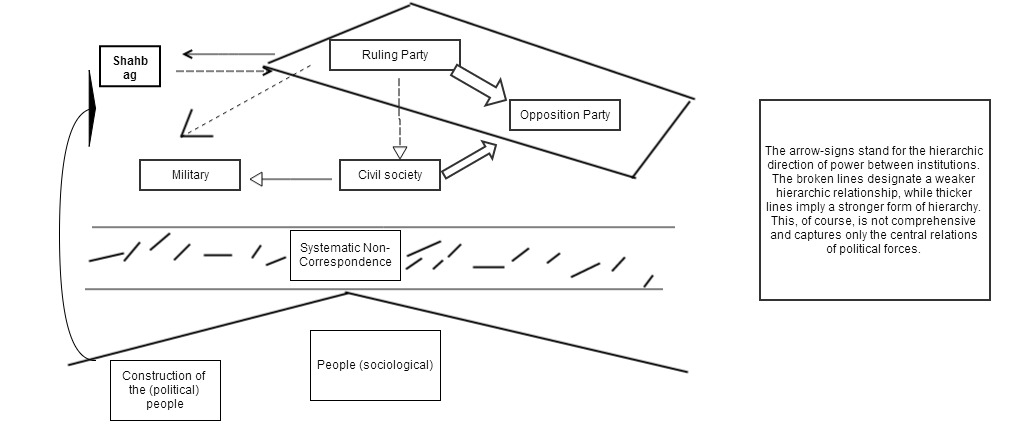
The political power that the movement generated did not arise through any institutional process, nor did it gather force in the manner of issue-based social movements that operate through channeling the demands and mounting pressure on the concerned authority. The event came into being abruptly, and mobilised political claims by way of reclaiming the founding legitimacy of the polity. The people that the Shahbag Movement brought into being by way of re-invoking the political community form founded by 1971 is political in the sense that it generated political power independently of the permanent agencies of the sphere of political power. The virtual impossibility of affecting the sphere of political power through an institutionalised process breeds the possibility for the people to put themselves in the sphere of political power through bypassing what I have called “the sphere of systematic non-correspondence”. As I argued above, while the Shahbag movement contended with the state over the source of legitimacy, it did not result in an antagonistic contestation with the state over political power. This is precisely the feature that made it susceptible to the cooptation of the ruling regime. With the symbolic fulfillment of the explicit demands that the movement put forward, the AL regime could articulate the afterlife of the movement in its own terms. Political events do not just burst through the surface and then vanish without any effect. They do disappear, but in so doing, they alter the relations of forces in often not-so-apparent manner. The continued presence of the Shahbag Movement registers such a transformation. On the one hand, it has made it nearly impossible for the political parties and platforms to negotiate with what the movement had identified as “anti-1971” forces, thus affecting the border of the regime of political power. On the other hand, its claim to the source of legitimacy –and the attendant construction of the people — provided it with a political authority that, however, was not directly antagonistic to the state. These paradoxical features have rendered the event amenable to cooption by the ruling regime, which through such cooption sought to boost itself with the power that flowed from the Shahbag Movement. If the Shahbag Movement is reduced to the demands that it voiced, then it is possible to find the cooption acceptable. The present crisis is not a crisis centered on the war-criminal issue. It is a structural crisis integral to our political system, whereby the afterlife of the Shahbag movement has added productive complexity to the crisis.
The empty politics of “good governance”
The civil society is once again at the forefront of national politics. The civil society — or what is rather barbarically translated as Susheel Samaj (civilised society) in Bengali — is a complex entity whose understanding requires close theoretical and historical investigation. This is a task that I cannot undertake here. The grotesque name that they have given themselves is more than a symptom of mere linguistic incompetence. It designates the preconception that posits both the political society and the people as unqualified subjects of politics. Nevertheless, let us consider some of the prevalent (mis)conceptions about civil society in the context of Bangladesh. While it is obviously true that the Bangladeshi civil society did not evolve in the way in which western civil societies have, this contrast does not warrant us to conceptualise this civil society as historically parasitic or an entity without any social root. The civil society is neither simply a conglomeration of self-interested agents bent on procuring their economic and cultural interests. To be sure, they are self-interested, but that does not tell us much about their political drives and actions. The modern theorisation of civil society that came into being with Hegel explicates it as a mediator between the natural realm of family and the rational sphere of the state. For Hegel, individuals operate as self-interested subjects in civil society; but, in so doing, they conjure up a collective rationality which, in turn, results in a form of society that strikes a balance between the individual and the collective. The self-conception of Bangladeshi civil society expresses the desire to mediate between the “development-seeking” people and the “corrupted and irrational” state. However, since they deem the state as utterly irrational and self-serving, and the people as incapable of acting at the institutional sites, that dual presuppositions lead them to decide for both the state and the people. The task of mediation, as it were, is nothing less than dictating the logics of the entities between which they purport to mediate. In one sense, the political constitution of civil society captures the paradox of our political community in a rather actualised way. The paradox resides in the duality of the nation and the state. The civil society is as much under the condition of the national as any other political agent in Bangladesh. The cultural imagination of the civil society, however westernised, clearly feeds into the horizon of Bengali nationalism. The border and order of the political community that it envisages is under the condition of the national. As I noted above, its commitment to the liberal-democratic structure as the form of governance – with its attendant institutionalism, moral and cultural configurations and so on — puts them in an antagonistic relationship with regard to the political society. Indeed, there is clearly a generalised opposition to the civil society from the otherwise diverging entities of the political society. If the ruling regime does little to ensure the autonomy and independence of the institutions such as the judiciary and administration, it is because these institutions do not figure in the production of legitimacy and its attendant political power in the way in which the street does. Missing this central site of political power, the civil society takes institutions as the objects of politics. The liberal democracy that they push for is one that only knows institutions, extricated as it is from the extra-institutional sources of politics.
Being preoccupied with the task of ostracising corruption from the institutions, the politics of “good governance” is unable to intervene in the extra-institutional sites of politics. As a result, it is an ideology — regardless of its intentions — that strives to negate and excoriate the unruly self-representing people from the sphere of politics. The true subject of the politics of “good governance” is a non-subject proper. From the student rebellion of 2007 to the Shahbag Movement, the civil society had found itself incapable of — if not always indifferent to — dealing with the extra-institutional grounding of politics. The signature characteristic of the civil society’s political vision is the fear of disorder. Constitutionally incapable of realising how the moments of “disorder” are the fecund sites of politics, the civil society locates the source of all crises in the corruption of institutions. Owing to the lack-based understanding specified above, it transposes political contestations on to an empty normative horizon. The failure to influence both the institutional terrain dominated by the ruling regime and the extra-institutional sites, the ideologues of good governance have no other option than relying on the superlative intervention of western diplomats and the military.
The Crisis of the Left-Over Left
This complicated scenario of national politics has dragged the left into a quagmire. The modest success of the post-1971 Left has been dependent on the mobilisation of the nationalist condition of politics. With the emergence of a group of strong nationalist political activists in the last decade — a group that ideologically leans towards the Awami League and yet maintains a distance from its institutional aspects — the Left has been encountering contest and resistance in the attempt to short-circuit between nationalist and traditional leftist discourses. Nor can the Left lay claim to represent the urban workers and poor, the conspicuous outsider in the national politics. In short, the left is unable to instantiate any particular people as the legitimising ground of its politics. The stage-ist left, by and large, is happy to hibernate, while waiting for the coming of the pure (and thus mythological) class-conscious working class. The more active section of the left is oriented to the social issues. In the recent past, they have rather successfully led few social movements. This otherwise promising social-content-oriented section of the left’s crisis lies in its failure to transform social issues into political contest proper. While the Left’s pointing out of injustice and oppression normatively makes sense to the public, that act of making-sense does not get catapulted into a political contestation by itself. The precondition of the emergence of a political contestation requires not only an articulation of the terms of opposition, but also a contesting horizon of the collectivity, i.e. the possibility of a political community. This is precisely what the Left has been unable to generate in the recent years.
As an insignificant actor in the equation of electoral politics, the Left does not hold any effective leverage in shaping the terms of parliamentary elections. A large chunk of the old Left has allied with — or rather tailed behind —the ruling regime. At the level of ideological articulation, this section of the Left has little bearing on Bangladeshi politics. This political inaction is exacerbated by the Left’s understandably ambivalent relationship to the afterlife of the Shahbag movement. The epochal importance, if any, of the Shahbag movement resided in its instantiation of the possibility to re-enact the politics-form of the national by way of constructing the extra-statal people. With the subsumption of the afterlife of the movement by the ruling regime, the persistent presence of its after-effect has got crystallized into something that tends in the direction of lending legitimacy to the Awami League regime. Clearly, any provisional alliance with the AL has to reckon with the fact that the Shahbag movement does not have primacy here — it is the AL’s internal contest with the oppositional party and the civil society that dictates the terms.
Although it is true that the national is the dominant condition of the political in Bangladesh, there is no reason to resign and hold that there is no possibility of articulating a political grounding that would stand outside the present condition. I argued that the crisis of the Left owes to their growing dislocation from the internal order of the national, resulting in a redundant tailism with the mainstream Bengali Nationalist forces. The “outside” that the left needs is not necessarily an absolute outside — the possibilities of constructing a new ground of politics is present in the society. The possibilities themselves must be seized upon — the task of politics is more about subjectivating those possibilities than about waiting for a fully interiorized outside. The manoeuvre to dislodge this state of politics must re-examine the unquestioned ontological presuppositions and discursive strategies of the traditional Left. Hopefulness is empty and self-circling when it obdurately bypasses the facticity of despair. The Left must recognise and reflect on its apparently unmoving negativity, if it wants to break out of the existing state of political order.
Notes
(1) Claude Lefort, Democracy and Political Theory, (Cambridge: Polity, 1988).
(2) Ernest Laclau, “Democracy and the Question of Power,” Constellations 8, no. 1 (2001): 12.
(3) I do not consider the anti-Shahbag Hefazat-e-Islami movement as another example of constructing the people. For sure, the Hefazat reaction drew huge crowds, garnering considerable support. However, in terms of the politics-form, it was neither able to carve out a space outside of the national nor was it able to appeal to the existing political foundations. As a result, notwithstanding its numerical force, it remained caught up in the moment of its negative energy vis-à-vis the Shahbag Movement.
 Radical Notes
The Insurrection of Akhtaruzzaman Elias
The question of politics as far as an artist or a litterateur is concerned is usually posed in terms of what position the artist or the litterateur in question strikes as an individual with regard to the political situation of his day. Those terms often also extend to what such an artist or writer says about politics in his works of art or literature. That is mostly how the question of an artist or a writer’s politics is approached and framed. We could call this the question of literature in politics or politics in literature – the problematic of art/literature about politics, or the problematic of political art. Now that, most certainly, is a valid approach in dealing with the question of art and politics, and their relationship. The attempt here, however, is to engage with the works of Bangladeshi writer Akhtaruzzaman Elias by way of another approach. One that has arguably come down to us from Marx — evident in his engagement with the literature of Classical Hellenic Antiquity – through, primarily, Walter Benjamin and Bertolt Brecht. (There have, of course, been others like Adorno and Ernst Bloch, and such Althusserians and post-Althusserians as Pierre Macherey and Jacques Ranciere respectively, not to forget Fredric Jameson, who have adopted one or another variant of this approach in their engagement with art and literature.) This approach seeks to deal with the question of art and politics in terms of what we ought to call ‘the politics of art’.
What does this approach entail? It seeks to deal with art and literature not principally in terms of what artistic or literary works have to say on or about politics, but what is the politics they pose by virtue of being the works of art or literature they are. More precisely, this approach attempts to grasp the politics posed by the aesthetics of the works in question. That is, it tries to grasp the politics of a work of art or literature by figuring out the organisation of space constitutive of that work. This approach attempts to unearth the politics of art in terms of how the question of relationality has been embodied by the text of a work of art or literature, and envisaged in its production. For, it is the logic of relationality that is constitutive of the organisation and structure of space thus giving that structure and organisation a specific character, whether in our so-called real, social life or the life of the world that is a novel, a story, a poem, a painting or a film. It is this character of the structure or organisation of space of a work of art that is its economy, while that which founds this character or economy and/or renders it manifest is its politics.
Politics of Literature And Elias’s Savage Mind
The two approaches of dealing with the question of art and politics delineated above are not mutually exclusive. They are interdependent. However, the stress here, in dealing with the question of politics with regard to Elias’s literature, will fall principally on the latter approach. That is not to say one intends to evade engaging with Elias’s works in terms of the former but one certainly wishes to understand how what Elias says about politics in and through his literary works derives from the politics his literature as such speaks. That is, how it is actually the politics of Elias’s literature which renders what that literature says on or about his contemporary political situation, and on politics in general, complete and effective. It might be a repetition to once again explain and explicate the terms of the approach and concept of politics of literature. But it might not be a bad idea to do so, perhaps at some length, before we begin engaging our determinate object – that is, the literary works of Elias. On that score, Ranciere (2011, pp.3-4) provides us with an apposite conceptual compass:
“The politics of literature is not the same thing as the politics of writers. It does not concern the personal engagements of writers in the social or political struggles of their times. Neither does it concern the way writers represent social structures, political movements or various identities in their books. The expression ‘politics of literature’ implies that literature does politics simply by being literature. It assumes that we don’t need to worry about whether writers should go in for politics or stick to the purity of their art instead, but that this very purity has something to do with politics. It assumes that there is an essential connection between politics as a specific forms of collective practice and literature as a well-defined practice of the art of writing.
“….Politics is the construction of a specific sphere of experience in which certain objects are posited as shared and certain subjects regarded as capable of designating these objects and of arguing about them. But such a construction is not a fixed given resting on an anthropological invariable. The given on which politics rests is always litigious. A celebrated Aristotelian formula declares that men are political beings because they have speech, which allows them to share the just and the unjust, whereas animals only have a voice that expresses pleasure or pain. But the whole issue lies in knowing who is qualified to judge what is deliberative speech and what is expression of displeasure. In a sense, all political activity is a conflict aimed at retracing the perceptible boundaries by means of which political capacity is demonstrated. Plato’s Republic shows at the outset that artisans don’t have the time to do anything other than their work: their occupation, their timetable and their capabilities that adapt them to it prohibit them from acceding to this supplement that political activity constitutes. Now, politics begins precisely when this impossibility is challenged, when those men and women who don’t have the time to do anything other than their work take the time they don’t have to prove that they are indeed speaking beings, participating in a shared world and not furious or suffering animals. This distribution and this redistribution of space and time, place and identity, speech and noise, the visible and the invisible, form what I call the distribution of the perceptible. Political activity reconfigures the distribution of the perceptible. It introduces new objects and subjects onto the common stage. It makes visible what was invisible, it makes audible as speaking beings those who were previously heard only as noisy animals.(1)
“The expression ‘politics of literature’ thereby implies that literature intervenes as literature in this carving up of space and time, the visible and the invisible, speech and noise. It intervenes in the relationship between practices and forms of visibility and modes of saying that carves up one or more common worlds.”
Now the question is: what is the politics of Elias’s literature? It is, we ought to contend, insurrectionary. And that is exactly what this essay intends to demonstrate. To be more accurate, it must be said the politics posed by Elias’s literary aesthetic is insurrectionary. In fact, one should further qualify one’s take on Elias by contending the politics that the aesthetic — or more precisely the aesthetic economy — of his literature renders evident is insurrectionary, as opposed to being merely insurgent.
Before we proceed any further we would do well to clarify what insurrectionary politics is and how exactly is it to be distinguished from what one has chosen to term insurgent politics. Insurrection is generalisation of the emergent logic of a localised moment of insurgency – which is doubtless its constitutive moment – through the overcoming of that localisation into multiple insurgent moments that erupt uninterruptedly and simultaneously.
But how does this politics of insurrection manifest itself in aesthetics, the aesthetics of literature to be precise? Elias’s literature – his two novels [Chilekotar Sepai (Soldier in the Attic) and Khowabnama (Dream Chronicle)] and over two dozen stories – is an apposite instantiation of the same. The organisation of the space of his literature – which is its aesthetic – is constitutive of what Levi-Strauss terms “the savage mind”. It is on account of such constitutivity that the politics of Elias’s literary aesthetic becomes insurrectionary. According to Levi-Strauss (1966, p.245), “The savage mind totalizes” and “it is in (the) intransigent refusal on the part of the savage mind to allow anything human (or even living) to remain alien to it, that the real principle of dialectical reason is to be found”.
The French anthropologist further clarifies the principle of dialectical reason – and thus the savage mind – when he takes issue with Sartre’s Critique of Dialectical Reason to explain and explicate the relationship between analytical reason and dialectical reason. He writes (1966, p.246): “…the opposition between the two sorts of reason (analytical and dialectical) is relative, not absolute. It corresponds to a tension within human thought which may persist indefinitely de facto, but which has no basis de jure. In my view dialectical reason is always constitutive: it is the bridge, forever extended and improved, which analytical reason throws out over an abyss; it is unable to see the further shore but it knows that it is there, even should it be constantly receding. The term dialectical reason thus covers the perpetual efforts analytical reason must make to reform itself if it aspires to account for language, society, and thought; and the distinction between the two forms of reason in my view rests only on the temporary gap separating analytical reason from the understanding of life. Sartre calls analytical reason reason in repose; I call the same reason dialectical when it is roused to action, tensed by its efforts to transcend itself.”
After all, a new analytic of thinking emerges as the subjectivity of an object to critically overcome externalised determination, and the meaning imposed on it through representation by an already existing analytic subjectivity so that the object can free itself from the violence done to it by the latter analytic, which is nothing but the abstraction of its own prior subjectivity. This, in order to assert itself in its concreteness. That is, to affirm itself as its own subject: Badiou’s “subjective-materiality”.(2) (2009, p.-198)
As a result, the unconscious of the analytical mode of reason is to overcome all analytic abstractions, including itself. The savage mind is the generalisation or awakening of this unconscious of analytical reason with the latter self-reflexively grasping itself as the former.
Therefore, the savage mind is activation of dialectical reason, which is analytical reason constantly overcoming itself by grasping its own logic of emerging to actualise it. The logic of emerging of analytical reason is, it must be stated at the risk of some repetition, also its unconscious when it exists as itself, which is dialectical reason in “repose”. Clearly, the savage mind is constitutive of the process of the self being transfigured into its beyondness. Therefore, as the actuality of the principle of dialectical reason it is de-identitarianising and cannot, therefore, have its locus ontically fixed in a self. Levi-Strauss puts that across quite succinctly when he writes: “I do not regard dialectical reason as something other than analytical reason, upon which the absolute originality of a human order would be based, but as something additional in analytical reason: the necessary condition for it to venture to undertake the resolution of the human into the non-human.”
And insofar as the savage mind is constitutive of the critical overcoming of externalised determination and analytical abstraction, it posits a critique of duality and relationality on one hand and identity principle on the other. The savage mind can, therefore, also be envisaged in terms of affirmation of singularity and non-identity. It could be construed as a figure of the actuality or historicity of singularisation or counter-totalisation of infinitely different space-times. A historicity of singularity as it were.
It must, however, be stated here as an aside that one has absolutely no intention of upholding the methodological structuralism of Levi-Strauss’s anthropology. In horizontalising various historical phenomena into an ethnography of relativised laissez-faire in terms of the universality of the deep structure that, according to the French anthropologist, constitutes them, this structuralism shares a methodological affinity with a kind of ahistorical Kantianism. This problem, it must be stated here in passing, stems from the theoretical level of abstraction being collapsed on to the practical or existentially-lived level of determination. A move that conceptually renders the subjective operation of dialectical thinking directly correspondent to and fully commensurate with the dialectical constitutivity of the structure (structural dialectic) in its objectiveness.
What the argument here takes from Levi-Strauss is basically his conceptualisation of the “savage mind” as a mode of social being animated by, and constitutive of, the operation of dialectical thinking. That not only serves to explicate the singularising and insurrectionary politics of Elias’s literature, it also arguably enables one to find the resources, from within Levi-Strauss’ anthropological discourse itself, to critically break with the twin-crises of structuralism and relativism of his ethnological method and discourse. That becomes possible on account of this conceptualisation of the “savage mind” being premised on the explicit recognition of the dialectic between history and structure (or logic). One that, in Benjamin’s words, enables us to brush history (as in its historical analytic) against its own grain (the dialectical logic of its emerging).
This counter-totalising savage mind, which both singularises infinitely diverse spatio-temporalities and is thus simultaneously also their singularity, is rendered rather explicitly evident in a constellation of different space-times of resistance that Elias constructs in his Chilekotar Sepai (2000, pp.187-188). Those different spatio-temporalities come together in and as the unity of their moments of insurgent, and thus evental, emerging to palpably inhabit, in the eyes of protagonist Osman Gani, a protest march on the streets of Dhaka against Pakistani occupation of East Bengal:
“Yesterday Ayub Khan’s police killed a boy from the university, such a huge protest happens, Anwar can’t get to see any of it! …Osman’s heart skips a few beats: so many people here, are they all breathing, fish-rice-eating normal human beings like him? This human flood here, he finds the attire, demenaour of many of them unfamiliar? Who are they? Does it mean, people from eras long gone by have also joined the procession? Here see, smack in the middle of the procession are short dhoti-clad denizens of Dhaka from the time of Islam Khan’s reign! In fact, those who would, in an even earlier time, travel to Sonargaon and back in boats full of sacks of rice have come too. Inhabitants of Bangla Baajar and Tantibaajar (weavers’ market) have emerged from the frozen heart of the vanished canal to come here? Here are the turbaned soldiers, from the time of Ibrahim Khan’s reign, who were killed in a skirmish with Prince Khusro. Osman gets a start on seeing those who died of hunger in Shaiyasta Khan’s Dhaka of the time of eight-maunds of rice for a taka. They have had nothing to eat for 300 years, — their steps in harmony, they march ahead with their black hair fluttering in the breeze like a wave. People battered by the Mughals, people battered by the Mogs, people battered by the Company’s merchants — could this procession have been this big had everyone not turned up? The Maratha priest has emerged from the dry layers of bricks of the Racecourse Kali Temple to come down here swinging the falchion, Majnu Shah’s fakirs are here too, here go the Muslin weavers throwing and waving their thumb-torn fists in the air, their eternally black bare bodies roast in the sun. Today, the naked, starving, skeletal bodies of weavers who weave taka 4,000- worth jamdanis walk an erect walk. The imams, muezzins, musullis of Babubajar Mosque riddled with bullets by the British are marching ahead, instead of muttering verses from the Quran they roar today, ‘We shall not let it go in vain!’ Here come the soldiers of Lalbagh Fort, mangled by the beastly bites of insatiable desire of Nabab Abdul Gani, Ruplal, Mohinimohon, let loose by the red-faced sahibs. Sepoys of Merrut have torn away the nooses around their necks to come down from the palm trees of Victoria Park, sepoys of Bareilly, sepoys of Swandeep-Sirajganj-Goaland. No dear, even that doesn’t suffice. The mother-worshipping youths of Jugantar and Anushilan in their dhoti and vests are coming, in their midst the two murdered boys of Kaltabajaar can be separately identified. From below the Naarinda bridge comes Somen Chanda, the bloody wave of Dolai canal on his head. There, that is Barkat! His skull has been blown off. That, at first sight, frightens Osman a little but he quickly takes hold of himself. So many people! In the high tide of a new water Dhaka’s past and present are today overflowing and dissolving into one another, today its morning-afternoon-evening-night are forgotten and stand dissolved, today the city is without its east-west-north-south, all the signs that divide and distinguish the seventeenth-eighteenth-nineteenth-twentieth centuries stand erased. Today, the city of Dhaka is fully intent on occupying this limitless time and space. Osman’s heart trembles: how far will he be able to go with this massive deluge? How far? Like a quaking pitcher under the running tap at the mouth of Golok Pal Lane becomes still once it is full to the brim, our Osman Gani’s heart too has gradually become full and complete, by becoming one of the smallest molecules of this uninterrupted tidal surge he is experiencing a warmth in his heart. That is no mean recompense? With his heart full he throws his fist in the air and roars, ‘Will not let it go in vain.’” (My translation.)
Clearly, what the historical-sociological specifications or mediations of those struggles are – that is, their identities – do not seem to matter in this novelistic depiction. At any rate, it is a secondary concern. Instead, what the discourse of the novel seeks to bring to the fore is the universality that each of those struggles in their mediational specificity posit. Each of those struggles in the specificity of being ranged against their respectively particular historical domination posit the unconscious of overcoming the general condition of externalised determination, and thus duality and relationality. It is this singularising unconscious, which can also be called the unconscious of universal-singularity, that is actualised in this passage from Chilekotar Sepai through the construction of this constellation that is accorded the reality of an existentially-lived world or space-time. This constellation is, therefore, nothing but the world of the savage mind – the savage mind in its own space and time.
Insurrection as Popular Culture, or from the Subaltern to the Oppressed
This example – typical of Elias’s literary aesthetic of the savage mind, and thus its insurrectionary politics – is, among other things, the enactment of popular culture. The discourse constitutive of such an aesthetic enables us to discern in it a conception of culture that is the singularising and singular configuration of space-times. It affirms a politics of culture that can, following Raymond Williams, be termed “cultural materialism”. Following his literary aesthetic, we could say that Elias, not unlike Williams, envisages culture as the materiality of life, wherein this materiality of life is not the positivist abstraction of that empirically-lived life. Instead, real materiality of life, for militant-intellectuals like him and Williams, emerges only when the living of life is a mode of struggle and self-critique. This aesthetic seems to suggest that popular culture, as Elias would grasp it, is not the symbolicness or discursivity of forms of subaltern expression that identitarianises culture. Rather, it would, for him, be precisely the expression of an impulse – of course made possible as that expression through the mediation of forms and their historically and sociologically given discursive resources – that tends to overcome the identitarian logic and politics of culture. On the other hand, culture is an embodiment of identitarian logic and politics when it is grasped in terms of its formal stability and discursive abstraction. This latter sort of culture should – following the insurrectionary aesthetic vision embodied in and by the discourse of Elias’s novels and stories – be comprehended as nothing but culture as the logic of representation, identitarianisation and domination. This, for us, is, clearly, culture as a commodity and ideology, and thus culture as capital and the politics of capitalism.
In the Eliasian scheme, which can be discerned from the nature of the writer’s literary aesthetic, popular culture would be the flow and flux beyond the abstraction of forms — which are nevertheless its constitutive moments because they serve to determinately actualise the de-formalising or de-identitarianising flux. It would be the force of the flow that unravels its own formal fetishes, which are tendentially inevitable, to overcome the centripetalising regimentation that compels it to turn into culture as bourgeois domination, and thus also into an embodiment of its politics of hegemony (in a precise Gramscian sense). Thus popular culture would, for Elias, be the expression of the generalisation of the tendency of de-representation, de-identitarianisation and centrifugalisation. Insurrection is nothing but the generalised expression of such a tendency, which in and as that generalisation is the actuality or historicity of non-identity and singularity. Clearly, for Elias, culture is truly popular only when it seeks to instantiate the tendency of the minor.
In the novel Khowabnama, for instance, the actuality of the centrifugalising force in its singularity is broached through the opposition posed by the mediations of the paganised-heretical Islamic discursivities of wandering mendicant and minstrel Cherag Ali’s traditional canon of mythic stories and anonymous Delphic dream-reading riddles, songs, limericks and doggerels to the sociology and discursivities of the culture, with a relatively more orthodox Islamic religious dimension, of the dominant class of rich kulaks such as Sharafat Mandal. The historical sociology of this opposition, more precisely contradistinction, is envisaged in the novel to reveal the unconscious of the heretical cultural discursivity and its concomitant subaltern sociology. And that unconscious of the sociology and discursivity of the subaltern culture, by virtue of it being constituted thus in its bid to overcome the domination and externalised determination by the dominant culture, is to obtain to the condition of singularity. After all, the sociologically relational existence of those two discursivities of culture proves the discursivity and sociology of the subaltern culture has constituted itself as what it is – that is, in its difference from the discursivity and sociology of the dominant culture – to thwart being represented, determined and thus dominated by the latter. By that same token of its constitutive or emergent logic, therefore, it must also overcome itself as that culture of subalternised discursivity and sociology, which renders it an identity precisely and simultaneously in being the difference it is.
The novel in question reveals that unconscious, or incipience, of the heretical-subaltern sociology and discursivity of Cherag Ali’s culture by actualising it, precisely by having that culture-as-difference (or difference-as-identity) overcome and transfigure itself. The constitutivity of mystic-mendicant Cherag Ali’s culture, which is subtractive and singular, is shown in the novel to actualise itself through its unfolding by overcoming, and in the process transfiguring, the discursively specified discourse of Cherag Ali. Such overcoming and transfiguration sustains the actuality of the centrifugalising force in its singularity, which is popular culture, by preventing its hypostatisation into a sociology or artefact of so-called popular culture. And that happens through the reconstitution of the centrifugalising force, which was constitutive of Cherag Ali’s discourse in its moment of emerging, as and in the new songs of social criticism and revolutionary transformation composed and performed by his self-appointed disciple Keramat Ali in the high-noon of the Tebhaga movement. What is at stake here is clearly not the actuality of the two cultural or discursive forms. It is not about the difference registered by the latter form with regard to the former in mutating from it either. What is, instead, at stake, as far as the emphasis of the novel at this point is concerned, is the actuality of the mutation itself. In other words, what is being staked out here through the two discursive, cultural or sociological forms and their difference is the actuality of the simultaneity of difference and the deployment of that difference. The novel demands that we focus here not on the actuality of difference but on the actuality of deployment of difference that the emergence of difference registers.
The break constitutive of the transfiguration of the figure of Cherag Ali into that of Keramat Ali produces, to talk in an Althusserian language, two different forms of “historical individuality” (Balibar; 1999, p. 252). But these two historical individualities, or figures of discourse, are different not merely in terms of the two sociologically different ontic positions, and historical situations, they occupy. Nor, therefore, is the difference between the two limited to the different discursive appearances of their respective discourses: anonymous mythic doggerels on one hand, and avowedly self-composed songs of social transformation on the other. Rather, what sets the two individualities radically apart is the break between their respective modalities of discourse, which marks an epistemological rupture in the qualities of the orientation of their respective subject-positions. Something that makes them inhabitants of not only two different historical situations but two radically different historicities or epochs. It is precisely on account of this difference that the two figures faithfully bear out the Althusserian concept of “historical individuality”.
The novel in having Keramat Ali assert that he is a disciple of Fakir Cherag Ali, even while he explicitly abandons the discursive pattern of the latter’s discourse, makes him into an active subject of his own invention as the singular centrifugalising force by reconstituting it through and as the new discursivity of songs of social transformation. It reveals that Keramat Ali is aware he is reclaiming the singular centrifugalising force, constitutive of the subalternised sociology and discursivity of Cherag Ali’s discourse in its moment of emerging, in precisely abandoning the discursive tradition of that discourse. This, therefore, also implies that, unlike the sociological figure of Cherag Ali, the sociological figure of Keramat Ali is self-reflexive in his awareness of the unconscious of the discursively-specified discourse he produces. The way he has been envisaged in the novel implicitly indicates his awareness of the need to also overcome the discursivity and sociology of his own discourse – which he has produced in the process of overcoming the sociology and discursivity of Cherag Ali’s discourse – in order to maintain his fidelity to the reconstitution of the singularity of the centrifugalising force.
So, while the historicity and sociality constitutive of the sociological figure of Fakir Cherag Ali are respectively that of duality and identity, the historicity and sociality constitutive of the figure of Keramat Ali, which are also the historicity and sociality posited by the novel, go beyond the historical sociology of Keramat Ali to be the historicity and sociality of singularity and non-identity. The former is a figure of anti-capitalism that is constitutive of the epoch of capital. The latter, on the other hand, is a figure of the communist epoch. It must, however, be stated here that precisely because the historicity that Elias’s novel Khowabnama constitutes is singular, do we encounter Cherag Ali not only as the sociological self he is, but also as a figure beyond that sociologically specified, existential self of his. That figure is animated by the character of the spectre of Cherag Ali, who appears after the death/disappearance of his sociologically-specified existential self. This clearly instantiates the radicalisation of the empirically-lived, sociologised finitude of a character such as Cherag Ali by transfiguring his existentially-limited and sociologically-specified present into a perpetually open present by stretching that existentially-lived finitude in its very moment to that of infinite beyondness. The doubling, or tripling, of the figure of Cherag Ali – in and as the characters of existentially-lived Fakir, his spectre and his self-appointed disciple Keramat Ali – symptomatises his finitude in its inhumanly monstrous radicalisation. This savagely insurrectionary spatio-temporality is the novelistic space of Khowabnama, insofar as that novelistic space is constitutive of the inhumanity of such monstrous radicalisation of the existentially-limited human finitude.
The transcending of the self-other binary – by bringing the self and the other into a constellated synchrony of, what Badiou would term, “the singular-multiple” (2010, p.82) by abolishing the dualising relationality among them – is precisely what such doubling (or repetition or twinning) of character-figures accomplishes. Such constellated transcending of that binary is a recurrent motif in Elias’s literature. It is echoed, for instance, by most of his stories that are enactments of the singularising interplay of different, psychotically estranged alterities of otherwise consolidated selves. The devices and registers of subtraction,(3) which are so integral to Elias’s literary discourse, enable the enactment of such singularising interplay of alterities. They are dream [Laalmiya and Bullet in ‘Jaal Sopno, Sopner Jaal’(The Dream-web and Counterfeit Dreams’)]; violently idiosyncratic reverie [Osman in ‘Pratishodh’ (Revenge), Romij Ali in ‘Keetnashoker Kirti’ (The Pesticide Magic)]; eccentric recalcitrance [Mobarok Ali in ‘Apaghat’ (Mishap), psychotic break [Haddi Khijir and Osman Gani in Chilekotar Sepai, Abbas Pagla and Mili in ‘Miliir Haatey Stengun’ (Mili and Her Stengun), Nurul Huda in ‘Raincoat’]; intoxication [Samarjeet in ‘Khonwari’ (The Alcoholic Stupor)]; and schizophrenic meditation on self and history [Ronju in ‘Nirrudesh Jatra’ (The Unknown Journey)].
These examples – and especially Khowabnama – serve to demonstrate that in Elias’s creative prose the practice and discourse of the subalternised and marginal subject-positions are not championed as such in terms of their sociology and discursive abstractions. Rather, they are affirmed in terms of their singular/singularising logic of emerging. This is indicated and indexed by the discursivity and sociology characterising their subaltern/marginal culture in its difference from the identitarianised discursivity and sociology of the dominant culture. Such affirmation is, as the example from Khowabnama demonstrates, integral to the reclamation of the singularity by critically overcoming precisely the identified discursivity and sociology of subaltern culture. This, among other things, implies that for Elias subaltern cultures in the mere finitude of their difference do not denote popular culture. The former do not amount to the latter in its uninterrupted and infinite openness. Subaltern culture as difference instantiates, at best, the repetition of the succession of infinite finitudes, wherein finite freedom as withdrawal from the horizon of infinite totalisation is really no more than subjective illumination that only serves to accelerate, at the objective level, the reproduction of that identitarian horizon of infinite totalisation.
A subalternised culture is objectively coeval with popular culture only in its evental moment or moment of emergent constitutivity. And in that moment the culture in question is neither subaltern nor an identity but precisely the determinate instantiation of the nonidentitarian excess of their ontological structure. This nonidentitarian excess, needless to say, immobilises the metaphysical dynamic of that ontological structure, while simultaneously also interrupting the differentiating flight from it that only serves to return and reproduce that structure.
To grasp the sociologies and discursivities of the cultures of the subalterns and the marginals in such terms is to realise that justice can be done to the popular grain of those cultures only by critically overcoming them in their subalternised/marginalised existence. Grasping and actualising such internal critique posited by those subaltern/marginal cultures due to the fact of their differentiating and differential existence vis-à-vis the identity of dominant culture, is considered indispensable by Gramsci for an effective and meaningful project of Marxist sociology.
Through his criticism of Nikolai Bukharin’sTheory of Historical Materialism: A Manual of Marxist Sociology, which is shown to be lacking on that score, Gramsci (1996, pp.419-420) demonstrates why and how the sociological discursivities of subaltern cultures must be grasped in terms of their own singular constitutivity of emerging, and thus their own internal critique. This they themselves mediately posit as their own unconscious or negativity. He articulates his criticism of Bukharin thus:
“The first mistake of the Popular Manual is that it starts, at least implicitly, from the assumption that the elaboration of an original philosophy of the popular masses is to be opposed to the great systems of traditional philosophy and the religion of the leaders of the clergy – i.e. the conception of the world of the intellectuals and of high culture. In reality these systems are unknown to the multitude and have no direct influence on its way of thinking and acting. This does not mean of course that they are altogether without influence but it is influence of a different kind. These systems influence the popular masses as an external political force, an element of cohesive force exercised by the ruling classes and therefore an element of subordination to an external hegemony. This limits the original thought of the popular masses in a negative direction, without having the positive effect of a vital ferment of interior transformation of what the masses think in an embryonic and chaotic form about the world and life. The principal elements of common sense are provided by religion, and consequently the relationship between common sense and religion is much more intimate than that between common sense and the philosophical systems of intellectuals…. In common sense it is the “realistic”, materialistic elements which are predominant, the immediate product of crude sensation. This is by no means in contradiction with the religious element, far from it. But here these elements are “superstitious” and acritical….”
It, therefore, follows that the sociological specificity of subaltern culture establishes its own specific identity precisely in the moment it tends to differentiate itself from the sociology and discursivity of dominant culture in its identified and identitarianised specificity. The assertion of discursive specificity of a subaltern culture to differentiate itself with regard to the particular identity of a dominant culture is intrinsic to its attempt to obviate its representation and domination by the latter. However, the assertion of such differentiating identity presupposes the condition of duality – for, difference, in order to affirm itself, needs to assert and exist in its discursive particularity with regard to a specific identity from which such assertion is meant to affirmatively distinguish it. And this condition of duality and relationality is constitutive of competition, domination and representation. This condition is the condition of possibility of the mutually interdependent existence of domination and competition. Hence, a particular form of domination cannot be truly abolished without simultaneously abolishing competition and the condition of possibility of their mutually constitutive existence in general. It is precisely for this reason that a subaltern culture, even when it exists as such through the assertion of its difference vis-à-vis the identity of a dominant culture, continues to be dominated, marginalised, and even represented – in terms of the very discursivity it asserts to affirm its specified difference – by the dominant classes and their cultural systems. Clearly, the assertion of a subaltern culture as the index of affirmation of difference vis-à-vis a dominant culture spells the abolition of neither the latter as the specific identity it is nor the relationality of domination it co-founds.
In that context, the attempt by a subalternised people to rid themselves of their subordination by the dominant class through the assertion of their culture – that is, their specified way of life – reveals itself to be governed by the very condition of possibility of domination. For, the assertion of such difference with regard to identity, as we have seen, posits the structure of duality that is this condition of possibility of identitarianisation and domination. In such circumstances, this struggle of the subaltern and the marginalised against their subordination through the assertion of the differentiating specificities objectively amounts to no more than competition, which co-founds domination and is thus simultaneously co-constitutive of duality as their condition of possibility. That is exactly what Gramsci implies when he writes about “the popular masses” and their “original thought” being subordinated “to an external hegemony” of “the great systems of traditional philosophy and the religion of the leaders of the clergy”, even as such “conception of the world of the intellectuals and of high culture…are unknown to the multitude and have no direct influence on its way of thinking and acting”.
What this suggests is that the existence of a way of thinking and culture specific to the subalterns and the marginals (“original thought of the popular masses” in Gramsci’s words) in spite and because of its particular difference, which sets it apart from the specified identity of the thought of the dominant classes by differentiating it from the latter, is still determined or articulated by its structuring logic. Being subjected to such hegemony means that not only does the subordination of the differentiating specificity of subaltern culture by the culture that has identified and established itself as dominant not cease in spite of the affirmation of the former as difference, but also that this difference in being affirmed as such is rendered a subordinate cultural form or identity. The latter itself then turns into a dominant material force with regard to other strata that it simultaneously produces through its own internal differentiation. The production of such strata, through that process of internal differentiation of the ‘original’ subalternity, is coeval with the variation of the discursive resources constitutive of that culture-as-difference-turned-identity so that those strata come to acquire the discursive markers of their respective cultural specificities that also serve to designate their respective social status.
Gramsci (1996, p.420) lays this process bare in this note on Bukharin: “The principal elements of common sense are provided by religion, and consequently the relationship between common sense and religion is much more intimate than that between common sense and the philosophical systems of intellectuals. But even within religion some critical distinctions should be made. Every religion, even Catholicism…, is in reality a multiplicity of distinct and often contradictory religions: there is one Catholicism for the peasants, one for the petits-bourgeois and town workers, one for women, and one for the intellectuals which is itself variegated and disconnected.” Khowabnama further elucidates this process when it shows how Islam, which is the religious-cultural, and eventually also political, expression of the subordinate social status of rich kulaks such as Mandal and his Muslim Leaguer son Abdul Qader, vis-à-vis the upper-caste Hindu absentee landlords and their Congress backers, is itself internally differentiated into a paganised-heretical Islam of landless peasants, poor sharecroppers and fisherfolk. That is so because the relatively more orthodox Islam – which is doubtless a marker of both subordination of kulaks like Mandal by the upper-caste Hindu culture of the absentee landlords, and thus also the competitive struggle of the former against the latter – is, however, in relation to the social stratum of those believers of paganised-heretical Islam, a discursive cultural marker of the material force of domination that is constitutive of such differentiation of the Muslim identity in that part of East Bengal where the novel is set.
There should, however, be no doubt that the orthodox variant of a kulak’s Islam would instrumentalise the heretical Islam of the poor and the landless if the latter fail to grasp the self-critique unconsciously posited by the particularity of their religio-cultural differentiality. A self-critique whose actualisation would lead to that heretical religio-cultural difference overcoming both itself as the identity it becomes in asserting itself as that difference, and thus also the social differentiation and the politics of competition that are its conditions of possibility. It is through such overcoming of itself that a subalternity grasps and transforms itself into a figure of the oppressed as it occurs in Marx. This process of transformation of a subalternity into the Marxian figure of the oppressed, through the critical unraveling and supersession of itself as the identity it becomes in asserting its difference, entails that this identity self-transformatively grasp the domination it experiences in the particularity of its historical situation as the operation of political force as simultaneously both dominance and hegemony. Such an operation of political force tends to repress, distort and decimate singularity. This is the fact of oppression that subalternity conceals and which the figure of the oppressed, constitutive of self-realisation and transfiguration of such subalternity, brings to light.
As a consequence, it envisages its struggle against the historical particularity of the domination it experiences as the universal affirmation of singularity in the very finitude of that historically and sociologically particular domination. It is this that makes such struggle, at once, both world- and self-transforming. Thus the struggle of a dominated people who grasp themselves as the figure of the oppressed is a dialectically articulated struggle that is simultaneously directed both against their domination in its immediate historical particularity, and exploitation and duality, which comprise the mediated generalised condition of possibility of such domination. The figure of the oppressed in its self-realisation and concomitant struggle is, therefore, a figure of the critique of political economy in its actualisation. It is, by that same token, also the figure of revolutionary politics that Marx designates as “class-for-itself”.
But the problem is the bearers of particular and particularised subordinate cultural identities do not experience the specific relationships of domination, which results in them acquiring those identities, as part of a larger, totalising historical-social process. Marx (1986, p.817) says as much while criticising “vulgar economy” for affirming and “feel(ing) particularly at home in the estranged outward appearances of economic relations”. That, according to him, “does no more than interpret, systematise and defend in doctrinaire fashion the conceptions of the agents of bourgeois production who are entrapped in bourgeois production relations”. This impels him to conclude that “all science would be superfluous if the outward appearance and the essence of things directly coincided”.
Nevertheless, implicit in this otherwise sound formulation of Marx is the fact that the science of general and generalised essence of exploitation is the synthesis of the infinitely open totality of historical experiences of different dominations. In such circumstances, the oppressed in its self-realisation would be the embodied concentration of that science of generalised exploitation into the finiteness of a particular experience of domination. It would be the realisation of the general and generalised infinity of different historically specific experiences in the finitude of that experiential particularity. Clearly, through such self-realisation of the oppressed the Marxist science of revolution fulfils itself by being restored to and dissolved into experience. It is this restoration of science to experience, which accords to science the hallmark of Nietzschean gaiety, that the generality of science and the particularity of experience are short-circuited to be transfigured into the universal-singularity of praxis. Elias seeks to accomplish precisely that in his literature. The constitutive deployment of the affective registers and tropes of psychotic break as subtraction — either as characters or situations, or both – in almost all his novels and stories serve to manifest the critical science of generalised singularity in and as the affectivity of experience. We could call this literary discourse of Elias his gay science.
And the above example from Khowabnama, which reveals precisely that, is no exception to the gay scientificity of his discourse. It attempts to show how the Tebhaga movement, by virtue of being a movement of radical transformation of inegalitarian agrarian production relations, is enabling the margin of margins to grasp this differentially particularised identity of theirs in terms of the unconscious self-critique it posits. The actualisation of such self-critique begins to enable, as the novel demonstrates, the identity of the margin of margins (not in the Derridean deconstructive sense ascribed to it by Ajit Chaudhury but in a literal sense) to overcome and transfigure itself and, therefore, in the same movement also move towards abolishing the stratified and differentiated socio-economic order that is its condition of possibility. But the novel also shows how the retreat and eventual collapse of that movement — thanks to the withdrawal of its Communist leadership for the sake of Hindu-Muslim amity in undivided Bengal and the rest of India — leads to the instrumentalisation of the pagan-heretical Islamic cultural identity of the landless peasants by the relatively more orthodox Islamic identity of the kulaks such as Mandal and his son Qader in the service of the Muslim League demand for the partition of undivided Bengal. An indisputable example of hegemony-reinforcing competitive politics of a subordinate people – Islam being the identity of the common struggle of landless, middle and rich peasants — against the dominant absentee landlords, whose specifying cultural identity is by and large upper-caste Hindu.
Yet, the fact remains that it is precisely such competitive struggle of the subalternised people against the particular form of their subordination by the dominant classes that posits the unconscious will of such competition to overcome itself and its constitutive condition of possibility (duality). This unconscious is posited by virtue of its striving to stop being dominated, and thus represented and identified, in its immediate particularity. That is clearly symptomatised by its exertion to establish its own particular identity – in the process of differentiating itself from the dominant cultural, and thus political, identity as a move to beat the latter’s representative imposition – through the assertion of a specifying discursivity and sociology to affirm its difference. But as long as this unconscious is not grasped for what it is, and generalised – which would lead to the creation of a qualitatively new historical and social actuality; the insurrectionary historicity and sociality of the savage mind – the struggle of the subordinated against the dominant is doomed to remain a struggle against the particular kind of domination the former directly encounters and experiences. This would obviously amount to no more than the assertion of a specific cultural and political identity by the subordinated against the cultural and political identity of the dominant in the particularity of their historical and sociological situation. As a result, it would, precisely in being the struggle that it is against domination, cancel itself out by being the vehicle of the very hegemony of the logic of domination, and its identitarianising and dualising condition of possibility that it is implicitly directed against. It must be said here that this perpetuation of hegemony by the struggle of the subordinated masses against their domination is not on account of the fact that it wages such a struggle – which is clearly inescapable and necessary – but it is so because of how that struggle is waged in its limited particularity.
Gramsci indicates that when he says the “external hegemony” of “the great systems of traditional philosophy and the religion of the leaders of the clergy” to which “the original thought of the popular masses” are subject to “limit” that thought “in a negative direction, without having the positive effect of a vital ferment of interior transformation of what the masses think in an embryonic and chaotic form about the world and life”. Hence, the only way for the subordinated masses to rid their culture and its politics of the hegemony they are subjected to is through their reflexive grasping of the unconscious will of such culture to non-representation, non-identity and singularity. Something that subjection of such culture to hegemony prevents, leading it to simply assert itself as a ‘differential identity’ vis-à-vis the discursively-specified identity of the dominant without simultaneously critiquing its own assertion as that differentiating identity in order to actualise the essential grain – or unconscious — of such an assertion. It is this grasping of its unconscious will to singularity and non-identity by a discursive specificity of subaltern culture that Gramsci terms the “interior transformation of what the masses think in an embryonic and chaotic form about the world and life”.
Therefore, when the Italian militant and philosopher states that in “common sense it is the “realistic”, materialistic elements which are predominant, the immediate product of crude sensation”, he is effectively arguing that common sense is an analytic of thinking that emerges as the subjectivity of an object to critically overcome externalised determination, and the meaning imposed on it through representation, by an already existing analytic subjectivity. This subjective emerging occurs, as has been observed earlier, for the object to free itself from the violence of abstraction perpetrated on it by an already existing analytic, and assert itself in its concreteness. But precisely because it does not self-reflexively grasp this logic of its own emerging it ends up replacing one analytic abstraction, that of great systems of traditional philosophy and high culture, with another, that of common sense. And that is precisely why, according to him, the elements of common sense “are here ‘superstitious’ and acritical”.
While criticising Croce and Gentile’s understanding of common sense in this note on Bukharin, Gramsci (1996, pp.422-423) characterises the same as “…the naïve philosophy of the people, which revolts against any form of subjectivist idealism, or… (it is) good sense and a contemptuous attitude to the abstruseness, ingenuities and obscurity of certain forms of scientific and philosophical exposition”.
That, however, does not suffice for Gramsci. He knows that common sense – which is the cultural system of thought of the “popular” or subaltern, masses – fails to engage in its own critical overcoming. A self-critique posited as its unconscious, which can be discerned from the discursively indicated fact of it having been constituted in opposition and difference to the traditional philosophy of the leading classes. For him, common sense is the necessary but not sufficient condition of possibility for the emergence of popular culture. He clarifies that by claiming his “methodological” emphasis on “starting from a critique of common sense…(does) not mean that the critique of the systematic philosophies of the intellectuals is to be neglected”. He also adds, “Indeed, because by its very nature it tends towards being a mass philosophy, the philosophy of praxis can only be conceived in a polemical form and in the form of a perpetual struggle.” He then qualifies that by arguing that “none the less the starting point must always be that common sense which is the spontaneous philosophy of the multitude and which has to be made ideologically coherent”. Gramsci clearly demonstrates that something more than sheer common sense is needed for popular culture to be actualised in its full insurrectionary glory. It means that common sense, or whatever other identified and identitarianised forms and sociologies of culture of the subalternised masses there are, must simultaneously seek to critically overcome themselves even as they constitute themselves as those discursively-specified forms in their difference and/or opposition to the identities of cultures that are dominant in relation to them.
The Gramscian Moment in Elias and His Crude Thinking
A similar critical spirit and approach with regard to the sociologies and discursively-specified forms of cultures of the subordinated, the marginals and the subalterns is evident in Elias too. Like the Gramsci we have just encountered, Elias is also not at all concerned with such sociologies and discursivised cultural forms as such and in themselves. He, in striking contrast to many petty-bourgeois radical intellectuals and artists of his modern South Asian and Bengali milieu, is arguably not enamoured of such sociologies and forms of subaltern and marginal cultures. Hence, unlike them, he also does not believe in romanticising such sociologies and forms of marginal and subaltern cultures. He is, instead, interested in those sociologies and discursive forms, and is drawn to them, precisely because they – by virtue of being characteristic of particularisingly ‘differential identities’ of subaltern/marginal cultures vis-à-vis identified cultures of the elite and the dominant – posit their unconscious will to singularity and non-identity by tending to critically unravel, supersede and transfigure themselves as those cultural discursivities and sociologies of marginality and subalternity. Such an approach is not only rendered evident by his literary aesthetic – something that we have already seen through examples from his novels, especially Khowabnama – but is also evident in his theorisation of culture and its politics. In an essay, Elias (2000, pp.12-13) writes:
“The community of lower-class working masses has been the home of some of the recent Bangla novels. Some writings have even managed to effectively bring out their misery and deprivation. In poetry, exploitation of the lower classes has been dealt with, and resolutions to participate in the struggle for emancipating them from such exploitation have been declared. Such literary and artistic productions have conscientised many boys from lower-middle-class and middle-class families. They have shed middle-class beliefs and petty aspirations to walk the rough road of leftist politics. But in none of these literary and artistic productions is the culture of the lower classes brought to fruition. Then how can I, in these cases, accord anything more than the prestige of still photographs to the reflections of lower-class life found in them.” (My translation.)
This excerpt is representative of the deep aversion he nurses for the petty-bourgeois radical propensity to valorise sociologies and historical forms of subaltern and marginalised cultures as such. Sociologically and discursively specified forms of culture of the marginal and the subordinated are, for Elias, no more than hypostatised artefacts of popular culture. It is for this reason that he critically designates such cultural forms — which he finds manifest in the representation of the lives of subalternised people in much of contemporary Bangla art and literature — “still photographs of lower-class life”. According to him, such congealed and abstracted moments – still shots — of the life of the popular masses do not manifest and realise popular culture. What he implies here is that the existence of the artefacts of subaltern culture, which are nothing but abstracted and hypostatised moments of popular culture, symptomatises the failure of the singular constitutivity of those artefacts in their moments of emerging (which is thus also their singularising unconscious) to generalise and actualise itself by overcoming and unraveling precisely those artefacts.
The conception of popular culture posed by this Elias essay is one that moves uninterruptedly from localised insurgency to generalised insurrection in the process of preserving and actualising the singular constitutivity of the former in its evental moment of eruption by cancelling the abstracted fetish of the form into which such eruption from social mediation has lapsed precisely in being determinately actualised by it.
This, therefore, means that Elias has no intention of jettisoning those artefacts of discursively-specified practices and discourses of subalternity – which is cultural difference-as-identity. However, he does not consider them significant in themselves either. For him, their only significance is their potential capacity to accomplish precisely what those artefacts of subordinated culture have failed to do on account of their romanticised identitarianised existence. For Elias, the importance of those identitarianised artefacts of subaltern culture lies in the self-historicising and self-critical unconscious they posit by virtue of their specific historical situation and position, which is highlighted through their discursive specificities. And they become, as we have already seen through some examples, indispensable resources of Elias’s literary discourse precisely by actualising their self-historicising, self-critical potential or unconscious. It is on account of such radical functioning of those artefacts and discursive forms of subaltern culture in Elias’s literary discourse as its constituent elements that the discourse is an instantiation of the aesthetic of the savage mind and its politics of insurrection.
This self-historicising, self-critical radical functioning of discursivities and forms of subordinate cultures in Elias’s literary discourse as its indispensable constitutivity is nothing but the singularising mode of “crude thinking” at work. Brecht seeks to propound this mode of thinking — which he calls dialectical as opposed to the undialectical modalities of high philosophical thinking – by affirming such non-conceptual registers of commonsensical mass discourse as adages, proverbs, folklore, fairytales, rhymes and doggerels. He was once supposed to have famously remarked: “Nothing is more important than learning to think crudely. Crude thinking is the thinking of great men.” But what Brecht hails, when he affirms those non-conceptual, commonsensical discourses, is not those discourses in their immediate discursive appearances or identities, but the modality of thinking constitutive of those discourses that their discursive appearances render mediately accessible.
Such discourses emerge in and as the articulation of resistance of non-specialist thinking of the common masses against the abstruse modality of high-philosophical thinking, and its esoterically specialised and thus conceptually systematised discourse that tends to dominate, objectify, identify and identitarianise. The specifying discursive patterns of the former discourse, in indicating its difference with regard to the latter, reveal that. It follows, therefore, that the logical tendency of thinking constitutive of such commonsensical mass discourses in their emerging is de-identitarianising and de-representational. Hence, the modality of thinking constitutive of such common and mass discourses in their crude, non-systematic and non-systemic registers militates against the tendency of representation, discursive abstraction, identitarianisation and domination. To that extent, the mode of crude thinking is also the self-critique its constitutive common, non-systemic discourses posit as the unconscious of their own discursive abstractions. It is this that makes crude thinking — cognate with Levi-Strauss’s savage mind as analytical reason “tensed by its efforts to transcend itself”, or Gramsci’s philosophy of praxis as common sense in autocritique — a dialectical, singularising and singular modality of thought.
Elias, not unlike the crude-thinking Brecht, disdains the high-philosophical modality of thinking, constitutive of conceptually systematised registers of discourse, for its propensity to produce dead abstractions estranged from feelings, emotions and the affectivity of experience. He (2000, pp.14-15) writes:
“Man is not merely an ingredient of history. Or, man is not merely an equipment to establish some theory. The working people are makers of history. Their lives cannot be explained and understood in theory….” (My translation.)
And this disregard for high theory, especially the conceptually articulated theoriations of revolution and socialism, figure continually in his literary discourse. Such scorn for the mode of high philosophical thinking arises off and on in both his novels, especially Chilekotar Sepai, and many of his stories, as unsparing statements of ridicule directed at the register of high theory and culture and their mostly upper-middle-class and middle-class social location. Often, this ridiculing of high theory, especially its radical variant, is realised in his literary discourse through ironical descriptions of, or sarcastic comments on, the sociological detail of the lives of its upper-middle-class and middle-class purveyors. In Elias’s accurate estimation, that is a phenomenon symptomatic of the alienation of the culture and idea of radical politics from the experiential affectivity of the subalternised working people. The following excerpt from his (2000, pp.211-212) story ‘Utsob’ (‘Festivity’) makes for a telling example:
“When either Muntasir, or Ishtiaq, or Aaharaar come, conversations on socialism in soft dulcet tones ensue even as they play Kanika Bandyopadhyay’s LP. Again, amid all this what sweet pain of loneliness is suffered. And when that happens there is nothing to be done save listening to Duke Ellington for full two hours with the air-conditioner running while the ceiling fan is turned on at its fullest.
“And see here! In the dead of night eight-nine dogs are running around – from this end of the alley to that. Aren’t there dogs there? They are there too. There was one, a gentleman, at the wedding reception. What a solemn expression the gentleman had, what physique! With what majesty he stood there mildly wagging his tail. It seemed as if a gentlemanly landlord, just like in a Bangla film, is sitting on his balcony in a deck-chair rocking himself while enjoying the sunset. When you see such dogs a feeling of devotion is bound to be aroused in the soul.” (My translation.)
Such examples seem to suggest that Elias’s politics of discourse is anti-theory. And that he, like most other modern radical petty-bourgeois intellectuals and artists from South Asia, is in the business of degrading and rejecting theory to romanticise and sociologise the life of the common masses in the name of some authenticity of experince. Nothing, however, could be farther from the truth. If we do a close reading of the essay, which has been cited here in bits and pieces, we will realise the folly of such an inference. The last cited passage itself, when read in its entirety, reveals that. Even as Elias argues that man is “not merely a useful ingredient for the establishment of a theory”, and “that the way of life of the working people cannot be explained with the aid of theory”, he also makes it a point to state that the meaningfulness of art is derived from it being the search for the deep truth of life amid the working people’s way of living and practice of culture. He (2000, p.15) goes on to add:
“Only through such a process of inquiry can the truth immanent in theory be revealed. Art and literature is not about proving things, in there inquiry and ideology move together, they are contiguous with one another, it does not do to show one by tearing it away from the other.” (My translation.)
This declarative statement by Elias implies that like a classical crude thinker, he is also equally negatively disposed to the practice of experiences estranging their registers of emotion and feeling from thinking thus becoming hypostatised and reified in their discursivities into discourses and practices – i.e. cultures – of common sense and massified belief.
It also indicates that Elias’s rejection of the modality of high philosophical thinking is certainly not meant to spell a romanticised celebration of discursive abstractions of discourses and practices of the so-called common people dwelling in their massified passivity as popular culture. He is, after all, as averse to theory alienating itself from the consciousness of felt living, as the practice of affectively-experienced living alienating itself from thought to be reduced to custom and belief. The following excerpt from the essay (2000, p.9) in question bears that out:
“…the cultural practice of the lower classes is not witnessing any development, after having reached a particular stage its evolution has virtually come to a halt…. Their practice of culture has, in trying to move from its current stage to a new level, been stumbling.” (My translation.)
What this reveals is that Elias does not consider sociologies and discursivities of the culture of marginals and the subordinated to be popular. For him they were popular culture in their respective moments of insurgent emerging and will once again be so when their insurgent constitutivity or tendency of their emerging is generalised and actualised into the insurrectionary historicity of singularity.
Therefore, his rejection of the culture of high philosophical thinking is meant to be an affirmation of, what can, following Benjamin (1998, pp.159-235), be called the allegorical principle of theory, and its politics. And it is this allegorical principle of theory that Elias enacts as the authorial subject of his literary discourse.
The Literature of Practical Consciousness and Its Allegories of Command
As a writer of creative prose, he faithfully adheres to this allegorical principle of theorising. That is evident in his desire — symptomatised by the operation of his literary discourse – to grasp theories and concepts in and as the affectivity of the respectively different experiences of living them in their formation and thus grasp the singularity in those affects and feelings of experiencing the formation of theoretical discourses in their emerging. This affective living of discourses in their formation is to experience, what Williams calls, their “practical consciousness” (2010, pp.130-131). Such consciousness, Williams (2010, p.131) writes, is “…what is actually being lived, and not only what it is thought is being lived”. What is, however, even more crucial for us is what the British literary thinker (2010, p.131) says by way of further elaboration of that concept: “Yet the actual alternative to the received and produced fixed forms is not silence: not the absence, the unconscious, which bourgeois culture has mythicized. It is a kind of feeling and thinking which is indeed social and material, but each in an embryonic phase before it can become fully articulate and defined exchange. Its relations with the already articulate and defined are then exceptionally complex.”
Clearly then, to experience that affect of living a discourse in and as the moment of its pre-discursive formation and emergence is not to contemplatively grasp it but to grasp the singularity of living it as it is being formed through the affective experience of such living. The singularity thus grasped is — by virtue of its modality of grasping through living the grasped – a command concept and not discursively encoded knowledge. We must call it so because it is a concept that commands us to recommence the practical living of singularity, and affectively experiencing it as such, by overcoming precisely that discourse, whose formation one lived and experienced affectively to cognitively grasp the command of singularity. It must be added here that this singularity, which is cognitively grasped by experiencing the affectivity of living discourses, ideas and practices in their emergent formation, is what Williams (2010, p.132) conceptualises as “structures of feeling”. He (2010, p.132) explains: “The term is difficult, but ‘feeling’ is chosen to emphasize a distinction from more formal concepts of ‘world-view’ or ‘ideology’. It is not only that we must go beyond formally held and systematic beliefs, though of course we have always to include them. It is that we are concerned with meanings and values as they are actively lived and felt, and the relations between these and formal or systematic beliefs are in practice variable (including historically variable), over a range from formal assent with private dissent to the more nuanced interaction between selected and interpreted beliefs and acted and justified experienced.” He (2010, p.132) then goes on to add, “We are talking about characteristic elements of impulse, restraint and tone; specifically affective elements of consciousness and relationships: not feeling against thought, but thought as feeling and feeling as thought….”
It is, therefore, not surprising that dreaming is one of the principal registers of thinking and theorising history in Elias’s literary discourse. The experience of dreaming, as opposed to the knowledge of dream one acquires after waking up from dream, is one of the key devices of psychotic break constitutive of Elias’s literary discourse. His literary discourse represents the working of this allegorical principle of theorisation through the psychotic disposition of the characters and the organisation of the literary space such dispositions are constitutive of in his novels and stories. Thereby, the discourse itself also becomes a performative demonstration of the allegorical principle of thinking. In being what it represents within itself, Elias’s literature becomes an allegory itself.
In Elias’s literary discourse, dream, not unlike the other registers and devices of psychotic break, is not its discursivised form or identity. Rather, it is the experience of dreaming as subtraction from, or overcoming of, the determination by wakefulness. For, when one dreams one does not know one is dreaming but experiences the dreamworld as the only reality that follows no rule of human wakefulness and normalcy and is completely free of the governance by such rules. Dream gets made sense of and identified as dream only when one wakes up. The cognition of singularity — which this dream experience enables through the end of the affectivity of living it as reality in waking up from it into its identified knowledge – gets posed as a command for reclamation of singularity. It is a command that can be followed only through the generalisation of singularity beyond the existentially-limited discursivity or identity that mediated the pre-wakeful dream-experience into being. This would be the practice of being singular by becoming it and thus also concomitantly living the affective experience of such being and becoming.
Dream experience ends, as we have seen, in wakefulness to inhabit its horizon of duality or binary as a constitutively alienated and subordinated identity. Similarly, experiences of insurgent (or evental) experiences of popular culture end with the beginning of history, or more precisely the historical, to inhabit it as myths. The project articulated by Elias’s literary discourse is to transfigure wakefulness, sanity and history into the singularity posed in cognition by the dreaming-experience, the experience internal to what is identified and seen from its outside as madness, and the pre-mythic insurgent moment of formation of what will eventually become myth. Such experiences are singular because in subtracting from or overcoming the externalised determination of wakefulness, sanity and history, and in concomitantly being their own ground and meaning, they reject duality and relationality. By that same token, they also pose the critical overcoming of their own discursively-specified and/or sociologically-identified mediating forms. Such allegorised actuality of the experiences of dreaming, insanity and popular pre-mythic insurgency would, in being generalised, be constitutive of its own historicity, which is historicity of singularity. Revolution is nothing but this condition and situation of singularty as its own historicity.
Let us now return to Khowabnama as an example of how the device and affective register of dream enables the allegorical articulation of Elias’s literary discourse with regard to history. Let us, for instance, look at how he (1998, p.9) begins the novel:
“The place where Tamijer Baap (Tamij’s Father) had planted his feet a little and had been waving his coal-black hands to chase away the ashen-grey clouds by standing erect to look up as much as was possible by stretching the veins of his neck, that place must be carefully considered. Once upon a time when, forget Tamijer Baap, even his father had not yet been born, it would even be a long time before his grandfather Baaghaad Majhi came into the world, one is not even sure whether Baaghaad Majhi’s grandfather or the father of his grandfather had been born or not, and even if he were born he would be merely crawling around on the freshly-laid mud floor of the yet-to-be constructed house whose foundation had just been laid after clearing off the forest. On an evening of one of those days Munshi Barkatullah Shah, in order to be part of Majnu Shah’s entourage of innumerable fakirs headed for the Mahasthan Fort, was headed towards Korotowa when he was killed by a bullet from the gun of Taylor, the chief of the White soldiers, and fell from his horse. The hole the bullet had made in his neck did not ever close. Once he had died, he, with chains around his neck and with his ash-smeared body, climbed on to the top of the pankur tree on the northern head of the Katlahaar marsh, and sat there with a pair of iron tongs, which had a fish engraved on it, in his hands. Ever since, during the day, he is spread out all over the marsh as sunlight within the sunlight, and all through the night he rules the marsh from the top of that pankur tree. Only if a glimpse of his could be caught – that is the hope with which Tamijer Baap waves his hands to chase away the clouds in the sky.” (My translation.)
The ashen-grey clouds that Tamijer Baap tries to chase away are his historical present, which is the eve of the Tebhaga movement, within which lives its past – the defeated Fakir-Sanyasi rebellions of 18th-19th century among others, for instance. This past lives within his historical present as its constitutively subordinated and contradictory identity (or difference-as-identity). This is the past-as-defeat — experienced and lived as myths and beliefs by poor landless peasants and fisherfolk like Tamijer Baap, who are the bearers of this past in the dominant historical present as its difference. And precisely for that reason is this subalternised difference simultaneously also a subordinated identity. Tamijer Baap attempts to chase away those clouds of his historical present because that present obscures the experiencing of its past, when it was its own present, by dominating and identifying the past as past. By chasing away those clouds of his historical present he wants to experience that past when it was its own present. That is, before it became identified as past. He wants to experience and live the past before it became identified as such through its subjection by the historical present. This chasing away of the clouds by Tamijer Baap is, therefore, a gesture to be in an open present, which is a present that does not itself become or produce a past. Following Derrida (1994, pp.xix-xx) we would do well to term this present present without presence.(4)
And since his existential self inhabits the historical present, Taamijer Baap can access past-when-it-was-present through his dreaming self that in subtracting itself from the governance of wakefulness of the reality of the historical present becomes an allegorical figure of its own singularity and thus a command-giving concept to generalise that experience of living the singularity beyond the empirical threshold of that past as it exists in its identified form determined by the historical present in question.(5) What this simply means is that Tamijer Baap is an allegorical figure, whose existence functions as a command for reconstituting the evental experience of insurgency — as lived, for instance, during the Fakir-Sanyasi rebellion against the oppression of British colonialism — in and through the new historically mediating experience of oppressive agrarian production relations of 1940s Bengal. Not unlike Benjamin’s (2003, p.395) Robespierre, who cited Ancient Rome for French Revolution by blasting it out of the linearly hierarchised continuum of history to grasp it simultaneously in its own present and his, Tamijer Baap is envisaged as a similar figure who cites the 18th-19th century Fakir-Sanyasi rebellions against British colonial oppression for the Tebhaga movement in 1940s Bengal. As a matter of fact, he not only cites but is also simultaneously the citation of those rebellions for his own existentially-lived historical present to generalise the evental singularity of those rebellions in their moment of lived emerging. Here is an example (Elias; 1998, p.178) of how Tamijer Baap functions as an allegorical figure of singularity, and thus a command-giving concept for the generalisation of singularity by tearing the historical present asunder:
“Tamijer Baap is, however, completely quiet. He looks towards Cherag Ali with the same sleepy eyes, his eyes give Kulsum an eerie feeling, does this man sleep with his eyes open, is he seeing grandfather’s face in his sleep? But sleep gets the better of Kulsum’s fear and prevents it from congealing, is the man smearing Kulsum’s eyes with sleep from where he sits at the other end of the mat? When Cherag Ali starts singing, Kaalaam Majhi says, ‘Hey you, Tamijer Baap, why the hell are you drowsing? Go home’. Yet, the man continues to sit where he is. The way his still eyes are stuck on Cherag Kulsum feels as if that man is seeing her grandfather in a dream. What kind of a man is this man? Unmoved, he sits dreaming amid so many people? Or is it that Kulsum herself is dreaming? That may be so. Otherwise how come iron chains dangle from grandfather’s neck? He gave up wearing those iron chains quite a few years ago, at the behest of the new khadim at the dargahsharif (shrine of a Muslim mystic.) For that matter, how is there a black turban on his head? But if Kulsum is, indeed, dreaming how can she hear the shopkeeper say, ‘Hey Baikuntha, you are here listening to songs? Let Shaha come, he’ll give you a piece of his mind?’, loud and clear.” (My translation.)
This encounter between Kulsum and a psychotic Tamijer Baap is an instance of the past-ised subalternity of the historical present – or the past in its subalternised identity within the historical present – encountering itself as past without presence. That is, it is an encounter between past, as the subalternised identity of and within the historical present, with itself when it was its own present and thus an evental insurgency. This singularising encounter is staged in the novel to depict how that encounter is a command that tends to induce the historical present – as both a dominating identity and a dualising horizon with its metaphysics of presence – to become an open, and thus non-identitarian and singular, present. One that, therefore, will neither itself lapse into nor produce the identity of past. Such a simultaneity of encounter with, living of, command for and transfiguration into the singular time of open present is constitutive of Benjamin’s (2003, p.395) “now-time” of revolution in its allegoricality-becoming-actuality. There is no doubt that the insurrectionary, or revolutionary, actuality can only be allegorical. But precisely because allegory is a command-giving concept — which arises precisely due to and through the punctuation of the actual – for reconstituting or re-commencing the truncated actuality, it stands validated as such only when allegory is itself sought to be practically actualised by overcoming the historical-discursive confines that mediate its experiential cognition. Clearly, allegory and practical actuality of revolution are dialectically bound to each other, and one cannot be itself without the other.
Therefore, the “now-time” of revolution, seen from the vantage point of a historically identified present that is enclosed within the continuum of history, is a spectral temporality. Such a temporality is the space-time constitutive of how things are, for instance, in dream or when one is under the influence of hallucinogens. The dimensions of such a time are inhuman and monstrous. The spectral and ghost-figures that populate Elias’s literary discourse, together with the eerie world they compose, are meant precisely to represent such non-human dimensions of space-time in his literature. For, it is through such representation that the affectivity and experience of living such savage and monstrous dimensions of a space and time animated, as it were, by an insurrectionary mind, can be communicated to be induced.
Clearly, the allegorical mode of theorising is continuing the insurrectionary unfolding of life, when that has stalled at the level of practical living, in the register of discourse, and thereby be a lived command – a Dionysian didacticism of desire, so to speak – for the reconstitution and resumption of the insurrection in the empirical practicality of existential living. It would not be an exaggeration to say that such reclamation of the insurrection involves the radicalisation and transfiguration of that empiricality of historically determinate existential living. Elias wants art to perform that allegorical function with regard to stalled unfolding of insurrection. For him that is the only way art can become meaningful. He (2000, p.5) writes:
“Bengali culture and artistic practice today has been transformed into a monotonous and lifeless habit because of its alienation from the large majority of lower-class Bengalis….
“What is drummed about as Bengali culture, if that fails to take inspiration from the lives and livelihoods of the majority of the country’s people then it too is bound to become as outlandish and groundless as that which is called degenerate culture.” (My translation.)
Elias’s creative prose, in its fidelity to its constitutive allegorical modality of thinking and discoursing, performs precisely that gay-scientific function of Dionysian didacticism. What such kind of didacticism amounts to is best explicated by Adorno’s (1997, pp.321-322) reflections on Brecht when the philosopher, while critically engaging with the politico-aesthetic positions of the poet-dramatist, sees the role of the latter’s theory inside his creative works. Elias’ literary discourse, especially his two novels, end as open texts that give commands precisely through that fact of being open. And their command is to practically live the singularity those texts have grasped and posed in and through the discursive specifications of the determinate existential finitude of their represented world by going beyond it. That is, have the discursive world they represent – or textually constitute – brush against its own constitutive or formational singular grain.
In Khowabnama, for instance, the fabulistic-spectral figure of Tamij, which climbs into the moon with its bullet-riddled neck after the life of existentially-lived, sociologically-specified and historically-limited character of Tamij has been ended by the paramilitary shooters, is nothing but an allegory. It is, therefore, a figure whose existence is a command to reclaim it as the singular and singularising constitutivity of Tebhaga in its moment of eruption by continuing to live it beyond its discursively-specified historical and existential finitude by stretching that humanly, and thus historically, finite moment to its savage, inhuman, monstrous beyond.
NOTES
(1) Politics as an abstraction is against drawing up of boundaries of the perceptible, so it is singularity that in challenging certain historically-given boundaries of the perceptible, and posing other boundaries for that is how singularity can actualise itself through the mediation of the specificity of a historical situation, redraw boundaries of the perceptible and yield political situations. Thus the political is never singular, it is instead the historically specific situation that mediates the singularity of politics into actuality even while, in the same movement, limiting it.
(2) To read Levi-Strauss’s conception of the “savage mind”, as a principle of the interminable process of dialectical reason, through the prism of Badiou’s (2009, p.189) “a materialism centred upon a theory of the subject” would take that conception to its radical conclusion by setting it free from its original conceptual matrix of structuralism. Such a reading, arguably, renders the conception of the process of dialectical reason – which in Levi-Strauss is a linear, punctuated and bounded interminability – uninterrupted in its interminability, and thus non-linear and unbounded. The two citations below from Badiou (2009, p.186, p.189) indicate how inflecting Levi-Strauss’s “savage mind” with Badiou’s conception of “subjective materiality” would radicalise the former:
“Materialism stands in internal division to its targets. It is not inexact to see in it a pile of polemical scorn. Its internal makeup is never pacified. Materialism most often disgusts the subtle mind.
“The history of materialism finds the principle of its periodization in its adversary. Making a system out of nothing else than what it seeks to bring down and destroy, puffed up in latent fits of rage, this aim is barely philosophical. It gives colour, in often barbarous inflections, to the impatience of destruction….
“However, this time of offensive subjectivization produces no stability. We see this as early as in the French Revolution, when the anti-Christian excess of the provisory allies, the plebeians of the cities, is broken by Hebert’s execution on the guillotine, whereas the regeneration of spiritualism of the great idealist systems connotes the possibility of a universal concordat. Bourgeois secularism, established through the State, will sometimes be anticlerical, never materialist.”
“Neither God nor Man, in modern idealism, has the function of the organizer of being. The constituent function of language, which excentres every subject-effect, deactivates the materialist operator of the inversion—of the inversion in the sense in which Marx spoke of putting Hegel back on his feet.
“To claim, by a ‘materialist’ inversion, to go from the real to the subject means to fall short of modern dialectical criticism, which separates the two terms—subject and real—so that a third, the symbolic or discourse, comes in to operate as a nodal point without for this reason becoming a centre.
“Barred from the path of a simple inversion and summoned to hold onto the scission in which the subject of idealinguistery comes into being as an effect of the chain, we Marxists find ourselves on the dire road of a procedure of destruction-recomposition.
“To pierce through the adversary’s line of defence requires this heavy ramrod whose idolatrized head bears our subjective emblems.
“That a conceptual black sheep—a materialism centred upon a theory of the subject—is equally necessary for our most pressing political needs…no doubt proves something….”
(3) Subtraction is a concept of politics that comes from Badiou. It is not constitutive of a political move or struggle against power and domination in order to withdraw from or disengage with them. In that, Badiou’s concept of subtraction is quite unlike the conception of withdrawal in Martin Heidegger that is concomitant with his concept of “ontological difference” in particular, and difference-thinking in general. Rather, subtraction is constitutive of the political manoeuvre – or struggle – to break with the horizon constitutive of domination and competition and its dualised and dualising structure, in the process unraveling and destroying it. Subtraction is a conceptual figure of singularity that is the science of revolutionary politics or praxis as ontology.
(4) Derrida’s “Present without presence” is present that does not pose itself in a manner so as to have its existential affirmation as itself produce an identified past of itself. “Present without presence” is present that does not become past and thus has no past. It is not present as a historical identity, something which as that historical identity produces its constitutively contradictory identity of past (as the present that has become absent).
(5) The conception of allegory as command — which is premised here on the asymmetrical dialectic, and thus torsion, between the particularity of the sensuous and affective (“beauty”, “material”, “individual”) on one hand, and the generality of the cognitive (“divine”, “transcendental”, “moral”, “ethical) on the other – is derived from a reading of Walter Benjamin’s ‘Allegory and Trauerspiel’, the last chapter of his The Origin of German Tragic Drama. It is precisely this asymmetrical dialectic, and the concomitant torsion, that Benjamin reveals to be the defining characteristic of the Baroque allegory when he (2003, p.160) affirmatively explicates the Baroque allegorical principle through his criticism of the classicist, as also the romantic, “symbol” for effacing this dialectical asymmetry between those aspects in order to present them as an organic harmony: “The unity of the material and the transcendental object, which constitutes the paradox of the theological symbol, is distorted into a relationship between appearance and essence. The introduction of this distorted conception of the symbol into aesthetics was a romantic and destructive extravagance which preceded the desolation of modern art criticism. As a symbolic construct, the beautiful is supposed to merge with the divine in an unbroken whole. The idea of the unlimited immanence of the moral world in the world of beauty is derived from the theosophical aesthetics of the romantics. But the foundations of this idea were laid long before. In classicism the tendency to the apotheosis of existence in the individual who is perfect, in more than an ethical sense, is clear enough…. But once the ethical subject has become absorbed in the individual, then no rigorism – not even Kantian rigorism – can save it and preserve its masculine profile. Its heart is lost in the beautiful soul. And the radius of action – no, only the radius of the culture – of the thus perfected beautiful individual is what describes the circle of the ‘symbolic’. In contrast the baroque apotheosis is a dialectical one. It is accomplished in the movement between extremes.”
It must also be stated here as an aside that the principle of baroque allegory bears, in Benjamin’s affirmative exposition of it, a strong conceptual affinity with the conception of philosophy of history that comes from Marx. The latter (dialectical materialism) is, clearly, not an epistemology of history as a presence-at-hand or identitarian existence. Hence, it is also not a code of moral, or conventional, directive to live (or live in) that empirical history as such. Rather, it is a philosophy of the moment of formation or making of history that is logically prior to the moment of history as such. Clearly, the Marxian philosophy of history – or dialectical materialism – is a philosophy that seeks its own realisation in and as the practicality of politics precisely by abolishing itself as the discursivised concept it is. It is “philosophy” only when it is, to cite Badiou’s Althusserian maxim, “under the condition of politics”. Such a philosophy of (more accurately, for) the making of history is, to once again resort to Benjamin, the grain of history against which history must be brushed.
REFERENCES
Adorno, Theodor W., Aesthetic Theory, tr. Robert Hullot-Kentor, eds. Gretel Adorno and Rolf Tiedmann (Continuum, London, 1997)
Badiou, Alain, ‘The Indissoluble Salt of Truth’. In Theory of the Subject, tr. Bruno Bosteels (Continuum, London, 2009)
Badiou, Alain, ‘The Black Sheep of Materialism’. In Theory of the Subject, tr. Bruno Bosteels (Continuum, London, 2009)
Badiou, Alain, ‘One, Multiple, Multiplicities’. In Theoretical Writings, edited and translated by Ray Brassier and Alberto Toscano (Continuum, London, 2010)
Balibar, Etienne, ‘The Elements of the Structure and their History’. In Reading Capital by Louis Althusser and Etienne Balibar, tr. Ben Brewster (Verso, London, 1999)
Benjamin, Walter, ‘Allegory and Trauerspiel’. In The Origin of German Tragic Drama, tr. John Osborne (Verso, London, 1998)
Benjamin, Walter, ‘On the Concept of History’. In Selected Writings (Volume 4), tr. Edmund Jephcott and Others, eds. Marcus Bullock, Howard Eiland and Michael W. Jennings (The Belknap Press of Harvard University Press, Cambridge, Massachusetts, 2006)
Derrida, Jacques, Spectres of Marx, tr. Peggy Kamuf (Routledge, London, 1994)
Elias, Akhtaruzzaman, Chilekotar Sepai [Soldier in the Attic] (The University Press Limited, Dhaka, 2000)
Elias, Akhtaruzzaman, Khowabnama [Dream Chronicle] (Naya Udyog, Kolkata, 1998)
Elias, Akhtaruzzaman, Galpa Samagra [Collected Stories] (Naya Udyog, Kolkata, 2000)
Elias, Akhtaruzzaman, Sanskritir Bhanga Setu [The Broken Bridge of Culture: Essays on Literature, Society and Culture] (Naya Udyog, Kolkata, 2000)
Gramsci, Antonio, ‘Problems of Marxism’. In Selections from the Prison Notebooks edited and translated by Quintin Hoare and Geoffrey Nowell Smith (Orient Longman, Hyderabad, 1996)
Levi-Strauss, Claude, ‘History and Dialectic’. In The Savage Mind, (The University of Chicago Press, 1966)
Marx, Karl, ‘The Trinity Formula’. In Capital (Volume III), ed. Frederick Engels (Progress Publishers, Moscow, 1986)
Ranciere, Jacques, ‘The Politics of Literature’. In The Politics of Literature, tr. Julie Rose (Polity, Cambridge, 2011)
Williams, Raymond, ‘Structures of Feeling’. In Marxism and Literature (Oxford University Press, Oxford, 2010)