When the state declares war on the people

In 2009, the Indian Government launched a major anti-Maoist offensive in forest areas Operation Green Hunt. Fact-finding investigations have uncovered the atrocities security forces are committing in these areas, but now those very findings are being questioned.

This 10-minute preview contains interviews with victims and their testimony about what is happening in Chhattisgarh. The clear intention of the State – to wipe out all resistance through terror in the name of fighting the Maoists – is demonstrated in this film. – Note on YOUTUBE

Part I

Part II

Courtesy: SPRINGTHUNDERFILMS at YOUTUBE
Video: Dharna for Proper Implementation of Forest Rights Act

A dharna organised by Campaign for Survival and Dignity and Adivasi Vikas Manch at Jantar Mantar, Delhi on Nov 3 2009.

Want to know what the protests were about? Click here: Forests Under Siege.

Thousands joined protests across India against the Central and State governments to place Forests Under Siege. A dharna took place in Delhi on the 3rd and a rally on the 4th, with participants from MP, Chhattisgarh, Rajasthan and Gujarat. Dharnas and rallies also took place in Bhopal, Udaipur, Raipur and Bhubaneshwar on the 3rd. More than 5,000 people participated.

Meanwhile, the Prime Minister informed State governments at the Tribal Ministry’s “review meeting” that “systematic exploitation of tribals must end.” In that case, why is his government intensifying this exploitation? The mockery of democracy and the rule of law continues.

Nov 3 Protest Video (IV): Pothik Ghosh

Nov 3 Protest Video (III): Banjyotsna

13th November Public Meeting

A public meeting was organised by Campaign Against War on People in The Faculty of Arts, North Campus, DU on the 13th November. In spite of BJP’s Delhi Bandh call, and DUSU’s call for a University Bandh, slight rain, and posters for the event having been mysteriously torn up, over a hundred and fifty people attended the meeting. Representatives from many organisations including PUDR, AISA, Disha, DSU, Jan Hastakshep, Correspondence, JNU Forum Against War on People and NSI addressed the gathering. The group also launched its signature campaign against the state’s offensive addressed to the Prime Minister, which will be circulated in the university during the next few weeks. The event also included musical performances. Videos of the event will be put up soon.

“But a hungry man is dangerous”

During the Great Depression, the administrators of Pennsylvania learnt their lessons in managing the unemployed and impoverished workers:

the wisest strategy would be “to urge [them] to shun our large cities and towns, go into the country and work raking gardens, building fences or any other work which they are capable to do…. This may seem drastic, but a hungry man is dangerous.”

Growing militancy among workers in India is definitely a cause of concern for capitalists, who already seem to know that it is the same Hungry Man’s awakening (see the following report).

India Food Strike, Fatal Riots Hobble Push to Export Car-Parts

By Vipin V. Nair and Subramaniam Sharma

Nov. 13 (Bloomberg) — Prem Kumar’s demand for higher pay and better food at the cafeteria at the auto-parts factory where he works near New Delhi forced General Motors Co. and Ford Motor Co. to shut three plants on the other side of the world.

The strike Kumar led at Rico Auto Industries Ltd., coming after managers were beaten to death in labor disputes at two other partmakers, may derail an Indian government goal to boost components exports about sevenfold to $25 billion by 2015. One global automaker already is reviewing plans to source as much as $3 billion in parts from India and may instead buy half from China, said Vikas Sehgal, a Chicago-based partner at Booz & Co. He declined to name the company, which is his client.

“People are suddenly looking at India with an eye of suspicion and concern,” he said. “When a single company’s strike jeopardizes the global value chain, the country suffers in the long run.”

GM, Ford and other automakers have increased their parts procurement from India and other emerging markets to lower costs. India’s overseas sales of components grew 10-fold in the past decade to $3.6 billion in the year ended March 2008, according to the Automotive Component Manufacturers Association of India.

Labor costs in India are a tenth of what companies pay in the U.S., and raw material costs are lower by 11 percent, said Puneet Gupta, an analyst at CSM Worldwide Inc., an industry consultant. That’s prompted Hyundai Motor Co. and Suzuki Motor Corp. to open plants in India to export cars.

“India’s biggest advantage is cost, especially labor costs,” said Koji Endo, managing director of Advanced Research Japan, a Tokyo-based equity research company. “Good quality parts can be made cheaply.”

45-Day Strike

Labor unrest may undermine that advantage. The 45-day strike at Rico, which ended Nov. 6, caused GM to shutter a factory in Delta Township, Michigan. Ford closed plants in Chicago and in Oakville, Ontario, in Canada.

Each factory was idled for one week because the Rico strike disrupted supplies of transmission components to plants that build vehicles such as Ford Tauruses, Lincoln MKXs and Buick Enclaves.

“Such strikes put a question mark on India,” Gupta said. “If the government doesn’t act and the problems continue, in the long run, companies may shift their locations to elsewhere, like Thailand.”

Ford, GM

Ford continues to see India as a key part of the global supply chain, said Todd Nissen, a company spokesman in Dearborn, Michigan. GM also has no immediate plans to stop using Indian parts.

“As a global purchasing group, we need to manage through supply issues no matter where they occur to keep vehicle production as close to schedule as possible,” said Alan Adler, a GM spokesman in Detroit.

Rico Auto’s customers haven’t terminated contracts because of the strike, said Chief Executive Officer Arvind Kapur. The company is working on a plan to ensure that future incidents don’t affect operations, he said.

In September, a human resources official at Pricol Ltd., a supplier to Toyota Motor Corp. and Honda Motor Co., was killed by workers protesting against the management, said Chief Operating Officer K. Udhaya Kumar. He didn’t elaborate.

Last year, the managing director of Graziano Trasmissioni India Ltd. was beaten to death after a group of sacked employees turned violent, police said.

“The meltdown dynamics in a competitive environment not only create survival pressures on the managements but also induce an acute sense of insecurity and uncertainty in the minds of the wage-earning employed,” said Jerome Joseph, who teaches industrial relations at the Indian Institute of Management, Ahmedabad.

Rising Strikes

More than 1.5 million workers were involved in 250 strikes at Indian factories in 2008, compared with about 1 million workers involved in 255 strikes in 2003, according to Rajesh Thakur, a director at the government’s Labour Bureau.

Also, overall wages rose 0.8 percent, compared with 4.4 percent growth in productivity between 1990 and 2006, according to a 2008 report by the International Labour Organization. China’s wage growth in the same period was 9.9 percent, beating a productivity gain of 9 percent, it said.

Between 2006 and 2007, food prices rose by 9 percent in India, hurting purchasing power, according to ILO.

Rico’s CEO Kapur said a new hire costs the company about 6,000 rupees ($130) a month. Kumar, the union leader, said the company favors hiring temporary workers, who can be easily fired and take home about 4,000 rupees a month. That compares with full-time employees, who can earn about 11,000 rupees, he added.

“How can they secure themselves, educate their children and feed their families on such meager wages?” Kumar said. “It’s the rule of the jungle.”

Tetley’s Tata Tea Starving Indian Tea Workers into Submission

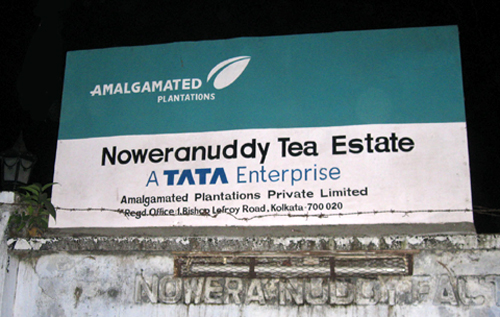
Tata, the transnational Indian conglomerate whose Tetley Group makes the world famous Tetley teas, has taken 6,500 people hostage through hunger. The hostages are nearly 1,000 tea plantation workers and their families on the Nowera Nuddy Tea Estate in West Bengal, India. Permanently living on the edge of hunger, the workers and their dependants are being pushed to the edge of starvation through an extended lock out which has deprived them of wages for all but two days since the beginning of August. The goal of this collective punishment is to starve the workers into renouncing their elementary human rights, including the right to protest extreme abuse and exploitation.

The hostage-taking began with a first lockout on August 10, when workers protested the abusive treatment of a 22 year-old tea garden worker who was denied maternity leave and forced to continue work as a tea plucker despite being 8 months pregnant. On August 9, Mrs Arti Oraon collapsed in the field and was brought to the hospital, on a tractor normally used for garbage, after the medical officer refused to make an ambulance available (he had proposed she be brought by bicycle). She was initially refused treatment, and only after her co-workers protested did she receive minimal care. Her treatment was inadequate and she had to be taken, in the same garbage tractor, to the local government hospital one hour away.

As news of her treatment spread, some 500 mostly female estate workers gathered in protest at the medical facility, demanding sanctions against the medical officer. Local management promised to meet with the workers, but on August 11 the management, along with the medical officer, left the estate and declared a lockout.

On August 27 an agreement was signed with three trade unions, representing some workers on the estate but not a majority, on reopening the garden. In the agreement, all workers’ wages for the lockout period were withheld. The agreement included a clause that a “domestic inquiry” (an internal, company-controlled investigation) would be conducted. The agreement was written in English, a language few if any of the workers understand.

The garden was reopened the following day, although workers were not informed of the conditions of the reopening. On September 8, management issued letters of suspension and ordered a domestic inquiry against eight workers.

None of the eight workers received a letter of notification. None of the eight had committed any act of violence or were involved in any illegal practice. These eight workers have been targeted because they are active in the garden campaigning for workers’ rights.

At a September 10 meeting, management told the workers that suspension letters had been issued in accordance with the August 27 agreement and that opening the garden depended on compliance with that agreement. In other words: agree to the suspensions or you’ll be locked-out again. Workers requested six days to respond to this ultimatum.

The ultimatum was a powerful one: tea garden wages are just 62.50 Indian rupees per day – the equivalent of USD 1.35 daily. One kilogram of the cheapest, poorest quality rice in the local market costs 20% of a worker’s daily wage. Tea workers permanently live on the edge of hunger. The loss of wages for even a few weeks can tip them into starvation.

Although wielding the weapon of hunger – with workers’ lives in the balance and the deadline to respond not yet expired – management on September 14 again left the plantation and implemented a lockout. This was the day workers were meant to receive their annual festival bonus, amounting to roughly two months wages. No bonus payments were made. Prior to the lockout, since the beginning of August workers have only received a wage payment amounting to two days work.

Following the closure, workers have sought to communicate with the management, requesting it to reopen the garden. The company has insisted that the garden will not be reopened and wages paid unless all workers accept the September 10 ultimatum to effectively sign off their right to protest abuses.

Tata Tea is a powerful global company; it’s wholly owned Tetley Tea is one of the world’s biggest-selling tea brands. Nowera Nuddy Tea Estate is owned by Amalgamated Plantations Private Limited, a company 49.98% owned by Tata Tea. Tata and Amalgamated share the same office in Kolkata, the capital of West Bengal. According to the Tata Tea 2009 annual report, Tata Tea Managing Director Percy T. Siganporia earns in a single day roughly 1,000 times the daily wage of a Nowera Nuddy worker – assuming that worker is paid .

Tea from Amalgamated Plantations’ tea estates goes into the famous Tetley Tea bags.

Tetley Tea is a member of the Ethical Tea Partnership (ETP), whose standard commits member companies to, among other requirements, ensure that there is no “harsh or inhumane treatment” of plantation workers and that “Workers should be paid at least monthly and should receive their pay on time.” The actual conditions on the Nowera Nuddy estate, where workers are being subjected to brutal collective punishment, could not be more remote from this CSR wish list.

Workers at the Nowera Nuddy Tea Estate have formed an Action Committee which has called for the immediate reopening of the garden, the withdrawal of the suspension letters and no recriminations against workers, back payment of wages and rations since 14 September, immediate payment of the annual festival bonus and a management apology to Mrs Arti Oraon.

You can support their struggle – CLICK HERE to tell Tata and Tetley Tea to stop starving workers now! You can also use the features provided on the Tetley Tea website to send the company a message, or use the freephone number provided to give them a call!

Courtesy: IUF-Uniting Food, Farm and Hotel Workers World-Wide

“America’s Head Servant?”

An article in the recent issue of New Left Review (Nov-Dec) authored by Hung Ho-Fung demonstrates the fragility of the Chinese rise. The author singles out two major factors that fuelled this rise:

1) Stagnant industrial (especially manufacturing) wages for the last three decades;

Wages

2) An urban-biased approach to development leading to a “prolonged ‘limitless’ supply of labour”.

By bankrupting the rural economy, China has pumped up its urban industrial growth, trade surplus and financial capital.

ruraltourban

This is how China lured global capital, even from other East Asian economies, which consequently put China at the helm of East Asian capitalism. But the same strategy has made China dependent on the ups and downs of the global (esp., American) economy. Cheap labour and rural bankruptcy, which constitute the basis of Chinese growth, cannot provide a viable domestic demand structure for the growth to sustain during a global recession. Further, the rise of the Coastal bourgeoisie and their cohorts within the Communist Party will not allow demand stimulus which brings about structural changes challenging their political-economic hegemony.

The “capitalist roaders” in China are fully entrenched within the State and Party, so “class struggle within the party” will not be enough, a new full-fledged Chinese Revolution is what is called for.

How can the U.S. Unemployment be solved?

10.2% of Americans are unemployed. Another 5.3% are underemployed. Now President Obama faces criticism that he lost focus on creating and saving jobs.

Courtesy: newsy

Conference on “Region Formation in Contemporary South Asia”

25-27 November 2009
Room No. 22, Arts Faculty, North Campus
The University of Delhi,
Delhi (India)

Day One, 25th November 2009

Inaugural Address: 9.00 am to 9.40 am

Dr. Salvatore Engel-Di Mauro : On Not Confusing Regions with the Product of Ideological Confrontations between Opposing Ruling Classes.

Requiem: 9.40 am to 10.10 am

Mr. N. Babaiah: K Balagopal: A Portrait of An Activist.

Tea Break: 10.10 am to 10.25 am

The ‘National Question’, Communist Party and South India: 10.25 am to 1.00 pm

Mr. Vijay Singh: THE COMMUNIST PARTY OF INDIA AND THE NATIONAL QUESTION 1942-1955.
Mr. A. Bhoomaiah: “STRUGGLE FOR TELANGANA STATE HOOD” AS A PART OF NATIONALITIES AND DEMOCRATIC MOVEMENTS.
Dr. V S Shreedara: Kannada Daughter and the Indian Mother: the question of Kannada Nationality.
Prof. A Marx: Tamil Nadu: The Inclusive Tradition.

Lunch Break: 1.00 pm to 1.30 pm

Constituents of a Region: The South Indian Case: 1.30 pm to 4.30 pm

Mr. Simon Chilvers: Social Formation and Articulation of Modes of Production in Karnataka.
Ms. Pranjali Bandhu: The Adivasi Situation in The Nilgiris With Special Focus On Their Educational Status.
Mr. Sachin N: Muthanga-Manvelimantam: A Dialectic between dystopic region in History and utopian space in Literature.
Ms. Yemuna Sunny: Kuttanada: The Making And Unmaking Of A Region.
Ms. Terah Sportel: Labour Market Change, Plucking Nuts: Exploring Regional Trajectories of the Kerala Coconut Sector, India.

Tea Break: 4.30 pm to 4.45 pm

SAARC 4.45 pm

Ms. Ipsita Sengupta: SAARC: Is human rights on the agenda?
Dr. Pawan Kumar Jha: Region Formation: The Perspective for New South Asia.
Mr. Sashi Kumar: Regional Protection of Rights: Emerging Concern.
Ms. Shveta Dhaliwal: Regional Human Rights Mechanism: A Pre- Requisite for Contemporary South Asia.

Day two, 26th November 2009.

Keynote Address: 9.00 am to 9.40 am

Prof. K M Shrimali: Title not submitted

Cultural/Ideological (Re)Production of Region: Northeast 9.40 to 11.30 am

Dr.Jae-Eun Shin: Pragjyotish – Kamrupa: Imagined Boundaries and Imposed Historicity.
Dr. Manjeet Baruah: Guerrilla Space as Literary Plot in Aulingar Zui (Spring of Ash): Space/Culture and Ideological Explorations.
Dr. Joy L. Pachuau: Death and locality in the creation of an identity: the Mizo case.

Tea break: 11.30 am to 11.45 am

Mapping the North east 11.45 am to 1.30 pm

Dr. Chandan Sharma: Reclaiming the Foothills from Colonial Discourse: Space, Settlement and Strategy in Northeast India.
Dr. Sarah Hilaly: Trajectory of Region Formation In The Margins: Arunachal Pradesh In Colonial and Post-Colonial Period.
Mr. Thingnam Sanjeev: Recasting Space: Strategies and Politics of Frontier Making.

Lunch Break: 1.30 pm to 2.00 pm

Situating Region and Politics in the North east: 2.00 pm to 3.45 pm.

Messrs. Asok Kr. Ray and Gorky Chakroborty: Contextualizing India’s North East vis-a-vis South Asia: The Realities and Imaginaries.
Mr. Kundan Hazarika: Uneven Development and Formation of Regionalism: A Study of The Assam Movement.
Mr. Pankaj Jyoti Gogoi: Nationalist Discourse and Regional Consciousness: The Retrospect and Prospect of Regional Uprising in North-East India With Special Reference to Assam.

Tea Break: 3.45 pm to 4.00 pm

Region and Politics in the North and Western India: 4.00 pm

Messrs. R. Venugopalan Nair and Varadrajan N: Defining a Region: Palimpsest of Identities and Politics of Dismemberment.
Dr. Vedpal Rana: Language or Geo-cultural zones? A case study of Partition of Punjab-1966.
Mr. Yogesh Snehi: Politics of Language, Identity or Ecology: Reorganisation, State and the Emergence of Himachal Pradesh.
Prof. Hameedah Naeem: (Title not submitted)

Day Three, 27th November 2009.

Morphogeny of a Region 9.00 am to 11.00 am

Dr. Ryosuke Furui: Sub-regional Identities and Cultural Hegemony in Early Medieval Bengal.
Mr. Kundan Kumar: Reconstructing The Historical Landscape of The Kosi River.
Mr. Pradeep Kumar Nath: The Identity of Western Orissa.

Tea Break: 11.00 am to 11.15 am

Imagining the Region/Regional Imagination: 11.15 am to 1.15 am

Ms. Radhika Borde: The Sarna Movement: Adivasi Religious Bioregionalism.
Mr. Sachida Nand Jha: Rethinking the representations of Maithili Identity in print.
Mr. Sadan Jha: Representing a Region: History, Memory and Literature in the Construction of Purnea (North Bihar) as a Cul De Sac.

Lunch Break: 1.15 pm to 1.45 pm

Prometheus Bound: Region and/in the Nation States: 1.45 pm to 4.15 pm

Mr. Swatahsiddha Sarkar: Formation of Region and Regional Identity in Darjeeling Hills.
Mr. Delwar Hussain: Re- arranging the regions- The coal villages on Bangladesh/India Border.
Dr. Nasir Uddin: Between Peace and Conflict: A Study on Conflict Management and Peace Building in Chittagong Hill Tracts of Bangladesh.
Mr. Fraser Sugden: Understanding spatial subordination: the evolution of modes of production on the Nepal terai.

Tea Break: 4.15 pm to 4.30 pm

Region and Politics in Central India: 4.30 pm to 5.45 pm

Mr. Yogesh Diwan: Adivasi Identity and Regional Politics.
Mr. Kumar Sanjay Singh: Madhya Pradesh: A Geographical Entity With Split Personalities.

Valedictory Session 5.45 pm to 6.30 pm

Prof. James Petras: Separatism and Class Politics in Latin America.