Salwa Judum in Narayanpatna: A Fact-Finding Report

Satyabrata

On November 23 a fact-finding team comprising intellectuals and activists from several organisations visited Narayanpatna to inquire about the killing of the adivasis. The team had to face difficulties in entering the region and members of the team were harassed and even beaten up by the police, as one of the team members reported in the press conference held today (November 25). The following is the report of the team released during the press conference.
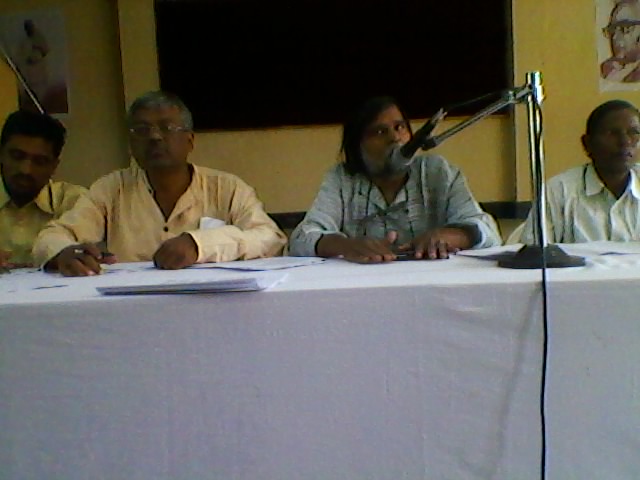
REPORT OF THE FACT-FINDING TEAM

Salwa Judum in Narayanpatna when rest of Orissa sleeping
Planned murder of Singhana by police, land grabbers celebrating
Bauxite miners, landlords, mafia, police unleash reign of terror
Who is with the people when naveen is with miners, ask people?

A team consisting of representatives of peoples’ organizations that visited Narayanpatna on 23rd of November 2009 after the killing of two members of Chasi Mulia Adivasi Sangh spearheading the movement for restoration of tribal lands from non tribal land grabbers on 20th of November 2009 by paramilitary police of the state in pretext of self defence has come across shocking evidences which are unacceptable in a democracy guided by a constitution and established acts and laws. The team at the outset would like to state here categorically that

1. The killing of K. Singana a top ranking leader of Chasi Mulia Adivasi Sangh along with Andrew Nachika was a well thought out murder executed by the state police with the help of IRB and CRPF and it was not an act of self defence.

2. The killing of Singana was preceded by a series of house to house raids in the villages in Narayanpatna area in which the men had been tortured and the women humiliated and sexually abused.

3. The Chasi Mulia Adivasi Sangh had brought the matter to the notice of the OIC of Narayanpatna Police Station who had given them the assurance that the combing operation in search of Maoists was not targeted against them and he would personally supervise and ensure that no member of the Sangh is harassed.

4. Since the OIC did not keep his words and atrocities continued the Sangh leaders had gone to the PS with only one intention of asking the OIC why he breached the trust and to take the ‘foreign’ security forces back to the barrack.

5. The number of people assembled outside the PS was hardly one hundred and some of them carried their conventional weapons which is an accepted tribal habit in the region.

6. The firing started when K.Singana was inside the PS and discussing with the OIC and as soon as he came out of the PS he was targeted and killed. His dead body was then dragged into the PS.

7. More than 60 rounds of ammunitions fired killing K.Singana and Andrew Nachika and injuring 25 others some of them critically wounded.

8. Plain cloth policemen and local landlords were roaming around jointly and identifying tribal leaders who were tortured by them before they landed up in police custody.

9. Those sustained critical bullet injury don’t receive any medical attention as there is fear of arrest and torture by police.

10. Salwa Judum type squads formed and anyone visiting the region is tortured and humiliated with active patronage and support from the local OIC.

11. Budha Gamang, veteran tribal leader and President of Lok Sangram Manch, taking part in the funeral of Singana was beaten up by police. Com. Sivaram of CPI-ML and other leaders faced humiliation in the hands of police and ‘Salwa Judum’ team.

12. Most of local media persons are operating from Narayanpatna Police station. Fair reporting is a remote possibility as most reporters are also a part of the land grabbing communities.

13. Repression against the democratic mass movements is going to increase in coming days and there is no sane voice available to protest. The victimised tribals have been left out uncared and isolated.

14. The land grabbers are getting reorganised in the form of peace committees with active support of police and ruling party leaders.

15. The police was restless as Narayanpatna had become a litigation free police station with no cases registered by tribals against anyone which happened mostly because tribals had given up liquor and tribals were looking after their own welfare collectively.

16. The landlords and traders were restless because the organised tribals had taken back their land occupied by them.

17. The mining company and its potential beneficiaries were restless because the Chasi Mulia Adivasi Sangh had organised conventions declaring that no Mali (bauxite rich mountains) in the area shall be given for mining.

18. The nexus killed Singana by making the local police their instrument that in turn made use of the Green Hunt operation declared by the UPA government and now they want to kill the most successful and democratic land restoration movement in the history of Orissa by brute force.

19. Chasi Mulia Adivasi Sangh is a democratic mass organisation and existed much before Maoists became an issue in the region.

20. The CM Naveen Patnaik is shamelessly sleeping while the dignified opposition is yet to wake up to the call of the tribal peasants crying for justice.

BACKDROP:

Narayanpatna came to the news when on 8th of May 2009, the land grabbers 400 to 500 in number attacked tribal households in Narayanpatna with the support of local police which was challenged by members of Chasi Mulia Adivasi Sangh who instantly got organised after the alarm was raised. The police under pressure seized a house of the land grabbers in which they were making bombs. After that Narayanpatna has been constantly in news because the tribals had launched a very powerful and yet peaceful movement for restoration of their lands grabbed by outsiders. There have been very systematic attempts to divide them and brand a larger section of them as Maoists or Maoist sympathisers. Out of about 37000 people living in the region, 30000 are tribals who lived for last 40-50 years as bonded labourers at the disposal of outsiders who had gone and settled there primarily to capture their resources.

In the last two months the state has witnessed the formation of ‘peace’ committees by powerful vested interests with the support of the police and prospective mining companies. They have organised peace conventions demanding arrests of CMAS leaders and activists who have expressed their solidarity with the victimized tribals. The media has highlighted these events in Laxmipur (Birla’s Hindalco is there), Semiliguda, Koraput and Dushamantapur rich with bauxite deposits.

DEMANDS:

1. Immediate withdrawal of all armed and paramilitary police such as Cobra, IRB and CRPF from Narayanpatna and immediate stop of farce called combing operation.

2. Dismantling of the Salwa-Judum-operation happening in the name of peace committees in entire Koraput region and registering murder cases against local OIC and other culprits.

3. A compensation of Rs.10 lakhs to the next of the kin killed by the police and immediate medical treatment with proper financial compensation to the tribal peasants sustaining bullet injuries.

4. Immediate withdrawal of all cases against innocent peasants of CMAS and releasing them from jail.

5. State protection to tribals who have captured back their lost land which normally the state was expected to do but did not.

6. Investigation by serving judge of Orissa High Court into the killing of Singana and the land grabbing issue.

Prafulla Samantara, Lok Shakti Abhiyan
Radhakant Sethy, CPI(ML)(Liberation)
Budha Gamanga, Lok Sangram Manch
Sivaram,CPI-ML

The Great Resource Grab Continues: People fight for law, Government throws it to the winds

Campaign for Survival and Dignity

On November 20th, the police opened fire on an unarmed protest rally in Narayanpatna, Orissa, by the Chasi Mulia Adivasi Sangha and killed three people. The Campaign condemns these murders – for that is what they are – in the strongest possible terms. Meanwhile, adivasi groups organised demonstrations across Andhra Pradesh yesterday against the State government’s illegal move to record community forest management rights and powers in the name of Joint Forest Management committees – which function as proxies of the Forest Department. In Andhra Pradesh or in Orissa, the irony is the same: it is the people who are fighting for the law, and the government that is using all the force possible to break it. In Delhi we find the Prime Minister and the Home Minister talking of the “rule of law” all the time, but for the government it seems that the “rule of law” is just another word for the rule of brute force.

The Chasi Mulia Adivasi Sangha is an adivasi movement that came to attention earlier this year when it mobilised to take back adivasi lands. The lands had been illegally taken over by non-tribals, in violation of the Orissa Land Reforms Act and the Orissa Scheduled Areas Transfer of Immovable Property Regulation. Though the government insists, as usual, on calling the Sangha a “Maoist front” and a “Maoist overground organisation”, the Sangha’s leaders have always been very clear that they are not linked to the CPI(Maoist) and have publicly stated their differences with the Maoists. They have organised people in a mass movement for adivasi land rights. This movement, of course, is intolerable for the government and for powerful interests; so, as usual, those fighting for people’s rights are labelled Maoists and, on this pretext, killing, beatings and torture all are considered justifiable.

On the 20th, the adivasis gathered to protest harassment of women and children, including beatings, that had taken place during so-called “combing operations” in the preceding days. According to fact finding reports, they were not carrying even their traditional bows and arrows. The police opened fire within half an hour of the protest reaching the police station. An estimated 60 people have been injured (no injuries to police have been reported) and those injured are not receiving medical treatment. The police are still engaged in combing operations and have arrested a number of other adivasis. There is no report of any action being taken against those responsible for the killings.

In Andhra Pradesh, meanwhile, a quieter attack on democracy is underway. The Forest Rights Act recognises the right and power of forest dwellers to protect, conserve and manage their “community forest resources”. This was the biggest step forward in this law, and it is the one part that the government appears most keen not to respect. In AP, the Forest Department has found a new trick to get around these provisions – it has persuaded the State government to confer community management rights under the Act on Joint Forest Management committees, which have forest guards as their secretaries / joint account holders and are effectively controlled by the Department. This is completely illegal and amounts to robbing people’s resources through the back door. But, once again, we find deafening silence or active support from the Central government for these illegal activities, and reportedly AP has even been cited as a ‘model’ by Central officials for this action.

Thus the struggle of the people for control over their resources and their livelihoods continues. The question that the government has to answer is very simple: does it actually believe in the rule of law? Or does it believe in crushing all those who fight for the very laws that it has passed?

Response to S Sivasegaram’s Rejoinder

Ron Ridenour

S Sivasegaram’s rejoinder to my series on the plight of Sri Lankan Tamils and the role of Cuba – ALBA in this tragedy is an excellent, well-thought and balanced piece. He, much more than I, knows the history and the peoples.

Without knowing anything about that part of the world until the end of the civil war, I was moved to conduct research because of the treatment the Sri Lankan government and military conducted against Tamils. I was also moved by what I believe essential for revolutionary morality: one does not side with a brutal government which practices discrimination (genocide even) against an entire people regardless of errors or incorrect attitudes by members of that people. I did not write to support elitism on any side, nor the Tigers, who, as I understand it, did act as Sivasegaram described they did. I wrote, in part, to admonish my comrades, the governments of ALBA countries whose resolution in the Human Rights Council is abhorrent in its applause for such a government and in its lack of solidarity for the interned Tamil people.

The fact that Sri Lanka has become a pawn in the hands of imperialism and authoritarian governments sometimes in opposition to US-led imperialism (China and Iran) in no way justifies an immoral stance by revolutionaries. The enemy of our enemy is not necessarily our friend. So, if ALBA must trade with the authoritarian-anti-democratic-anti-revolutionary governments of China and Iran that is for them to decide, but that must not make them dependent upon them politically. We certainly should have learned that, after all those years with the Soviet Union, which did not always conduct foreign policy in the interests of the people at hand.

We revolutionaries must not act cynically. Even if the Tamil nationalists should support other peoples and should have discussed matters with Latin Americans, this failure cannot justify abandoning a tortured people and applauding the torturers.

Analysis of Classes in India: A Preliminary Note on the Industrial Bourgeoisie and Middle Class

Deepankar Basu, Sanhati.

In a previous paper [Basole and Basu (2009)] an attempt to begin an analysis of social classes in contemporary India organized around the idea of economic surplus was initiated, by revisiting the 1970s mode of production debate. The focus in Basole and Basu (2009) was on the rural classes and the unorganized industrial and service sector workers. In this paper, I extend that analysis by shifting attention to the classes that had been left out in Baole and Basu (2009): the industrial bourgeoisie and what might be called the middle class.

Introduction

In the Marxist tradition, the notion of class is intimately related to the idea of economic surplus. Thus, I would like to begin this paper with a few brief and introductory comments on the relationship between the two. Every society, if it is to reproduce itself over time, must organize social production in such a way that it manages to reproduce the material and non-material conditions of its existence. Production in excess of what is necessary to reproduce the material conditions of its existence is the production of what we can call economic surplus. Thus, a society produces economic surplus when it produces more than what is necessary to cover the costs of social production, i.e., when it produces more than is necessary to replace (or replenish) the labour and non-labour inputs used up in the production process. This allows us to divide the total labour time of society into two parts: necessary labour time, which corresponds to the labour time required to merely replace the labour and non-labour inputs to production; and, surplus labour time, which corresponds to the economic surplus.

It is the economic surplus, moreover, that allows any society to grow and develop, to not only increase the scale, scope and sophistication of material production and encourage and facilitate technological change but also to increase the scale and depth of its non-material products. Every viable, growing society, therefore, must produce an economic surplus to sustain its material and non-material growth.

Of course, reproduction of a society requires not only the continuous production of an economic surplus but also the reproduction of its social relations of production. While the problem of the reproduction of the social relations of production is an important one and deserves serious study, here I would like to draw attention to another, though related, issue: the relationship between economic surplus and class.

What is class? Here I can do no better than give a fairly comprehensive definition of class by Lenin:

“Classes are large groups of people differing from each other by the place they occupy in a historically determined system of social production, by their relation in most cases fixed and formulated in law to the means of production, by their role in the social organisation of labour, and, consequently, by the dimensions of the share of social wealth of which they dispose and the mode of acquiring it. Classes are groups of people, one of which can appropriate the labour of another owing to the different places they occupy in a definite system of social economy” (Lenin 1919 (1972), p.421).

Thus, classes, as understood in the Marxist tradition, are defined by the appropriation of the surplus labour time of the group of direct producers by the group of non-producers (or exploiters). This appropriation is made possible by the differential location of the classes in the process of social production and the differential ownership of the means of production. The appropriation is guaranteed by the existing legal system enforced through the power of the State.

But if classes are defined by the appropriation of surplus, then they can only come into existence when the productive capacity of society has progressed to the extent that it can produce a surplus over and above what is needed for bare subsistence. Thus, class-divided societies are made possible and materially supported by the existence of economic surplus, corresponding to the surplus labour time of direct producers.

Being defined by the relationship between exploiters (those who appropriate the surplus) and exploited (those who produce the surplus), class-divided societies have often been studied with two-class models: master and slave, serf and lord, worker and capitalist. It is of course clear that two-class models arise as abstractions from the more complex class structures of real societies; the presence of groups which lie in the “middle” of, or straddle, both class locations, i.e., exploited and exploiters, needs to be taken into account to arrive at a more realistic class analysis of real societies. Before proceeding to take account of the “middle” in Indian society, it needs to be reiterated that even though two-class models are simplified representations of reality, they are useful for understanding the basic dynamics of the societies they refer to at a high level of abstraction. For instance, Marx’s analysis of the dynamics of capital accumulation presented in Capital, Volume 1 (Marx, 1992), where he works primarily in terms of two fundamental social classes – the proletariat and the capitalists – is extremely useful in understanding the long term tendencies of capitalist societies.

With these preliminary comments in place, let me propose the following three-class typology as a first approximation to the class structure of contemporary India: the working classes, the ruling classes and the middle classes, the plural being used to draw attention towards the internal heterogeneity of each of these three classes.

Three Fold Classification for India

The working classes are the only productive classes in Indian society and are defined by the fact that they produce the economic surplus in the following specific sense: the income that accrues to this class, which is equal to the value of its labour-power, is lower than the value added by the use of that labour power during any period of time (say a year). Taking account of the internal heterogeneity of the working class in India, it can be broadly divided, with two important qualifications, into two large groups: (1) the unorganized workers (i.e., workers in the unorganized sector of the economy) as defined by the National Commission for Enterprise in the Unorganized Sector (NCEUS), and (2) productive workers in the organized sector of the economy. The first qualification relates to the fact that the NCEUS defines the unorganized workers to include almost all of the agricultural sector; hence we must exclude the following two rural classes from the NCEUS definition of the unorganized workers: (a) rich farmers and landlords, and (b) middle peasants. The second qualification relates to a tiny portion of the workers in the organized sector whom we will include in the middle class and not in the surplus-producing working class, viz., the highly skilled workers, the professionals, the managers, and all the employees of the State sector. Thus, in India, the working class consists of: (1) the landless labourers, (2) the marginal and poor peasants, (3) the workers in the unorganized industrial and service sectors, and (4) a large part of the workers in the organized private sector.

At the other pole of Indian society resides the dominant, or ruling, classes. These classes are defined by the fact that they not only appropriate the economic surplus (that has been produced by the working classes defined above) but also determine the direction and mode of its utilization. For historical and structural reasons, the ruling class combine in India has been, and still is, internally heterogeneous and consists of the following three elements: (1) the industrial bourgeoisie, (2) the rich farmers and landlords, and (3) the professionals (State-elite, i.e., the top-level managers of PSUs, the top-level officers of the bureaucracy, the police, the army and the judiciary, and the top-level managers and professionals in the private sector). The industrial bourgeoisie is the dominant element in the ruling class combine.

Lying between these two poles, the productive and the non-productive poles, is what we might call the “middle class” which is defined by the following two characteristics: (1) this class is the recipient of a part of the economic surplus, i.e., the total compensation earned by the middle-class is higher than the value of its labour power (i.e., the cost of producing and reproducing the labour power); and (2) the middle class is crucial for the reproduction of the existing social relations in India which is what fetches it the extra income, i.e., the income above the value of its labour power, in the form of rent from the ruling classes. There are two main segments of the middle class: (a) the petty bourgeoisie, who largely own their means of production: middle peasants in agriculture, the merchants, the traders, and the owner-operators of small enterprises, and (b) the professionals: the technical experts, the managers, and the skilled workers in large-scale private enterprises, and the large majority of the employees of the State sector.

Basole and Basu (2009), by revisiting the 1970s mode of production debate, attempted to begin an analysis of social classes in contemporary India organized around the idea of economic surplus. The focus in Basole and Basu (2009) was on the rural classes and the unorganized industrial and service sector workers. In this paper, I extend that analysis by shifting attention to the classes that had been left out in Baole and Basu (2009): the industrial bourgeoisie and what might be called the middle class. But before moving on to an analysis of the industrial bourgeoisie and the middle class, let me briefly summarize the findings of Basole and Basu (2009) about the rural classes and the unorganized workers.

The main input into agricultural production is land and so the analysis of property and power in the agricultural sector has to carefully look at the ownership distribution of land. While the aggregate distribution of land ownership remains as skewed today as it was five decades ago, interesting and important patterns are visible within this unchanging aggregate picture. The share of land owned by large (10 ha or more) and medium (4 ha to 10 ha) landholding families has steadily declined over the last few decades from around 60% to 34%; the share owned by small (1 ha to 2 ha) and marginal (less than 1 ha) landholding families has increased from around 21% to 43%, while the share of semi-medium (2 ha to 4 ha) families has remained unchanged at around 20%.

Going hand-in-hand with the decline in the share of land owned by large landowning families, is the steady decline of tenant cultivation and its gradual replacement by self cultivation in Indian agriculture. The share of operational holdings using tenant cultivation declined from about 24% in 1960-61 to about 10% in 2002-03. There are large geographical variations in the extent of tenancy, with the largest share of leased-in land as a share of total operated area occurring in Punjab and Haryana, two prominent examples of what Basole and Basu (2009) called large landholding states; Orissa has high prevalence of tenancy and is an example of a small landholding state. The proportion of area owned and the proportion of area operated by the different size-classes are almost equal; hence, there is no evidence of reverse tenancy on any substantial scale at the aggregate level, though this might hide reverse tenancy at state or regional levels.

Disaggregating total incomes of rural households engaged in agriculture according to types of income showed that wage income has become the main source of income for a large majority of the population. For about 60% of the rural households in 2003, the major share of income came from wage work, supplemented by income coming from petty commodity production, both in the agricultural and non-agricultural sector. Another 20% of rural households drew equal shares of their total income from wage work and cultivation, both at about 40%. The natural corollary to this is that “effective landlessness” is large and has steadily increased over the past few decades. The share of effectively landless households in total rural households has increased from about 44% in 1960-61 to 60% in 2002-03.

These, and other related, facts led Basole and Basu (2009) to conclude that: (a) the hold of semi-feudal landlords had declined significantly over the past few decades; thus, the primary element of the rural ruling class today seems to be the rich farmers; (b) there has been a significant growth of the rural proletariat, and (c) the prevalence of petty production, in agriculture, industry and services, remains undiminished; hence the petty bourgeoisie remains numerically and politically important; (d) the vast majority of the industrial proletariat is seen in India today as unorganized workers, who lack social security, work security and employment security (NCEUS, 2007). Let us now turn to a study of the industrial bourgeoisie and the middle classes.

The Industrial Bourgeoisie

The dominant element in the ruling class combine is the industrial bourgeoisie, which emerged and grew under the long shadow of British colonialism. Accumulating capital through merchant and trading activities related to the colonial economy, this class gradually diversified into industrial activities, beginning with the textile industry in an around colonial Bombay. Significant portions of the industrial bourgeoisie has been, and continues to be, organized along family lines, with the Tatas and the Birlas being the most prominent historical examples. Three characteristics of the Indian industrial bourgeoisie demand further analysis and comment: its attitude towards other elements, especially the semi-feudal landlords, of the ruling class combine; the evolution of its internal structure and its relationship with the State; and, its relationship with the center of the global capitalist system.

The Indian bourgeoisie has, because of its historical origins, always had an ambivalent attitude to the whole gambit of semi-feudal interests in the economy. Even though it hesitantly supported the nationalist leadership of the Indian National Congress, it was never strong enough to push for its hegemony either in the nationalist movement or in the post-colonial State. It never fought a frontal battle with feudal interests, the biggest indicator of which is the half-hearted nature of land reforms in independent India. As a result, it could neither fashion an independent capitalist development path for the country based on the home market nor consistently democratize the polity. If the nationalist struggle for independence is, therefore, understood as the beginning of the bourgeois democratic revolution in India, then it largely remains unfinished even 60 years after political independence from British colonialism.

Even though the Indian bourgeoisie has not initiated and led a broad-based capitalist development, which could have improved the material conditions of the vast masses of the country, it has nonetheless managed to significantly widen and deepen the industrial structure of India. Starting with consumer goods industries like textiles, it has diversified into the production of basic capital and intermediate goods, and consumer durables. This has been largely possible because of the protection and patronage of the State, with which this class has had a complex relationship. On the one hand, it has resisted all attempts at disciplining by the State for larger development programmes (Chibber, 2006); on the other, it has utilized industrial, tax, credit, export and import policies of the State to further its own narrow class interests.

At the time of political independence, the industrial structure in India was very concentrated at the top, with a few large monopoly business houses controlling large swathes of the market. Three trends have emerged, slowly at first, since then. The first trend has been the differentiation of the economy into an organized and an unorganized sector, roughly coterminous with large and small scale industries; policies of the Indian state helped in this differentiation. The second trend has been the relative growth and proliferation of the small scale sector, i.e., relative to the large-scale, organized sector. The third trend has been the slow but steady growth of a regional bourgeoisie, different from and often competing with the established large business houses. Thus, concentration and centralization of capital has proceeded in several branches of the organized sector; but this has also been accompanied by increased regional and sectoral competition and growth of the small scale sector.

To get a sense of the evolution of the concentration of Indian capital at the very top let us look at some data. In 1971, total sales of the top 20 industrial houses in India accounted for about 61 percent of the net domestic product of the private organized sector; the corresponding figure for 1981 was 87 percent (Bardhan, 1998). To come to the situation in the early part of this century, note the continued dominance of what the business press regularly calls the “big four” of Indian business: the Tatas, the Birlas, the Ambanis and the Mittals. In key industries like energy, telecom, steel, automobiles, IT and retail, these four business houses either continue to dominate or are poised to do so in the near future. Another measure of the concentration of Indian capital at the top can be seen from the following: according to data from the ET 500, in 2008 the top 20 private companies accounted for about 40 percent of the sales, 47 percent of after-tax profits and 45 percent of market capitalization of the top 500 private companies. Though not strictly comparable with the earlier data for the 1970s and 1980s, the data about 2008, when situated in a historical setting, suggests the following: the monopoly power of Indian big capital increased continuously after political independence till the mid-1980s, and has seen a relative decline since the inception of the process of economic liberalization.

While Indian capital continues to be highly concentrated at the top in many industries, we notice another trend too: regional capital has grown by leaps and bounds over the past two decades and has made serious forays into industries such as automobile ancillaries, capital goods, casting and forging, chemicals, construction, diamond and jewelery, entertainment and media, textiles and transportation and many others.

The relationship of Indian capital to the center of the global capitalist system has been the focus of much debate and discussion within left circles in India with one prominent strand characterizing the big bourgeoisie as comprador and the Indian state as semi-colonial, both these characterization meant to convey the continuing hold of foreign capital on the Indian economy and polity, especially since the beginnings of the 1990s. Concrete evidence regarding the presence of foreign capital in the Indian economy and the continuous overseas expansion of Indian capital seem to suggest a more complicated story.

Let us first look at the evidence on the presence of foreign capital in the Indian economy. In 1981-82, “only about 10 per cent of total value added in the factory of mining and manufacturing was accounted for by foreign firms.” (Bardhan, 1998); if only large firms are kept in the picture, foreign firms still account for only about 13 per cent of the value added. Of course, there were a small number of industries where foreign presence was substantial: industries producing cigarettes, soap and detergents, typewriters, electrodes, etc. To the extent that there was a rise of foreign collaboration during this time, “the overwhelming proportion of such agreements [did] not involve any foreign participation in equity capital.” (Bardhan, 1998). Similarly, there has been an increasing trend of outright purchase of technological imports thereby reducing the dependence of domestic capitalists on the foreign suppliers of technology. Of the top 25 industrial units in 1983, only 4 were foreign.

The contemporary picture is tilted even more towards the domestic bourgeoisie. Of the top 500 companies in 2008, only 2 were foreign: Larsen & Tubro and Maruti-Suzuki; if we restrict ourselves to only private companies, then the corresponding figure is 3 out of the top 25: Larsen & Tubro, ITC and Maruti-Suzuki. If we look at the same issue at a more disaggregated level, there are only three major industries which has substantial foreign capital: capital goods (Larsen & Tubro), fast moving consumer goods (ITC and Hindustan Lever), and retail (Pantaloon retail). Other than these three, all the major industries are controlled by Indian capital: automobiles, banks, chemicals, construction, consumer durables, entertainment, fertilisers, finance, metals & mining, oil and gas, pharmaceuticals, power, real estate, steel, textiles, transportation (ET 500, 2008).

The overseas expansion of Indian capital in recent years has been commented on a lot, especially in the ecstatic business press in India. Some of the prominent examples that have been splashed across the national media are: Videocon’s acquisition of South Korea’s debt-burdened Daewoo Electronics; Tata’s acquisition of Corus; ONGC Videsh’s acquisition of Exxon Mobil’s stake in the Campos Basin Oil Fields in Brazil; Suzlon Energy’s acquisition of Belgium’s Hansen Transmissions International NV; Ranbaxy’s acquisition of Terapia, the largest independent generic drug company in Romania; Wipro’s acquisition of United States-based Quantech Global Services; and the largest acquisition of all, Reliance’s reported move to acquire controlling stake in LyondellBasell, the world’s third largest chemical company. Going beyond such anecdotal evidence from the business press, there is substantial evidence based on detailed research that major fractions of Indian capital, with active assistance from the State, has successfully entered the global scene. Researchers have pointed out that Indian investments abroad has moved through two stages. During the first stage of the 1970s and 1980s, the quantity of investments was small, and the destination was primarily in the developing world, shifting from Africa to Southeast Asia. During the second phase, starting roughly from the mid 1990s, there has been a dramatic quantitative increase of outward flow of capital, accompanied by a widening breadth and depth of industries where investment has been directed to; interestingly, in this phase, an increasing share of the investment have found destinations in the imperialist core: USA and Europe. (Pedersen, 2008).

Thus, taking account of these recent trends, viz., growing concentration and centralization of capital in certain key sectors of the Indian economy, the rise and growth of the regional bourgeoisie, and the increasing overseas expansion, especially into the core of the global capitalist system, it seems that the characterization of the big bourgeoisie as “comprador” and the Indian state as semi-colonial needs to be seriously rethought. What this implies is not the absence of imperialism but a suggestion to carefully rethink how imperialism operates in the Indian context, i.e., to rethink how the Indian economy is articulated to the global capitalist system by imperialism. Two issues that might be helpful in this context, and needs to be explored further, are the following: (a) the role and effect of financial capital (i.e., flows of portfolio capital as opposed to direct foreign investment) on the Indian economy, and (b) the possible influence of imperialism operating through the channels of government policy rather through the channel direct investment, i.e., export of ideas replacing the primacy of the export of capital à la Lenin. Next, we look at the middle classes.

The Middle Class

What I have called the middle class, for lack of a better expression, is composed of two distinct segments in contemporary India, the petty bourgeoisie and the professionals (technical experts, managers, skilled workers scientific personnel and state sector employees). The first segment of this class owns its means of production and thus, does not produce, surplus value; the second segment, on the other hand, receives a small portion of the total surplus value due to their crucial position in the production process and their important role in the reproduction of the existing social relations.

The petty bourgeoisie owns its means of production and, therefore, does not need, in the main, to sell its labour power for ensuring its livelihood. In the agricultural sector, the petty bourgeoisie refers to the middle peasants, i.e., families whose main source of income is cultivation and who mainly rely on family labour for organizing cultivation. In the industrial and service sectors, the petty bourgeoisie refers to owner-operators of small enterprises operated mainly with family labour and the small traders and merchants. There is internal differentiation within the petty bourgeoisie, with one section managing to produce surplus and accumulating capital while the other part lives perpetually in poverty, barely managing to reproduce themselves at a constant level of operation.

The privileged position of the professionals in the production process can be better understood if we focus on two crucial dimensions of the production process: skill and expertise, and exercise of authority in the production process. The analysis of professionals in this paper draws heavily on the pioneering work of Marxist sociologist Erik Olin Wright (Wright, 1997).

Let us consider authority first by looking a little more carefully at the production process. Capitalists not only hire labour in the market, but also dominates labour in the production process relating, for instance, to the pace, intensity and other dimensions of work; this aspect of power and control of capital by labour is crucial. As the scale and scope of production increases it becomes increasing difficult for capitalists to carry out this function; hence, they delegate this function to the class of managers and supervisors: managers and supervisors exercise the authority of capital over labour in the production process on behalf of capital. Thus, this dimension of delegated authority is one crucial dimension along which working people are differentiated, creating a contradictory class position: managers and supervisors can be seen as belonging both to the capitalist class and the working class. To the extent that they exercise the delegated authority of capital in the process of production, they act as capitalists; to the extent they are themselves controlled by capitalists, they resemble workers. There is, of course, a whole range of such contradictory class positions with lower level supervisors strongly resembling workers and top level managers, like corporate directors and CEOs, identifying completely with capital.

How do capitalists, in turn, monitor and control the managers and supervisors? Thinking about this question gives us a way to explain the earnings differentials, compared to the working class, of managers and supervisors. For the smooth functioning of the production process and the continuous generation of surplus value, capital needs managers and supervisors to exercise the power and authority over workers in an effective manner. This cannot be ensured by surveillance and monitoring of managers, both because it is difficult to monitor managerial effort and because coercive methods hamper creative managerial intervention. The alternative is to pass off a part of the surplus value to the managers so as to build loyalty of the managers towards the organization, internalize the imperatives of capital and thereby do capital’s bidding effectively in the production process. This part of surplus that goes to the managers and supervisors, and explains the huge differentials in earning from the working class, can thus be understood as a “loyalty rent”that capital pays to maintain its power and control in the production process.

Let us now turn to the other dimension: skill and expertise. Much like the class of managers and supervisors, workers who manage to acquire skills and expertise relevant to the production process attain a privileged position. There are two aspects of this privileged position. First, not only are skills always in short supply but there are systematic obstacles to the acquiring of these skills by members of the working class which often operates through the monopoly of the middle class on the educational system and training programs. This allows skilled and technical workers and the so-called experts to derive a “skill rent” from capital, which partly explains the wage differential vis-a-vis the working class and is an indicator of their privileged position. Second, technical and skilled work often cannot be effectively monitored; hence, capitalists generate optimal effort from skilled and technical workers by building up their loyalty to the organization, again through a part of the surplus being passed off as a “loyalty rent” to the skilled workers.

Among what we have called professionals, there is a special category that deserves separate attention: state sector employees. There are two characteristics of this group that deserves mention. First, their income comes from the tax revenue of the State, and thus can be easily seen to be a part of economic surplus of society; their income is thus a deduction from the surplus, they do not produce surplus in the sense in which workers produce surplus value for the valorization of capital. But this also means that they are not dependent on capitalist profit making for their livelihood; this might have important implications in terms of class consciousness vis-a-vis capitalism. Second, following Wright (1997), the various institutions of the state can be broadly divided into two parts, the political superstructure and the decommodified state service sector. The political superstructure consists of all the institutions that work for the reproduction of the existing social relations: the police, the courts, the military, the legislature and other such institutions. The decommodified state service sector, on the other hand, produces use values, and not exchange values, directly beneficial to the people at large: health care, educational services, public infrastructure and utilities, public recreation and entertainment, etc. The rationale for separating the two sets of institutions is that the second, the decommodified state service sector, operates largely outside the logic of commodity production and capital accumulation. Production in this sector is not subordinated to the imperatives of profit maximization; hence, this sector can be viewed as part of the institutional set-up of a post-revolutionary State and hence would need to be preserved even when the current configuration of power is dismantled. The political consciousness and orientation of workers working in these two sectors of the State might be expected to be radically different, a point of particular relevance to radical mass movements.

It goes without saying that there is a gradation of the middle classes, and the upper sections merge into the ruling class while the lower sections are very close to the working classes. The upper sections of the middle class share in the decision-making process relating to the use of the economic surplus (CEOs, top managers, and directors of corporate sector firms, etc.), have significant control over a large part of the productive resources of society in the form of public sector units (top managers of the PSUs) and have a monopoly over the use of the ideological and repressive apparatus of the State (top level bureaucrats, army officers, members of the judiciary). They seamlessly merge into the ruling class.

Relative Population Shares, Income and Wealth: Initial Estimates

What are the numerical strength of the three broad classes – the ruling class, the middle class and the working class – in Indian society today? Some very interesting recent research (Jaydev, et al., 2009; Vakulabharanam, et al., 2009) can throw some light on this important question. In their comparative study of the changing nature of inequality in India and China, Vakulabharanam, et al. (2009) use data from two rounds of the National Sample Survey (NSS) to provide a detailed picture of class structure in India. They use the National Classification of Occupation (NCO 3-digit, 1968 scheme) to divide households into various occupational categories, which can used to roughly compute relative shares of what I have defined as the ruling, middle and working classes. Using data from Table 2 in Vakulabharanam, et al. (2009), I get the rough picture presented in Table 1.

Table 1: Class structure in India (Percentage share in population)
1993-94 2004-05
Ruling Class 11.89 11.71
Middle Class 24.26 21.08
Working Class 63.85 67.21

Though lot more work needs to be done to get a more accurate and refined picture, Table 1, nonetheless provides a rough estimate of the relative shares of the three social classes in contemporary India. Ruling classes, in Table 1, consist of the following: owners or managers of the formal and informal sector enterprises and the rich farmers; the middle class consists of the following: professionals and skilled workers in manufacturing and services, middle peasants, rural professionals and moneylenders; the working class is composed of the rest of the population: the unskilled workers in manufacturing and services, the small and marginal peasants and the landless labourers. An interesting, though expected, fact that emerges from Table 1 is the relative squeezing of the middle class and not their growth, as the mainstream media constantly suggests. Since the size of the ruling class has remained more or less constant over the decade, it must mean that sections of the middle class is getting pushed down into the working class.

The picture presented in Table 1 is only an approximate picture; hence some caveats are in order. First, the National Sample Survey Organization (NSSO) consumption expenditure surveys, which is used by most researchers including Vakulabharanam, et al. (2009), do not give a correct picture of the members of the big bourgeoisie (the super rich in terms of wealth and income); they need to be oversampled if they are to be truly representative of their population weight in the sample. Second, some of the owners and managers that are currently part of the ruling class would actually need to be included in the middle class; this is because many of the owners would be owner-operators of small scale enterprises and some of the managers would occupy lower levels in the firms’ hierarchy; but this adjustment could not be carried out because of lack of more disaggregated data at the moment. That is why the sample share of the ruling class in Table 1 seems to be an overestimate of their true population share. Both these facts, moreover, suggest that the figure for the ruling class in Table 1 needs some serious modification. Third, some of the skilled workers that are currently part of the middle class in Table 1 should be actually included in th working class; again, this could not be done because of lack of more disaggregated data. This is the reason why, just like in the case of the ruling class, the sample share of the middle class in Table 1 is an overestimate.

A more disaggregated analysis to arrive at a more accurate picture will be conducted in the future. My conjecture is that the disaggregated analysis will throw up a picture which will correspond closely to the distribution of households according to consumption expenditure that was reported in Table 1.2, NCEUS (2007): the ruling class would be roughly 4 percent of the population and their average consumption expenditure would be greater than 4 times the official poverty line, the middle class would be roughly the next 19 percent of the population with an average consumption expenditure between 2 and 4 times the poverty line, and the rest, about 77 percent, would be what I have called the working class and which corresponds to what the NCEUS called the poor and vulnerable section which, in 2004-05, spent less than Rs. 20 per day on consumption (Table 1.2, NCEUS, 2007).

Of course, the consumption expenditure distribution that is deduced from the NSSO surveys do not provide an accurate idea about the true income and wealth of the big bourgeoisie and the top professionals in India. There are two sources that provide a much more accurate picture of the income and wealth of this class: income tax data that has been used to estimate top Indian incomes from 1922 to 2000 (Banerjee and Piketty, 2005) and the World Wealth Report and the Forbes list of the richest persons in the world (which now, quite understandably, has a separate list for India).

To get an idea of the wealth of the big bourgeoisie, note that in 2009, India had 52 billionaires, which was close to twice the number in 2007; the wealthiest them of all, Mukesh Ambani, has a net worth of $ 32 billion (Times of India, Nov., 19, 2009). The combined net worth of the richest 100 Indians in 2009 was US$ 276 billion; their Chinese counterparts had a combined net worth of US$ 170 billion (Livemint, Nov., 20, 2009). To make the comparison fair recall that China’s GDP in 2008 was $ 7.992 trillion (PPP) while India’s GDP in 2008 was only $ 3.304 trillion (PPP): wealth is far more concentrated at the top in India than it is in China.

Moving on to incomes of the richest Indian, Banerjee and Piketty (2005) present some very interesting facts. First, the top 1 per cent of the population accounted for about 12-13 per cent of total income in the 1950s; the share fell to 4-5 per cent in the early 1980s, and then picked up again to reach 9-10 per cent in the late 1990s; whatever the problems of the Nehruvian policy frameowrk, it did manage to redistribute income away from the rich. This U-shaped pattern, which is very similar to patterns observed in the USA too, can be an entry point into understanding the sharp policy change from the mid-1980s onwards in India: the big bourgeoisie pushed for the change in policy direction to reverse the trend of income distribution. While the top 1 per cent have more or less gained back their pre-Nehruvian era share, there are interesting patterns if we look more closely at the various sections within the rich: there has been a rapid divergence in the income shares accruing to what can be termed the super rich (the top 0.01 per cent), the moderately rich (the top 0.1 per cent) and the rich (the top 1 per cent).

Conclusion

Mao’s analysis of the class structure of Chinese society in the 1920s was extremely influential in the Chinese communist movement and facilitated the formulation of the strategy and tactics of the Chinese revolution. Given the widespread use of Mao’s basic framework of class analysis in Third World settings, it would be useful to contrast the results of the analysis presented in this paper with Mao’s characterization of classes in pre-revolutionary China (Mao, 1926).

For Mao, the ruling class in pre-revolutionary China consisted of “the warlords, the bureaucrats, the comprador class, the big landlord class and the reactionary section of the intelligentsia attached to them.” In contemporary India, the ruling class consists of the big bourgeoisie, the rich farmers and the top sections of the professionals and bureaucrats; the crucial difference, to our mind, is the absence in contemporary India of what Mao called the comprador class (the class of merchants who acted as agents of foreign capital) and the big feudal landlords. The big bourgeoisie in India today seems to be less under the influence of foreign capital than their counterparts in pre-revolutionary China; similarly, the big feudal or semi-feudal landlords that held sway over the economy of rural China seem to have been largely replaced by the rich farmers as the key ruling class element in rural areas of contemporary India.

Mao’s analysis had identified a tiny proletariat in China, which, according to him, would be the leading force in the revolution. In contemporary India, in sharp contrast to China, the proletariat is significantly larger, not only in absolute terms but also in relative terms, i.e., relative to the other social classes. This is the direct result of the wider and deeper industrial development following political independence in India compared to pre-revolutionary China. The proletariat consists, in contemporary India, of the vast majority of workers in the unorganized industrial and service sectors, part of the lower level workers in the organized sector and the effectively landless laborer families in the agricultural sector, and thus partially includes what Mao had called the semi-proletariat.

In Mao’s analysis, the petty bourgeoisie was accorded “very close attention” both because of its size and because of its class character. He had concluded that this large and important group would be an ally of the revolutionary proletariat. In contemporary India too, the petty bourgeoisie – composed of the middle peasant and the owner-operators of small enterprises and small traders and merchants – is numerically very large and because of its objective economic position will play an important role in radical social change.

What Mao did not stress and what seems to have become important in contemporary India is the place occupied by the second segment of what I have called the middle class: the professionals. With the growing complexity of social organization and social production, this group will become even more important, not only in the present social order but also in any radically different society that might arise in the future. In both the Russian and the Chinese revolutions, the post-revolutionary regime had to rely very heavily on this class to ensure functioning of the economy. According more attention to this segment of the middle class, therefore, seems warranted.

REFERENCES

Banerjee, A. and T. Piketty. 2005. “Top Indian Incomes, 1922-2000,” The World Bank Economic Review, 19(1), pp. 1-20.

Bardhan, P. 1998. The Political Economy of Development in India (expanded edition with an epilogue on the Political Economy of Reforms in India). Oxford University Press: Delhi.

Basole, A. and D. Basu. 2009. “Relations of Production and Modes of Surplus Extraction in India: An Aggregate Study.” Working Paper, Department of Economics, University of Massachusetts, Amherst. Available at: http://www.umass.edu/economics/publications/2009-12.pdf and http://sanhati.com/non-excerpted/1506/

Chibber, V. 2006. Locked in Place: State-Building and Late Industrialization in India. Princeton University Press: Princeton, NJ.

ET 500: http://economictimes.indiatimes.com/Features/ET-500-companies/articleshow/3603974.cms

Jaydev, A., Motiram, S. and V. Vakulabhranam. 2009. “Patterns of Wealth Disparities in India during the Era of Liberalization,” in A Great Transformation? Understanding India’s Political Economy (forthcoming).

Lenin, V. I. 1919. “A Great Beginning: Heroism of the Workers in the Rear.” Collected Works, Volume 29, pp. 409-434. 4th English edition, Progress Publishers, Moscow, 1972. Available at: http://www.marxists.org/archive/lenin/works/1919/jun/28.htm

Marx, K. 1992. Capital: A Critique of Political Economy, Volume 1. Penguin Classics. (first published in 1887).

National Commission for Enterprise in the Unorganized Sector (NCEUS), 2007. “Report on the Conditions of Work and Promotion of Livelihoods in the Unorganized Sector.” Government of India.

Tse-tung, Mao. 1926. “Analysis of the Classes in Chinese Society.” available online at:http://www.marxists.org/reference/archive/mao/selected-works/volume-1/mswv1_1.htm

Pedersen, J. D. 2008. “The Second Wave of Indian Investments Abroad,” Journal of Contemporary Asia, 38(4), pp. 613-637.

Vakulabhranam, V., Zhong, W. and X. Jinjun. 2009. “Patterns of Wealth Disparities in India during the Era of Liberalization,” Working Paper, Graduate Economics Research Center, Nagoya University.

World Wealth Report, 2009. Available at: http://www.ml.com/media/113831.pdf

Wright, E. O. 1997. Class Counts: Comparative Studies in Class Analysis. Cambridge University Press: Cambridge, UK.

Deepankar Basu is Assistant Professor at the Department of Economics, University of Massachusetts.

A Rejoinder to Ron Ridenour’s essay on Sri Lanka

S Sivasegaram

For Ron Ridenour’s essay, First Article, Second Article, Third Article, Fourth Article, and Fifth Article

I fear that the attitude of supporters of the Tamil cause towards Latin America is rather subjective, and that their approach is still sentimental. I will come to that later in my response, but, before that, the Tamil nationalist, especially pro-LTTE, claims need to be studied with care.

Firstly, accepting the right of Tamils in Sri Lanka to self-determination is correct. But the national question is far more complex than supporters of the Tamil cause in Tamil Nadu and elsewhere in India are made to understand. I have elaborated on this in my long essay which Radical Notes published as a book. Secession is still not the answer and the call for secession in 1976 was thoroughly ill-considered.

Secondly, the history of Tamils in Sri Lanka is being wilfully distorted. A most objective version of ancient history exists in the recent work of Dr K Indrapala, a Tamil, now in Australia. The point that comes out is that there is evidence of Tamil settlements in the island much earlier than acknowledged in the past. But that does not mean that the present-day Tamils are their descendants. The Jaffna Kingdom on which Tamil nationalists lay their claim to Tamil statehood is something of the Second Millennium A.D. which ceased to be nearly 5 centuries ago. There were, however, Tamil chieftains and despotic rulers in the Vanni who survived until the British moved in early in the 19th Century. Part of the Vanni was under the ‘Sinhalese’ Kandyan Kingdom.

The Sinhalese have had a longer history in terms of kingdoms ruled by ‘Sinhalese’. (Not all rulers were really Sinhalese. At least one was from Kalinga. Several were Tamils or Telugus). But what does all of this prove? Not a lot.

The reality is that in the course of modern history, two Sinhala-speaking polities that had a separate existence for 450 years merged into one to serve certain class interests. Tamil-speaking polities ended up as three nationalities with distinctions in many ways and with problems for which Eelam was not an answer. The attitude of the Tamil elite in early 1900s alienated the fisherfolk of the west coast of the island and let them accept a Sinhala identity. In course of time the Tamil identity of the Colombo Chetties and the Paravar communities was lost. The main reason for these was that the Tamil leadership (of Jaffna mainly to which the Vanni and the East got added much later) was dominated by the Vellala Saivaites (equivalent of the Pillai/Mudaliyar etc. of Tamil Nadu, Nayar/Pillai/Menon of Kerala, Patels of Gujarat etc.)

To talk of a Tamil nation comprising 25% of the population is incorrect. The Tamil nationalists nominally represent about 10%, but they truly represent the interests of a fraction of it. When the armed conflict escalated in the 1980s, the elite fled and it was the oppressed who bore the brunt of intensifying chauvinist oppression and war. The elite are abroad, living in comfort, and want to prolong the conflict to pursue their pet project of ‘Tamil Eelam’. The vast majority of the Tamil diaspora have been misled by a few nationalists (pro-LTTE and now the vociferous pro-government groups). What I like to stress is that history has been successfully distorted on all sides to serve narrow interests and to divide the people.

Thirdly, the LTTE was on the one hand the only remaining armed resistance to state oppression. But on the other they systematically failed the people. Their dominance of Tamil politics came about mainly by brutal repression of all opposition, rivals and potential rivals. That continued until their ultimate fall. The genuine left still treated them with some deference for being the only defence that the Tamil people had against state repression; but the LTTE was undemocratic, acted to please imperialism (especially since antagonising India), never believed in people’s struggle, and relied on military victory led by their army. They recruited children by force especially as their fortunes faded. They let the rich get away by paying off while the poor had to send heir children to join the LTTE ranks. All these are factors that contributed to their defeat. But that does not in any way justify any of the cruel and at times barbaric acts of the state.

Yet, failure to criticise the LTTE for its attacks on civilians (not just Sinhalese) has done a lot of harm. Rivals of the LTTE with Indian and Sri Lankan state patrons have been just as guilty. A section of the genuine left criticised the LTTE’s faults while defending the struggle and denouncing state oppression.

Fourthly, leaving alone the anti-democratic and even terrorist acts against civilians, the LTTE and its supporters among the Diaspora have much to answer for the failure of the peace talks (although the government is the main culprit); its reliance on the US (which used the peace talks to get the better of India in Sri Lanka while undermining the LTTE in collaboration with the UNP leadership); and its failure to protect the people.

The LTTE cannot escape the charge that it led 30,000 to the slaughterhouse and 300,000 to what are open prison camps. That tragedy could have been averted had the LTTE let the people go after the fall of Kilinochchi in December 2008. If they did not drag along with them the 100,000 or so from the Kilinochchi District, the government forces could not have advanced fast without clearing the District, and that would have allowed the LTTE leadership to change their strategy. Also there would have been political issues that would have arisen preventing the government from taking people out of their homes. That was water under the bridge when the people were taken to Mullaitivu and compelled to live a life of misery, with the government curtailing if not blocking the supply of essentials. But what justification was there to forcibly prevent the people from leaving when they could not bear the agony anymore? I have heard from people who escaped before the fall of the LTTE about the anti-people methods used by the LTTE to keep the people with them?

Did they seriously think that they could reverse their military fortunes? Did they expect meaningful foreign intervention? If so, in what form? There is substantial circumstantial evidence that they were given false hopes by a section of the Tamil elite among the diaspora about some form US/UN led intervention (to save the LTTE leadership even if not to save the Tamils). Many such questions are being carefully avoided by the Tamil nationalists.

Thus the blame lies with firstly the Government, secondly with the Tamil nationalists as a whole and the LTTE in particular, and thirdly the forces of foreign intervention (the US and India especially) for the tragedy of 2009.

To turn to Latin America:
Objectively, Latin America is increasingly facing US-led threats (The Honduras coup and the Colombian bases are additions to an existing threat). Human rights have consistently been used by the West to undermine defiant states. The US, which uses one set of rules for the Palestinians, a different set of rules for the Kurds of Turkey, and a slightly different one for the Kurds of Iraq, also encourages secessionist forces in the wealthy parts of Bolivia and Venezuela). Latin America sees the issues in terms of a global reality that it faces.

The UNHRC resolution was a pre-emptive response to an anticipated resolution that the US, UK, Germany and Mexico (of all countries!) were planning. Why did Sri Lanka become an issue to them? It was to punish Sri Lanka, not for killing Tamils or denying Tamils their basic rights, but because the government was drifting out of US control. (Indo-US rivalry too has been a factor). USSR and China even during their socialist days had steered clear of UN intervention (and have hopefully learnt from their mistake of allowing meddling in Afghanistan and let the invasion of Iraq pass).

The basic guideline for countries confronting US imperialism is to do what is possible to prevent US meddling in any form. To imagine that a resolution denouncing the Sri Lankan government would have brought relief to the Tamils is fantasy.

Then there are subjective reasons, which cannot be ignored.

Leading Tamil nationalists of all shades have cared little for struggles for justice internationally. (Anton Balasingham, the LTTE ‘theoretician’ had even denounced the struggle in Kashmir as trouble making as he did the resistance in eastern India). The LTTE has not denounced the oppression of the Palestinians or US aggression anywhere, much in line with their political forebears in the Federal Party who denounced the Vietnam struggle as communist trouble making. The SLFP had an anti-imperialist past, but had been dodgy after the 1980s. Of late, the government has occasionally stood up for the Third World on important issues; the role of Dayan Jayatilleka (whose politics is not necessarily genuine) during his short spell as Sri Lanka’s UN ambassador has made an impression in Latin America. I do not think that the Tamil nationalists have had a moral right to ask for support from any country outside the imperialist world and India whom they loyally served. The tragedy is that they have left the Tamil people badly isolated.

By isolating themselves from the left governments, the Indian, especially Tamil, friends of Latin America will achieve nothing. They should have sought to discuss the matter with some of the Latin American embassies before jumping to conclusions. Taking decisions one-sidedly without reference to their friends is not healthy practice. It will be the progressive forces of India who will lose most by such kneejerk action.

Narayanpatna: An Interview with Gananath Patra

Satyabrata

On the 20th of November three adivasis, including a leader of Chasi Mulia Adivasi Sangha (CMAS), were gunned down near the police station of Narayanpatna. The CMAS has been struggling for the redistribution of land among tribals in the region. Nachika Linga and Gananath Patra have been spearheading the movement since its inception. The police alleges the CMAS of conducting violence. According to the police, hundreds of adivasis had come to loot the police station; the police had to fire in retaliation and hence the incident. Later, a section of media claimed that the government has issued a shoot-at-sight order against Nachika Linga. Kumudini Behera, another leader of the CMAS, is already under arrest. The following is a telephonic interview with Com. Gananath Patra.

Satyabrata: The media is projecting that hundreds of members of CMAS had organized themselves around the police station in order to loot weaponry. How much truth does this statement of the police carry?

Gananath Patra: It is ridiculous that the police is even able to say such things. Firstly, there were only hundred and fifty adivasis who had come to the police station. There was a genuine reason for that. The previous night, in the name of hunting down the Maoists, innocent adivasis were beaten, looted and women were molested in Kumbhari panchayat. They had only come to seek an explanation. They were naturally agitated because of what they had to face the night before but they had no intentions of looting the police station, they were unarmed; they came without even their traditional weaponry. Moreover, if they had intentions of looting the police station, they could have easily conspired that in the night. Why would they, in broad daylight, come to the police station unarmed!

Satyabrata: Curfew has been declared in the region with the enforcement of Section 144 of the IPC. Cobra battalions have reached the region. The situation is being militaristically dealt with by the government. Why so?

Gananath Patra: Due to the pressure of our movement, several landlords and liquor merchants ran away from the area, and they have organised themselves in adjoining Laxmipur in the name of a Shanti (Peace) Committee under the patronage of the BJD, the ruling party of Orissa. The State has its class character and this move only explicates it. The State is against the movement of the adivasis for their rights because their rights mean loss to the landed propertied classes which are the class base of the ruling party in that region.

Satyabrata: The state has militarized itself. What will its effect be on the movement?

Gananath Patra: We know very well that behind the military intervention of the State is its intention to militarize our movement in order to find a plea to brutally subjugate it. We know their intentions and we are careful about any move we shall be taking. The movement must continue.

Satyabrata: The CMAS is being projected as the frontal organization of the Maoists. Is that true?

Gananath Patra: You mean the CPI(Maoist). No. we have considerable differences with the CPI(Maoist) line, though they are our sympathizers and critics. I believe in Marxism-Leninism- Mao Tse-tung Thought, which has considerable differences with the Maoism of the CPI(Maoist). Our method of occupying and cultivating land is mass line task and has nothing in common with the CPI(Maoist).

Satyabrata: Why are you being projected as Maoists then?

Gananath Patra: We pose a danger to the status quo the ruling class wants to maintain and hence it wants us to be branded as Maoists. Then the matter becomes simple; pick up anyone who is against this status quo, brand him a Maoist and rob him of his movemental potentiality by either putting him behind bars or by gunning him down. History has been spectator to this strategy of several States at several conjunctures in the past. The state has banned the CPI(Maoist) to facilitate this purpose.

Satyabrata: Your message to the people who will be going through this interview.

Gananath Patra: The movement at Narayanpatna is the struggle of the indigenous adivasis against the exploiters. Time will show, if things go our way, we will be able to produce agricultural products in a quantity many times more than that produced under exploitation, and the produce will go to the producers. We don’t need any Green Revolution. Of course, the State is trying its best to subjugate the movement, but, this is our struggle – the struggle of indigenous adivasis against our exploiters. The State and the media have joined hands in projecting it as a terrorist movement and CMAS as a terrorist outfit. Let us join hands to prove them wrong.

Finance, Class and Politics in the European Economic Crisis

Was the German Election a Turning Point?

Courtesy: Socialist Project

A Public Meeting on the “Right to Dissent”

Janhastakshep, Campaign Against Fascist Designs invite you for a public meeting
on
THE RIGHT TO DISSENT
Date & Time : November 26 at 5 P.M.
Venue: Gandhi Peace Foundation, Deen Dayal Upadhaya Marg, ITO, New Delhi.
Panelists: Mr. Surendra Mohan (Former M.P.), Mr. Rajendra Sachar (Former Chief Justice Delhi High Court), Mr. Neelabh Mishra (Journalist), Mr. Prashant Bhushan (Advocate Supreme Court), Mr. Manoj Mitta (Journalist), Mr. Jaspal Sidhu (Journalist) and others

On November 16, thousands of people gathered in the village Nanda Ka Pura in the district of Kaushambi in U.P. to pay their respectful homage to Uda Devi, a well known dalit martyr of the 1857 Indian War of Independence. To prevent the assembly the State Administration had imposed preventive measures U/s 144 of Cr. P.C. leading to lathi charge and firing on the people. People there were not deterred even by such repressive measures wherein 30 peoples sustained injuries.

On November 3, when the Sikh community in Punjab was protesting against the anti-Sikh violence of 1984 and against the denial of justice for the victims of that violence, a group of tenant- peasants of village Khanna-Chamiara were subjected to unprovoked and indiscriminate firing. These peasants were protesting against the attempts to vacate the land being cultivated by them for the past 60 to 70 years. The irony is; the entire operation culminating in the killing of two and injuring many peasants, was ordered by the so-called Task Force of S.G.P.C., which was supposed to protect the interest of Sikhs.

The country is witness to widespread popular movements on the issues of displacements of dalits and tribals in the States of West Bengal, Chhattisgarh and Orissa. The rulers in different States are resorting to the draconian provisions under the Unlawful Activities (Prevention) Act, 1967 (UAPA) for suppressing the voice of dissent. In Chattisgarh mere criticism of the state government invites black laws such as “sedition” to be slammed upon members of the press, intellectuals and civil liberties activists. In West Bengal well know intellectuals such as Aparna Sen and Mahashweta Devi have been threatened under the UAPA.

Recently contempt proceedings have been initiated against Shri Prashant Bhushan, a noted Human Rights activist in the Supreme Court for his reported statement that Hon’ble Mr. Justice S.H.Kapadia should have recused himself from hearing matters relating to the Vedanta Group of Companies since there was an element of conflict of interest.

In his reported statement, Shri Prashant Bhushan had only raised the issue of judicial propriety wherein Hon’ble Mr. Justice S.H. Kapadia had candidly observed in the open court that he was holding shares in the Vedanta/Sterlite Group of Companies; and even after making such observation he proceeded in the hearing and passing orders in the matters involving the said Vedanta/Sterlite Group of Companies. It is the basic postulate in the Rule of Law that no person shall be judge in his own cause and justice should not only be done but seen to be done. The reported observation of Shri Prashant Bhushan was made with a view to bring about transparency in the judicial functioning. The fact that in a subsequent development, Hon’ble Mr. Justice Kapadia has recused himself from hearing matters relating to Vedanta/Sterlite Group of Companies on the self – same ground is also indicative of the prima facie correct view on the part of Shri Prashant Bhushan.

The resort to invoking contempt jurisdiction of the Superior Courts to deal with such situations is nothing but an attempt to gag the fearless voice of human rights activists who are striving to bring forward issues of judicial transparency and accountability to public domain. From being the institution which has been entrusted to protect the citizens constitutionally guaranteed rights, the courts are increasingly becoming willing instruments for further suppression and curtailment of people’s rights and freedom by the state and ruling political powers.

Jan Hastakshep as a part of its constant endeavor to raise basic issues concerning the working masses would request your participation in the meeting to be held on November 26 at 5 P.M. at Gandhi Peace Foundation, Deen Dayal Upadhaya Marg, New Delhi.

Prof. N.K. Bhattacharya
Convener

“Deadly Labor Wars” in India

Even a leading newspaper of global capitalism, Wall Street Journal, recognises that the capitalist India is engaged in deadly class wars. In the following article, it presents its own version of industrial conflicts in India, with special reference to the recent agitation in the automotive industry, especially Pricol (Coimbatore, Tamil Nadu).

Deadly Labor Wars Hinder India’s Rise

PETER WONACOTT

COIMBATORE, India — This ancient city has turned itself in recent years into a manufacturing dynamo emblematic of India’s economic rebirth. But a homicide case playing out in an auto-parts factory here is raising concerns about whether the Indian industrial miracle is hitting a wall of industrial unrest.

Pricol Ltd., which makes instrument panels for the likes of Toyota Motor Corp. and General Motors Corp., was rocked in late September when workers burst into the office of Roy George, its 46-year-old human-resources boss. Angry over a wage freeze, they carried iron rods, witnesses say, and left Mr. George in a pool of blood. Police arrested 50 union members in connection with his death, their lawyer says. Charges haven’t been filed.

Battle lines are being drawn in labor actions across India. Factory managers, amid the global economic downturn, want to pare labor costs and remove defiant workers. Unions are attempting to stop them, with slowdowns and strikes that have led at times to bloodshed.

The disputes are fueled by the discontent of workers, many of whom say they haven’t partaken of the past decade’s prosperity. Their passions are being whipped up, companies say, by labor leaders who want to add members to their unions and win votes for left-leaning political parties. Adding to the tensions are the country’s decades-old labor codes, which workers and companies alike say require an overhaul.

“We can’t be a capitalist country that has socialist labor laws,” says Jayant Davar, president of the Automotive Component Manufacturers Association of India.

The unrest serves as a reminder that India has far to go before it stands alongside the world’s other economic powerhouses. With its widening middle class and growing base of rural consumers, India has averaged more than 8% growth for the last half-decade. It is seen as a country that can help lead a global economic recovery.

But first, it must show it can ride out booms and slowdowns alike. The country’s manufacturing sector, after growing about 7% annually for the past 16 years, logged 2.4% growth in the 12 months that ended in March. That has pressed manufacturers to make some unpopular cutbacks — spurring labor actions that have slowed production further and suppressed growth.

Strikes at India’s manufacturing and service companies rose 48% in 2008 from the year before, India’s Ministry of Labor says. This year, labor actions have hit manufacturers from Indian automaker Mahindra & Mahindra Ltd. to Finland’s Nokia Corp. and Swiss food giant Nestle SA.

Workers at a unit of Korea’s Hyundai Motor Co. staged sit-ins in April and July, demanding recognition of an outside union and reinstatement of suspended workers.

In September, workers at a unit of Japan’s Honda Motor Co. tried to prevent a trial of a new assembly line by threatening engineers and executives with shock-absorbers and motorcycle pieces, according to a court documents.

Some confrontations have turned vicious. Last year, the chief executive of Graziano Trasmissioni India Pvt. Ltd., a manufacturing unit of Swiss high-tech group OC Oerlikon Corp., was beaten to death by workers who had been suspended at a plant outside New Delhi.

The impact has been global. A strike that started in late September at Indian supplier Rico Auto Industries Ltd. left Ford Motor Co. without transmission parts, forcing it to halt production temporarily at an Ontario plant that makes Edge sport-utility vehicles and at a Chicago plant that builds Taurus sedans.

The six-week Rico strike spurred GM to idle an SUV-production facility in Delta Township, Mich., for a week and cut one shift for a second week. GM also cut a shift at a transmission factory in Warren, Mich., said a person familiar with the matter.

At Pricol, the standoff that led to Mr. George’s killing continues. The company says its pay is generous for the market. It accuses S. Kumarasami, a labor lawyer who organized the Pricol union, of inciting violence and trying to bring the company to a standstill to advance his broader leftwing political agenda.

Mr. Kumarasami, who wasn’t among those arrested and represents 20 Pricol workers who remain in custody in the matter, says he doesn’t advocate violence. The company risked workers’ lives, he says, by choosing to suppress wages. “Economic violence is also violence,” he says.

An Asian Manchester

Coimbatore, a colonial-era textile hub in the southern state of Tamil Nadu, expanded in recent decades into a manufacturing center for machine parts and small motors. Dubbed the Manchester of South India, its streets are lined with shops that sell pumps, coils and bearings.

manufacturing

Pricol was founded here in the 1970s by Vijay Mohan, the son of a textile-factory owner, as a maker of moped speedometers. Now its seven plants around India export 50 products — from fuel gauges and clocks to cigarette lighters — to some 40 countries.

As its work force grew, so did its problems.

Pricol, like other Indian manufacturers, is guided by two old labor laws. The country’s Industrial Disputes Act of 1947 requires companies to gain government permission before dismissing workers. The Contract Labor Law of 1970, meanwhile, prohibits employers from using temporary workers for long-term jobs. Both aim to encourage companies to protect workers by making them permanent.

Manufacturers have long complained that it can take years to dismiss their permanent employees, leading to bloated work forces and hampering companies’ ability to respond quickly to changing business conditions. Executives and industry groups say relaxing the labor laws would allow companies to hire more workers and would attract more manufacturers to India, ultimately underpinning a rise in wages.

“Some of the hardships faced by labor will be lessened if there is greater demand for workers, as would happen in a more flexible market,” says Cornell University economics professor Kaushik Basu, who was recently appointed chief economist for India’s Ministry of Finance. There are no current efforts to change the laws, officials say.

Union leaders complain that companies are hiring contract workers for longer than the law intends. They say that by using these workers — who are generally paid less and don’t draw company pensions — employers undercut permanent employees’ leverage in wage negotiations.

“Companies are doing well in India, even during a global recession,” says D.L. Sachdev, national secretary for the All India Trade Union Congress, which is backed by the Communist Party of India. “The way they keep their margins safe is to increase the exploitation of the workers.”

Mr. Mohan, now 62 years old, says Pricol tried to do right by workers from the beginning — offering employees one cafeteria instead of separate facilities for workers and executives, and adopting equal wages for male and female workers before most other local manufacturers did so. And for 25 years, Mr. Mohan says, it avoided hiring cheaper contract workers.

“People said I was a bloody fool,” he says. “I was, in fact, an idealist.”

But in 2000, fearful of building a costly permanent work force, Mr. Mohan changed course. Factory contract workers now account for about one-third of the 2,200 people employed at Pricol’s three Coimbatore plants, the company says.

By 2007, Pricol’s sales had nearly tripled from 2000, to 4.81 billion rupees ($104 million).

Workers grew upset that their wages hadn’t seemed to rise along with company sales, says machine operator C. Murali Manoharan. Then a 16-year Pricol veteran, he made about $170 a month at current exchange rates. He says supporting his school-age daughter grew harder as food and education prices rose, and he seethed as executives saved enough from their salaries and bonuses to buy new cars and houses.

“The company’s growth was huge,” Mr. Manoharan says. “But our wages were still low.”

Workers began demanding bigger pay increases. Mr. Mohan resisted, telling workers that raises had already been negotiated by Pricol’s existing unions.

Doused With Kerosene

In early 2007, workers turned to Mr. Kumarasami. The head of the All India Central Council of Trade Unions in Tamil Nadu’s capital, Chennai, Mr. Kumarasami promised Pricol workers he would help secure higher wages for permanent and contract workers alike.

Mr. Kumarasami immediately led a strike at Pricol’s three Coimbatore plants. At one point, striking female factory workers doused themselves with kerosene and threatened to light themselves on fire. Mr. Mohan says the threat was a union stunt to wring concessions from the company, which Mr. Kumarasami denies.

With production slumping, Mr. Mohan replaced the striking contract workers with other contract workers, and braced for a battle with Mr. Kumarasami. “He’d thought we’d buckle in a day,” says Mr. Mohan. Permanent employees returned to work in June, after striking for 100 days.

In July — when Pricol traditionally announced its wage increases — Mr. Mohan said there would be no raises, citing the work stoppages’ impact on production and sales. Soon after, several contract laborers who had been hired during the strike were rounded up by workers and tied to trees outside the factory, say executives and workers.

These disruptions stung. In 2008, as India’s automobile market boomed, Pricol’s sales remained essentially flat. Net profit fell to half of 2007 levels.

In July 2008, Mr. Mohan again said he couldn’t raise wages. The next month, engineers and Pricol executives touring the factory floor were beaten by a group of workers with iron rods, says V. Balaji Chinnappan, a general manager of manufacturing. Several were hospitalized. Mr. Kumarasami said his union discourages violence and blames the flaring tempers on “the intransigence of the management.”

Splits developed in Mr. Kumarasami’s union. Machinist Mr. Manoharan, then serving as a union leader, said he began to believe a labor settlement wasn’t possible with Mr. Kumarasami in the picture. Toward the end of 2008, he says, he started meeting privately with Pricol executives to explore a settlement.

Soon, he recalls, came a telephone call from another worker, who told him: “Join with management and I will beat you.”

In March 2009, two men on motorcycles he couldn’t identify came to his house and thrashed him with iron rods, breaking his hand. In May, he says, another Pricol worker slashed him from behind with a machete as he waited at a bus station, leaving him unable lift his arm.

“That union achieved nothing,” says Mr. Manoharan, who is paid by Pricol though his limp arm has kept him off the job.

Such feelings led some Pricol managers to believe they could work around Mr. Kumarasami. One executive who spearheaded this approach was human-resources manager Mr. George, a native of the southern Kerala state educated at one of India’s top management universities.

Hired into a volatile situation in March 2009, the new HR boss tried to bond with workers, executives say, particularly those who had protested wage freezes with work slowdowns, including cardplaying or sleeping during their shifts. He asked to hear grievances and maintained an open-door policy. Attempting to cool tensions among co-workers, the balding father of two organized “bring your kids to work” days.

In the summer, citing flat sales and a rare net loss stemming from the unrest, Mr. Mohan declined to raise pay.

On Saturday, Sept. 19, Pricol handed dismissal notices to more than 40 workers that Mr. Mohan calls “militant” union members.

Pricol calls the dismissals legal and says it warned workers verbally and in writing. Mr. Kumarasami maintains the dismissals are “illegal” and says he is challenging them through the government’s Labor Bureau.

Shattering Glass

The next Monday during lunch break, Pricol’s Soundarya Rammurthi says she heard shattering glass and screams. The 30-year-old human-resources executive says she saw two workers with iron rods and “burning eyes” heading into Mr. George’s office. She fled the building and called security guards.

Pricol executives say two video cameras — one that would show people entering the building, another near Mr. George’s office — were intentionally disabled. A third camera recorded about eight workers fleeing the human-resources building, says Mr. Chinnappan.

Mr. Kumarasami declined to comment about the 20 workers still detained in the matter before charges have been filed. He calls Mr. George “an unfortunate victim,” but accuses Pricol of using the murder to destroy his union. He says more than 1,200 Pricol workers remain members.

Mr. Mohan says he’s ready to make peace. He has enlisted outside mediators and agreed to their suggestion to unfreeze factory wages. Mr. Kumarasami said this has helped create “a mood to consult” with management on labor issues.

Pricol’s output has rebounded. Between shifts, workers amble around a cordoned-off murder site. In Mr. George’s vacant office, gashes remain in the walls.

“I don’t say that everything is hunky-dory,” says Mr. Mohan. “There’s an artificial calm.”

A Hindu Version of the UAW: Labor Strife in India

David Macaray

Despite the economic gains India has made over the last thirty years, it’s important to note that its story, while impressive, is no glittering fairy tale. Although the country has made extraordinary progress, the notion that India is anywhere close to establishing even a fledgling “middle-class” is wildly farfetched. The reality of India is that poverty and misery continue to haunt the sub-continent.

The reality is that 400 million Indians are illiterate, that universal rural electrification (promised to be in place by 1990) is still out of reach, that infant mortality rates and child malnutrition are alarming problems, and that non-union factory workers are still being exploited. Indeed, as more international pressure is brought to bear on Indian companies, more liberties are being taken with the industrial work force.

As for union workers, the case can be made that—cultural differences aside—India’s labor unions are almost identical in temperament and outlook to what American unions were 100 years ago. The Indian economy is robust, companies are expanding, manufacturing jobs are plentiful, and entrepreneurial confidence is sky high—just as it was in the U.S. a century ago. And just as it was in America a century ago, Indian unions are learning that, prosperity and rosy predictions notwithstanding, they have to fight and claw for every last nickel.

On November 5, a 45-day strike by 3,000 workers at Rico Automotive Industries in Haryana, a state in northern India, adjacent to Punjab (where I once lived), was called off by the AITUC (All-India Trade Union Congress). A settlement between Rico, AITUC and the Haryana state government was reached just hours before thousands of workers at other plants in what is called the “Gurgaon-Manesar corridor” were expected to hit the bricks in a sympathy strike in support of Rico workers.

With the sprawling Gurgaon-Manesar corridor representing the heart of the country’s immense and rapidly growing automobile and motorcycle manufacturing sector, Haryana state has become the locus of union activism. Given their prodigious numbers, economic leverage and willingness to take on management, workers in the G-M corridor have the potential to become India’s UAW (United Auto Workers).

The planned sympathy strike was a healthy sign of union solidarity—again very reminiscent of what used to happen in the U.S. prior to passage, in 1947, of the anti-union Taft-Hartley Act, which, among other things, outlawed jurisdictional strikes, wildcat strikes and secondary boycotts.

Another healthy sign was the October 23 demonstration, where nearly 100,000 workers at 60-odd manufacturing plants in the G-M corridor walked off their jobs in a one-day protest of the murder of a Rico striker, a 25 year old man allegedly killed by company assassins. One-hundred thousand workers walking off their jobs! What an astounding show of solidarity!

Of course, as happens in contract negotiations, there were varying opinions and theories as to how effective the strike was. While Rico management and the Congress Party-led state government of Haryana boasted that they had not acceded to any “unreasonable” union demands, AITUC leadership depicted the strike as a success and the final offer as a victory for the union.

While many strikers were pleased to be able to return to work, others were disappointed their union hadn’t held out for more. Among the issues not settled to their satisfaction were: a significant GWI (general wage increase), amnesty for miscreant strikers, further restrictions on the use of outside contractors, and a unit clarification of AITUC’s status as bargaining representative.

But “satisfactory” or not, the efficacy of a 45-day strike should not be minimized. Give the union credit for pulling it off. Forty-five days is a formidable strike, a respectable strike—whether it takes place in Haryana, India or Detroit, Michigan. In truth, shutdowns that last longer than two months risk evolving into mini-sieges; and sieges, no matter how “valid,” tend to warp everyone’s perspective.

Rather than cast the strike as a life-or-death proposition, a prudent union (like AITUC) will stay out for a “meaningful” period of time, but no longer. Work stoppages are supposed to be tactical moves, not exercises in martyrdom. When it’s time to go back to work, you lick your wounds and go back to work….and live to fight another day. Also, it’s not as if there wasn’t sufficient drama before the Rico strike was called off. Besides the one-day walkout in October, and the planned sympathy strike, on November 4, the day before the strike ended, Gurudas Dasgupta, the General–Secretary of AITUC, was arrested by Haryana state police as he was set to address striking workers. His speech was to be the centerpiece of a fiery pep rally.

Although Dasgupta remained in custody for only a few hours (upon being released he was forced to leave the G-M corridor), his arrest is indicative of the volatility of the Haryana labor scene. Again, what happened with the Rico Automotive people evoked memories of what used to happen right here in the U.S. during organized labor’s remarkable ascendancy.

Yet, despite the vitality of the Indian labor movement there are ominous clouds on the horizon. While America’s early 20th century unions were able to take their cow to market—battling with management, politicians, special interests, goon squads, traitors, their own “weak sisters”—in the relative seclusion of an autonomous U.S. economy, the Indians have no such luxury.

India is already a world player. Companies in Asia, the U.S., Europe and Australia all have vested interests in what happens in India, and, accordingly, will apply enormous pressure to protect those interests. Haryana’s vital G-M corridor is regularly tracked by Wall Street; India’s AITUC is on the computer screens of security companies around the world; and just as Harry Bridges was harassed by U.S. feds during the 1930s and ‘40s, Gurudas Dasgupta is clearly already in the Congress Party’s crosshairs.

Not to paint too grim a picture, but it’s only a matter of time before joint government-corporate interests seek to neutralize India’s unions. The stakes are simply too high. To international corporations relying on Indian output, the notion of a burgeoning, indigenous labor movement being allowed to freely test its strength is simply too dangerous.

These joint interests will get the dirty job done through bribes and political maneuvers. Although it took government-corporate collusion many decades to finally tame America’s unions, with globalization having accelerated the process, these noble Indian unions could be reduced to puppet-status within a few years. And that would be tragic.

—–
David Macaray, a Los Angeles playwright, is a former union rep and author of “It’s Never Been Easy: Essays on Modern Labor” (available at Amazon, Borders, Barnes & Noble, etc.) He can be reached at dmacaray@earthlink.net

Courtesy: Counterpunch