Curfew in Ludhiana after migrant workers’ protest

Ludhiana which is considered to be the richest district of Punjab and a major industrial centre saw a curfew imposed on Friday (December 4) after militant protests by migrant labourers, and the subsequent police-instigated violence against them by a section of the local youth. The labourers were protesting against “inaction by the police in acting against gangs of motorcycle riders who rob them of their earnings during the first week of every month”.

Protests began Thursday night after police shooed away the workers when they went to “report another incident of looting”. They blocked Delhi-Ludhiana-Jalandhar highway. Violence began after daybreak when the callous police administration refused to act. In fact, as Indian Express reports further:

“Desperate to contain the rioting, police encouraged youth in Dhandari Kalan to combat the migrant protesters,most of whom live in Dhandhari Khurd village. As a result, what began as a clash between migrant labourers and police, quickly turned into a clash between Punjabi’s and migrants. Police claimed the locals came out on their own after protesters torched their vehicles but they did nothing to stop them. Instead the cops were seen encouraging the attackers, armed with swords, gandasas and baseball bats,and used them as shields to launch baton charges against the protesters.”

Subsequently, curfew was imposed in five worst affected parts of the city. In other areas too police flag marched “to discourage other migrant communities from joining the protests”. Further, the State administration has already requested “the Union Home Ministry…to send two battalions of paramilitary forces for deployment in Ludhiana.” Hence, the so-called “War on People” is not just limited to jungles and only for securing natural resources, but also to discipline “human resources”; after all, all these are needed to secure a 9% growth rate.
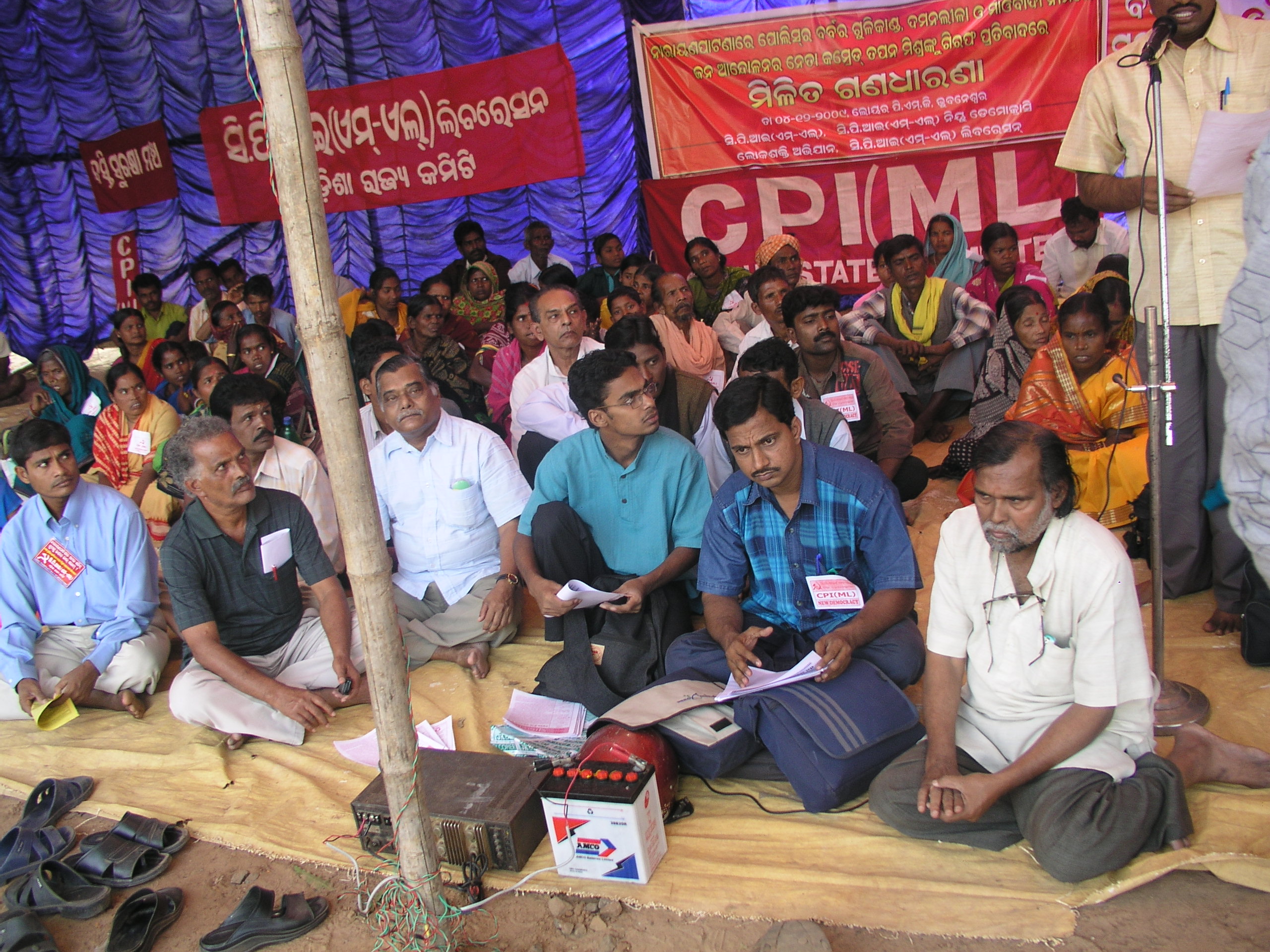
Call to stop an anti-Maoist witch hunt in Orissa

Satyabrata

On the 3rd of December, 2009 there was a general closure of all shops and offices in Athamalik to protest against the arrest of Tapan Mishra. On the 4th of December, a public meeting was organized in Lower PMG Square, Bhubaneshwar by several left groups like CPI(ML)(Liberation), CPI(ML)New Democracy, CPI M-L, Gandhians of Lok Shakti Abijan, Lohia-socialists of Samajbadi Jan Parishad and liberals of Athamalic Sachetan Nagarik Mancha. Human rights activists like Biswapriya and other progressive individuals together with the above groups comprised about 200 protesters. Among the speakers were Com. Jayadev, Com. Sivaram, Com. Bhala Chandra, Prafulla Samantara and Lingaraj. Beginning from the communists and Gandhians to Lohia-socialists and liberals, all of them united in their struggle against the ongoing McCarthyist repression in Orissa in the name of hunting down the Maoists. People who had come from different regions of Orissa reported similar arrests of tribal and dalit leaders in their areas. The protesters unanimously raised their voices against the crushing down of democratic movements in general and that at Narayanpatna. The apathy of the media towards the democratic movements was also discussed.

With already five days past the arrest of Tapan Mishra and with no response from the government after protests against his arrest, a four member delegation, consisting of Saraju Singh Samanta, Pratap Nayak, Mahendra Parida and Pramila Behera submitted a memorandum to the Governor of Orissa which included an unconditional release of Tapan Mishra among other demands.

With the government having turned a deaf ear towards the voices of dissent and using its fully armed machinery to crush them down, it is only creating a passion for destruction, of its own destruction, in the sphere of radical democratic politics and as Bakunin would say, “the passion for destruction is a creative passion too.”

Bubbles, risk, crunch and war

This 2008 interview with Prof Cyrus Bina is published here for educational purposes only.

Click here to download the interview

Young, educated and jobless in India

Craig Jeffrey

There is mass unemployment among India’s graduates. What can be done for them?

In 2005 I spent time with a student named Rajesh in Meerut College, in Uttar Pradesh. Rajesh was in his early 30s and had been studying in Meerut for 13 years. Like many long-time students there, he described himself as “unemployed”, someone “just waiting”.

There are many like Rajesh in Meerut and across northern India. Behind the image of tech-savvy IT specialists in India lies a dispiriting picture common throughout Asia, Africa and Latin America: a multitude of educated but unemployed young men.

The sources of this problem are not difficult to identify: rising education rates have led to higher aspirations around the world. At the same time, governments have often cut the public sector jobs upon which educated people formerly depended. The result in numerous places has been the “overproduction” of educated people: the “men hanging out on the street” that seem to feature in so many travel accounts and contemporary anthropologies of poorer countries.

Over the past 15 years I have been doing research funded by the Economic and Social Research Council on the problem of educated unemployment in Uttar Pradesh, whose 190m people make it India’s most populous state. Many parents in Uttar Pradesh are able to finance school and university education for their children. But these graduates find it impossible to obtain salaried jobs.

The sheer scale of the problem of youth unemployment is staggering. There are regularly more than 10,000 applicants for a single government post in Meerut. Students there tell me that to get a job it is now necessary to possess “source” (social connections) and “force” (the money for bribes).

Students’ anger is compounded by their fury at educational decay. Lack of investment in higher education and widespread corruption in many universities has undermined the value of students’ degrees. Things came to a head in 2006 when it emerged that, as an economy measure, the registrar of a prominent university in Meerut had been sending masters theses to be marked by school pupils, some allegedly as young as eight. When students discovered what had happened, they came into the streets to burn their degrees.

Some young people in Meerut give up on the search for salaried work and return to farming or manual labour. There are MAs, even PhDs, working in the fields of Uttar Pradesh. But like Rajesh, many students respond to unemployment by simply remaining in education, collecting degrees, and hoping that their luck will change.

What are the social and political implications of this mass unemployment? At the family level, the impact is marked. Those unsuccessful in finding decent, permanent jobs often face parents who resent scrimping and saving for their sons’ education. Parents often complain about the sacrifices they made to educate their children. Moreover, young women sometimes work in the field to keep their brothers in college – and this has led to many tensions between siblings.

What of political unrest? Commentators in the past have tended to imagine these men as either politically apathetic or violent threats to civilised society. My research – which involved years of interviewing and hanging out with young men – has tried to move beyond these stereotypes. To be sure, some unemployed young men have been involved in violence, such as the Hindu/Muslim riots and pogroms that erupted in India in the early 1990s. But the reality may be more mundane. Jobless young men have adopted one of two strategies in contemporary Uttar Pradesh. Some use their free time and skills to advocate on behalf of the poor. There are many such “social reformers” in Meerut, who often voice critiques of the Indian state, but tend to avoid violence.

A second group work as political entrepreneurs at the local level: they call themselves “fixers”. These men traded on their knowledge of how politics works at the local level, to sell places in private universities, extract bribes from government officials, or steer contracts towards favoured businessmen. These men do use violence and their actions encourage the further proliferation of corruption in Uttar Pradesh.

Mass unemployment among the educated in India may have contradictory implications. On the one hand, it may lead to the emergence of a set of people who can play key development roles in the countryside and small towns. These bright young “social reformers” are keen to find outlets for their zeal. On the other hand, there are many young men whose joblessness has provoked aggressive individualism and an “anyhow” mentality when it comes to making money. The Indian government and international organisations need to get much better at enrolling the first group into processes of planned development, and persuading the second group to redirect their energy in more positive directions.

The time is also ripe for a broader discussion of mass unemployment among educated young people across the world. What do they have in common? How do their responses differ? How might governments and others address the problem? The answers to these questions are likely to reveal a great deal not only about youth the world over, but about the chance of progressive social change in places like India.

Courtesy: Guardian

The High Court orders meaningful public hearings

Rahul Choudhary

Whenever any project is envisaged and approved, the local affected persons’ consent is the least concern for the authorities. The formal process of public participation in the decision making process comes only at the time of public hearing as provided in the Environment Impact Assessment (EIA) Notification 2006. As per the notification, thirty days notice should be given prior to the public hearing, so that the local affected person and others can submit their comments and objections. Thereafter the Expert Appraisal Committee of the Ministry of Environment and Forest has to do the detailed scrutiny of the project including the proceedings of public hearing and the objections raised at the time of public hearing. However the Notification does not empower the affected persons to say no to project. At best they can raise objection. And the Expert Appraisal Committee in most of the cases just see whether public hearing was held or not and not into the objections of the public during the hearing.

M/s Pandurang Timblo Industries, Margao, Goa is the lessee of Borga Dongrachem Fall Mine and Sociedade Timblo Irmaos Ltd. is lessee of Oiteiro Borga Do Bairro Queri Mine. Both mines were in operation till 1994. When there was again an increase in demand of iron ore from countries like China, South Korea and Japan, the owners in 2006 proposed for restarting the mines. There was a total opposition to the project at the time of public hearing. There was not a single participant who was in support of the project. The detail of the project, and the Executive Summary was made available to the gram panchayat and local affected person only nine days prior to the Public hearing. In the proceedings of public hearing it was clearly recorded that “not a single application nor a single member of the public was in favour of restarting of mine due to grave environmental and social damage”. The opposition of the restarting of mine was on the grounds of damages to agricultural fields and depleting ground water level that the mining will result into.

Without considering the objections and opposition of the affected persons in the public hearing, the Expert Appraisal Committee granted Environmental Clearance to the project on July 26, 2007. The local affected person challenged the order of the Ministry of Environment and Forest before the National Environment Appellate Authority (Utkarsh Mandal Vs. Ministry of Environment & Forest, Appeal No. 12 of 2007). As expected, the NEAA dismissed the appeal against the order of the Ministry of Environment and Forest. The NEAA categorically noted that the Executive Summary of the project was made available only 9 days prior to the Public Hearing, but then it argued that the EIA notification does not specify any time period for giving Executive Summary to the affected people. The NEAA also gave the finding that the Expert Appraisal Committee (EAC) has not considered the opposition at the public hearing, but concluded that this will not vitiate the environmental clearance granted to the project.

The order of the NEAA was challenged by the local affected persons before the Delhi High Court. The Delhi High Court headed by Chief Justice and Justice S. Muralidhar allowed the petition (Writ Petition (Civil) No. 9340 of 2009, Delhi High Court) and also questioned the functioning of the Expert Appraisal Committee. During the course of hearing, it was also brought to the notice of the Court that the EAC (Mines) was chaired by a person who happened to be the director of four mining companies and as many as 410 mining approval has been granted in the first six months of 2009. In this context, the court concluded that appointing a person who has a direct interest in the promotion of the mining industry as Chairperson of the EAC (Mines) is an unhealthy practice that will rob the EAC of its credibility since there is an obvious and direct conflict of interest. The High Court by order dated November 26, 2009 gave findings on issues related to public hearing and functioning of EAC. This order of the High Court interpreted the provisions of public hearing provided in the EIA Notification 2006. The High Court gave the finding that the purport of the clause (2.4 and 3 of Appendix IV of EIA Notification 2006) of the notification is to “make the public hearing a meaningful one with participation of all interested persons who may have a point of view to state. The above clauses operationalise the de-centralised decision making in a democratic set up where the views of those who are likely to be affected by decision are given a say and an opportunity to voice their concerns. This procedure is intended to render the decision fair and participative and not thrust from above on a people who may be unaware of the implications of the decision… If their participation has to be meaningful, informed and meaningful, then they must have full information of the pros and cons of the proposed project and the impact it is likely to have on the environment in the area.” The High Court concluded that the Executive Summary should be made available 30 days in advance.

On the requirement of the EAC to give reason, the Court held that “in context of EIA Notification dated 14th September 2006 and the mandatory requirement of holding public hearings to invite objections it is the duty of the EAC, to whom the task of evaluating such objections has been delegated, to indicate in its decision the fact that such objections, and the response thereto of the project proponent, were considered and the reasons why any or all of such objections were accepted or negatived. The failure to give such reasons would render the decision vulnerable to attack on the ground of being vitiated due to non-application of mind to relevant materials and therefore arbitrary.”

This judgment delivered by the Delhi High Court, for the first time, discusses the issues of public hearing, the functioning of EAC and the manner in which the environmental clearances are being granted by the Ministry of Environment and Forest. The Ministry has virtually become a clearing house, accepting almost every project that it receives. Anyone who fulfills the required paper work will get the approval, irrespective of the socio-economic and environment impact.

Narayanpatna: The Arrest of Tapan Mishra

Satyabrata

On the 29th of November, 2009, Tapan Mishra, a democratic political activist who was about to board his train to Narayanpatna from Parvatipuram railway station was arrested by police in civilian uniform. Throughout his life of 42 years Tapan Mishra has been linked to several left groups and has been part of popular dissent movements. He was once a member of AIDSO (All India Democratic Students Organisation), the student wing of the SUCI and the President of the Ravenshaw College Students’ Union. Later he joined the CPI(ML)(Liberation) and was an active participant in the then agrarian struggles and struggles of forest dwellers. Tapan Mishra was the councilor of Athamalic NAC and also contested the last Assembly elections from Athamalic: the later two facts show that he had no strategic ideological compatibility with the CPI(Maoist).

Before leaving for Parvatipuram, he met several press people in Bhubaneshwar and had assured them that he would provide reliable information on what was going on in Narayanpatna. It is also worth noting that Tapan Mishra was a potential leader of the Chasi Mulia Adivasi Sangh of Narayanpatna having experience in agrarian and forest dwellers movements. He is also a sympathizer of the Narayanpatna movement and is closely associated with its leadership.

Today, most of the leadership of the Narayanpatna movement is under arrest or is underground. This has been due to the brutal repressive measures that the state government has taken in the region using the police. Nachika Linga, leader of the CMAS, is underground. The police have destroyed his house. Two leaders have earlier been killed in police firing. Anyone like Tapan Mishra who knows the significance of the Narayanpatna movement would be a spontaneous positive contribution to the movement: this, probably, the State knew better than anyone. Tapan has been projected by the police as a ‘hardcore Maoist’ who is in charge of training cadres in military offensive. His arrest has already been linked to the police’s finding of ammunition elsewhere. The police in Narayanpatna are part of the larger nexus of landlords and liquor mafia – it is evident from the way the truth has been distorted by them in general and in Tapan’s case in particular. But what about the government of Orissa (or to be more appropriate the whole bourgeois Assembly as there has been no voice from the opposition also)? The government of Orissa is part of a larger nexus the scope of whose explication is beyond the limitations of this report. Suffice to say that the rulers of Orissa are one of the most authoritarian anti-people lot that gives no space to democratic voice which it apprehends shall, in the long run, bring an end to the brutalities of its nexus. This is precisely the reason why Tapan is being silenced.

Video: Nov 13 Meeting in Delhi University

A public meeting organised by Campaign Against War on People in Delhi University on November 13 2009 to protest against the Indian State’s war on tribals of Central India.

Part I

Part II

America the hungry

Patrick Martin

A front-page report in Sunday’s New York Times, detailing the skyrocketing rise in food stamp use, provides a far different picture of America at the end of 2009 than the complacent assurances of economic “recovery” voiced by Wall Street and the Obama administration.

The Times conducted a statistical analysis of food stamp use by county, in an effort to present a more detailed social portrait of the 36 million people currently on the food stamp rolls. “They include single mothers and married couples, the newly jobless and the chronically poor, longtime recipients of welfare checks and workers whose reduced hours or slender wages leave pantries bare,” the report noted.

Among the significant findings:

  • In 239 counties, more than a quarter of the population receives food stamps.
  • In more than 750 counties, at least one in three African-Americans receives food stamps.
  • In more than 800 counties, more than one-third of all children depend on food stamps.
  • In 62 counties, food stamp rolls have doubled over the past two years.
  • In 205 counties, food stamp rolls are up by two-thirds.

The geographical dispersal of the mounting social need for food is staggering, from traditional centers of poverty such as rural Appalachia and inner-city urban ghettos to the suburbs built up in the Sunbelt in the last two decades. The map showing the counties where food stamp usage is growing most rapidly includes the affluent Atlanta suburbs, most of the state of Florida, most of Wisconsin, western and northern Ohio, and most of the Mountain West, including large swathes of Nevada, Utah, Arizona, Wyoming, Colorado and Idaho.

While unemployment is the main trigger of rising food stamp usage, the immediate economic cause varies widely, from the collapse of the housing bubble in the southwestern states and Florida, to the collapse of the auto industry in the Great Lakes region, to the layoffs sweeping through white collar America as the recession worsens.

The Times notes the impact on affluent suburban areas, long dominated by the Republican Party, where food stamp usage has more than doubled since the official start of the slump in December 2007, such as Orange County, California and Forsyth County, Georgia. Food stamp use has grown more slowly, in percentage terms, in cities like Detroit, St. Louis and New Orleans, but only because so much of their populations were already living in poverty and receiving food assistance when the slump began.

All these figures significantly understate the level of social deprivation. An estimated 18 million people who are eligible for food stamps do not receive them, partly because of institutional barriers like inadequate outreach services, particularly to immigrant communities—the state of California reaches only half of those eligible—and partly because of the social stigma attached to receiving “welfare,” especially in suburban areas where impoverishment has been a sudden and recent event.

According to a study by Thomas A. Hirschl of Cornell University and Mark R. Rank of Washington University in St. Louis, half the children in America will depend on food stamps at some point during their childhood. The figure rises to 90 percent for black children. The study was published this month in the Archives of Pediatrics and Adolescent Medicine.

Since it is based on analyzing 29 years of data, the latter study gives a picture of the levels of social need during a period when unemployment averaged well below the 10.2 percent mark hit last month. A protracted period of double-digit unemployment—now widely predicted by business and government economists—will make more and more children dependent on federal aid to meet their basic nutritional needs.

The findings of both these studies confirm the conclusions of a US Department of Agriculture survey released November 16 that found 49 million Americans, including 17 million children, were not consistently getting enough food to eat in 2008. The vast majority of the 17 million families struggling to put food on the table had at least one employed worker in the household, but with wages too low to ensure basic necessities. The level of food insecurity was the highest since the USDA began keeping records in 1995.

These figures demonstrate that for American working people, the social reality today is the worst since the Great Depression. Some 30 million people are unemployed or underemployed. Nearly 50 million lack health insurance. Nearly 50 million have difficulty feeding themselves and their children. Some 40 million live below the official poverty line, and the figure would rise to 80 million if a realistic family budget were used as the yardstick.

Young people face the greatest challenge. According to a Pew Research Center report issued last week, 10 percent of adults under 35 have moved back with their parents due to the recession. More than half of men 18 to 24 were still living with their parents, and 48 percent of young women. The proportion of young people with jobs—46 percent—is the lowest since records began in 1948.

These figures are an indictment of American capitalism and its criminal sabotage of the productive forces of society. How is it possible that in a country whose agriculture is so productive that it can literally feed the world, tens of millions of people struggle to feed their children and themselves? It is because production and distribution take place on the basis of private profit, and feeding hungry children is far less profitable for the ruling elite than speculation in the financial markets.

These figures are also an indictment of the political representatives of big business in the Obama administration and the Democratic and Republican parties. Apparently hunger, like unemployment, is viewed by Obama merely as a “lagging indicator”—something that the American people simple have to endure, but not a crisis, not even a cause to lift a finger.

Having funneled trillions into the financial system, to ensure a return to profitability and seven-figure bonuses on Wall Street, and set his course for military escalation in Afghanistan at the cost of countless billions, Obama is now declaring that his top domestic priority is deficit reduction. After Wall Street and war, there will be little or nothing left over to meet the needs of hungry children—or their parents.

Courtesy: World Socialist Web Site

Singhitarai Project: NEAA creates history

Rahul Choudhary

When the National Environment Appellate Authority (NEAA) has dismissed all the cases (except one in the Polavaram dam case in 2007) filed before it in past 13 years, one cannot expect anything when you approach it but another dismissal. The NEAA is the sole statutory body to challenge the environmental clearances granted to the projects like mining, thermal power plant, hydroelectric projects etc. The authority is composed of a retired Chief Justice of a High Court or a retired judge of the Supreme Court as the chairperson, one vice chairperson and three technical members. Interestingly for last eight years, there is no chairperson in the Authority and no vice chairperson for last six years, and the so-called technical members are all retired bureaucrats. Now there is only one member in the Authority who is deciding the Appeals against the grant of environmental clearances.

The Ministry of Environment and Forest (MoEF) granted environmental clearance on August 17 2009 to the 1200MW Thermal Power Plant near village Singhitarai, District Janjgir-Champa, Chhattisgarh by M/s Athena Chhattisgarh Power Pvt. Ltd. The project was approved by the MoEF even after the process of public hearing was incomplete. At the time of public hearing, the presiding officer came to declare that the hearing is cancelled. Interesting part is that the Presiding officer said that the project proponent has not informed the public about the project in proper manner, and hence the public hearing is cancelled. But when minutes was prepared, it was recorded that the public hearing is cancelled due to the law and order problem because 400-500 people entered the public hearing place and started shouting slogan for cancelling the public hearing. As per the Environment Impact Assessment Notification, the expert committee recommending environment clearance has to do detailed scrutiny of outcome of public hearing. But in this case the Athena Power Ltd. manipulated the public hearing proceedings and must have influenced the expert committee as the owner of company is late Y.S. Rajasekhara Reddy’s family.

The granting of environmental clearance was challenged by Villagers of Singhitarai before the NEAA. The main issue of challenge was incomplete process of public hearing. Now the NEAA has only one member and is hearing all the cases. Taking the precedent of the NEAA, when case came up for hearing there was no expectation of relief even after such a blatant violation of the EIA Notification. After watching video recording of the public hearing, the member of the NEAA was convinced that the minutes of the public hearing is different from what has happened during the public hearing and the process of public hearing was incomplete.

In a surprise move, first time in the history of the NEAA, the member stayed the Thermal Power project. This sudden spur of prudence has left many bewildered and guessing, but this stay of the project on the reason of incomplete public participation process will have impact on conducting future public hearings. In the whole process of Environmental Clearances, the Public Hearing is the only stage where the affected person can participate in the decision making process.

Farmers’ organisations under attack in Punjab

NK Jeet,
President, Lok Morcha Punjab

The peasants’ organizations in Punjab have been in the forefront in the struggle against the anti-people new economic policies of globalization, liberalization and privatization. They have fought for remunerative prices for agricultural produce, its procurement by state agencies, writing off farm loans, and against arrests of farmers due to non-payment of farm loans advanced by Cooperative Societies, attachments and sales of their lands at the instances of Commission Agents and money lenders etc. They have also led glorious struggles against setting up of Special Economic Zones (SEZs) in the state, forcible acquisition of agricultural land for setting up giant industrial complexes, power projects, multi-lane roads etc. and against unbundling and ultimate privatization of the Punjab State Electricity Board (PSEB). Faced with stiff resistance from the farmers’ organization, the Punjab Government was forced to abandon or curtail many projects. Irritated at this, the Akali-BJP Government in Punjab launched a massive offensive against the organizations of the farmers. A large number of leaders and activists of these organizations were implicated in false criminal cases. On September 8 2009, when Bharatiya Kisan Union Ekta (Ugrahan) held a massive demonstration at Chandigarh to oppose unbundling of the State Electricity Board, 4 FIRs were registered against all of its State Office-bearers. The leaders of Punjab Khet Mazdoor Union and Lok Morcha Punjab were also implicated in these cases. Hundreds of farmers were injured in the brutal lathicharge by the police. Their vehicles were badly damaged. As a result of the police brutalities, four persons lost their lives. The sacrifices of these farmers did not go in vain. Akali-BJP Govt was forced to postpone the unbundling/ corporatisation of the PSEB, till mid-December.

Now as the day of reckoning is reaching near, and the farmers’ organizations have started mobilizing the people against the privatization of the PSEB, the Akali-BJP Govt has launched another attack. On November 17 2009, President of BKU (Krantikari), Sh Surjit Singh Phul was arrested from the court premises when he had gone there to attend a hearing. The police would have kept him in illegal confinement and subjected to torture, but the democratic-minded advocates and farmer activists approached the Sub Divisional Judicial Magistrate (SDJM) and apprised him of the illegal act of the police. The SDJM immediately called the SHO of the concerned police station. Fearing exposure, the police registered a case under Section 10, 13 of the Unlawful Activities (Prevention) Act against Mr. Surjit Singh, branded him a member of the CPI (Maoist), planning to illegally overthrow the Government through armed struggle. He was immediately arrested in this case. Next day the police obtained his custody for 8 days by producing him before the Magistrate at his residence after court hours, and he was immediately sent to the infamous Joint Investigation Centre, Amritsar, which is Punjab’s Guantanamo.

On November 26 2009, Mr. Surjit Singh was to be produced before the SDJM Phul for further remand. The police with a view to hoodwink his lawyers, made elaborate security arrangements at Phul Courts. Riot-police commandoes in full battle gear were deployed not only in and around the court-premises, but also on all entrances of the town, and at important road-junctions leading to this town throughout the district. But it was merely a drama. In fact the police filed an application before the District and Sessions Judge Bathinda, expressing false and baseless apprehensions that people at Phul might take away Mr. Surjit Singh forcibly from the police, and obtained permission to produce him before the CJM at Bathinda. The real intention was to deprive Mr. Surjit Singh of any legal aid and exposure of the third degree methods adopted by the police. The police succeeded in obtaining his remand in its custody for another 8 days till December 3 2009.

As soon as this information reached his lawyers, who were camping at Phul Town, they immediately moved the court to obtain permission to meet Surjit Singh in police custody and for his interrogation only in the presence of his lawyers. The court allowed the lawyers to meet him on November 26 and 27, and informed the police about this order. But the police did not care about the Court’s order and sent him to Joint Interrogation Centre, Amritsar again without informing the Court. When the lawyers tried to contact the Investigating Officer to fix the venue of the meeting, he switched off his mobile phone.

On November 27, the lawyers filed another application before the CJM Bathinda, seeking initiation of contempt of court proceedings against the police officials, and fixing new time and date for meeting with Surjit Singh. Acting on this application, the court granted permission to the lawyers, to meet Mr Surjit Singh during his detention at Joint Interrogation Centre Amritsar, everyday from 5 to 6 PM from November 30 onwards.

Although the game-plan of the police has been foiled for the present, but its attack can be repulsed only by mobilizing masses against these anti-people, undemocratic, and repressive measures.