Narayanpatna: Attack on an all-women fact-finding team

From the Press Conference: Update at 9 December, 2009, 2.45 p.m.

The 9 women fact-finding team just concluded a press conference at Parvathipuram, Vijayanagaram District, Andhra Pradesh.  Here’s the narrative of the day’s happenings as told by Shweta Narayan and Madhumita Dutta to Nityanand Jayaraman over phone:

At 10 a.m., the All India Women’s Fact Finding Team consisting of 9 women reached Narayanpatna Police Station and requested to meet the Station In-charge.

1. Sudha Bhardwaj, Advocate, Chhattisgarh
2. Mamata Dash, Delhi
3. Madhumita Dutta, Chennai
4. Shweta Narayan, Chennai
5. Rumita Kundu, Bhubaneswar
6. Pramila, Bhubaneswar
7. Kusum Karnik, Bhubaneswar
8. Ramani, New Democracy, Orissa
9. Durga, Chhattisgarh

We were told that the policeman was busy and were asked to come in the evening.  The person questioning us asked us for names and mobile phone numbers and names of organisations.  We gave all of that.  We noticed quite a number of uniformed policemen and many people in plainclothes.  None of the people in uniform (we assume they were policemen) had any name tags.  We asked one of them who the people in plainclothes were and were told that they were all policemen.  We asked the man how many police were there in this area, and he said more than 2000 police.  One striking thing is that none of the many people gathered there were adivasi.

About 20 adivasi men were huddled, squatting inside the police station premises.  We asked the policeman near us who they were and were told that the adivasis were former activists of the Chasi Mulia Adivasi Sangh, who had come to surrender.  This has been happening for a few days now, and many newspapers are reporting this.

By this time, the crowd of so-called plainclothes police were getting restless.  We heard people commenting, saying: "Ab aa rahen hain.  Jab hamarey gaon jal rahe the, tho kahaan the?" (When our farms were being burnt, where were you?  Now they show up).

Madhumita felt the situation was looking troublesome and suggested we leave.  As we were stepping out of the police station, our driver was cordoned off and was being questioned in a very hostile manner and being threatened.  We heard someone saying that he is a regular to these parts and they enquired as to his antecedents.

We somehow managed to extricate the driver.  One of the policemen in plainclothes, whom we saw inside the police station premises, was taking photographs, and he said "Maaro Inko." (Beat these people up).  That is when more than 200 people surged ahead.  The driver was being slapped repeatedly.  Madhu and 75-year old Kusum Karnik tried to intervene and that is when one man went for Madhu’s throat.  Kusum was hurt too.

Rumita Kundu was verbally abused inside the police station.  One man crudely said that all these women had come to sleep with the men there.  Mamta Dash was hit on her back and abused.  One man attempted to strangle Madhu.  When she moved to save herself, her jaw was injured.  All this happened inside the police station premises.

The driver was the one that was being assaulted most, and we did all we could to extricate him and board our vehicle.  By this time, the vehicle was being broken.  The rear windscreen was broken.  With great difficulty, we fled the area driving towards Bandhugaon.  We were followed by the plainclothesmen who claimed to be police on bikes.  Somewhere between Bandhugaon Police Station and the village itself, we were stopped by two men in plainclothes.  They said they were police, and they demanded to see the driver’s license.  As he was enquiring, about 20 people gathered there.  But nothing untoward happened here.  We were scared nevertheless.

From there, we proceeded to Kottulpetta.  Even before we got to this village, news seemed to have reached them about our visit.  A road blockade had been organised, with a bullock cart blocking the road.  There were no oxen.  The people there, again all non-tribals, pulled out the driver and started assaulting him.  They tried to pull down another male colleague of ours, Mr. Poru Chandra Sahu, and tried to beat them up.  We intervened, and that’s when Kusum didi, the 75-year old activist, was hurt on her head.  We were there for more than 15 minutes.  More violence.  More damage to the vehicle.  More slaps for the driver.  Our friends outside had been notified almost as soon as problems began, and phone calls must have been pouring into the Collector and SP’s office.

By this time, two bikes carrying one of the plainclothes "policemen" who had taken our names in Narayanpatna, and another plainclothes guy who was tall and burly, reached there and asked the youth to disperse.

We reached Bondapalli, the border village within Andhra Pradesh.  Almost in no time, a jeep load of Andhra Pradesh police along with plainclothes youth (young boys) armed with rifles and bullets arrived on the scene.  They demanded to know who we were.  We were treated more like criminals than victims, and our vehicle was searched.  Only after Madhu spoke to the SP of Vijayanagar and the DGP were we allowed to go.  The police who stopped us immediately changed the tune and offered to help us with medical assistance etc.

Our experience with armed youth and police has left us clearly terrified and convinced that the situation created by the police in Narayanpatna and this part of Orissa is extremely vitiated.  We have the following concerns and demands which we conveyed to the media at a press conference in Parvathipuram, Vijayanagarm District, Andhra Pradesh.

Concerns:

  1. The scenario of terror that we witnessed and were subject to shows the kind of tense situation prevailing in the Narayanpatna area post November 20, 2009’s police firings in Narayanpatna.
  2. There is no access for people to get in and out of the villages in Narayanpatna, with all routes blocked by armed goons.
  3. There is no way to get information about what is happening inside, and no means of verifying the very disturbing accounts we are getting about abuses, molestations and violence against adivasi people.
  4. The number of plainclothesmen who claimed they were police, and the comfort with which people outside the Narayanpatna police station were interacting with the police, and reacting to one policeman’s instruction to beat us up, suggests that there may be some truth to reports that there is a Salwa Judum style Shanthi Samiti in this area as well.  This may either be sponsored or working in close complicity with the police and state.
  5. If the Fact Finding team of prominent women has been treated with such violence, it is clear that there is absolutely no room for dissent inside the villages.
  6. All the people who attacked us were non-tribals.

Demands:

  1. The officers at the Police Station should be suspended to create an impartial situation and enable the carrying out of investigations into the firing of 20 November, 2009, and the subsequent reports of atrocities against tribal people.
  2. The SP Koraput should be suspended.
  3. The Government should constitute a high-level independent investigation team and not depend on the police, who are clearly biased, and are using the language of terror and violence to suppress dissent.

Please show your protest by calling the DM and SP of the district:

DM — Gadadhar Parida  0 94381 8184649

SP — Deepak Kumar Chauhan  0 94379 62200

For more information, contact:
Adv. Sudha Bharadwaj: 09926603877
Madhumita Dutta: 9444390240
Mamta Dash: 09868259836

This All India Women’s Fact-Finding Team was in Narayanpatna to enquire into the Police Firing that took place on 20 November, 2009.
Under the Pretext of Fighting the Maoists: Kavita Krishnan

Central Committee Member of CPI-ML (Liberation), Kavita Krishnan on how the state and corporations are suppressing not only the ‘maoist’ struggle but movements of any kind that are challenging neoliberalism.

State Terrorism in Manipur: Malem Ningthouja

Malem Ningthouja from the Campaign for Peace and Democracy (Manipur) talks about the brutality of state repression that the Manipuri people have been suffering.

“Almost non-violence”

“If a man fights with his sword single-handed against a horde of dacoits armed to the teeth, I should say he is fighting almost non-violently. Haven’t I said to our women that, if in defence of their honour they used their nails and teeth and even a dagger, I should regard their conduct nonviolent? She does know the distinction between himsa and ahimsa. She acts spontaneously.

“Supposing a mouse in fighting a cat tried to resist the cat with his sharp teeth, would you call that mouse violent? In the same way, for the Poles to stand valiantly against the German hordes vastly superior in numbers, military equipment and strength, was almost non-violence. I should not mind repeating that statement over and over again. You must give its full value to the word ‘almost’.”

Mahatma Gandhi, “Discussion with B.G. Kher and others” (August 15, 1940), Collected Works, Vol 79, p. 122.

Why does India Inc want changes in labour laws?

India Inc is still worried about labour laws in the country. Even OECD recommends a rationalisation of these laws if a 9% growth rate is to be attained. Such views usually make people think that there is some kind of favouritism going on towards labour. They are unable to understand that labour laws that exist today were also according to the needs of India Inc, but these needs themselves are dynamic, they change with the changes in the regime of accumulation – the way the capitalists accumulate and profit. Thus they often demand laws to be rationalised according to their dynamic needs.

Let’s see how they fare under the existing labour law administration.

India’s Minister of State for Labour and Employment, Harish Rawat informed on December 7, 2009 in a written reply in the parliament that in the year 2007-08, 39115 inspections took place in the “central sphere” (which does not include action taken by the State Governments) under various labour laws on receipt of complaints regarding their violation. These inspections led to prosecution in 65 per cent of the inspected cases (i.e. 25801 cases in absolute figures). In comparison to the previous two years, this definitely shows an increased efficiency of the labour administration, as in 2005-06 it was just 38 per cent, while in 2006-07 it was 42 per cent.

However, the revelation comes when we try to find out how many cases were resolved in favour of the workers. While in 2005-06, in 92 per cent of prosecutions the employers were found to be guilty of violation of labour laws, the figure was drastically reduced to just 42 per cent in 2006-07, and in 2007-08 it further came down to 36 per cent. This statistics gives us more – in 2005-06, only in 35 per cent of inspected cases, convictions took place, in 2006-07 it was 17 per cent and in 2007-08 it was 23 per cent.

So, what does all this imply? The capitalists are already getting what they want. But the point is that they want more. In fact, they are being quite rational and honest when they want labour laws to be rationalised – after all these laws are obviously meaningless, when they can easily flout them and remain unconvicted.

Narayanpatna: Nachika Linga, the Most-Wanted

Satyabrata

On the 4th of December, 2009 an order was issued for the immediate arrest of Nachika Linga, leader of the Chasi Mulia Adivasi Sangha (CMAS). He is now in the “Most Wanted” list of the government of Orissa. Posters have been put up by the government throughout Koraput and other regions of southern Orissa displaying a photograph of Nachika Linga and the “crimes” he had committed written underneath. Cash awards have been announced for anyone who helps arrest him. There are about 46 cases in Nachika’s name which include murder, attempt to murder, dacoity etc. Section 302 (punishment for murder) of the Indian Penal Code among other sections has been lodged in his name.

On the 6th of December, the Superintendent of Police, Koraput publicly announced (which he has no legal authority over) that the CMAS should be banned. Here it is necessary to take a bird’s eye view of who Nachika Linga is and what the CMAS has been doing recently.

Nachika Linga is one of the many indigenous tribals who inhabit Narayanpatna. Lately he became the Nayak Sarpanch of his area. Nachika Linga joined the CMAS which was leading the movement for land redistribution. It is necessary here to mention that the movement was never illegal. Even the issues that it raised were broadly related to a proper implementation of the existing laws. To be specific, there is an act passed by the Orissa Legislative Assembly in 1952 (Act 2) which says that the non-tribals cannot keep the lands of tribals in that region, and the CMAS was simply trying to get this law implemented. The authorities of the region till recently were therefore in constant dialogue with the CMAS. In fact, a collector who facilitated this dialogue most sincerely too earned the name so many progressive people are earning now-a-days: Maoist. Due to this movement, the local tribals were able to acquire their lands and the process of collectivization of ownership of land too was started. There were social reform measures taken within the movement, like limiting the consumption of liquor by the tribals to festive occasions only.

Evidently, the landlords and liquor traders who were thriving on land-grabbing, commercialistion of local economy found their ‘businesses’ hampered. They were ‘forced’ to flee the region. In ‘fear’ they joined hands with dominant political forces, and found the police and their actions the only mechanisms to reenter Narayanpatna. Attempting to limit the movement territorially, and to create ‘a civilian’ support base for the state’s brutal measures to suppress the movement in Narayanpatna, they formed ‘salwa judum’ like groups in adjoining Laxmipur. As reported earlier, two leaders of CMAS were gunned down and today there is a warrant in the name of Nachika Linga.

The whole organization which was giving an organized and definite shape to the spontaneous resistance of the rural poor in the region stands accused of a conspiracy to wage war against the state. Does it not seem parallel to the draconian measures during the initial days of capitalism everywhere through which the states declared every association of workers and poor as conspiracies? What is happening in India today demonstrates that such measures are not simply historical, but rather constitutive of capitalism – capitalists and their states invoke them every time they find it opportune.

There are press reports that inform about the return of the landlords and traders in the region. How brutal the police force in the region has been and whom in the region it is nepotistic to is no secret. Several tribals in fear of arrest and at gun-point have reportedly ‘committed’ not to indulge in any ‘unlawful’ activities of the CMAS. The clean image of the government of Orissa is being projected by the media at a time when a fascist political economy is being nurtured with its very own hands. Under such conditions, as old Marx would have said, force alone can impregnate this old society with a new one. This force has to make its development and is making its development within and in spite of this authoritarian bourgeois rule in the form of territorially limited movements, which have already nurtured many Birsa Mundas who are daily confronting the brutalities of the state – and Nachika Linga is definitely among them. The final expression of this force shall be in bringing down the authority of this state but that is possible only by generalizing the spirit of struggle beyond localities.

Campaign Against War on People: Signature Campaign

To                                                                                
Dr. Manmohan Singh
Prime Minister,
Government of India,
South Block, Raisina Hill,
New Delhi,
India-110 011.

Sir,

For some time now, there has been a heated discussion in various public forums on the intentions of your government to deploy 100,000 troops – ostensibly against Maoist insurgents – in 7 states in central and eastern India, including Maharashtra, Chhattisgarh, Orissa, Jharkhand and Andhra Pradesh, a vast area inhabited by tribal groups. To this end, forces withdrawn from Jammu and Kashmir (e.g. Rashtriya Rifles) and the Northeast are joining battalions of CRPF commandos, the ITBP, the CoBRA and the BSF, equipped with bomb trucks, bomb blankets, bomb baskets, and sophisticated new weaponry. The IAF has also been called in to provide air support to these ground forces. The actual strength of the intended targets of this massive action – the Maoist cadre – is believed to be no more than 20,000. We, the undersigned, have no option but to believe therefore, that the scale of this military offensive is because the state is unable to distinguish the millions of tribals in this area from the Maoists, and has chosen the quick solution of war on the entire region. We believe that the eventual goal is to throw open the region to exploitation of its mineral resources by big corporate interests.

Central India is rich in mineral wealth that is already being auctioned: Till September 2009, Rs 6,69,388 crore of investment had been pledged toward industry in the troubled areas—14 per cent of the total pledged investments in the country. All that stands between vested interests and this wealth is the tribal people and their refusal to consent to their own exploitation. Even constituent bodies of Indian state machinery acknowledge the gross failure of state in the tribal areas of the country in no uncertain terms. Recently, The Planning Commission Report on Social Discontent and Extremism and The Approach Paper for the 11th Plan have clearly identified equity and justice issues relating to land, forced displacement and evictions, extreme poverty and social oppression, livelihood, malgovernance and police brutality as widespread in the region. They have also clearly identified ‘private interests’ and the state’s culpability in these processes. Again, the Fifth Schedule of the Constitution grants tribals complete rights over their traditional land and forests and prohibits private companies from mining on their land. Despite the above, and in the name of fighting the Maoists the state – in blatant violation of Constitutional rights and against the recommendations of its own committees – the govt is set to evacuate the entire area of the tribals and ghettoise them forcefully in ‘relief camps’, to allow free rein to big business. Instead of addressing the basic rights and needs of the tribals, the state/big business in the face of the stiff resistance from them, is leading a full-scale war on people who are already fighting an everyday battle for livelihood and survival.

This war on the people is in continuance with the Indian state’s repressive measures against all “inconvenient” citizens – as we have seen in the past with the North-eastern states and in Kashmir. As in those instances, this time too, the plan entails a further shrinking of already limited spaces for democratic dissent and articulation of pro people development paradigms. It opens the way for the state to act with force against any form of dissent or struggle, anywhere in the country. Any individual or organization protesting against the policies of the state can be labelled as a threat to ‘internal security’.

We, the undersigned, strongly deplore and condemn your government’s plans in this regard. We call for the immediate cancellation of the proposed military and/or paramilitary action, in the interests of the lakhs of destitute and deprived tribal populace who will be affected by this action. We also demand the immediate revocation and annulment of draconian instruments such as the Armed Forces Special Powers Act (AFSPA) in all parts of the Indian territory, especially in the Northeast and in Kashmir, as well as the Unlawful Activity (Prevention) Act and the Chhattisgarh Special Public Security Act. We demand that all MoUs signed towards corporate investments in these regions be made public and cancelled. We also demand that your government immediately initiate a broad-based, participatory, people-oriented discussion on economic and social development in these regions, founded on the rights of these populaces to their lands and the products thereof.

Number of Signatories so far:

133

Notes on ‘Class’

Richard Gunn,
Common Sense, No. 2, 1987

1. It is much easier to say what, according to Marxism, class is not than to say what class is. A class is not a group of individuals, specified by what they have in common (their income-level or life-style, their 'source of revenue' [1], their relation to the means of production, etc.). The proletariat, for example, is not to be defined as a group 'as against capital'. [2] Nor is a class a structurally and relationally specified ”place” in the social landscape (a place which individual may ”occupy” or in which, as individuals, they may be 'interpolated', [3] etc.). The difference between ”empiricist” and ”structuralist” Marxisms, which respectively treat classes as groups of individuals or as ”places”, is in this regard a trivial one. For want of a more convenient term I shall refer to the view which treats classes either as groups or as places as the 'sociological' conception of class.

2. Marxism regards class as, like capital itself (Marx 1965 p. 766), a social relation. That which is a relation cannot be a group even a relationally specified group; nor can it be a place (relationally specified place) in which a group may be constituted, or may stand. Setting aside such views, we can say that class is the relation itself (for example, the capital-labour relation) and, more specifically, a relation of struggle. The terms 'class' and 'class-relation' are interchangeable, and 'a' class is a class relation of some particular kind.

3. In other words: it is not that classes, as socially pre-given entities, enter into struggle. Rather class struggle is the fundamental premise of class. Better still: class struggle is class itself. (This is how Marx introduces 'class' in the opening sentence of The Communist Manifesto.) That 'class struggle' is intrinsic to 'class' is Marx's point when he stresses that existence 'for itself' – i.e. the oppositional, struggling existence – is intrinsic to the existence of class (Marx 1969 p. 173).

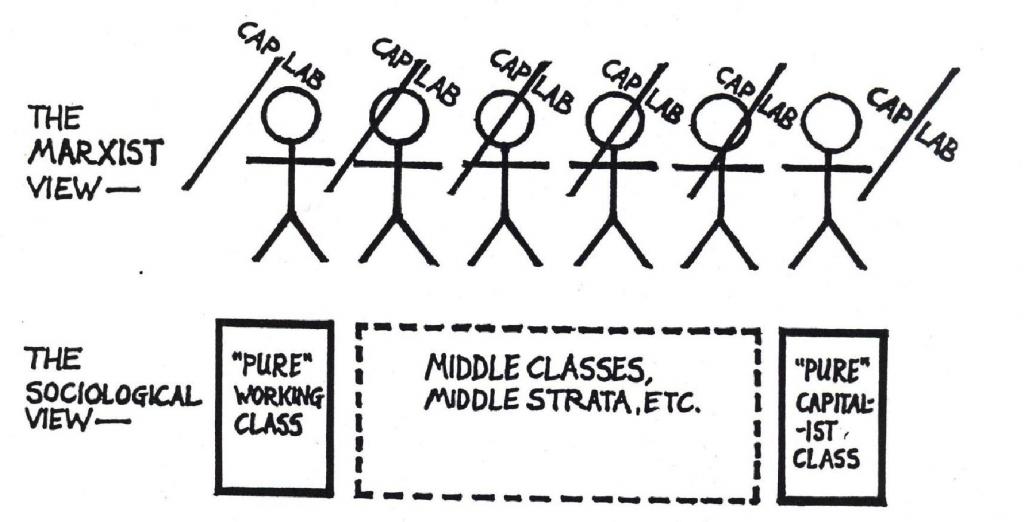
4. I shall refer to the conception of class as a relation (a relation of struggle) as the 'Marxist' conception of class: here, more than convenience dictates the terminological choice. Notoriously, the sociological conception of class faces the embarrasment that not all individuals in bourgeois society can be fitted, tidily, into the groups which it labels 'capitalists' and 'proletarians'. This embarrasment is produced by the conception of classes as groups or places, and to escape this embarrasment, sociological Marxism has recourse to categories like 'the middle classes', the 'middle strata', etc.: such categories are residual or catch-all groups and, in short, theoretical figments generated by an impoverished conceptual scheme. The Marxist conception class, on the contrary, faces no such difficulties: it regards the class-relation (say, the capital-labour relation) as structuring the lives of different individuals in different ways. The contrast in this regard between the Marxist and the sociological conceptions of class can be illustrated, very roughly, as follows:

Not least, this illustration is rough because the difference in the ways in which the capital-labour relation structures the lives of individuals in bourgeois society is as much qualitative as quantitative: a spatial diagram can only be ”undialectical”, abstracting not only from qualitative distinctions but also from the 'sheer unrest of life' (Hegel 1977 p. 27) – the unrest of struggle – which characterises a class-relation in any given case. (The model for such spatial diagrams is the Figurae of Joachim of Fiore, which become no longer necesary once the spiritual intelligence they summon has come into its own: cf. Reeves 1976 p. 13.)

5. What qualitative forms can the structuring of lives by the capital-labour (once again, a relation always of struggle) take? The form to which Marx especially attends is that of exploitation/expropriation. Other forms include inclusion/exclusion (Foucault), appropriation/expenditure and homogeneity/heterogeneity (Bataille) and incorporation/refusal (Marcuse, Tronti):[4] the list is phenomenologically rich, and open-ended.

6. One difference between the Marxist and the sociological views, as illustrated above, is that on the Marxist view the 'pure' worker (situated on the extreme left-hand side), whose social being is (unlike all the ”intermediate” figures) in no way divided in and against him or herself, is in no way methdolologically privileged. Neither is the 'pure' capitalist. Both, rather, are merely limiting cases and, as such, they are seen only as figures comingled with other in a diversely-structured crowd. The sociological view, on the other hand, treats the 'pure' worker and the 'pure' capitalist as methodological pillars between which the web of intermediate classes is slung.

7. The difference is important because, acoording to Marx, the 'pure' worker does not exist. This is not at all because of a relative decline in the numbers of the ”traditional working class” (however this theoretically suspect group be defined). On the contrary, it is because the wage relation itself is a bourgeois and mystifying form (Marx 1965 Part VI): whoever lives under its sign – even, and especially, the fully-employed producer of surplus-value -lives a life divided in and against itself. His or her feet remain mired in exploitation even while his or head (which is tempted to construe this exploitation in terms of ”low wages”, i.e., in terms which are mystified) breathes in bourgeois ideological clouds. [5] Accordingly, the line of class-struggle runs through the individual by whom surplus-value is produced (as with, say, the figure standing second-to-the-left in the diagram in para. 4, above). Here, again, there is no embarrasment for the Marxist conception of class which is interested in the specific ways in which the capital-labour relation structures, antagonistically, particular lives. But the non-existence of a proletariat in all its purity can only bring the sociological conception of class to the ground.

8. A further evident difference between the two schemes is that the Marxist one speaks of a single class-relation (namely, the capital-labour relation) as obtaining in existing society whereas the sociological scheme acknowledges as many such relations as there are possible link-ups between social places or groups. For this reason, the 'sociologists' accuse the 'Marxists' of reductionism. In fact, it is against the sociologists themselves that the charge of reductionism may properly be brought. The sociologists want to situate each individual, unequivocally and without remainder, in one or other of the specified groups or places: a ”cross categorial” individual cannot be allowed to appear in the picture which the sociologists draw. The point of the sociologists' proliferation of middle classes, middle strata, new petty bourgeoisies, etc., is to find some pigeon-hole to which each individual may be unequivocally assigned. Hence precisely the ways in which, in class terms, individuals are divided in and against themselves – the numerous and complex ways in which the geological fracture-line of class struggle lies through and not merely between individuals – enters theoretical eclipse. Hence sociologists' reductionism. The Marxist conception of class, by contrast, brings experiental richness of this (self-)contradictory life-texture into full theoretical and phenomenological light. The charge that Marxism reduces the lived experience of individual subjectivity to a play of impersonal and sheerly objective ”class forces” [6] is least of all applicable when 'class' is understood in its authentically Marxist sense.

9. A related point is that the Marxist conception, unlike that of the sociologists, does not construe class in terms of the bearing of this or that social role. From his early essay 'On the Jewish Question' onwards, Marx castigates, as alienated and unfree, any society wherein role-definitions (or a ”social division of labour”) obtain. Far from inscribing role-defintions as a methodological principle, the Marxian view of class depicts the individual as the site of a struggle – of his or her own struggle – which brings not only the ”universal” (role-bearing and socially homogenous) but also ”particular” (unique and socially heterogeneous) dimensions of individuality into play. Neither in theory nor in practice do role-definitions such as ”proletarian” or ”bourgeois” (or indeed ”man” or ”woman” or ”citizen”) represent Marx's solution; on the contrary they figure as one among the problems which 'class' in its Marxist designation is intended to resolve.

10. As between the Marxist and the sociological conceptions of class yet another area of difference is, of course, political. The sociological view advertises a politics of alliances between classes and class-fractions: moreover it ascribes to the 'pure' working class a privileged – a leading or hegemonic – political role. No question of such alliances arises on the Marxist view. Nor does the 'pure' working class (the employed as opposed to the unemployed, the direct producers of surplus-value as opposed to the ”indirect” producers, the proletariat as opposed to the lumpenproletariat, those whose labour does not) have a politically any more than a methodologically privileged place: for no such ”places” exist. Nor is there any question of ascribing to ”rising” as opposed to ”declining” classes a monopoly of revolutionary interest or force: such specifications only make sense when classes are seen as places or as groups. Finally, the whole notion of a vanguard party (plus its diluted variants) is overturned since the distinction between ”advanced” and ”backaward” class-elements disappears along with the sociological conception of class itself. In sum: what has traditionally passed as 'Marxist' politics is in fact sociological, and authentically Marxist politics amounts to politics in an anarchistic mode.

11. If classes are not groups or places but relations of struggle, then insofar as revolutionary conflict takes the form of a conflict between groups (but it always does this imperfectly and impurely) this has to be understood as the result of class struggle itself. It is not to be understood sociologically as, for example, an emergence of pregiven classes – at last! – into their no-less-pregiven theoretical and political 'truth'. The question before the individual is not on whose side, but rather on which side (which side of the class relation) he or she stands; and even this latter question is not to be understood as a choice between socially pre-existing places or roles. Not only quantitatively but also qualitatively, class struggle remains inherently unpredictable. The Marxian conception of class focuses sharply the issue of choice with which class struggle confronts us and in doing so it disallows appeal to any role or place or group in which (according to sociology) we already stand prior to whatever self-determining commitment we choose to make. It disallows this not least because it depicts us as torn by the force of the class struggle in which, in a class society, we are always-already consciously or unconsciously engaged.

12. Whoever wishes, can derive sociological wisdom from Marx's texts. Certainly, and especially in his political writings, Marx was not always a Marxist: for example the 'two great camps' conception of class espoused in the Communist Manifesto results from constructing the Marxist conception of class in an out-and-out sociological sense. Nonetheless, unless the Marxist conception of class were in fact Marx's the circumstance that Marx wrote Capital would be unintelligible. It was Marx himself who, long before his critics and revisionists, pointed out that as capitalism developed the numbers of the 'middle classes' could be expected to grow (Marx 1968 pp. 562, 573); and yet he writes a book, entitled Capital, in which a single class-relation (the capital-labour relation) is the theoretical 'object' addressed. This conundrum can be resolved only by taking his remark about the middle classes to be sociological, and by reading the main argument of Capital as Marxist in the above-specified sense.

13. The sociological conception of class, whenever it wishes to establish Marxist credentials, always becomes economic-determinist. This is so because the only ”indicator” of class-membership ('class', here, being seen as once again a place or group) which Marx's writings supply is that of a common relation to the means of production. Besides being related to the means of production, however, individuals are class-members (or who are class-interpolated) find themselves related to the state and to ”ideology” to say nothing about their local church or football team or pub. Hence, at once, the sociological conception of class generates a schema of discrete social 'levels' or 'practices' or 'instances' (Althusser) and must address the question of how these levels are related. The answer is well-known: in the last instance 'the economic movement…asserts itself as necessary'. [7] In the last instance, in other words, sociological Marxism amounts to an economic determinism with, to be sure, long and complex deterministic strings. To claim, as Althusser does, that such a theory (because of its complexity) is no longer economistic is like claiming that a machine is no longer a machine in virtue of the number of cogwheels its motor drives.

14. With the Marxist conception of class, everything is different. Marx's distinction between class 'in itself' and 'for itself' is to be taken as distinguishing, not between societal levels (cf. Footnote 5, above), but between the sociological and the Marxist conceptions of class itself: if a class only becomes such when it is 'for itself' then political struggle with all its unpredictable ramifications and developments and expenditures is already built into what sociological Marxism treats as the economic ”base”. Whereas sociological Marxism attempts to unite levels which it assumes to be discrete, and on the basis of this starting-point and problem can only fall back upon causalist and external relations of however 'structural' (Althusser) a kind, Marxist Marxism moves in the opposite direction and draws distinctions within a contradictory totality, i.e. within an internally and antagonistically related whole: 'The concrete is concrete because it is the concentration of many determinations, hence the unity of the diverse (Marx 1973 p. 101). As diagram in para. 4 makes clear, the totality of the class-relation which is specific to, for example, bourgeois society (the capital-labour relation) is present – wholly present, though in qualitatively different ways – in each of the individuals who form that society's moments or part. The essential thing was said long ago by the early Lukács: 'It is not the primacy of the economic motives in historical explanation that constitutes the decisive difference between Marxism and bourgeois thought, but the point of view of totality' (Lukács 1971 p. 27).

15. Along with 'the point of view of the totality', a wholly novel conception of class politics is brought into play. Once ”politics” is seen (as it is by the sociologists) as a discrete social level the litmus test of the existence of class 'for itself' becomes the formation of a political party of a more or less conventional – which means: a bourgeois – kind. Seen thus, even a vanguard party amount to a variation on a bourgeois theme. However it is not Marx, but rather bourgeois society, which distinguishes between the levels of political state and civil society – cf. 'On the Jewish Question' – and prescribes the former as the arena wherein social groupings in their maturity (which is to say their conformity) may compete. The Marxist conception of class, or in other words 'the point of view of totality', rejects precisely the narrowness of the conception of politics which the sociological conception of class entails. On the Marxist view, the category of politics becomes as wide as the forms which class struggle (and thereby class itself) unpredictably takes. Not merely is no issue excluded from the political agenda; the notion of political agendas is itself excluded since any such agenda excludes and marginalises whatever does not fall within some theoretically pre-established political domain.

16. The above notes claim neither to completeness nor to the provision of a defence at all points of the conception of class which they have attempted, schematically, to restate. Rather, their aim has been to make clear something of what a Marxist understanding of class entails. As regards evaluation of this understanding: the suggestion may be hazarded that the only possible line of critical questioning which seems fertile is that which asks whether the capital-labour relation is the sole such relation of struggle which, in all its richness, structures our lives. And here there can be no question of supplanting Marx: other such relations (sexual and racial relations, for example) are mediated through the capital relation just as, for its part, it exists as mediated through them. Inquiry as to which such relation is ”dominant” remains scholastic unless embarked on in concretely politcal (which is also to say phenomenological) terms. Both politically and methodologically, the great superiority of Marxist over the sociological is that it frees Marxism from every taint of the determinism which Marx castigated as amongst the most murderous features of capitalism – the tyranny of 'dead' labour over 'living' labour, or in other words of the past (as in all deterministic schemes) over the present and the future – and to which from start to finish his best thinkin stands implacably opposed. This is so because the single theme of Marxian ”class analysis” is the finely-textured and continually and uninterruptedly developing struggle which, for Marx, is the existence of class per se.

Acknowledgements

This paper owes much conversation with John Holloway. Filio Diamanti made me realise that my understanding of 'class' required clarification before discussion of it could even begin.

Notes

1. This much at least is clear from the final, fragmentary, chapter of Capital vol. III (Marx 1971 pp. 885-6).

2. Marx (1969) p. 173.

3. Cf. Althusser (1971) pp. 160-5.

4. See Foucault (1979) Part Four, ch. 2; Bataille (1985); Marcuse (1968); Tronti (1979).

5. The view that the ”ideological” mystification inherent in the wage-form leaves the class-purity of the worker uncontaminated depends on treating production and ideology as discrete social 'levels' or instances; so too does the reading of Marx's distinction between class 'in' and 'for' itself which is rejected in para. 14, below. On the notion of 'levels' see para. 13. In passing, it is worth noting that the conception of ideology as a discrete level (however specified) remains wholly mysterious, if only because social existence without remainder – for example gender distinctions, architecture, work-discipline and scientific knowledge – carries with it an ”ideological” charge.

6. For a discussion of this charge see Sartre (1963).

7. Engels to J Bloch September 21-22 1890 (Marx/Engels n.d. p. 498). Althusser's distinction between 'determining' and 'dominant' instances represents a permutation of the same theme.

References

Althusser L. (1971) Lenin and Philosophy and Other Essays (New Left Books)

Bataille G. (1985) Visions of Excess: Selected Writings 1927-1939 (Manchester University Press)

Foucault M. (1979) Discipline and Punish (Penguin Books)

Hegel G.W.F. (1977) Phenomenology of Spirit (Oxford University Press)

Lukacs G. (1971) History and Class Consciousness (Merlin Press)

Marcuse H. (1968) One-Dimensional Man (Sphere Books)

Marx K. (1965) Capital Vol. I (Progress Publishers)

Marx K. (1968) Theories of Surplus Value Part II (Lawrence and Wishart)

Marx K. (1969) The Poverty of Philosophy (International Publishers)

Marx K. (1971) Capital Vol. III (Progress Publishers)

Marx K. (1973) Grundrisse (Penguin Books)

Marx K./Engels F. (n.d.) Selected Correspondence (Lawrence and Wishart)

Reeves M. (1976) Joachim of Fiore and the Prophetic Future (SPCK)

Sartre J-P. (1963) The Problem of Method (Methuen)

Tronti M. (1979) 'The Strategy of Refusal' in Working Class Autonomy and the Crisis (CSE Books / Red Notes)

Courtesy: libcom.org

Video: The Story of Cap and Trade

Courtesy: The Story of Stuff Project. Watch another great video – THE STORY OF STUFF.

War on people in Manipur

Statement delivered by Malem Ningthouja,
on behalf of Campaign for Peace & Democracy (Manipur)
at the Convention Against War on People on 4 December 2009
in New Delhi.

Most of us are concerned about the escalating scale of war on people perpetrated by the state mercenaries in several parts of the present day Indian subcontinent. Under the aegis of the bourgeoning Indian capitalist rulers who are in control of the state and the media, war crimes are being perpetrated with impunity everywhere and wherever democratic movements towards durable peace, development and democracy become prominent. On this occasion of the Convention Against War on People I would like to draw your attention towards the prevailing war on people in Manipur.

Historical Background

(1) Present India is a post 1947 political invention under the vested capitalist initiative of the Indian ruling class by overriding the national interests of several ethnic and political communities. The principle of voluntary unionism has not been followed.

(2) The history of war on people may be traced as early as the year 1948 when several Mao Nagas of Senapati District and Hmar in the Tipaimukh regions who had asserted for local self-determination were suppressed and some were killed for their democratic aspiration by the then Manipur government under the instruction of the Indian rulers. In the valley there was a heavy repression upon the attempted communist revolution under the leadership of Comrade Irabot during 1948-1951. Since the early 1960s several Naga peasants have been facing the brunt of military occupation leading to physical assaults and restriction of free movement in search for sources of livelihood. From 1980 to 2004 Manipur as a whole was physically, economically and psychologically affected by military rampages under the provisions of the Armed Forces Special Powers Act (AFSPA). There are still several other repressive and suppressive acts as well to curb democratic movements.

State of War since 1949

The present state of war on people in Manipur is illustrative in terms of its character manifested in the crisscrossing tactical and structural arrangements.

Tactical collusion:

(1) The Indian rulers (industrialists, compradors, and business establishments) have capitalist interests, dubbed as geo-strategic exigencies in Manipur. Manipur serves as a market, a source of raw materials and a military base for the expansion of Indian capitalism in Manipur and in other Southeast Asian regions.

(2) The bulk of Manipur’s upper class cutting across community affiliations has a class interest of retaining political power in its hands, for which its members at times clubbed together with various political, regional and communal interests in election campaigns and other sectarian assertions. They have emerged as the rulers of Manipur, supporting Indian rulers, so that the Indian state would serve their interest.

(3) The Indian rulers have found a reliable ally in Manipur’s upper class and have erected puppet governments in successive terms who in their turn mortgaged Manipur to capitalist enterprises and perpetuated a class order in the region. Communal and armed agents are being reproduced, if not recruited from amongst the Manipuri people to defend Indian capitalism and fight against the democratic forces. Several misguided youth lured by the prospect of private property or disillusioned by the relative weakness of revolutionary propaganda have either joined the rank and file of the imperialist mercenaries in waging war on the people or have became effective tools of carrying out communal politics.

Structural arrangement:

(1) Firstly, the armed forces (including the union paramilitary forces) are carrying out an unrestrained war on people with impunity under the provisions of the Armed Forces Special Powers Act 1958.

(2) Secondly, the police forces (particularly the Manipur Police Commando) lured by money and the prospect for promotion are carrying out massive looting and fake encounters.

(3) Thirdly, the underpaid auxiliary forces recruited on contract basis such as the Village Volunteer Forces in hill districts and Special Police Officers or Village Defense Forces in the valley districts are the camp followers of the regular forces in carrying out widespread hunt for democratic activists.

(4) Fourthly, gangsters in the guise of revolutionaries who are operating either from inside the state jail or under the command of the security forces are carrying out rampant looting, killing and psychological propaganda to confuse the people between gangsters and democratic activists.

(5) Fifthly, communal warlords and conservative reactionaries are being sponsored to divide the people vertically along communal lines and to divert the focus of the democratic movement.

(6) Sixthly, several undercover secret agents, both regular and part time informers are operating as watchdogs upon democratic activities and to advance psychological warfare in order to misguide the oppressed and the exploited people, diverting them from the democratic movement towards personal interest and sectarianism.

(7) Seventhly, the war on people is being covered up through official jargons such as ‘war on terrorism,’ ‘counter insurgency,’ and ‘law and order problem’ and so on. A wrong picture about the democratic movement in Manipur is being presented and widely published across the Indian subcontinent and beyond by imperialist media.

What are the impacts of war on people?

(1) Politically, since the 15th October 1949 the political community of Manipur as a whole has not been able to exercise their right to political self determination (including the right of accession or secession).

(2) Structurally, bourgeois democracy in Manipur is governed by a puppet regime composed of Manipur’s upper class under the strict surveillance of a Governor instituted by the Indian state. At the grassroots the backbone of the government is provided by a bulk of the forces mentioned above.

(3) Economically, while Indian capitalism (a mixture of market expansion and finance imperialism) installed upon a semi-tribal cum agro-based backward economy has drained the wealth of the people and reduced Manipur to dependency, on imports for food and other consumer goods; displacement, marginalization and pauperization have increased because of the ‘development’ projects undertaken under the protection of security forces such as forcible construction of capitalist dams, power projects, offices and institutional buildings.

(4) Physically and psychologically, increasing militarization has created a reign of terror leading to insurmountable human rights violations and a long lasting psychological effect or war hysteria among the affected population.

(5) Constitutionally, the right to life and other democratic rights are being denied. The space for democratic assertion of civil, political and economic rights has been shrinking. There has been a heavy crackdown upon civil society organizations for exposing state terrorism. The number of persons convicted, tortured and jailed or killed for their democratic ideas and initiatives has been increasing. For fear of state repression and brutality several of the war affected persons are forced to submit to the class rule against their own democratic conscience.

(6) Finally, under the patronage of the Indian rulers, sectarianism and communalism continue to play a divisive role by addressing the fundamental question of democracy from sectarian and communal perspectives. As a result no unified democratic force under a common banner capable of overthrowing the class rule could be developed.

Fundamental question

(1) The war on people does not distinguish people along communal or regional lines and the war impact is being felt similarly by the affected people. No particular community or region is responsible for the rampant capitalist onslaught in the name of security and counter-terrorism.

(2) If the class rulers are united for common purpose there can be no reason why the organizations representing the oppressed and the exploited peoples should remain divided in their just struggle against the common enemy.

(3) We need to contextualize the war paradigms of the ruling class and accordingly carry out an all encompassing ideological propaganda and political assertion for a democratic society free from any form of suppression and exploitation. And the emancipated peoples should enjoy the right to either voluntary unionism or secession based on common consent to be drawn out of the objective material conditions.

Down with war on people
Long live democracy