Solidarity Meeting on Telangana (Dec 26 2009)

National Forum for Telangana
JNU forum for Telangana

Venue: Press club, Raisina Road no 1,
Date: 26th December
Time: 3PM

It is none other than the class interests of ruling political parties which pressurized the central government to backtrack their decision over separate statehood for Telangana. Contrary to its statement on 9th December (to initiate the process to create the Telangana state), the central government made a very confusing statement, satisfying the ruling class of Andhra and Rayalaseema on 23rd December. The Home Minister announced that the opinions of all the concerned forces will be taken into consideration from now on. Not a single word was mentioned about the formation of Telangana. The statement not even states whether opinion will be considered to form Telangana or to continue with the united Andhra Pradesh. This particular statement led to the celebrations in Andhra and Rayalaseema, and once again the people of Telangana felt the betrayal.

Now the class dimensions in opposing the separate statehood to Telangana are clearly visible. In one word, this is a war between upper class power coalitions of Andhra Rayalaseema and the poor, marginalized and deprived people of Telangana. The ruling class across the spectrum of political parties came together launching war against the democratic aspirations of the people of Telangana. The huge land interest in the name of SEZ’s and real estate business, of Lagadapati Rajagopal (MP from Vijayawada constituency) and several other similar forces, led to the fabrication of a ‘movement’ in these two regions against the democratic aspirations of Telangana people. All the mainstream political parties and their opportunistic stands were never so exposed in the political history of Andhra Pradesh. Political parties such as Congress, TDP, CPM, PRP, Loksatta extended their support for the formation of Telangana prior to the centre’s decision on the 9th. Some parties even stated that they will support the resolution on bifurcation of the state if it is introduced in the state assembly. However, immediately after the 9th December announcement, these opportunistic political parties took a u-turn and refused to support the people of Telangana. The so-called struggles in these two regions were sponsored by ruling parties in Andhra and Rayalaseema. The keen observation of the ground situation explains the nature of their sponsoring class interests.

The feudal and capitalist forces are unable to visualize a situation of not having control over the rich natural resources of Telangana such as water, coal mines, forest, granite quarries, and vast cultivable lands. Decades of exploitation pushed this region to underdevelopment whereas the Andhra region flourished at the cost of blood and sweat of the Telangana people and their resources. It is a pure class war between the mainstream political lobby of Andhra and Rayalaseema on one side and people of Telangana on the other. At this historical juncture the common people of Andhra need to recognize the same forces as their enemies too and launch a struggle against them in the spirit of the Telangana movement.

Now once again Telangana is burning. The people voluntarily came to the streets expressing their dissent against the centre’s betrayal. The state government deployed forces in universities turning them into battlegrounds. As we all are aware, generations after generations the people of Telangana have spilled their blood for the cause of Telangana. And the people are aware that it is the ruling class interest which is operating underneath the so-called united Andhra Pradesh sentiment. We request one and all to come and express solidarity with the struggling people of Telangana. Your presence encourages us to take our struggle further. The support from like minded individuals will also send an encouraging message to people on ground.

Video: GN Saibaba on Adivasis’ Struggle for Survival

On the issue of contempt

Rahul Choudhary

In a recent judgement of the Supreme Court, the three Judges bench agreed to the summary procedure for imposition of punishment in the contempt case. In the case, Leila David vs. State of Maharashtra, filed before the Supreme Court, the petitioner among other reliefs, had also asked for direction to initiate criminal proceedings and strongest punishment against some twelve judges of the Bombay High Court. When the matter was being heard in March in the Court of Justice Arijit Pasayat and Justice A.K. Ganguly, one of the petitioners threw chappal at the Judges ((2009)4SCC578 Leila David vs. State of Maharashtra & Ors ). The case of contempt was taken up the same day in the Supreme Court. Justice Pasayat passed the following order:

“Today when these matters were taken up suddenly the contemnors started shouting and used very offensive, intemperate and abusive language and one had even gone to the extent of saying that the Judges should be jailed for having initiated proceedings against them and not interfering with orders by various judges of the Bombay High Court. They said that Judges are to be punished for not taking care of their so –called fundamental rights. One of them even threw chappal at the Judges. This happened in the presence of learned Solicitor General of India, two learned Additional Solicitor General and large number of learned counsel including the President of the Supreme Court Advocates –on – Record Association. This conduct is contemptuous. There is no need for issuing any notice, as the contemnors stated in open court that they stand by what they have said and did in the Court.”

The contemnors were sentenced a three months simple imprisonment by Justice Pasayat. However Justice A.K. Ganguly disagreeing with Justice Pasayat, passed a dissenting judgment. He held that, as per section 14 (1) of Contempt of Courts Act, 1971, in initiating a contempt proceeding and when contempt is allegedly committed in the face of the Court, the Court has to inform the alleged contemnors in writing the charge of contempt and then afford them opportunity to make their defence to the charge. Thereafter on taking such evidence as may be necessary or as may be offered by the persons and after hearing them, the Court may proceed either forthwith or after adjournment to determine the matter of the charge and may make such order for the punishment or discharge of such persons as may be just. Justice Ganguly held that:

“The safeguards statutorily engrafted under Section 14 of the Act are basically reiterating the fundamental guarantee given under Article 21 of the Constitution. This guarantee which possibly protects the most precious fundamental right is against deprivation of one’s personal liberty “except according to procedure established by law”. This Court, being the guardian of this right, cannot do anything by which that right is taken away or even abridged and especially when the court is acting suo moto.”

He further concluded in his order that:

“Therefore, in this view of the matter, I cannot agree with the view expressed in the order of His Lordship Justice Passayat, for sending the alleged contemnors to prison for allegedly committing the contempt in the face of the Court without following the mandate of the statute under section 14. I, therefore, cannot at all agree with His Lordship’s order by which sentence has been imposed. I am of the view that the liberty of a person cannot be affected in this manner without proceeding against them under Section 14 of the Act. In my opinion Section 14 is in consonance with person’s fundamental right under Article 21.”

The matter was then directed to be placed before the Chief Justice, who on the very day of the incident, constituted three judges bench to hear the matter. When the contempt proceedings came up for consideration before the Supreme Court, Attorney General supported the view taken by Justice Pasayat. The Solicitor General and the President of the Supreme Court Bar Association also agreed with the submission of the Attorney General. The three judges bench of the Supreme Court concluded

“As far as the suo motu proceedings for contempt are concerned, we are of the view that Arijit Pasayat, J. was well within his jurisdiction in passing a summary order, having regard to the provisions of Articles 129 and 142 of Constitution of India [see the note below]….While, as pointed out by Ganguly, J., it is a statutory requirement and a salutary principle that a person should not be condemned unheard, particularly in a case relating to contempt of court involving a summary procedure, and should be given an opportunity of showing cause against the action proposed to be taken against him/her, there are exceptional circumstances in which such a procedure may be discarded as being redundant.” (Para 28 and 29, (2009)10 SCC 337)

Further coming to the conclusion that the procedure adopted by Justice Pasayat was right, the Supreme Court said:

“In the instant case, after being given an opportunity to explain their conduct, not only have the contemnors shown no remorse for their unseemly behavior, but they have gone even further by filing fresh writ petition in which apart from repeating the scandalous remarks made earlier…this is one of such cases where no leniency can be shown as the contemnors have taken the liberal attitude shown to them by the Court as a license for indulging in decorous behavior and making scandalous allegations not only against the judiciary, but those holding the highest positions in the country…” (emphasis mine)

Just for a comparison and to show the changing tenor of the judiciary today, we might quote from a recent book penned by one of the most revered Indian judges of all time, Justice O Chinnappa Reddy, who narrated the following story, while suggesting “that the expression ‘contempt of court’ should be replaced by the expression ‘obstructing justice'” and that the definition of criminal contempt should be drastically modified to exclude most kinds of criticism of judiciary and judgements:

“There is a well-known story of a judge of the American Supreme Court who when asked by the Court as to why he did not take action against a litigant who shouted ‘Nine old fools’ when the Court pronounced judgement against him said ‘There is no question that all the nine of us are old men and whether we are fools or not is a matter of opinion’.”

————–
Note: Article 129 provides “The Supreme Court shall be a court of record and shall have all the powers of such a court including the power to punish for contempt of itself.” Article 142 (the part relevant here) provides that Supreme Court shall have every power to make any order for the purpose of punishment of any contempt of itself.

Discussion Notes 1: Three Fragmentary Theses

On the Politico-theoretical Problematic posed by
the Current Phase of the Indian Maoist Movement for Working Class Politics

Pothik Ghosh

I

The question of overcoming the problem of systemic cooption that faces the Maoist insurgency raging in certain tribal and preponderantly agrarian (in the sense of socio-occupational geography) areas of the country is essentially a question of how to beat the legal-illegal dichotomy that is constitutive of capitalism – a system made possible only in and through contradictions – and its horizon of legality. (This threat of cooption confronts the current Maoist movement – as it indeed would and does any movement against the ways and codes of dominant institutions that regulate and reinforce the various sectors of capitalist life – either in the form of the movement being determined and articulated by the dualised logic of capitalist regulation that compels it to envisage itself as responding to a war while fighting it; or in the form of being accommodated by and within the given form/forms of the capitalist state.) This question, of course in being posed but also in being answered, also gives rise to a corollary in that it posits the problematic of how a workers’ opposition to a state formed through revolutionary eruption can, because of such opposition and not despite it, retain its working-class orientation. To get back to the Maoist movement, the problem of its subsumption by capitalism – manifest either as its cooption within the given capitalist state-forms or in its determination and articulation by the dualised logic of the capitalist state even as it is apparently still in its movemental moment – can be effectively dealt with and beaten only when the ‘illegal’ ontology, which is seeking to become yet another law in and through its dualism-articulated struggle against the prevailing law to displace it from its legitimate place to occupy it, is challenged from within its own zone where it has already become, both structurally and functionally, the law. Before we proceed any further we would do well to realise that an ontology of working-class resistance, which is designated as illegal within the dualised horizon of capitalist legality, is an ontology that in its formation is an expression of the tendency to transgress and unravel the horizon of capitalist legality and thus move beyond the legal-illegal duality and contradiction it constitutively engenders. But this ontology gets designated (or symbolised) as ‘illegal’ because of its struggle against the prevailing law, which maintains and reinforces the capitalist horizon of conflict and contradiction that the struggle of this ontology in its formation seeks to transcend. Simply put, the foundational translegal or law-unraveling manoeuvre of an ontology of resistance comes to be designated as illegal because of the inescapable duality inherent in all struggles, of which its specific struggling orientation too is an intrinsic part. The recognition of the necessity of this duality, to paraphrase Engels, is constitutive of the freedom called dialectic.

But the only way this endogenous challenge against the law-constituting structure and function of the ‘illegal’ ontology at its own location can become truly translegal – which would mean it does not acquiesce to or align with the established law against which the ‘illegal’ is ranged – is when the given horizon of capitalist ‘legality’ that is maintained and reinforced by the established law is sought to be decimated through a proliferating series of determinate and simultaneous challenges to it at its various multiple locations. These challenges, needless to say, are specific manoeuvres to overcome the capitalist horizon of the legal and the legal-illegal dichotomy it constitutively engenders at each of those respective specific locations. These challenges or manoeuvres, in their continuous proliferation, come to constitute the totality of the horizon of trans-capitalist process, which is the inverse opposite (negativity) of the capitalist horizon of legality and ontological fixities. This real horizon of continuous motion, in emerging as an inversely opposite (negative) alternative to the symbolist horizon of ontological fixities through critical transcendence and displacement of the latter, and its constitutive logic of duality, overcomes, in terms of concrete situation, the state and the law. That, clearly, renders the twin or binary conceptions of legal-illegal redundant. This is the theoretical essence of Marx’s idea of “revolution in permanence”, which Mao Zedong complemented through refoundation in the Chinese conditions through his formulation of the “two-line struggle”. Such an understanding, and its deployment, brings to fore and makes one sensitive to the ineluctable operation of dual power in a working-class revolutionary struggle. It, therefore, indicates why it’s impossible to conceive of completing a socialist revolution in one country, or one socio-occupational geographic zone, to the exclusion of all else.

II

To grasp this impossibility and go beyond it – especially with regard to the current Maoist movement being stuck in its ‘original’ tribal-peasant socio-occupational zones – we need to understand that the history of capitalism is a history of contradictions. Its various moments are, as a consequence, pitted against each other, even as each of those moments are constituted by contradictions and duality that are determinate (or specific) in terms of their respective formal configurations of the general political economy of alienating and competitive capitalism. So, the universal political-economic logic of contradiction and duality, which constitutes the specific forms of such contradictions and duality in particular moments of history – which in turn have been particularised and have thus congealed into conflictive locations with regard to one another – has to be grasped in its determinateness. Therefore, the theoretical (subjective or vanguardist) outside, which was envisaged by Lenin in his attempt to theorise the party in What is to be Done and which has been integral to the Leninist practice ever since, must be seen as the expression of the one in a determinate moment of contradictory and dualised history of capitalism. The ontological form through which the logic of the one expresses itself at a determinate moment should, precisely because of its determinateness, be seen as specific to that moment and therefore provisional. It must not be mistaken, as it often is both by the upholders and detractors of Leninist vanguardism, for a transhistorical ontology, which actually implies the imposition of a form that expresses the logic of the one at particular historical moment of contradiction and duality on another logically similar but historically (and thus idiomatically) different moment of capitalism.

Each of these historically different moments of capital must, however, be seen as arising internally from one another through a process of internal motion that is wrought by determinate subjective interventions in their momentary and thus ontic specificity. This motion is really a process of quantitative changes (at the historical-formal level) leading to a qualitative mutation of and rupture from that given historical form or idiom. This will obviate the Althusserian absolutisation of relative autonomy of various moments or levels of capital’s lived history. Althusser’s idea of relative autonomy is productive when we are envisaging intervention at specific moments in their determinateness but not when we see the entire capitalist system in the totality of the process it must become in order to supersede itself. In other words, the determinate intervention at a specific historical moment must be seen to be giving rise to a new moment of duality that must be intervened in if the spirit of the preceding intervention – overcoming duality and contradiction to obtain to the one – is to be sustained by discerning the logic of that prior intervention in the new moment into which the preceding one has unfolded and in the process has obscured the possibility of relocating that logic by dislocating it. So, intervention has to be envisaged both in terms of the given segmentised and fragmentary stasis of the capitalist system and the internal continuity of its own motion. This means that the former type of intervention needs to be correlated with and envisaged as the latter. For, that is how it actually is, and must be seen, refracted through the prism of terms of its own logic of transcending segmentised duality to obtain to the one – the process expressed and constituted through and in the critical manoeuvre of dissolving its preceding congealed momentary appearances.

III

B.T. Ranadive’s ‘Russian’ and ‘Trotskyite’ line during the Telangana movement of accomplishing revolution through general strike and mass insurrection in the cities is, in the context of the failure of the current Maoist insurgency to move beyond its tribal-peasant bases, particularly valid today. The practitioners of this line must, however, know that its validity is contingent on the line not falling into the undialectical and partial (in Laclau’s sense) trap of envisaging itself as privileged over the Maoists’ model of agrarian (New Democratic) revolution, which is fully valid within its own determinate socio-occupational geography. This line must, in its articulation, see itself in constellational continuity with the localised, momentary anti-capitalist form of the Maoist agrarian revolutionary movement only insofar as that form emerges as an expression of the trans-capitalist and thus processual constitutive logic at that historical moment or location of the rural-tribal-agrarian. The form in question is an expression of the trans-capitalist processual logic in its formative and enunciative moment and this moment must, therefore, be distinguished from the congealed, institutionalised moment of the form when/where the formalised content or the logic of the form per se dominates. (This constellational logic could be understood through Lefebvre’s recognition of “revolution lagging behind itself”; or in an Adornoesque-Benjaminian vein articulated as the momentary forms of the revolutionary process being registered and grasped as the various afterimages of its processual essence. This constellational logic could also be stated in Althusserian terms by envisaging the various localised or momentary forms of the working-class struggle as traces or effects of their respective foundational encounters in order to overcome the necessity those forms exude in their particularity of being free and floating signifiers.) This constellational logic of revolution is conceptualised in Negri’s Spinozist-Marxist idea of the multitude, which rightly sees the historical forms or socio-occupational subjects enacting the singular logic called the working class multiple. This naturally renders the party of the working class movemental, and the vanguard dynamically hierarchical. Many of our current comrades, who kind of propose the Ranadive line of urban strikes leading up to a mass insurrection as a ground from which to critique the Maoists, make precisely the same non-constellational, ‘workerist’ (sectionalist) mistake as committed by Ranadive in the context of the Telangana peasant movement of the undivided CPI in the late forties and early fifties.

Their critique of Mao’s model of agrarian revolution and his formulation of “New Democracy” is plagued by the same problem for they are unable to see how those anti-capitalist forms – which Mao posed at a specific, Chinese moment of the unfolding of the global revolutionary process – have been constituted through the determinate enactment of the trans-capitalist and trans-ontological processual logic in the specificity of their socio-occupational, political geographic and historico-temporal moment. This error could, however, be averted if Mao’s Chinese Revolution is not seen as a one-time occurrence that ended in 1949, but is situated in constellational continuity with Mao’s praxes embodied in what has subsequently come to be known as “The Great Leap Forward” and the “Great Proletarian Cultural Revolution” and which constituted the unfolding of the revolutionary logic of Mao’s China that had congealed in the state form through the ‘seizure’ of power by the Communist Party of China in 1949 precisely because of that congealment. These two moments of Mao’s praxis can be clearly seen to be embodying (or performing) his idea of what he called “continuous revolution”.[Mao explicated this theory of his in, among other places, a speech to Supreme State Conference on January 28, 1958, where he clearly stated, “I advocate the theory of the permanent revolution. You must not think that this is Trotsky’s theory of the permanent revolution. In making revolution, one must strike while the iron is hot, one revolution following another; the revolution must advance without interruption….” He expanded on this formulation in his Sixty Articles on Work Methods when he wrote, “ideological and political struggle among men as well as revolution will continue to exist forever and universally…”.] Clearly then, this theory of Mao’s was a re-enactment of Marx’s formulation of “revolution in permanence”. [See Marx’s The Class Struggles in France 1848 to 1850 for this formulation.]

Mao’s continuous revolution was nothing but the codification of the practice of mobilisation – through “The Great Leap Forward” and the Cultural Revolution – of the emerging new social subject of working-class politics to critically undermine and supersede the inevitable institutionalisation and congealment of his earlier “New Democratic” moment of the trans-capitalist revolutionary process. That, in phenomenological terms, meant the waging of struggle to eliminate the nomenklatura and “capitalist roaders” in the party. The nomenklatura and capitalist roaders can, generally speaking, be designated as the bureaucratised elite of a Communist Party when it ceases to be a movement-form to become a state-form. In the specific instance of Mao’s China, this elite, which signified the restoration of capitalism through its embodiment of the differential (and thus bourgeois) configuration of class power, had been formed as a result of the congealment, institutionalisation and statisation of the global revolutionary process enunciated by and constitutive of the form of the Communist Party of China at its New Democratic moment. [Though these moments of revolution have, in the specific experience and praxis of Mao’s China, turned out to be posed in the frame of successive temporality, that is not necessarily how revolutionary moments would always become discernible. Our position vis-à-vis the Maoist movement here, for instance, shows that different moments ripe for revolutionary, working-class intervention inhabit the same temporal moment (in scalar terms) of a temporality that empirically has just the vector (or teleology) of capitalism, but are separated in their being located within different socio-occupational geographies. The overgeneralisation that the Indian Maoists have been effecting through their dogmatic and Stalinised adherence to the formalisation of the revolutionary experience and practice in the New Democratic, agrarian revolutionary moment of Mao’s China has led to the conflation of the processual revolutionary essence and the form that essence constituted in the process of expressing itself determinately at a specific moment of its unfolding. This has meant the undermining of the processual, historico-logical or, what Moishe Postone calls the quasi-objective, character of the revolutionary operation. That has, not surprisingly, brought the Indian Maoists and some of their ‘workerist’ critics on the same page in terms of the theoretical approach they have adopted to expand the current Maoist movement or in criticising this endeavour respectively. The tenor of the latter’s rejection of Mao’s and the Maoist forms of intervention indicates they are not willing to distinguish the dualising logic of those forms per se in their moment of congealment from the processual revolutionary logic they constitutively express. They throw the baby with the bathwater even as the Maoists, whom they seek to criticise, envisage the bathwater itself to be the baby.]

To come back to the praxis of continuous revolution in revolutionary China, the Mao who is a living, practising embodiment of this idea of continuous revolution is many as each time he is organic to the multiple, constellationally bound – essentially united and therefore formally conflicted — social subjects of the working-class logic. Thus Mao’s emphasis on constantly occupying the antithetical position – so much so that in his understanding of the dialectic there is no moment of synthesis – (Zizek on Mao in In Defence of Lost Causes) renders his individuality into that of a trans-subjective revolutionary, which is composed of both his institutionalisation and his own iconoclasm vis-à-vis the congealment of his preceding revolutionary selves. His practice led to the Communist Party of China being envisaged as a horizon of movement-form that is constitutive of the unfolding of the constant dialectical dance of congealment and decongealment; institutionalisation and deinstitutionalisation; revolution-restoration-and-revolution; and negation, negation of negation, negation of negation of negation ad infinitum. The Indian Maoists’ claim that they are capable of repeating Mao on this score is erroneous as their conceptualisation of the Maoist path flows from their reification of Mao’s specific experience of revolutionary moments in the form of linear temporal succession of stages.

As a result, they fail to see the many subjectivities embodied in Mao the individual in multiple moments that are in logical continuity through and because of the conflict of their congealed momentary forms with one another. Thus the assertion of various intellectuals, sympathetic to the CPI (Maoist), to make the logic of the Maoist movement unfold is nothing but a proposal to spread ‘Maoism’ through the overgeneralisation of the locally valid and localised experience and resultant practice of the CPI (Maoist) in its tribal-agrarian socio-occupational zones. Such a proposal implies, tendentially, the authoritarian and coercive imposition of the party and its ‘revolution’ as state-forms on a heterogeneity of working-class experiences. This is clearly a Blanquist programme of envisaging revolution in terms of capturing the twin and constitutively twinned spheres of circulation and regulation without transforming the sphere of capitalist production through the decimation of value creation, which is a constant realisation of the tendency to make the state and its function of distributing value wither away. For, the persistence or emergence of the state, and the circulation-distribution spheres that it is constitutively integral to, retroactively implies the creation and extraction of value at the point of production. Such a Blanquist strategy, needless to say, undermines the communist invariant of the one (revolutionary process) a la Badiou (Saint Paul: The Foundation of Universalism) and restores  capitalism and its foundational logic of dualised contradiction, existence of classes and (class) differences and class domination.

Video: Rally against War on People (17th December, 2009)

On 17th December a rally was held in New Delhi (from Ramlila Ground to Parliament Street) to protest the state’s ongoing offensive against the people of Chhattisgarh, Jharkhand, West Bengal, Orissa, Andhra Pradesh and Maharashra. People from many states joined the rally. For more information…http://radicalnotes.com/2009/12/11/rally-against-war-on-people-december-17-2009/

Videos: Convention against War on People (4 December, 2009)

On 4th December, a convention of organizations and campaigns from all over India was held in New Delhi, to protest the state’s ongoing offensive on the tribal people. For more information… CLICK

Randhir Singh inaugurates the Convention (part 1)

Randhir Singh (part 2)

———————–
Gautam Navlakha (part 1)

Gautam Navlakha (part 2)

————————–
Alok (Krantikari Yuva Sangathan)

TO BE UPDATED

Two Thousand Almond Workers Stage a Protest

Abhinav Sinha,
Bigul Mazdoor Dasta

Demanded implementation of Labour Laws, condemned the collusion of Police with contractors and employers

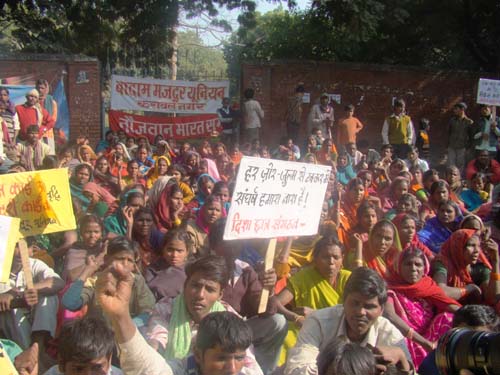
December 23, New Delhi. Nearly 2000 almond workers staged a huge demonstration at Jantar-Mantar in the afternoon under the leadership of ‘Badaam Mazdoor Union’. As is well known, approximately 20 thousand almond workers have been on strike for past one week. These workers organized themselves into ‘Badaam Mazdoor Union’ (BMU) a year ago and since then, they have been fighting for the rights to which they are entitled under various labour laws. The BMU declared strike in the almond processing industry located in Karawal Nagar which is situated in the North-East Delhi, following which 20 thousand workers’ families stopped work, who were engaged in this work. Due to this strike the entire almond processing industry of Delhi has come to a standstill. This pressure is hurting even more because these almonds come from the US, Canada and Australia to India for processing, after which they have to be sent back. These companies outsource the work of processing to India to exploit the extremely cheap labour of India. Khari Baoli, situated in Delhi, is the largest dry fruits market of Asia. The big businessmen located in Khari Baoli take contract for this processing work and then give it on subcontract to petty contractors situated in Karawal Nagar. These petty contractors get this work done by poor labourers on wages which are next to nothing. The workers are given a mere Rs. 50 for the processing of one 23 kg bag of almonds. The total profit on one bag of almonds is arount Rs. 7000. Of this profit, one share goes to the foreign company, another to the big businessmen of Khari Baoli, and yet another to the petty contractor who play in lakhs of rupees, while the workers are constantly on the verge of starvation.

Workers who came to Jantar-Mantar demanded that this almond processing industry which runs in Karawal Nagar and some other areas of Delhi should be given a formal status by the government and it should be regularized, as not a few hundreds are involved in this industry, but thousands of workers are toiling in it to earn a meagre livelihood. Ashish Kumar, Convener of BMU told the mediapersons that the contractors who are at the helm of the affairs in this industry laugh away the labour laws and exploiting the workers in a primitive and barbaric way. It is one of the most glaring example of wage slavery in modern times and that too in the heart of National Capital. For this, they have squandered away money to collude with the Police and local musclemen and political leaders. Against this dictatorship and exploitation, the workers in this strike are demanding that this industry be regularized by the government and labour laws be implemented. The second demand of the workers is that the workers should be given Rs 80 per processed bag of almonds rather than Rs 50. That would be equivalent to minimum wages. Besides, these contractors have not provided the workers with any identity card of job card due to which often they refuse to make due payments to the workers and the latter have no proofs whatsoever, to make a claim. The BMU also demanded that double payment should be made for the overtime. Apart from that, the contractors sell the rind of almonds to the workers. The workers use it as fuel to cook food. As this is a useless by-product of the process of processsing done by the workers themselves, it should not be sold to the workers. It should be given to them free of cost. The workers also demanded that the Police should lodge an F.I.R. against those goons of the employers who attacked BMU leaders and women workers with deadly weapons on the morning of December 17. Ironically enough, the Karawal Nagar Police arrested the Union leaders instead of arresting the contractors and their goons and lodged a F.I.R. against them under section 107 and section 151 and sent them to jail, from where they were released on bail on December 19. The BMU leaders also demanded action against the Karawal Nagar Police.

This strike which started on December 16, is being already hailed as one of the biggest unorganized workers’ strike in the history of Delhi. Almost 20 thousand workers’ families are involved in it. The whole almond processing industry of Delhi has been paralysed due to this strike. Due to the stoppage of almond supply, the prices of almond are increasing. On the other hand, the contractors are dreaming of crushing this huge movement of workers with the muscle power of their goons and tacit support of the Police administration. However, the workers are in no mood to surrender and they are intensifying their strike with every passing day. The BMU leadership demanded the Labour minister of Delhi and the Deputy Labour Commissioner of North-East Delhi to intervene in the matter and ensure the implementation of the labour rights of these workers. If the snatching away of workers’ rights goes on like this, then the workers will gherao the Labour Minister and Chief Minister of Delhi. It is the right opportunity for them to become cautious and implement these laws. They also warned the employers and contractors to wake up before the time runs out. They warned them not to try strength of the workers as it might cost dearly to their profit machinery. They cannot defeat organized working class power with petty street goons. They need to implement the labour laws and give the workers what they are legally entitled to.

“The British left India but their colonial mentality remained”

Nepal’s Maoist party Tuesday ended a countrywide three-day general strike and threw an open challenge to India to begin direct talks with it instead of ‘remote-controlling’ the Nepali ruling parties. It also threatened to launch an indefinite general strike from Jan 24.

After paralyzing the country for two days and a half with a general strike that shut down transport, industries, markets and educational institutions, Maoist protesters Tuesday brought out ‘victory rallies’ in many parts of the capital that converged in a meeting in front of the interim parliament.

Watched by hundreds of riot police guarding the parliament building, Maoist chief and former prime minister Pushpa Kamal Dahal Prachanda said talks with the ruling parties were breaking down regularly since the ruling alliance was a ‘robot’ taking its orders from the Indian government.

‘In the past, (after King Gyanendra dissolved the elected government and imposed a handpicked cabinet), the then ruling parties asked us to hold talks with them,’ Prachanda told a mass meeting of hundreds of people in the capital. ‘But we refused, saying we will not hold talks with servants but only with the master (the king).’

Nearly seven years later, after an anti-monarchy movement that deposed the king, Prachanda said that time had come to say the same thing. Only this time, he said, the master was New Delhi.

‘We are ready to go to Delhi and start talks,’ he said.

Prachanda added that civilian supremacy in Nepal ‘had been assassinated by India’.

He referred to the Indian Army chief Deepak Kapoor’s reported statement at a banquet in New Delhi recently that Maoists combatants should not be incorporated into the Nepali army.

‘Is he the governor of Nepal,’ Prachanda asked. ‘Can he order the Nepali people?’ Isn’t the integration a decision to be taken by Nepal’s government and parties?’

Nepal, he said, became semi-colonized by the British rulers of India in the 19th century after being forced to sign an unequal treaty that made the country cede almost a third of its territory.

‘The British left India but their colonial mentality remained,’ he said.

Prachanda is calling for a five-point negotiation with India that will scrap all unequal treaties and make public ‘secret treaties’ detrimental to Nepal’s national interests. He is calling for the resolution of all boundary disputes and the withdrawal of Indian troops from Nepal’s Kalapani region. The Maoist chief is also calling for an end to the ballooning trade deficit between the two neighbours.

He has asked New Delhi to draw a strategy on a war-footing so that Nepal, sandwiched between India and China, can benefit from its proximity to the world’s two fastest growing economies.

The Maoist chief is asking India to treat its smaller northern neighbour as an equal instead of trying to keep it reduced to a ‘puppet’ and ‘robot’.

The Maoists Tuesday also pledged to start a month-long campaign from Christmas Day to ‘awaken the people’.

Prachanda said during the meeting that his party would expose Indian and other foreign agents and the corrupt, including those indicted in a commission that was to have brought deposed king Gyanendra and the other abettors of the royal coup in 2005 to justice but was never made public.

The Maoists have also warned of an indefinite general strike nationwide from Jan 24 if the ruling parties still fail to reach an agreement. (IANS)

Courtesy: Sify

Almond Workers’ Strike: one of the largest unorganized workers’ strikes in Delhi

Abhinav Sinha,
Bigul Mazdoor Dasta

Delhi witnesses one of its largest unorganized workers’ strikes in last 20 years
Strike continues into sixth day despite threats and intimidations by the police and goons of factory owners
Supply to international markets badly hit, Delhi’s almond processing industry paralysed
2000 workers organize a huge warning rally

December 20, Delhi. The huge almond processing industry of Delhi, situated in the Karawal Nagar, continued to be paralysed on consecutive sixth day. As is well known, nearly 30 thousand almond workers’ families went to strike with their families six days ago under the leadership of Badaam Mazdoor Union (BMU). In the meanwhile, on the morning of December 17, the contractors and their armed goons attacked a peaceful procession of women workers, injuring three BMU activists and several workers. In self-defense, workers started pelting stones on the goons due to which 4 of them were injured. However, the Karawal Nagar Police, completely playing in the hands of the employers, unilaterally lodged a case against the Union leaders under section 107 and section 151, and sent them to Tihar Jail. These BMU leaders were released on bail on the night of December 19. The shameless Karawal Nagar Police kept the injured, bleeding BMU activists in the Police Station, without providing them any kind of medical assistance, and doing so intentionally. On the other hand, the real culprits, the hooligans of the contractors were let go by the Police! Not even a single case was registered against them. Even more shameful is the fact that the Police lied to other BMU officials that they were taking the arrested leaders for M.L.C. and a case has been registered against the contractors and their henchmen. The contractors used casteist abuses against dalit workers and dalit BMU activists. And yet, the Police refused to register any case against the contractors and their gundas. The contractors and owners had calculated that with the arrest of the top BMU leaders, the strike will disintegrate. But, contrary to their great expectations, the arrest of BMU leaders, rather than shaking the courage and confidence of workers instilled in them an indomitable resolve to fight till the end. The 20 percent workers who had not joined the strike, joined it on the night of 19th December.

After the release of the leaders, workers warmly welcomed them and organized a historical rally on the morning of December 20 in the whole western Karawal Nagar. The rally had been organized as a symbolic warning to the contractors and the Police. Almost 2000 workers participated in the rally, predominantly female. The rally started in Prakash Vihar area of Karawal Nagar and covered the entire western Karawal nagar. During the rally, workers raised various slogans against the contractors, Police, capitalism, etc. The common citizens of Karawal Nagar saw this rally with awe and supported the demands of the workers. It was the biggest workers’ rally in the history of Karawal Nagar. The workers demonstrated their militant unity with this rally and re-emphasized their resolve to continue the struggle till their demands are met.

Due to the continuation of the strike into the sixth day, the almond processing industry of Delhi has come to a halt. Thousands of unprocessed almond bags are lying dump in the godowns of the contractors. On the other hand, the demand for almonds is increasing with every passing day as Christmas and New Year is coming near. It is noteworthy that the almond that is processed in Delhi comes from the companies of the US, Australia and Canada and a number of European countries. These companies, in order to exploit the cheap labour of India and minimize their costs, send their almonds for processing to the big businessmen of Khari Bawli of Delhi, which is the largest dry fruit market of Asia. These big businessmen give this work of processing on sub-contracting to the petty contractors of Karawal Nagar, who laughing away all labour regulations and laws, exploit the workers cruelly. These are the very workers who have been on strike for the sixth consecutive day and who have been demanding for the fulfillment of all their rights given by the labour laws, for example, the piece rate should be fixed in accordance with the law of minimum wages, that is the per bag processing rate should be fixed according to the minimum wages; the workers should be given double overtime payment; they should be provided with identity card and job card; and the due payment should be made in the first week of the month; abuse of workers should be stopped immediately by the contractors. The almond workers formed their Badaam Mazdoor Union last year and since then they have successfully fought on a number of issues. Due to the present strike the rates of almond are increasing swiftly in Delhi’s markets.

Convener of BMU, Ashish Kumar Singh said, “Till now, the Police administration has worked hands in gloves with the contractors to sabotage the strike. We have completely lost faith in the Karawal Nagar Police administration and to initiate action against the goons of the contractors, we will lodge a complaint directly in the office of DCP, North-East Delhi. And if the DCP office fails to take action, we will move to court. The goons of contractors will not be spared and they’ll have to pay for every drop of blood of workers and their leaders. Strike is our weapon. We’ll continue the strike till all our demands are met.”

Yogesh, member of BMU, said, “It is for the first time that the workers have organized themselves in such huge numbers. We have witnessed strikes in the past too, however, then the workers of U.P., Bihar and Uttaranchal failed to come together and the strikes failed. It is for the first time, under the leadership of Badaam Mazdoor Union that the workers have organized themselves across the divides of caste, gotra and region, with their class interests in command.” Yogesh told that they have been reported by various sources that the baffled contractors are planning a fatal attack on the leadership of the BMU, with the Police on their sides. He said that faced with any such attack, we will reply proportionately. Despite the patronage of the Police, the contractors cannot defeat the worker power.

An interview with Benedict Anderson

Benedict Anderson was in Delhi recently to deliver a lecture on his latest work. He “is one of the first and original theorists of nations and nationalisms. His pathbreaking work ‘Imagined Communities’ is an exploration of how various peoples have at a certain juncture in history imagined themselves into nations. An anthropological explorer of various national-liberation movements in East and Southeast Asia, Prof Anderson sees the rise of nationalism as being closely connected with the growth of printed books and with the technical development of print as a whole”. Paramita Ghosh interviewed Anderson for Hindustan Times. FOR THE FULL TEXT

Q: As a man of the Left, what is the future of Marxism in south Asia and in India?

A: Communism has taken a beating in the last 20 years. But it won’t go away if underlying problems in society don’t go away. There has to be new ways to revive it. However, one framework which Marx never anticipated was how the atomic tests would destroy civilisation. The limits of resources are not there in Marxist vocabulary, it comes from Thomas Robert Malthus and it has to be grappled with.

India has three kinds of Communisms. The established left, the CPI M-L and the new Naxalites who are no longer led by college students. They go to the bottom of society.

Q: One of our living realities is the competition between Indian and China amid the babble of economic cooperation. How can Third World solidarity be revived?

A: What solidarity can there be to speak of? There was never a leftist government in India. The Cold War put China on one side and India played a role in between…. Both are rapidly expansionist, they are bound to get in each other’s hair. But it is in everyone’s interest to reduce the power of America.

China wants a ring of friendly countries around it, but it won’t occupy them. It’s not clear what China wants in Africa. I don’t know whether they intend to stay. If the Chinese start moving there, then it might get interesting.

There is, I think, however, a growing acceptance that war will not get you more territory. What threatens nation-states are not external states, but internal collapse. It has happened in Soviet Union, Czechoslovakia. It may happen in India. States can’t get any bigger, but they can get smaller.