China: Some thoughts on Foxconn and the Honda strike

Lang Yan, China Study Group

While I was walking around the Shanghai World Expo on a weekday a couple of weeks ago I met a group of workers from a nearby clothing sweat shop. Their company had sent them to the Expo for the day (for which they had to trade their only day off, Sunday). They were too tired to enjoy the Expo as they worked 14 hours a day, six days a week. While this may seem like a nice gesture on the part of the company, the workers also explained that the company was moving much of their production to another building that week, because a worker burned much of the factory down after not being paid on time. I heard this story just as the news of the Foxconn suicides began to break into the media and shortly after that the Honda strike began.

Within public discussion, the Honda wildcat strike has transformed the meaning of the Foxconn suicides. Early interpretations of the Foxconn suicides tended to argue that the suicides should either be understood as individual psychological issues and as copycat suicides, on the one hand, or a result of the particularly brutal and alienating conditions at Foxconn, on the other. Some marshaled statistics to show that there were no more suicides at Foxconn than the social average when one considers the size of Foxconn (for example, see Tom Holland “Why there’s less to the suicides at Foxconn than meets the eye” and Michael R. Phillips “Foxconn and China’s Suicide Puzzle Workers: may not be taking their own lives for the reasons everyone thinks”). Statistics average out, in other words, the social difference of the militarized factory space; Foxconn was treated as a normal social space, a city. (For a discussion of suicide rates and Foxconn, see EastSouthWestNorth #19. Notable also is that the Chinese rate of suicide for people 15 to 34 is quite high. See Suicide main cause of death in 15 to 34-year-olds.)
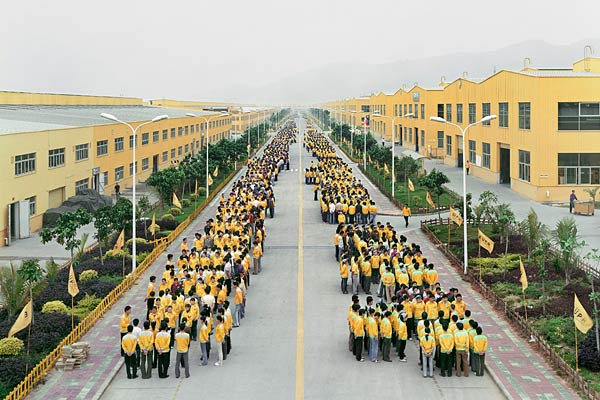
Analysis of the social and work conditions at Foxconn also appeared. The particularly militarized and alienating work environment at Foxconn is a result of capital’s relentless drive to lower assembly costs and the Asian subcontracting regime; reform-era China and the CCP have been a willing partner in that effort. Activists and scholars have argued that Foxconn is one of the worst factories in terms of it labor regime, with a very long (usually about 70 hours) work week (since the pay structure means that workers must work a lot of overtime) and a very rapid assembly line. Foxconn was able to become the world’s largest assembly company exactly because of its harsh Taylorist production process, which cuts up the process into highly regimented movements, its ability to intensify labor exploitation and its repressive management style (See this article by Andy Xie for some analysis and background on the Taiwanese management style). There are reports that Foxconn initially responded to the suicides by pushing workers to sign contracts that they would not commit suicide, and stating that their families would not receive compensation if they did. It went so far as to state that suicide harmed Foxconn’s reputation.

But the successful Honda wildcat has changed the discussion. The suicides and the strike are being put into the context of changing labor relations in China, with many now arguing that Chinese labor is at a turning point.

For example, NPR’s Marketplace (Honda, Foxconn workers demand more power) argues that a “labor shortage in China is empowering workers to demand better wages and treatment at their workplaces….” In a discussion of the Honda strike, Reuters notes that “[s]ome other foreign companies have begun to address workers’ discontent over pay and working conditions. Taiwan’s Hon Hai Precision Industry Co Ltd for instance plans to raise salaries by about a fifth at its Foxconn International unit, maker of Apple Inc’s iPhone, as it struggles to stop a spate of suicides and quell public anger.” Foxconn has said that it will raise base salaries by 30% now with more raises to come in the near future. Clearly this wasn’t only caused by the suicides, however. Foxconn was planning a salary increase earlier in the year in response to the difficulty hiring workers due to labor shortages.

The Honda strike (workers’ demands included wage increases from about 1,500 yuan (less than $220 US) to about 2,300 yuan ($337 US) for higher paid workers) is likewise getting more press than any other worker action in recent years.

China’s economic stimulus has given large subsidies for car sales, and car manufactures are attempting to rapidly increase production in China. Honda plans to add a third to its Chinese production by 2012. But its integrated production process is vulnerable to strike activity. This is particularly true of transmission plants, which are highly automated and expense to construct. Thus they are usually put in the most stable regions, notes the New York Times. But the stability of the Chinese working class is now in doubt. According to the Wall Street Journal:

“The strike has exposed unexpected vulnerabilities in Honda’s China supply chain. Because of the relative absence of labor unrest in China, Honda makes do with only one source of transmissions there, the Foshan factory that supplies roughly 80% of demand, according to Mr. Fujii. The rest are brought in from Japan. Typically, Honda insists on at least two suppliers of parts, partly to protect against any industrial action that might cripple production.”

While quick to tamp down any political interpretation of the workers’ activity, the New York Times argues that in the beginning the state allowed media coverage of the strike because it wants to push up internal demand. On the other hand, the China Daily (in an article now taken off their website) used the strike to editorialize that the Chinese state needs to do more to raise the wages of workers. Since the end of the strike, Chinese media coverage has continued while broadening its analysis. At the same time, the government seems to be increasing its efforts at raising the wages and internal consumption. This follows several years of increased investment for rural China, which means there is less pressure for peasants to migrate out for work.

Broader Implications: First question looking forward:

What does this mean in terms of the changing Chinese political economy? A few points: Increasing wages in China could help rebalance the global economy. As their wages increase Chinese workers will be able to spend more (the wage share of GDP fell from 56.5 percent in 1983 to 36.7 percent in 2005). A rise in internal demand will mean a drop in the savings rate in turn forcing a rise in the savings rate in the US. This will likely also mean inflation, which is already a problem with the huge Chinese stimulus, yet inflation is also another way–other than a direct change in the exchange rate–for the Chinese state to rebalance its trade relationship with the US. The power of the export manufacturers in China seems to have been able to keep the state from changing the exchange rate to any great extent, but inflation might help take care of this for the state. Of course inflation will eat into wage increases and possibly lead to more social unrest. Meanwhile, the Beijing government announced on June 3rd that it was raising the minimum wage by 20% in response to inflation–the past few years it was raised about 10% per year. Other regions are following suit.

The June 7th issue of The Economic Observer (Jingji guancha bao) has articles on the labor situation noting that both the Honda strike and the situation at Foxconn are symptoms of a broader change going on in the Chinese labor market. One article argues that China has reached the “Lewisian turning point”. Arthur Lewis argued in 1954 that, for a period of time, developing countries could rely on rural surplus labor to keep wages from rising. This would allow them to industrialize without wage inflation. But once rural surplus labor is absorbed by the industrial economy and the labor market unifies wages will begin to increase more rapidly. The influential economist Cai Fang has been predicting this shift for some time, and in 2007 edited a volume on the turning point called “The Coming Lewisian Turning Point and its Policy Implications.”

Arthur Kroeber argued in the March issue of China Economic Quarterly that China’s cheap labor regime was coming to an end and that wage inflation will drive up the consumption share of GDP. In the planning for the 12th Five Year Plan, the CCP itself emphasizes this rebalancing and the important role that raising the wage share of GDP should plays in the process. At the same time, some commentators seem to be taking this argument a bit too far. Andrew Peaple states that “the dynamics of China’s economic development are moving inexorably in favor of the country’s workers.” While this will change the shape of the Chinese economy, its effect on capital will be mixed. Higher wages will mean more consumption, helping many companies as much as it hurts. But the assembly and clothing industry in the Southeast will be hit hard, as those plants are both more easily moved to other, cheaper-wage countries and have thinner profit margins. It is too early to say what this transition (of the Chinese economy and of the Chinese labor process) might mean more globally.

A second question looking forward:

Does the Honda strike indicate increasing self-activity of the working class in China? Certainly the example of the success of workers in the Honda strike in winning some wage increases (initially about 24% but in the end much more) might spread to other workers in China. Also, the strike itself was very highly organized, leading to the participation of about 1,900 workers (including a large number of low-paid interns). The workers seemed split, however, when gave in to a lower wage increase than initially demanded. The People’s Daily reports that the hold out group was involved in a confrontation with representatives of the state union, the ACFTU. (The local ACFTU seems to be playing a more conservative role–by protecting Honda–than even the state-run media.) The World Socialist Website details the attempts by the company to split the workers by putting pressure on the interns to sign no-strike pledges in return for smaller wage increases. According to The China Daily, the strikers also demanded changes in work conditions, more transparency in company finances (this seems like a reflection of the history of worker democratic involvement in enterprise management in China), and a change in union representatives. The New York Times points out that workers complained that Japanese employees at the Honda plant make about 50 times that of Chinese workers. It is likely that nationalism has also played a role in how this strike has been reported in China. Most of the workers held out, however, and the agreement reached will lead to high wage increases. Kroeber talking Reuters stated that “Foreign investors have been lulled into a false sense of security that China has a docile work force. There’s nothing intrinsically docile about the Chinese labor force. There was a period when everything was kind of fine; now we are entering a period of more constraint.” Following the Honda strike, workers at a Hyundai factory near Beijing went on strike, but returned to work after they were immediately promised wage increases. Over 5,000 textile workers in Pingdingshan, Henan have been out on strike since May 14th at a factory privatized in 2006.

As the WSWS notes of the Honda strike:

The strike is a sign of sharpening class tensions in China amid the worsening global economic crisis. While China’s economic growth rate continues to be high, propped up by huge stimulus spending, the gulf between rich and poor is widening. Last year there were 98,568 labour disputes filed in Chinese courts, up 59 percent on the previous year. Most disputes, however, were not reported.

It remains to be seen, however, how successful the CCP’s attempt at economic transition will be. We need to know how much of China’s growth and job creation is due to the stimulus and how sustainable it is. The unsustainable property market is creating an investment bubble. Just as likely as transition to a consumer-based economy, inflation could lead to stagflation once the property bubble bursts and the initial affects of the stimulus wear off. The real question is what then for the activity of the Chinese workers. They are clearly learning important lessons now. The fundamental question is whether their new found strength will lead to a break from the domination of capitalist accumulation or not.

GurgaonWorkersNews: Newsletter 26

GurgaonWorkersNews – Newsletter 26 (May 2010)

Gurgaon in Haryana is presented as the shining India, a symbol of capitalist success promising a better life for everyone behind the gateway of development. At a first glance the office towers and shopping malls reflect this chimera and even the facades of the garment factories look like three star hotels. Behind the facade, behind the factory walls and in the side streets of the industrial areas thousands of workers keep the rat-race going, producing cars and scooters for the middle-classes which end up in the traffic jam on the new highway between Delhi and Gurgaon. Thousands of young middle class people lose time, energy and academic aspirations on night-shifts in call centres, selling loan schemes to working-class people in the US or pre-paid electricity schemes to the poor in the UK. Next door, thousands of rural-migrant workers uprooted by the agrarian crisis stitch and sew for export, competing with their angry brothers and sisters in Bangladesh or Vietnam. And the rat-race will not stop; on the outskirts of Gurgaon, Asia’s biggest Special Economic Zone is in the making. The following newsletter documents some of the developments in and around this miserable boom region. If you want to know more about working and struggling in Gurgaon, if you want more info about or even contribute to this project, please do so via:

http://www.gurgaonworkersnews.wordpress.com
gurgaon_workers_news@yahoo.co.uk

In the May 2010 issue you can find:

1) Proletarian Experiences –
Daily life stories and reports from a workers’ perspective

*** Three Communists in Gurgaon
The industrial development and proletarian unrest in Gurgaon did not remain unnoticed. We talked to three communists who decided to focus their political activity on the vast landscape of working class formation. The comrades are part of the revolutionary Marxist-Leninist left, belonging to three different political organisations.

*** Service?! What the hell! / Reports from Service Proletarians, Street Labour Markets and Factory Workers in Gurgaon
Some voices of security guards and drivers, metal and textile workers. Some voices from workers looking for a job at corner labour markets, harassed by the police and other thugs.

2) Collective Action –
Reports on proletarian struggles in the area

*** Inflationary Proletarian Struggles
While opposition parties arrange token protests against the price hikes, workers on the ground battle for higher wages. In March 2010 Delhi government announced 33 per cent increase of minimum wages, but this hike hardly ever reaches shop-floor reality. In the aftermaths of the minimum wage increase we observe various spontaneous proletarian actions in Gurgaon and Okhla industrial areas. The combination of an interlinked (automobile) industry and organisational efforts like Faridabad Majdoor Talmel can become future lines of coordination and generalisation of the unrest.

*** Update on Struggles of Permanent Automobile Workers at Sanden Vikas and Exide
The first-tier supplying industry of the automobile industry is heating up under the double pressure of increasing demand of the assembly plants on one side and the more confident claims of the workforce on the other. The recent struggles at Denso, Sanden Vikas and Exide express the difficult position of a young permanent work-force: they appeal to the classical union form of struggle hoping to secure an increasingly precarious position. These classical forms detach them from the wider casual and temporary workforce and therefore from the true ‘material’ power-base.

*** Waterwars, Energy Crunch and Revolting Villages
Groundwater levels in Gurgaon drop dramatically, gobbled up by industry and upper-middle class life-style. Water and energy flows are diverted away from workers’ and peasants’ spheres. We document some struggles of ‘villagers’ against the lack of resources and oil-pipe-line projects crossing their fields.

3) According to Plan –
General information on the development of the region or on certain company policies

*** The Social Tsunami Impact / Snap-Shots against Capital-Class-Crisis
This is an attempt to introduce a regular update on general tendencies of crisis development in Indian – motivated by Greek shock-waves, naked shorts and potential spillovers. Apart from short glimpses on the macro-level of things we focus on general trends in agriculture and automobile sector: the current demise of the past and the toxicity of the future.

4) About the Project –
Updates on Gurgaon Workers News

*** Glossary
Updated version of the Glossary: things that you always wanted to know, but could never be bothered to google. Now even in alphabetical order.

Poems by Bilquis Zafirul Hasan

(Translated by Arjumand Ara)

POETESS

God does not give sufferings
Greater than the broadness of one’s bosom.
But in my heart He has put the vastness
Greater than the earth and heavens.

I

No
I do not complain, nor do I reproach You.
Like You, I too, have written stories, pure in nature.
I have carved characters, blameless and innocent.
Then instilled in them the sorrow of failures, unfulfilled desires,
Punishments and disgrace, as You did.
Sometimes, I crucified them upon the cross of guiltlessness.
Sometimes, I pushed them into the blind caves of solitude.
Sometimes I imprisoned them in the prisons of their own existence.
I pushed through their bosoms the daggers,
The wounds of which will never be healed.
But – what else could I do?
To make a story out of a story
One has to accomplish all these things.
Your limitations – who else, if not I, would understand.
I know, the way you have written me, as story
You did it, excellently!
OCEAN, O OCEAN!

Ocean! O ocean!
This dreadfulness of your streams,
These whirling vortex and roaring storms,
May only be a way of your flowing waters!
But – the straws?
They are facing gusts of the billowing waves,
Nobody knows, as to where they helplessly flow.

You are grand and magnificent – your depths are fathomless.
The surges of your waves are all boundless.
You may not know the pain of being fragile and helpless.
You may not have experienced all this,
As the roaring of boundless waves is always carefree and mindless;
To storm and surge is just a habit of flowing waters.

But these defenseless straws do always bear the brunt,
Of your flowing waters, of the storm of vortex.
If these straws get drowned, nothing would happen.
Neither your surges would be subdued nor your greatness would be questioned.
But when will end this pain of being wasted?
Ocean, O ocean!
SUICIDE

There are several ways of committing suicide.
She may choose any of them.
She may die by consuming poison,
Or by setting herself afire – after dousing kerosene.
By jumping from the seventh floor,
Or by throwing herself before a running train.
By hanging from a roof, or a ceiling fan,
Or by drowning herself in an ocean.
There are several ways, indeed.
Each of them more horrible than the other – and easy too.
But the most horrible is – to die while living.
In this, nobody can notice – that a person is dead.
This is no innovation –
Many have tried this before me,
And have succeeded.
And the best thing about this
is that
One takes no chance of being saved.
TREACHERY OF THE LAND

In fact, the land does not own any thing.
She is owned by one who gets her registered.
Before she bears fruit, she is divided among the owners;
Distributed in small patches.
One who owns one of her patches, has the right
To decide whether to cultivate
or not to cultivate her.
She is dug and beaten
Yet she yields the dues to those who are called her claimants.
The land – is always very faithful.
But there remains in her – something from being shared.
Otherwise, how do there grow
These wild cacti – boorish celsia.
These illegitimate, yet very own, children of the Land.
MELON AND KNIFE

Either a knife falls upon a melon, or a melon upon a knife,
It causes no harm to the knife.
Which, that gets cut, is always the melon.
The knife remains, as always it is, sharp and shining –
Prepared to cut another melon!

A hoodlum whistled while passing from her street,
Seeta no longer steps out her home – she is forbidden from going out.
A neighbour began to peep about – my brother sent his wife to her parents.
After being raped, Savitri died, committing suicide.
Yes! –  a knife falls upon a melon, or a melon upon a knife,
Melon has to get cut.
But,
Is there no difference between a woman and a melon?
BANU

What a great shock! Banu was not such a woman.
It is already past twenty years
When she first stepped into this house.
And during these twenty years – she did not utter a single word
(of dissatisfaction) to anybody.
– Neither a complaint, nor reproach.
She used to be busy in everyday chores, day and night.
Poor woman – she didn’t find time even to have a chat.
She used to live on – whatever was left from others consumption.
What about her desired articles? She was such a woman,
who did never change her clothes even on a festival!
She used to serve her mother-in-law, bear the whims of her sister-in-law.
For her brothers-in-law, for her father-in-law,
for her husband – for all – she was ready to sacrifice her life.
During these twenty years – she did not go to her mother’s house, even once.
From the day when she stepped down from her bridal palanquin
She did not cross the door of her husband’s house.
What happened then to such a woman?
Why did she consume the poison of rats? Who knows – why!
What a great shock! Banu was not such a woman!
DARKNESS

The darkness prevails only because
You did not light a candle, yet.
Do no sit idly
Light a candle – see for the fuse
Possibly, the electricity has gone
Because the wire is fused.
Then – change the fuse-wire.

If you do not know, how to make fused-wire – then
Sit frightened in this dim light of a candle
And pray for the morrow to come.
Sit for all night in this darkness.

Do remember – the darkness is
Only a name of no light.
Bring light and see – where does the darkness go?
GOOD WIVES – A SERMON

Dear good Ladies!
A woman is blessed with the promise of Heaven who
Adorns herself before her husband comes back to home,
Decorates her hair with strings of beads;
And keeps ready the odorous dishes of appetizing food.
Keeps ready fresh hot bread and soft bed;
Puts warm and cold water in two separate jugs –
(Yes, who know if he would like to use cold or warm water!
One cannot anticipate his desire.)
So that when her demigod, her master comes home,
He gets everything ready he needs, without demand.

And yes, dear ladies!
Do not forget to keep ready
A cane-stick, quite strong –
Who knows that the tired soldier, coming from the battle-ground of troubles,
Unfortunately,
Might be returning with injuries of failures.
When he comes back – he does not take the trouble to search for it.
He may push down with the help of this cane-stick
The colourful silken robe from the shoulders of his virtuous wife,
And Sprinkle the blood of his failures on her tender body;
So that he is able to sleep a blissful sleep.
(Yes, he is your metaphorical God. Were you allowed to worship someone other than God, its he, your husband. He saves you from the burning sun of the world, inside the secure walls of his house. Your subsistence depends upon the earnings of his hard work.)
Therefore, my dear ladies!
A woman is blessed with the promise of Heaven
Who spends her life as her husband willed.
If he calls the day night, she says it night.
She keeps herself alive for him, even if dying.
And she dies for him.
She would be sent to the Paradise, directly.
She would not be questioned for her sins,
They all will be pardoned.

In her sermon,
The preacher thus spoke, and then kept quiet.
She just announced the good news of deliverance of a pious wife.

But where will such a husband go?
– about this, she did not utter a word.

O God! O God!
For generations, in long queues, these are worthless maids!
Do instill in them a sense of being themselves.
HOUSE

No doubt – this is your house.
Your wealth was spent in its building.
It was your hard-earned money.

Your name is written on every brick.
But my blood – ? My toil – ?
What became the kneaded clay for these bricks – was my blood.
The walls of your house are raised over the base of my hard work.
How can you drive me out of this house?
I too, have written my labour,
With the ink of my blood, over each brick.
Do not give, if you don’t want to,
My right, my share, in this household.
Return it, as my wages.
I absolve you from paying back
My blood, which was spent on its building.
Bilquis Zafirul Hasan (born on September 1, 1938) is an Urdu poetess based in Delhi. Her first collection of poems Geela Eendhan (Damp Firewood) was published in 1996. Her second collection Sholon ke Darmiyan(Amidst the Flames) appeared in 2004. She writes short stories as well, and her only collection Weeraney Aabaad Gharon ke (Deserts of Inhabited Homes) was published in 2008. At first glance the mainstay of Bilquis (both in poetry and prose) seems to be the sufferings of woman. While writing on woman as mother, wife, beloved, or just a woman as opposed to man, we see her standing forlorn, unheard, neglected, abused and exploited in every role. However, the beauty of Bilquis’ narration lies in her moderate voice and subtle use of irony to drive home her point. She stands beside all, exploited and humiliated. Woman being the greater victim of injustice and abuse, she naturally walks to the centre of her poems. Besides woman, she is concerned with war, abuses of power, communal riots, besieged identities in a hostile environment, displaced and homeless people (see her poems on trampled Iraq, victims of Gujarat riots etc.). All the poems translated here are from Geela Eendhan.

Arjumand Ara is a prominent Urdu scholar, translator and activist. She is an assistant professor at the Delhi University, and is associated with the progressive writers movement. Recently, she translated the autobiography of Ralph Russell, a prominent indologist and Urdu scholar, who died in 2008.

Eva Golinger Misinterprets Solidarity: Support Tamils not Sri Lanka’s War Criminal Government

Ron Ridenour

Eva Golinger is known for her counter-intelligence analysis in the service of Venezuela’s peaceful revolution against the local oligarchy and the United States Empire. She is a noted author (“The Chavez Code: Cracking US intervention in Venezuela”). A dual citizen of the US and Venezuela, she is an attorney, and a personal friend of President Hugo Chavez, who dubbed her, La Novia de Venezuela (“the bride of Venezuela”). She is a frequent contributor to left-wing media around the world, and is the English editor of the Venezuela government newspaper, Correo del Orinoco.

Golinger is a name synonymous with solidarity and anti-imperialism. However, she recently inexplicably immersed herself into being a supporter for the most brutal, racist and genocidal government of Sri Lanka in a resoundingly irresponsible opinion piece printed in the Spanish daily version of Correo del Orinoco, May 15, and on May 21, published by the Caracas city government newspaper, Ciudad CCS. The piece was simply entitled, “Sri Lanka”. Printed in Spanish, I translate into English the major part of its content and analyze its errors with the goal of countering rumors she started, and in an effort to broaden support for a most maligned and oppressed ethnic group, the Tamils of Sri Lanka.

Golinger wrote that, in 2005, Sri Lankan “presidential elections occurred for the first time in nearly 30 years. Mahinda Rajapakse obtained victory with more than 58% of votes. He was reelected, January 2010 with more than 60%.”

“Rajapakse, Buddhist leader, is supported by a coalition of leftist parties, among them the Communist Party. In May, 2009, Rajapaske finalized the civil war, defeating the armed organization, LTTE.

“The LTTE had close ties with the CIA, and Washington negotiated an accord with them for establishing a military base in the country, if they obtained power. Upon its defeat, the LTTE had established numerous organizations—fronts in different countries around the world, seeking to create `a government in exile´ and hoping to isolate the current government of Sri Lanka. Last week, representatives of one of its fronts, Canadian Hart, passed through Venezuela; it met with government functionaries seeking support in its intent to weaken the relationship between the two governments.

“Instead of relating to the illegitimate opposition in Sri Lanka, Venezuela should shake the hand of an ally that also suffers imperial aggressions.”

Golinger is factually incorrect

1. Mahinda Rajapakse is not the first president elected. In 1982, J.R. Jayawardane won the first presidential election with 52.9% of the vote. The United National Party (UNP)—a pro-western party of the comprador bourgeoisie—introduced a new constitution after its 1977 landslide victory. Before then, the office of prime minister was the highest, and Jayawardane won that post and the UNP took 80% of the parliamentary seats. In 1978, the new constitution renamed the country, “Democratic Socialist Republic of Sri Lanka”, but this had nothing to do with socialism. The economy then, as now, was a capitalist one with a neo-liberal orientation much like Chile after the 1973 coup d´etat.

According to the Government Department of Census and Statistics own figures (2006/2007), 82% of the rural population lives under the national poverty line while 65% of the urban population is not able to meet the minimum level of per capita daily calorie and protein intake recommended by the government Medical Research Institute. See official figures on the government website.

There can be nothing “democratic socialist” about discriminating against 15% of its population, the Tamil ethnic group, making them unequal by legally restricting their rights and privileges. Such has been the case since independence from Britain, in 1948. Even the U.S. Library of Congress studied Tamils as an “alienated” group. In 1988, it published, “Sri Lanka: a Country Study”:

”Moderate as well as militant Sri Lankan Tamils have regarded the policies of successive Sinhalese governments in Colombo with suspicion and resentment since at least the mid-1950s, when the `Sinhale Only´ language policy was adopted…”

2. Rajapakse won the fifth presidential elections and with the least majority of all presidents, 50.29%, not 58% as Golinger wrote. [Wikipedia ]

Rajapakse is the current leader of the Sri Lanka Freedom Party (SLFP), founded in 1951 to represent the Sinhalese bourgeoisie. In 1960 elections, Sirimavo R.D. Bandaranayake became the world’s first woman prime minister. The Moscow oriented Communist Party and the Trotskyist Lanka Sama Samja Party (LSSP) formed the “United Front” coalition with the SLFP, in 1970. Now with three minister posts, the “old left” betrayed the young. Many Sinhalese leftist youth became disillusioned with the “old left” and after the SLFP returned to government, they rebelled. The so-called “leftist” government, with the CP and LSSP, branded this upsurge a “Che Guevarist uprising” and crushed the rebellion by killing about 20,000 mainly rural Sinhala youth, in 1971. The next year, these “left” parties drafted the first republican constitution in which Sinhalese was codified as the only official language and Buddhism the only the official religion—Tamils are not Buddhists. This eroded whatever support the “old left” had among both leftist Sinhalese and all Tamils. Since then neither the CP nor the LSSP has managed to get a single seat in the parliament independently. They are always with the capitalist party, SLFP.

3. Rajapakse won the January 2010 elections with 57.88%, not 60%, over his former chief general, Sarath Fonsekla, in charge of liquidating the LTTE (Liberation Tigers for Tamil Eelam). Fonseka’s party, New Democratic Front, received 40.15% of the vote. In desperation, a few Tamils voted for General Fonseka knowing that he was the main army force in carrying out the president’s orders in liquidating the LTTE, and massacring tens of thousands of Tamil civilians. The one difference between the two war criminals was that Fonseka later promised that he would release the rest of the interned Tamils and return their possessions and land. Tamils are crushed for now and resort to seeking a bit of breathing space. (Wikipedia entry on United People’s Freedom Alliance).

The egomaniacal president was not satisfied with just defeating his former general in the ballot box, he had him arrested and beaten, on February 7, shortly after the elections, and charged him with plotting a coup, which General Fonseka denies. A purge of scores of top military officers has occurred; a dozen or more Sinhalese and Tamil Journlists have been arrested. In the four years of Rajapakse rule, at least 23 journalists critical of his regime have been murdered: See 1 and 2.

4. “The LTTE had close ties with the CIA, and Washington negotiated an accord with them for establishing a military base in the country…” That is an outrageous and unsubstantiated allegation. In my month-long research last autumn, I found nothing to indicate Golinger’s unsupported claim. Looking up in Google for “LTTE and CIA”, nothing exists. When searching for LTTE and CIA and LTTE ties to CIA without quotation marks, nothing exists that binds them. I looked up some 200 hits and only found reference to the Golinger claim, and this was cited by a most skeptical Patrick J. O´Donoghue, news editor for the English-language website www.Vheadline.com, in a May 23 commentary. He said: “I couldn’t believe what I read in the Caracas CC blatt!” We have no way of knowing if the LTTE even met with the CIA, but in war most anything is possible. What we can know is that the US, and its CIA and Pentagon, have long supported the genocidal Sinhalese governments, and most certainly that of Rajapaske, and it placed the LTTE on its Foreign Terrorist Organization hit list in 1997. I will delve into this farther on.

5. Golinger’s claim that Canadian Hart is a front for the LTTE is denied by several solidarity groups in Canada who know that organization for its humanitarian work. See their perspective, “Venezuela: Eva Golinger’s misinformation endangers exiled Tamils’ fight for freedom”, at: http://vheadline.com/

6. Golinger depicts the Sri Lankan capitalist and genocidal government as an “ally” of Venezuela, one that she recommends her revolutionary government to “shake the hand of an ally that also suffers imperial aggression.” This boggles the mind, or “beggars belief”, as O’Donoghue wrote. Instead of opposing the Yankee Empire, her position is allied with imperialist United States and its allies Zionist Israel, the United Kingdom and other former European colonialists, as well as the emerging superpower and worker-exploiter China. (See my pieces “ALBA Let Down Sri Lanka Tamils”, “Equal Rights or Self-Determination”, and “The Terrorists: International support for Sri Lanka racist discrimination”. See the entire five-part series at: Radical Notes). There is no shred of evidence that the United States aggresses against Sri Lanka governments, on the contrary.

US Supports Sri Lanka Genocide

The Indian Ocean is a vital waterway where half the world’s containerized cargo passes through. Its waters carry heavy traffic of petroleum products. Sri Lanka cooperation is vital to the US Empire’s global interests. A separated Tamil state would complicate cooperation requirements.

The United States of America has been arming and financing Sri Lanka for most of the civil war period. [www.cdi.org/PDFs/CSBillCharts.pdf ] From at least the 1990s, the US has provided military training, financing, logistic supplies and weapons sales worth millions annually. A Voice of America installation was set up in the northwestern part of the country.

The United States government praised Rajapaksa for restarting the war already in July 2006, and officially ending the ceasefire in 2008. The US embassy in Colombo issued this statement: “The United States does not advocate that the Government of Sri Lanka negotiate with the LTTE…” (See www.globalresearch.ca)

On May 26, 2002, the Colombo English-language Sunday Times wrote about a joint military pact between Sri Lanka and the U.S., a development taken soon after the CSA was signed.

“The Acquisition and Cross Servicing Agreement [ACSA]…will enable the United States to utilise Sri Lanka’s ports, airports and air space. As a prelude to the signing of the agreement scheduled for July, this year, United States Naval ships have been calling at the Colombo Port for bunkering as well as to enable sailors to go on shore leave.

“In return for the facilities offered, Sri Lanka is to receive military assistance from the United States including increased training facilities and equipment. The training, which will encompass joint exercises with United States Armed Forces, will focus on counter terrorism and related activity. The agreement will be worked out on the basis of the use of Sri Lanka’s ports, airports, and air space to be considered hire-charges that will be converted for military hardware.”

US Assistant Secretary of State Christina Rocca was the key liaison person with the Sri Lankan government. [Rocca had been a CIA officer before joining the state department.] (See www.colombopage.com) The ACSA agreement was not finally signed until Rajapaksa came to power. It was U.S. citizen Gotabhaya Rajapaksa, Secretary Defense Minister, and brother to President Rajapaksa, who signed the agreement, on March 5, 2007. (Their younger brother, also a minister, is a US citizen as well.)

George W. Bush was especially glad for Sri Lanka’s state terrorism. In 2006, he encouraged the government to resume the civil war, which Bush financed with $2.9 million. The Pentagon provided counter-insurgency training, maritime radar, patrols of US warships and aircraft. This was a continuation of “Operation Balanced Style”, which uses U.S. Special Forces instructors since 1996.

At the end of Bush’s first term, the US was forced to cut back on aid given that it was bogged down in Afghanistan and Iraq. That, coupled with critical public opinion, organized by the Diaspora, of state terrorism and systematic discrimination of Tamils, prompted congress to make noises about abuses of human rights by not only LTTE but possibly by paramilitary forces linked to the S.L. government. Thousands of Tamils blocked highways in Canada, camped outside British parliament for months, some committed suicide in front of government offices, while Indian Tamils conducted paralyzing strikes. Nevertheless, in 2008, the U.S. granted $1.45 million in military financing and training to the Sri Lanka government out of a total of $7.4 million in total aid. The US made noises about a ‘humanitarian crisis’ when the Sri Lankan army was about to finish the war but it never took affirmative action to bring the war to an end nor to condemn the army or government.

Even after leading international observers, and some of the mass media, especially in the U.K. and France, began to expose S.L. government and the army’s systematic atrocities against Tamil civilians, and captured LTTE soldiers, the US continued to back up the Sri Lankan government, in contradiction to Eva Golinger. In mid-April, 2010, the U.S. and Sri Lankan military forces conducted military exercises in Eastern Seas (Trincomalee) for the first time in 25 years.

Said Lt Col Larry Smith, the US defense attache: “The joint exercise helped members from our two militaries to exchange best practices on how to address complex humanitarian challenges.”

He added: “The US and Sri Lanka have a long tradition of cooperation. We hope this partnership can be expanded.” http://jdsrilanka.blogspot.com/

Documentary film-maker John Pilger compares Sri Lanka’s genocide to Israel

“The Sri Lankan government has learned an old lesson from, I suspect, a modern master: Israel. In order to conduct a slaughter, you ensure the pornography is unseen, illicit at best. You ban foreigners and their cameras from Tamil towns like Mulliavaikal, which was bombarded recently by the Sri Lankan army, and you lie that the 75 people killed in the hospital were blown up quite willfully by a Tamil suicide bomber.” “Distant Voices, Desperate Lives,” New Statesman, 13-5-09.

When the U.S. does not want to be seen on the frontlines in a war, it sends in surrogates and Israel is its main partner in this war crime. Israel was officially re-awarded diplomatic relations, in May 2000, after Sri Lanka had severed them in 1970, in protest at Israel’s continued illegal expansion into Palestinian territory. (www.dailymailnews.com/)

Nevertheless, Israel continued to operate inside S.L. out of a special interests office set up in the US embassy. Under the table, Sri Lanka’s successive regimes embraced Israel’s military advisors, a special commando unit in the police, and Mossad counter-intelligence agents—who sought to drive a wedge between Muslims and Tamils. Israel sent Sri Lanka16 of its supersonic Kfir fighter jets, some Dvora fast naval attack craft, and electronic and imagery surveillance equipment, plus advisors and technicians. Israel personnel took part in military attacks on Tamil units, and its pilots flew attack aircraft. Tigers shot down one Kfir. Just before the end of the war, Prime Minister Wickremanayake was in Israel to make bigger deals with Israeli arms supplies. (See 1 and 2)

Sri Lanka government war crimes

Golinger even ignores ample evidence of extreme war crimes committed by her choice for president, Mahinda Rajapakse, against the minority Tamils. They have a righteous claim for liberation because of being subject to systematic discrimination, oppression and genocide. (Ibid: “Equal Rights or Self-Determination”.) Sri Lanka’s first president, J.R.Jayewardene, expressed the essence of this genocide to the “Daily Telegraph”, on July 11, 1983. “Really if I starve the Tamils out, the Sinhala people will be happy.”

In May 2009, Rajapakse had all the civilians who survived his gun fire placed into concentration camps, which he called “welfare villages”, much like those the Yankees concocted in Vietnam. In violation of United Nations international rules, as many as from 280,000 to one-half million people were forced interned. Today, one year later, 100,000 remain. Only two million S.L. Tamils remain in the country. Nearly one million have fled in the past three decades.

Even the U.S.’s choice for secretary-general of the UN, Ban Ki-moon, was displeased with these camps when he made a brief visit to one shortly after the war’s end.

“I have traveled around the world and visited similar places, but this is by far the most appalling scenes I have seen…I sympathize fully with all of the displaced persons.”

Several internationally respected organizations concerned about war crimes, and a few mass media journalists, have conducted interviews with IDPs, taken or viewed photographs, videos, satellite images—taken surreptitiously during the war—and have read electronic communications and documents from many sources. Some observers have been able to visit a camp or two.

On May 17, one of those organizations, the International Crisis Group, released its report, “War Crimes in Sri Lanka”. I cite from it:

“The Sri Lanka security forces and the LTTE repeatedly violated international humanitarian law during the last five months of their 30-year civil war…from January 2009 to the government’s declaration of victory in May [violations worsened]. Evidence gathered by the International Crisis Group suggests that these months saw tens of thousands of Tamil civilian men, women, children and elderly killed, countless more wounded, and hundreds of thousands deprived of adequate food and medical care, resulting in more deaths.

“This evidence also provides reasonable grounds to believe the Sri Lanka security forces committed war crimes with top government and military leaders potentially responsible.”

Here is a revealing example of this evidence.

On August 25, 2009, Channel 4 News (UK) broadcast raw footage, one minute long, showing S.L. government soldiers casually executing eight bound and blindfolded, naked Tamil men, believed to be LTTE combatants. This is a war crime according to all international agreements. Rajapakse’s government denied the authenticity of the photos, apparently taken by a S.L. soldier and provided to Channel 4 through the exiled group of Sinhalese and Tamil journalists, Journalists for Democracy in Sri Lanka. But internationally renowned forensic experts have validated its authenticity. (See 1, 2 and 3)

In a recent Channel 4 News broadcast by Jonathan Miller, two eyewitnesses spoke of systematic murder of all LTTE fighters caught or surrendered. One witness is a senior army commander: “Definitely, the order would have been to kill everybody and finish them off.” A frontline S.L. soldier told Miller: “Yes, our commander ordered us to kill everyone. We killed everyone.”

Even the head general in charge of defeating the LTTE, General Fonseka, spoke of having orders from the Defense Secretary to kill leaders without taking prisoners—“all LTTE leaders must be killed”. http://www.defenceforum.in/

Returning to the International Crisis Group war crimes report:

“Starting in late January [2009], the government and security forces encouraged hundreds of thousands of civilians to move into ever smaller government-declared No Fire Zones (NFZs) and then subjected them to repeated and increasingly intense artillery and mortar barrages and other fire. This continued through May despite the government and security forces knowing the size and location of the civilian population and scale of civilian casualties.

“The security forces shelled hospitals and makeshift medical centres—many overflowing with the wounded and sick—on multiple occasions even though they knew of their precise locations and functions. During these incidents, medical staff, the United Nations, the International Committee of the Red Cross (ICRC) and others continually informed the government and security forces of the shelling, yet they continued to strike medical facilities through May…”

Among the charges that must be investigated, wrote ICG, is “the recruitment of children by the LTTE and the execution by the security forces of those who had laid down their arms and were trying to surrender.”

Shortly after this report, Amnesty International released its report of torture in 111 countries. Among those A.I. condemns for the “politicization of justice” is Sri Lanka’s government. It also criticizes the UN “for its failure to intervene…By the end of the year, despite further evidence of war crimes and other abuses, no-one had been brought to justice,” A:I:’s Secretary General Claudio Cordone said. “One would be hard pressed to imagine a more complete failure to hold to account those who abuse human rights.” (See 1, 2 and 3)

Some leaders of ALBA countries may be under the impression that when westerners (A.I., ICG, Channel 4) protest about human rights abuse that this reflects the double speak language of white imperialism, or NGO imperialists. This is sometimes the case. But it is definitely not so with Sri Lanka. None of the western governments on the HRC wished to condemn Sri Lanka. They only condemned the LTTE and simply asked Sri Lanka to look into its own behavior during the war.

Do not take my word or those of A.I and ICG for this assessment alone but look at the conclusions drawn by internationally renowned figures with impeccable solidarity credentials, such as Francois Houtart, who, among other positions, is an honorary professor at the University of Havana. He chaired an 11-judge panel looking into war crimes charges against Sri Lanka’s government and army—the Permanent People’s Tribunal on Sri Lanka (PPT), held in Dublin in January. Among the many supporters of the panel and their conclusions is the senior advisor to President Daniel Ortega, Miguel D´Escoto. Ironically, Nicaragua is one of the ALBA countries that praised the Sri Lanka government and voted for their resolution at the HRC. The PPT’s conclusions approximate those allegations made by the above mentioned organizations: Sri Lanka committed “war crimes” and “crimes against humanity”. These conclusions are found on pages 14-15 of the 50-page verdict.

On the Qualifications of the Facts

“Summing up the facts established before this Tribunal by reports from NGOs, victims’ testimony, eye-witnesses accounts, expert testimony and journalistic reports, we are able to distinguish three different kinds of human rights violations committed by the Sri Lankan Government from 2002 (the beginning of the CFA) to the present:

• Forced “disappearances” of targeted individuals from the Tamil population;
• Crimes committed in the re-starting of the war (2006-2009), particularly during the last months of the war:
• Bombing civilian objectives like hospitals, schools and other non-military targets;
• Bombing government-proclaimed ‘safety zones’ or ‘no fire zones’;
• Withholding of food, water, and health facilities in war zones;
• Use of heavy weaponry, banned weapons and air-raids;
• Using food and medicine as a weapon of war;
• The mistreatment, torture and execution of captured or surrendered LTTE combatants, officials and supporters;
• Torture;
• Rape and sexual violence against women;
• Deportations and forcible transfer of individuals and families;
• Desecrating the dead;
• Human rights violations in the IDP camps during and after the end of the war:
• Shooting of Tamil citizens and LTTE supporters;
• Forced disappearances;
• Rape;
• Malnutrition; and
• Lack of medical supplies”
(See 1 and 2).

Conclusion

I urge ALBA members of the Human Rights Council—Cuba, Bolivia and Nicaragua—along with their brothers and sisters in Venezuela to recognize an error made when they promulgated Sri Lanka’s own resolution laid before the HRC and adopted by the majority, on May 27, 2009 –Resolution S-11/1, “assistance to Sri Lanka in the promotion and protection of human rights”.

The self-serving resolution only condemned the LTTE for acts of terror while praising the Sri Lankan government and supporting, naturally, its right to sovereignty. These ALBA countries, along with most members of the Non-Aligned Movement on the Council, let the entire Tamil people down, especially the Internally Displaced Persons. My assessment is shared by the people’s tribunal in paragraph 5.5:

“The Tribunal stresses the responsibility of the Member States of the United Nations that have not complied with their moral obligation to seek justice for the violations of human rights committed during the last period of war. After repeated pleas, and in spite of the appalling conditions experienced by Tamils, the UN Human Rights Council and the UN Security Council failed to establish an independent commission of inquiry to investigate those responsible for the atrocities committed due to political pressure exerted by certain Members.”

The PPT came to the opposite conclusion that Golinger does on all accounts. The US is not an actor of “aggression” against Sri Lanka’s government rather it is the case of one war criminal supporting another. The tribunal “highlights the conduct of the European Union in undermining the CFA of 2002. In spite of being aware of the detrimental consequences to a peace process in the making, the EU decided – under pressure from the United States and the United Kingdom – to list the TRM (Tamil Resistance Movement, which included the LTTE) as a terrorist organization in 2006. This decision allowed the Sri Lankan Government to breach the ceasefire agreement and re-start military operations leading to the massive violations listed above. It also points to the full responsibility of those governments, led by the United States, that are conducting the so-called “Global War on Terror” (GWOT) in providing political endorsement of the conduct of the Sri Lankan Government and armed forces in a war that is primarily targeted against the Tamil people.”

As solidarity activists, we advocate the right to resist and the necessity to conduct armed struggle once peaceful means fail to induce oppressive governments to engage in a process aimed at justice and equality—such is the case in Sri Lanka with the Tamil people, just as surely as it is in Palestine.

I find that most armed movements commit acts of atrocities, even acts of terror. The struggle for liberation in Cuba was an exception to the rule. Fortunately, it lasted just over two years. The armed struggle for liberation from Sinhala oppression against another indigenous group lasted for quarter of a century and, at the end, the LTTE clearly did resort to acts of desperation and terror. Other brave and righteous groups fighting for liberation, for equality and justice, such as Colombia’s FARC and Palestine’s PFLP, have also committed acts of terror. The ANC in South Africa was brutal in its struggle for liberation.

I wonder how I would act in such circumstances!

True solidarity activists have no choice. We must support the Tamil people. Today, they are in disarray. Various tendencies are in formation. But dialogue with them all is what solidarity forces must engage in around the world. One tendency is the new Provisional Transitional Government of Tamil Eelam (TGTE), which just formerly constituted itself in Philadelphia. Their coordinator, Visuvanathan Rudrakumaran, is a resident of the United States and an attorney. In February, he filed a suit in the US Supreme Court that would negate parts of the U.S. Patriotic Act and allow people to provide “material support or resources” to armed groups fighting for their liberation. Tamil Eelam advocates in the US have associated with the civil rights organization, Humanitarian Law Project, and along with supporters of the crushed LTTE and the PKK (Kurdish rebels in Turkey) are seeking to legitimize the rights of oppressed minorities to fight for liberation, if necessary with arms when peaceful means are impossible. See TGTE’s website.

My main motivation for siding with people who fight against oppression and for liberation is a matter of basic solidarity morality, and an understanding of this necessity for the suffering people. The basic reason why so many millions of people have respected and loved Che Guevara is because of this moral stance. To back any corrupt, capitalist, genocidal government—albeit in the name of support for “sovereignty”—is not consistent with Che’s and our collective moral stance.

Doing In-Against-and-Beyond Labour

John Holloway

(1)

At the heart of the social movements of recent years, at least in their more radical variants, is a drive against the logic of capitalist society. The so-called social movements are not organised as parties: their aim is not to take state power. The goal is rather to reverse the movement of a society gone mad, systematically mad. The movements say in effect “No, we refuse to go in that direction, we refuse to accept the mad logic of the capitalist system, we shall go in a different direction, or in different directions.”

The anti-capitalist movements of recent years give a new meaning to revolution. Revolution is no longer about taking power, but about breaking the insane dynamic that is embedded in the social cohesion of capitalism. The only way of thinking of this is as a movement from the particular, as the puncturing of that cohesion, as the creation of cracks in the texture of capitalist social relations, spaces or moments of refusal-and-creation. Revolution, then, becomes the creation, expansion, multiplication and confluence of these cracks.(1)

How do we conceptualise this sort of revolution? By going back to a category that was of central importance for Marx, but has been almost completely forgotten by his followers. This is the dual character of labour, the distinction between abstract and concrete labour.

The social cohesion of capitalism against which we revolt is constituted by abstract labour: not by money, not by value, but by the activity that generates the value and money forms, namely abstract labour. To crack the social cohesion of capitalism is to confront the cohesive force of abstract labour with a different sort of activity, an activity that does not fit in to abstract labour, that is not wholly contained within abstract labour.

 (2)

This is not a dry theoretical point, for the starting point for considering the relationship between abstract and concrete labour is and must be rage, the scream. This is empirically true: that is actually where we start from. And also, rage is key to theory. It is rage which turns complaint into critique because it reminds us all the time that we do not fit, that we are not exhausted in that which we criticise. Rage is the voice of non-identity, of that which does not fit. The criticism of capitalism is absolutely boring if it is not critique ad hominem: if we do not open the categories and try to understand them, not just as fetishised expressions of human creative power, but as categories into which we do not fit, categories from which we overflow. Our creativity is contained and not contained in the social forms that negate it. The form is never adequate to the content. The content misfits the form: that is our rage, and that is our hope. This is crucial theoretically and politically.

(3)

In recent years, it has become more common to cite Marx’s key statement in the opening pages of Capital. “this point [the two-fold nature of the labour contained in commodities] is the pivot on which a clear comprehension of Political Economy turns” (1867/1965:41). After the publication of the first volume, he wrote to Engels (Marx, 1867/1987:407): “The best points in my book are: 1) the two-fold character of labour, according to whether it is expressed as use value or exchange value. (All understanding of the facts depends upon this. It is emphasised immediately in the first chapter).”

It is important to emphasise this statement, against the Marxist tradition which buried it for so long, and with quite extraordinary success. It is important to emphasise it because it takes us to the core of Marx’s critiquead hominem, understanding the world in terms of human action and its contradictions. The two-fold nature of labour refers to abstract and concrete or useful labour. Concrete labour, according to Marx, is the activity that exists in any form of society, the activity that is necessary for human reproduction. Arguably, Marx was mistaken in referring to this as labour, since labour as an activity distinct from other activities is not common to all societies, so it seems more accurate to speak of concrete doing rather than concrete labour. In capitalist society, concrete doing (what Marx calls concrete labour) exists in the historically specific form of abstract labour. Concrete labours are brought into relation with other concrete labours through a process which abstracts from their concrete characteristics, a process of quantitative commensuration effected normally through the medium of money, and this process of abstraction rebounds upon the concrete labour transforming it into an activity abstracted from (or alienated from) the person performing the activity.

 (4)

It is thus the abstraction of our activity into abstract labour that constitutes the social cohesion of capitalist society. This is an important advance on the concept of alienated labour developed in the 1844 manuscripts: capitalist labour is not only an activity alienated from us, but it is this alienation or abstraction that constitutes the social nexus in capitalism. The key to understanding the cohesion (and functioning) of capitalist society is not money or value, but that which constitutes value and money, namely abstract labour. In other words we create the society that is destroying us, and that is what makes us think that we can stop making it.

Abstract labour as a form of activity did not always exist. It is a historically specific form of concrete doing that is established as the socially dominant form through the historical process generally referred to as primitive accumulation. The metamorphosis of human activity into abstract labour is not restricted to the workplace but involves the reorganisation of all aspects of human sociality: crucially, the objectification of nature, the homogenisation of time, the dimorphisation of sexuality, the separation of the political from the economic and the constitution of the state, and so on.

 (5)

If we say that revolution is the breaking of the social cohesion of capitalism and that that cohesion is constituted by abstract labour, the question then is how we understand the solidity of that cohesion. In other words, how opaque is the social form of abstract labour? Or, rephrasing the same question in other Holloway - Crack Capitalismwords, is primitive accumulation to be understood simply as a historical phase that preceded capitalism?  If we say (as Postone (1996) does) that labour is the central fetish of capitalist society, then how do we understand that fetish?
Marx, in the passage quoted above, refers to the dual character of labour as the key to an understanding of political economy. He does not refer just to abstract labour but to the dual character of labour as abstract and concrete labour, and yet the commentaries that focus on this point concentrate almost exclusively on abstract labour, assuming that concrete labour (concrete doing) is unproblematic since it is entirely subsumed within abstract labour, and can simply be discussed as productivity. This implies that primitive accumulation is to be understood as a historical phase that was completed in the past, effectively establishing abstract labour as the dominant form of concrete labour, thus separating the constitution of capitalism from its existence. It implies the understanding of form and content as a relation of identity in which content is completely subordinated to form until the moment of revolution. This establishes a clear separation between the past (in which concrete doing existed independent of its abstraction) and the present (in which doing is entirely subsumed within its form), effectively enclosing the analysis of the relation between concrete doing and abstract labour within the homogenous concept of time that is itself a moment of abstract labour. This takes us inevitably to a view of capital as a relation of domination (rather than a contested relation of struggle) and therefore to a view of revolution as something that would have to come from outside the capital relation (from the Party, for example).

However, it is not adequate to understand the relation between abstract labour and concrete doing as one of domination. Rather, abstract labour is a constant struggle to contain concrete doing, to subject our daily activity to the logic of capital. Concrete doing exists not just in but also against and beyond abstract labour, in constant revolt against abstract labour. This is not to say that there is some transhistorical entity called concrete doing, but that in capitalist society concrete doing is constituted by its misfitting, by its non-identity with abstract labour, by its opposition to and overflowing from abstract labour.

This means that there can be no clear separation between the constitution and the existence of the capitalist social relations. It is not the case that capitalist social relations were first constituted in the period of primitive accumulation or the transition from feudalism, and that then they simply exist as closed social relations. If concrete doing constantly rebels against and overflows beyond abstract labour, if (in other words) our attempt to live like humans constantly clashes with and ruptures the logic of capitalist cohesion, then this means that the existence of capitalist social relations depends on their constant reconstitution, and that therefore primitive accumulation is not just an episode in the past. If capitalism exists today, it is because we constitute it today, not because it was constituted two or three hundred years ago. If this is so, then the question of revolution is radically transformed. It is not: how do we abolish capitalism? But rather, how do we cease to reconstitute capitalism, how do we stop creating capitalism? The answer is clear (but not easy): by ceasing to allow the daily transformation of our doing, our concrete activity, into abstract labour, by developing an activity that does not recreate capitalist social relations, an activity that does not fit in with the logic of the social cohesion of capitalism.

 (6)

This might seem absurd, were it not for the fact that the revolt of concrete doing against abstract labour is all around us. Sometimes it takes dramatic proportions when a group like the Zapatistas says “no, we will not act according to the logic of capital, we shall do what we consider important at the rhythm that we consider appropriate.” But of course it does not have to be on such a large scale: the revolt of doing against abstract labour and the determinations and rhythms that it imposes upon us is deeply rooted in our everyday lives. Pannekoek said of the workplace that “every shop, every enterprise, even outside of times of sharp conflict, of strikes and wage reductions, is the scene of a constant silent war, of a perpetual struggle, of pressure and counter-pressure” (2005:5).(2) But it is not just in the workplace: life itself is a constant struggle to break through the connections forged by abstract labour to create other sorts of social relations: when we refuse to go to work so that we can stay and play with the children, when we read (or write) an article like this, when we choose to do something not because it will bring us money but just because we enjoy it or consider it important. All the time we oppose use value to value, concrete doing to abstract labour. It is from these revolts of everyday existence, and not from the struggles of activists or parties that we must pose the question of the possibility of ceasing to create capitalism and creating a different sort of society.

 (7)

Not only is there a constant revolt of concrete against abstract labour, but there is now a crisis of abstract labour. Abstract labour cannot be understood as something stable: its rhythms are shaped by socially necessary labour time. Since abstract labour is value-producing labour and value production is determined by socially necessary labour time, there is a constant redefinition of abstract labour: abstract labour is a constant compulsion to go faster, faster, faster. Abstract labour constantly undermines its own existence: an activity that produced value a hundred (or ten, or five) years ago no longer produces value today. Abstraction becomes a more and more exigent process, and it becomes harder and harder for people to keep pace with it: more and more of us misfit, and more and more of us consciously revolt against abstract labour. Abstraction becomes an ever greater pressure, but at the same time it becomes a more and more inadequate form of organising human activity: abstraction is not able to channel effectively the activities of a large part of humanity.

The dynamic of abstraction comes up increasingly against a resistance that splits open the apparently unitary concept of labour and poses the struggle against abstract labour at the centre of anti-capitalist struggle. Anti-capitalist struggle becomes the assertion of a different way of doing, a different way of living; or rather, the simple assertion of a different way of doing (I want to spend time with my friends, with my children, I want to be a good teacher, carpenter, doctor and work at a slower pace, I want to cultivate my garden) becomes converted into anti-capitalist struggle. The survival of capital depends on its ability to impose (and constantly redefine) abstract labour. The survival of humanity depends on our ability to stop performing abstract labour and do something sensible instead. Humanity is simply the struggle of doing against labour.

 (8)

It is in the context of the crisis of abstract labour that the discussion of abstract labour acquires importance. It is important, that is, if we focus not just on abstract labour, but on the dual character of labour, the antagonism between doing and labour. If we focus just on abstract labour and forget concrete doing, then we just develop a more sophisticated picture of capitalist domination, of how capitalism works. Our problem, however, is not to understand how capitalism works but to stop creating and recreating it. And that means strengthening doing in its struggle against labour.

It is not theory that brings about the splitting of the unitary concept of labour. The splitting of the unitary concept has been the result of struggle. It is a multitude of struggles, large and small, that have made it clear that it makes little sense to speak just of “labour”, that we have to open up “labour” and see that the category conceals the constant tension-antagonism between concrete doing (doing what we want, what we consider necessary or enjoyable) and abstract labour (value-producing, capital-producing labour). It is struggle that splits open the category, but theoretical reflection (understood as a moment of struggle) has an important role to play in keeping the distinction open.

This is important at the moment when there are so many pressures to close the category, to forget about the antagonism the category conceals, to dismiss the notion that there could be some form of activity other than abstract labour as silly, romantic, irresponsible. In capitalist society, access to the means of production and survival usually depends upon our converting our activity, our doing, into labour in the service of capital, abstract labour. We are now at a moment in all the world in which capital is unable to convert the activity of millions and millions of people (especially young people) into labour, other than on a very precarious basis. Given that exclusion from labour is generally associated with material poverty, do we now say to capital “please give us more employment, please convert our doing into labour, we will happily labour faster-faster-faster”?  This is the position of the trade unions and many left political parties, as it must be, for they are organisations based on abstract labour, on the suppression of the distinction between labour and doing. Or do we say “no, we cannot go that way (and we do not ask anything of capital). We know that the logic of faster-faster-faster will lead to ever bigger crises, and we know that, if it continues, it will probably destroy human existence altogether. For this reason we see crisis and unemployment and precariousness as a stimulus to strengthen other forms of doing, to strengthen the struggle of doing against labour.” There is no easy answer here, and no pure solution, because our material survival depends, for most of us, on subordinating our activity to some degree to the logic of abstraction. But it is essential to keep the distinction open and find ways forward, to strengthen the insubmission of doing to labour, to extend the rupture of labour by doing. That is the only way in which we can stop reproducing the system that is killing us.


John Holloway
 is a Professor in the Instituto de Ciencias Sociales y Humanidades of the Benemérita Universidad Autónoma de Puebla in Mexico. His publications include Crack Capitalism (Pluto, 2010),Change the World Without Taking Power (Pluto, 2005), Zapatista! Reinventing Revolution in Mexico (co-editor, Pluto, 1998) and Global Capital, National State and the Politics of Money (co-editor, Palgrave Macmillan, 1994).


Notes:

(1) For a development of this argument, see my forthcoming book, Crack Capitalism.

(2) I take the quote from Shukaitis (2009:15).


References:

Holloway, John (2010) Crack Capitalism (London: Pluto Press)

Marx, Karl (1867/1965), Capital, Vol. 1 (Moscow: Progress Publishers)

Marx, Karl (1867/1987), ‘Letter of Marx to Engels, 24.8.1867’, in Karl Marx & Friedrich Engels, Collected Works vol. 42 (London: Lawrence & Wishart), p. 407

Pannekoek, Anton (2005) Workers’ Councils (Oakland: AK Press)

Postone, Moishe (1996) Time, Labour, and Social Domination: A reinterpretation of Marx’s critical theory(Cambridge: Cambridge University Press)

Shukaitis, Stevphen (2009) Imaginal Machines: Autonomy and Self-Organisation in the Revolutions of Everyday Life (New York: Autonomedia)

Forest Areas, Political Economy and the “Left-Progressive Line” on Operation Green Hunt

 Shankar Gopalakrishnan

As central India’s forest belts are swept into an ever-intensifying state offensive and resulting civil war, there has been a strong convergence of left, liberal and progressive arguments on Operation Green Hunt. This note argues that this ‘basic line’ is problematic. The line can be summarised as:

  • The conflict is rooted in resource grabbing by corporate capital, in the form of large projects, SEZs, mining, etc.
  • Such resource grabbing leads people to take up arms to defend themselves, resulting in the ongoing conflict.
  • The conflict thus consists of a state drive to grab people’s homes and resources, with people resisting by taking to arms as self-defence.

Supporters of the Maoists’ positions now often conflate these points with the more orthodox positions on the necessity for “protracted people’s war” in a ‘semi-feudal semi-colonial’ state. Liberals in turn tend to deny these orthodox positions and instead advocate the resource grab – displacement – corporate attack issue as the “real” explanation. Both, however, accept this as the predominant dynamic at the heart of the current conflict.

But at the heart of this line lies an unstated question: why are forest areas the main battleground in this war? While the conflict is not coterminous with the forests – most of India’s forest areas are not part of this war, and the conflict extends outside the forest areas in some regions – forests are both politically and geographically at its heart.

Most answers to this question are either over-specific – “the minerals are found there” – or over-general – “these areas are backward / remote / marginalised, a creation of uneven development, and the state is weak there.”  The latter are all correct generalisations, but in themselves they beg the question: why are these areas backward, marginalised and under-developed? This note argues that we need to engage with the political economy of forests and the nature of accumulation in these belts before we can accurately answer this question. Such an engagement, in turn, reveals political risks in the standard narrative.


The Forest Areas

Some basic features of the political economy of forest areas are outlined in a sketch here. The key defining feature of these areas is one legal-political-institutional complex: India’s system of forest management. The British initiated the current system of resource control in forest areas in the mid nineteenth century, and it reached its present form around the turn of the 20th century. The system has since then maintained a remarkable continuity for more than a century, an indicator of its importance to India’s ruling classes.

This system has its roots in the requirements of British industrial capitalism in the nineteenth century, for which timber was a key raw material, both within India (for the railway networks that strengthened imperial control and allowed extraction of resources) and in the UK itself (particularly ship building). The systems of forest control that existed in India at the time, where village communities, religious institutions, local rulers and tribal societies operated multiple and complex systems of management, did not permit such easy extraction. They also did not serve British interests, since timber trees were naturally not given high priority in such management systems. As a result, the British instituted the Forest Department and passed a series of three Forest Acts – in 1865, 1878 and 1927 – to essentially bring India’s timber resources under their control and provide a legal-institutional form for their management. The 1927 Act remains India’s main forest law.

The British Forest Acts were based on the principle of expropriation: any area could be declared to be a government forest, whereupon rights in this area would have to be respected / settled (the process varied over the course of the three acts). The form of such rights was whittled down to essentially individual land rights by the time of the 1927 law, and even these were subject to the decision of a forest settlement officer. The resulting failure to record even the individual rights of adivasis, Dalits and most other forest dwelling communities is well documented. This process continued and was consolidated after independence, excepting in the Northeast.

But this was not merely a question of administrative failure. The forest laws had three key consequences for production relations. The first was that, as with enclosures anywhere, they sought to reduce what were essentially territories and landscapes to commodities, in this case exemplified by timber. The variations in pre-colonial management systems notwithstanding, none of them was based on principles of commodity management; though often far from democratic or egalitarian, they were concerned with regulation of use and (at most) extraction of revenue. Their purpose did not revolve around the extraction of a single commodity; this was an innovation of the British. The result of this process was to bring Indian forests into a specific position within the global capitalist commodity circuit, servicing the industrial needs of transport sectors within the imperialist bourgeosie.

But, unlike the classical enclosures of England, in the enclosure attempt in India’s forests failed – bringing about the second consequence. The attempt to seize most of central India’s forests met with fierce resistance, being one of the triggers for a series of adivasi uprisings across central India (the tribals of the Northeast having largely fought off British control from the beginning). The British lacked the force to clear these areas of people and suppress their management systems, and the post colonial Indian state – despite its ever increasing reserves of repressive power – has also lacked the ability to do so. The result has been that one reality exists in the world of law, where forests are uninhabited wilderness, and another exists in reality, where millions use and depend on them for survival. More important than the fact that these uses are illegal is that they are not recorded, and as such outside the knowledge of the state system.

This produced the third and most important consequence: a distorted system of property relations, from the point of view of classical ‘capitalism’. In short, security of private tenure does not exist in the forests. Enclosure, rather than creating and defining the rule of private property, has produced a chaotic situation of competing claims, de facto management systems that clash with de jure ones and state policies that are based on a combination of fantasy at the time of policymaking (Project Tiger, for instance) and brutality in implementation. These apply to all resources in the area, not only to land.


Integration into India’s Political Economy

A lack of defined property relations has, in turn, further shaped both the integration of these areas into Indian capitalism (1) and the forms of resistance adopted by people in these areas. First, accumulation in these areas is simultaneously constrained and driven by the direct exercise of state force. Close relations with the formal state machinery are a precondition for acccumulation in forest areas, whether one is a tendu leaf contractor, a landlord, a tea estate, a forest guard or Vedanta. This is accumulation by dispossession as a continuous process.

Such a situation obviously poses risks both to legitimacy and to ‘orderly’ accumulation. But it also proves to be a useful compromise in a context where state force alone simply cannot exterminate or remove the entire forest dwelling population. The current situation provides direct benefits to large sectors of India’s ruling classes. On the one hand, the continuous subsidy to capital that is created by the provision of free or cheap minerals, water, timber and land from forest areas has contributed an untold and inestimable amount to India’s capitalist ‘development’, both earlier and in the recent neoliberal era. It is no accident that most large projects at all stages since independence have involved forest land. On the other hand, this situation has produced a partially proletarianised population of crores of people – mostly, but not only, adivasis – whose traditional productive resources (particularly forest produce) have been expropriated, and who are now vulnerable to super-exploitation as migrant workers. Nor are the consequences limited to present day forest dwellers; the resulting desperate reserve army of workers has had a historical and geographical ‘ripple effect’, diminishing the strength of the working class as a whole (most visible in the heavy and increasing use of adivasi migrant labour across India’s “developed” capitalist belts).


Resistance in Forest Areas

The consequence of this is that the link between capital, the state and the use of force is thus blatantly obvious in forest areas in a manner that it is not elsewhere. If hegemony consists of the combination of consent with the armor of coercion, it is the armor that forest dwellers see. This, together with the reality of ill-defined property relations, has had consequences for the way people have fought back.

Indeed, I would argue that the persistence and reproduction of collective property relations among adivasi and tribal communities is not the result of some kind of historical exceptionalism, or relics of a “past culture” or “feudal mode of production.”  Rather they are a reflection of the concrete combination of weak private property relations and state repression on the other. In the forest and tribal areas, the nature of capitalist exploitation makes collective production both concretely possible and a key source of resistance (since it is the subject of direct repression), and as a result these forms of production are being reproduced. Indeed, the communities with the strongest systems of collective production in India today are the tribal communities of the Northeast, such as the Nagas, the Mizos, the Garos and others, who have literally been at war against expropriation attempts continuously since the colonial period. In central India, where such struggles have been less successful, the state suppression of community management systems has progressed much further – but they remain alive in such phenomena as community forest management (practiced by thousands of villages in Orissa and Jharkhand), collective gathering and management of minor forest produce, collective grazing systems, etc.

Where internal differentiation has occurred, as it has in all communities, such differentiation has also been ‘distorted’. It has produced small elites, generally among those close to the state machinery (including beneficiaries of reservations, panchayat leaders, JFM Committee members, etc.), who are polarised against large masses of people on the brink of destitution. This is also true among non-adivasi forest dwelling communities, most of whom were already integrated into a greater degree of private property relations prior to the declaration of state forests, but among whom similar processes have operated in forest areas.
 

Forms of Resistance

The net result of this has been to produce a situation where the state is both strong and weak. The strength, of course, stems from the availability of force and the lack of integration into the mainstream political system, which ensures that any agitation is met with inhuman repression. But the weakness stems from the lack of hegemony and the very clear boundary between “rulers” and “ruled.”  In the forest areas, the binary of “state vs people” has a glaring reality that people experience in their daily lives. The state both is and is seen to be the direct agent of exploitation.

The result is that struggles in these areas have often given space for more radical formations, and for raising more fundamental political issues, than in other parts of India. This is not just true of the CPI(Maoist), but of the history of struggles in adivasi areas generally, both before and after independence. Often phrased in millenarian and revivalist language, the adivasi uprisings of the nineteenth century demanded not just the exit of the British but the reconstruction of their entire society. Closer to the present day, the undivided CPI found some of its strongest bases among adivasis, as have both the CPI(Maoist) and the democratic mass organisations. The longest running armed conflicts in India – the struggles in the Northeast – are also marked by the same dynamics. Meanwhile, the weakness of the state has also made it the target of other struggles in forest areas. For instance, practically all streams of the Indian left – from the parliamentary parties through the armed groups and the mass organisations – have staged their most successful drives for land occupation (i.e. land takeovers by the landless) on forest land.


Forests and the War

It is incorrect, in this light, to see forests as either separate from Indian capitalism or society or to see them as simply the more remote or backward parts of that society. Rather, forests and forest areas function within a specific politico-economic space as a result of the manner in which they are integrated with the Indian economy. It is not that there are no similarities between this space and that of other parts of the Indian socioeconomic formation; there are parallels with the role of the state in urban areas, for instance, or with the nature of oppression among the landless peasantry. But the specificity of forest areas, produced by their role within the current socioeconomic formation, is still valid. As said earlier, most of the current discussion on Operation Green Hunt does not recognise this fact, and instead seeks to both over-specify it and, more importantly, over generalise it.

The tendency to over-specify is visible in a factual error made by nearly all current cirtiques: the argument that the conflict is over corporate projects. Displacement by corporations and projects covers a huge area in absolute terms, but this is only a small part of India’s forests and adivasi areas. The vast majority of adivasis and forest dwellers, including in Maoist areas, are not threatened with displacement, and will not be threatened with it, however intense the corporate offensive may become.

To fail to see this is to open an obvious factual contradiction that is easy for the state and its supporters to attack. If the armed struggle is a question of self-defence against displacement, the Digvijay Singhs immediately ask why the CPI(Maoist) did not so strongly oppose displacement-inducing projects earlier. Others demand to know that if the only issue is corporate projects, why are some of the most intense struggles being fought where there is no project visible? Moreover, say the news anchors, if the war is one of self-defence against corporate displacement (which after all does not apply to most of India), is the CPI(Maoist) being delusional when it talks of overthrowing the Indian state? Indeed, by over-emphasising the displacement issue, many reduce the Maoist movement to precisely the kind of formation that they are most critical of: an issue based anti-displacement struggle, with all its ideological and political vulnerabilities.

The answer to all of these questions, of course, is that the struggles (armed and unarmed) in forest areas are not a response to displacement alone; they are a result of the continuum of state-driven repression and expropriation that dominates in these areas, of which corporate projects are but the most extreme example. Operation Green Hunt may have been initiated due to corporate pressure, but the war as a whole is much older and much broader.

But to accept this is to, in turn, open another flank for attack. If displacement and “annihilation” are not the issue, can it be said that there is “no choice” but to take up arms? If oppression in the forests is the problem, many mass organisations have worked in these areas before the Maoists, and many such struggles continue both there and elsewhere. True, most of these organisations have resorted to physical self-protection when attacked – the vast majority were and are not Gandhians. But there is a gulf between such “violence” and the strategy of protracted people’s war.

In order to respond to this, many abandon over-specific arguments, but instead fall into over-generalisation – using simplified versions of traditional Maoist positions. In this view, the war in the forests is the “leading edge” of working class struggles in the country, a result of the intensification of “neo robber baron capitalism” (2). This war is here presented as the most radical response to a brutal state intent on expropriating everything from its oppressed, and the rest of India’s working class should, in this view, look upon the war as both model and inspiration. The CPI(Maoist) itself tends to adopt this position in its recent public statements (being clear, after all, that it is not fighting an anti-displacement struggle).

But it is not clear how a struggle that currently has its deepest roots in forest areas – with their specific history – can be described as the “leading edge” of a new democratic revolution. There is no linear manner in which the forest areas can be placed on a continuum of backwardness from the other areas of India; their configuration is specific to them, with some similarities but many differences with formations in other parts of the country. Sweeping claims of being a “leading edge” would only be true if the war in the forests is obviously generalisable, in the sense of developing a praxis that is extendable to other areas and configurations of exploitation in the country. This is not clear in either Maoist statements or in the external analyses that adopt this line.

Indeed, one might note, as a “stylised fact”, that in some senses the Maoist organisations have undergone the opposite journey – from having their core base among sectors of the landless and the marginal peasantry, who are more within ‘normal’ state functioning and property relations, their centre has moved into the forest areas. Even within the forests, the majority of communities and areas are not within the Maoist fold. The party has shown less ability to expand in regions such as western Maharashtra, south Gujarat, western Madhya Pradesh, etc., where – due to regional social processes and struggles – the forest economy has shifted more towards a “normal” peasant configuration. Thus, overall, the party appears to have moved from areas of stronger hegemony to ones of weaker hegemony. This does not strengthen belief in the ability of “people’s war”, as they frame it, to be a strategy of struggle in areas where binary “state vs people” modes of exploitation do not exist so concretely.

And it is here that the more fundamental danger arises. Posing the question of people’s war as an inevitability, a choice between a marauding state intent on annihilating people and a revolutionary force whose promise lies in making a “better state”, does not correspond to the political reality of most of the oppressed in India today. For all its venality, brutality and inhumanity, the Indian state retains a weakened but still very real hegemonic status in most of the country. For most working class Indians, bourgeois democracy may have failed to deliver its claims, but it is not a lie; and to merely declare that it is one is not going to make it so.

To ignore this, and focus only on the state’s coercive operations in the forests, makes the conflict appear either irrelevant or, worse, alien to the majority of the population. It converts oppression rooted in Indian capitalism into the problem of some remote far off area, a war between “tribals” and “corporates” in what seems to be a foreign land. This, ultimately, only serves the government’s purposes; what better way to ensure that opposition to Operation Green Hunt, outside the conflict zones, fails to develop a mass character? Instead of weakening state hegemony, we thus find ourselves reinforcing it.


Alternative Possibilities

If we are to place Operation Green Hunt accurately within our own analyses, it is important to stress theconnections and parallels between the forest conflict and oppression in other areas, without slipping into over-generalisations. These parallels operate at different levels. One instance is the increasing use of law as a direct tool of accumulation, such as through Special Economic Zones, anti-encroachment drives in urban areas, etc. There are strong similarities between these processes and the use of forest law; exposing this function of law in turn exposes the class nature of the state. Another similarity is the continuous process of enclosure and extermination of systems of common production, often using the law, but also through other methods.

Which parallels are relevant and how are, of course, matters of separate debate. In this of course there will be sharp differences the various left streams on our understanding of the present socioeconomic formation. In general, however, such connections need to be exposed and analysed to build both a broader praxis and an understanding of how, in each sphere of struggle, hegemony can be weakened. But to simply overlook the political positioning of forest areas and continue with over-specific or over-general arguments is to risk strengthening the government’s narrative – with attendant dangerous consequences for us all.


Notes:

1. In this note, I am not entering into the debate as to whether this is genuine autonomous capitalist development or that of a compradore bourgeoisie; for the limited purpose here, there is little difference.

2. An example of the former is Saroj Giri, “‘The Dangers Are Great, the Possibilities Immense’: The Ongoing Political Struggle in India“; for the latter see Bernard D’Mello, “Spring Thunder Anew“.

Through and Beyond: Identities and Class Struggle

Paresh Chandra


The New and the Primitive: the New is the Primitive

I

In India, the effectuation of the New Economic Policy in 1991 is seen as a move forward, a move out of the “mires” of public sector enterprise, a “mandate” for privatization and against public and state ownership of industries. It is a short-sightedness characteristic of our times, our inability, Fredric Jameson would say, to historicize, which speaks when we make such utterances. Unable to look beyond the immediate we are unable also to make logical generalizations and connections that are needed to contextualize what occurs. Before putting forth my arguments I feel the need to make two assertions: (a) The NEP was not adopted because ‘Plan 1, public sector,’ failed and (b) state ownership does not mean public ownership, hence the seeming failure of public sector enterprises is by no means evidential of the problems of truly collective ownership of means of production.

Historians have noted that ‘at the eve of Independence’ the Indian bourgeois class was much more developed than that of most third world nations. Post 1910 the British government had begun to include the interests of this class in its policies, partly because of its own compulsions (the British needed the support of the Indian bourgeoisie in World War I) and partly because of strength of this class (Mukherjee, 2002). Subsequently, the plan of development that was charted out centrally after Independence had to accommodate the said interests as well. In 1944-45 when prominent capitalists sat down to ponder the possibilities facing an Independent India, and divined the Bombay Plan, they knew that they were going to have a very big say in the path the country takes. As a result of underdeveloped infrastructure, it seemed convenient to Tata, Birla and Co. to lay out an arrangement which required the state to make all necessary large investments, before they take over. To overstate for rhetorical effect, the next thirty years fulfilled the wishes of the Indian capitalist class. Of course, the Bombay Plan was never actually followed, but the ‘development’ that ensued in these years was more or less in concert with it. In the 80s, even as the judiciary’s earlier attempts to strengthen labour laws and expand the purview of Constitutional provisions like the “Right to Life” took a down turn, the state continued with this construction of infrastructure, at the same time beginning to prepare for the change of hands that was finalized in 1991. From state capitalism to privatization in the age of neoliberalism – this has been the movement of the Indian socio-economic formation. So, we might as well stop arguing about this “development paradigm”, for its “theoretical underpinnings” and its genealogy are clear enough: contesting this development is without a doubt, contesting capitalism.

Neoliberalism, the stage of finance capitalism, even as it (as will be discussed later) uses direct dispossession to accumulate capital, is also the most decentralized and dispersed form of capitalism. As Jameson observes in his essay “The Cultural Logic of Late Capitalism” the magnitude of this system and the manner in which it operates is such that one cannot find a centre to it, and it becomes impossible to locate a dominant form to understand or attack. It is capable of assimilating and preserving local forms and identities, which it brings together in relationships or ‘networks’ of competition.  Due to the absence of a dominant form of hegemony, of a monolithic state, it becomes impossible to think of a universally valid form for struggle. The problem of “identities” the way it exists in the current conjuncture, where many of them coexist, all equally subordinated to the rule of capital, and without palpable partiality on part of the state, is one that is borne off this situation. Identities are forced to compete in the networks created by the generalization of capital that has brought neoliberalism. In this situation it is hard to believe in grand-narratives; since identities coexist, interests appear relative, none seems to have a greater claim to authenticity than any other – the schizophrenia of the postmodern subject is what we get. The internationalism of neoliberalism, together with its ability to preserve and force identities into competitive relations, makes it hard to conceive of a transcendental politics; and the harder it is, the greater the need to envision it. Jameson (1991, p. 49) says:

“…the as yet untheorized original space of some new “world system” of multinational or late capitalism, a space whose negative or baleful aspects are only too obvious – the dialectic requires us to hold equally to a positive or “progressive” evaluation of its emergence, as Marx did for the world market as the horizon of national economies, or as Lenin did for the older imperialist global network. For neither Marx nor Lenin was socialism a matter of returning to smaller (and thereby less repressive and comprehensive) systems of social organization; rather, the dimensions attained by capital in their own times were grasped as the promise, the framework, and the precondition for the achievement of some new and more comprehensive socialism. Is this not the case with the yet more global and totalizing space of the new world system, which demands the intervention and elaboration of an internationalism of a radically new type?”

II

Terms like “development”, “displacement”, “identity” and “violence”, come together most visibly in the context of the rush for resources that are buried in parts of India inhabited predominantly by “tribals” and the attempt of the state to dispossess by force the tribal population of its lands (which it is doing under the garb of waging war on the “Maoists”). The people living on this land depend upon it for their existence, often completely, sometimes partially. Capitalism and capitalist development, not just in India, but world wide needs these resources to feed the “economy of wants” and so the land has to be taken away. Recently we went to Orissa and spoke to many activists who have been working in areas where dispossession and displacement is being challenged by the local people. In these conversations we found, what we find only too often – the state, using the cover of bringing “development”, builds highways to the most underdeveloped parts of the state, which are also the most mineral rich. Mining companies follow, mine for resources, in the process acquiring local land by hook or by crook, and taking from the people the power to reproduce their labor power. This has happened before, in India and in other countries – the “enclosure movement” in 18th century England was the most famous/notorious example of this. Marx had called this process of accumulation of capital through direct dispossession primitive accumulation. This method of accumulation, one must keep in mind, is primitive only when seen in a logical register and historically, as we witness, it can be used by capitalism at any and all points. Michael Perelman writes:

“While primitive accumulation was a necessary step in the initial creation of capitalism, it actually continues to this day. For example, at the time of this writing [Perelman’s essay], petroleum and mining companies are displacing indigenous people in Asia, Africa, Latin America and even in the United States.” (Saad-Filho, 2003, p. 125)

Pratyush Chandra and Deepankar Basu (2007) in an essay titled “Neoliberalism and Primitive Accumulation in India” argue that primitive accumulation is not simply the originary moment of capitalism but is also constitutive of it. Starting with the premise that the very existence of capitalism is predicated upon its expansion and the continuous separation of laborers from the means of production they argue that while in a perfectly functional capitalist setup the market takes care of this recurrent enactment of the capital-relation, “at the boundaries (both internal and external), where capitalism encounters other modes of production, property and social relations attuned to those modes and also to the earlier stages of capitalism, other ways of subsistence, primitive accumulation comes into play. More often than not, direct use of force is necessary to effect the separation at the boundaries” (Chandra and Basu, 2007).

Neoliberalism is a response to the crisis of the Keynesian welfare state, through a reassertion of the absoluteness of the power of the ruling class and a restructuring of the state as regulator of circulation into a more partisan mould. The state even in its welfarist avatar was an organ of the ruling class, but now it becomes more blatantly than ever a tool in its hands. “Despite the talk of separating the political from the economic, which is a staple rhetoric of the current phase, it is the state as the instrument of politico-legal repression that facilitates neoliberal expansion. Firstly, the state intervenes with all its might to secure control over resources – both natural and human (“new enclosures”) – and secondly, to ensure the non-transgression of the political into the economic, which essentially signifies discounting the politics of labor and the dispossessed from affecting the political economy” (Chandra and Basu, 2007). An interesting account of this process is offered in “Aspects of India’s Economy,” No. 44-46. The relationship between the model of development that the Indian state (now) espouses and impoverishment of the people is explored in great detail, and how development itself becomes exclusion is established.(1)


Of Identities and Co-option

I

Marxian attempts to understand Indian reality, with their “fixation” with ‘class’ and ‘mode of production’ have not found sympathy in Indian sociology. These analyses do not hold, it is argued, because caste is the dominant feature of ‘social stratification’ in India. This objection is predicated upon the understanding that class, in being an import, even if it has managed to ground itself in India, is only an addition to forms of stratification; caste has its own grounds and class its own. ‘Overlaps’ are acknowledged, but in the same breath comes the warning that class remains a relatively less affective part of this reality; capitalism/class/class-struggle together are said to form one aspect of Indian reality (owing, some many scholars might suggest, to the experience of colonialism), while caste, patriarchy, religion with their own respective baggage form other aspects.

There are two arguments to be made to combat these objections, the first takes issue with their epistemological foundations, and the second with their ahistoricity. Firstly then; the reduction of notions like capitalism and class to ontological fixities (admittedly, something which Marxist scholars have also been guilty of) implicit in these objections does not recognize that it is the logic of capitalist production which is re-enacted in each reality, not its form. India can be capitalist, and just that, even if the Indian reality has a bazillion other features which Europe never had to contend with. Of course, formally speaking, it is a different capitalism. Secondly: Even as the process started by the ‘colonial encounter’ unfolded, the seeds of capitalism were already coming to fruition in the decaying structures of the Mughal feudal order. Indian reality, of which the caste system and the experience of colonization both were parts, was giving birth to Indian capitalism. Capitalism, as a possibility, was not superimposed upon, or imported into the Indian landscape, but was borne by its own facticity.  In an essay entitled, ‘Potentialities of Capitalistic Development in the Economy of Mughal India,’ in addition to establishing that the Mughal economy was highly monetized and dominated by domestic industry, Irfan Habib (1995) also shows that contrary to usually held opinion, caste did not obstruct the emergence of capitalism in India.

“It has been held, and the opinion has been powerfully reinforced by Weber, that the caste system put a brake on economic development, through separating education from craft, segregating skills, preventing intercraft mobility, and killing or restricting individual ambition in the artisan…Three or four points ought to be borne in mind. First, the mass of ordinary or unskilled people formed a reserve, from which new classes of skilled professions could be created when the need arose…Secondly, in any region there was often more than one caste following the same profession, so that where the demand for products of a craft expanded, new caste artisans could normally be drawn to that place. More important still, castes were not eternally fixed in their attachment to single professions or skills. Over a long period, economic compulsions could bring about a radical transformation in the occupational basis of caste.” (Habib, 1995, pp. 216-217)

Caste was present at, and constitutive of, the foundational moment of Indian capitalism, and is, hence, also a functional characteristic of its being – the last few decades show how Indian capitalism first contained discontent, by limiting its expression to caste-assertions, and then sublimated it through elite formation. It used caste-division to not only resolve contradictions that its inherently self-contradictory nature threw, but also to perpetuate itself.


II

“Country feeds town,” has gone from being a catch phrase for “backward-looking” reformers to become a sort of theoretical cliché. In the current Indian conjuncture, however, as a few say often, the cliché has come back to life. That tribes of Chhattisgarh, Jharkhand, Orissa etc. are sitting on mineral resources which are needed for the country’s “development” is again a discursive commonplace these days. Many opposed to development at such costs say: “it’s their land, their resources; they should be allowed to decide what is to be done with it.” The tribal/non-tribal identitarian binary being posed by many anti-displacement assertions is implicit in the first statement concerning country and town. It seems as if it is impossible to talk without creating “identities.’

Each utterance, right from the moment of its enunciation contradicts some other – the bad universality of abstract labor does not demolish the particularity of concrete forms of labor, but robs them of their respective singularities. No statement can in its singularity be a universal and coexist with other interests; and the only relation between diverse forms is one of competition. The “I” always defines itself as different from and in opposition to an “other”.  In this case, ostensibly, the competition is of two, tribal India and non-tribal India. This seems to imply that there are only two groups of interests in India, at least as far as this debate is concerned. As if the people yoked together by these absurd over-generalizations are similar, as if the “tribal community” is completely homogenous, as if the non-tribal community is completely homogenous. The tribal populace wants its lands, the non-tribal wants minerals. We know that calling somebody a non-tribal is hardly calling her/him anything at all; the term is too inclusive to be of use. We also know that there are too many differences of interests as far as the non-tribal population is concerned. In the case of “tribals” this is not so obvious. What is being referred to here is not that there are many different tribes, but that even within each tribe homogeneity is absent; hierarchies and conflicts of interest exist. If in anti-displacement discourses it is held that the tribal people should have the right to decide what happens to their land and resources, one is impelled to ask: if this is allowed, does it guarantee that the resources will be distributed equally? Will those who have never had land, or access to other resources get their share? That this will not happen is easy to see even now. Whenever the question of returning acquired land arises the seemingly homogenous tribal society breaks. Only some owned land earlier. Should the returned land be redistributed? Or should it be returned to those who had owned it earlier? On this question the conflict between the few who owned or own means of production and those who did not/do not becomes clear – what can be called class-conflict becomes apparent.

However, should the struggle of the tribal people for their land be condemned because it does not seem to challenge other forms of exclusion within? Is class somehow a more significant identity than that of being a tribal fighting against dispossession? Many left groups and intellectuals affirm this contention, and draw back from such struggles – “we don’t do tribal politics, we do class politics,” they say. It is here that we falter in our analysis of politics, and it is in this that the reification of identity is seen. In saying that they do not do “tribal politics”, such groups think that they stay safe of the pitfalls of identitarianizm, only to create another reified identity – class.


III

“Caste is not merely a division of labor; it is also a division of laborers.” (B. R. Ambedkar)

“The organization of the proletarians into a class, and consequently into a political party, is continually being upset again by the competition between workers themselves.” (Marx and Engels, 1999, p.98)

The Chashi Mulya Adivasi Sangha was made in the Narayanpatna-Bandhugaon region of the Koraput district of Orissa, by the Adivasis, initially to stop liquor production and the problems caused by its consumption but which eventually led the struggle to get rid of “lemon grass” cultivators. This region is a scheduled tribal area, and as per the Constitution no non-tribal can procure land here. Yet 85% of the land was owned by non-tribals, who in this instance were Dalit. Huge chunks of land were owned by Dalit landowners, who employed both tribal and non-tribal/Dalit workers to cultivate lemon grass. The Chashi Mulya Adivasi Sangha’s struggle against liquor production, partly due to the inertia of its own success and partly because it was a pressing need of the community, had to extend to and change into a struggle against these Dalit landowners. Most Adivasis living in this area are very poor, and migrate to other parts of Orissa for seasonal work. Even those who have some land are only able to reproduce their labor power on what they get from it. The Sangha’s struggle transformed into a struggle for land, a struggle which as many point out was completely within the purview of law and the Indian Constitution. This struggle was not driven by an Adivasi ‘land-hunger.’ It was simply the struggle to procure the minimum means necessary to reproduce themselves (2), much like the struggle for minimum wages elsewhere.

On this occasion Adivasis, by and large, constituted the exploited and some Dalits owned the means of production. However, there were also a large number of Dalits employed by these landowners. In this struggle against the landowners these Dalits were essentially, as dictated by their location, on the same side as the struggling Adivasis. But they chose to overlook this logical unity of all exploited, to side with the exploiters, deeming their “Dalit” identity more significant. Standing by the Dalit exploiter they stand against their fellow workers. What seems to be a Dalit versus Adivasi struggle is then actually a struggle between two groups of workers, between two segments of the working class.

The first shock: Dalit landowners! This proves that the congealed identity of being a Dalit, of having suffered a “historical wrong” does not make one immune to taking up the role of exploiter. In addition one sees that even among the Dalits there are exploiters and exploited. The Dalit landowner/exploiter in a situation like this cannot be let off because of his Dalit identity. The tribal worker perhaps finds it easy to understand the conflict between her/him and the Dalit- landowner, because of the latter’s out-group status. Even though the Dalit-exploiter and the Dalit-worker are not exactly friends, the Dalit-worker continues to side with the Dalit-exploiter. There is more than one reason for this. The first is the exploiter’s in-group status. The second, and the most important of all, is the tribal-worker’s out-group status, which implies that the tribal-worker is perceived only as a competitor in the labor market. The third is the perception of the tribal-worker, that the Dalit-worker is an outsider.

An attempt to resolve this contradiction on a local level has led to the breaking of the Sangha. The Bandhugaon faction has decided to compromise; they will not take land of all Dalits, because they say some of them are “poor”.(3) Furthermore they have decided not to put an immediate end to all lemon grass cultivation since it is a source of employment. The Narayanpatna faction tried to take over all the land, end lemon grass cultivation and the ownership of landlords altogether. The thesis and antithesis of a genuine contradiction have been broken apart and the movement has spiraled downwards (4). The unity needed between the Dalit-worker and the tribal-worker cannot be created here; this conflict cannot be resolved on this level. For these segments of the working class to come together they need to transcend (not forget) their identities and allow themselves to be assimilated in the larger struggle against capitalism.

In this localized struggle, a resolution is impossible because local issues are inextricably intertwined with locally defined identities. Only when the immanent logic of transformative politics is generalized, the logic escapes the hold of the local form that pulls it down. In the context of what is happening in Orissa, such a generalization would require this movement to interact with other movements in the state, which are predominantly anti-displacement. Admittedly, unlike the Naryanpatna movement, the moments of enunciation of the other struggles have been defensive, but convergence is necessary and desirable insofar as this union can also benefit these defensive identities, by shifting the grounds on which the battle is being pitched by them, making co-option harder. A programmatic understanding of the situation, evolved gradually through such a dialogic interaction would give the Narayanpatna movement a direction that can be used as a referent to decide upon questions that cannot be answered locally.


IV

The Marxian notion of class is part of a particular act of abstraction performed to understand society and to perceive possibilities of its transformation. Capitalism is understood as a system in which the primary conflict of labor and capital is the dominant determinant of social being. In their analysis of capitalism Marx and Engels came to the conclusion that only those who labor, i.e. workers, have the potential of being agents of radical transformation.

“All previous historical movements were movements of minorities, or in the interest of minorities. The proletarian movement is the self-conscious, independent movement of the immense majority, in the interest of the immense majority. The proletariat, the lowest stratum of our present society, cannot stir, cannot raise itself up, without the whole superincumbent strata of official society being sprung into the air.” (Marx and Engels, 1999, p. 100)

“Class struggle” is, in this way, a process of transforming society, and “class” is envisaged not as an identity, like caste or gender or that of being a tribal, but as a process of continuous becoming (conscious) – the working class-in-itself becoming the working class-for-itself.

Where does one find class? It is a problem faced very often by literature students – for instance if one does an analysis of Balzac’s Pere Goriot keeping in mind the “class angle”, how does one go about it. Often critics end up identifying classes with particular characters, and reduce class struggle to an interpersonal battle. The way out of this mess is to study contexts, situations and relationships. One character through the length of a novel does not remain a “member of the working class”, although he might well be a factory worker throughout. In life too one finds a factory worker, but not the “working class”, and being a factory worker, or just a worker is also an identity. Much like representation in art, representation and self-representation in life needs identities. If one does not identify a worker, one cannot even begin to understand the working class, but to say that being identified as a worker makes a person of the revolutionary class is problematic. A fixed form of the working class to be identified at all times and in all locations does not exist. These indurated forms are identities, which at their moment of articulation express the inherent revolutionary logic of the working class, but are not themselves the complete working class.

The relationship between identities and the process called class is akin to that between particulars and the universal immanent in them, and constructed through continuous abstraction from them; the relationship is dialectical. An identity is valid at a particular spatio-temporal location, and rooted within it is the logic of truly transformative politics. But so long as an identity does not destroy itself, it continuously gets co-opted within the competitive system of capitalism. After a point an identity needs to transcend itself and move towards assimilation into the multitude of struggling identities. At the same time if one does not recognize the struggles of identities, one recognizes nothing, since struggle is necessarily posed in terms of identities. The class-for-itself is always in the process of being constructed, but is never out their, present a priori, to be recognized as somehow different from and superior to the multitude of identities.

In the Communist Manifesto Marx and Engels repeatedly asserted the significance of the union of many smaller groups of workers waging their local struggles. The struggle for transformation of society is to a large extent the struggle against the divisions within the working class, for it is understood that a united working-class-for-itself would necessarily transform society – in fact society is being transformed in fighting off segmentation within the working class. Marx and Engels wrote:

“Now and then the workers are victorious, but only for a time. The real fruit of their battles lies, not in the immediate result, but in the ever-expanding union of workers.” (Marx and Engels, 1999, p.98)

Only the path that goes through and beyond the thesis and antithesis of identities to a transcendental synthesis can transform the base. It is through identities that articulation and struggle take place, but the struggle of a localized identity is not enough, and is always exposed as superstructural, seen to reinforce the hegemonic structure. Identities are inevitable, and a necessity, but identitarianism divides and restrains the revolutionary multitude. Even in charting out the role of Communists, Marx and Engels had in mind the weeding out of segmentation and sectarianism within the working class, and the creation of a union.

“The Communists are distinguished from the other working-class parties by this only: 1. In the national struggles of the proletarians of the different countries, they point out and bring to the front the common interests of the entire proletariat, independently of all nationality…” ( Marx and Engels, 1999, p. 102) (5)

Marx and Engels here speak of national struggles, but the essence of what they say deals with insurgent identities in general. A localized identity can only fight for immediate results, after which the struggle and its result is subsumed in the hegemonic system. An identity ‘voices’ demands, which the system is asked to fulfill. In this two-step act of asking, and being given, the basis of hegemony goes unquestioned; the status of the giver as a giver and his capacity to give goes unchallenged. To put it in other terms (since the state is not itself ‘superior’ but works on behalf of those who are superior), the state, which in being a state, is a symptom of class power is not questioned. Its role as adjudicator of social relations and as the regulator of value distribution is predicated upon the fact that value is apportioned differentially; at the same time it is its task to maintain and defend the differential apportionment of value. In the act of placing a demand, an identity asks the state for a share of the value being distributed, a share which, presumably, was being denied to it. Once the state allots the identity its share the struggle subsides. This is what one means, when one says that an identity (earlier insurgent) is co-opted into the system.


Challenging Development, Challenging Neoliberal Capitalism

“In 1970…1 per cent of the population had 18 per cent of the wealth, in 1996 the same 1 per cent owned 40 per cent of wealth. After 50 years of independence 26 per cent of the total population lives below the poverty line and 50.56 per cent are illiterate, if we take official figure into account. Even today due to various reasons, 98 children out of every 1,000 between the ages of 1-5, die. An official report of the government’s mines and mineral department, published in 1996-97, states that India’s natural gas will be consumed within 23 years, crude oil within 15 years, coal within 213 years, copper within 64 years, gold within 47 years, iron ore within 135 years, chromites within 52 years, manganese within 36 years and bauxite within 125 years. All this is taking place in the name of national development.” (Debaranjan Sarangi, ‘Mining “Development” and MNCs’, EPW Commentary, April 24, 2004. Quoted in “Factsheet on Operation Green Hunt” published by the ‘Campaign against War on People.’)

“The notion that growth of manufacturing or services industries is per se desirable is a form of fetishism. We need to ask questions such as “Does it create net employment (i.e., does it create more jobs than it destroys)?”, “Does it meet mass consumption requirements (either directly or by developing the capacity to meet these requirements)?”, “Does it squander the economic surplus on luxuries? Does it divert resources from more pressing priorities?” “Is it environmentally sustainable? Does it exhaust natural resources?”, “Does it uproot people?”, and so on. In fact one can cite several industries which, not as an avoidable by-product of their development, but as an essential part of it, harm the masses of people, and benefit only a small class. True, the so-called ‘value added’ by these industries contributes to the GDP; but this fact merely underlines the irrationality of using GDP as a measure of development.” (Aspects of India’s Economy, No. 44-46, India’s Runaway Growth: Private corporate-led growth and exclusion, p. 9)

It should be clear that changing the manner in which notions like development are envisaged is not an administrative matter. The hegemonic understanding of development is intimately connected to the interests of the hegemonic class, and challenging this development implies challenging hegemony. By extension, to transform the development paradigm would necessarily require the transformation of the power relations structuring a socio-economic formation. Assuming that the need for a unity among those “who have nothing to lose but their chains”, is established in our minds, one could contend that the tribal opposition to the form of development that the Indian state has embarked upon, which has emerged in response to the immediate danger to their lives, would need to consciously recognize the constellational unity it bears with workers’ opposition to hegemony in other locations. In a paragraph that has already been quoted, Perelman goes on to say:

“Emphasizing the social relations of advanced capitalist production to the exclusion of the ongoing process of primitive accumulation obscures the fact that the struggles of the Ogoni people in Nigeria or the Uwa in Columbia are part of the same struggle as that of exploited workers in Detroit and Manchester.” (Saad-Filho, 2003, p. 125)

The same can be said about the “tribals” struggling in Chhattisgarh or Orissa and workers in Gurgaon.(6) As mentioned earlier, displacement and dispossession are forms of primitive accumulation, which is only one form of accumulation of surplus, the other two being relative and absolute surplus value. Capitalist development is about the maximization of the accumulated surplus, and the various forms of accumulation bear an essential unity. If in rural areas we witness this accumulation in the form of direct dispossession, in other locations we see it in the form of increasing alienation of workers from their work, in low wages, increasing work hours, higher and higher degrees of mechanization and lack of job security. If this is the case, then one should also recognize that the challenges being posed to capitalism, at various moments are part of a single struggle to transform society.

Till the conflict between the tribal population and the state continues to be posited in terms of “war”, “village community”, and so on, this unity of logic will not be recognized – binaries like tribal/non-tribal, village/town etc. will blur the lines along which the actual struggle is being waged and (as was explicated earlier) will give the sense of a false unity of interest between exploited and exploiter. In the moment at which land is acquired the ruling class within the tribal population, which holds most of the land fights back together with the landless tribal who too works on this land. However these landowners usually fight either for compensation or for a part of the new stakes and go over to the state soon enough. In the final analysis the interests of the ruling class within the tribal population and those of “external”, more dominant state forms like multinational companies are the same. When the crucial moment of conflict comes this unity between the rulers becomes apparent, the logical unity of parts of the hegemonic structure is clearly reflected in the coordination of forms. To counter this structure, the revolutionary class needs to recognize and consolidate its own multitudinal, insurgent structure. The workers who participated in the huge strikes in the automobile industries in Gurgaon, following the incidents in the Rico factory, are part of the same struggle as the one being waged against dispossession by those tribals who either work on others’ land or possess land enough only to reproduce their labor power. To be able to reconfigure the development paradigm, to move to a form of development that takes into account the interests of the majority, the multitudinal majority needs to consciously create itself through the recognition of its diverse and localized forms.

It would be useful here to hint at the difficulties of such a dialectical theorization of the relationship between forms and logic, identities and class. Indeed we find in the difficulty of such a theorization an allegory of the difficulty of class struggle in its entirety. Formally, there is no difference between this understanding of the struggle of an identity (as a moment of class struggle), and the one which reifies the insurgent identity. But logically, there is a difference. The latter gets co-opted at each moment because it fails to question the foreclosure that creates this exploitative structure, seeking to solve, as Laclau says “a variety of partial problems”, while the former posits the struggle of partial forms as the process of creation of a good universality. Formally, the attempt to de-legitimize the struggles of identities, or to “subsume” them, rendering them somehow less important than the struggle against capital, and the attempt to understand how these struggles are moments in the process of struggling against exploitation at large also appear the same. But logically they are different. While the former reifies a partial form of the struggle, and posits it as superior to another, the latter tries to perceive (and create) a constellational unity between these partial forms. Formally there seems no difference between a call to concede the superiority of one identity, and the one to recognize the constellational unity between identities. But logically there is a difference. Totalitarian is the very fabric of capitalist differentiation – on the surface neoliberalism seems to allow difference, but actually it hollows out the concreteness of diverse forms. The unity that we need to forge to end exploitation will have immanent within it the logic of difference, where the universal is the particular and nothing more.


Winding Up

In the era of “late capitalism”, with the “death” of the high-capitalist adventurer/entrepreneur, modernism, the individual, of meta-narratives like class and nation, difference rules. On the one hand capitalism is extending its domain, making every “outside” it’s part, constantly subsuming the hinterland, repeatedly redefining its own centre, and on the other this is also the era of “identity-assertions”. Many have analyzed these phenomena, but the effort to understand them as facets of a systemic totality have been inadequate. Neoliberalism, with its form of decentralized hegemony is able to make use of difference. As capitalism pushes its boundaries, not just geographically, but also in spheres which have been within its geo-political territory without being constitutive of it, identities are posed. Neoliberalism instead of suppressing these is able to co-opt them – it brings identities into competitive relationships, at the same time allowing each validity on its own turf. This horizontality that neoliberalism is able to maintain creates a relativity in values which seemingly makes classical notions like class-struggle, working class, capitalism, communism, transformation, revolution and so on meaningless. If each identity is able to make its assertion, then why talk of fundamental/radical transformation, and furthermore if there are so many equally valid voices how does one decide what the nature of transformation will be? And yet, when encountered by the realities of neoliberalism, the costs of its form of development, one understands the need for transformation. This is the antinomy of postmodernity – one’s condition is abominable and because it seems impossible to ascertain the nature of the system, transformation seems unattainable.

This paper, seeking to be an intervention in this situation has tried to hypothesize the possibilities of such a political dialogue between local forms and identities, to take into account the postmodern stress on difference and at the same time assert that a system of differences is a system nonetheless. What is the “internationalism of a radically new type” that Jameson speaks of, but an attempt to rethink the working class as the agent of change within the capitalist system, in the era of postmodernism? To rearticulate the relation between diverse identities and the meta-narrative of the “working class” one can make use of the notion of “class composition”, “designed to grasp, without reduction, the divisions and power relationships within and among the diverse populations on which capital seeks to maintain its dominion of work throughout the social factory – understood as including not only the traditional factory but also life outside of it which capital has sought to shape for the reproduction of labour power” (Cleaver, 2003, p. 43). What have been called identities in this paper, can, when speaking of class composition be termed as “sectors of the working class”. These “sectors of the working class, through the circulation of their struggles, “recompose the relations among them to increase their ability to rupture the dialectic of capital and to achieve their own ends” (Cleaver, 2003, p. 43). The sort of dialogue needed for this recomposition would need to take the form of a direct, political confrontation, an engagement that would leave nothing unchanged; one’s identity and the ideology constituted by ones own experience changes in this encounter, even as the other is made to take into account one’s identity. “A double agenda,” as Cleaver (2003, p. 55-56) puts it: “the working out of one’s own analysis and the critical exploration of ‘neighboring’ activities, values and ideas.”

“The particular interests of passion cannot therefore be separated from the realization of the universal; for the universal arises out of the particular and determinate and its negation…Particular interests contend with one another, and some are destroyed in the process. But it is from this very conflict and destruction of particular things that the universal emerges…” (Hegel, 1974, p. 89)

Notes:

(1) Interestingly the writers try to extract the notion of “primitive accumulation”, in its logical purity and conflate history and logic in a manner rejected in this paper’s deployment of the said notion. They write:

“This giant capture of land and natural resources by the corporate sector is superficially similar to the ‘primitive (or primary) accumulation’ of capital which served as a necessary stage of capitalist development in Europe. It resembles that stage in its brutality and venality. But whereas the capital thus accumulated in the original countries of capitalist development was deployed in manufacturing activity that absorbed the bulk of the dispossessed rural labour force, such absorption is very restricted here.” (Aspects of India’s Economy, No. 44-46, India’s Runaway Growth: Private corporate-led growth and exclusion.)

The difference between the ‘original’ European situation and the current one in India that they point out is certainly present. But the implicit assertion that the “proletarianized” workforce needs to be absorbed in the location where dispossession occurs lacks logic. The dispossessed do become part of what Marx had called the latent reserve army of labour, and this is ‘absorption’ enough.

(2) Pratyush Chandra writes:

“Now, the sense of being dispossessed is rampant among the rural poor, those who are ready to take up arms. Whatever be their identity, they come mostly under the class of allotment-holding workers, a term that Kautsky and Lenin used to characterise the majority of the so-called “peasantry” – land in whose possession is just for reproduction of their own labour-power. Hence, rural struggles today, including against land acquisition and those led by the Maoists, are not merely against threats to their livelihood but to life itself – to the very sphere of their reproduction.” (Chandra, 2009)

(3) In situations like these, using a definition of poverty alien to the context can cause problems. Compared to the urban middle class even the Dalit exploiter is “poor”. But in that particular context, they control the labour processes of many others through their control over the means of production. Saying that they should not be treated as “class enemies” only blunts the thrust of transformative politics, which in that location is that those who work should own the land and that only food crops should be grown.

(4) The other reason for this spiral downwards has been the uncalled for violence that the state has used against the Narayanpatna movement, killing two Adivasis, injuring many other, and forming a violent “shanti sena” to terrorize the people (till the time this paper was written).

(5) To complete the quote: “2. In the various stages of development which the struggle of the working class against the bourgeoisie has to pass through, they always and everywhere represent the interests of the movement as a whole.” (Marx and Engels, 1999, p.102)

(6) http://radicalnotes.com/developing-unrest-new-struggles-in-miserable-boom-town-gurgaon/

References

Butler. J, Laclau, E. and Slavoj, Z. (2000). Contingency, Hegemony, Universality: Contemporary Dialogue on the Left. New York: Verso.

Chandra, P. and Basu, D. (2007). Neoliberalism and Primitive Accumulation in India.http://www.countercurrents.org/chandra090207.htm (accessed on January 16, 2010).

Chandra, P. (2009). Revolutionary Movement and the “Spirit of Generalization. http://radicalnotes.com/the-revolutionary-movement-in-india-and-the-spirit-of-generalisation. (accessed on January 15, 2010)

Cleaver, H. (2003). Marxian categories, the crisis of capital, and the constitution of social subjectivity today, in Werner Bonefeld (Ed.), Revolutionary Writing: Common Sense Essays in Post-Political Politics. New York: Autonomedia.

Habib, I, (1995). Essays in Indian History: Towards a Marxist Perspective. Delhi: Tulika Books.

Hegel, G. W. F. (1975). Lectures in Philosophy of World History. Introduction: Reason in History, trans. H. B. Nisbett, Cambridge: Cambridge University Press.

Jameson, F. (1991). Postmodernism, Or, the Cultural Logic of Late Capitalism. Durham: Duke University Press.

Marx, K. and Engels. F (1999). The Communist Manifesto, in Prakash Karat (Ed.) A World to Win: Essays on The Communist Manifesto. New Delhi: LeftWord.

Mukherjee, A. (2002). Imperialism, Nationalism and the Making of the Indian Capitalist Class, 1920-1947. New Delhi: Sage.

Negri, H. and Hardt, M. (2004). Multitude. New York: Penguin Press.

Perelman, M. (2003). The history of capitalism. In Alfredo Saad-Filho (Ed.) Anti-Capitalism: A Marxist Introduction. London: Pluto.

“Make the lie big, make it simple, keep saying it…”: Naveen Patnaik’s motto

The morning of 12 May 2010, the Chief Minister of Orissa Naveen Patnaik decided to tell a big fat brutal lie with the hope that it comes true merely by saying it. Was he echoing somebody from World History?

Courtesy: Samadrusti

The Eurozone Crisis: Macroeconomics and Class Struggle

Deepankar Basu

Introduction

The Eurozone seems to have temporarily averted a serious sovereign debt crisis in its periphery – which had the potential to quickly spread from Greece to Portugal to Spain and possibly even wider afield and to morph into a full-blown banking and financial crisis – with a nearly 750 billion euro bail-out plan. The plan requires European governments to commit about 500 billion euros for emergency loans through a special purpose vehicle (SPV), the IMF to promise another 250 billion euros if the need arises, countries receiving emergency loans to agree to harsh “austerity measures” and the European Central Bank to agree to purchase bonds of member countries. With the real fear of contagion spreading across the Atlantic, the US Federal Reserve has reopened swap lines to provide dollar funding to European banks, again, if needed.

Will these extraordinary set of measures be adequate to the task of dealing with the crisis? The answer is not at all clear. There are reports that credit markets in Europe have started tightening up, especially in the periphery, with small businesses taking the first hit. The average cost of borrowing dollars in Europe (usually done by banks) has started inching up; the spread between the three month dollar LIBOR (London Interbank Offered Rate) and the Overnight Indexed Swap (OIS) rate has also risen over the last few weeks, providing tell tale signs of growing stress in financial markets. Financial markets around the world tumbled on May 20 amid fears that not only will the Eurozone debt crisis not be “solved” by the bail-out package but will instead spread to the US and halt the fragile recovery currently underway. Things are moving fast and it is difficult to arrive at a conclusive answer at this point, but the debt crisis in Europe might very well be the start of the next phase of the global structural crisis of capitalism that started in 2007 in the US.

While it would be interesting, and possibly even useful, to speculate on the future path of the European, and US, economies, in this article I would like to focus on some other, but related, questions. How did the sovereign debt crisis in the Eurozone area come to pass? What are the underlying causes of the crisis? What are the possible exit routes? Who bears the costs of adjustment?

Crucial Sequence of Events

To set the ball rolling, let us quickly go over the sequence of crucial events. The sovereign debt crisis in the European periphery started in October 2009 when it came to light that the budget deficit of the Greek government was much higher than what had been previously reported, both in the press and in government documents. Figures for the Greek budget deficit were rapidly revised upwards to about 13 percent of GDP, much higher than the 3.7 percent figure released earlier in the year. By the beginning of 2010 it became clear that government statistics were highly unreliable and that there had been deliberate attempts to massage the books, drawing inspiration perhaps from the now infamous examples of Enron and Lehman Brothers. What was especially striking was the heavy involvement of sophisticated Wall Street investment banks like Goldman Sachs in assisting the Greece government fudge its accounts with the use of complex financial instruments.

Financial interdependence

With a large budget deficit and a mounting sovereign debt, ratings agencies like Standard & Poor’s downgraded Greek government debt, first in late 2009 and then in April 2010 to junk bond status. The yield and credit default swap (CDS) rates on Greek government bonds increased rapidly, reflecting financial market participants’ expectations of an increased probability of default. Interest rates increased, increasing the debt burden even further, thereby worsening matters for Greece. Because of the complex web of financial interdependence among the countries in the Eurozone area (see Figure 1), and especially the countries in the so-called European periphery, real fears of contagion spread rapidly through European financial markets. Bond markets in Portugal, Spain, Ireland and even Italy were badly hit, with Spain’s government debt downgraded.

Underlying Causes

What caused this crisis in the European periphery? From a macroeconomic perspective, there seems to have been two major causes behind the current build-up of sovereign debt in the European periphery: (a) the dynamics of Germany’s growth process in the 2000s, and (b) the loss of policy options, for the countries in the European periphery, resulting from participation in the European Monetary Union (EMU). Let us investigate each of these in turn.

Germany is the largest economy in the EMU – accounting for about a quarter of its GDP – and its growth process is bound to have profound impacts on the European periphery. In the 2000s, Germany’s growth was fueled not by internal demand but by running persistent trade surpluses with the rest of the world, including countries in the European periphery. Sluggish or non-existent real wage growth, enforced by a strong German neoliberal regime, hampered growth of aggregate demand and kept inflation rates low. Low inflation in the context of a monetary union meant high real interest rates in Germany and, going hand in hand with low aggregate demand growth, had a negative impact on private investment expenditure. But, the slow real wage growth relative to countries in the European periphery, at the same time, gave Germany a competitive advantage in the internal markets of the periphery countries. Recall that the raison d’etre of the monetary union was the closer integration of the economies through the unfettered cross-border movement of goods, services, capital and labour. German firms took full advantage of this integration; building on the advantage of lower wage growth, they moved in to capture markets in the periphery; the persistent trade surplus of the German economy largely drove its GDP growth through the 2000s.

But persistent German trade surpluses meant persistent trade deficits for its trading partners, including some of the countries of the European periphery; this feature of the German growth process gave rise to severe and persistent imbalances in the countries of the Eurozone. Right through the 2000s, countries like Greece, Portugal, Spain, and Italy were forced to accept huge and growing current account deficits (see Figure 2).

External Balance

Current account deficits entail net borrowing from the rest of the world and can show up either as private or public sector debts. If the difference between private sector savings and investment remains more or less stable, as seems to have happened in several Eurozone countries during the 2000s, persistent current account deficits would entail deficits of the public sector. This is what seems to have happened in several countries of the periphery, where persistent current account deficits fed already ballooning government budget deficits, leading, in the case of Greece, to a historically high build-up of sovereign debt.(1)

This is not to suggest that government expenditure and revenue, and hence the government budget deficit, have no autonomy; they do. While governments can increase their budget deficits for countercyclical policy action, as seems necessary during recessions, the existence and persistence of trade (and current account) deficits might add to the growth of the government’s budget deficit in the following way: persistent trade deficits negatively impact on aggregate demand ceteris paribus and, through the multiplier, reduce aggregate output and income; while countercyclical government welfare spending increases as a result, the fall in aggregate output reduces tax revenues; while aggregate savings decline with the fall in aggregate income so does private sector investment expenditures, keeping the saving-investment gap more or less unchanged; the net result, therefore, is a widening budget deficit. As can be seen from a comparison between Figure 2 and Figure 3, apart from Spain, trade deficits, for the most part, were contributing to high budget deficits.(2)

Government Budget

But how were the persistent deficits financed? Along expected lines and following the logic of financial integration entailed by a monetary union, a large part of the government budget deficit in the periphery was financed by capital outflows from Germany (and France); large financial institutions emerged as major players in the market for government debt in the European periphery. The structural imbalance at the heart of the monetary union, whereby Germany’s growth is supported by persistent trade surpluses, which in turn finances persistent trade deficits in the periphery, therefore seems to be one of the most basic causes of the current sovereign debt crisis in Europe.

The second cause of the current crisis is the severe loss of policy options of the countries in the periphery due to their participation in the EMU. Being part of a monetary union with a common currency, countries in the periphery have lost two crucial policy tools: (a) exchange rate policy, and (b) monetary policy (understood either as the ability to set key short-term interest rates or to control some measure of the quantity of money, however measured, in the aggregate economy). Thus, faced with a growing trade deficit, countries like Greece, Portugal, Ireland, Italy and Spain could not devalue to stem the tide; neither could they tamper with interest rates to deal with the recession and high official unemployment rates that came with the global economic crisis of 2007.

Thus, while the export-oriented German growth process, leading to a severe and persistent trade imbalance in the countries of the EMU, contributed to the build-up of sovereign debt in the European periphery, participation in the EMU by these same countries severely restricted their ability to deal with the imbalance. Thus when the global economic crisis of 2007 hit these economies as massive negative demand shocks, leading to precipitous fall in export earnings, the underlying decade-long structural imbalance was rapidly augmented by an accelerating trade deficit. Attempts by the government’s in the peripheral countries to counter some of the adverse impacts of the global recession with stimulus spending and falling tax revenues due to the recession, increased the already high deficits even further. The result was the build-up towards the sovereign debt crisis that Europe is currently reeling under.

Which Way Out?

How could the current crisis be resolved? Without dismantling the monetary union, there are two broad ways to deal with the crisis, one that imposes the lion’s share of the cost of adjustment on the working class of the European periphery, and the other that ensures that part of the cost to be borne by European finance capital as well. It is therefore obvious, given the differential distribution of the costs of adjustment across social classes, that the balance of class forces will ultimately decide which is chosen.

The first option, the one favored by European finance capital, is to advance emergency loans to Greece, and if necessary to the other countries too, and enforce Structural Adjustment Program (SAP)-type conditionalities. The logic behind this option – roughly what has been adopted with the 750 billion euro bail-out package – is as follows: loans will allow Greece to continue to service its debts (most of which is owed to banks and other financial institutions in Germany, France, and other advanced capitalist countries) so that bondholders do not incur any losses. The conditionalities – reduction of government spending on social sectors, freezing of public sector jobs, reduction in wages, privatisation of the pensions sector, labour market reform, tax increases, and other such measures – will  serve two related purposes.(3) First, it will severely contract the level of aggregate demand in the Greek economy and thereby push it into a prolonged and deep recession; this will ensure a disinflation or even a deflation in the Greek economy relative to Germany, leading to a possible reduction in the Greek trade deficit.(4) This is how, in this option, the basic imbalance in the EMU will be addressed.

Second, since a crisis always opens up channels to alter the balance of class forces, this occasion will be used to weaken the European working class further – by pushing up unemployment rates to historically unprecedented high levels – and push through a slew of neoliberal reforms like privatisation of pensions, education, health care and insurance. All in all, this option will bail-out financial interests and impose the costs of adjustment on the working people. It is not clear whether this option will work even on its own terms. Most realistic assessments of the situation assert the necessity of debt-restructuring; the question is not whether it will take place but when and at what terms. Additionally, the deeply recessionary implications of the “austerity measures” will, in all probability, slow down the whole eurozone economy and militate against efforts to get the core countries of global capitalism growing again.

The second option, the one that should be favored by the working class in Greece and other countries, including Germany, is to work out a sensible debt-restructuring program with bondholders and force the German economy to reflate. The logic behind this option is as follows: debt-restructuring would ensure that some of the cost of re-adjustment is borne by finance capital, the same finance capital that had recklessly lent to the periphery when profits were flowing, the same finance capital which helped the Greek government massage its books. Increasing aggregate demand in the German economy through a mix of fiscal and monetary policy would revive aggregate demand, push up inflation, drive down real interest rates and thereby boost private investment expenditures; through the multiplier, this would lead to robust output growth. The resultant inflation, in the German economy, relative to the countries in the periphery, would increase the German real exchange rate, reducing its trade surplus thereby addressing the basic imbalance in the EMU.(5) The growth is aggregate demand and output can, in turn, allow real wage growth, something in the interests of the German working class reeling under the burden of neoliberalism. This option, therefore, has the potential to forge an alliance between the working classes of the European periphery and the center.

Thus, while the first option addresses the basic cause of the crisis – the persistent trade imbalances in the countries of the European periphery – by forcing a painful deflation in the periphery, the second option addresses the same issue by enforcing, instead, a reflation of the German economy, the largest constituent of the EMU. The secondary problem of sovereign debt is addressed, in the second option, by a sensible re-structuring program to avoid financial chaos and contagion, while in the first option that problem is ignored altogether. On both counts, the second option is, therefore, what the working class should push for even when the first is presented, with a 750 billion euro bail-out package and adequate media support, as a fait accompli. Of course, other options will open up if Greece and other countries in the periphery decide to opt out of the eurozone altogether.

Acknowledgement: I would like to thank Debarshi Das and David Kotz for helpful comments.

Deepankar Basu teaches in the Department of Economics, University of Massachusetts. He is associated with Sanhati, an international solidarity group committed to fighting neoliberalism in India. He has been a regular contributor to Radical Notes, and has authored The US Financial Crisis (Aakar Books, 2009)


Notes:

(1) As a matter of ex post identity, the budget deficit (BD) is the sum of (a) the difference between private sector savings (S) and investment (I) and (b) the trade deficit (TD), i.e., BD = (S-I) + TD; thus, an increase in the trade deficit, with the savings-investment gap remaining unchanged, will contribute to an increasing budget deficit possibly through a reduction in tax revenues and increase in government welfare expenditures.

(2) Spain, as is well known, had witnessed a massive property bubble financed by capital flows from Germany; hence, in the case of Spain, the savings-investment gap was fed by the current account deficit while the government’s budget deficit remained relatively small until the beginning of the global economic crisis of 2007.

(3) For details of the Greek austerity package see: http://news.bbc.co.uk/2/hi/business/10099143.stm

(4) Not only Ireland and Greece, even Spain, followed by Portugal, has announced its self-imposed “austerity” measures; for details, see http://www.ft.com/cms/s/0/91ca42de-5d9e-11df-b4fc-00144feab49a.html

(5) If the inflation spreads to the countries of the periphery it might even reduce the debt burden in real terms and help in efforts to deal with the debt problem.

Kalinga Nagar: The demolition of houses

The forced demolition of houses sparked protests amongst the village women which led to the police firing.

Courtesy: Samadrusti