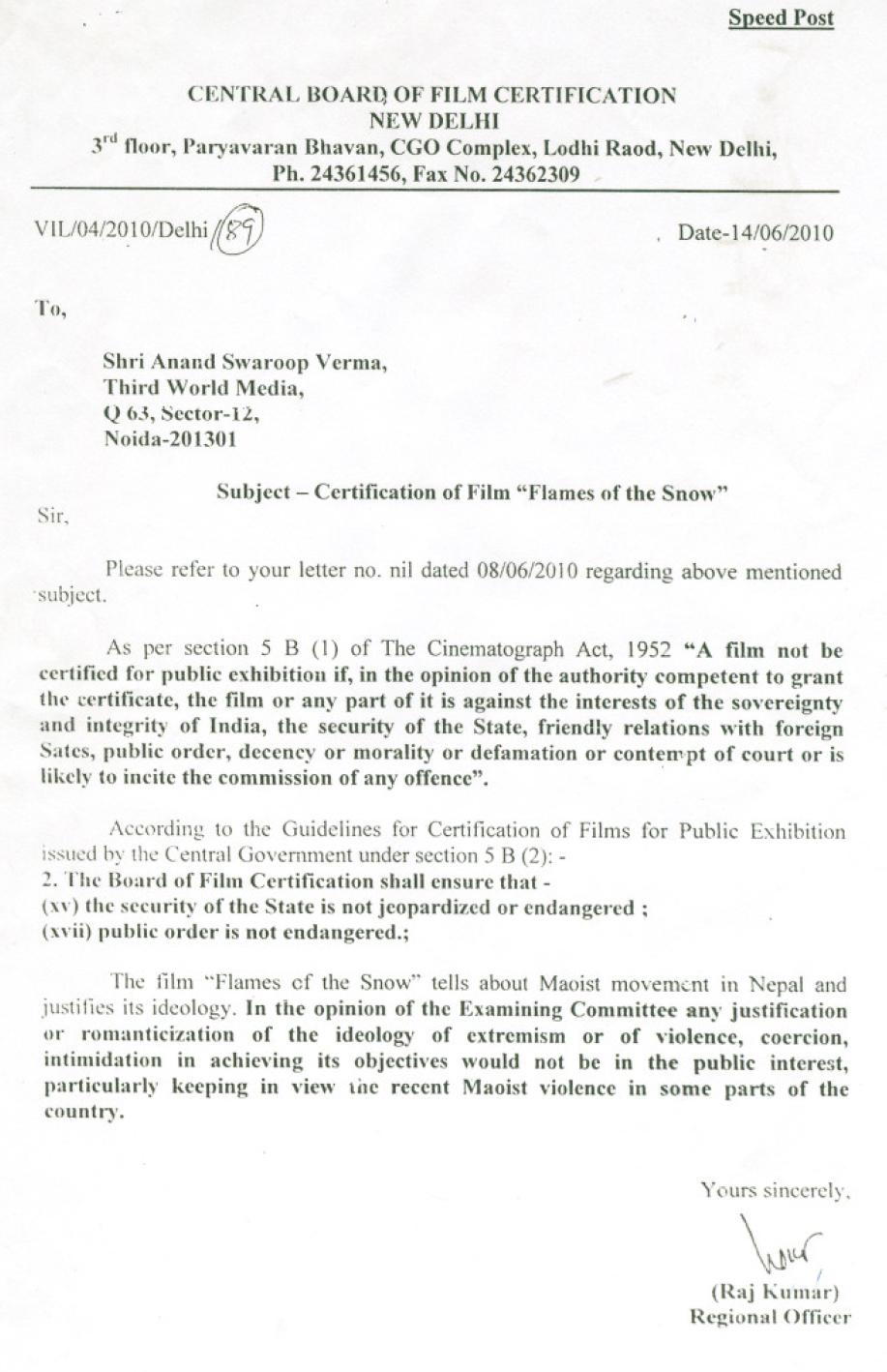
Protest Against Operation Green Hunt in New York, August 13 2010

Protest Against the Indian Government’s “Operation Green Hunt”

Where: At the Consulate in New York City (3 East 64th Street)

When: On August 13 at 11 a.m.

Contact: communications [at] sanhati [dot] com

NEW YORK CITY – Sanhati, and other organizations and individuals, are organizing a protest against the Indian government’s insidious war, named “Operation Green Hunt,” which has been unleashed on the inhabitants of the forested regions of East-Central India. The protest will approximately coincide with Indian Independence Day (August 15) to emphasize that the promises of independence have remain largely unfulfilled for a large section of the population, including the tribal peoples.

In its current phase, this war is concentrated primarily in the forested regions of East-Central India, stretching from the states of Chhattisgarh to Jharkhand and West Bengal. This region is home to significant amounts of natural resources.

Big corporations, both Indian and foreign, are plundering these natural resources for quick profits and plan to continue doing so while paying almost no attention to the enormous environmental and human costs inherent in their ventures. The state and central governments continue to welcome these big corporations with open arms by signing an unknown number of memoranda of understanding with them—whose details have been kept secret. A recent report by the Ministry of Rural Development, on the other hand, described these trends as one of the biggest land grabs since the time of Columbus.

Yet these forested areas house not only natural resources. This region is home to a large section of India’s roughly 100 million Adivasis (i.e., the tribal population). Using all means at their disposal, the Adivasis resisted the government’s efforts to forcibly drive them from their ancestral lands. Drawing on the Fifth Schedule of the Indian Constitution, which is devoted to Adivasi rights and provisions for their protection, Adivasi activists challenged the government’s expropriations.

Instead of addressing the genuine grievances of the Adivasis, the Indian government has cracked down on their legitimate protests in violation of the letter and intent of the Indian Constitution. Peaceful resistance movements across this region have been met with police brutality and military might; this forced the arming of a section of the resistance movement. State-assisted vigilante groups like the Salwa Judum in Chhattisgarh and Harmad Bahini in West Bengal were a response of the state to the armed resistance of the Adivasis.

When that failed, Operation Green Hunt—a further escalation and militarization of the State’s response—emerged. Such militarization is facilitated by the Indian government’s military cooperation with the United States and Israel.

Sections of civil society have been urging the central government to stop Operation Green Hunt and begin negotiations with the diverse people’s organizations opposing the looting of natural resources. The response of the government to the idea of dialogue has in general not been encouraging in view of the plans of increased militarization, human rights abuses committed by the security forces, suppression of dissenting voices, and abductions and killings of the leaders of people’s organizations.

In this context, Adivasis in India, and all the people who are with them in this struggle for freedom from exploitation and oppression, need your support. Join us to protest against Operation Green Hunt and the increasing violence of the Indian State on democratic movements on August 13, 2010 at 11 a.m. in front of the Indian Consulate in New York City.

Oppose the biggest land grab since Columbus!

Oppose Operation Green Hunt!

Oppose the war on people!

###

Sanhati (www.sanhati.com) is a forum of activists, professionals, workers, academics and intellectuals that stand in solidarity with peoples’ struggles against corporate capital and for the upholding of democratic rights in India. The group strives to be an integral part of the international search for alternatives to the capitalist social order.

Contact: communications [at] sanhati [dot] com

********************

Background Note

********************

India Shining, so claimed the BJP-led government. Today, the Congress-led regime might boast that it successfully increased annual economic growth from 5.6% to 8.3% in the last six years, while criticizing the previous BJP-led alliance.

Between the 5.6% and 8.3%, there lurk other stories. About three-quarters of India’s people live on less than Rs. 20 per day, while almost half of the women in India are still illiterate and about 80% of households do not have access to safe drinking water.

Between 1997 and 2006, there lurk other stories. Nearly 170,000 farmers committed suicide by drinking pesticide because they could not keep up with demands to repay their loans. In addition to the agrarian crisis, whatever little access the poor had to common property resources has come under increasing attack by the Indian government in the guise of Special Economic Zones (SEZs) and other “development” projects related to mining, industrial development, information technology parks, and so forth.

Immeasurable stories such as these are grafted onto the underbelly of neo-liberal economic “development” in India. A recent report, penned by the Indian Ministry of Rural Development, described these trends as the biggest land grab since Columbus. In truth, it wouldn’t be hard to keep citing official statistics revealing not only the shadows within the Shining India myth, but huge pockets of darkness. To be perfectly honest, none of this is new. If there is one image of India that has persisted in the Western media, it is the image of bone-thin, bare-bodied children with swollen bellies, scavenging for food-crumbs in trash-cans next to stray dogs and wild birds.

But something has changed in the last five years.
India, like many other parts of the world, has seen the emergence of a whole spectrum of mass movements challenging the global neo-liberal onslaught in many different ways. These movements are not attempts to “brainwash” the masses by English-spouting city-bred students or intellectuals with romantic dreams of social change. On the contrary, these movements are being led by the very people who have been persistently excluded from reaping the benefits of development and growth – in short, the people who live in the pockets of darkness within the so-called shining India.

The proverbial aam aadmi has spoken. The oppressed of India have shown an unwillingness to stay oppressed for eternity, despite the policy of the government to “kill the poor and not the poverty.” These struggles are primarily about defending their lands, rivers and homes from corrupt officials and swindlers. Moreover, these movements have demonstrated that not only has the government failed to deliver on the promises of the basic rights of the Indian constitution itself, the interests of the most economically disadvantageous people have seriously been compromised by its almost total and unconditional submission to the interests of corporations like Mittal, Vedanta, Tata, Essar, Salim, Jindal, and POSCO.

Instead of improving governance while addressing dissent and discontent in an inclusive way, as be-fitting any democratic government, the Indian government has unleashed severe state violence. The government of India has launched an insidious war nicknamed Operation Green Hunt. While the terror initiated by the government since 2009 is by no means unique in view of the history of the state repression across India (e.g., West Bengal, Orissa, Kashmir, the Northeasten states, Punjab, and Andhra Pradesh), Operation Green Hunt is unprecedented both for its array of military force and its media mobilization.

Since last year, more than 100,000 military and paramilitary troops have been sent into Adivasi (i.e., indigenous) areas. Moreover, it was recently announced that 36 battalions of Indian Reserve Forces will be added to the 105 already raised, along with 16,000 more “Special Police Officers” (civilians trained and armed by the government) bringing their total strength to 30,000. Through this new military campaign, which almost brings to mind histories of colonial occupation of land, the military “occupiers” are to gradually spread into one “sanitized” area after another.

Some additional relevant facts:

  • Twenty Warfare Training Schools are being built in India.
  • Prime Minister Manmohan Singh recently spent $18 billion in the US to buy huge amounts of military supplies and munitions. This included state-of-the-art global positioning systems and night-vision-capable automatic rifles.
  • Drones are being purchased from Israel and the Israeli Mossad is training Indian police as snipers. The aim of the training is to enable assassination of the leaders of diverse mass movements. The recent murder of the Communist Party of India (Maoist) spokesperson Azad, who was also the party’s emissary for negotiations on a ceasefire, clearly reflects one aspect of the government’s modus operandi (i.e., targeted killings).
  • According to numerous reports, dozens of indigenous people are being killed each week in the Adivasi regions.
  • The Communist Party of India (Maoist) has been declared India’s “gravest internal security” threat and has been banned. Bans have also been imposed on other democratic organizations on the claim that they are frontal” organizations of CPI (Maoist) and the witch hunt against these civil rights activists continues unabated.
  • The last few months have seen the arrests of increasing numbers of media personnel, journalists, writers, and intellectuals who have shown the slightest sympathy to people’s struggles in the Adivasi heartland. The discussions within the ranks of the police forces in the state of Chattisgarh as to whether the Booker Prize winning writer Arundhati Roy is to be charged under an “anti-terrorism” law following the publication of her essay Walking With the Comrades is a case in point.
  • The state of Gujarat has joined Operation Green Hunt by alleging that “Maoists” are attempting to expand their networks into Gujarat and in particular the tribal regions of South Gujarat. Several activists have been arrested. This witch-hunt of the Gujarat police amounts to a systematic effort by the state government to suppress all manner of dissension and opposition.
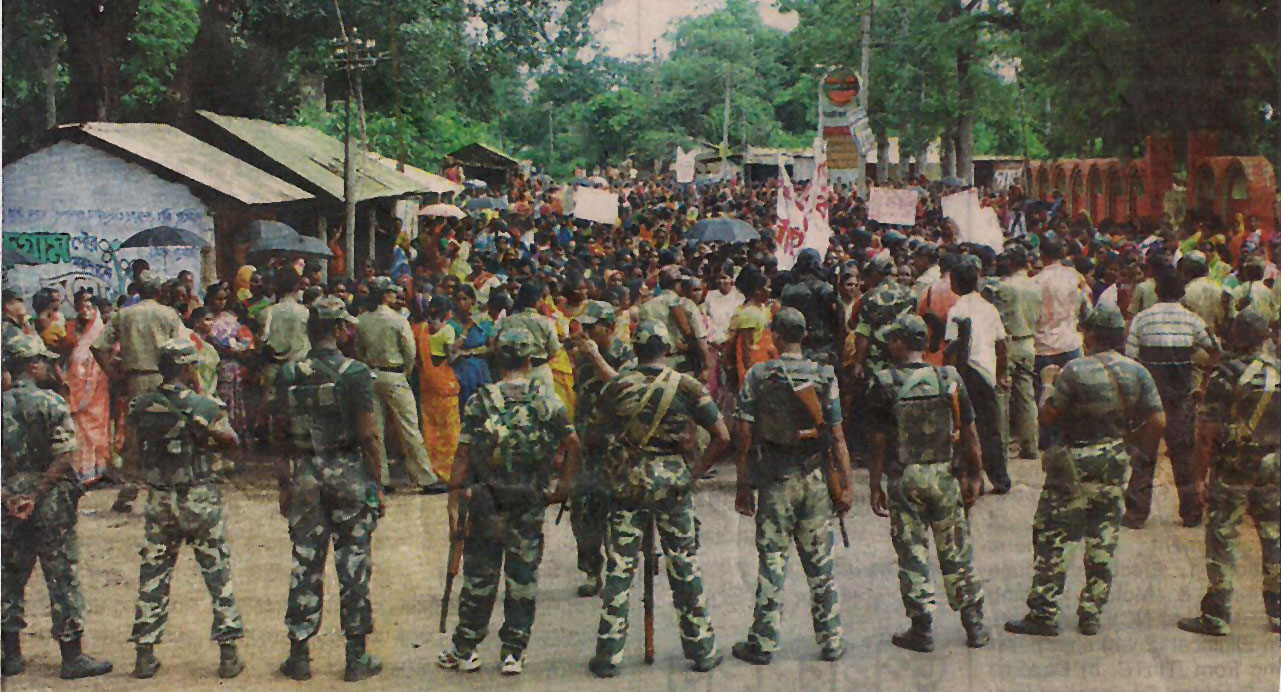
  • Operation Green Hunt includes widespread incidents of rape committed by the security forces. Recently, about 50,000 women tried to march into Jhargram town in West Bengal to protest against these rapes (see photograph above). The marchers included school students in uniform, teachers, housewives and even many elderly women. Widespread rape is a progeny of Operation Green Hunt.
  • The Armed Forces Special Powers Act (AFSPA), one of a number of anti-democratic Acts, continues to give Indian troops immunity from civil legal action and promotes human rights violations. The Naga People’s Movement for Human Rights has aptly observed that this Act is a systematic tool of the Indian government that contributes to terrorizing and dehumanizing civilian populations. This Act also protects security personnel in Kashmir guilty of killing and torturing the people of the valley.


The Indian state, in other words, has declared war on its own people. It has declared war precisely on those sections of the population who have always been at the receiving ends of multiple forms of systemic and institutional oppression. Instead of addressing the genuine grievances of Adivasis facing forcible displacement and dispossession, the Indian government has cracked down on their legitimate protests in flagrant violation of the letter and intent of the Indian Constitution.

Foreseeing the disastrous impact that Operation Green Hunt will have on the common people in those regions, different sections of civil society have called for a dialog between the state and various sections of the resistance, including the CPI (Maoist) and different people’s organizations, involved in struggles in the Adivasi regions. Several attempts to make progress in these efforts failed, with different politicians, bureaucrats and security officers continuously attempting to scuttle negotiations.

A glimmer of hope had risen due to the civil society initiative represented by Swami Agnivesh, with the Union Home Minister and Azad, as spokesperson of CPI(Maoist), responding to him in a letter detailing the suitable conditions under which a dialog might begin. It is reported that Azad was on his way to consult other members of CPI (Maoist) in order to decide future steps for proceeding with this initiative when he was allegedly abducted and killed, thus throwing the possibility of negotiations into disarray. The murder of a spokesperson of a political organization, with which dialog is supposedly being planned at this crucial juncture, raises serious doubts regarding the government commitment to such a dialog.

In this situation, the activists in India need your presence support. Join us to protest against Operation Green Hunt and the increasing violence of the Indian State on democratic movements on August 13, 2010 at 11 a.m. in front of the Indian Consulate in New York City. We have chosen August 13, as this date roughly coincides with Indian Independence Day, when the country became a sovereign nation-state following its colonial occupation by Great Britain. We would, therefore, like to record our protest and remind the public that the promises of the Indian independence have not only remain unfulfilled, but the current Indian government has resorted to military repression to quell democratic dissent in a way uncannily similar to the erstwhile British “overlords.” We invite all in diaspora, the international community of media activists, human rights workers, academics and intellectuals and artists to join us.

Misery is Relative / Comparison of Minimum Wages in Delhi and London

GurgaonWorkersNews no.28 (July 2010)

The following text is devalued with increasing speed: the global crisis and subsequent struggles shake the global wage scale. In June 2010 the Indian government ‘free-floated’ the petrol and diesel prices, fueling the already double-digit inflation. In the UK the government increased the VAT by 20 per cent and cut wage-subsidising benefits. The collapsing Euro inflates the Rupee. The struggles in China and Bangladesh put pressure on wages in the global low-income zones. We will see whether class struggle and crisis will re-shape the global wage-division, old concepts like ‘workers’ aristocracy’ and most of the concepts of ‘integrated’ working-classes ‘in the imperialist nations’ will help little to understand. We need global proletarian debates.

The following ‘relative’ comparison of Delhi and London minimum wages and their respective purchasing power would be a rather tedious endeavor if seen as a purely statistical enterprise or poverty competition. It would result in the usual ‘statistical findings’, e.g. that if you are inclined to become a well-groomed truck-driver with a passion for cheap daily newspapers and road-side cups of tea you should move to Delhi; whereas for any other reasons you should make it to or stay in London – if you can – because you will earn roughly four and a half times as much in terms of purchasing power. If you were a textile company manager looking for low wage zones your perspective might be a little more blunt. You would compare the absolute wage difference between a potential minimum wage worker in London’s East End (around 1,200 GBP per month) and those of a worker in Delhi’s Okhla industrial zone (around 76 GBP per month). The fact that in absolute terms the London wages are about sixteen times higher will make investment decisions a fair bit easier.

We compare the workers’ wages to consumer goods and services. This in itself will tell us little about the actual social position we find ourselves in once we depend on this wage and have to sell our labour power for it. How does our wage compare to the income of people in the city around us? Will we feel ‘excluded’ from wider social life and life-styles? How does the wage compare to the general ‘productive social wealth’, the material power to set in motion bodies and minds for profitable purposes or mass destruction? We compare wages which are set by two different states, wages which are defined as ‘minimum’ in terms of the local, moral, historic minimum level of reproduction for a worker. One local context is the capital of an ‘ex-colony’, the capital of a developing country, the regional centre of an emerging global industrial cluster. The other local context is the capital of an ‘ex-empire’, the centre of historical Industrial Revolution, with 250 years of industrial working class history. The centre of world finance, real estate bubbles and a declining manufacturing base. This also means that Delhi area is dominated by a work-force which – in general sense – knows how many acres of wheat you can reap in a certain amount of time or how many shirts or metal parts a worker can produce per day. Productive workers from mainly rural backgrounds have a rough notion how their productivity relates to wages they receive and prices they have to pay. London is characterised by mainly ‘unproductive labour’: a cleaner might know how much money their company charge the client, they know about exploitation on an immediate level, but less on a social scale.

Workers’ wages and their consumption level tell us something about the ‘stage of capitalist development’, if we agree that one of the characteristic outcomes of industrial working class struggle is that after the class wars of mining, railway building and machine and weapon manufacturing workers a following generation of workers is able to buy ‘industrial goods’ in form of long-lived consumption goods like radios, fridges or washing machines. We also have to mention the ‘sources’ of our consumer products. In Delhi we refer to the most common trade-form for basic food items, vegetables or durable consumer goods: small traders. The prices in London are based on prices of large super-market chains for daily goods and internet price comparisons for durables – because this is how proletarians shop in general. We leave it to a different research to find out whether the demise of small traders and the consequent drop of general wage level due to increased competition will be compensated by ‘cheaper’ large-scale and ‘more direct’ trading.

When we compare London-Delhi wages relative to food items, the London wages are about five to six times higher, if we compare them in relation to the mentioned ‘durable consumer articles’, London wages are fifteen times higher. The astonishing fact is the relative ‘expensiveness’ of agricultural goods’ in India, compared to ‘basic manufactured items’: While I can buy five times as much rice of my London minimum wage, I can ‘only’ buy three times as many shirts or shoes. This is only partly due to higher relative petrol prices in India, which form a decent chunk of food prices. Apart from room rents – which are a peculiar issue – it is personal services such as cooked food or hair cuts where a minimum wage in Delhi can command as much personal service labour as the wage in London. This tells something about the low levels of service proletarian wages in the Indian metropolis! Out of good attitude we put ‘global goods’ into the equation, e.g. Nescafe, Mc Chicken, Nokia mobile phones or IPods. We can see that the ‘wage division’ widens when it comes to these ‘global goods’ – which doesn’t mean that the Delhi young proletarian would not have access to the ‘use value’ of these goods. Let’s not argue about the use value of a McChicken, but of Chinese Fake-Brand MP3-Players or Handy-Cams. Apart from the ‘old school’ consumer durables like fans, gas-cookers and bicycles, the modern proletarian in Delhi owns a mobile phone with gadgets. We suggest the thorough article on Sanhati: “Do 600 Million Cellphones Make India a Rich Country”

But let’s stick to the basics: the level of minimum wage as means of reproduction for a worker. Behind this phrase a political field of question opens up. In London the nominal/direct wage does not cover reproduction, in the sense that in case of illness, unemployment, old age the state has to guarantee an additional part of income. The London minimum wage is hardly a ‘family wage’: the state has to top up in terms of child benefits etc. In Delhi these ‘welfare provisions’ only exist on paper, in 90 per cent of cases workers won’t get unemployment or pension money, neither health care. For most workers in Delhi the minimum wage has to cover parts of these future or ‘accidental’ costs. In a purely economical sense we would have to add these monetary benefits or service costs to the London minimum wage. On the other hand a London worker is very likely to be ‘fully proletarianised’ in the sense that s/he hasn’t got a ‘second home’ in a village and no access to – however small – a piece of land and wider family network which could act as a basic security net. We can argue whether it is not the other way around – that the urban wage has to finance the maintenance of the small piece of land and the rural family members. Fact is that many workers in Delhi industrial areas try to save money – first of all on rent – in order to be able to ‘save money for the home’. Ideally a ‘single worker’ – who is either unmarried or whose family lives in the vilage’ will try to save half of his or her monthly wage. The most common life perspective – or illusion – is that the urban industrial wage work is a temporary stage and that there is a future as semi-peasant / shop-keeper etc. in the village.

When it comes to rent and living arrangements the ‘village’ plays a role. In London only ‘migrants’ would stay five people to a room, no separate kitchen – which is the norm in Delhi, not only for families, but also for unrelated young workers. In this way they can drop the rent share of their total wage to under 10 per cent. In London you might rent a room in a shared flat, giving you access to a kitchen and a toilet, which will cost you around 50 per cent of your wage. In the relative wage comparison we took all three different scenarios into account: comparing the most common set-up; comparing ‘a single worker’ to ‘a single room’ according to the respective local ‘workers’ housing standards’; comparing ‘a single worker’ to ‘a single room’ according to London housing standards. The main obvious result is that compared to other ‘goods’ rent in London is relatively high and the main reason for why the relative wage levels are ‘only’ four to five times higher. Who would have thought?! At this point the quantitative state of mind leaves us clueless: Is it expression of a higher living standard to live in a London Stratford bed-sit, while your two-weeks dead neighbour starts to send his whiffs through the mortar?

What about the ability of workers in Delhi and London not only to be a categorial part of global working class formation, but to take part in it in a physical and communicative way. We can compare costs for flights Delhi-London and costs for an hour spent on the internet and we can see that a flight belongs to the ‘fridge/washing machine’-category out of reach for most Delhi workers, while the internet is closer to home. Here again, we reach other forms of exclusion. Even if a worker in Delhi would be able to save money for the flight, that does not mean that s/he will get a visa. Even if a worker in Delhi can surf on the net, the fact that the Hindi sites are still rather insular compared to the ‘global electronic village’ of the the English speaking Indian upper-class is not an ‘economical’ problem. Which does not mean that the worker in Delhi would not have the means for ‘political mass-expressions’, see prices for printing a small newspaper or for sending it by post. On a similar relative price level range the products of ‘knowledge circulation cum mental domestication’ such as daily newspapers or cinema. In terms of access to career paths to leave the minimum wage misery it looks rather bleak for proletarians on both sides of the globe. A truck driving license might be within reach, but won’t solve the initial problem. The worker in Delhi would have to save around 833 years in order to afford the two years fees for a MBA (management degree), while the worker in London might make it in 20 years. Great.

How do these wages relate to themselves in the historical dimension, does the gap close or widen over time? Difficult question. We can assume that since it’s introduction in 1997 the relative minimum wage in the UK fell – which was 3.60 GBP at the time. But did it increase in Delhi? Minimum wage in Delhi 1990 was around 900 Rs. The early 1990s were turbulent times in terms of inflation, up to 18 per cent annual consumer price increase in 1994 to 1996. If we assume an average annual inflation of around 8 per cent for 1990 to 2010 period, the wage of 900 Rs would have had to increase to 4,177 Rs by 2010 to compensate. Here the fundaments of statistics become drift-sand. Since 1990 the share of temporary and casual jobs, the amount of jobs through contractors increased rapidly, while more and more permanent workers lost their jobs. May be the minimum wage has increased in real terms, the general conditions of industrial workers in Delhi have hardly improved. In what kind of ‘working class position’ would a London minimum wage be situated in Delhi? If we take a common commodity basket (rent, food, clothes, transport, consumer goods – according to average share of total wage), we come to a medium wage ratio of 4.5 times higher wages in London. This would mean that the ‘equivalent’ to the London wage in terms of purchasing power would be around 23,400 Rs per month in Delhi. What kind of wage workers in Delhi would earn this kind of wage – which would place them into widely hailed ‘emerging Indian middle-class’? Some call centre workers earn that kind of money. Permanent workers in the automobile industry earn this much, partly more. We can see that major wage differences run within the industrial areas of Delhi as much as within the global working class. We can also see that the ‘wage question’ is everything but an ‘economical question’, but – in the end – a question of social-historical power, of class power. Let’s stop calculating!

But whoever wants to know how we calculated things: We could see a rather shaky exchange rate between Rupee and British Pound during 2009 – 2010. At the end of November 2009 the rate was 1 GBP / 78 Rs. Since then the British Pound steadily declined in value – or rather, the Rupee got appreciated. On 3rd of May 2010 the rate was 1 GBP / 68 Rs. For the total wage calculation we take the minimum wage for industrial helpers in Delhi May 2010 of 5,200 Rs per month based on an 8-hours day and a 6-days working week. We have to emphasise that only a fraction of workers actually get this wage, most workers earn less or have to work considerably longer hours for it. We base the London hourly minimum wage of 5,80 Pounds on the same monthly working times.

Monthly Minimum Wage Delhi: 5,200 Rs / 76.5 GBP
Monthly Minimum Wage London: 81,600 Rs / 1,200 GBP
Exchange Rate 3rd of May 2010: 68 Rs / 1 GBP

Item [Kilo Rice]: Price Rs in Delhi [22 Rs] / Price GBP in London [1.10] – Amount of Items I can buy with monthly wage in Delhi [236] / London [1091] (London Wage this times higher/lower than Delhi Wage [4.6])

Food

Kilo Rice: 22 Rs / 1.10 GBP – 236 / 1091 (4.6)
Kilo Wheat Flour: 14 Rs / 0.3 GBP – 371 / 4,000 (10.7)
Kilo Potatoes: 10 Rs / 0.5 GBP – 520 / 2400 (4.6)
Kilo Pasta: 35 Rs / 0.8 GBP – 149 / 1,500 (10)
Kilo Red Lentils: 48 Rs / 1.2 GBP – 108 / 1,000 (9.2)
Kilo Chickpeas: 80 Rs / 1.3 GBP – 65 / 923 (14.2)
Kilo Sugar: 35 Rs / 1 GBP – 148 / 1,200 (8.1)
Kilo Carrots: 20 Rs / 0.85 GBP – 260 / 1412 (5.4)
Kilo Apples: 40 Rs / 1 GBP – 130 / 1200 (9.2)
Kilo Milk: 26 Rs / 0.75 GBP – 200 / 1600 (8)
Kilo Joghurt: 45 Rs / 2 GBP – 115 / 600 (5.2)
Liter Bottled Water: 12 Rs / 0.7 GBP – 433 / 1714 (4)

McChicken: 52 Rs / 1 GBP – 100 / 1200 (12)
Nescafe 50g: 63 Rs / 1.5 GBP – 86 / 800 (9.3)
0.5 Liter Bottle Coke: 20 Rs / 0.6 GBP – 260 / 2,000 (7.7)
Bottle Beer: 50 Rs / 1.3 GBP – 104 / 923 (8.9)
10 Cigarettes 30 Rs / 3 GBP – 173 / 400 (2.3)

Consumer Goods

Shirt: 150 Rs / 15 GBP – 35 / 80 (2.9)
Shoes: 250 Rs / 20 GBP – 21 / 60 (2.9)
Plastic Bucket: 60 Rs / 3 GBP – 86 / 400 (4.6)
Block Soap: 13 Rs / 0.6 GBP – 400 / 2000 (5)
Second-Hand Bicycle: 500 Rs / 30 GBP – 10 / 40 (4)
Nokia Mobile Phone: 1,500 Rs / 25 GBP – 3.5 / 48 (13.7)
Cheap Television: 5,000 Rs / 30 GBP – 1 / 40 (40)
Flat-Screen Television: 10,000 Rs / 110 GBP – 0.52 / 11 (21.1)
Fridge: 8,500 Rs / 100 GBP – 0.6 / 12 (20)
Washing Machine: 7,000 Rs / 120 GBP – 0.7 / 10 (14.3)
Dell Laptop Inspiron 14: 31,400 Rs / 500 GBP – 0.16 / 2.4 (15)
IPod Classic 80GB: 12,000 Rs / 179 GBP – 0.43 / 6.7 (15.9)
125cc Honda Motorbike Stunner CBF: 57,000 Rs / 2,300 GBP – 0.091 / 0.5 (5.5)
Basic Ford Fiesta 1.6: 650,000 Rs / 12,000 GBP – 0.008 / 0.1 (12.5)

Personal Service

Fresh Squeezed Fruit Juice: 20 Rs / 1.8 GBP – 260 / 666 (2.5)
Tea in Cafe: 4 Rs / 0,8 GBP – 1,300 / 1,500 (1.2)
Basic Meal: 20 Rs / 3 GBP – 260 / 400 (1.5)
Haircut: 20 Rs / 8 GBP – 260 / 150 (0.6)

Housing

Monthly Room Rent (three to a room): 400 Rs / 400 Rs – 13 / 3 (0.23)
Monthly Room Rent (working class room): 1,100 Rs / 400 GBP – 4.7 / 3 (0.64)
Monthly Room Rent (same standard): 5,000 Rs / 400 GBP – 1.04 / 3 (2.88)
Monthly Electricity Bill: 40 Rs / 30 GBP – 130 / 40 (0.3)

Transport

Innercity Bus Journey: 15 Rs / 1.2 GBP – 347 / 1,000 (2.9)
500 km Train Journey: 200 Rs / 60 GBP – 26 / 20 (0.77)
Flight Delhi-London AirIndia: 20,000 Rs / 310 GBP – 0.26 / 3.9 (15)
1 Week Thailand (Mallorca) incl. Flight: 15,000 Rs / 180 GBP – 0.35 / 6.6 (18.8)
Liter Petrol: 48 Rs / 1.2 GBP – 108 / 1,000 (9.3)

Knowledge Circulation

Daily Newspaper: 4 Rs / 1 GBP – 1,300 / 1,200 (0.77)
National Letter Stamp: 5 Rs / 0.41 GBP – 1040 / 2927 (2.8)
Soft-Back Book (Penguin): 200 Rs / 9 GBP – 26 / 133 (5.1)
Cinema: 50 Rs / 7 GBP – 104 / 171 (1.6)
Hour Internet: 15 Rs / 1 GBP – 347 / 1,200 (3.6)
Print of 7000 Copies 4 Pages A4: 4,000 Rs / 400 GBP – 1.3 / 3 (2.3)

Career

Truck Driving License: 1,600 Rs / 1,400 GBP – 3.25 / 0.86 (0.26)
MBA Two Years Fees: 1,000,000 Rs / 49,900 GBP – 0.0052 / 0.024 (4.6)
Three Years Apprenticeship Mechanic: 187,200 Rs (three years no income) / free

The Political Economy of Oil Prices in India

Sanhati

Based on the recommendations of the Kirit Parikh Committee, the Government of India (GOI) on 25 June, 2010 announced the full deregulation of the prices of two crucial petroleum products: petrol and diesel.[1] Henceforth, prices of these two products will be determined by the unfettered play of market forces and government “subsidies” on these products, which worsen the fiscal situation, will be completely removed.[2] In one deft move, therefore, government control over the determination of the prices of these key commodities was willingly ceded to the magic of the market, presumably to “rationalize” prices and to wipe away losses of state-run Oil Market Companies (OMCs) to the tune of Rs. 22,000 crore.

There were generally three types of reactions to this announcement in the mainstream English news media. Firstly, the markets were ecstatic about the full liberalization of petrol and diesel prices and these sentiments were almost immediately reflected in rising oil stock prices.[3] Secondly, there were strident complaints that this policy change was not enough: prices of kerosene and liquefied petroleum gas (LPG) were still minimally under government control and therefore even after the deregulation move, the losses of the OMCs on account of these two petroleum products would stand at Rs. 53,000 crore for fiscal 2011.[4] Thirdly, various opposition parties have pursued their ‘Bharat Bandh’ without much vigor.

Before getting into a detailed analysis of the political economy of oil prices in India, let us quickly address three questions. Why are the financial markets and the mainstream media pleased with the liberalization of petrol and diesel prices? An important reason is that this policy shift is a victory for capitalist interests of a long drawn struggle against the regulation of oil prices in India. Using the myth of subsidization and fiscal burden, capitalist interests have long been pushing for the liberalization of oil prices. The first crucial victory of this struggle came in 2002 when the government dismantled the administrative pricing mechanism (APM). This move reduced the “subsidies” on petrol and diesel but the government decided to continue to “subsidize” kerosene and LPG. In 2005, the GOI constituted the Rangarajan Committee to study pricing and taxation of petroleum products.[5] This committee recommended a half-way house: a ceiling on the refinery gate price (computed according to the so-called trade parity formula) along with the freedom for OMCs to set retail prices. Of course, this was not enough. Accordingly, in 2009 the next committee was constituted to examine the same set of issues, i.e., the Kirit Parikh Committee.[6] In its report submitted in February 2010, the Kirit Parikh Committee finally recommended what the capitalist sector had been telling GOI all these years. It recommended full liberalization of petrol and diesel prices.[7] Although it was famously opined that the “executive of the modern state is but a committee for managing the common affairs of the whole bourgeoisie” we wonder whether it might be more reasonable to believe instead that “the committees of the Indian state are but committees for managing the affairs of the big bourgeoisie under neoliberalism.”

In any case, this immediately bring us to the second question: what will the next committee recommend? The Kirit Parikh Committee has allowed some minimal control over the prices of kerosene and LPG. Recall that the private sector is livid with the residual losses of the OMCs (often misleadingly equated to the “under recoveries”) to the tune of Rs. 53,000 crore resulting from the marginal control that had been retained in the pricing of kerosene and LPG. Thus, even if one does not know the exact date when the next committee on petroleum prices will be set up, one presumes that this yet-not-constituted committee will strongly recommend liberalization of kerosene and LPG prices. Otherwise, it would be either censored or ignored under the current arrangements.

The third question is related to the carefully constructed mythology of oil prices in India. One of the crucial components of the carefully nurtured mythology about oil (i.e., petrol, diesel, kerosene and LPG) prices in India is the idea that the government offers a huge subsidy to consumers. This subsidy, it is claimed routinely in government pronouncements, policy analyses and media reports, shows up as the “under recovery” of state-owned OMCs and pushes up the budget deficit of the government. The subsidization of oil products, follows the next step in the argument, is wasteful of scarce resources. It is ultimately unsustainable from a public finance perspective and should therefore be curtailed. How should this huge subsidy burden be curtailed? By withdrawing government control over petroleum product prices and letting market forces a free rein, or so runs the argument.

The wide currency of this argument would be obvious from even a cursory glance at mainstream media reports related to oil prices in India. A Business Standard report last year highlighted the close to Rs. 25,000 crore of “under recoveries” of the OMCs, dramatizing this “finding” by suggesting a revenue loss of Rs. 75 crore a day.[8] Similar reports find their way to the international media too. Earlier this year, Reuters highlighted the need for deregulation of oil prices because of the increasing burden of “under recoveries.”[9] A special 2008 report on BBC made the same point and speculated that Indian oil companies might be losing about 100 million US Dollars (USD) a day.[10] The Financial Times, in an editorial of July 6, 2010, argued for the need to phase out “subsidies” and end state control over petroleum prices.[11] Such pronouncements are not confined to media reports. It is also propagated by policy analysts in various research institutes. In a series of studies starting at least as early as 2006,[12] the International Energy Association (IEA) of the Organization for Economic Cooperation and Development (OECD) has highlighted the so-called fiscal burden of “under recoveries” of the OMC and has argued for the deregulation of oil prices.[13]

To sort through the complex of issues surrounding oil prices in India we need to address, at least, the following questions. Is the government really subsidizing petroleum products? Can “under recoveries” of the OMCs be understood as a measure of such subsidies? What, after all, are these “under recoveries”? Why is the private sector ecstatic with the deregulation of petrol and diesel prices? To answer these questions we will adopt a political economy perspective, i.e., we will try to see the class interests lurking behind the analysis of “experts”, changes in government policy and news coverage in the mainstream media. Once we carefully sort through the issues we will see that there is a simple motive force behind the whole complex of policy changes and committee recommendations: private sector PROFIT and more PROFIT.[14]

OIL INDUSTRY: STRUCTURE AND PRICES

To understand the much talked about “under recoveries” of the OMCs, it would help to familiarize oneself with the structure of the oil industry in India. The industry starts at what analysts call the “upstream” end, the site of exploration and production of the primary component that gives all varieties of petroleum products: crude oil. The major state-owned players in the upstream sector are Oil and Natural Gas Corporation Ltd. (ONGC), and Oil India Ltd. (OIL); the major private sector players are Reliance, Cairn Energy, Hindustan Oil Exploration Company Ltd. (HOEC), and Premier Oil.

The output of the upstream sector is crude oil, which feeds into the “downstream” sector: the sector responsible for refining the crude oil to get petroleum products (like petrol, diesel, kerosene and LPG), marketing the final products, and development and maintenance of pipelines. The major state-owned entities in the downstream sector are Indian Oil Corporation Ltd. (IOCL), Hindustan Petroleum Corporation Ltd. (HPCL), Bharat Petroleum Corporation Ltd. (BPCL), and Mangalore Refinery and Petroleum Ltd. (MRPL); the major private sector players are Reliance, Essar and Shell.

The distinction between the upstream and downstream sectors give us several important prices. There are the price of crude oil, and the refinery gate price of petroleum products. The first is the price that refiners pay to purchase the crude oil (either from domestic or foreign producers), and the second is the price at which the refiners “sell” the petroleum products to the next stage of the industry. Note in passing that about 80 per cent of India’s crude requirement in 2008-09 was met with imports. Hence, this is the primary channel through which international prices of crude oil affects the Indian economy.

The final sector of the industry is that which maintains an interface with the consumers, the sector which takes care of transportation and distribution of the petroleum products to the retail outlets. The major state-owned players in this sector are GAIL (India) Ltd., and IOCL; the main private sector players is Petronet India Ltd., though Reliance, Essar and Shell have also entered into the fray. This brings us to the third important price in oil industry analysis, the pre-tax price: this price can be arrived at by adding marketing, storage and transportation costs to the refinery gate price of the relevant petroleum product. Adding excise duty (a form of tax levied by the Central Government) and sales tax (levied by State Governments) to the pre-tax price gives the final retail price of petroleum products, the price, for instance, that you or any of us pay at the petrol pump.

Let us summarize: the retail price of petroleum products (like petrol, diesel, kerosene and LPG) equals the sum of the price of crude oil, refining cost plus profit, marketing & storage cost plus profit, distribution cost plus dealer profit, and taxes & duties.

PETROL: COMPONENTS OF PRICE

To clarify matters further and to get a firm grasp on the various prices that we have introduced, let us work through a concrete example. In July 2009, the average international price (FOB) of crude oil was 64.618 USD per barrel, which translates into 1.538 USD per gallon and hence 19.87 rupees per liter. Note that in converting from USD to rupees we are using the average exchange rate between the USD and rupees that prevailed in July 2009: 48.83 rupees per USD.[15] Two things should be kept in mind. First, in 2008-09, India imported about 80 percent of its crude oil consumption; second, in the current dispensation there is zero customs duty on crude oil.[16] Hence, for the oil industry in India, the price of crude oil was 19.87 rupees per liter.[17]

figure1.jpg

Figure 1: Price Build-Up for Petrol

In a written reply to a question in the Lok Sabha in August 2009, Petroleum Minister Murli Deora informed that “of the Rs 44.63 a litre retail selling price of petrol in Delhi, Rs 13.75 is because of the incidence of excise duty and Rs 7.44 a litre due to sales tax.”[18] Here we have two more prices: the retail price of petrol in Delhi(44.63 rupees per liter) and the pre-tax price of petrol (23.44 rupees per liter).

As far as we know refinery gate prices of petroleum products are not publicly available; hence we cannot give exact figures for these prices. But we do have publicly available information which allows us to provide rough estimates of refinery gate prices. In a November 2006 report on the cost structure of OMCs, we learn that the average operational and function costs (excluding labour cost) of the OMCs come to about 1.9 rupees per liter. Thus, if we deduct this amount from the pre-tax price of peterol (23.44 rupees per liter), we arrive at the following rough estimate of the refinery gate price of petrol in India in July 2009: 21.54 rupees per liter. This information is summarized in Figure 1 and 2.

figure2.jpg

Figure 2: Components of Retail Price of Petrol

UNDER RECOVERIES?

With this background in place, we can now address the issue of “under recoveries”, which is misleadingly referred to either as “losses” or as “subsidy”. The OMCs “are currently sourcing their products from the refineries on import parity basis which then becomes their cost price. The difference between the cost price and the realized price represents the under-recoveries of the OMCs.” (Rangarajan Report, 2006, v). In other words, under recovery = import parity price – realized price. Realized price is something on which the government exercised some control. If this is fixed at a lower rate than the import parity price then under recovery shows up. But under recoveries are different from losses. To understand this we need to focus on the definition of import parity price. The Rangarajan Report informs us,

[i]mport parity pricing has been a commonly used approach in a regulatory context or in making a case for tariff protection. The argument in support of this approach is that in a situation where there is no domestic manufacture of a product, the cost of supplying it in the domestic market will be the landed cost which is the import parity price. However, even in a situation where there is domestic manufacture, import parity price can be taken as the international competitive price that sets the ceiling for the domestic price. When domestic refiners are given the import parity price, they enjoy a rent which is equivalent to the differential in ocean freight and associated costs as between crude and products. In such a situation, there is case for mandating the refiners to share the rent with public interest. (Rangarajan Committee Report, 2006, pp. 5)

In other words, import parity price is the price which one would pay if the good is imported. In India this is clearly not the case as demand for petroleum products (like petrol, diesel, kerosene and LPG) can be met by domestic refineries. Indeed, there is a 35% surplus refining capacity over the domestic demand (Sethi, 2010). The price at which domestic refineries can supply petroleum products (export parity price) is less than the import parity price. The difference was about 1.71 rupees per litre of diesel in April-Spetember 2005 (Rangarajan Committee Report, 2006, pp. 4). To correctly measure the under recoveries, therefore, a better formula would be to use export parity price as the benchmark. Using import parity price inflates the notional concept of under recovery, which is then trumpeted by the mainstream media as state-owned OMC losses. Secondly, it is also to be noted that the government had provided sumptuous subsidies towards building the refineries. It is but natural that the refineries share some burden by quoting a lower benchmark price. Instead, the private refineries are being allowed to sell products at import parity price to the state OMCs (Rangarajan Committee Report, 2006, pp. 30). The third reason why under recoveries are only notional and “are different from the actual profits and losses of the oil companies as per their published results” is that “[t]he latter take into account other income streams like dividend income, pipeline income, inventory changes, profits from freely priced products and refining margins in the case of integrated companies.” (Rangarajan Committee Report, 2006, v). Public Sector oil companies do constitute an integrated structure – the notional losses of the OMCs are therefore shouldered by the upstream firms such as the ONGC, and GAIL (Rangarajan Committee Report, 2006, 30). They also are some of the biggest profit earners of the country[19]. Hence to talk about unsustainable susbsidies is a white lie.

To sum up: first, under recoveries can only occur when there is some control over the prices that OMCs can charge the consumers; if OMC were given full flexibility in terms of setting prices, they would probably always charge a price so as to keep the under recoveries to nil. Second, most of the OMCs don’t import petroleum products (like petrol, diesel, kerosene and LPG). They buy these products from refineries which, in turn, import crude oil. Thus, import parity price – which uses the import price of petroleum products instead of crude oil – is only a notional cost that they pay for the products they sell to the consumers. Hence, “under recoveries” of the OMCs refer only to a notional value of the losses of the OMCs; it is not a real quantity which figures on their balance sheets. Thus, it is a mistake to equate “under recoveries” with state-owned OMC losses, as the mainstream media constantly does. Of course, the meaning of under recoveries will change drastically if we allow private sector players into the scenario, as we will see later.

While the mainstream media commits the mistake of portraying the under recoveries of the OMCs as “losses”, government officials and policy analysts err by depicting the under recoveries as “subsidies” or “effective subsidies” (the 2009 IEA report and the Kirit Parikh Committee are notable recent examples). Let us see why.

GOVERNMENT SUBSIDY?

It is meaningful to talk about government subsidies in relation to a commodity only when the tax revenue generated by the commodity (for the government) is lower than the subsidy that the government offers to producers/sellers of that commodity. Another way of saying the same thing is to insist on the usage of net subsidies: if the government tax revenue on a commodity is higher than the subsidy that it offers on that commodity, then on a net basis the subsidy is a negative quantity. In such a situation it is meaningless to say that the government subsidizes the commodity.

figure3.jpg

Figure 3: Financial Balances of the Oil Sector in India

Is the GOI subsidizing petroleum products in any meaningful sense, i.e., on a net basis? There is a simple way to answer this question: compare the total tax revenue coming from petroleum products to the exchequer with the sum of under recoveries and direct subsidies. Figure 3 plots precisely these quantities for the past few years. Note that the sources of the data in Figure 3 are as follows: (a) the data for under recovery, taxes (sales tax) and duties (excise and customs duties), and total revenue has been taken from the website of the Petroleum Planning and Analysis Cell (PPAC) of the Ministry of Petroleum and Natural Gas, GOI, and the Kirit Parikh Committee Report; (b) the data for direct subsidy has been taken from Table 26, Basic Statistics on Indian Petrol and Natural Gas. [20]

Several interesting facts emerge from Figure 3. First, the direct subsidy of the GOI for petroleum products is extremely small. In fact, direct subsidy is a tiny fraction (less than 1 percent) of the total tax revenues from the oil sector. Second, the total contribution of the oil sector to the exchequer has been higher than the sum of under recoveries of the OMCs and direct subsidies on petroleum products for all the years since fiscal 2004. Third, even the sum of duties (customs and excise) and (sales) taxes on petroleum products, which is only a fraction of the total contribution of the oil sector to the exchequer, has exceeded the sum of under recoveries of the OMCs and direct subsidies in all the years since 2004-05. The inescapable conclusion from Figure 3 is that there is a negative net subsidy on petroleum products in India. Another way of saying the same thing is that the government extracts a net positive tax revenue from petroleum products in India. The oft-repeated assertion that petroleum products are subsidized in India is simply not true.

WHAT ARE UNDER RECOVERIES, TRULY?

We have suggested, so far in our analysis, that under recoveries of the state-owned OMC are neither financial losses (because notional prices are used) nor can they be used as measures of subsidization (because there is negative net subsidy on the oil sector).

What are they? Why is the private sector and the mainstream media so concerned about under recoveries?

To get a handle on this important issue, let us imagine a vertically integrated, state-run corporation that sells petroleum products. This corporation imports crude oil, much like India does today, refines it to produce petroleum products and sells it to consumers. Thus, this corporation contains within itself both the upstream and the downstream sectors of the industry, as well as the retailers/dealers. If the final price at which this hypothetical corporation sells petroleum products to the consumer is higher than the sum of the price of crude oil, the cost of refining & distribution (with some rate of return included) and taxes/duties, then this corporation would be said to be making a profit (from the perspective of the people of the country).

Now, let us break up this hypothetical state-owned corporation into two parts, one of which is involved only in refining and the other only in distribution, both still being state-owned. In this case, there will be two balance sheets and the transaction that was earlier internal to the big corporation would now show up as sale/purchase between the two smaller corporations. Even in this case, we would adopt the same procedure as above to see whether the two firms taken together are making a profit: if the final retail price is higher than the sum of the price of crude oil, the cost of refining & distribution (with the same rate of return as before included for both corporations now) and taxes/duties, then the arrangement is profitable. In other words, it does not matter if “losses” show up in the balance sheet of one of the corporations as long as the government’s tax revenue is adequate to cover that “loss”.

Thus, if the government administratively fixes the price of petroleum products such that the distribution corporation suffers under recoveries, it is hardly a matter for concern because (a) the government’s tax revenues are far above the under recovery of the state distribution corporation (in our example), (b) upstream firms make enough profits to bear the burden. This is more or less the situation of the oil sector in India if we consider the state-owned upstream and downstream corporations taken together. Since the total revenue from the sector, and government taxes, are higher than the “losses” showing up on the balance sheets of some of the corporations, Indian society is not making a net loss.

The last and crucial step of the argument is to allow private sector players into the scenario and see how everything changes drastically. Continuing with the example, suppose now, we have, in addition to the two state-owned corporations, a private corporation. This hypothetical capitalist firm is involved in refining and distribution. Now, it is obvious that government control over prices that lead to “under recoveries” would translate into true losses or lower rates of profit for the private corporation. If the realized price is lower than the import parity price, in the balance sheet of the private OMC it would show up as loss – provided the OMC adopts the import parity price as the benchmark. But since the private firm has the refining facilities arm, like Reliance for instance, overall the firm might still make a profit because (a) taking import parity price as the benchmark means high profit margin for the refinery, (b) even without this high margin the refinery may itself be profitable enough to make up for the loss of the private OMC. Nevertheless, let us note that decontrolling the “realized price” promises even higher opportunities to earn profits for the private sector firm, as no under recovery now shows up.

That really brings us to the crux of the matter as regards under recoveries. The under recoveries of the OMCs do not mean much as long as they are covered by the tax revenue of the oil sector only when private sector players are absent from the scenario. As soon as private sector players enter the picture, the under recoveries of OMCs become a proxy for the losses of private sector players. Since the private sector wants to enter the oil sector and earn windfalls, it highlights the under recoveries and policy analysts endeavor to show it as a burden and the mainstream media faithfully relays that concern. The way to remove the under recoveries, i.e., the way to ensure a positive and high rate of profit for private capital in the oil sector is to do away with cause of under recoveries: government control over petroleum product prices. Hence, the recommendations of various “experts” is to liberalize oil prices, and the GOI, by accepting and implementing that recommendation is working to ensure high and positive rates of profit for private capital in the oil sector.

Let us end with an example that you can chew. From Petroleum Minister Murli Deora’s answer to the Lok Sabha we know that the pre-tax price of petrol was about 23.44 rupees per liter in July 2009; if Reliance or Essar sold petrol in Delhi in July 2009, this is roughly the after-tax revenue it would make on each liter of petrol. What would be an estimate of the cost that Reliance or Essar would bear for a liter of petrol? In July 2009, the average international (FOB) price of crude oil was, as we have already noted, 64.618 USD per barrel, which translates into 19.87 rupees per liter.. Thus, if Reliance or Essar imported crude for their refineries, they would pay about 19.87 rupees for each liter.

What mark-up over processing and marketing cost would they want? The average international pre-tax price of gasoline in July 2009 was about 2.33 USD per gallon; since the international price of crude oil was 1.538 USD per gallon, this implies a mark-up over processing and marketing cost of 1.515 (= 2.33/1.538). Thus, for an international oil company, the price of petrol (gasoline) was set at about 152 per cent of the cost (of crude oil). It seems reasonable to assume that Indian capital would also like a similar, if not higher, mark-up over cost. Thus, in July 2009 Reliance or Essar or Shell would have liked to be able to set a pre-tax retail price that was 152 percent of the cost of crude oil. So, what pre-tax price of petrol in India would have been required to ensure an internationally competitive mark-up over processing and marketing cost? The answer is 30.20 rupees per liter (= 19.87 * 1.52).

Now things are clear. According to the Petroleum Minister, the pre-tax price of petrol in Delhi was only 23.44 rupees per liter in July 2009; that meant, using an international rate of return benchmark, a 6.75 rupees per liter less profit for a private sector player like Reliance. That, it is clear, was enough to create a hullabaloo about under recoveries and fiscal burden and the efficiency of the market and push the government to set up the Kirit Parikh Committee and decontrol petrol and diesel prices. Profit, you see, is what this whole fuss is about.

Resources for Further Study:

Rangarajan Committee Report: http://petroleum.nic.in/Report1.pdf

Kirit Parikh Committee Report: http://petroleum.nic.in/reportprice.pdf

Surya Sethi’s 2010 EPW article: “Analysing the Parikh Committee Report on Pricing of Petroleum Products,” Economic and Political Weekly, March 27, 2010. [PDF] »

——————————————————————————–

[1] http://www.pib.nic.in/release/release.asp?relid=62834

[2] The Times of India has reported that diesel prices have not yet been fully deregulated. This is misleading. The very first paragraph of the press release of the government (http://www.pib.nic.in/release/release.asp?relid=62834) says: “In the light of Government’s budgetary constraints and the growing imperative for fiscal consolidation, and the need for allocating more funds to social sector schemes for the common man, the Government has decided that the pricing of Petrol and Diesel both at the refinery gate and the retail level will be market-determined.” (emphasis added) The next sentence of the press release has the caveat that the TOI report picks on: “However, in respect of Diesel, the initial increase in retail selling price of Diesel will be Rs. 2 per litre at Delhi, with corresponding increases in other parts of the country. Further increases will be made by the Public Sector Oil Marketing Companies (OMCs) in consultation with the Ministry of Petroleum & Natural Gas.” So, it is true that any price increase of diesel which is over Rs. 2 will require government consent at the moment, but this seems mere window dressing given that the principle of market-determined retail prices has been accepted and loudly affirmed.

[3] http://blogs.wsj.com/indiarealtime/2010/05/20/governments-price-rise-gives-gas-to-oil-stocks/

[4] http://www.deccanherald.com/content/77473/under-recoveries-remain-high-despite.html

[5] http://petroleum.nic.in/Report1.pdf

[6] http://petroleum.nic.in/reportprice.pdf

[7] Writing on the budget earlier in the year, Debarshi Das had already noted the government’s move towards decontrolling prices of petroleum products to facilitate the growth of private profit: http://sanhati.com/excerpted/2205/

[8] http://www.business-standard.com/india/news/psu-oil-companies-may-lose-rs-25000-crunder-recovery/369561/

[9] http://in.reuters.com/article/idINIndia-48367020100510

[10] http://news.bbc.co.uk/2/hi/7430784.stm

[11] http://www.ft.com/cms/s/0/44586cac-8930-11df-8ecd-00144feab49a,s01=1.html

[12] http://www.iea.org/work/2006/gb/papers/petroleum_product_pricing.pdf

[13] http://www.iea.org/papers/2009/petroleum_pricing.pdf

[14] Some of the points raised in this article were also made by Surya Sethi in a post-budget analysis in the EPW (“Analysing the Parikh Committee Report on Pricing of Petroleum Products,” Economic and Political Weekly, March 27, 2010)

[15] International prices of crude oil and other petroleum products can be found here: http://www.eia.doe.gov/emeu/international/prices.html#Motor

[16] Paragraph 4.43, Kirit Parikh Committee Report.

[17] To be more precise, we will need to add the the cost of insurance, ocean freight, ocean loss; this quantity is typically assumed to be about Rs 50 per tonne (http://www.projectsmonitor.com/detailnews.asp?newsid=9540). Since it is not very large, for our current computation, we will ignore it.

[18] http://www.expressindia.com/latest-news/Kerosene-LPG-prices-lowest-in-India-Govt/498859/

[19] http://en.wikipedia.org/wiki/List_of_companies_of_India

[20] http://petroleum.nic.in/petstat.pdf

Sanhati’s statement on the killing of Azad

Sanhati

We strongly condemn the heinous killing of Cherukuri Rajkumar aka Azad, spokesperson and Politbureau member of CPI(Maoist), and Hemchandra Pandey, a freelance journalist. Although the Andhra police claimed that they were killed in an alleged encounter in the hills of Adilabad in Andhra Pradesh, multiple reports strongly indicate that they were abducted by the Special Intelligence Branch (SIB) of Andhra Police from Nagpur, Maharashtra and then murdered, before their dead bodies were left in Adilabad. We join all democratic-minded people in demanding a thorough enquiry by an independent citizens’ group into the incident which would provide a clear picture of the sequence of events that led to their illegal abduction and killing and which should lead to the prosecution of all personnel involved in the crime. Simultaneously, we demand the immediate disbanding of all such quasi-secret branches of the security establishment, whose sole aim seems to be silencing the voices of resistance.

These killings are occurring with the Operation Green Hunt in the background, in the name of battling the influence of CPI(Maoist) in the forest areas of East-Central India. But, in reality, the Green Hunt is a militarized project of the central and state governments for grabbing land, by breaking and clearing people’s resistances, for eventual exploitation of natural resources by multinational corporations. During this operation, that has been on since October 2009, there has been complete blackout on the information of what is happening in these remote areas, with sometimes news leaking out of incidents of severe state repression in the hands of the joint state and central forces, threatening the life and livelihood of people in this region. Any attempts by civil liberties activists or independent journalists to access these areas have led to detentions and even arrests. In the last few months, several activists belonging to different kinds of resistances in these regions and also in urban areas have either been killed or imprisoned under draconian laws.

Foreseeing the disastrous impact that OGH would have on the common people in those regions, from the very beginning, different sections of the civil society have called for a dialog among the state and different facets of the resistance, including the CPI(Maoist) and different people’s organizations involved in struggles in the adivasi regions. Several attempts to make any progress in these efforts have failed, with different politicians, bureaucrats and security officers continuously attempting to scuttle discussions on these possibilities. In recent days, a glimmer of any headway had risen due to the civil society initiative represented by Swami Agnivesh, with the Home Minister P. Chidambaram and Azad, as spokesperson of CPI(Maoist) responding to him via letters detailing the suitable conditions under which dialog can begin. It is reported that Azad was on his way to consult other members of CPI(Maoist) in order to decide future steps for going ahead with this current initiative, when he was allegedly abducted and killed by the SIB – thus throwing the possibility of talks into complete disarray. Such an act – the murder of a spokesperson of the political organization with which dialog is supposedly being planned – at this crucial juncture by security agencies thus raises serious doubts regarding the sincerity of the state to the process of resolving the conflict through any dialog. Any confidence that the common people would have had in the process is completely shattered.

What happens now ? With sections of media commentators encouraging more pinpointed decapitation of the rebel leadership, and reports of strongly-worded rhetoric from CPI(Maoist) leaders, the possibility of an immediate resumption of the process leading to any dialog seems to be receding, with the spectre of Operation Green Hunt continuing to haunt the lives of people.

Meanwhile, the multitude of protests across the country, after the inception of Green Hunt, has certainly brought to the forefront the single-most important issue confronting us – a debate on the development paradigm to be followed which would lead to justice and prosperity for the vast majority of the people, currently reeling under neo-liberal economic policies of the governments. This is the burning question and this would inevitably be the central issue during any dialog if it was to occur – in which, people from all segments of the society, specially the marginalized, could significantly contribute. This fundamental debate the ruling class certainly does not desire and that is possibly why the state continuously dithers and tries to stall, by various mischievous means, any progress leading to any form of dialog, trying to scuttle, divert and divide people’s movements on questions like violence/non-violence etc. Therefore, the burden of responsibility lies with the civil society to continue to remain focused and united in demanding an end to the military campaign of the state, while vigorously campaigning for a genuine national debate on questions related to development. We remain committed to this process.

Commonwealth Games in Delhi: Down with eviction of students from College Hostels!

Down with eviction of students from College Hostels!
Onwards to students self-activity!!

The current administration of Delhi University has attempted to reshape the University through a series of sinister agendas – be it the introduction of semester system, the European Studies Programme or the biometric identification system. All of them have shared one thing in common: the thwarting of democratic debate on proposals for change, and the routine violation of regulatory protocols.

The latest episode has been the eviction of students (2,000 students according to reports) from a number of hostels in Delhi University in order to make them available for the Commonwealth Games. Hostels are being renovated and beautified for the officials and visitors of the Games, while students are scrambling around for their own accommodation. The students, like the 40,000 families on the Yamuna bank, are now among the many that have been displaced in the name of national glory. What comes into question is the fact that the University has agreed to avail of 20 crores of rupees from the Commonwealth Games project without taking any cognisance of how and where such resources are generated. It has thus become an accomplice in the larger process of reckless corporatisation that the whole city is undergoing in the bid of becoming a “global city”.

This has left students at the mercy of private accommodation, with its unregulated rents and precarious guarantees. Rents are rising in anticipation of the increased demand for PGs and flats, forcing many existing residents to move out and making accommodation unaffordable for incoming residents as well. The University has made no attempt to devise a mechanism to control or subsidise rents. The inflated prices that students pay are in effect the costs they bear for the cosmetic surgery DU is undergoing, and by extension, the hidden burden they carry for the Commonwealth Games. Some newspaper reports even indicate that hostel fees may increase after the hostels have been “upgraded”. Moreover, the lack of a viable and safe alternative has compelled many girls seeking admission in DU to rethink their decision. The University has also failed to consider living conditions around campus, especially from a gender-sensitive perspective. We can only begin to imagine what it must be like for those with physical disabilities to navigate around dug-up roads, unmarked holes and hazardous construction material.

The students are told that their eviction is “for their own good”. It is “for them” that the authorities are “improving student infrastructure”, making “world-class” hostels. Where was this concern for well-being when the college authorities took the decision to evict students? Not once was there any dialogue with students about this “upgradation”, or about the best and most suitable way to go about it. Instead, the whole decision-making process was shrouded in mystery, leading to utter chaos and confusion: while Hansraj made its hostel residents sign a bond last year declaring they had no objection to being evicted between July and October 2010, Miranda House students have still not been officially informed about the eviction!

We cannot allow the University to get away with such deliberate and avoidable irresponsibility. We make the following demands from the University:

• We demand the provision of alternate accommodation for evicted students.
• This accommodation should be at par with the hostels, both in terms of prices as well as qualitative conditions such as basic amenities and safety.
• We also demand, as conscientious members of a larger community, that this provision not be met at the cost of another section of society.

On our part, let us work towards creating another space, a commune perhaps, an imaginative and practical alternative that is self-governed by members of the university community, a cooperative living space that meets its own needs and conducts itself in a responsible and democratic fashion.

If you are angered by what you see around you in the University, and indeed, in the city, if you want to speak out against the shrinking of democratic space and are ready to reclaim what is rightfully yours, please come and join us!

THIS IS OUR UNIVERSITY! LET’S SPEAK OUT!!

University Community for Democracy

Contact: cwgresistance@gmail.com * Malay 9871924612 * Naina 9313356046 * Praveen 9911078111

A socialist manifesto for education

Dave Hill

The author is a supporter of Socialist Resistance and was the Trade Unionist and Socialist Coalition parliamentary candidate for Brighton Kemptown in the June 2010 British general election. He offered his alternative to the market driven education “reforms” of the other parties.

I have spent my lifetime as a teacher in `challenging’ primary and secondary schools and in teacher `training’ and in universities trying to tackle inequalities in schooling- inequalities that result in millions of working class children having far less educational opportunities- and subsequently, usually lower paid jobs- than the children of richer parents, especially the 7% who go to private schools- and snap up most of the highest paid, elite, jobs.

The very choice of what and how it should be taught, how and what schooling should be organised, how any whom it should be funded, and where and how the funding should be targeted, and a consideration of `who wins and who loses’ through all of the above, are all intensely political. And we want that politics to be in the interests of the millions not the millionaires!

I come from a working class family brought up in some poverty, for example on Free School Meals (like a million others!) in St. Martins’ St., off the Lewes Rd., Brighton. I went to Westlain Grammar School, my brothers to underfunded secondary modern schools, such as Queens Park and Moulscoomb. Three times as much was spent on the education of grammar school students (which educated 20% of state schooled children) than on Secondary Modern students (which educated nearly all the other state school children under the then selective school system)! My children went to local state schools. The inequalities I have witnessed- and lived- as a child, and as a teacher and socialist political activist, have led me to spending my life fighting for greater equality in education and society, and against racism, sexism and against homophobia.

What an indictment of our divisive education system that students from private schools are 25 times more likely to get to one of the top British universities than those who come from a lower social class or live in a poor area. And that (in 2008), only 35% of pupils eligible for free school meals obtained five or more A* to C GCSE grades, compared with 63% of pupils from wealthier backgrounds. This stark education inequality mirrors that in our grossly unequal society.

It is incredible, actually it is only too believable, that in Britain today, the richest section of society have 17 years of healthy life more than the least well-off in society. The minimum wage should be raised by 50%. How can people- decent hard working people like some in my own family, live on take-home pay of less than £200 a week! And there should be a maximum wage, too! Nobody, banker, boss, or buy-out bully, should be on more than £250,000 a year- (and this figure should reduce progressively so that within 10 years no-one is taking more than four times the average wage, nobody should be creaming off £27 million or £90 million a year for example! Certainly not when there are 4 million children living in poverty! I was once one of them. I was helped by the welfare state. We need our public services. We need to improve them, not cut them, not attack them.

All three parties, New Labour, LibDem, Tory, dance to the music of big business. All are promising cuts. Whatever they say, those cuts will hit schools, children, and the quality of education in our state schools. Already we are seeing staff cuts and course closures in universities up and down the country. In Brighton, for example, both Brighton and Sussex Universities are promising to cut out the nurseries, and Sussex to chop over 100 jobs. Brighton University is proposing to cut its Adult Ed art courses. Vandalism! Cutting popular and widely used public services!’

And don’t believe cuts are necessary. They’re not! Cutting the Trident nuclear submarine replacement programme, bringing troops home from Afghanistan and Iraq, stopping the Identity Card programme, and collecting even some even of the £120 billion in taxes unpaid by the rich… yes, £120 billion! And raising taxes high earners…would mean cuts are not necessary at all!

But you won’t hear that from the other parties, just from Socialists, like the Trade Unionist and Socialist Coalition, and from Respect.

A socialist manifesto is:

1. Cut class sizes (they are currently some of the largest in the rich world- much larger than in private schools for example). According to OECD research Britain is 23rd out of 30 developed countries in terms of large class size. Other countries such as Finland have a maximum class size of 20. Finland is widely seen as providing an extremely high quality of education. For a maximum class size of 20 by 2020 in both primary and secondary schools!’

2. Abolish league tables and abolish SATS (some external testing is necessary, but SATS so very often restricts teaching to `teaching to the test’, and results in undue stress (and an increase in bedwetting, compared to the pre-SATS era, for example).

3. Restore local democratic control of `Academies’. They should be run by the democratically elected local councils, and keep to national pay and conditions agreements. Why should rich businessmen and women take control of any of our schools? Let’s keep the added investment- but it’s the government that pays for that added investment anyhow! Let’s keep and enhance the added investment, but distribute it fairly between all schools. Our schools and the children in them are not for sale! Nor, through uneven funding for different types of school (e.g. academies) should some schools be set up for success at the expense of others being set up (and underfunded) for relative failure.

4. Private profiteering out of our schools! Bring the education services hived off to private profiteers back into either national or local private ownership! These include Ofsted, Student grants, school meals, cleaning and caretaking.

5. Free, nutritious, balanced school meals for every child to combat poor diets, obesity, and… yes… for some children… hunger!

6. Restore free adult education classes in pastime and leisure studies as well as in vocational training/ studies

7. Restore free funded residential centres and Youth Centres/ Youth clubs for our children so they can widen their experiences of life in safe circumstances and enhance their education beyond the confines of the home or city.

8. For a fully Comprehensive Secondary School system, so that each school has a broad social class mix and mix of ability and attainment levels.

9. For the integration of Private schools into the state education system- so that the goodies of the private school system are shared amongst all pupils/ students. All schools to be under democratic locally elected local council control. No to Private Schools. No to religious groups running schools. No to big business / private capital running our schools and children!

10. Free up the curriculum so there can be more creativity and cross-subject/ disciplinary work.

11. Get Ofsted and their flawed tick-box system off the back of teachers. The results of Ofsted are to penalise even the best schools (outstanding in every aspect- other than in SATS attainments) in the poorest areas.

12. Encourage Critical Thinking across the curriculum. Teach children not `what to think’, but also `how to think’. Including how to think critically about the media and politicians.

13. Teach in schools for ecological literacy and a readiness to act for environmental justice as well as economic and social justice Encourage children to `reach for the stars- and to work for a society that lets that happen- a fairer society with much more equal chances, pay packets and power, and about environmental and sustainability issues.

14. Proper recognition of all school workers, and no compulsory redundancies. For teachers, secretarial and support staff, teaching assistants, school meals supervisory assistants, caretaking staff, there should be workplace democratic regular school forums in every school. Regarding jobs (for example the threatened job cuts at Sussex University- and the `inevitable’ job cuts in every? school after the election- no compulsory redundancies- any restructuring to be conditional on agreement with the unions.

15. Setting up of school councils – to encourage democratic understanding, citizenship, social responsibility, and a welcoming and valuing of `student/ pupil voice’.

16. Ensuring that schools are anti-racist, anti-sexist and anti-homophobic- making sure schools encourage equality, welcome different home and group cultures.. As part of this, anti-bullying practices in every school must be fully implemented, to combat bullying of all sorts, including racism, sexism, homophobia, and bullying based on disabilities. And this should be not just in anti-bullying policies, but also be part of the curriculum too!

17. An honest sex education curriculum in schools that teaches children not just `when to say no’, but also when to say `yes’, a programme that is focuses on positives and pleasure and personal worth, not on stigmatising sex and sexualities.

18. No to `Faith Schools’ and Get organised religion out of schools. If Christians, Jews, Muslims, Hindus, Zoroastrians, or whichever religion wishes to teach religion, let them do it in their own time, places of worship (Saturday/ Sunday schools) or in their supplementary or complementary schools. Teach ethics and spirituality by all means, and teach about religions. But no brainwashing. Teach a critical approach to religions.

19. Broaden teacher education and training so that the negative effects of the `technicisation and detheorising’ of teacher training (that were the result of the 1992/1993 Conservative re-organisation of what was then called teacher education- subsequently retitled teacher training). Bring back the study and awareness of the social and political and psychological contexts of teaching, including an understanding of and commitment to challenge and overturn racism, sexism, homophobia and other forms of under-expectation and discrimination- such as discrimination against working class pupils.

20. A good, local school for every child. No school closures! “Surplus places” should actually mean lower class sizes! And increased community use of school facilities.

21. A completely fully funded, publicly owned and democratic education system from pre-school right through to university. Education is a right not a commodity to be bought and sold. So, no fees, like in Scandinavia, Cuba, Venezuela, Bolivia, where education up to PhD level is free. No university of further education/ vocational training fees, and a living grant for students from less well-off backgrounds/ income.

In my jobs, firstly as a teacher, and now as a Professor of Education (and writer/ editor of 17 books on education and equality) I have been round hundreds of schools. Many of them are brilliant. Schools in the poorest areas, schools in better off areas! Brilliant. But, with better funding, smaller class sizes, an end to the destructive competition between schools (if every school is a good local school) and with more professional judgement being allowed for teachers- then I look forward to a time when all state schools match the class sizes and results of the currently more lavishly funded private schools’. And working class kids – black, brown, white- get the fair deal currently trumpeted- but in actuality denied- by all three major parties.

Prof. Dave Hill, The Trade Unionist and Socialist Coalition (TUSC) parliamentary candidate for Brighton Kemptown. He teaches at Middlesex University and is Visiting Professor of Critical Education Policy and Equality Studies at the University of Limerick, Ireland. This article appeared in Socialist Resistance on 15 April 2010.

A Fabulist among Communists: José Saramago

Manash Bhattacharjee

The death of José Saramago (1922-2010) doesn’t escape its sombre irony. It is a final punctuation mark in the life of a writer who wrote unpunctuated, seamless sentences. The man who designated the writer as an apprentice and his characters as masters, was ultimately forced to quit his training at the ripe age of eighty-seven. Nevertheless, in tune with his working class roots, Saramago kept his tryst with productivity as diligently as his respiratory illness worked against him.

In his meditative, 1998 Nobel Prize speech, Saramago began by paying tribute to his illiterate grandfather, Jerónimo Meirinho, calling him the wisest man he ever knew. Why was the grandfather so wise? Because he could tell stories endlessly, recounting, what Saramago called, “an untiring rumour of memories”.

This early exposure to oral storytelling helped Saramago incorporate its skills in his writing. He urged the reader to “hear” his novels by reading them aloud, rather than silently. His prose demanded the recognition of the oral as much as the written techniques of language. Saramago himself used the term “written orality” to signify the language he deployed. It opens up an interesting horizon in our understanding of writing’s aural character, apart from the visual. It also grants a twofold meaning to the narrator: as a voice and as a signature.

This must have immediate repercussions on Roland Barthes’ contentions regarding the death of the author.

Unlike what Barthes pointed out, in Saramago’s writing, the “hand” is not “cut off from any voice”. Saramago makes hand and voice work together, where the voice feeds the hand, the way hearing precedes (hence, dictates) writing. The author (in) Saramago thus exists between two disparate credentials, that of the writer and of the oral narrator. The dissemination of language occurs through this process of reciprocal translation between voice and hand, body and mind, memory and invention.

The other contention of Barthes, about the difference between reader and writer, gets blurred as Saramago’s writing itself emerges as a kind of reading. Saramago is infamous for committing mischief with religious and historical narratives. A task he owes to both, a reading and a counter-reading of canonical texts to produce new, critical versions by a reader. The author (in) Saramago is a reader beyond recognition.

For example, in The History of the Siege of Lisbon, Saramago reads between the lines of history and legend, to produce a counter tale. Raimundo Silva, a proofreader, tampers with a vital fact about the Christian re-conquest of Lisbon, by making the Crusaders refuse to help the Portuguese king, hence by default siding with the Moors. Such a move mocks and disturbs Portugal’s nationalist imaginary.

Saramago also spoke of inviting the reader (speculatively, including himself) to “accept a pact”, where he would transform an “absurd idea” into a “logical” stream of thought. He called this “the possibility of the impossible”.

This is particularly evident in novels like Blindness, Seeing and Death with Interruptions, where improbable events take place in a believable language. The events serve as an allegorical device by Saramago to bring to focus his deepest concerns about the human world. The language is believable because Saramago’s plots exaggerate on the oldest anxieties of human beings. He reworks old questions in the light of contemporary concerns, where the bizarre clashes against the everyday. This rupture between the bizarre and the everyday is the key secret of Saramago’s power to both enthral and disturb his audience. Whenever Saramago delves into the theme of political decadence, as he does in Seeing, he traps the reader at the psychological level, but keeps him marvelling at the ingenuity of the plot. The question of plot in Saramago works in an insidious manner: to highlight a particular crisis in the world which the writer finds to be going out of hand, and therefore in need of a radical sub-version of vision. It is a critical subversion of reality, where uncanny events emerge from the heart of the mundane. There is a constant tendency in Saramago to fuse the surreal with the pragmatic. Born to landless peasants, and brought up in a working class neighbourhood, the writer was vigilant about the contradictions of life.

Saramago spent his formative years under Salazar’s fascist dictatorship. This had a deep impact on his working class sensibilities. Saramago became a card carrying member of the Communist Party of Portugal from 1969, when the party was illegal. His relationship with the movement was, however, always critical.

In the 1980s, Saramago sided with the reformist rebellion within the party. Except him, everyone else was expelled. Fidel Castro was a friend who invited him many times to Cuba. Yet in 2003, despite and because of his love for Cuba, Saramago disowned Castro by saying, he “has lost my confidence, damaged my hopes, cheated my dreams”. In 2004, during his visit to Columbia, Saramago designated the two rebel guerrilla groups in that country as “armed gangs”.

There have been polemical attacks by communist intellectuals against Saramago on these issues. It includes sociologist James Petras’ open letter to Saramago regarding the comments on the Columbian guerrilla in the American newsletter Counterpunch, where he accused the writer of “bizarre historical amnesia”.

What is, however, missing in these attacks is the old question post-Stalinist, communist politics needs to ask itself: How does the movement and the party understand the relationship between writers and politics?

For Saramago, like Garcia Marquez, being a writer and being part of politics sometimes uncomfortably came to mean torn loyalties. This rupture of loyalty however doesn’t take place under any relativistic prism. It is not a rupture with the political but rather a rupture within the political. It works as an event which always reaffirms the presence of ethics in politics. Am alert writer, free from the burdens of bourgeois/religious morality, may not fail to distinguish and question the difference between politics as such, and what happens in the name of politics. In other words, the writer would question the representative form of politics and probe the justifications of its excesses. Such an intervention, in cases like Saramago’s, steers clear from any individualised conception of both society and politics.

Despite the de-individualised form of such a writer’s identity, involved in the larger dream of historical transformation, clashes can occur with the vagaries of political expediency and its justificatory, ideological logic. Saramago called himself a “hormonal communist” and yet added, he wouldn’t “make excuses for what communist regimes have done”.

This is a post-Sartrean distinction where a writer refuses to follow any diktat which seeks to undermine criticism in the name of ideological commitment. The angst of good faith is privileged over the paranoia of bad faith. To the disgrace of political regimes, such writers have been violently punished by disciplining bosses in the shadow of ideological excuses. Saramago was fortunate to escape, unlike others, in this regard.

Both literary temperament and politics work within certain constraints. The rationalist logic of politics cannot forcibly restrain the intense logic of literary imagination. Imagination is political, but on its own grounds. This issue not only begs a re-reading of the Frankfurt School and other intellectuals, but more importantly a re-reading of the (auto)biographies of poets and writers who were convicted under communist regimes.

What Saramago owed to communist ideas is best exemplified in his novels. A modern fabulist, he set the mythical vis-à-vis the historical, and the moral vis-à-vis the political. The materiality of Saramago’s imagination never failed to assert its concern of how class divisions work in historical contexts.

In Balthazar and Blimunda, Saramago used the baroque style to capture the violent contrasts between the royalty and the Church on the one hand and the common people on the other. His description of elaborate grandeur surrounding royal and religious formalities gets constantly tampered by his sense of bitter irony and irreverence. The story pays homage to the courage of marginal but talented heroes and heretics who don’t give up the audacity to dream and love in the midst of an impending auto-da-fé.

In novels like The History and All the Names, Saramago also showed his keenness towards certain minor figures like the proofreader and the clerk. These figures, alluding to Saramago’s own journey through these crafts and positions, gain extraordinary prominence due to their idiosyncratic insights into history and society.

Once when asked to specify his identity, Saramago said: “First of all I’m Portuguese, then Iberian, and then, if I feel like it, I’m European.” To prefer linguistic and geographical specificities about oneself over an occidental frame of reference shows how Saramago understood political contexts without taking the rhetoric of grand, cultural narratives too seriously. His understanding of communist politics can also be read through this register.

In 2002, Saramago enraged Jews by comparing Israel’s barbarities with the Holocaust. Saramago’s interest in the Middle East and his siding with the Palestinians is an illuminating shift from a writer who was whimsical about his European identity.

In his last published book of essays, The Notebook, Saramago severely criticised the new global economic order. He called George Bush “the high priest of all liars” and severely took the United States to task.

In a world besieged by neo-liberal fascism, the populist decadence of democracy and the calculated murdering of the poor and the other, Saramago’s voice is a warning from the future. It is very different from the way Hollywood imagines the future in the form of re-colonising, scientific fantasies. Saramago tried to persistently tell us, the future is disappearing before our eyes.

The writer is a poet and a political theorist, living in New Delhi. This article is a slightly improved version of the one by the same title as it appeared in the Literary Review section of The Hindu, 4th July, 2010.

PUDR Statement on the killing of Azad, spokesperson of CPI(Maoist)

Peoples’ Union for Democratic Rights (PUDR) strongly condemns the killing of Cherukuri Rajkumar alias Azad and a free lance journalist Hemchandra Pandey at Adilabad District in Andhra Pradesh on 2nd July 2010. It has been claimed by the Andhra Pradesh police that Azad and one Sahadeva were killed in an encounter near Sarkepalli village in Jogapur forests in Wankhidi mandal, Adilabad, while some other Maoist members escaped. However, the police version is contradicted by media reports which claim that both Azad and Hemchandra Pandey (Sahadev) were picked up by the Andhra Pradesh police from Nagpur at 11 am of 1st July 2010 and brought to Adilabad and killed there. It has also been reported in the press that villagers deny having heard of any gun shots between 10pm to 2am in the night of the alleged encounter. Also it is strange that no policemen was injured in a 4 hrs long encounter. Thus, the police version of the incident is full of contradictions. And the killing could be a part of the official policy to use encounters as a means to eliminate unwanted voices through extra judicial killings.

In its directive of 1996, NHRC had clearly stated that all cases of encounters are cognizable offence until the police version is verified by an independent investigating agency and that ‘whenever information is received of encounter and death is ascertained as a result of firing by the police during the encounter, prima facie the ingredients of culpable homicide under appropriate sections of the IPC are satisfied and a magisterial inquiry shall be instituted against the encounter’. An Andhra Pradesh High Court’s ruling on encounter killings states that ‘the state is responsible to register an FIR against the encounter killing and the plea of self defence be proven before the court of law by the involved security personnel’.

In the light of all of this, PUDR demands registration of an FIR and initiation of investigation into the incident of killing of Azad and Hemchandra Pandey, without any delay. We also demand an independent magisterial inquiry as per the NHRC guidelines.

Moushumi Basu
Asish Gupta
Secretaries, PUDR
4th July, 2010

On arrest of Dr. Nisha Biswas and other civil rights activists in Lalgarh

We, the undersigned organizations and individuals, are shocked by the arrest on 14th June of Dr Nisha Biswas, Scientist – Central Glass & Ceramic Research Institute Kolkata, Manik Mandal, writer, Kanishka Choudhary, school teacher, and ten other persons by the W Bengal police from Lalgarh area, where they had gone at the request of the local people to investigate human rights violations by police and paramilitary. At the time of their arrest they were charged with violation of Sec 144 (anticipated major public nuisance or damage to public tranquility), a bailable offence. However, when produced in court on 16th June they were charged with several other false cases, such as waging war against the state, criminal conspiracy, and unlawful assembly, and remanded to 14 days jail custody. At a hearing on 25th June, a police application requesting her transfer to police custody- on the spurious charges based on a photograph in her camera- was rejected by the court and her bail hearing is due on 6th July.

We believe that this is not an isolated incident, but part of the repression and reign of terror let loose by the central and state governments over the past few years in the tribal parts of central India to crush dissent, and the accompanying attempts to delegitimize and criminalize all dissent and opposition to its policies.

On one hand, the state has launched an armed offensive in the forested tribal areas of Chhattisgarh, Orissa and West Bengal, in the name of countering the `Maoist menace’, to actually destroy the numerous resistance movements against forced acquisition of their land for mining and big industry, against displacement from their land and homes and loss of their livelihoods. This has been accompanied by the increasing use of extra-judicial killings and arbitrary arrests of villagers and leaders, and extra-legal measures that curb ordinary freedom of expression. Lalgarh area of W Bengal has been a site of intense police repression for more than a year now and under Section 144 for as much period. Civil society persons have not been allowed to visit the area and attempts to do so have been met with detentions and arrest. In Chhattisgarh there has been use of the draconian CSPSA to stifle opposition and of non-state actors like Salwa Judum that terrorises and kills villagers, destroys their homes, perpetrates sexual violence against women, and forces them into camps, or to desert their home and hearths and flee to neighbouring states.

On the other, the state has been suppressing in several ways efforts of civil liberties/democratic rights activists to expose the lawlessness and brutalities being committed in these areas by the security forces and to inquire into issues of violation of people’s rights in the process of `development’ of these areas. These tribal areas have been rendered out of bounds for people from outside the area, in violation of all Constitutional provisions regarding freedom of movement and of expression. Any person or group of persons visiting these areas, or talking about or writing about the situation there, or raising questions about the deployment of paramilitary forces in such large numbers is harassed, intimidated, or arrested and labeled as `Maoists’ or `Maoist sympathizers’, thus criminalizing all such democratic rights activities. Starting with Dr. Binayak Sen in Chhattisgarh, a large number of civil liberties activists across the country have been illegally arrested and implicated under false charges of `waging war against the state’ and accused as `Maoists’. Just over the past three months 14 people – trade unionists, forest rights activists and ordinary people – from Gujarat have been arrested under an omnibus FIR.

The recent arrest of Nisha Biswas and others, and the shrill tirade against writer Arundhati Roy, are part of this trend of targeting civil and political rights activists and urban intellectuals, and discrediting them for raising questions, for sincerely carrying out their democratic responsibility of drawing attention to violation of Constitutional and legal safeguards.

We are also deeply concerned by the extreme intolerance being displayed by the state and sections of urban society towards Arundhati Roy for her views on development, displacement, on the situation of the tribals, the violation of their Constitutional rights, and the military offensive of the state. Freedom of expression and vigorous discussion and debate are indispensable for a true democracy. Instead of carrying forward an informed debate on the issues raised by her, attempts are being made to stifle her voice by vicious abuse, public threats of arrest and much more. It is very disturbing that sections of the media too have been (ir)responsible and complicit in this matter, by false reporting of Ms Roy’s statements to suit their requirements. We also take this opportunity to condemn the statement reportedly made by a BJP leader of Chhattisgarh that Ms Roy ‘should be publicly shot down’. That such public incitements to kill a person are ignored by the state machinery exposes the extent of double standards and hypocrisy that characterize our political institutions and leaders. Such intolerance to Ms Roy’s writings and speeches not only makes a mockery of the claims of this country to being a `great democracy’ that grants immense freedom of expression to its citizens, it also poses a grave threat to the spirit of critical public discussion and debate warranted on crucial issues such as development and marginalization.

We are also extremely disturbed and anguished by the reports of rape and other forms of sexual violence by the security forces and Salwa Judum against innocent village women in Chhattisgarh as `punishment’ for alleged support to `maoists’. We ask of the political leadership – in this `war against the Maoists’, for that matter in any place whether it be in Kashmir or the north-east, why are women systematically targetted for sexual violence by the security forces? As already stated above, any attempts to bring this to light and extend assistance are also prevented by intimidation of the affected women. By not taking any action ever against the perpetrators the entire state machinery is accessory to these gruesome acts.

In this situation, we demand:
1. The immediate release of Dr. Nisha Biswas and others arrested along with her.
2. The witch-hunt against Ms Roy be ended.
3. Strict measures be taken against the security forces to put an end to the sexual violence being perpetrated by them against women.
4. We once again demand immediate withdrawal of the armed offensive against the tribal population. Instead, as expected of a democratic government, the government should move towards addressing politically the long-standing grievances of the tribal population, which have been explicitly pointed out and discussed by the government’s own report.

We strongly urge all other democratic minded women’s groups and organizations to join us in this urgent appeal to the Indian government and the respective state governments.

29 June 2010

Women Against Rape and Repression (WARR)

Women Against Rape and Repression (WARR) is a network of individuals and women’s and human rights organizations from across India. It is a non-funded effort initiated by women, and is concerned with atrocities and repression against women by state and non-state actors, especially in conflict zones.

Contact: women-against-sexual-violence@googlegroups.com

Endorsed by:

Organizations

1. AIPWA (Delhi)
2. Alternative Law Forum (Karnataka)
3. Anhad (Delhi)
4. Chhattisgarh Mahila Adhikar Manch
5. Committee Against Violence On Women -India
6. Committee for the Protection of Democratic Rights (Maharashtra)
7. Healthwatch Forum (Uttar Pradesh)
8. Jagrit Adivasi Dalit Sangathan (Madhya Pradesh)
9. Madhya Pradesh Mahila Manch
10. Manasa (Karnataka)
11. MARAA (Karnataka)
12. Narmada Bachao Andolan
13. National Alliance of People’s Movements
14. PUCL-India
15. SAHELI
16. Samanatha Mahila Vedike, Karnataka
17. SANHATI
18. Stree Jagruti Samiti (Karnataka)
19. Vidyarthi Yuvjan Sabha,
20. Women in Governance (WinG) -India
21. Women against Militarisation and State Violence Programme (The Other Media, Delhi)

Individuals

1. Ajay Kishore Shaw
2. Anand Bala
3. Anand Patwardhan
4. Anu Fern
5. Asha K.
6. Bishakha Datta
7. D.P.Duvvuri
8. Daniel Mazgaonkar
9. Dipak Ray Choudhary
10. Dipankar Basu
11. Helam Haokip
12. Dr Indira Chakravarthi
13. Dr Imrana Qadeer
14. Irfan Engineer
15. Dr Janaki Nair
16. Dr Jesse Ross Knutson
17. Jyoti Punwani
18. Kamayani Bali-Mahabal
19. Khadijah Faruqui
20. Dr K.J. Mukherjee
21. Dr Leena Ganesh
22. Dr Manali Chakrabarti
23. Manasi Pingle
24. Milind Champanerkar
25. Dr Mira Sadgopal
26. Dr Nandini Manjrekar
27. Dr N. Raghuram
28. N. Vasudevan
29. N. Venugopal Rao
30. Nandini Chandra
31. Niekesanue Sorhie
32. Piya Chatterjee
33. Prasad Chacko, Gujarat
34. Prarthana
35. Priti Turakhia
36. Priyanka Srivastava
37. Rahul Banerjee
38. Rahul Varman
39. Rajashri Dasgupta
40. Rakesh Ranjan, Delhi University
41. Ranjana Padhi
42. Renu Khanna
43. Ruchi Shroff
44. Sandy Singh
45. S Srinivasan
46. Sanober Keshwaar
47. Shripad Dharmadhikari
48. Snehal Singhvi
49. Dr Uma Chakravarti
50. Uma V. Chandru
51. Vivek Sundara
52. Dr Y. Madhavi

Censor Board denies certificate to “Flames of the Snow”

New Delhi, June 22: Indian Censor Board has refused to certify ‘Flames of the Snow’, a documentary on Nepal, for public screening. The Board feels that the film ‘tells about Maoist movement in Nepal and justifies its ideology.’ It feels that ‘keeping in view the recent Maoist violence in some parts of the country’, the permission of its public screening can not be given. Produced under the joint banner of ‘GRINSO’ and ‘Third World Media’, the 125 minute film has been produced by Anand Swaroop Verma, a senior journalist and expert on Nepalese affairs. He has also written the script for the film. The film has been directed by Ashish Srivastava.

Reacting to the decision of the Board, Mr. Verma said it is quite surprising as the film does not have any reference at all to the current Maoist movement in India. The film is only about the struggle of the people of Nepal against the despotic Monarchy and the anarchic reign of Ranas. With the formation of Nepal in the year 1770 by Prithvi Narayan Shah, the foundation was laid for Monarchy in Nepal which was finally given a burial in the year 2008 when Nepal was declared a Republic. Thus 238 years of Monarchy also included 105-year rule of Rana dynasty which is known as the black chapter in the history of Nepal.

Talking about the film, Mr. Verma further said that the film actually shows how in 1876 Lakhan Thapa, a young man from Gorkha district organized the peasants against the atrocities being unleashed by the rulers of Rana dynasty and was, later, put on gallows by these rulers. Even today, Lakhan Thapa is remembered as the first Nepali martyr. Exploring the movements led by ‘Praja Parishad’ and ‘Nepali Congress’ against the despotic system, the film focuses on the armed struggle carried on under the leadership of the Maoists for 10 years and unfolds the story of how the movement mobilized the Nepalese people by first attacking and dismantling the feudal system in the rural areas and subsequently taking the people’s movement to the urban areas bringing more urbanites into its fold.

The film begins with the establishment of monarchy in Nepal, further touching the developments like the elections for the constituent assembly, the emergence of Maoists as the largest party in the elections and finally ends by showing the decline and complete disappearance of Monarchy and Nepal being declared a Republic.

Taking note of the objections put forward by the Censor Board, it seems that the Board will never give its certification to any political film made on Nepal since no political film on Nepal can escape underlying the prominent role of Maoists. Maoist party was heading the government in Nepal till May 2009 and even today is the largest party in the Constituent Assembly and is the main opposition party. Moreover its president Pushp Kamal Dahal ‘Prachand’ as the Prime Minister of Nepal had visited India on the invitation of the Government of India.

Mr Verma is now submitting his film to Revising Committee of the Board.