
An interview with Matrika Yadav: For a continuous revolution in Nepal
October 14, 2010 by Leave a Comment
The following interview with Matrika Yadav was recorded in June 2010. Comrade Yadav was a minister in the Prachanda government in Nepal and a politburo member of Prachanda-led Communist Party, which was rechristened as the United Communist Party of Nepal (Maoist) after its merger with the CPN (Unity Centre-Masal). While being a minister in 2008, Matrika Yadav was heavily criticised by the mainstream forces both within and outside the party for his active support to radical land struggles and reforms (“seizures”). In his defense, he famously said: “Prime Minister had the compulsion to ensure the survival of the government. [As a land reforms minister] I had the compulsion to advocate in favour of landless people.” Since the beginning of the year 2009, he has been involved in the process of a Maoist realignment by reviving the CPN (M). As the interview is in Hindi, we will try to upload its transcipt in English as soon as possible.
Part 1
Part 2
Part 3
Part 4
Birendra Nayak on People’s Movements in Orissa
October 12, 2010 by Leave a Comment
Birendra Nayak, Prof. of Mathematics, Utkal University, has been studying the movements in Orissa for the past 30years. In this interview, he talks to Correspondence and Radical Notes about the limitations of the very many struggles in the region and future possibilities.
Part -1
Part – 2
Part – 3
Against privatisation of education in Haryana
October 11, 2010 by 1 Comment
KRANTIKARI YUVA SANGATHAN (KYS)
Haryana State Unit of All India Revolutionary Youth Organisation (AIRYO)
Munshi Premchand Library, Dharodi, District-Jind, Haryana
Email: kys.haryana@rediffmail.com, Ph. : 7876103701
On October 5, students enrolled in Adarsh College of Education, Shadipur (Julana), held a militant protest outside the college along with their parents and youth activists of Krantikari Yuva Sangathan (KYS). They were protesting against the college authorities for forcing students to pay Rs. 40,600 for the B.Ed course offered. This amount exceeded what the college had earlier advertised as the fee for the B.Ed course. The youth were also protesting the manhandling of students who tried to meet the college administration earlier and get an appraisal on the situation. The protest successfully drew working class youth from different districts in Haryana.
The protesters argued that as an ‘educational’ institute, it was expected that the college run on the basis of no-profit-no loss/minimal profit. They emphasised that even if the concerned college was a private institution it could not ignore the fact that education is a sector which is based on the notion of service to the society. When mobilising the affected students for the protest, KYS highlighted the fact that the declared fee for the course was already a very large amount and so the extra fees charged was completely unjustified. The fee structure was especially unwarranted considering the fact that most students enrolled were children of agrarian labourers and small peasants.
Indeed, this is no isolated incident, but one which is symptomatic of rampant privatisation of education in Haryana. It is a fact that the government has not been spending adequately on education and health. It is not, for example, creating more of its own institutes for B.Ed/JBT education. Rather than increasing the number of its own educational institutions the government has increasingly allowed private capital to enter the education field. It has been consistently doing this by giving recognition to private institutions that actually refuse to perceive education as a social service. Such private education institutes are well known for their profit-hungry mentality. In the interest of cutting costs to the minimum, these private institutes have no qualms functioning from small, cramped buildings, and in providing minimum teaching facilities. They are simply interested in manufacturing degrees, and are hence, characterised by the lack of teachers, regular lectures and classrooms/other infrastructure.
It is a shocking fact that in Haryana out of the total 459 B.Ed institutes only 19 are institutes funded and run by the Haryana government. Similarly, out of the 20,117 JBT institutes in Haryana only 2620 are government run institutes. Expectedly, in such a situation where government run educational institutions are scarce, the competition is very high and only those with good public schooling make it to the government colleges. On the other hand, students who have studied in badly run government schools due to their working class background are unable to make it to the few government run colleges. As a result, they are forced to enroll in expensive private colleges to pursue higher education. Clearly then, the nexus between the interests of private capital (in the education sector) and the government is a cause of much suffering to lakhs of students and their families.
Unfortunately, while the students were holding their peaceful protest outside the private B.Ed institute, the hired goons of the institution attacked the protest. Some of the protesters were struck by bricks and lathis. Many were bruised in the assault and four were seriously injured. Angered by the administration’s bullying tactics, the protesters decided to approach the District Commissioner. After being apprised of the situation and given a copy of the memorandum, the District Commissioner assured the youth of a positive intervention on his behalf.
Considering how the rampant privatisation of education in Haryana, KYS has decided to intensify its struggle on the issue and mobilise working class youth against the Haryana government’s measures to privatise education. It has been decided to launch a state-wide struggle so as to block the government’s openly capitalist education policy. Indeed, despite the fact that some of the protesting students were returned their money by the college principal on October 9, there remains a strong desire in them to take on the government on the issue of privatisation and commercialisation of education. This is best reflected in the fact that many of the affected youth refused to toe the line of the local panchayat (dominated by wealthy landed elements) which was suggesting a more amicable settlement of the issue. It is also reflected in their decision to march to Kurukshetra University (to which many of these private institutes are affiliated) so as to expose the nexus between the University and the education mafia.
Voices Against The Day: Seven Young Workers from Gurgaon
October 5, 2010 by 1 Comment
We spoke to seven young workers from Gurgaon about village and urban life, about work and hope. They are in their early twenties, part of the new generation of workers in urban India. They work in textile and automobile factories, as rickshaw drivers and cleaners in guesthouses. The conversations touch upon the question of gender, religion and other identities thrown into urban social transformation. They ask the question of social power against the current state of being.
*** Woman Textile Worker
I have just slept. I was injured so I went to sleep after I came back from work. I got injured from the [sewing] machine. The needle went into my hand. The thread was stuck in the machine. When I tried to remove it, I accidentally moved the machine with my foot and my hand came under the machine. The company provided no treatment. Many people get injured like that. There are more accidents in the night.
There are about 3,000 workers in the factory. Many are women. About 1,500-2,000 must be women. They do all kind of work. Everything – operator, sewing also work as hand operators. I am an sewing machine operator. I sew only one part, the arm of a shirt. In one shift I have to sew at least 80 pieces. If I don’t meet the target, the line keeps moving. Nothing happens. The clothes are exported, but I don’t know where to.
I am 17. I have worked in this factory since six months. Before that I worked in another factory. Brown, they produce medicines. I like to work in the export line, because making clothes is clean work. In medicine – don’t ask. Like there is a lot of glass. When it breaks, it cuts into the hand. We have to wash the bottles. Then the drugs powder – if it comes on your hands or face, they burn. It damages. I worked in that factory for two months. It was my first job. I left it, because I did not earn much money. Rs 2500. And I had to work a lot. My bones used to hurt. Then I had to work with medicines. I did not like it. I felt claustrophobic.
The money I earn, girls who are younger than 18, do not get jobs. But I was desperate, and I told a lie at the job. It is so difficult in my family. There is no one to earn except me and my older sister. My father lives, but he has knee problems. He does not work. I have a younger brother. We are educating him. My sister and I – by working. So I said to them at work that I was 19. So they gave me work. Otherwise they would not have let me.
It is normal for women to work there. Women workers have been there from the start. The atmosphere in export is good. There is no harassment, in fact there is pressure on the men to behave themselves. So nobody says anything. Yes, we talk a lot, men and women, but nobody forces anybody. They can talk in the factory. In our canteen too, boys eat on one side and the girls eat on the other side. But they work together. Because they make even women work very hard. And women are getting ahead of men. Women even do the work that men cannot do, they work harder. The employers think that perhaps women will not resist.
The biggest problem is that of the toilet. There are so many women and men working in the factory, but only 2 or 3 toilets. So there is always a queue. When we do overtime, the advantage is that we get double the money. For 2 hrs work we get 4 hrs money. If we work on a Sunday for 8 hrs work we get wages for 16 hrs. For a 8 hour day, I earn Rs 4200 per month. I give all the money to my family, I keep about Rs. 400-500 for myself. The rest I give. Our real salary should be Rs. 4500. But the company is not giving it. The company gives 4200. From Rs 4200, Rs 500 go into pensions. So after the cuts, we get about Rs 3600. From that I keep Rs 300 for transport, I keep Rs 50 – 100 for my own costs. If everybody joins, something an be done about the wages. I cannot do anything alone. Together we can ask for he wages that are our right. We talk that when our grade is Rs 4500, we should get it. We should get the perks. Like today, when I got hurt I went to get medical aid. They did not do much for me. Just gave me half a tablet. Then I went and got myself a tetanus injection. And I got medicine myself, and so it became better. I paid myself. 50 Rupees.
Question: Is there a union in the factory?
A.: Union?
Question: Union – how do you say it? AITUC for example?
A.: Unity [Ekta]? There is unity. If anybody puts pressure on us, then not one person alone, but everybody protests. If somebody shouts, we all answer back. We are all united. The supervisor shouts because if we do not give him the piece, we do not produce, we do not meet the target, he will shout. If a piece is not right he will shout. We just say, “what we did not do in this hour, we will do in the next”. Or “We don’t know what is going wrong”. So we correct him. There is same unity between men and women.
I have one girl friend in the factory, named Bharti. Here in the basti [workers dwelling], I have only neighbours. Here, I do not want to make friends. They talk nicely in front of you, but criticise at the back. They criticise me. If I tell them something private they spread it everywhere.
I would like to be somebody, although I did not get any education. Some profession, some office job. If I get such a job, it would be nice. Here, I go fresh in the morning; but come back tired. I get tired working.
Perhaps my parents will get me married in 1 or 2 years. If not here, then with somebody from the village. What those other people ask me to do and what they don’t let me do – they must decide. If I get married, will I be allowed to see my family? I will not be able to see how my parents are. I would like to stay with them. Our present situation should change. I should work well so our conditions become better. Yes, I would like to work after marriage, because the inflation is so high these days. So if there are 10 people in a family if they all don’t earn, the household will not work. It is so expensive. The house cannot run on one salary. That’s why I wish if after marriage, I am allowed to work I will work. I don’t want to live in the village. I have never been to the village. I don’t know what it is like. I cannot do the work of a village.
*** Rickshaw Worker
I live in Gurgaon since ten years. I drive a bicycle rickshaw. The conditions were better 10 years ago, but now they are very bad. Because the numbers of people have increased a lot. The work we used to do for Rs 2000, now people are doing for Rs 1000. So it is bad. People come from West Bengal, Bihar, UP, Jharkhand, Madhya Pradesh…
When I first came to Gurgaon, there was nothing here. There were not such big houses, not so many houses, not so much rent. We paid Rs. 200, 300 or maximum Rs 500 for rent. Landlords used to beg us to take the house on rent and were ready to do everything for the tenant. Now, when I want to rent, people say they have no room, even when they do have empty houses to rent. Because we cannot pay them the rent they want. We can pay Rs. 1000 – 1200. But Rs 2000 – 4000 how can we pay?
Most workers rent their rickshaws, the rent is Rs. 1000 per month. We earn Rs. 4000 – 4500. So Rs. 3500 are left. We pay Rs. 1.000 for the rent of our shacks. The shack costs Rs. 1000, but you can also get a room for Rs. 1000. To live in a brick-room is difficult because there we have to cook on gas fire. We cook on wood fire. For gas we need a cylinder. We don’t get a cylinder because you need a ration card. Also, they don’t give you any place to put the auto rickshaw. This is why we live in shacks.
Some tension goes on between old people and newcomers. For example you come, I say “Rs. 50 for the fare”, while another rickshaw driver will come and say, “Rs. 20?. So how should it work? There will be tension. When the fare is Rs. 50, why should we take Rs. 20? A minimum rickshaw fair? Nobody talks about this. Because we do not have a rickshaw union here. So nobody talks about this. So if we do not get Rs 20 per kilometer, it is no use.
Sometimes the police make raids. They say “this is an illegal immigrant”, but they are just ordinary workers. The trouble we have with the police is that we park our vehicles everywhere on the road. The police does not let us park on the road. If we park in front of a mall, the guards complain and the police beat us with batons. We have to bear this.
But what can you earn in a different job, for example in the factory – Rs. 2000 to 3000, maybe Rs 3.500. But nobody gets more than that. How can with survive with that? In the factory one works for 12 hours. We work about 10 hours. And in the factory there is an owner and a supervisor. We work when we want to. But yes, there is tension: no passengers, no work.
I think it will become worse in the future. The situation is so bad now. In 2-3 years it will be completely bad. People will be forced to starve. The rice we used to eat for Rs.10 a kilo, we eat today for Rs. 25 a kilo. After 2 years it will be Rs. 30 or 40 for a kilo. Our rickshaw fares are not going up. So if we will not starve, what else will we do?
What can we do about it?. We cannot go to the police. If we complain to the government, they do not listen to us. If we, 10 or 100 rickshaws, jam the road, and ask the public to increase our fares, the police will come and beat us up, because we do not have a union. If there were a union, if even two rickshaws block the road, no car will pass them.
How to make a union? Suppose you are the representative from here. You could tell all rickshaw drivers to pay Rs 500 or Rs 200 per month. All rickshaw drivers in Gurgaon would then deposit Rs. 100 or Rs 200 per month with you, and get a certificate, with the fare for each area on it. So if the police bother you, you show this certificate. If they still don’t listen, you leave the vehicle there and ask the union to intervene. There is a union in Bihar, also in Bengal, but not in Haryana.
*** Guest House Workers
L.:
It is now two and a half years since I came here. For a job, for work, to earn money, this is why I came here. One person can earn Rs 2000 – 3000. In the village getting a job is not so easy. To get a government job you need a lot of qualifications, backing, money, everything. We do not have this. If you cannot get a government job, in the village there are no companies. What can you do there – some work in farms or in houses. It is not permanent. It is temporary. You work for one day and then sit around for a week. This is not right.
N.:
I came in 2000. I have been here for 9 years. First I was small. Now I am grown up so I should earn a little more. I think I will not stay long here. I will go back to my village. It is better in the village than here. Here no one respects you. In Haryana, Gurgaon, if a Bengali makes a mistake they get beaten up. We cannot live nicely or easily here. So I do not like it very much here – in Haryana, in Gurgaon. Yes, 9 years ago it was even worse. In the village what else could my parents have done. They did farming. We still have a little land, but now my parents live here.
L.:
When I came first, I came with a friend. He used to be here, then he went to the village and brought me with him. I found a job after two – three days. It was a company. A small one. A guest house. Yes, cleaning in the guest house. Yes, I found work fast because my friend took me.
N.:
When I came, as I was small, there was no work to be found. That time, I was 10 years old, and people did not give work to small kids. An uncle had come to Gurgaon earlier, he brought us here. When we first came to Haryana, there were no big flats. It was like a forest. And we too lived in shacks. We did not have a flat. Now we have a flat. Gurgaon has become such a nice city. It was not so nice before. There weren’t many roads. My parents went to the village some days ago and have returned, and will go again. My father does cleaning jobs here. In the village there is not so much smell, not so many cars, not so many roads.
L.:
I have come to Gurgaon for the first time in my life. When I came here, I had not been to such a big town. I thought I would get lost. I did not know what I would say if someone spoke to me. That time I did not speak any Hindi, only Bangla. If somebody asked, “What is your name?” I used to think, “What should I say?” Because I am a Bengali. My language is Bangla. Now I do not have any difficulties. All the other Bengalis who are here have some relative, but I until now, I do not have any relative – only friends. No relative by blood.
Here the habits are a little bad, because the Bengalis drink a lot, quarrel with their wives and do not talk to each other with respect. If there is one vacancy here, there are ten young men who want to have it. So what can you do? So which one of the 10 will get the job? So there is always this danger about jobs, a lot of difficulty. How much salary do we get? Rs 3000-4000. What can you do with Rs 3000-4000? Nothing. We have so many expenses. Just the rent for one room is Rs. 1500. To work in a call centre, the first thing you need is qualifications. And the qualifications that you need, I don’t have them. You need at least a Bachelor. And the BA should be in English Honours. But there was no English in my village. There is no Hindi, either. Only Bangla. We learn Hindi after coming here.
There is a big difference between a guest house and a factory. The work in a guest house is a little easy. You don’t have to work that hard. We work in an air conditioned room not in the heat. We can work freely. Nobody is there to watch. Factories are full of the noise of the machines and there are many people. So it is difficult. In a guest house, the supervisor should have a minimum qualification of a B.A. And without a B.A.? – You cannot earn anything. If you live alone, it is very hard. I have taken another person in my room. So the rent is reduced to Rs. 700 – Rs. 800. If you take one more person, it becomes even less.
I have come here for many days – not a lifetime. After living here for a year or so, I will go back to my village, and live with my parents. Then I will come here again for 6 months – 1 year. But we don’t want to stay here permanently.
N. and me, we are friends, he is Muslim, I am Hindu. But people who are not friends think “this person should not talk to me, should not touch me”. “It is not good to meet with them”. They think like this in the village. It is less here. It does not work like that here. Here the friendship works. Like in the village, if I go to somebody’s house they stop me. They say, “Don’t come in, don’t touch me”. It happens a lot even today. I think differently. He is a good friend of mine – that’s what I think.
*** Automobile Worker
I am just coming back from work in the company. I have just done the night duty for 12 hours. I am a VMC operator. Vertical Machining Center – it is designing and modelling work. It is dyeing work. From the dyes, models are made, and then production is made and after production it goes to the press shop. The main client is a company JCB – they manufacture diggers. We make a part for them. And also for Hero Honda and Escort.
About 450-500 workers work in the factory. About 200-250 are permanent. I am employed directly by the company. Among the subcontractors the rate is Rs. 4,200 for 8 hours and they give around 3,500. I earn Rs. 9,000 per month. For 8 hours plus 4 hours overtime daily shift. One week night, one week day shift. There is forging work in the factory, so the furnaces are on and there is fire. This is hard work and the workers have problems. There is a lot of work. The factory runs for 24 hours, even on Sundays. After 12 hours work, I sleep for 4-5 hours and sit with my family. I just have to go to work and eat and sleep.
I work on a CNC machine. After you set it, it runs by itself, and you don’t have to do anything. I have done a diploma in machining. It takes about 2 years to get this diploma. The course costs about Rs. 30,000. With a diploma you can get a job for Rs. 8,000 – 10,000 for 8 hours work. I worked there since 3 months. Before that I was training. The actual work can be done without doing the course, but it would take time.
My father works for the Electricity Board. So he is the only one who does not live in Allahabad. His brothers still live there. My wife still lives there, too. I am a Brahmin, but in the factory there is no difference between castes. Here in the bastis [workers dwelling], people think according to castes and this makes a difference. It makes a difference in terms of eating. We eat separately. We don’t eat meat whereas people of lower classes eat meat. I like it when people mix and eat together. That is correct.
*** Textile Worker
The first time, after I came from the village, I found the environment in the city strange. Finding a job is difficult; I came here to work for 7-8 months and then go back and come again. In the city, the ways of living and eating are strange. There is no time to eat or sleep. You get up to go to work, have a shower to go to work, eat to go to work. Nothing is left for one’s own life.
I had learnt sewing work for 2 years in the village. I was 12 years old then. I was 14 and a half years old when I came here. I did not come to the city on my own. I had a relative – my father`s uncle’s son. I came with him. He taught me the work for 7-8 months. I lived with him for 3-4 years, after which I started to live separately. Since then I have been in this place.
The first job was hard. For 6 months I worked continuously from 9:00 a.m. to 1:00 a.m. No, there was no holiday. Because of that I had health problems – breathing problems. I had to be treated for 1 year. I spent more than I earned on my treatment. Now I am alright. After 6 months I worked in another factory J P Export until I was 15. Then I was 15. Then I worked for 2 years in Liliput Kidswear. Now, since 1 year, I have been working at Unistyle Image. I worked in 7-8 factories altogether, in the last seven years the wages did not increase. I was never made permanent – it has been just like this. I am 22 years old now.
In a year we work for at least 10-11 months and spend one month in the village. And that too – we go for a week or 15 days every 3-4 months. We go for one week and then come back. It is not convenient. There are some people who go back to the village after 5 years because nothing changes there – it remains the same. So people go home according to their need. Those people who have a relation to the village, because of parents, they stay in the village for 2-4 months. They work only for 6 months. Those who do not have money they go to the village after 9-10 months or 4-5 years. Somebody who comes from Bihar, it is difficult for them to go back every 3 months. He earns Rs. 3,000 and can save Rs. 1,000 or Rs. 2,000. The train fare costs Rs. 1,000 or Rs. 2,000. So he won’t go. My village is somewhat close. It costs only Rs. 150, so I go often. But for those whom it costs Rs. 500 – Rs. 600 and it takes 36 hours, they do not do this so often.
Somebody who is old – 45 years, they can’t do much work so why should anyone harass them? And the older you get, the less capable you are of working. Now, when I am 40, I will not be able to see the sewing, I will be practically blind. Because the threads are fine – it is detailed work. So I have to think what I will do after this. We’ll see. Some people go back to the village and do farming.
Normally I earn Rs 5,000 – 6,000. I pay Rs 850 for rent. We are three, so my rent costs are Rs. 300. For food I manage in Rs. 2,000 – Rs, 2,200. If you smoke and drink, those expenses can be increased as much as you want. But I live simply so I manage within Rs. 2000. If we fall ill, there is no telling how much money we will need. One does not know what the doctors will charge. If someone earns Rs. 6,000, he can save Rs. 3,500. I have to send some money back home.
The government has been raising the daily wage, but the wages you earn from piece rate have been coming down. And I have so far worked on piece rate. Seven years ago, the Delhi rate for 8 hour week was Rs, 3,200; now it is Rs.4,550. For example we can say that 20 years ago, all workers were permanent. Perhaps 10 years ago about half were subcontract workers. Now perhaps 80 per cent of the workers are subcontracted. But compared to earlier times, the earnings have gone down.
Previously, the machines were run with the feet. Now there is a computer machine in which we do not need to cut the thread. The computer machine is safer and faster. Whereas with the previous machines we could make 7 pieces, with the new machines we can make 10. We can make 3 pieces more. Where you got Rs 12, you can now get Rs. 36. The problem is to have to sit 16 hours in one place. It is a difficult situation but we are forced to sit there because the company puts pressure on us. If we don’t do it, we will have to leave the company. So we do it in order to be able to live. The atmosphere between the workers is okay, but sometimes there are tensions. Some workers get more work and others less. It is piece rate so if someone gets 10 pieces while another one gets 20, and so the workers will talk why someone got more pieces.
To improve their lives, the workers believe in one thing only – that what is written in their fate – just that will happen. This is their only target. If they are fated to do 12 hours work, then it is useless or beyond their thinking to ask what they can do about it. Life has not improved, rather it has become hell. And it is deteriorating because work is decreasing- There is one company that is being closed down and everything is being sold. In the next 3-4 years, work will decrease and the situation will become very bad. We will move from company to company. 15 days here and then move. We will manage to earn our bread but where we used to get Rs. 5,000 – 6,000 we will get Rs. 4,000. Finding another job is difficult because you have to learn the job. When you see another person doing it, you think it is nice work but as soon as you get in, you find out that it is rubbish work.
The workers feel angry, but there are supervisors standing there all the time. And they have no shortage of workers. If one leaves, there are 10 to take his place. If you do not meet the target, they will remove you and somebody else will take your place. And the workers are always changing – nobody is permanent. Today you come back from work, but there is no guarantee that tomorrow you will have the same work. So it is pointless to think about the future. The workers here keep going on in these conditions. If there is little space to breathe, he wants to cope there. So there is no hope because we do not know what will happen tomorrow.
In 7 years, this is the only factory I have been to where workers stop working, because they offer to pay Rs. 10 per piece and we say this is too little and they say they will not increase it. So we stop work. Then through negotiations, they increase it by Rs. 1 or Rs. 2 or Rs. 4. When we see that this will give us Rs. 200 – Rs. 250 more, we start working again. Recently they offered Rs. 28 for a piece. We stopped working so he increased it to Rs. 32, then offered Rs. 35. We still did not work so he eventually offered Rs.37. In this, there are 50 people who do the sewing. They were all involved.
In total about 100 workers work in the factory of which 50 are tailors, 20 ladies who cut thread, 15-20 in ironing, and helpers. The tailoring craftsmen fought for their rate, the others did not take part. They are mostly subcontractor’s workers. And they also tell us, “You are craftsmen. If you leave here, you will get another job. We will have difficulties in finding a job. We are fine the way we are.”
We were not too afraid to go on strike. Our work is so insecure that we, who work in piece rate, we don’t know when they will throw us out. Some people did fear that they might lose their jobs. But we work on piece rate so that if there is no work tomorrow they will get rid of us anyway. That is why when he refused to give us the rate we asked for, we asked him to settle our accounts. As he was preparing to release us, the man in charge of production came and said he would give Rs. 37. So the work started again.
No, there was no leader. There were 50 craftsmen. When it was lunchtime at 3 o’clock, all the craftsmen went outside and talked with one another that the rate was low and it should be raised otherwise we should stop working at 3:30. So everybody went inside and stopped working. When the supervisor asked us to work, we said “First increase the rate”. There was no need for a leader. And there was no agreement with the management, only with the contractor. The management says they do not have anything to do with us. The owners have nothing to do with us. We are subcontract workers so the subcontractor comes and talks to us. There are two subcontractors. They talk to the management. The management never talks to us, whether we work or not.
We won Rs. 100 for every 12 hours. Once the rate is agreed it stays the same for that production [order]. Because the orders are for 2,000 – 4,000 pieces. What is being made now, there are 12,000 pieces and for these pieces the rate we have agreed that will apply. But the biggest problem is that there is a vast supply of workers. So it is difficult to think how to do this. With us it was that we were making the full piece. In other places it is done in a production chain so you cannot do it. With the full piece you can stop work. In many such factories, which work on piece rate, this kind of thing goes on constantly. There is always disagreement over rate and they increase the wages by Rs.2 – Rs.4. And the workers manage to get something. But the trouble with piece rate is, today there is work and tomorrow not whereas those who are on salary, they get it regularly. But it evens out. The salaried workers earn Rs. 5,000 and we earn Rs. 5,000. But in piece rate there is tension and there are targets.
The labour power, when the workers want it, everything is possible, but they have constraints – there is a wife and kids. When we stopped working for 4 days our wages were increased. If everybody became like this, conditions can become better. But if the workers have a tiny breathing space, they try to manage within that. So how can you talk to them, they are not even prepared to think like that. And one cannot hope that there will ever be a revolution. What should I say? If the worker unity happens we will see. This is a very old tradition and it will take time to get rid of it.
*** Textile Worker
In the sewing department 300 craftsmen work – we are tailors. Then about 250 in pressing, then about 150 in the cutting department. Normally at 9:00 in the morning we start and at 8:00 p.m. or 9:00 p.m. they let me finish. Normally on Sunday, they don’t let me off. No holiday in a week, not even in a month.
It is very simple. If we work hard for 16 hours, we go straight to bed and sleep. We eat and drink whatever is there – hot or cold – and go to sleep. If we feel exhausted, we go and get a medicine for bodyache and go back to our job. If you don’t turn up for the job, you will get thrown out. If you get there in time, they enter your attendance, then they make you work. And suppose you worked till 2:00 a.m. through the night yesterday, your body hurts – it does not matter. They get the same amount of work from you.
With the body, it is that suddenly my stomach started to hurt. I took a tablet and went to the company. I sit at my machine, but if output is less, this does not suit him. He wants to get maximum work, according to the target. He wants to have as much target from me today as he had yesterday.
There are many complaints. They do not give us clean water to drink. By drinking dirty water we catch a cold, or get a fever and headache and many things go. Also because of the lack of hygiene in the toilets, we get health problems too – malaria, tubercolosis or something else. If you work 16 hrs non stop, without proper food and rest, it is simple – you will get tb.
The body does not co-operate. How can the body co-operate, because you take 16 hours work from it. If you work with the body properly and give it proper rest, there is no problem. But it is very simple. We get Rs 4000 – Rs 4300 salary. If the company does not give us overtime work, just Rs. 2,000 is the cost of our room and food. If on top of that we take away Rs. 500 for other costs, then Rs 1000 – Rs 1500 are left. And we cannot do anything with that. So we do overtime in the interest of earning more money.
It is not a rule to work till 1:00 a.m. I can finish early. The situation as it is in my house. In my family, I have registered my children for school and college. To educate them and keep them well, to clothe them, I will have to work, even though it is a lot of stress for me. It might kill me but I will keep working. It is like this. For others, for our parents – for their poverty, to give them money for food, this is why I must earn.
My heart says, “Okay, let’s work till 1:00 a.m. because we do not get double time but single time. Three hours overtime is not enough. We must put in 6 hours. So we have to stay back until 1:00 a.m. When we work till 1:00 a.m. we will fall ill, and have other problems with the body. And so the money we earn with overtime, will get spent on medical problems. So our need is that the salaries should be better. If it is now Rs 4,000 it could be raised to Rs 5,500. Then we will have no need to do overtime.
I see that one year after starting a company the owners can buy three other companies, and think about putting in more machines. So much profit they can make.
The condition of workers injured outside JLN Stadium worsens
September 30, 2010 by Leave a Comment
Alok Kumar, DELHI NIRMAN MAZDOOR SANGHARSH SAMITI
Affiliated to All India Workers’ Unity Centre (AIWUC)
Office: 3267, Gali No. 8A, Baljeet Nagar, Delhi-8
Ph: 9313730069
On the night of September 28, two workers, Ashok and Phoolbabu, who were injured in the foot-bridge collapse outside JLN Stadium, were discharged from Safdarjung Hospital. In their discussion with trade union members of Delhi Nirman Mazdoor Sangharsh Samiti (DNMSS), both the workers explained in detail how they were shamelessly exploited by the contractor. Their job cards showed that they had worked way above the prescribed norms for overtime. Punni, one of the workers injured in the accident and who is still in coma in AIIMS Trauma Centre, had worked for 21 hours at a stretch just two days before the accident. The workers who have been discharged so far have clearly exposed that whenever they resisted overtime, they were badly threatened and were told that if they didn’t comply their pending wages would not be released. In this way they were completely silenced and treated like animals. In fact, the workers mentioned that just prior to the accident they had complained of having to work in the bad weather. Considering they were provided no helmets or any safety gear, they were apprehensive from the very beginning about working on the foot-bridge.
The condition of the discharged workers is very troubling for they are all need of long term rehabilitation/ physiotherapy and are still complaining of pain and discomfort. The fact that their compensation money has still not been released is a source of great anxiety to them and their families. It is shameful that so far no interim amount of money has been released for them so as to help in their immediate recuperation. To add to their anxiety the workers are being harassed by the contractor’s goons, who are forcing them to hand over their discharge papers and to sign/give thumb impressions on blank papers.
The situation is disturbing even in the case of workers still hospitalized. Punni and Jitendar are still in coma in AIIMS. Meanwhile their relatives in hospital are struggling with no help coming forth from the CWG Organizing Committee or Delhi Government. The workers’ relatives have run out of money but are still harassed to pay for MRIs, CAT SCANS, etc. They are continuously pressed to arrange for blood provided by the hospital to their injured ones. Furthermore, with no special arrangements being made for them in the hospital, relatives of the workers are absolutely alone and find themselves struggling for proper shelter. Indeed, it is a shame that they learnt of the accident not through the CWG Organizing Committee or Delhi Government but through the media and word of mouth.
If this situation continues any further, DNMSS will be compelled to launch a city-wide strike of construction workers along with other trade unions and civil liberty groups. We continue to demand immediate release of compensation money to the workers, the provision of government jobs to seriously injured workers, the implementation of a help-desk for relatives struggling in hospitals where many workers are still admitted, and the provision of post-discharge rehabilitation/ physiotherapy to the workers injured.
Book Launch: Pothik Ghosh’s “Insurgent Metaphors” (October 1, 2010)
September 28, 2010 by Leave a Comment
INSURGENT METAPHORS by Pothik Ghosh
published by Aakar Books
to be launched on October 1, 2010
Time: 2.00-5.00 pm
Venue: Room No 308, Indian Social Institute (ISI),
10, Institutional Area, Lodi Road, New Delhi
(Near Jor Bagh Metro Station)
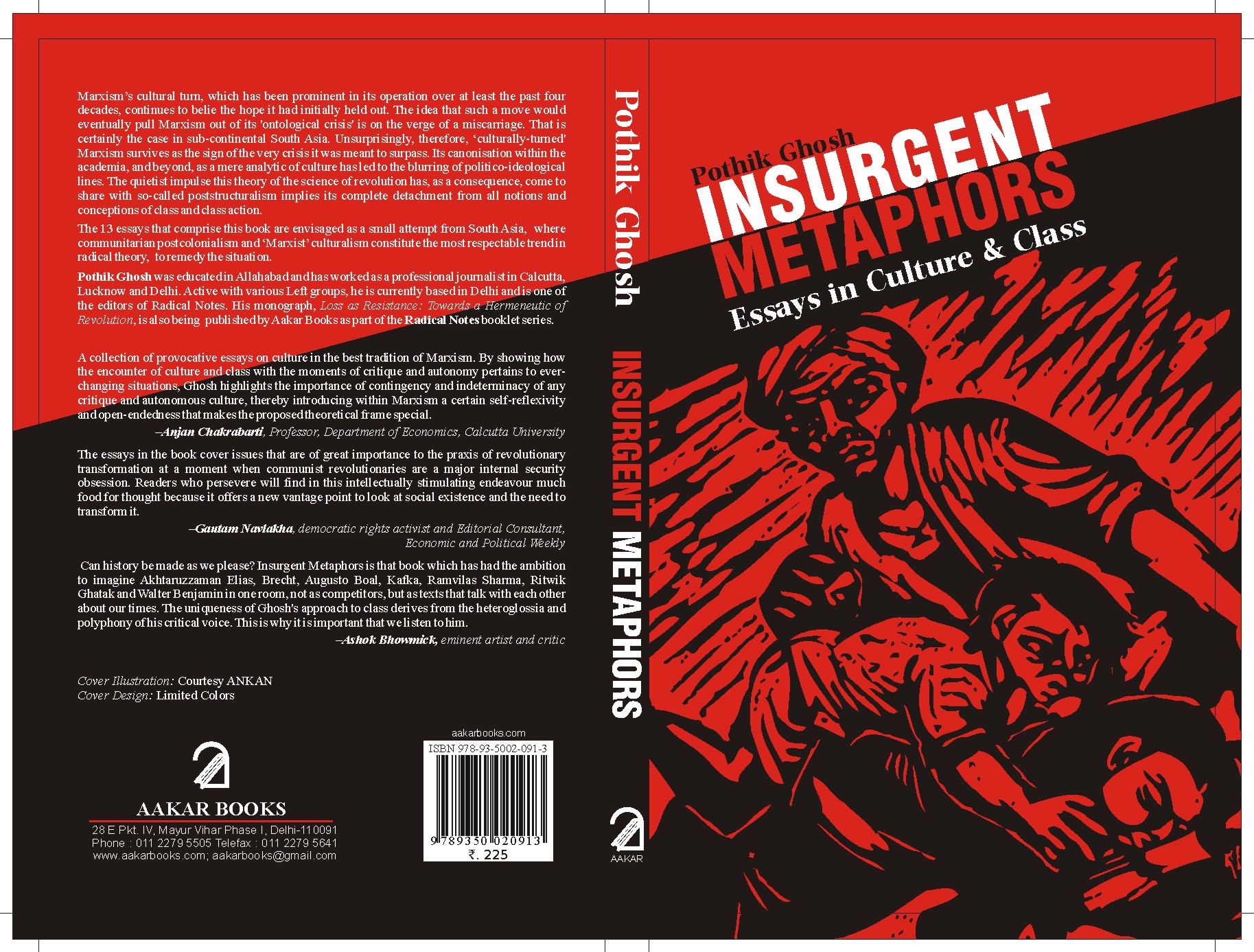
Marxism’s cultural turn, which has been prominent in its operation over at least the past four decades, continues to belie the hope it had initially held out. The idea that such a move would eventually pull Marxism out of its ‘ontological crisis’ is on the verge of a miscarriage. That is certainly the case in sub-continental South Asia. Unsurprisingly, therefore, ‘culturally-turned’ Marxism survives as the sign of the very crisis it was meant to surpass. Its canonisation within the academia, and beyond, as a mere analytic of culture has led to the blurring of politico-ideological lines. The quietist impulse that this theory of the science of revolution has, as a consequence, come to share with so-called poststructuralism implies its complete detachment from all notions and conceptions of class and class action.
The 13 essays that comprise this book are envisaged as a small attempt from South Asia – where communitarian postcolonialism and ‘Marxist’ culturalism constitute the most respectable trend in radical theory – to remedy the situation.
A collection of provocative essays on culture in the best tradition of Marxism. By showing how the encounter of culture and class with the moments of critique and autonomy pertains to ever-changing situations, Ghosh highlights the importance of contingency and indeterminacy of any critique and autonomous culture, thereby introducing within Marxism a certain self-reflexivity and open-endedness that makes the proposed theoretical frame special.
Anjan Chakrabarti, Professor, Department of Economics, Calcutta University
The essays in the book cover issues that are of great importance to the praxis of revolutionary transformation at a moment when communist revolutionaries are a major internal security obsession. Readers who persevere will find in this intellectually stimulating endeavour much food for thought because it offers a new vantage point to look at social existence and the need to transform it.
Gautam Navlakha, Democratic rights activist and Editorial Consultant, Economic and Political Weekly
Can history be made as we please? Insurgent Metaphors is that book which has had the ambition to imagine Akhtaruzzaman Elias, Brecht, Augusto Boal, Kafka, Ramvilas Sharma, Ritwik Ghatak and Walter Benjamin in one room, not as competitors, but as texts that talk with each other about our times. The uniqueness of Ghosh’s approach to class derives from the heteroglossia and polyphony of his critical voice. This is why it is important that we listen to him.
Ashok Bhowmick, eminent artist and critic
Pothik Ghosh was educated in Allahabad and has worked as a professional journalist in Calcutta, Lucknow and Delhi. Active with various Left groups, he is currently based in Delhi and is one of the editors of Radical Notes. His monograph, Loss as Resistance: Towards a Hermeneutic of Revolution, too has just been published by Aakar Books as part of the Radical Notes booklet series.
Commonwealth Games, National Pride and Workers’ Death
September 23, 2010 by 4 Comments
THERE IS NO ‘NATIONAL PRIDE’ IN WORKERS DYING OR BEING DISABLED FOR LIFE IN THE NAME OF COMMONWEALTH GAMES!
Dharna held outside Head Office of the CWG Organizing Committee against blatant exploitation of workers
Fact-Finding Team Visits Injured Workers: Shocked at Lack of Crucial Arrangements like a Help Line
Today on September 23, workers, trade unions, students and civil rights activists held a dharna outside the Head Office of the Commonwealth Games Organizing Committee in Jantar Mantar. This protest was called following the collapse of the hastily built footbridge outside JLN Stadium on September 21. The incident left 27 workers injured, five of whom are critically injured and admitted in AIIMS.
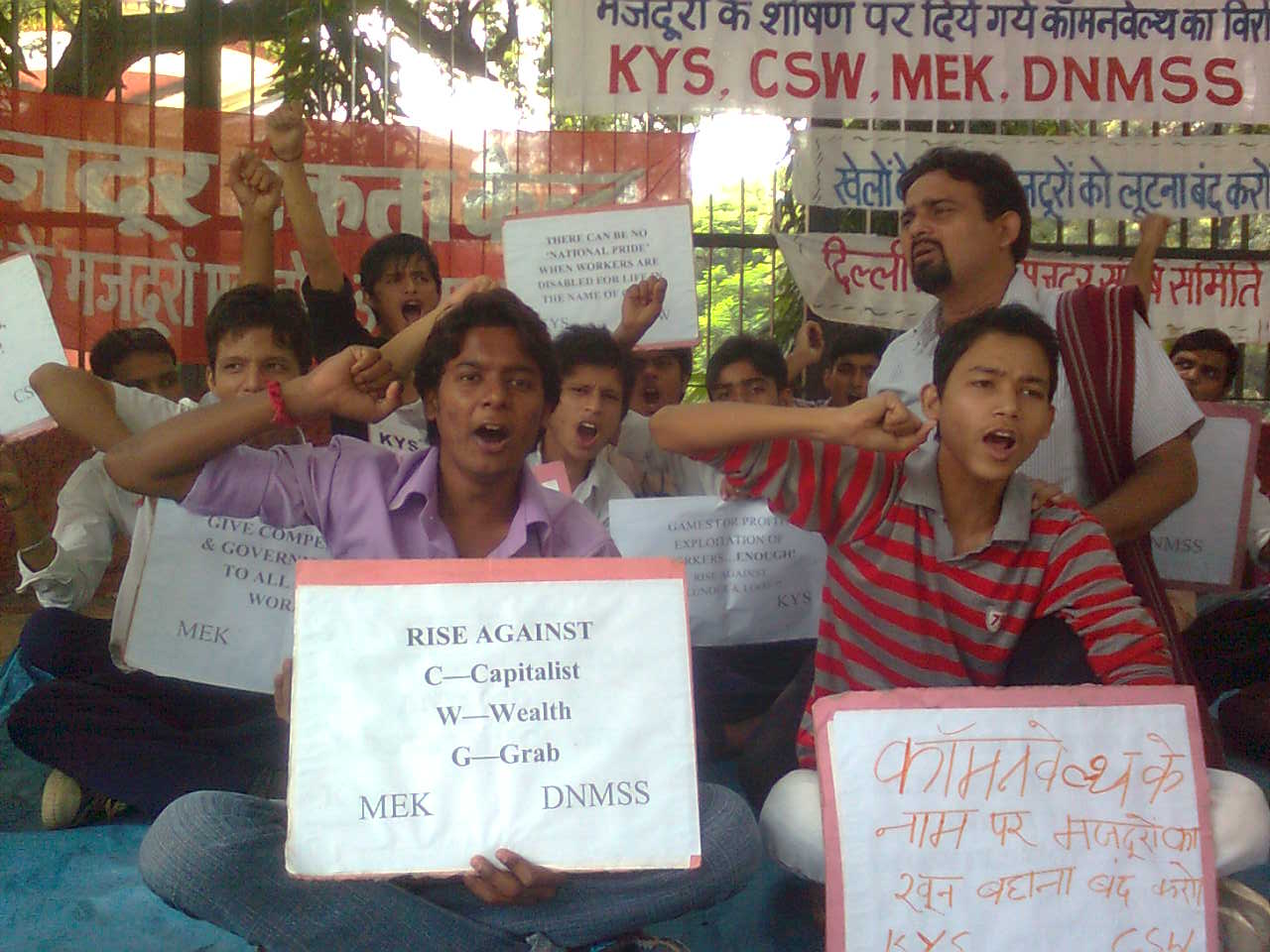
The protesters pointed to the obvious negligence on the part of government officials, and the fact that workers have been continuously exposed to dangerous work conditions across CWG work sites. They argued that the Games were being used to rake in huge profits for builders, many of whom acquired tenders surreptitiously from the government, and have unhesitatingly exploited workers and built structures of poor quality to save on building costs. Hailing the Games a profit-vending event rather than an event of ‘national pride’, Shri Alok Kumar (Secretary of Delhi Nirman Mazdoor Sangharsh Samiti), specified that contractors have made most of their profits by exploiting workers. He said that contractors have been openly exploiting construction workers by exposing them to long hours of work and dangerous work conditions. The government has been party to this exploitation since it is the principal employer in all CWG construction projects. Shri Nag Bhushan, a prominent trade unionist from Gurgaon also addressed the protest. He argued that that the government’s silence, and at the most its tardy response on the issue, has allowed for continuous and brutal exploitation of workers in the name of the Commonwealth Games.
It is for these reasons that the protesters targeted the Organizing Committee (OC). The delegation sent by them demanded the following:
i) Resignation of the state PWD Minister, Shri Rajkumar Chauhan
ii) Provision of government jobs to all 27 workers injured
iii) Immediate release of adequate compensation to all workers injured in CWG work sites.
iv) Cancellation of all contracts given to the accused construction company
Following the apathetic response of the OC the protesters decided to intensify the struggle against the exploitation of workers across CWG construction sites by using all democratic means possible. Trade unions present at the protest have decided to mobilize workers across all CWG worksites on the issue of workers’ blatant exploitation. Considering the fact that CWG organizers have repeatedly boycotted the interests of workers, workers have now decided to organize themselves and reach out to civil society in a bid to stall the Games completely. Through spontaneous protests throughout the period of construction work in CWG work sites, workers have rightfully delayed construction work of the CWG in the past. Now by providing their struggle an organized form they aim to expose to the Indian public, the brutality with which such mega events are organized and executed.
Following the protest at Jantar Mantar a fact finding team was constituted which visited the workers admitted in AIIMS. The team consisting of trade unionists, Delhi University teachers and students visited AIIMS and were shocked by the lack of crucial arrangements that should have been made by the CWG Organizing Committee. Out of the 8 patients hospitalized in AIIMS, 3 are admitted in the ICU (in critical condition, suffering from severe head injuries), and 5 have spinal injuries, out of whom one is already paralyzed. From the discussions with the patients’ relatives it was evident that no information was provided to them on the accident by the CWG Organizing Committee (OC) or Delhi Government. Relatives reached the hospital on hearing about the incident by word of mouth and no provisions were made by the OC/Delhi Government for their travel to Delhi! It was evident to the fact finding team that no volunteers from the OC were made available at AIIMS so as to help/guide relatives coming in to meet the patients. Indeed, the fact finding team itself had difficulty locating the workers in the hospital and ended up wasting crucial time before locating one of the injured workers. The apathy of the government officials was also revealed by the fact that some of the patients’ relatives have been asked to arranged for blood themselves. In its appraisal to the fact finding team, the AIIMS staff made it clear that the injured workers require long term rehabilitation.
The response of the Delhi Government is very shocking and their callous behavior (reflected in their unwillingness to provide proper facilities to workers injured in the name of CWG), is condemnable. We must highlight the terrible way in which workers have been exploited in the name of CWG. We hope that the larger civil society will step forward to help their laboring brethren.
Alok Kumar, Secretary, Delhi Nirman Mazdoor Sangharsh Samiti (Ph: 9313730069) Sujit Kumar, State Committee Member, Krantikari Yuva Sangathan (Ph: 9312654851)
Supported by:
Indian Council of Trade Unions (ICTU)
Centre For Struggling Workers in Trade Union (CSWTU)
All India Federation of Trade Unions (AIFTU)
The struggle of Ludhiana powerloom workers
September 20, 2010 by Leave a Comment
Workers of about three dozen power loom factories in Ludhiana’s Gaushala, Kashmir Nagar, Madhopuri etc. areas are on strike from 16th September 2010 under the leadership of the Karkhana Mazdoor Union (KMU). The workers have revolted against their pathetic living conditions, total absence of labour laws, callous attitude of the factory owners and administration and the opportunistic behaviour of the established trade unions affiliated to parliamentary left parties. They are energised by the recent successful strikes in 42 power loom factories in Shaktinagar area and the Jindal Textiles factory.
Ludhiana is among the big industrial cities in India and the industrial capital of Punjab. The main industries here are hosiery, bicycle, tyre, auto-parts, engineering etc. In recent years the workers in Ludhiana have been fighting for their basic rights e.g. the struggle of the thousands of workers of the big factories of Ludhiana such as Hero cycles, Rockman, Avon, Rolson, Highway, Garetave, Bajaj Sons etc; the militant struggle of the thousands of workers against the factory owners and police-bureaucracy after the Hindustan Tyres episode; the outburst of anger of the workers in December 2009 after the Dhandari episode, the workers hitting the road after a recent disappearance of a workers of Poddar Tyres. These outbursts are just a reflection of the terrible conditions of the life which the workers of Ludhiana are forced to live and the total failure of the governance system to protect even the basic rights of the workers. The anger of workers is expressed at times spontaneously and at other times in a planned and organised manner. It is because of this reason that most of the time section 144 of the Cr. P.C. is imposed in the industrial areas of Ludhiana which prohibits assembly of five or more persons and holding of public meetings besides other restrictions.
Most of the workers of Ludhiana are migrant workers coming from the states of Uttar Pradesh and Bihar. They are treated as aliens in their own country. These workers are subject to abject poverty and extreme exploitation. Despite toiling for 12-14 hours a day, most of the time they do not even receive the minimum wages fixed for a helper for 8 hours work {Rs 3400 (less than 80 USD) monthly}. In case of the power loom workers, there has been no increment in the piece rates and wages for last 10-12 years while the prices of all basic necessities like food, housing, medical care, travel have been skyrocketing. On the other hand there has been manifold increase in the profit level of the factory owners.
The working condition of the power loom workers of Ludhiana is so difficult and so dangerous that it can at best be called inhuman. Serious injuries and deaths at workplace are quite common in the industrial areas. Even basic safety measures and regulations are not implemented by the factory owners. Even the administration does not take any initiative to fulfil its constitutional obligation of implementing the labour laws in these areas. On the contrary in most of the cases, the administration is found connived with the factory owners to serve their interests. No labour law whatsoever is implemented in these factories. Provident Fund, Employees State Insurance, Job Card, Attendance Register have no existence here. The regional labour department is fully hand in glove with the errant factory owners and is suitably compensated for its services. Not only the factory owners have bought up the officials and police, they do not even hesitate to use the services of goons to intimidate the workers if they raise their voices for justice. In the Dhandari episode in December 2010, they unabashedly used the local goons called Bikers’ Gang to brutally attack the agitating workers. Even the police favoured the factory owners and held the workers responsible for the violence. The owners portray any agitation of workers as being launched by “outsiders” and the local politicians and regional media also take the side of the owners only.
The workers of Ludhiana have been fighting for their rights for years through the established trade unions. But of late they have begun to realise that it is because of the betrayal of the leadership of opportunistic and corrupt trade unions such as CITU and due to the lack of well planned strategy that they have not been able to put up an effective resistance and the factory owners manage to crush their struggle. In a number of struggles of workers of large factories of Ludhiana such as Hero Cycle, Rockman, KW,Avon, Rolson, Highway, Bajaj Sons, Moonlight etc since 2004, the opportunistic, compromising, corrupt and pro-management character of CITU has been thoroughly exposed before the workers.
The recent surge of militant agitation among the power loom workers of Ludhiana began with the strike of the 42 power loom factories of Shaktinagar, Tibba Road areas on 24th August 2010 under the leadership of the Karkhana Mazdoor Union. It was the apathetic attitude of the power loom factory owners which was mainly responsible for the inhuman conditions of living which forced the workers to halt the work and choose the path of strike. The main demands of the workers were: hike in the piece rates/wages, necessary provisions for the safety of the workers and implementing all the labour laws including identity cards, PF, ESI etc. The bold, organised and determined fight of the workers forced the power loom owners to relent and they were forced to agree to the demands of the workers. On 31st August the workers withdrew their strike after a written agreement with the owners. It was a glorious victory of the workers after a long time. A remarkable aspect of this victory was that the power loom owners were not only forced to hike the piece rates/wages but they also agreed to give half wages for the days of strike. It is very rare that the factory owners agree to pay for the days of strike. On the contrary, one can find many instances in the labour movement of Ludhiana like the shameful Avon Cycle agreement in which due to the compromising, pusillanimous character of the renegade leadership, the workers were forced to work for 9 days without pay as a punishment for going on strike.
After this a strike broke out in the Jindal Textile factory and there too it reached a successful culmination. It is noteworthy that this was after 18 years that a workers struggle had achieved such success in Ludhiana. During the last one and a half decade the workers of Ludhiana had fought many long struggles but they culminated in shameful defeat due to the betrayal of the established trade unions. The recent victory is important in this respect and it has raised the morale of the workers to a new high.
Meanwhile, workers of some other power loom factories agitating under another union were brutally attacked by armed goons of the factory owners last week. Around 50 workers were wounded in this lethal attack, some of them seriosly. Karkhana Mazdoor Union has demanded the authorities to carry out an investigation and punish the culprits.
Taking inspiration from the recent successes in the Shaktinagar and Jindal factory strikes, hundreds of the power loom workers of about three dozen factories of Ludhiana’s Gaushala, Kashmir Nagar, Madhopuri etc also decided to call a strike on 16th September 2010 under the leadership of the Karkhana Mazdoor Union. These workers are on a strike to force the factory owners to increase their piece rate/salary and to implement other basic rights. They are united and determined to make their strike successful. They have appealed to the fellow workers of other power loom factories who are yet to join the strike to come forward and join the strike to make the struggle more united and strong. Along with this the workers have also organised vigilant squads of their own against the possibility of fresh attacks by the factory owners. A great achievement of these strikes is that the workers are no longer terrified of the police and the goons of the owners. Moulder and Steel Workers Union of Ludhiana has supported the power loom workers in their strike. The workers have also distributed pamphlets among the civilian population explaining to them their wretched working and living conditions and the rationale behind their demands. They have also appealed to other factory workers of Ludhiana to support and join their strike. The workers have warned the officials of the labour department not to work as stooges of the factory owners and perform their constitutional duties otherwise their strike will become more vigorous.
On the third day of the strike i.e. on 18th September 2010, the henchmen of a factory owner attacked the KMU members who were distributing the leaflets in a market and also kidnapped two workers. Immediately hundreds of workers gathered outside the factory where the kidnapped workers were being held. The owner ran away and the workers were rescued. This was another psychological victory for the workers.
Contact for further information:
Rajwinder – 098886 55663, Lakhwinder – 096461 50249
Email: lakhwinder0143@yahoo.co.in
Office: Karkhana Mazdoor Union, Shaheed Bhagat Singh Pustkalaya, Gali No.5, Lakshman Nagar, Gyaspura, Ludhiana, Punjab
 Radical Notes
A Review of “Social Movements I & II”
Gilbert Sebastian
T.K. Oommen (ed.) Social Movements I: Issues of Identity (pp.252+x, HB), & Social Movements II: Concerns of Equity and Security, (pp.352+xii, HB), Oxford University Press, New Delhi, 2010.
The volumes edited by T.K. Oommen constitute a sociological contribution to the study of social movements in India. The first volume deals with identitarian movements and the second, with movements for equity and security. For spatial constraints, we do not attempt a review and critique of individual articles but confine ourselves to the theoretical issues identified by the editor himself.
I
The first volume on identitarian movements has two sections. The first section on Religious and Caste Movements has contributions from Kenneth W. Jones on Socio-religious movements, Christophe Jaffrelot on ethno-religious mobilisation, Walter Fernandes on conversion movements, Vivek Kumar on Dalit mobilization and Shail Mayaram on the emergence of Tablighi Jamaat as a transnational relgious movement. The second section on Regional, Linguistic and Tribal Movements has contributions from Robert L. Hardgrave on the dravidian movement, Dipankar Gupta on the Shiv Sena movement, Sanjib Baruah on the Assam movement, Surajit Sinha on tribal movements and Frederick S. Downs on Christian conversion movements in northeast India. Apparently, the contribution by Vivek Kumar was previously unpublished.
Speaking of identitarian movements, Oommen mentions four processes, namely, homogenisation, pluralisation, traditionalisation and hybridisation at work leading to persistence, eclipse and mutation of identities (I: 40).
Introducing the section on regional, linguistic and tribal movements, interestingly, he mentions the three Great Traditions of India with civilisational differences – Aryan-Hindu-Sanskritic, Dravidian-Hindu-Tamil and Islamic-Urdu (I: 160). Ethnicity, religion and language come into play here.
Introducing the second volume on issues of equity and security, Oommen makes a pertinent point that “equity rather than equality is the motive force behind contemporary social movements” (II: 39). He says that even “radical groups are not arguing for equality of rewards these days” but are only demanding “equality of opportunity” or going a step further and demanding “equality of condition” through ensuring “distributive justice” (II: 39). His understanding of “comprehensive security” including the military, political, economic, socio-cultural and environmental dimensions (II: 40) is, indeed, a welcome concept in these days of extreme paranoia.
In the introduction to the volumes by T.K. Oommen, the theoretical contributions of the “founding fathers” are discussed: Durkheimian structural differentiation, Weberian rationality and Marxian class analysis. He rightly argues that Marx’s “basic argument” on social movements “stood the test of time” except for his overemphasis on collective rationality and lack of emphasis on non-class collectivities (5-6). In defining social movements, Oommen counts in all mobilisations with ideology and organisational framework, irrespective of goals (change or stability) or means (violent or non-violent) (11). He says that one of the aspects – ideology, organisation, leadership – acquires primacy at different phases of all movements (13). He says that the classification of “old” and “new” social movements is inadmissible in the Indian context (14, 38). His classification of movements based on the type of collectivity as biological (women, youth, etc.), primordial (caste, religious, linguistic, tribal, etc.) and civil (workers, peasants, students, environmental movements, etc.) is useful. A better term than “biological” (15-17) should have been used since apparently, these are primarily socially constituted categories. He distinguishes between the instrumental and symbolic goals of movements. Instrumental goals seek reallocation of wealth and power and symbolic goals seek redefinition of status and privilege. The term, “instrumental”, however, sounds rather pejorative. ‘Re-distributive’ could have been a more appropriate term.
Oommen considers mobilisation and institutionalisation as a dialectical process and does not oppose the latter. Questionably, he simply brushes aside the perspective that movements do often go through a life-cycle (25) and may even turn into vestiges of the past weighing down upon the present. He says, “[N]one of the four processes – repression, discreditation, co-optation and institutionalization – will herald the death-knell of a movement. Movements will survive if they have the required legitimacy and appropriate resources” (28). Apparently, he is not sufficiently critical of the processes like co-optation and institutionalisation.
II
Interestingly, right at the beginning of his introduction, Oommen briefly discusses how the disciplinary focuses – historical/political, psychological and sociological – in studying social movements, the object of inquiry, vary. Sociologists were late-comers into this field. Nevertheless, compartmentalisation of knowledge-fields as such could hamper the advancement of knowledge. Indeed, it is when history, sociology, economics and political studies are knit together in an interdisciplinary manner that we can have an enlightening study.
Oommen says, “There is no hierarchy of identities, but only contextuality of identities” (I: 40). One reason why Oommen has missed the punch is because the notion of primacy (not a hierarchy in an a priori sense) among social contradictions is missing. At any given point of social development, one or the other contradiction comes to the fore and assumes primacy and urgency over other contradictions which of course, are related to the former. Addressing this principal contradiction may lead to viewing social reality in an intersectional manner so that different kinds of oppressions can be interrelated. For instance, addressing the land question in contemporary India entails taking on the historically constituted property structure, addressing the interrelated issues of class, caste and gender.
Along with this, comes the question of the quality and extent of change. Oommen junks M S A Rao’s classification of movements as reformist, transformative and revolutionary, for shifting the defining criteria. But it would have been quite useful to retain this classification on the criterion of quality and extent of change. This would be clearer if one tries to substantively understand the social and political movements during their high point in the 20th century. We could classify them under four rubrics on grounds of the structural bases and the transformative agencies involved: (1) Class struggles; (2) Anti-colonial and national liberation movements; (3) Social liberation movements of women, Dalits, Adivasis, minorities, African-Americans and other ethnic minorities, etc., which are pitted against dominant sections within a society more than against a regressive State and global capitalism towards which they maintain a love-hate relationship; and (4) General democratic movements such as anti-globalisation movements, environmental movements, etc. The extent of social transformation achieved through radical class struggles and progressive national liberation movements are, apparently, of a qualitatively higher order than those achieved by social liberation movements and general democratic movements. This is because the former were able to take head on macro-structures of de-humanisation like State, semi-feudalism and global monopoly capitalism and therefore the consequences for the system were much more serious. The sociological classification of movements by Oommen looks more abstract than substantively historical. The latter approach would have entailed seeing the movements in a process of change or movement in time, assigning them importance according to their transformative potential.
On the Indian scenario, Oommen also makes a controversial remark: “[T]here was/is no archetype class movement in India; the equivalent of that was the anti-colonial movement (37).” Telangana, Tebhagha and Naxalbari movements and the class struggles led by the Naxalites/Maoists today, with a wide geographical spread, challenge this argument. That the Maoist movement interrelates class with other social categories such as nationality, caste and gender does not disqualify it from the status of a class-based movement. The anti-colonial movement had, most often, failed to address issues of class/social equity and as G. Haragopal says, bequeathed us the negative legacy of a false dichotomy between the ‘social’ and the ‘political’.
Oommen says that “the real threat to the state emanates from primordial collectivities”. The book “leaves out movements which are explicitly ‘political’ … such as anti-colonial or secessionist movements” (19; I: 160). This omission is serious if we consider the immense transformative potential of nationality movements. Considering the fact that Armed Forces (Special Powers) Act (AFSPA), 1958, the most draconian legislation in the country violating the very right to life in the narrow sense of the term, is operational in the intensely militarised frontier nationalities, the issue of the ongoing nationality movements merited treatment at least from a human rights angle.
Crucially, Oommen draws a distinction between “hegemonic” and “emancipatory” identitarian movements (I: 42). Anchoring this distinction in the contemporary rights discourse, we could, better term them as “privileges-based” and “rights-based” identitarian movements. The former are disempowering and the latter, empowering. Given this perspective, the Shiv Sena movement finding its place alongside the rights-based regional, linguistic and tribal movements is an anomaly in the book.
He argues that it is cumulative dominance and coercive equilibrium that becomes the context for social movements (I: 42). However, the cumulatively oppressed and coercively repressed may, often be too weak to initiate social/political movements on their own. Instead, it may be more useful to harp back on the Marxian notion of relative deprivation as the context for movements. Moreover, ‘humiliation’ rather than just exploitation may spur movements.
We could describe a movement as ‘an idea whose time has come’. There is, at times, a simultaneous upsurge of movements in an epoch of social transformation such as the colonial period in India. The making of an epoch of social transformation involves complex interactions of material conditions including the cultural context on the one hand with subjective forces on the other. Collective human agency may be held to be the crucial factor in this process.
Oommen notes the interesting difference between old class activism of the “union-mode” and the new community activism of the ‘campaign-mode’ (50). A separate section critically analysing the global civil society movements could have been usefully undertaken in the book.
If we agree with Manoranjan Mohanty that “rights are political affirmations in course of struggle” or movements, one cannot underestimate the importance of studies on social movements. Oommen needs to be commended for this collection of otherwise scattered across papers. Along with the volumes from Ghanashyam Shah, these volumes can be useful reference material on social movements in India. Oommen’s introduction to the volumes, “On the Analysis of Social Movements” carried in both volumes is a must-read for researchers on social and political movements in India. It is a valuable contribution to the typologies of movements, bringing up many subtle insights, besides sparking off little controversies.
Oommen rightly says that ongoing movements are rarely studied (II: 322) and [probably, for this reason,] what we have is more of a “sociology of movements” rather than a “sociology for movements” (II: 318). For all the crucial insights that they provide, regrettably, Oommen’s edited volumes, may qualify only as a “sociology of movements”.
Gilbert Sebastian is associated with Developing Countries Research Centre (DCRC), University of Delhi, New Delhi. He can be contacted at gilbertseb@gmail.com.