Slum dwellers in Bhubaneswar fight the police – A Report

Satyabrata

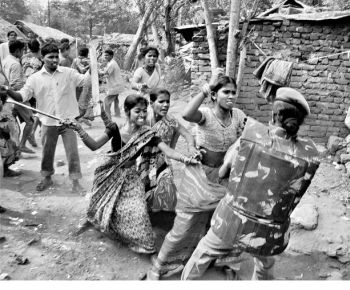
Two hundred and fifty-nine families (1195 people) resided in sixty year old Narayani Basti (slum near Unit 8 DAV School, Bhubaneswar) till the 29th of January 2011. On the 29th of January 2011, ten platoons of police with 9 platoons armed force and DCP and Commissioner of police went into the region and demolished the slums. Slum dwellers protested and many of them were seriously injured in their struggle against local goons and police who assaulted women. The police arrested hundred slum dwellers which included forty nine women. These women were kept locked in a van and were not allowed to leave the van for any reason. On the 30th of January local goons present did not allow either food or water to reach these people after they forcefully returned to their slums. Food prepared by the people from outside (Basti Suraksha Manch) was also not allowed to reach these people. The people organized themselves and started throwing stones at the local goons to get some time to collect and store food. Dodgers came again but this time failed to oust the organized masses. The people of the slums have now decided to take up arms (anything they have at their disposal, hammers, knives, etc) against anyone who tries to come to attack them.

Courtesy: The Hindu

These people living in the slums of Narayan Basti have been attacked by the police without Notice several times before. For the first time it happened in 16th of December, 2009 and since then there has been continuous opposition by slum dwellers against any attack by the forces of the Government. Through protests, they have been able to force dodgers back that had come to demolish the slums and this they have been able to do for about seven to eight times. The recent attacks before the demolition were made continuously from the 10th to 14th January, 2011.

There are several such slums in Bhubaneswar who fear demolition and the Basti Suraksha Manch of Bhubaneswar is playing a leading role in organizing these people. According to the Basti Suraksha Manch, the demolition of these slums is illegal. According to Orissa Municipal Corporation Act Chapter 21, slums are classified as Tenable (which can’t be moved to other places) and Untenable (which can be moved to other places). The Narayan Basti slum is declared Tenable according to this act with its code being 3301 (every slum has a code). In spite of their having tenable status, the Government doesn’t even give alternative accommodation, rather, has a ‘transit house’ (about three kilometers away in Niladri Vihar) where these people will be given accommodation for 15-30 days only and will be left to their own. One can judge how the Government sees its people when one finds that these transit houses have two toilets for two hundred families.

The following is a copy of the letter written to Chief Justice of Orissa High Court:

The Honourable Chief Justice
Odisha High Court, Cuttack
Sub: Pray for justice

Sir,

49 women of Narayani Basti (Khandagiri PS, Bhubaneswar) are illegally detained in the Khandagiri PS at night(after sunset) on dtd.29.01.2011. Who were forcibly evicted from their slum in spite of High court judgment in writ petition(C) No. 11667/2010 and writ petition(C) No. 12723/2010.

You are therefore, requested to kindly intervene the matter in the interest of justice.

Yours faithfully,

Pramila Behera
Plot No. 1819 (opp N6/10)
IRC Village, Bhubaneswar-15

Arab Uproar

Ron Ridenour

Long time in the making! Long time suffering poverty, inequality, official murder-torture-imprisonment, despotism, fundamentalism, and governments lackeyed to US/Western powers.

I am no expert on Arabic/Middle East history or politics, other than knowing that US/Israel-led imperialism has had a grip on the entire area for decades, and before that there were other foreign oppressors. I know that in part of the Arab world—not currently involved in this uproar—the US-led “humanitarian” operation has cost upwards to two million Iraqi lives, millions of migrants fled and fleeing, tens of thousands tortured, and the destruction and thievery of much cultural wealth and history. European allies assist in this butchery. Something similar is occurring in Afghanistan, and extending into Pakistan.

Wikileaks’ dispersal of US Embassy cables from Tunisia—posted in the British Guardian, December 7, 2010 and January 28, 2011—show how duplicitous and corrupted all US governments are with the Ben Ali family government for the past two decades.

US ambassador to Tunisia, Robert F. Godec, wrote, on July 17, 2009, that the Ben Ali regime is: “sclerotic;” and that “Tunisia is a police state, with little freedom of expression or association, and serious human rights problems.”

On the other hand, Godec expressed the need to continue supporting this regime because, “The government is like-minded on Iran, is an ally in the fight against terrorism…the US Mission has, for the past three years, [responded] by offering greater cooperation…notably in the commercial and military assistance areas.”

The US government supports Egypt with $1.3 billion in military aid annually, second only to Israel.

Most shamefully, a number of Arabic governments aid and abet the US in its “war against terrorism”. Egypt, and Tunisia—where the courageous uproar began a month ago—are among them. In others—Yemen, Algeria, Lebanon—many thousands of people act supportively with the Tunisian people, and with their own similar demands.

Will this lead to revolution, to socialism, as a rejection of misery under capitalism? Marxist analysis of what is takes before a socialist revolution can break out and grow entails two aspects. First, objective conditions must be present: too much poverty, exploitation and oppression to ignore; plus sufficiently high level of technology (industrial or?), and acutely antagonistic productive relations.

The second condition is subjective, in which a significant number (majority or?) of the most productive and exploited of industrial workers (perhaps also or either a significant number of land proletariat and small peasants) are conscious enough of their position as exploited, and are angry enough to take up the call for revolt. Overthrowing oppressors—as is occurring now, or is in the process of occurring, in some Arabic nations—is a good indication that a huge percentage of folk (in many places the large majority) are ready subjectively. Many have been murdered, thousands more arrested, yet they persist, especially in Tunisia and Egypt.

(Iraq, also an Arabic nation, has not moved into supportive action. Most of its people are too brutalized by the US+ invasion and their accomplice national governments, supported by the Persian neighbor, Iran, to come into the streets. But, I suggest that many have their hearts beside their Arabic brothers and sisters in uproar, and time may bring them to fore. But this will probably not occur shortly in Saudi Arabia where the US-backed multi-billionaire government leaders rule with a fascist fist.)

The objective material factors for Tunisia and Egypt are, in large part, present as well. Does the high level of production relations necessary exist? I do not know. Are the workers antagonistic enough with the bosses and do they know that (condition two)? I’d say yes to both.

I do not seek to become an oracle. I wish merely to shed us of illusions. It takes more than what is occurring now to win over not only the national oligarchies and their armies and police forces well-equipped with US-French-British armaments, but also the very Empire itself awaiting in nearby skies and waters for the signal to move in if all else fails. The people are not armed well enough.

Nevertheless, I am encouraged by a sense of pan-Arabic unity, a sense that they are all one brethren no matter the name of the State. I do not see, however, in many of these areas, that the people are well organized, that they have their own parties or unions that lead with sagaciousness, or that they lead at all. There is great spontaneity and determination. All to the good! But people never win over the oppressors unless they have organizations that formulate policy and direction.

In Tunisia, however, I see a positive development with the January 14th Front, forces involved in the revolt. The eight organizations and political parties forming it, several illegal and operating underground, gathered into a united front on the day that the dictator fled the country. They propose 14 points to move forward, to form a people’s government and change the economic foundations.

Among the key points are anti-capitalist and anti-imperialist demands, coupled with democratic and social demands to raise the people out of poverty and exploitation.

  • Eliminate all temporary governments that have any relations with the Ben Ali government and party (the RCD).
  • Dissolve the existing state apparatus and create an assembly of peoples’ organizations for a new constitutional foundation.
  • Eliminate the secret service and the political police.
  • Jobs, health care, civil and social rights for all.
  • Solidarity with all forces for liberation, especially with Palestinians in opposition to Zionism.
  • Most of you who read this commentary are not in the Arabic region. To you I say: we are all brothers and sisters in our common struggle! Take up what arm you can and support these people today, and hope that, one day, we will all support one another to build a universe where we are all one free people living with essential needs!

    For other articles by the author visit his website.

    Lawful, Playful & Busy Delhi


    For a slideshow click on the photo…

    A Review of “Finding Delhi: Loss and Renewal in a Mega City”

    Ankit Sharma

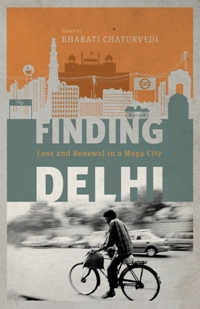
    Bharati Chaturvedi (ed.) Finding Delhi: Loss and Renewal in a Mega City, Penguin Books India, New Delhi, 2010

    Delhi is often thought of as the culturally best endowed city in the country. It has had a rich heritage, from the Walled City of the Mughals (presently called Old Delhi) to the Lutyens’ capital of the British raj; now there are chains of multinational corporations working in the peripheral areas of the city, and the city has declared its “world-classiness”, reshaping its infrastructure to host the grand spectacle that was the Commonwealth Games. Hence, most writings on the city stick to celebrating the warm-heartedness of the “dilliwallas,” its ever increasing count of flyovers and shopping-malls. Weighed down by such images that flood the media Finding Delhi comes as a relief to its reader because it tries to engage with that part of Delhi that is left out in the sort of accounts mentioned above: the not too pretty underbelly of the Indian capital.  The book offers an account of the city culled out of the experiences of fourteen different writers, ranging from urban planners to informal-sector workers, concentrating on diverse urgent issues like public transport, women in the city, housing rights of the poor, problems faced by street vendors, and the situation of the homeless ahead of the Commonwealth Games. The writers try to represent the city from an unconventional angle, where they concentrate on the living conditions of the poor living in the city, and the damage done to their lives due to the infrastructural developments that have taken Delhi way “ahead” of cities like Mumbai and Kolkata. It can, in fact, be argued that the book aims to confront the middle class, whose India is “shining”, with this “other angle” in an attempt to make them to realize that the actual cost of this accelerated drive toward “development” is being paid by the poor, in the form of ever deteriorating living conditions; presumably the monologues of a waste collector, a domestic worker, a dhobi and a fruit vendor are included in book to fulfill this end.

    The book is divided into three parts: “Cityscape”, “Challenges” and “Experiences”. The first part explores how lines of class and gender demarcate the urbanFinding Delhi space. It begins with an article by Amita Baviskar that looks into how the newly reconfigured urban space of Delhi excludes the poor. She takes the example of the Vishwavidyalaya metro station, where an adjacent plot of land was allegedly allotted for a mall, when it could have been used as a park, or to house the poor. She elaborates her point by citing the example of the jhuggi-jhopdis near Majnu Ka Tila that were demolished in order to provide land for a private apartment builder. Our own experiences over the last few years offer us enough examples to buttress this point; for instance one can look at the manner in which the poor were not only neglected, but even hidden behind hoardings and posters during the CWG fiasco. This article is followed by a historical/analytical essay on Delhi from pre-colonial to post-liberalization times by Lalit Batra. Batra explores the history of the Delhi poor, and argues that the exclusion that, for instance, Baviskar speaks about is nothing new, and is an integral part of how the administration functions. For the state, land is capital, to be used optimally, and slums do not allow this optimum use, as a High Court ruling on land squatting proves.
    “Nobody should squat upon the land … [the] policy of relocation [is a] premium to unscrupulous elements in the society as on the one hand an honest citizen has to pay for a piece of land or flat and on the other hand on account of illegal occupation on the government land an encroacher is given premium by giving him a plot on the name of relocation … we direct the removal of jhuggis … “. (The High Court of Delhi, Case No. CWP 6160/2003)

    The next article also works along similar lines, arguing that the work that the poor do is absolutely essential to the city’s functioning, though the rich do not acknowledge this. It describes the workers who work in scrap-yards where old, now-useless items are recycled; now with the government giving out tenders to private companies, to dispose of this scrap, the employment of these people is in danger.

    The critique that these articles offer touch our “humane side” and force us to acknowledge that the poor are indeed hard done, and that something must be done for them, so as to ensure in Delhi, a perfect balance between “classiness” and humanity (presumably evidenced by improved life conditions of the poor); this is of course the balance wished for by all these writers. Herein, strangely, lies the problem with these critiques. The majority of these writers seem to call out to the middle-class to go beyond their “petty needs”, to feel for the condition of the poor and also that it is up to them to do “something” about it. They do not seem to understand that this compassion is itself premised upon the existence of these conditions. Capitalism creates inequality so that a small number of people can exploit and extract surplus value from a much larger number of poor people. The city, the ultimate symbol of modernity and of capitalism, is also the ultimate breeding ground for these social-relations. The editor of the present book claims that the main aim of the book is to provide a critique of the present developmental model adopted by the government; evidently the book offers not post-facto theorizations, but seeks to serve as a manifesto for concrete actions to be taken in the future, for the city’s benefit. Hence, the book has a special section called “Challenges”, in which authors highlight the issues which need to be addressed immediately. Sadly, though not surprisingly, this section of the book, that comes after the initial discussions of the pro-rich shaping of the city, moves straight to issues like cleaning of the Yamuna, and to the experience of a writer who spent an entire night roaming the streets of Delhi, looking after homeless people etc; despite the implicit insights provided by the earlier essays no mention is made of how capitalism and its state are responsible for these problems. Coming to think of it, even the earlier essays pose this question as one of reform; the incessant struggle between labor and capital that is reflected in the cityscape was un-mentioned and in essence it was argued that all problems could be solved if only the government were to look after the poor a little better. One writer, anxiously, even speaks of the possibility of the poor taking over Connaught Place, the India gate, and Gurgaon – what would happen then? The possibility of a revolution and a post-revolutionary state clearly make this writer uneasy. She is unable to appreciate the idea of a laborer controlling her/his labor – something which is common enough in NGO-type activism.

    At present, in India, large companies (Tatas, Birlas, Ambanis etc) are monopolizing all industries, and are now making a move even into the informal sector. It’s common to come across supermarkets like Big Bazaar, Reliance Fresh, Big Apple etc, and clearly local fruit and vegetable sellers are unable to compete with them. The case of the waste-pickers is evidence of the same state affairs. However the book does not take the reader beyond this level of appearances; which is to say that it does not go into causes. The causes that underlie this state of affairs are too deep, too endemic to this system to be solved by human goodwill (the leitmotif of NGO-activism).

    A couple of other articles, however, do seem to try go beyond the surface, and in that seem to be able to keep off turning these issues into questions of ethics and morality. For instance in an article titled “Delhi: Expanding Roads and Shrinking Democracy”, Rajinder Ravi tries to bring across to the reader the plight of workers who used to cycle everyday to their respective workplaces (anyone who travels from East to Central Delhi will be familiar with the sight of thousands of workers cycling to work through cycle-lanes). The changes that were brought in preparation of the Commonwealth Games destroyed the cycle lanes to expand roads. While to the “average” Delhiite (actually only the middle/upper class) the expansion of roads has come as a boon because they use cars and motorbikes to commute, for the lower class it has meant a move to the more expensive public transports of the city (not to mention the environmental cost involved in the move made from cycles to buses etc).

    Similarly in “New Delhi Times: Creating a Myth for a City”, Somnath Batabyal, a former journalist takes on the ever so active torchbearer of our society – the “Media”. The writer presents to us quite an interesting take on the media and the type of work that they do. He shares with us two instances where media houses were campaigning actively, and were believed to be the face of the aam-janata, the “Campaign for Clean Air” in the 90’s and the recent anti-BRT campaign. The writer speaks of how media personalities work according to the interests of the middle class, for a city in which the poor have little for them. The media that had once campaigned for a clean, pollution free environment turns coat the moment this idea of a “clean environment” comes into conflict with the “shining India” of the middle class, and jumps into a drive against the BRT, a project which, if properly managed could help control pollution by limiting the use of private transportation. As is rightly pointed, a majority of the bourgeois environmentalists and journalists live around the corridor and use it to commute to their offices everyday. Due to the construction of separate lanes for buses and cars, these drivers have a hard time on the road; this did not go down well with these media persons and hence the anti-BRT media campaign.

    The article mentioned above does try to look at least this one problem through the optics of class struggle; but because of the book’s attempt to present a “kaleidoscopic” view of perspectives coming from different ideological tendencies, its emphasis on solving the problems of the poor gets lost. Even the monologues from the informal sector workers get mixed up in this cacophony of perspectives and do not serve any purpose except giving an appearance of the editor’s “democratic” designs. Failing to connect apparent problems to the fundamental underpinnings of the system, such attempts fail to see how perspectives on these problems are also in some sense takes on the system. It is not enough to allow everybody to speak, since the interests of some, a priori are against the interests of the poor that they nonetheless may seem to defend. In the final analysis the sort of reformism that this attempt represents acts as a pressure release valve, to negate the possibility of genuinely transformative collective action. The book fails to rise above the philanthropy that is also called “social activism”, and in that fails to reach toward a useful plan of action. But to its credit, it does succeed in throwing a somewhat different light on the state of Delhi, in a situation where the state and its media are feeding us on a diet of neoliberal propaganda; for those used only to the “mainstream” it could offer a useful change.

    Higher Education Cuts, Students Protests and Media Misrepresentation

    Bulent Gokay
    Farzana Shain

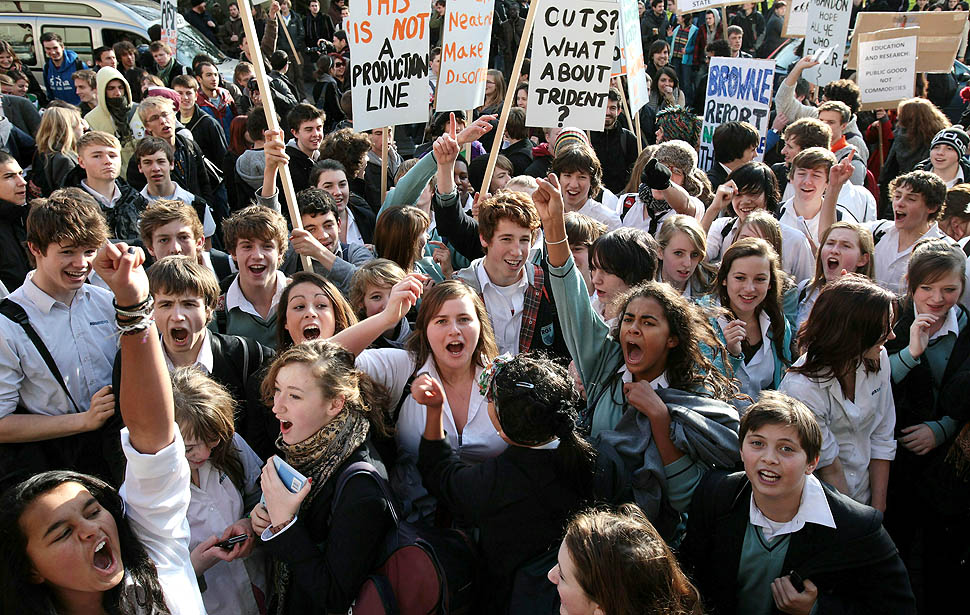
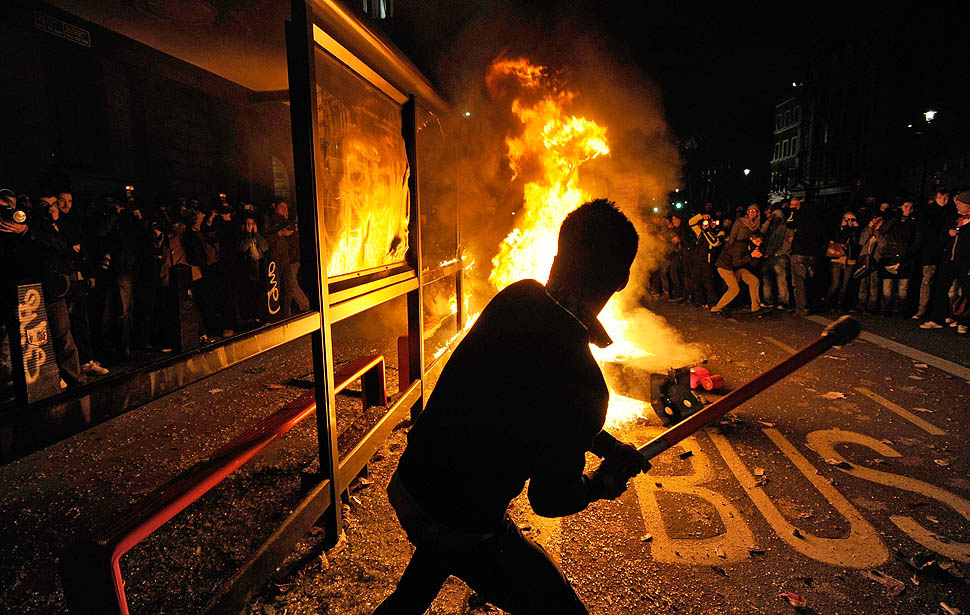
    At the end of 2010, tens of thousands of university students have demonstrated in central London and all over university campuses in the UK, against the coalition government’s proposals to raise tuition fees up to 9,000 pounds. Government and Media coverage of the protests has focussed primarily on two factors – the violence of a minority of protestors and the apparent ‘privileged’ profile of a few student protestors. ‘Rich rioting students’ was just one of the headlines describing the demonstrations. A panellist on BBC’s Question Time described protestors as ‘just a bunch of middle class students’. Michael Gove, the Education Minister, defending the planned increase in tuition fees posed the question: ‘Is it fair to ask a miner to subsidise the education of someone who can go and become a millionaire?’ The irony of this analogy can surely not be lost on those who remember how brutally Gove’s Conservative Party, in its previous incarnation, destroyed the heart of British working class mining communities.


    Courtesy: LATimes

    One of the most passionate, but misguided, commentaries on the recent student protests comes from Julie Burchill (the Independent, 16 December), who made a plea to the public to ‘spare us these pampered protesters who riot in defence of their privilege’. Focusing on one student, Charlie Gilmour, who has been singled out by almost all the British media because of his connection to a famous rock star, Burchill vents her anger at so called ‘middle class’ protestors at the same time as dismissing university education as a wasteful time of ‘boozing and bullshitting funded by the taxes of people who had the actual gumption to remove themselves from the playpen of education and get a job as soon as legally possible’. She goes on to suggest that for many working class youth, university education has made little difference to their prospects of getting a job.


    Courtesy: LATimes

    Burchill is right to question the success of government-sponsored schemes such as widening participation which critics argue has done little to equalise educational outcomes. All the research suggests that while working class students are more likely to attend university than they did 10 years ago the class gap has not necessarily diminished. Working class students are more likely to attend newer universities, to be part-time students and to study for more vocational subjects. But to dismiss university education for the masses as completely irrelevant is surely wrong. Burchill is also wrong to dismiss the current protests as entirely middle class-led. The fact that some students from middle and upper class families join the student protest does not make the whole student protest an action of the privileged few in defence of their privileges. University students, whatever social class their parents are from, historically tend to act together as ‘students’, and for most part for progressive causes as in the case of the 1968 student protests. At first in 1968 too, the governments and media also sought to portray the student protests as work of radical students and small groups of middle class troublemakers.

    The protests over the last few weeks have seen large numbers of working class students (some of them school students) protesting because it is they who have the most to lose from the proposed public spending cuts. Further, to get so hung up on the notion of a so-called middle class-led protest serves to support Gove’s and the coalition government’s attempts to create an ideological standpoint, presumably on the side of the ordinary working people, from which position to launch a wholesale attack on all the social and economic achievements of the previous generations, like the universal child benefit, housing benefit, disability benefits and similar other measures.

    The current representation of the protestors as middle class serves a deeply ideological and manipulative function of deflecting attention away from the stark realities of the public cuts and their real causes. Many people who oppose the cuts simultaneously accept the argument that there is no alternative but to sacrifice education and other public services in order to save the economy. Further, a large section of the British public and media appear to have accepted the line presented by the government that the total package of cuts worth £128 billion by 2015-16 was ‘unavoidable’ because of previous administration’s careless spending, and almost self-made huge deficits. Until the financial crash of 2008, however, the Labour governments had succeeded in keeping national debt below the 40 percent of GDP target that they set themselves. In 2006/07, public sector net debt was 36.0 percent of the GDP. In 2008, it rose rapidly primarily because of ‘financial interventions’ to bailout of Northern Rock, RBS and other banks, because of lower tax receipts, and because of higher spending on unemployment benefits, all caused by the global recession. The current deficit was caused primarily by the recession not by previous administration’s pre-crash careless spending. It currently stands as 63.7 percent of National GDP, and was projected to peak at 74.9 percent in 2014-15.

    Massive cuts to the NHS, local government, and education budgets are not the inevitable solution to national debt. During the Second World War, the UK national debt reached much higher figures of up to 150 percent of the GDP. It is not uncommon for countries to borrow more during the time of serious national and international crises, like wars, or economic upheavals like the one currently affecting the world, and to pay back the debt over a period of time once the economy starts to grow again. In this sense, budget deficits can be an effective way to deal with shocks such as wars, financial crashes and deep recessions. If anything, the problem of low economic activity is the real, and more urgent, issue than the fiscal stability.


    Courtesy: LATimes

    David Cameron’s ‘Big Society’ programme offers an ideological justification for the massive public spending cuts which are about much more than just deficit reduction. The pretence of ‘there is no alternative’ offers a means for the Conservative project to radically transform the state and to transfer more services and money from the public to the private sector. If the real intention was to take the British economy out of the crisis, then such massive cuts would not be the answer. There are alternatives: we need to find a fair and sustainable path out of crisis. Budget deficits will more or less automatically heal with the economic recovery. Trying to cut the deficit quickly, in the midst of a serious recession, will damage the economy and extend the crisis. The government instead should concentrate on growth and allow growth to reduce the deficit. Cuts will not reduce the deficit, investment will. Recently, the Confederation of British Industry (CBI) announced that it expects economic growth in 2011 to be much slower than previously predicted. A much weaker consumer spending, resulting from massive unemployment and lower wages in 2011, is described as the main reason for this. Cutting too far and too fast will mean more people out of work, fewer jobs in the economy, lower level of taxation from workers and businesses, and more people on unemployment benefit, which will cost the government more. The real challenge is to introduce constructive ways to restructure the national economy so that it can deliver strong and consistent growth.

    The current crisis and the way some other parts of the world economy have been dealing with it successfully, and all social and cultural legacies of this turbulent process have highlighted, like never before, the crucial role of education. The financial and economic crisis has had a particularly strong impact on young people with low levels of education. Investments in education pay large and rising dividends for individuals, but also for economies. On average, a young person with a university degree will generate £77,000 more in income taxes and social contributions over his/her working life than someone with a high-school degree only. Even after taking the cost of university education into account, the net public return from an investment in tertiary education is £56 000 for a male, in generated income taxes and social contributions over his working life. Enhancing tertiary education attainment can therefore help governments increase their fiscal revenues, making it easier to boost their social spending, in areas like, for example education. As the global demand for jobs shifts up the skills ladder, it has become crucial for countries to develop policies that encourage the acquisition and efficient use of these skills to retain both high value jobs and highly skilled labour. Burchill is right to suggest that ‘clever working class youth of this country [have] been socially and spiritually ‘kettled’ – hemmed in, suffocated and stifled’ historically by ‘the privilege and entitlement’ of the likes of elite. But does the answer really lie in cutting away higher education for working class students altogether?

    Britain’s total investment in higher education, even before the current cuts of the Coalition government, was 1.3 percent of the GDP which is behind the OECD average of 1.5 percent. Despite the student numbers rising by approximately 25 percent in the last 15 years, the UK has slipped from third to fifteenth position in numbers graduating among industrial countries because investment in higher education has risen much rapidly elsewhere. Within Europe, the UK is already falling behind France, Denmark, Finland, Sweden, Portugal and Netherlands, among others. Other Western governments, most notably the United States and Germany, have viewed the global financial and economic crisis as a sign not to retrench but to invest in their higher education systems as a necessary part of investing in the skills that will be needed for recovery in near future. In the UK, however, it was education that was first in line for cuts in spending: the cutting of the Future Jobs Fund, the cancellation of school building and refurbishment, the abolition of the Education Maintenance Allowance, and now funding cuts in university teaching budgets, fewer university places and a massive increase in university tuition fees. All these draconian measures will ensure that talented people from working class backgrounds will not achieve their full potential. The poorer you are the more scared you are by the prospect of tens of thousands of pounds of debt. It seems this is exactly what the Coalition government wants- to keep education for the rich and privileged. And this is what tens of thousands of students are protesting against. If we want British economy to recover and take its place in a much more competitive world, if we want Britain to be ‘open for business’, we should make higher education available for everyone, regardless of their social class. The more skilled people we have, the more likely companies will be willing to invest in the UK.

    Bulent Gokay is a Professor of International Relations, Keele University and Farzana Shain is a Senior Lecturer, Keele University

    A working class uprising – how far will it go?

    Taken from an article published at LIBCOM

    . For other articles on Tunisia uprising, visit

    The fundamental class nature of the protests in North Africa is undeniable. In Tunisia, Algeria and Libya a generation of proletarianised youngsters have led mass protests, the immediate reason for which has been their desperate standard of living in countries which support a wealthy and transparently self-interested ruling class, less schooled in the modern techniques of bourgeois self-justification than their Western counterparts. The same issues are repeated in countries across the region. We will attempt a brief and preliminary survey of the class aspects of events here; again due to restrictions on information and rapidly developing events this survey is necessarily incomplete.

    Expropriations

    The uprisings in Tunisia and Algeria have involved the expropriation of goods from supermarkets, shops and warehouses during mass demonstrations. This is to be expected ; one of the immediate catalysts for the uprisings was the cost of essentials rising rapidly, with scarcity compounded by security forces shutting down the country. Moreover, during situations where working class people are becoming aware of their own power, respect for the nicities of commodity exchange evaporates, especially when money (or the lack of it) limits their access to the essentials of life. Such expropriations are a feature of all proletarian uprisings, as is the line on “violent looters” spun to justify brutal crackdowns.

    Strikes – or the lack of them

    Information on the extent to which strikes have formed part of the movement in North Africa is limited. We know of strikes by teachers in solidarity with protesting students. Likewise there have been calls for general strikes led by ‘professional’ workers such as lawyers, but it is unclear whether they were attended by workers more widely. We can say the same of the general strike called in Sfax – until more information is made available, it is hard to say to what extent it was observed. We know of strikes in the mining town of Gafsa, but again the scale of participation in these strikes is unclear. We do not know to what extent people have participated in organised strikes, or simply not gone to work due to the unrest on the streets. Lockouts after the state of emergency was declared would have precluded many strikes.

    Obviously the unemployed and students who have formed the bulk of protesters on the streets do not have labour to withdraw in the same way as workers. Demonstrations, blockades and riots all can form part of class struggle, and can advance it by disrupting the economy and drawing lines of confrontation. Radicalisation by police truncheons can often push confrontation with the state further, and draw more people into events by making the role of the state in maintaining order through violence clear. However, all major uprisings have involved mass strike action, and the mass strike is a means by which the common interest of proletarians as working class and their power to cripple capital by expropriating the means of life from it can become clear. The direction and scale of the insurrection is likely to be determined by the extent to which strike action spreads through the economy.

    Part of the explanation of our limited knowledge of strikes could be the focus of the media on street protests and the ‘political’ dimension presented by the calls to oust the current government. Strikes taking place in parallel may not be deemed newsworthy. On the other hand, it may be that there has not been generalised strike action. The role of tourism in Tunisia’s economy, employing significant numbers of workers (half of the workforce is employed in the service sector) is not enough to account for this – industry such as manufacturing, mining and the oil industry accounts for a third of the workforce. This is the classic terrain for mass strikes of the kind that has been a feature of all historic working class uprisings, and this would have a significant effect in a major oil and minerals exporter such as Tunisia.

    On the other hand it is important to bear in mind the effect a drop in tourism revenues can have in a country like Tunisa – a few global headlines about rioting can lead to the paralysis of a major section of the economy. Ben Ali called on rioters to stop due to fears about the decline in tourism, and was clear and vocal about this. Nonetheless, a generalised strike movement would be vital in broadening a specifically class consciousness, widening the movement and radicalising the situation.

    Not a revolution – yet.

    The media has been quick to label events in Tunisia a ‘revolution’, and the name ‘ the Jasmine revolution’ has been rapidly applied to bring it in line with a range of other political revolutions which ushered in new governments (usually pro-US) in various countries. Such events are only ‘revolutions’ in a political sense, with one government replacing another. Tunisa has not yet seen a true revolution, as the rule of capital and the fundamental balance of power between classes in the country has not yet changed. Such a possibility would require the working class of the region to draw lessons from the radical display of their own power which has unfolded over the past weeks. Given that the fundamental issues – unemployment, high prices and poor housing cannot be solved by decree by governments even if they wanted to, it is unlikely that we will see the status quo return in North Africa any time soon.

    Ministry uses rhetoric of “community control” to hide the actuality of intensified state control

    Campaign for Survival and Dignity

    Much press attention in the last week has been devoted to the Environment Minister’s statements on “democratic forest management” and how the existing forest management system needs to change. Such statements are welcome, for they mark an official admission that India’s forest bureaucracy has impoverished millions and increasingly been an opponent of both forest conservation and forest dwellers.

    But what the Ministry says does not at all match what the Ministry does. Not only is the Ministry not moving in the direction of democratic management; it is moving against democratic management, while using the rhetoric of “community control” to hide the actuality of intensified state control.

    At a time when state control over forests and forest lands is a major weapon in the assault on people’s resources and livelihoods, this is not an arcane policy issue alone; it is one component in the ongoing intense struggle over deciding how we will use our natural resources and how we will define our society.

    A simple comparison throws up what is actually going on (click on links to know more about each issue):

    Issue What the Ministry Said What the Ministry is Doing
    Diversion of forest land for corporate projects One and a half years after passage of FRA, Ministry finally issues Aug 2009 order that requires FRA compliance i.e. recognition of rights and consent of gram sabha before land can be handed over * As per public minutes of Forest Advisory Committee, there is not a single project in which the Ministry has complied with FRA or its own order. In Polavaram, the FRA has been brazenly and publicly violated. In only one project has compliance even been considered – POSCO – but even after non-compliance has been exposed by three different committees, and five years of protest by the people, the forest clearance is still standing.
    * Meanwhile, there are ongoing attempts to get the order withdrawn.
    Joint Forest Management Throughout this year, including this week, statements by Minister that Joint Forest Management has become a Forest Department proxy and needs “reform.” * The reality is that there is only one nation-wide law that provides for democratic community control over forests – the Forest Rights Act(PESA provides even more extensive powers in Scheduled Areas). This supersedes all existing schemes. Therefore, if the Ministry is genuinely interested, the first steps for democratic control would be to shut down JFM, put the funds into the NREGA or other systems which permit local institutions to decide their priorities, and direct forest authorities to comply with local powers as provided in the FRA. MoEF would then have to join other Ministries in a coordinated effort towards democratic resource management, which is not MoEF’s domain alone.
    * What is happening is exactly the opposite. There is repeated talk of “revamping” Joint Forest Management (which has no legal validity), and this translates into giving JFM committees powers that actually belong to democratic institutions.
    * Even the basic fact that forest guards sit as the secretaries of JFM Committees, and their funds are controlled through the Forest Department, is completely ignored.
    In short, the Ministry is strengthening its proxies, not democratising them.
    Forestry Projects The Ministry repeatedly claims that the huge amount of money being poured into forestry projects will benefit forest dwellers and be spent in a “decentralised” fashion under “people’s control.” The money put into forestry includes money from the Compensatory Afforestation Management and Planning Authority (CAMPA) (1,000 crores per year), the proposed Green India Mission (46,000 crores in total), Japanese-funded “external” forestry projects, the National Afforestation Programme and the developing international REDD agreement. In every single one of these programs, funds are being channeled or are proposed to be channeled through JFM and the Forest Department, directly undermining democratic control and driving land grabbing. This is true in the case of CAMPA – despite a direct indictment by a Parliamentary Standing Committee. For details of other programmes see our statements on the proposed Green India Mission and the MoEF approach to REDD. If the Ministry is interested in democracy, why is it channeling funds to the very institutions that undercut democratic control – and this after it has itself said that they do so?

    The “forked tongue” approach that has come to characterise the forest bureaucracy and this Ministry is extremely dangerous. It blocks actual change by claiming to be engaging in it; and then it does precisely the opposite, cleverly garbed in the right terms and the right language. In the process, “participation” becomes a code word for devolving huge amounts of money to select individuals and sections of villages in order to create what are essentially state proxies and vested interests. Nor is this confined to the Environment Ministry; we now have a “Integrated Action Plan” for “developing” Maoist areas by putting thousands of crores into the hands of the very officials who have destroyed people’s lives and livelihoods, organised inhuman repression and violated all norms of democracy. In the long run, this approach is a formula for dividing communities, breaking resistance, undermining democracy and destroying resources. It may make sense for the interests of corporations and state machinery; but to the rest of us it is a formula for resource grabbing and destruction.

    Rapists roam free while victims and activists are jailed

    ML Update, CPI-ML (Liberation)

    Peasants, agricultural workers and women of Mansa district, Punjab observed New Year’s day this year with a protest gathering at the police headquarters in Mansa. Braving a severe cold wave, thousands of people gathered to protest a shocking situation where the rapists of a dalit minor girl roam free, while the woman activist who prevented the cover up of the rape case is in jail on false charges of ‘attempt to murder.’

    In mid-December, a 17½ year old girl from a poor Dalit family was lured by a havildar in Mansa to his house on the promise of employment, and subjected to gang rape by him along with three others including a local advocate, a trader, and a financier. When neighbours heard her cries and called the police, however, the police deliberately suppressed the rape case and instead booked both the victim and her rapists on charges of ‘loitering.’ Cases of rape and SC/ST atrocity were registered only two days later, after intervention by CPI(ML) and AIPWA activists. However, three weeks after the incident, the accused (apart from the havildar) were yet to be arrested, and, being influential locally, were bringing to bear all sorts of pressures and threats on the victim. Two other of the rape accused were arrested only on 4 January, following the protest rally at Mansa and the intervention of the central team of AIKM and AIPWA leaders, while the financier accused of rape is still at large. Worse still, the very same activists including AIPWA National Council member Jasbir Kaur Nat and National President of the All India Kisan Mahasabha Ruldu Singh, who helped book the rape case are now behind bars along with several other peasant leaders, on a patently false charge of ‘attempt to murder.’ The pretext for this was the fact that they raised slogans in Court against the main accused in the murder of a popular peasant leader, leading to a minor skirmish when police assaulted them.

    In the same area of Punjab some years ago, the dalit activist and singer Bant Singh had his limbs chopped off for supporting his daughter to pursue a rape case. The recent instance of rape of a dalit girl and victimisation of activists who pursued justice highlights the continuing strength of feudal survivals in Punjab. It also underlines the increasingly repressive response of the Akali Government in Punjab where every mass movement – of agricultural workers for homestead land, of peasants against debt – is me with mass arrests of leaders, activists and masses. What is happening in Punjab is also not very different from what is being seen in the rest of India – where scamsters, rioters and rapists roam free while activists like Binayak Sen are jailed.

    Punjab is no exception. Just recently, in BSP-ruled Uttar Pradesh, a 17-year-old OBC girl who accused the BSP MLA Purushottam Narain Dwivedi of rape is in jail on charges of ‘theft.’ The incident exposes the reality behind Chief Minister Mayawati’s claims of social justice.

    Meanwhile in Bihar, the BJP MLA from Purnea was stabbed to death by a woman who had filed charges alleging rape by the MLA and his associates some months ago. Police had taken no action on her complaint, and she had been pressured into withdrawing charges later. It is apparent that the woman was driven to take the desperate step because the chances of securing justice against a ruling party legislator were bleak. It is shocking that the BJP MLA’s supporters lynched the woman, critically injuring her, and that BJP leaders including the Deputy CM of the state have aggressively slandered the woman’s character while defending their MLA as a man of impeccable morals!

    The recent instances in Punjab, UP and Bihar are a reminder of the sorry state of affairs in India when it comes to justice in cases of violence against women in general and women from oppressed communities in particular. According to NCRB (National Crime Records Bureau) figures, the conviction rate in rape and molestation cases in India is a mere 27 per cent – about one in four cases. Likewise, the conviction rate for cases of atrocities against SCs and STs is abysmally low – less than 30 per cent against the average of 42 per cent for all cognisable offences under IPC.

    The national capital itself is witness to horrifying cases of rape, gang rape and other forms of violence on women. According to official figures, a rape takes place every day in Delhi, and 400 rape cases were registered in Delhi in 2010. The prevalent police attitude to such crimes can be gauged by the comment of celebrated police officer K P S Gill after the Dhaula Kuan rape case some years ago: Gill blamed women’s ‘provocative’ clothes for the rise in rape crimes in Delhi! The low conviction rates, trials that drag on for years, and insensitive police investigators who blame women themselves for such crimes, all empower rapists and molesters with a sense of impunity, the more so if the woman are from marginalised and oppressed communities, such as dalit and tribal women, or women from the North Eastern states.

    The CBI’s closure report in the case of murder of a teenage girl Arushi Talwar is yet another reminder of the apathy that marks investigations in cases of violence against women. The CBI had been called in after the Noida police botched up the investigation, but the CBI pursuit of the case also relied more on ‘confessions’ obtained from domestic servants through third-degree methods like narco tests than any professional investigative practices, and now the CBI has attempted to close the case file itself. If justice is so elusive for urban girls from reasonable well-off families like Arushi and Ruchika, whose cases got great media attention, one can only imagine what happens to cases of women from socially and economically weaker backgrounds. And if this is the state of affairs in rape cases where politically powerful people are not implicated, what of the cases where police and army forces are implicated in rape and violence against women? The young Manipuri woman Thangjam Manorama, raped and murdered by Indian army personnel in 2004 is yet to get justice. The rape and murder of two Kashmiri women — Asiya and Nilofar — in Shopian, Kashmir, last year had been subjected to a spectacular cover-up by the CBI, with the latter claiming that the two women ‘drowned’ in a stream six inches deep. In Chhattisgarh where Binayak Sen has been sentenced to life on no evidence, adivasi women who filed charges of gang rape against top Salwa Judum personnel live in terror, because their rapists are free while the women themselves along with their kith and kin are threatened that they will be branded as ‘Maoists’ and arrested or killed in fake encounters.

    Justice in violent crimes against women is non-negotiable. We must demand speedy passing of the Sexual Assault Bill, as well as fast-track courts to ensure speedy justice in such cases. Above all, we must build more and wider struggles to challenge the impunity and apathy that has become the hallmark of cases of rape and violence against women.

    Condolence meeting in Memory of K.G. Kannabiran (Jan 8)

    Dear friends,

    As you are aware Shri K.G. Kannabiran, former President PUCL, eminent lawyer, writer and the most active civil liberties activist, passed away on December 30, 2010. The PUCL is organizing a condolence meeting to pay our tributes to the doyen of civil liberties movement.

    Day and Time: January 8, 2011 (Saturday) at 5:00 p.m.
    Venue: Gandhi Peace Foundation,
    223, Deen Dayal Upadhyay Marg
    New Delhi – 110002

    You are requested to join us in paying respects to him.

    Sd./-
    (Mahi Pal Singh)
    Secretary, PUCL

    Public Expenditure: the Affordability Fallacy

    John Weeks

    Implicit almost all discussion of public expenditure and revenue, most virulently in the debate over deficit reduction, is the fallacy of public affordability. This fallacy is manifested, for example, in the argument in the United Kingdom that if university education is available to a large portion of the population, the public sector cannot afford to deliver it without substantial fees, even less to provide support grants to all students.

    Because “the public sector cannot afford” to provide university education, it is necessary to ration the public contribution on the basis of need (income or means testing). The same argument is applied in very major area of social expenditure: with an ageing population, “the public sector cannot afford” to pay more than a safety net pension; cannot afford to provide all the drugs and care needed by that ageing population, and so on.

    “Affordability” arguments are fallacious. The fallacy is obvious once one considers it from the level of society as a whole. Consider the example of funding of university education. Only a tiny minority of people would argue that primary education should be a matter for individual families to decide and wholly fund themselves. This near-consensus results from the conviction that children have a right to be educated, and that a democratic society requires an educated and informed public. These convictions, not finances, determine the provision of primary education by the public sector: for everyone, regardless of income or status, and if some wish to contract for private education, they may do so. The social consensus on public provision of secondary education is equally broad (for everyone), but number of years provided varies (lower in Britain than most developed countries). Only a few on the far right wing would argue that the pubic sector “cannot afford” to provide primary and secondary education for all, though in practice many right of centre attempt to minimize the expenditure and therefore the quality of provision.

    The same principle applies to university education: what is the appropriate coverage and to what level? Here there is no consensus, and those who believe that people have no right to higher education avoid taking that potentially damning position by seeking cover under the affordability argument: “I wish we could provide everyone with a university education, but we cannot afford it. In any case, people gain personally from higher education, so they should pay for it themselves to the extent that they can. The public sector can only afford to help the poor, and if you are poor and clever you will find funding.”

    This line of argument is the most superficial mendacity, and would apply equally to primary and secondary education (see my previous comment). The true essence of the affordability of higher education argument is, “People have no right to higher education. If they want it, let them pay for it. If you are poor and clever you might go to university. If you are dumb and rich you certainly will.”

    When there is a social consensus that people have a right to a university education if they want one, then reducing public expenditure and raising fees does not save society money. There are two affects: 1) for those with high incomes it shifts expenditure from the public sector to households, and 2) for those on low incomes it reduces provision. It “saves public money” in the same sense that not filling potholes is a financial gain.

    Most pernicious is the application of the affordability fallacy to pensions and health. Two core values of democratic societies are that children have a right to education and the old have a right to live their final years in decent conditions with dignity. Given this consensus on the elderly, discussing financial affordability is grotesque. The question is, in light of a country’s economic development and productive resources, what level of decency can and should society provide to everyone past a certain age? Once the level is decided, it merely remains to decide the institutional mechanism by which it will be funded. Considerable empirical evidence indicates that provision of pensions through the public sector has the lowest resource cost. This is primarily because unlike private insurers, the public sector need charge no risk premium. Its revenue is guaranteed, and the growth of that revenue is determined by the growth of the economy as a whole.

    Even more obvious is the fallacy of the affordability argument for health care. It is an appalling manifestation of the power of capital in US society that there seems to be no consensus that everyone has a right to be healthy, a principle Franklin Roosevelt included in his “Economic Bill of Rights” speech in January 1944, that every American had “the right to adequate medical care and the opportunity to achieve and enjoy good health”. In almost every other developed country this principle is accepted. When it is accepted, as with education and pensions, the issue is not financial affordability, nor is it coverage (everyone qualifies). The only issue is the level of society’s obligation to itself on health care.

    The affordability argument perpetuates a profoundly anti-social and anti-democratic fallacy. Whoever makes it asserts (as Margaret Thatcher did) that there is no society and no obligation to fellow human beings beyond an absolute minimum that the residual of social decency forces upon even the most reactionary Thatcherite or Reaganite. Reducing that residual of social decency is the project of the affordability fallacy. Existence is viewed as a collection of isolated individuals, for whom one has no concern, even if, or especially if, for those whose lives are rendered nasty, brutish and short.