Book Notice: P Eric Louw’s “Roots of the Pax Americana”

Michael Perelman

Louw, P. Eric. 2010. Roots of the Pax Americana: Decolonization, Development, Democratization and Trade (Manchester: Manchester University Press).

The United States, like Germany, came late to the empire business. It did not aspire to informal Empire, but rather went to great lengths to undermine the existing empires to open them up for US business. Eric Louw tells the story very well.
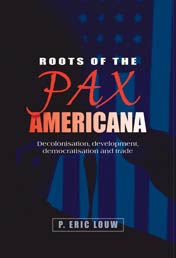
In his account, the US was going to great lengths to undermine Britain’s Empire, especially India, even when those powers were allies during the Second World War. He attributes Chamberlain’s behavior in Munich to a justifiable fear that dependence on US support in fighting the Nazis posed a greater threat to the empire than the Nazis themselves. He shows that the US made good use of Gandhi in discrediting the British Empire.

Rather than going to the expense and trouble of maintaining a formal Empire, the US preferred finding compliant regimes in important venues. For example, the US could have kept Cuba as a colony, but it got what it needed much more cheaply by keeping friendly governments in place. In contrast, Puerto Rico, which was much smaller, would not pose much trouble as a territory controlled by the US.

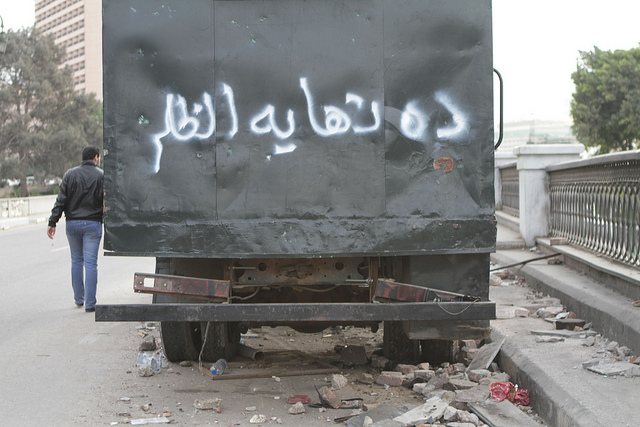
The book does not seem to be intended as a radical critique. It does not discuss how this Pax (Pox) Americana proved to be a disaster, leaving people under the rule of Marcos, Mubarak, the Shah, and other such klepocrats and thugs I am anxiously waiting new chapter being written today in the streets of the Middle East.
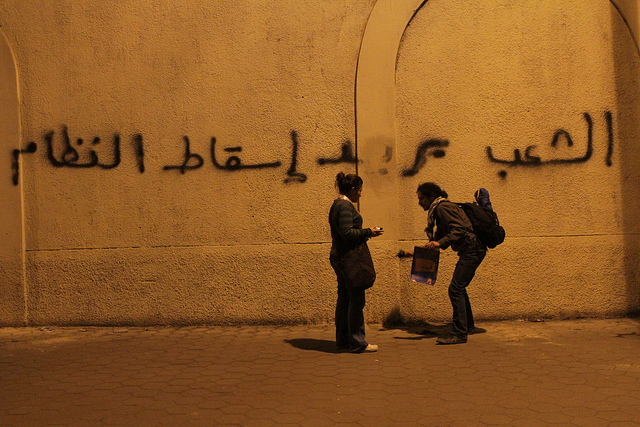
An Arab 1848: Despots Totter and Fall

Tariq Ali, Counterpunch

He can’t stay any longer because the military has declared that they will not shoot their own people. This excludes a Tiananmen Square option. Were the Generals (who have so far sustained this regime) to go back on their word it would divide the army, opening up a vista of civil war. Nobody wants that at the moment, not even the Israelis who would like their American friends to keep their point man in Cairo for as long as possible. But this, too, is impossible.

So, will Mubarak go this weekend or the next? Washington wants an ‘orderly transition’, but the hands of Suleiman the Spook (or Sheikh Al-Torture as some of his victims refer to him), the Vice-President they have forced Mubarak to accept, are also stained with blood. To replace one corrupt torturer with another is no longer acceptable. The Egyptian masses want a total regime change, not a Pakistan-style operation where a civilian crook replaces a uniformed dictator and nothing changes.

The Tunis infection has spread much more rapidly than anyone imagined. After a long sleep induced by defeats—military, political moral—the Arab nation is reawakening. Tunis impacted immediately on neighboring Algeria and the mood then crossed over to Jordan and reached Cairo a week later. What we are witnessing are a wave of national-democratic uprisings, reminiscent more of the 1848 upheavals — against Tsar and Emperor and those who collaborated with them — fthat swept Europe and were the harbingers of subsequent turbulence. This is the Arab 1848. The Tsar-Emperor today is the President in the White House. That is what differentiates these proto-revolutions from the 1989 business: That and the fact that with few exceptions, the masses did not mobilize themselves to the same degree. The Eastern Europeans lay down before the West, seeing in it a happy future and singing ‘Take Us, Take Us. We’re Yours Now.’

The Arab masses want to break from the ugly embrace. The US-EU has supported the dictators they’re getting rid off. These are revolts against the universe of permanent misery: an elite blinded by its own wealth, corruption, mass unemployment, torture and subjugation by the West. The rediscovery of Arab solidarity against the repellent dictatorships and those who sustain them is a new turning point in the Middle East. It is renewing the historical memory of the Arab nation that was brutally destroyed soon after the 1967 war. Here the contrast in leadership could not be more glaring. Gamal Abdel Nasser, despite his many weaknesses and mistakes, saw the defeat of 1967 as something for which he had to accept responsibility. He resigned. Over a million Egyptians poured into the heart of Cairo to plead with him to stay in power. And changed his mind. He died in office a few years later, broken-hearted and with no money. His successors surrendered the country to Washington and Tel Aviv for a mess of pottage.

The events of the last month mark the first real revival of the Arab world since the defeat of 1967. All the weathercocks ever-alert so as never to be on the wrong side of history, thus always avoiding any experience of defeat, were caught unawares by these uprisings. They forget that revolts and revolutions, shaped by existing circumstances, happen when the masses, the crowd, the citizenry—call it what you will— decide that life is so unbearable and they will be stifled no longer. For them a poor childhood and injustice are as natural as a kick in the head on the street or a brutal interrogation in prison. They have experienced this, but when the same conditions are still present and they are now adults, then the fear of death recedes. When this stage is reached a single spark can light a prairie fire. In this case literally as the tragedy of the stallholder in Tunis who set himself on fire demonstrates.

We are at the beginning of the change. The Arab masses have not been overwhelmed by force this time and they will not succumb. What will those who replace the despots in Tunis and Cairo offer their people? Democracy alone cannot feed or employ them…

The Political Significance of Arab Turmoil

Marzouq Al-Nusf, Sanhati

For more than a month now, the Arab world has been witnessing events unprecedented in its modern history. The self-immolation of a Tunisian college graduate on the 17th of December, 2010, has sparked a chain of events that resulted in the effective ousting of a dictator and the threatening of numerous others. After the departure of Tunisian president Zain Al Abideen Bin Ali this month, the 30 years old reign of Egyptian president Husni Mubarak is facing a serious challenge from its own rebelling people. Protests continue in many of the 22 Arab nations, either in solidarity with the Tunisian and Egyptian rebellions, or in hopes of instigating their own corresponding rebellions against their authoritarian regimes.

One reason for viewing the Arab rebellions as significant is that they are unprecedented in the modern history of the region. Specifically, it is the civilian character of the rebellions that is key. Traditionally, transitions in political regimes in the Arab world have been carried out either by foreign powers, as in the 19th century and earlier, or by military coups, which was the trend in the 20th century. Indeed, the fact that the Tunisian army, and more recently the Egyptian one, has elected to abstain from actively shaping the course of events reinforces the crucial break with previous historical trends of military interventions in domestic politics.

More generally, the robustness and effectiveness of the rebellions in Tunisia and Egypt have surprised even the keenest political observers, many of whom were more inclined to look for turmoil emerging from Europe in response to the global economic crisis. The Tunisian situation is a case in point. The country was perceived as so stable and uninteresting that the media, including the Arab speaking, could not excavate any worthy archival interviews with the Tunisian dictator to use in commenting on his character and inclinations. As for Egypt, the fact that there is a rebellion of any sort is seen as an anomaly in a national culture sometimes characterized, in a rather simplistic and prejudiced fashion, as submissive to the ruling figure from as old a time as when pharaohs ruled the land.

So far, the trajectory seems to point towards an increase in the spread and effect of rebellions in the region. The wave of civil unrest has spread from the relatively small Tunisia, with a population of around 10 million, to Egypt and its population of over 80 million. The rebellion against dictatorship has now taken root in the most populated, and arguably the most important, Arab nation. Hence, the remarkable significance of events in the Arab world has not yet exhausted itself, and may well continue to surprise the world.

It remains to be seen who will ultimately gain state power in the troubled Arab regimes, nonetheless it is possible to draw some implications of the very fact that regimes are being toppled by popular uprisings. Specifically, the fact that the Tunisian and Egyptian regimes have long been favored and supported by western powers means that the regimes’ uprooting will have ramifications on an international scale. France, as the primary guardian of the Tunisian dictatorship, has not only suffered strategic defeat with the dismantling of one of its strongholds in North Africa, but it had to endure public shame for its reluctance to give up its support to the Tunisian president, even when it was clear that his chances of survival were dismal. Right now, the United States seems to be hoping to avoid the French’s bluntness in suppressing Arab populations by carefully measuring its responses to the Egyptian situation.

A mapping of the Arab world’s alliances in pro and anti US hegemony terms is helpful. It is rather simple. The anti US policy regimes are 3: the Syrian regime, itself a dictatorship; the Hamas government in Gaza, which is an offspring of the islamist Muslim Brotherhood that was democratically elected to power; and potentially the new Lebanese government, where the former pro-US prime minister was voted out of office last month and replaced by a new one named by Hezbollah. As for the pro-US regimes, they are the other 20 governments in the region, including the Palestinian Authority. The camp’s members range from near-absolute monarchies of the Arabian Peninsula to secular dictatorships, such as the one in Algeria. Sudan and Libya are not considered in the anti US camp because they are not in fundamental contradiction with imperialist policy; rather their disputes with US hegemony can be resolved with minimal adjustments in policy.

From the US’s perspective, the alliances in the region thus far seem unproblematic, unless significant shuffling of regimes occurs. If democratic order is established in Tunisia and Egypt, then it is possible that the resulting governments will not align themselves with imperialist demands, if not oppose them diametrically. Aside from mere counting of numbers of allies, regime changes in the Arab world by people’s power could directly affect the US’s two main interests in the region, oil and Israel, particularly the latter. At this moment, two countries that border historical Palestine, Lebanon and Egypt, are experiencing regime shifts that are likely to lead to less compromising policy on the part of the Arabs. The rebellion in Egypt, if it brings a form of democracy, and the new democratically formed government in Lebanon might not instigate war in the region immediately. Nonetheless, if Israel decides to engage in warfare against Hams in Gaza or Hezbollah in southern Lebanon, then it is more likely for these new regimes to more actively participate in the resistance efforts against Israel, as opposed to the previously observed complacency with Israeli and US dictates.

As for the perspective of rebelling Arabs on the streets, it is probably safe to assume that they do not have US hegemony as their primary focal point, but that does not mean that they look favourably upon it. The US, as the chief foreign player in the region, has itself to blame if its name is implicated further as the enemy. The US’s support for notoriously corrupt and ruthless regimes has left little doubt in the minds of suppressed Arabs about the gap between US flowery rhetoric and grim action. If its unconditional support for Israel is added to the picture, then the US is virtually making it impossible for any genuinely democratic Arab government, if one emerges, not to oppose its policy.

As a matter of fact, there have been precedents of western powers planting through their own policy the seeds of antagonism in the region. Perhaps the most famous example is that of president Nasser of Egypt, who emerged as the leader of the first major Arab military-lead revolution in 1952. Although Nasser proclaimed progressive programs early on, he had no particular preferences when it came to choosing between the socialist and capitalist camps. He was not opposed to securing ties of cooperation with the west because of its historical interest in the region. However, in 1956 when Britain and the US drew their funding from his flagship development project, the High Dam in Aswan, Nasser nationalized the Suez canal and looked to fortify his anti imperialist stance through strengthening relations with the USSR and leading non-aligned nations, including India and Yugoslavia at the time.

What the rebellions in the Arab world have brought forth is the possibility of resurrecting a solid anti-imperialist block in the Middle East. At the moment, two nations that border the Arab world, Turkey and Iran, are at odds with US and Israeli policy in the region. If progressive forces are to gain power in key Arab states such as Egypt, then the US-Israeli agenda of war and domination could face a serious obstacle. On an interregional scale, the leftist and anti-imperialist governments in Latin America may finally have allies in the new emerging block of Middle Eastern states defiant of US hegemony.

All that being said, there remain a number of open questions, the answer to which will significantly influence the course of analysis. Will the interim government in Tunisia complete its promised transition to democracy? Will the Egyptian rebellion succeed in brining about democracy? Will the uprisings continue to spread in the Arab world? And perhaps more importantly, what are the prospects of a genuinely emancipatory political force gaining power in the newly emerging regimes? These matters deserve a more thorough analysis. One thing is certain, however, and that is that the future of dictatorships in the Arab world has never looked bleaker.

(The author is a graduate student at the Department of Economics, University of Massachusetts, Amherst.)

The POSCO “Green Signal”

Campaign for Survival and Dignity

On January 31st the Environment Ministry finally gave its long delayed decision on the POSCO project. The brazen chicanery of this decision is already well known. It asks the Orissa governmen,t already caught lying, to lie again, and promises a forest clearance in exchange; it imposes wonderfully meaningless conditions, such as the craven request that the company “voluntarily sacrifice” water which does not belong to it; and it violates the Forest Rights Act, the Forest Conservation Act and the Environment Protection Act. All this is hardly surprising from a government that has shown time and again that it cares a fig for the rights of people.

But the true message of this decision has nothing to do with the “environment” alone. It is quite simple: when a government is faced with real democracy, when it confronts organised people’s power, it will brush aside law, constitution and environment to destroy it. POSCO, the government and the business media all agreed on one point – how could they possibly accept that people themselves could decide on the fate of a project? How could they tolerate the idea – now required by law – that the project could not take forests and forest lands without the consent of the local community? Bring on the guns and the numbers – 51,000 crores, etc. etc. – to justify brazen illegality. Never mind that an international study exposed that this project will destroy far more livelihoods than it creates. Never mind that an official enquiry committee said “such attempts, if allowed to succeed, will result in neither development nor environmental protection, but merely in profiteering.” Who needs to know the facts when bigger issues are at stake. The key question that jarred our nation’s “best minds” was – who are these people to say we cannot take their resources? So what if the law is on their side?

Today land and forests are too important to be left to democracy and the rule of law. Even as the resource grabbing proceeds apace, a great charade has been played out in the media between our supposedly “green” Environment Minister and our supposedly “anti-green” industrialists, all of whom, however, agree at the end: they must control the decisions, not the people. Even when they don’t, they will act like they do; thus, after six years of determined people’s resistance to POSCO, the entire media today talks as if the only opponent of POSCO in India was the Minister. January 31st exposed this “debate” for what it always was: a farcical dance between Tweedledum and Tweedledee. On the one side, a Ministry whose only consistent act has been to deny people’s rights; on the other, a big business class that knows only too well that the state is on its side (as a CII representative said, “We know most clearances get through”) but likes to deflect the debate away from the issues and on to personalities.

After the Vedanta mining decision, we called it “a victory for the heroic struggle of the Dongaria Kondhs and for the spirit of democracy; and a betrayal, because the government will not comply with its own words.” That betrayal has come true today. Whatever law, democracy and human rights exist in this country are a reflection of the struggles of people. The “rule of law” is upheld by resistance, not by the state. The same is true of environmental protection; it was people’s resistance that stopped Vedanta and it is people’s resistance that will stop POSCO. At least now let us not hear of “green” Ministries and caring policies; the mask has been torn off to show the face of pitiless greed underneath.

‘It prefigures for the Arab people a new horizon’: Vijay Prashad on the Arab revolt (Part II)

This is the concluding part of our interview with Vijay Prashad, a prominent Marxist scholar who teaches at Trinity College, Connecticut. To read the first part, please click here. His recent book, The Darker Nations, was chosen as the Best Nonfiction book by the Asian American Writers’ Workshop in 2008 and it won the Muzaffar Ahmed Book Award in 2009. 

Vijay Prashad


Pothik Ghosh (PG): Why is it that most attempts in the Perso-Arabic world to conceptualise what Gramsci called the “national-popular” have come from radical left-nationalist intellectuals such as Edward Said rather than Marxists? How should or could the peculiarity of the Saidian theoretical enterprise of the national-popular inform and enrich working-class practice in West Asia? 

Vijay Prashad (VP): Strictly speaking, Gramsci’s “national-popular” is the emergence of the mass throughurban collective action, with the rural bursting through, and then being guided by the Jacobin (his word for an organised political force). The mass might drift into a-political action or passivity, Gramsci wrote, without the guidance of that Jacobin force. In today’s times, there is a tendency to hear about something like the Jacobin and shiver in fear that the energy of the “multitude” will be usurped by the Jacobin, that the authentic politics of the street will be taken over by the Organisation. It is in essence a misreading of anarchistic politics that this sort of fear has taken hold. I do not believe that anarchism is pure disorder; for those who believe this I propose a reading of Errico Malatesta’s “Anarchy and Organisation.” Of course, for those on the Marxist side of the ledger, Gramsci’s comments are our bread and butter. There is a need for the national-popular to be articulated through mass protest and the Jacobin canals. There is not so much that divides the Black and the Red.

It is not the case that only Edward Said has dealt with the national-popular in the Arab world. Take the case of Lebanon, where it is the Marxist historian (and eminent journalist) Fawaz Trabulsi who has written a remarkably informative account of the thwarted national-popular, with the emergence of Hezbollah. To my mind, Trabulsi’s is the best account of the Lebanese problem. It must be read widely to better understand the national dilemmas and the national-popular potentialities. My own interest in the Arab predicament was partly drawn by the work of people from an earlier generation like the writer and PFLP leader Ghassan Kanafani, who was assassinated in 1972. In the context of this new Arab Revolt, I recommend Kanafani’s pamphlet The 1936-37 Revolt in Palestine, a model for how to theorise the national-popular through the material of a revolt. These are role models for those who want to do detailed work on the Arab potential. The contingent is important, no doubt, but so too are the broad structures that need to be unearthed and developed.

PG: Lebanese-French Marxist Gilbert Achcar writes in his ‘Eleven Theses on the Current Resurgence of Islamic Fundamentalism’: “What is an elementary democratic task elsewhere – separation of religion and state – is so radical in Muslim countries, especially the Middle East, that even the “dictatorship of the proletariat” will find it a difficult task to complete. It is beyond the scope of other classes.” Does the ‘Jasmine’ Revolution portend a change for the better on that score? If not, how, in your view, should the working class forces in the region go about their business of shaping an effective ideological idiom that is rooted in local culture and yet articulates a question that is fundamentally global?

VP: We tend to exaggerate the authority of the clerics, or at least to treat it as natural, as eternal. Certainly, since the 1970s, clericalism has had the upper hand in the domain of the national-popular. In the Arab world, this has everything to do with the calcification of the secular regimes of the 1950s (the new states formed out of the export of Nasserism: from Egypt to Iraq), the deterioration of the Third World Project (especially the fractures in OPEC that opened up in the summer of 1990 and led to the Iraqi invasion of Kuwait), and the promotion and funding of the advance guard of the Islamism through the World Muslim League (by the Saudis. The WML’s impact can be seen from Chechnya to Pakistan, and in parts of Indonesia).

If one goes back and looks at the period when the Third World Project and Nasserism were dominant, what you’d find is clerical intellectuals in the midst of an ideological battle against Marxism (mainly), at the same time as they borrowed from Bolshevik techniques of party building to amass their own organisational strength. I wrote about this in New Left Review (“Sadrist Stratagems,” in 2008) where I catalogued the intellectual work of Baqir al-Sadr, with his Iqtisaduna, a critique of Capital Vol. 1. Baqir’s al Da’wah al-Islamiyah was modeled on the Iraqi Communist Party, then dominant in the Shia slums of Baghdad. If you go farther East along this tendency, you will run into Haji Misbach, an Indonesian cleric, also known as Red Haji, who confronted the dynamic Indonesian Communist Party with his own brand of Islamic Communism. Like Baqir, Misbach was perplexed by the popularity of the CP in his society. He wanted to find a way to bring the spiritual to socialism. These are all precursors of Ali Shariati, the great Iranian thinker who was influenced by the Third World Project, and by Marxism, but once more wanted to bring the spiritual into it. For all these thinkers, the problem was quite the opposite to what it is today: the workers seemed ascendant, driven by the science of secular socialism. It terrified them, as much as we are assaulted by the rise of the clerics over the last few decades.

It is also not the case that the religious is more difficult to expunge in the Arab lands, or that Islam is more intractable than other faiths. If one turns toward India, or turns toward the United States, it is clear that the religious domain is often very reluctant to wither away. It was equally hard to push it away in the USSR. This is not just a question of religion, or Islam, but of cultural change in general. Cultural change from below is slow-moving, excruciating. Cultural change from above is much faster, the tempo clearer. It has to do with who controls the cultural institutions, but also with the depth of cultural resources. Religion emerges over the millenia as a shelter from the turmoil of life, and it enters so deeply into the social life of people that it cannot be so easy to remove its tentacles. Of course Islam might be harder to walk away from, given that it, unlike say Brahmanism or Catholicism, has a much finer edge to its egalitarianism. This is what propelled it from a minor Arabian religion to Andalucia and China within fifty years of its emergence.

I would say one more thing on this: since the Utopian horizon of socialism is in eclipse, why should someone risk their lives in struggle for it? The idea of the inevitability of socialism inspired generations to give themselves over to the creation of the Jacobin force. Religion has an unshakable eschatology, which secular politics absent Utopia lacks. No wonder that religion has inspired action, even if destructive rather than revolutionary, whereas secular politics is less inspirational these days.

The Arab Revolt of 2011 prefigures for the Arab people a new horizon. That is why it has moved from Tunisia to Jordan. Ben Ali’s departure set the new horizon. It is what the youth hold onto. If he can be made to flee, why not Mubarak, why not Abdullah II, and if the remanants of the Saudi Voice of the Vanguard decide to blow off the cobwebs and get to the streets, then the repellent Abdullah of Saudi (whose idea of political reform was to bring in his son-in-law into the Education ministry!).

PG: Does not the ongoing ‘Jasmine’ Revolution explode the myth of a postcolonial, anti-imperialist Third World, which is precisely what you deal with and kind of theoretically anticipate in your book The Darker Nations? If that is so, what is the new programmatic direction that the anti-imperialist struggle must now take?

VP: My book, The Darker Nations, provided the history of the collapse of the Third World Project. This collapse begins to be visible by the early 1980s. The roots are there in the defeat of the New International Economic Order (NIEO) process (that opens in the UN in 1973), in the break-down of solidarity in OPEC, in the exhaustion of the import-substitution industrialisation model, and in the narrowing of political freedoms in the Global South. The “assassination” of the Project comes through the debt crisis (1982 in Mexico opens the door) and through the reconfiguration of the international order by the late 1980s with the disapperance of the USSR, and the push for primacy by the US (the salvo was fired in Iraq in 1991, when the US pushed out the Iraqi army from Kuwait, and ignored an attempt by the USSR to mediate on behalf of Saddam Hussein). US primacy by the early 1990s throws salt on the wound of the Third World Project.

My interest in the book was to seek out the dialectics of freedom that would emerge out of the corpse of the Third World Project. What is left in it to be revived, and what are the social forces capable of building a new revolutionary horizon? The other side of history opens up with La Caracazo, the rebellion in Caracas in 1989 that prefigures the emergence of Chavez. By the way, in 2009, a Brookings survey found that Chavez was the most popular world leader in the Middle East! Where is Chavez of Arabia, we asked, but were not confident. In 2007, in his “Jottings on the Conjuncture,” Perry Anderson bemoaned the paralysis on the Arab Street. The mutterings existed, and indeed the insurgency in Iraq showed that the will was there. Protests in Western Sahara and in Lebanon had become commonplace. But these did not say what the Tunisians said, which was that they, like the Bolivarians, were prepared to stake themselves for an alternative pathway into the future. From Caracas to Cairo, the expressway of Freedom is being paved.

The Bolivarians are at a much more advanced stage. They have been able to stave off counter-revolution, and even though still in peril, they are able to leverage their oil wealth into some very interesting experiments toward socialism. It is going to be imperative to prove for our Egyptian and Arab friends that the path out of Ben Ali and Mubarak does not lead to Paris and New York, but to Caracas and La Paz. The programme of socialist construction is being tentatively written (with lots of errors, of course). We have to nudge in that direction, and against the idea of liberty as the value above egalitarianism and socialism. There are few explicitly anti-imperialist slogans in the air at this time.

By the way, this other side of history will form the final chapter of The Poorer Nations, which I am now putting together, and which should be done by the Summer of 2011.

PG: The ‘Muslim Question’ has rightly been one of the key preoccupations of the Indian Left in all its variegated multiplicity. Yet it has consistently failed to frame and articulate it as a question having a transformative potential. What lessons must the Indian Left – which has in large measure centred its articulation of the ‘Muslim Question’ on solidarity with the Islamicised anti-Americanism of the Perso-Arabic peoples – draw from the current upsurges that would enable it to overcome its failing on that score?

VP: To get to the heart of the issue of the ‘Muslim Question,’ one has to understand the theory of alliance formation. In today’s world, the principal contradiction, the Large Contradiction, is between Imperialism and Humanity. The social force of imperialism seeks to thwart the humanity of the planet by creating political rules for economic theft (the preservation of intellectual property for the Multi-national corporations, the allowance of subsidies in the North and not in the South, the enforcement of debt contracts for the South, but not for the international banks), and if these rules are broken, by military power. Imperialism is the principal problem in our planet, for our humanity.

The Lesser Contradiction is between the Left and the Reactionaries, who are not identical to imperialism. Indian Hindutva, American Evangelicalism and Zionism are all reactionary, but not part of the Lesser Contradiction. Those forms of Reaction are ensconced in the Larger Contradiction, since they are handmaidens of imperialism. What I refer to as the Reactionaries of the Lesser Contradiction are organisations such as Hezbollah and Hamas, the Muslim Brotherhood and so on. I indicate the Muslim groups not from an anti-Islamic point of view, but because, as I just mentioned, most of the other Reactionary religious formations are inside the essence of imperialism (they are joined there by the official clerics of Saudi Arabia, and of Egypt). These other groups are antagonistic to imperialism, and are from this standpoint able to capture the sentiments and politics of the people who are anti-imperialist nationalists. We are divided from them, but not against them in the same way as we are against Imperialism. To make these two contradictions the same is to fall into the liberal error of equivalence. We need to retain their separation.

That said, it is important to always offer a scrupulous and forthright critique of their shortcomings and their social degeneration. In 2007, the Communist Parties in India held an anti-imperialist meeting in Delhi. A Hezbollah representative (I think it was Ali Fayyad) came for it. At the plenary, Aijaz Ahmad lit into Fayyad regarding Hezbollah’s position on women’s rights. It is just what should be done. By all means form tactical alliances, if need be, but don’t let them get away with silence on the issues that matter to us, on social equality, on economic policy, on political rights. Even the Lesser Contradiction needs to be pushed and prodded. It has virulence at its finger tips. That has to be scorched. Clara Zetkin warned that the emergence of fascism can be laid partly on the failure of the workers and their Jacobin to move toward revolution effectively enough. Part of that effectiveness is to challenge those in the Lesser Contradiction, who are equally willing in certain circumstances to turn against the Left and become the footsoldiers of fascism.

In the 1980s, Hezbollah mercilessly killed cadre of the Lebanese Communist Party. Over the past three decades, relationships have mellowed and the much weaker LCP now works with Hezbollah in various ways. The LCP sees Hezbollah as “a party of resistance,” as it were. Part of the Lesser Contradiction. That has to be the attitude in the short-term. The LCP seeks out elements who are not fully given over to Dawa, the hardened Islamic militants in Hezbollah. There is another side that is more nationalist than Islamist. They are to be cultivated. There is also a part of Hezbollah that is perfectly comfortable with neo-liberalism, privatisation of the commons and so on. They too lean toward the Larger Contradiction. One has to be supple, forge a way ahead, be assertive in unity, find a way out of the weakness and reconstruct a left pole. A weak left with the national-popular in the hands of the “Islamist” parties: that is the context.

‘Too precious to have people’s rights snatched away’: Michael Perelman

Modern civilization began in the Middle East. Modern imperialism has blotted out much of what is valuable in a civilized society. Rather than being encumbered by the expense and responsibility of ruling such societies, the imperial powers have relied on corrupt and brutal dictators to enforce the needs of capital.


The people want to bring down the regime
Courtesy: occupiedlondon.org

Bleeding the country to maintain the lavish lifestyles of their families and friends, these dictators left ordinary people to languish. A few months ago, the expectation of revolutionary activity in the Middle East would seem highly unlikely, yet the people rose up with great courage. The numbers of protesters were great enough that violent measures would be unacceptable around the world.


“Revolution, People, Revolution”
Courtesy: occupiedlondon.org

The danger is that their revolutionary courage will pave the way for a dictatorship with a more human face; not the direct dictatorship of a brutal and corrupt individual, but rather the more insidious dictatorship of capital managed by obedient bureaucrats.


“This is the end of justice”
Courtesy: occupiedlondon.org

The present opportunity is too precious to have people’s rights snatched away under the pretense of democracy. The courageous people in the streets today deserve whatever support we can offer.

Michael Perelman’s latest book: The Invisible Handcuffs of Capitalism: How Market Tyranny Stifles the Economy by Stunting Workers, Monthly Review, 2011

Manufacturing Sedition from Political Dissent: The Judgment against Binayak Sen

P A Sebastian, Analytical Monthly Review

Introduction

There have been moments when an event catches the public eye, and suddenly illuminates a process of decay and disintegration that has been proceeding in the background, slowly, step-by-step. The outrage and national attention focused on the conviction of, and imposition of life sentence on, Dr. Binayak Sen for “Sedition” is such a case. The process in question is the utter collapse of the majority of the Indian Judiciary into an agency of the political police.

Our reality is that the supposed “rule of law” has decayed into a sinister farce over vast areas: most notably Kashmir, Chhattisgarh, and much of the northeast. A police state regime that arose on the frontiers is slowly, step-by-step, extending itself into the core. The rot of corruption and injustice has now reached the heart. The immense significance of the judgment against Binayak Sen is that it strikes directly at whatever hope remains for a peaceful means of arresting, or even reversing, this deadly process.

Our responsibility is to insist on the right of political dissent, though without illusions. So long as the regime maintains the forms of the electoral exercise, of democratic rights, and of argued “judgments” in its courts, we must, as best we are able, strive to expose the substantive reality.

From this perspective we sought an informed legal opinion on the written judgment issued against Binayak Sen by second additional sessions’ judge, Raipur, B P Verma. P A Sebastian, a Mumbai-based lawyer and democratic rights activist, and a leading figure of the International Association of People’s Lawyers, its Indian constituent, the Indian Association of People’s Lawyers, and the Committee for the Protection of Democratic Rights, Mumbai, has provided for us the following analysis.

The charge against the accused in the case of Piyush Guha, Binayak Sen and Narayan Sanyal is that they have aided and abetted the Communist Party of India (Maoist), which has been banned under the Unlawful Activities (Prevention) Act.

The case starts with the arrest of Piyush Guha, a tendu leaf trader. The prosecution says that on 6 May 2007 the police superintendent, Raipur sent a wireless message to all the police stations under him that the police should closely search suspicious persons, suspicious vehicles, hotels, lodges, rest houses and dhabas. They were also directed to search thoroughly the street vendors, detain all suspicious characters and legally proceed against them. In the course of carrying out such a search, B S Jagrit, the inspector of Raipur police station, was told by an informer to keep an eye on all those walking towards the railway station. Then he says that he suddenly spotted Piyush Guha. The police stopped and questioned him on the basis of suspicion, but not receiving satisfactory answers, the police called one Anil Kumar Singh, a passer-by, and took both to the police station and opened the bag of Piyush Guha and found in his bag three magazines, a newspaper and three letters among some other things. Anil Kumar Singh, the passer-by, deposed before the court that he heard Guha say to the police that Binayak Sen used to meet Narayan Sanyal, one of the three accused, in jail and collect letters from him. Binayak Sen passed on the three letters concerned to Guha, who, in turn, passed on them to the CPI(Maoist).

The whole case revolves around this story which has many loopholes. Piyush Guha was produced before a magistrate on 7 May 2007 under Section 167 of the CrPC [Criminal Procedure Code]. He stated before the magistrate that he was actually detained on 1 May 2007, not on 6 May as claimed by the police. He was kept in illegal custody, blindfolded and incommunicado for 6 days in violation of CrPC, which stipulates that an accused should be produced before a magistrate within 24 hours of his arrest. He further said that he was picked up by the police not from the road leading to Raipur railway station as stated by the police but from Mahindra Hotel. The statement of Guha that he was picked up by the police from Mahindra Hotel is supported by the affidavit of the government filed in the Supreme Court while opposing the bail application of Binayak Sen.

However, the judge accepted the police claim that the statement in the Supreme Court (SC) was a “typographical error”. Here are two statements which are different from each other. Both of them were made on oath. A word, a figure or a few letters can be treated as typographical error. It goes against common sense and rationality to say that an important statement made in the SC on oath is typographical error. The second additional sessions’ judge, Raipur, B P Verma, has done a disservice by this statement to the Indian judicial system, which is already sinking under the burden of corruption and other misdemeanours.

The prosecution states that the police recovered three letters written by Narayan Sanyal and addressed to his party comrades from the bag of Piyush Guha. The only evidence produced by the prosecution in this respect is the deposition by one Anil Kumar Singh, the “passer-by” mentioned above. He said that the police called him by gesture and introduced to him a person called Piyush Guha. The police told him that Guha was a suspected person. Then they opened his bag and recovered some CPI(Maoist) literature and three letters, which later on the police claimed were written by Narayan Sanyal. Anil Kumar Singh further said that he overheard Guha say to the police that those three letters were given to him by Binayak Sen. The narration of the event shows that he did not know when the police took Guha into custody. When he saw Guha, he was already in police custody. He did not know whether the police had picked up Guha on 1 May and planted the letters and other articles on him. Yet the whole case rests on this Anil Kumar Singh assertion that he heard Guha say to the police that Binayak Sen had given him the letters. This hearsay has no evidentiary value. The statement made in police custody is not admissible against the accused. Once the police fail to prove that they caught Guha from station road, the whole edifice of the case falls.

Besides, Binayak Sen visited Narayan Sanyal with the permission of the senior superintendent of police. The prisoners are permitted to write letters. The restriction is that the prison authorities will read the letters and censor them, if necessary, before they are sent out. So the presumption is that the letters did not contain anything objectionable unless one concludes that the jail authorities collaborated with Sanyal to carry on illegal activities, in which case the judge should have asked the government to take legal action against the jail authorities. The judgment does not say whether the content of the letters was objectionable or not. No action could have been taken against the accused unless the content was unlawful. A discussion about the central point is missing in the judgment. Carrying letters from prisoners is not unlawful in itself.

Some of the things which the judge says are strange, and they do not go well with a supposed judicial mind. The judge refers to several people as Naxalites and treats them as criminals. There is no law in India or anywhere else in the world which defines the term “Naxalite” and treats them as criminals. However, the burden of the judgment is the term “Naxalite” and the inherent criminality of the term “Naxalite”. The judgment keeps on saying that Binayak Sen and Piyush Guha knew Naxalites and met them. The judgment uses interchangeably the terms “Naxalite” and CPI(Maoist) and concludes that Sen and Guha aided and abetted the CPI(Maoist), which is a banned organisation.

The judgment repeats that some letter or letters recovered from Sen’s house address him as “comrade”. The learned judge takes it for granted that “comrade” meant that Binayak Sen was a member or supporter of the CPI(Maoist). The English dictionaries state that “comrade” means an intimate friend or associate or companion. Does the judge know that Pandit Jawaharlal Nehru, Subhash Chandra Bose and Jayaprakash Narayan were addressed as “comrades”? Clement Attlee, the former prime minister of England, was addressed as “comrade”. One can rest assured that he does not know. Can India afford to have such judges to decide the fate of human life? The judgment is arbitrary to the extreme. It does not define the terms; it does not set up a nexus.

Just one instance will demonstrate the whimsicality and ideological bias of the judge: “Amita Shrivastav was a teacher in Daga Higher Secondary School two years ago. She came to the school through Ilina Sen who is acknowledged by Binayak Sen as his wife. She worked in the school for seven months and then stopped coming to the school. Amita had a CD related to the Second World War Nazi camps. This was shown to the students in the school. Later it was found that Amita was connected to Naxalites and had absconded”. It is really shocking that the judge interprets anti-Nazism as Communism. How did the judge know that she was connected to Naxalites and she had absconded? How did he know that she had not been abducted and killed by some criminals like Salwa Judum?

The judgment is full of such absurdities. Two examples will further illustrate the point. One case is the way he deals with a telephone conversation between Bula Sanyal and Binayak Sen. Bula Sanyal is the sister-in-law of Narayan Sanyal. The judge concluded from this that there was contact between Binayak Sen, the family of Narayan Sanyal and CPI(Maoist) supporters. Narayan Sanyal being a Naxalite the judge inferred that his whole family consisted of supporters of CPI(Maoist). Sen’s conversation with one of the family was sufficient proof that he was also a CPI(Maoist) activist. The contentions of this sort are really asinine.

The judge accepts the police version of Salwa Judum and says that it is not a state organised vigilante squad and is a spontaneous reaction of the tribals against Naxalites. The judgment indicates that “terrorism and oppression of the Naxalites increased so much that it became a question of life and death for the tribals of the area. Such reasons led to the launching of anti-Naxalite Salwa Judum campaign”. The judgment tries to explain what the ‘Salwa Judum’ means. “‘Salwa’ means peace and ‘Judum’ means meeting at one place for some specific purpose”. The judge makes reference to some articles seized from Piyush Guha and states that “they have demonstrated opposition to Salwa Judum and praised People’s Liberation Army and paid homage to the killed Maoist comrades”.

On the basis of such facts and logic, the judgment pronounces that Piyush Guha, Binayak Sen and Narayan Sanyal have committed sedition.

The accused have been punished under Section 124-A of the Indian Penal Code, which deals with sedition. It says that “whoever by words, either spoken or written . . . brings or attempts to bring into hatred, contempt, or excites or attempts to excite disaffection towards, the government established by law in India, shall be punished with imprisonment for life. . . .” A literal adherence to the Section makes every opposition to the government an offence punishable with life imprisonment. The Comptroller and Auditor General’s report states that the Indian state has lost 1.76 lakh crore because of the fraudulent dealings in the allotment of 2-G spectrum. A writ petition pending in the Supreme Court alleges that Rs 70 lakh crore has been deposited abroad to evade tax. These are enormous sums which could have made a difference to the quality of life which the Indian masses lead. Free education and free medical treatment are constitutional mandates. However, they have not been implemented on the plea that there was no money. If one articulates such matters, it naturally brings the government established by law into contempt and hatred and causes disaffection towards the government. It means that the vast majority of people can be prosecuted and jailed under this section. But where do we keep them? The whole country will have to be converted into the prison camp. Is this not an irredeemably absurd idea?

The constitutional validity of the Section 124-A the IPC has been challenged in the Supreme Court and the Court has repeatedly said that the sedition as defined under Section 124-A can be constitutionally tolerated only if the prosecution proves that the statement of the accused has led to violence. The judgment in this case does not even discuss the content of the letters allegedly recovered from Piyush Guha and whether he delivered them to the CPI(Maoist). If he delivered them to the party, the prosecution had to further prove that the letters led to such and such specific incidents of violence. The judgment is absolutely silent on such points. The judgment manifests the misuse and abuse of Section 124-A of the Indian Penal Code. A law which is so susceptible to misuse and abuse in raw hands or biased minds should be deleted from the statute book of India, which claims to be the largest democracy in the world.

This judgment is one more symptom of the ideological degeneration of the Indian judicial system. The judgment in the Babri Masjid case resorted to rule of faith in place of rule of law. In this case, the judge says that Piyush Guha has to prove that he was arrested from Mahindra Hotel on 1 May, not on 6 May and the letters were planted on him new through the prima facie evidence was in favour of Guha. The judge shifted the burden of proof to the accused, which violated the basics of the criminal justice system. The judgment indicates that the Indian judiciary is moving backward.

This article was first published in the January 2011 issue of Analytical Monthly Review

.

A “Green Signal” for the Rape of Justice and the People: Environment Ministry Decision on POSCO

POSCO PRATIRODH SANGRAM SAMITI

Jairam Ramesh and the UPA government have shown their true colours with their decision today on the POSCO project. Ignoring the reports of its own advisory bodies and enquiry committees, violating its own orders and the laws of the land, this Ministry has shown that the naked face of corporate greed – not the “rule of law”, the “aam aadmi”, “inclusive growth” or any of these other lies – is what rules this country. The decision today can be summarised in one sentence: “Repeat your lies, give us promises that we all know are false, and then loot at will.”

We repeat: we will not give up our lands, our forests and our homes to this company. It is not the meaningless orders of a mercenary government that will decide this project’s fate, but the tears and blood of our people. Through the road of peaceful demonstrations and people’s resistance we have fought this project, in the face of torture, jail, firings and killings. If this project comes it will come over our dead bodies.

We note the following about today’s decision:

  • The Orissa government has been asked to give an “assurance” that the people of the area are not forest dwellers under the Forest Rights Act, after which the “final forest clearance” will be granted. The Orissa government has already lied on this count on numerous occasions. Indeed, the majority report of the POSCO Enquiry Committee said “The Committee finds that the government’s own records such as census reports and voters list confirm that there are both other traditional forest dwellers (OTFD) and forest dwelling Scheduled Tribes in the project area and the statement of the District Collector of Jagatsinghpur to the contrary is false” (para II.1, Conclusions and Recommendations). Even the dissenting member agreed that the Act had not been implemented. The same finding had been reached by the subcommittee of the Saxena Committee earlier. After the Ministry’s own enquiry committees have found the Orissa government guilty of lying, what is the meaning of saying the project can proceed if the liars repeat their lies?
  • This Ministry has earlier made a song and dance of respect for people’s views and environmental laws. Under the Forest Rights Act, the consent of the gram sabhas of the area is an essential requirement, and this was confirmed by the Ministry’s own order. Three different committees – the Saxena Committee, the POSCO Enquiry Committee and the Ministry’s own Forest Advisory Committee – all therefore said the clearance should be withdrawn. The Minister today claims that the project can go ahead if he and the Orissa government decide they want it to. So much for the law and for people’s rights.
  • On the environment clearance, we recall again the words of the majority Enquiry Committee, which said “Potentially very serious impacts …have not even been assessed, leave alone planned for…. The cavalier and reckless attitude of the concerned authorities to such potentially disastrous impacts is horrendous and shocks the collective conscience of the Committee….There appears to be a pre dominant belief that conditionalities in the EIA/ CRZ clearances are a substitute for comprehensive evaluation and assessment of the environmental impact by the authorities. Imposing vague conditionalities seems to be a way out for the various agencies from taking hard decisions on crucial issues.” Again, it is not us who said this – it is the Ministry’s own Committee! And yet this is exactly what the Minister has chosen to do.
  • Independent reports and studies by reputed academics have confirmed what we have always said – this project will be of no benefit to anyone except POSCO’s profit margins. But yet we find this being called a project of “strategic importance.” To whom?
  • Today the veil stands ripped open; the government stands exposed before the nation, a mercenary willing to put its regulations, officials and security forces at the disposal of the highest bidder. Let the UPA and the Central government answer: where is the rule of law today, in the name of which you crush struggles across the country? Where is your much vaunted love for the people and for the environment? What do you stand for if not for corporate greed?

    ‘If power is not seized, counter-revolution will rise’: Vijay Prashad on the Arab revolt (Part I)

    Vijay Prashad is a prominent Marxist scholar from South Asia. He is George and Martha Kellner Chair in South Asian History and Professor of International Studies at Trinity College, Connecticut. He has written extensively on international affairs for both academic and popular journals. His most recent book The Darker Nations: A People’s History of the Third World (2007) has been widely acclaimed as the most authentic rewriting of the world history of the postcolonial Global South and the idea of the “Third World”.

    Vijay Prashad


    Pothik Ghosh (PG): In what sense can the recent events in the Arab World be called revolutions? How are they different from the colour revolutions of the past two decades?

    Vijay Prashad (VP): All revolutions are not identical. The colour revolutions in Eastern Europe had a different tempo. They were also of a different class character. They were also along the grain of US imperialism, even though the people were acting not for US but for their own specific class and national interests. I have in mind the Rose Revolution in Georgia and the Orange Revolution in the Ukraine. Otpor in the Ukraine, among others, was well lubricated by George Soros’s Open Society and the US government’s National Democratic Institute. Russian money also swept in on both sides of the ledger. These Eastern European revolutions were mainly political battles in regions of the world still unsettled by the traumatic transition from state socialism to predatory capitalism.

    The Arab revolt that we now witness is something akin to a “1968” for the Arab World. Sixty per cent of the Arab population is under 30 (70 per cent in Egypt). Their slogans are about dignity and employment. The resource curse brought wealth to a small population of their societies, but little economic development. Social development came to some parts of the Arab world: Tunisia’s literacy rate is 75 per cent, Egypt’s is just over 70 per cent, Libya almost 90 per cent. The educated lower-middle-class and middle-class youth have not been able to find jobs. The concatenation of humiliations revolts these young people: no job, no respect from an authoritarian state, and then to top it off the general malaise of being a second-class citizen on the world stage – second to the US-Israel and so on – was overwhelming. The chants on the streets are about this combination of dignity, justice and jobs.

    PG: Does the so-called Jasmine Revolution have in it to transform the preponderant character of the politico-ideological topography of oppositional politics – from Islamist identitarianism to an organic variant of working-class politics – in West Asia and the Maghreb? Under what circumstances can this series of general strikes, which seem to be spreading like a brushfire through the region, morph into a constellation of counter-power? Or, would that in your eyes merely be a vicarious desire of Leftists from outside the region?

    VP: I fear that we are being vicarious. The youth, the working class, the middle class have opened up the tempo of struggle. The direction it will take is not clear. I am given over to analogies when I see revolutions, largely because the events of change are so contingent.

    It is in the melee that spontaneity and structure jostle. The organised working class is weaker than the organised theocratic bloc, at least in Egypt. Social change of a progressive type has come to the Arab lands largely through the Colonels. Workers’ struggles have not reached fruition in any country. In Iraq, where the workers movement was advanced in the 1950s, it was preempted by the military – and then they made a tacit alliance.

    One cannot say what is going to happen with certainty. The Mexican Revolution opened up in 1911, but didn’t settle into the PRI regime till the writing of the 1917 constitution and the elevation of Carranza to the presidency in 1920 or perhaps Cardenas in 1934. I find many parallels between Mexico and Egypt. In both, the Left was not sufficiently developed. Perils of the Right always lingered. If the Pharonic state withers, as Porfirio Diaz’s state did, the peasants and the working class might move beyond spontaneity and come forward with some more structure. Spontaneity is fine, but if power is not seized effectively, counter-revolution will rise forth effectively and securely.

    PG: What are, in your opinion, the perils if such a transformation fails to occur? Will not such a failure lead to an inevitable consolidation of the global neoliberal conjuncture, which manifests itself in West Asia as fascistic Islamism on one hand and authoritarianism on the other?

    VP: If such a transformation fails, which god willing it won’t, then we are in for at least three options: (1) the military, under Egyptian ruling class and US pressure, will take control. This is off the cards in Tunisia for now, mainly because the second option presented itself; (2) elements of the ruling coalition are able to dissipate the crowds through a series of hasty concessions, notably the removal of the face of the autocracy (Ben Ali to Saudi Arabia). If Mubarak leaves and the reins of the Mubarakian state are handed over to the safe-keeping of one of his many bloodsoaked henchman such as Omar Suleiman…. Mubarak tried this with Ahmed Shafik, but he could as well have gone to Tantawi….all generals who are close to Mubarak and seen as safe by the ruling bloc. We shall wait to see who all among the elite will start to distance themselves from Mubarak, and try to reach out to the streets for credibility. As a last-ditch effort, the Shah of Iran put Shapour Bakhtiar as PM. That didn’t work. Then the revolt spread further. If that does not work, then, (3) the US embassy will send a message to Mohamed El-Baradei, giving him their green light. El-Baradei is seen by the Muslim Brotherhood as a credible candidate. Speaking to the crowds on January 30 he said that in a few days the matter will be settled. Does this mean that he will be the new state leader, with the backing of the Muslim Brotherhood, and certainly with sections of Mubarak’s clique? Will this be sufficient for the crowds? They might have to live with it. El-Baradei is a maverick, having irritated Washington at the IAEA over Iran. He will not be a pushover. On the other hand, he will probably carry on the economic policy of Mubarak. His entire agenda was for political reforms. This is along the grain of the IMF-World Bank Structural Adjustment part 2, viz., the same old privatisation agenda alongside “good governance”. El-Baradei wanted good governance in Egypt. The streets want more. It will be a truce for the moment, or as Chavez said, “por ahora“.

    PG: The Radical Islamists, their near-complete domination of the oppositional/dissident politico-ideological space in the region notwithstanding, have failed to rise up to the occasion as an effective organisational force – one especially has the Muslim Brotherhood of Egypt in mind. What do you think is the reason?

    VP: The Muslim Brotherhood is on the streets. It has set its own ideology to mute. That is very clear. Its spokesperson Gamel Nasser has said that they are only a small part of the protests, and that the protest is about Egypt not Islam. This is very clever. It is similar to what the mullahs said in Iran during the protests of 1978 and 1979. They waited in the wings for the “multitude” to overthrow the Shah, and then they descended. Would the MB do that? If one says this is simply the people’s revolt and not that of any organised force, it’s, of course, true. But it is inadequate. The ‘people’ can be mobilised, can act; but can the ‘people’ govern without mediation, without some structure. This is where the structured elements come into play. If there is no alternative that forms, then the Muslim Brotherhood will take power. That the Muslim Brotherhood wants to stand behind El-Baradei means they don’t want to immediately antagonise the US. That will come later.

    PG: What does the emergence of characters like El-Baradei signify? Are they really the “political face” of the resistance as the global media seems to be projecting?

    VP: El-Baradei comes with credibility. He served in the Nasserite ministry of external affairs in the 1960s. He then served in the foreign ministry under Ismail Fahmi. One forgets how impressive Fahmi was. He resigned from Sadat’s cabinet when the Egyptian leader went to Jerusalem. Fahmi was a Nasserite. For one year, El-Baradei served with Boutros Boutros Ghali at the foreign ministry. That was the start of this relationship. Both fled for the UN bureaucracy. Boutros Ghali was more pliant than Fahmi. I think El-Baradei is more along Fahmi’s lines. At the IAEA he did not bend to the US pressure. Given that he spent the worst years of Mubarak’s rule outside Cairo gives him credibility. A man of his class would have been coopted into the Mubarak rule. Only an outsider like him can be both of the ruling bloc (in terms of class position and instinct) and outside the ruling apparatus (i. e. of Mubarak’s cabinet circle). It is a point of great privilege.

    With the MB careful not to act in its own face, and the ‘people’ without easy ways to spot leaders, and with Ayman Nour not in the best of health, it is credible that El-Baradei takes on the mantle.

    PG: Is the disappearance of working-class and other avowedly Left-democratic political organisations, which had a very strong presence in that part of the world till a few decades ago, merely the result of their brutal suppression by various authoritarian regimes (such as Saddam Hussein’s in Iraq, Hafez Assad’s in Syria and Nasser’s and Mubarak’s in Egypt) and/or their systematic physical decimation by Islamists such as the Muslim Brotherhood? Or, does it also have to do with certain inherent politico-theoretical weaknesses of those groups? Has not the fatal flaw of left/ communist/ socialist forces in the Islamic, particularly the Arab, world been their unwillingness, or inability, to grasp and pose the universal question of the “self-emancipation of the working class” in the determinateness of their specific culture and historicity?

    VP: Don’t underestimate the repression. In Egypt, the 2006 budget for internal security was $1.5 billion. There are 1.5 million police officers, four times more than army personnel. I am told that there is now about 1 police officer per 37 people. This is extreme. The subvention that comes from the US  of $1.3 billion helps fund this monstrosity.

    The high point of the Egyptian working class was in 1977. This was the bread uprising. It was trounced. Sadat then went to the IMF with a cat’s smile. He inaugurated the infitah. He covered the books by three means: the infitah allowed for some export-oriented production, the religious cover (al-rais al-mou’min) allowed him to try and undercut the Brotherhood, and seek some funds from the Saudis, and the bursary from the US for the deal he cut with Israel. This provided the means to enhance the security apparatus and further crush the workers’ movements.

    Was there even space or time to think about creative ways to pose the self-emancipation question? Were there intellectuals who were doing this? Are we in Ajami’s Dream Palace of the Arabs, worrying about the decline of the questions? Recall that in March 1954 the major Wafd and Communist unions made a pact with the Nasserite regime; for concessions it would support the new dispensation. That struck down its independence. The unions put themselves in the service of the Nation over their Class. In the long run, this was a fatal error. But the organised working class was small (as Workers on the Nile shows, most workers were in the “informal” sector). The best that the CP and the Wafd could do in the new circumstances was to argue that the working class plays a central role in the national movement. Nasser and his Revolutionary Command Council, on the other hand, heard this but did not buy it. They saw the military as the agent of history. It was their prejudice.

    On the question of alternatives

    Werner Bonefeld
    A Talk to the London Anarchist Bookfair, October 2010

    I

    I want to start with a quotation from a Socialist Workers Party poster that I saw on the way to the Anarchist Bookfair. It said: ‘Fight Back the Wrecking Tory Cuts’. There is no doubt that the cuts have to be rejected and will be opposed; society will try to protect itself from misery. ‘Fight Back the Wrecking Tory Cuts’ says something disarmingly obvious, and yet there is more to it than it seems. What does ‘fight back the cuts’ entail as a positive demand? It says no to cuts, and thus demands a capitalism not of cuts but of redistribution from capital to labour; it demands a capitalism that creates jobs not for capitalist profit but for gainful and purposeful employment, its premise is a capitalism that supports conditions not of exploitation but of well-being, and it projects a capitalism that offers fair wages ostensibly for a fair days work, grants equality of conditions, etc. What a wonderful capitalism that would be! One is reminded of Marx judgment when dealing with the socialist demand for a state that renders capital profitable without ostensibly exploiting the workers: poor dogs they want to treat you as humans!

    This idea of a capitalism without cuts, a benevolent capitalism in short, is of course as old as capitalism itself. In our time, this idea is connected with the so-called global financial capitalism that came to the fore in the 1970s. At that time, Bill Warren, for example, argued that all that needed to be done was to change the balance of power, of class power, to achieve, as it were, a socialist hegemony within capitalism – a strangely comforting idea, which presupposes that the hegemony of capital within capitalism is contingent upon the balance of class forces and thus changeable – ostensibly in favour of a socialist capitalism achieved by socialist majorities in parliament making capitalism socialist through law and parliamentary decisions. What an easy thing socialism is! All one has to do is vote for the right party, shift the balance of forces in favour of socialism, and enact the right laws. With the left enjoying hegemony, the state becomes a means to govern over capital, or as Warren saw it, to make money work, not for profit but for jobs, for wages, for welfare. This argument makes it seem as if money only dissociated itself from productive engagement because of a certain change in the balance of class forces. And the crisis of accumulation that began in the late 1960s – what do we make of this?

    In the 1980s Austin Mitchell demanded the same thing in his book Market Socialism. He says ‘we need a state who will make money its servant, so that it is put to work for growth and jobs, rather than the selfish purposes of the merchants of greed.’ Later this became a demand of the anti-globalisation movement, from economists such as Joseph Stiglitz to proponents of the Tobin Tax, from journalists such as Naomi Klein, who wanted no logo, to political economists such as Leo Panitch who wanted the state to de-commodify social relations by putting money to work on behalf of workers within protected national economies – protected from the world market.

    In the last 20 years ‘fighting back finance capitalism’ was a rallying cry for those who declared to make money create jobs, conditions, employment, that is, to create – in other words – the capitalism of jobs, of employment, of conditions.

    Within the critical Marxist tradition, this sort of position is associated with the social-democratic conception of the state. This conception focuses on the way in which social wealth is distributed. It has little to say about the production of that wealth, other than that the labourer should receive fair wages for a fair days work. The perspective does not take into account the way in which we as a society organize our social reproduction; the question of the economic form of our exchange with nature is seen as a matter of benevolent state intervention.

    This separation between production and distribution presupposes something that is not taken into account: distribution presupposes production. Distribution presupposes a well-functioning, growing economy, that is, capitalist accumulation. So the social-democratic position, which I outlined earlier with Panitch, Bill Warren and others, including the SWP, in fact translates working-class demands – for conditions, for wages, for security, in some cases for life – into the demand for rapid capitalist accumulation, as the economic basis for job creation.

    Let’s talk about the working-class, this class of ”hands’ that does the work. Does the critique of class society entail an affirmative conception of class, which says that the working class deserves a better deal – employment, wages, condition. Is class really an affirmative category? Or is it a critical category of a false society – a class society in which wealth is produced by a ‘class of hands’ that have nothing but their labour-power to sell? To be a productive labourer is not a piece of luck, it is a great misfortune. The critique of class does not find its resolution in a better paid and better employed working class. It finds its resolution only in a classless society.

    Class analysis is not some sort of flag-waving on behalf of the working-class. Such analysis is premised on the perpetuation of the worker as seller of labour power, which is the very condition of the existence of capitalist social relations. Affirmative conceptions of class, however well-meaning and benevolent in their intentions, presuppose the working-class as a productive factor of production that deserves a better, a new deal.

    As I stated right at the start, it is obviously the case that the more the working class gets the better. For it is the working class that produces the wealth of nations. It is the class that works. Yet; what is a fair wage?

    In volume three of Capital Marx says something like this: ‘price of labour is just like a yellow logarithm’. Political economy in other words is indeed a very scholarly dispute about how the booty of labour may be divided, or distributed. Who gets what? Who bears the cuts? Who produces capitalist wealth, and what are the social presuppositions and consequences of the capitalist organization of the social relations of production, an organization that without fail accumulates great wealth for the class that hires workers to do the work.

    II

    I want to step back a bit to 1993, just after the deep recession of the early 1990s and the second of the two European currency crises. It was on 24 December 1993 that the Financial Times announced that globalisation – a term which hardly had any currency up until then – is the best wealth-creating system ever invented by mankind. And it said, unfortunately two thirds of the world’s population gained little or no substantial advantage from rapid economic growth.

    In the developed world the lowest quarter of income earners had witnessed a trickle up rather than a trickle down. So since the mid 1970s, and Warren picks up on this, we have a system where money, the incarnation of wealth, is invested – incestuously as it were – into itself, opening a huge gap, a dissociation between an ever receding though in absolute terms growing productive base. This created something akin to an upside down pyramid where a great and ever increasing mortgage, an ever greater and ever increasing claim on future surplus value accumulated – mortgaging the future exploitation of labour. This mortgage tends to become fictitious at some point when investor confidence disappears – when, in other words, the exploitation of labour in the present does not keep up with the promise of future extraction of value.

    It is against this background that Martin Wolf argued in 2001 ‘what is needed is honest and organised coercive force’. He said that in relationship to the developing world. And Martin Wolf is right – from his perspective. In order to guarantee debt, in order to guarantee money, coercion is the means to render austerity effective. Or as Soros said in 2003: ‘Terrorism provided not only the ideal legitimisation but also the ideal enemy for the unfettered coercive protection of a debt ridden free market society’, because, he says, ‘it is invisible and never disappears’.

    So the premise of a politics of austerity is in fact the ongoing accumulation of humans on the pyramid of capitalist accumulation. Its blind eagerness for plunder requires organised coercive force in order to sustain this huge mortgage, this huge promise of future exploitation, here in the present.

    Martin Wolf’s demand for the strong state does not belie neo-liberalism, which is wrongly caricatured as endorsing the weak and ineffectual state. Neo-liberalism does not demand weakness from the state. ‘Laissez faire’, said the late Sir Alan Peacock, formerly a Professor of Economics, ‘is no answer to riots’.

    ‘Law’, says Carl Schmitt, the legal philosopher of Nazism, ‘does not apply to chaos.’ For law to apply order must exist. Law presupposes order. Order is not the consequence of law. Law is effective only on the basis of order. And that is as Hayek put it in the Road to Serfdom: ‘Laissez faire is a highly ambiguous and misleading description of the principles on which a liberal policy is based.’ ‘The neo-liberal state’, he says, ‘is a planner too, it is a planner for competition’. Market freedom in other words requires the market police, that is the state, for its protection and maintenance.

    Capitalist social relations, Schmitt claims, are protected by an enlightened state, and in times of crisis a more or less authoritarian direction becomes unavoidable. Chaos and disorder create the state of emergency which call for the establishment of a strong, market facilitating, order making state. The state is the political form of the force of law – of law making violence.

    For the neo-liberals, disorder has nothing to do with markets. It is to do with what they perceive as irrational social action. That is, they see the democratisation or politicisation of social labour relations as a means of disorder, it undermines markets and renders state ungovernable. The state however, argue the neo-liberal authors, has to govern to maintain order, and with it, the rule of law, the relations of exchange, the law of contract. Free markets function on the basis of order; and order, they argue, entails an ordered society; and an ordered society is not a society that is politicised, but one which is in fact governed – by the democracy of demand and supply, which only the strong state is able to facilitate, maintain, and protect.

    III

    What is the alternative?

    I think the difficulty of conceiving of human self-emancipation has to do with the very idea of human emancipation. This idea is distinct from the pursuit of profit, the seizure of the state, the pursuit and preservation of political power, economic value and economic resource. It follows a completely different idea of human development – and it is this, which makes it so very difficult to conceive, especially in a time of ‘cuts’. One cannot think, it seems, about anything else but ‘cuts, cuts, cuts’. Our language, which a few years ago spoke of the Paris Commune, the Zapatistas, Council Communism, and the project of self-emancipation that these terms summoned, has been replaced by the language of cuts, and fight back, and bonuses, and unfairness, etc.. And then suddenly, imperceptibly it seems, this idea of human emancipation -in opposition to a life compelled to be lived for the benefit of somebody’s profit, a life akin to an economic resource, – gives way to the very reality that it seeks to change and from which it cannot get away – a reality of government cuts and of opposition against cuts. Government governs those who oppose it. Human emancipation is however not a derivative of capitalist society – it is its alternative, yet, as such an alternative it is premised on what it seeks to transcend. The SWP poster, with which I started, focuses this premise as an all-embracing reality – cuts or no cuts, that is the question.

    What is the alternative? Let us ask the question of capitalism differently, not as a question of cuts but as a question of labour-time. How much labour time was needed in 2010 to produce the same amount of commodities as was produced 1990? 50 percent? 30 percent? 20 per cent? Whatever the percentage might be, what is certain is that labour time has not decreased. It has increased. What is certain, too, is that despite this increase in wealth, the dependent masses are subjected to a politics of austerity as if famine, a universal war of devastation had cut off the supply of every means of subsistence. What a calamity: In the midst of ‘austerity’, this rational means to perpetuate an irrational mode of production, in which the reduction of the hours of labour needed for the production of the means of subsistence appears in reality as a crisis of finance, money and cash, the struggle over the appropriation of additional atoms of labour time pursues as if the reduction of the life-time of the worker to labour time is the resolution to the crisis of debt, finance, and cash flow. Indeed it is. Time is money. And if time really is money, than man is nothing – except a time’s carcass.

    And here, in this calamity, there is hope. The hope is that the struggle against cuts, is also a struggle for something.

    What does the fight against cuts entail? It is a struggle against the reduction of life time to labour time. The fight against cuts is in fact a fight for a life. For the dependent masses, wages and welfare benefits are the means with which to obtain the means of subsistence. The fight against the cuts is a fight for the provision of the means of subsistence. And that is, it is a conflict between antagonistic interests, one determining that time is money, the other demanding the means of subsistence. This demand, as I argued at the start, might well express itself uncritically as a demand for a politics of jobs and wages, affirming the need for rapid accumulation as the means of job-creation. It might not. It might in fact politicize the social labour relations, leading to the question why the development of the productive forces at the disposal of society have become too powerful for this society, bringing financial disorder and requiring austerity to maintain it. Such politicisation, if indeed it is to come about, might well express, in its own words, Jacques Roux’s dictum that

    “freedom is a hollow delusion for as long as one class of humans can starve another with impunity. Equality is a hollow delusion for as long as the rich exercise the right to decide over the life and death of others.”

    Editorial Note: The talk develops some insights from the Communist Manifesto, and is loosely based on the following publications by Bonefeld:

    • ‘Anti-Globalization and the Question of Socialism’, Critique: Journal of Socialist Thought, no. 38, 2006, pp. 39-59.
    • ‘Free Economy and the Strong State’, Capital and Class, vol. 34 no. 1, 2010, pp. 15-24.
    • ‘Global Capital, National State, and the International’, Critique: Journal of Socialist Thought, no. 44, 2008, pp. 63-72.
    • ‘History and Human Emancipation’, Critique: Journal of Socialist Thought, vol. 38, no. 1, 2010, pp. 61-73. A version of the article was initially published in Radical Notes.