
Egypt: A permanent revolution?
March 9, 2011 by Leave a Comment
Ray Bush, Ahram Online
Finally, it seems, and only after being pushed hard by permanent demonstrations, Egypt’s generals have indicated a procedure for promoting serious constitutional reforms as a first step towards the possibility of democratic deepening. The development of a new constitution will be delayed until a new parliament that can debate it. The appointment of a legal committee to assemble proposed reforms to be put to a referendum is clearly significant. But why has it taken so long, and why has this committee not been part of a more clearly defined new interim government? The continued presence of members of the old regime raises concerns about just how serious the military is in ridding the country of the economic elite that has destroyed Egyptian livelihoods for the last 30 years. How long does it take to get rid of the detritus of cronyism and enable the entry of democrats to Egyptian national politics?
This may not be the time to be curmudgeonly – and it is not my wish to be so. My recent experience at the biggest party I have ever attended, in Midan Tahrir, two weeks ago was exhilarating and joyful, full with expectation and real hope. It has been more than twenty years since I began visiting and studying Egypt’s political economy. I have often made annual pilgrimages to Cairo’s wonderfully vibrant, yet repressive and challenging city and I have witnessed attempts to transform the countryside by destroying benefits Nasser gave tenants and other smallholders, as the NDP decided instead to return land to land owning allies. Many of the landed elites were in the corrupt parliament so voting for rural (diss) possession was easy. if tenants have been impoverished, nouveau riche; mostly young and assertive investors have taken advantage of cheap (and corrupt) land ‘sales’, free water for high value and low nutritious food stuff for export rather than the promotion of local food security. The destruction of Egypt’s environment by agribusiness stripping the country’s valuable top soils became de rigour. Yet these processes among many other, have been contradictory in there outcomes. After most of my visits I would usually feel that Egypt would be unable to stay the same for more than 24 hours, and yet simultaneously I would have the feeling that the country would remain the same for a great many more years. Conflict, inequality and injustice were so evident alongside demonstrations of enormously opulent wealth, and struggles for economic and political transformation have always been evident.
The 25 January revolution has changed political life for good. Things will never be the same, even if the military seem unable or unwilling to properly gauge the mood of the country and ensure more swiftly a complete exorcism of the ancien regime. There is a revolution underway and it is a process that will go beyond the removal of Husni Mubarak from office. After 30 years of social and political stagnation that systematised brutal repression of rights and people’s dignity, and which helped to sustain intense poverty and the manipulation of religious prejudice, there is now a chance to promote an ambitious and transparent ‘root and branch’ reform programme. 25 January opened a dam of pent up resentment and frustration. That could easily have been funnelled into violence and envy, counter brutality and revenge yet that was only evident when NDP thugs entered the fray as the robber baron regime tried to cling to power. The revolutionaries, from all walks of Egyptian life, young and old, middle class, small farmers and destitute, workers and elderly demonstrated confident self controlled maturity of protest. Continued protest until remnants of the old guard are thrown away remains necessary and should receive not only local support, amid an understandable irritation by a few, that the ‘normal’ life of tourist trade and small business is disrupted. But these demonstrations need also international solidarity and support. The buzzards of the EU, UK and US are circling, and many have landed to establish an understanding of just what has been happening in the country of such geostrategic importance and historical ‘stability’. Caught out by the splendour of revolution Egypt’s allies in the international community have been busy playing ‘catch up’. This applies especially to the US. Why is Washington’s intelligence in the region so poor and outmoded and why couldn’t the (relatively) new broom in the White House grasp the nettle of real democratic transition rather than elevate concern with stability and defence of its Israeli ally. Tel Aviv is challenged by democracy on its door step and the US will have trouble in its historical strategy of determining the outcome of political transition without being seen to do so.
The revolution will have lots to say about Egypt’s regional presence. It will live with an Israeli neighbour that is peaceful and democratic, that respects Arab citizens of the Jewish state and abides by international law including complete withdrawal from Palestinian territory occupied since 1967. The revolution can legitimately question why the Camp David agreement benefitted Israel financially and militarily more than Egypt and the revolution can certainly question why Mubarak’s regime became the jailor of the Gazan concentration camp.
Domestically the agenda is long. Already people have shown greater respect for each other than was much in evidence with Mubarak’s bestial regime. The revolution demands a more open and democratic public sphere of mutual respect, this agenda has been driven by all demonstrators not only the youth that has so captured media imagery. Without doubt the youth demand and deserve a respect that is at odds with a moribund age set of deference (unearned), which helped structure a non-participatory political culture and at its worst was captured by the patronising stupidity of Mubarak and Omar Suleiman during the height of the revolution. High on the agenda is clearly the establishment of a rule of law, habeas corpus and the removal of systemic torture from Egypt’s landscape of law and (dis)order. This will not happen immediately as the chain of command in all police stations will need recasting in customs that will simply not be understood by many force commanders. The rights debate will need more than just a new minister. The idea of inherent human rights, that people are innocent until due process has found them guilty of whatever they may be charged with and the complete judicial and civilian oversight of the police, will be just a beginning but one that is essential to safeguard revolutionary gains. If the police needs reform, new training, skills and knowledge as well as raised salaries for rank and file officers, (reducing the incentive for bribery and links with local gangs) the security services needs closure. Security services are important in all democracies to ensure that legitimate opposition does not become converted to military insurgency. But security and police forces will need to internalise that they operate to defend the Egyptian people, not the Egyptian regime. Only when the forces of law and order are so reformed will it be likely that political opposition emerges free from infiltration and dirty tricks and mutual respect unifies people with a security agency that defends all Egyptians. There is thus no role for the aml dowla or muhabarat in the new Egypt and the sooner this is affirmed the better. After all it was the awful actions of these forces over more than a generation that partly drove the unprecedented mobilisation to Tahrir.
Of course Egypt’s revolution will only be successful and more easily defended if it can link the tremendous struggle over rights and representation with economic growth that provides jobs. Egypt’s economy has grown by about 5 per cent in real terms each year since 1980. It is the ambition of all developing countries to achieve such a level of growth especially where it outstrips the increase in population. Yet sustained economic growth singularly failed to deliver employment and poverty reduction. The NDP robber barons were successful in rewarding themselves – real estate, land, cement and steel, and of course the military too – after all didn’t the military get its ‘toys for the boys’ to a value of $1.3 billion per annum from the US as well as guarantees for its own enormous business ventures in land, real estate and manufacturing? But urban and rural poverty – the abjection of the majority of Egyptians from the wealth that they have produced is the biggest indictment of the last thirty years. At best Egypt has developed but Egyptians have not! Unemployment levels might be as high as 50%; food inflation of 20 percent accelerates poverty and child hunger and bread riots around the bakeries of Cairo in 2008, were an early indicator of tipping points to come.
It’s no longer popular to talk about ‘class’ in the Middle East (or anywhere else perhaps) the working class or the peasantry or fellahin, but it is these social classes that produce Egypt’s wealth. The financial and service sectors may have grown in the last thirty years but the wealth generated from speculation remained in the hands of the economic elite and not with the country at large. The NDP not only ignored structural impediments to growth, namely the high dependence upon rent – from Suez, labour remittances and oil and gas, it ensured that its cronies would benefit from kickbacks from contracts linked to construction and land deals often in the rentier sectors. And revenue that accrued from such skulduggery was used only for conspicuous consumption or more real estate construction that the vast majority of Egyptians could not even dream of occupying. It is one thing to say that market capitalism and economic liberalisation has given Egypt the greatest opportunity to boost livelihoods and well being – the mantra of Gamal Mubarak especially after Ahmed Nazif’s administration in 2004. It is quite another to evidence how the market economy has ensured the trickle down of growth rather than the funnelling up of wealth to the already mega rich.
If and when the dust begins to settle down around the political transition it is in the economic arena of sustained economic growth with justice that the revolution may stand or fall on. More than 40% of Egyptians live on less than $2 a day. It is probably much higher than that and possibly even as high as 80% in some rural areas – that would make Egyptians poorer than Zimbabweans – not a comparison many would immediately consider. But this is the depth to which the NDP and the Mubarak tribe took the country. The way they set thugs on Egyptians and destroyed their own party offices suggests there was also an orchestrated plan to ‘burn Cairo’ legitimising perhaps a more aggressive military intervention to defend the country.
It is going to take great care to dig Egypt out of the pit of economic crisis and to do so with justice and equality. The first step will require Egyptians to see that there is indeed a crisis and to construct a genuinely national participatory political system. World Bank and other international agency love affairs with headline growth figures veil inequality, uneven development and has accelerated social unrest. The long term crisis began with economic reform in 1991, (1987 in the countryside) – reform heralded by the international community that fostered robber baron capitalism. The medium term crisis lies in the pivotal working class and trade union unrest that has provided strong roots for the revolution. More than a million workers and their families have been involved in industrial actions since 2004 and the Mahalla revolt in 2006 involving 28,000 workers was a clear signal to all but the most illiberal government that kefaya (enough) really was kefaya. The vibrancy of worker unrest and the challenge to confront 19th century working conditions has not been lost on the fellahin. It is likely that at least, 300 farmers have been killed in 2010 with 1500 injured and 1700 arrested following rural struggles over access to land, boundary demarcations, struggles against dispossession and other disputes with land owners and police. The politicisation of land is at a level greater than any time since Nasser and it is an issue the future minister of agriculture will have to address with care and attention to redressing rural poverty and how it has been sustained by dispossession of small holders and accumulation by land owners.
Addressing all these themes will depend on the revolution being sustained, on the coalition of youth continuing to broaden their excellent and profound grasp of the realities underpinning wealth and inequality and building links between urban workers and rural small holders. This will require permanent revolution, permanent dissatisfaction with the status quo and of course vigilance against counter revolution. It will also need to be underpinned by a new system of education in Egypt that values not only the core principles of literacy and numeracy, and their delivery in the classroom without violence or sexual harassment. The revolution has begun to legitimise the importance of challenging all information and to question everything that is presented especially by government. That will need to continue as debate about an election, its timing and planning and organisation will no doubt dominate the next 6 months.
Ray Bush is Professor of African Studies and Development Politics, University of Leeds, UK and Author of Economic Crisis and the Politics of Reform in Egypt (Westview 1999) editor of Counter Revolution in Egypt’s Countryside (Zed Books 2002). His most recent book is Poverty and Neoliberalism. Persistence and Reproduction in the Global South (Pluto Press 2007).
Supreme Court on the Urgency Clause in the Land Acquisition Act
March 9, 2011 by 2 Comments
Rahul Choudhary
The contention that the Land Acquisition Act is an expropriatory legislation is reaffirmed by the Supreme Court in a recent judgment (SLP(C) No. 10993 of 2010 Dev Sharan & Ors vs. State of U.P & Ors). The Court was dealing with the issue of invoking of the urgency clause provided under section 17 of the Land Acquisition Act. The Urgency clause does not provide even the minimal opportunity for the aggrieved/ affected persons to express their opinion/ reservation against the proposed land acquisition. In this case the proposal was to shift a jail located in a congested area. The final notification was issued after 11 months of the first Notification under section 4(1) was issued. The court found that the slow pace at which the government machinery had functioned in processing the acquisition, clearly evinces that there was no urgency for acquiring the land.
In this judgment, the court put strong opinion about the Land Acquisition Act and also expressed opinion on the ‘public purpose’ in the land acquisition. The Court said ‘the Land Acquisition Act, a pre-Constitutional legislation of colonial vintage is a drastic law, being expropriatory in nature as it confers on the state a power which affects person’s property right.” In view of the large scale acquisition of land for setting up of industries declaring it as a public purpose the expression of the Supreme Court is significant. It says,
“It must be accepted that in construing public purpose, a broad and overall view has to be taken and the focus must be on ensuring maxim benefit to the largest number of people. Any attempt by the State to acquire land by promoting a public purpose to benefit a particular group of people or to serve any particular interest at the cost of interest of a large section of people especially of the common people defeats the very concept of public purpose.”
In past, the Supreme Court has disapproved the invoking of section 17 without any real urgency. But this judgment has looked into the concept of public purpose which it considers consistent with the concept of welfare State. This becomes important because the proposed amendment in the Land Acquisition Act has enlarged the concept of ‘public purpose’ to accommodate even mining as a public purpose. The judgment ask courts to first explore other avenues of acquisition to satisfy public purpose before sanctioning an acquisition, in exercise of its power of judicial review, and focus its attention on the concept of social and economic justice. When urgency clause is invoked then the process under section 5A is done away with. This section (5A) was introduced by the Land Acquisition (Amendment) Act, 1923 with an objective to give opportunity to person interested in the land to put objections. The Court in this case came to conclusion that “valuable right of the appellants under Section 5A of the Act cannot [be] flattened and steamrolled on the ‘ipsi dixit’ of the executive authority.”
Invoking section 17 of the Land Acquisition Act by the authorities is not an exception but has now become norm. It will take years in conceiving the project, but when it comes to land acquisition, they want to do away with the process of hearing.
A New Journal: Review of Agrarian Studies
February 28, 2011 by Leave a Comment

Review of Agrarian Studies is the peer-reviewed journal of the Foundation for Agrarian Studies (www.agrarianstudies.org), a charitable trust based in India and established in 2003. The major objectives of the Foundation are to facilitate and sponsor multi-disciplinary theoretical and empirical enquiry in the field of agrarian studies in India and elsewhere in less-developed countries. The Foundation does so in association with a wide section of people interested in the agrarian question, including persons associated with academic institutions, social and political activists, members of mass organizations working in the countryside, and other professionals and scholars.
Review of Agrarian Studies will appear in electronic and printed form. The online version is now live at www.ras.org.in or www.reviewofagrarianstudies.org. The online edition is free to all registered users. Do register now!
The journal invites articles on agrarian studies – on the forces and relations of production in agriculture and in rural areas, on living standards, and on different aspects of social formations in the countryside. The Review will carry theoretical and empirical articles on social, economic, historical, political and scientific and technological aspects of agriculture and rural societies. The Review also accepts photographic, audio and video material.
The Review will publish online first and aggregate online content into a print edition every six months. Rich media content (photographic, audio and video material, hyperlinks and interactivity) will be made available only online.
The print edition of the Review will be published jointly by the Foundation for Agrarian Studies and Tulika Books, one of India’s most important publishers of books in the social sciences. The HTML content of the Review is rendered online, and the print edition typeset, by TNQ Books and Journals, one of India’s leading providers of publishing services to scientific, technical and medical publishers worldwide.
Editor: V. K. Ramachandran (Indian Statistical Institute)
Editorial Board: Aparajita Bakshi (Indian Statistical Institute), Navpreet Kaur (Foundation for Agrarian Studies), R. Ramakumar (Tata Institute of Social Sciences), Vikas Rawal (Jawaharlal Nehru University), Madhura Swaminathan (Indian Statistical Institute)
Documents: Discussion between Orissa Govt and the Maoists
February 28, 2011 by Leave a Comment
PDF Copies of the Documents
1. Discussion_with_Maoist_Interlocutors
2. Discussion_with_Mediators1
3. Discussion_with_Mediators2
Falling Back or Falling Apart? – Impressions from a Visit in Babripur Village
February 26, 2011 by Leave a Comment
There are lot of ‘village case studies’ being published, contributing to the debate on ‘class stratification’ and general changes of the old village structure. There is less debate – and less empirical work – on the question of how urban wage work impacts on village conditions and vice versa. Based on his research in Gujarat, Breman states that ‘the landless lack resources in order to make the jump into urban wage work’, but this might not be the general case.
A classical position states that the ‘landed’ worker, who comes to the urban industrial landscape and shares the same experience of work with his landless co-worker, will mentally and materially relate to the wage as ‘future capital’. He acts in the hope that the urban wages will help him to secure his social position back in the village – as a peasant or petty bourgeois engaging in trade or other business. He will be less inclined to ‘act as a worker’, he has more to lose, he doesn’t depend solely on ‘better wages’ in order to survive.
This position – although sound from a materialistic point of view – seems to lack the ‘historic dynamic element’. It reduces the experience of factory work to the relation of the worker towards his monthly payment and it does not take into account the changes within the village and the changing aspirations of ‘peasant-workers’ after the urban experience.
With similar questions we went to visit our friends village in the North-East of Uttar Pradesh, Babripur near Kadipur, about 80km from Sultanpur. The following is a rather impressionistic account between ganna harvest and buffalo grazing, less of an empirical study.
There are about 5,000 people living in Babripur. Around half of the village population own around 0.5 hectar, there are few ‘landless’. Electricity and tube wells arrived around 20 years ago, there are only three to four tractors in Babripur. Most peasants engage in multiple agricultural production: sugar cane, pulses, wheat, potatoes, mustard, vegetables. Although Delhi is quite far away – around 800 km or 14 hours by train – labour migration from Babripur area towards Delhi and Faridabad started in the mid-1960s and has been passed on to the next generation. We met two old workers who both left Babripur area in order to work in Faridabad factories in the 1970s. One worker belongs to the Brahmin caste, the other to the ‘Scheduled Caste’ (Dalit).
“My grandfather – besides working as an artisan – had an additional income as an exorcist. This had been a family tradition for some 150 years or so. As a kid I would gather people around him, sometimes up to 100, and he would perform his miracles. On his deathbed he told us that we should not continue this family tradition, that it was useless work. My father had too little land to work on, he got engaged in leather contract work. I myself managed to get a government job, I would go around and collect certain kinds of taxes. I then worked as a bus conductor. There were problems – a lot of wheeling and dealing connected to this types of jobs – so I decided to go to Faridabad to work. Initially I was rather naive, I thought that I would not have to stick to one job too long, because there seemed to be many jobs on offer. I had a dozen different jobs during the first years. Then Emergency came, they erased the slum settlement where I used to live. We built a new place a bit further out. At that time it was not too expensive to ‘but some unauthorised land’ and to build a small house. I got a permanent job and stuck with it till the company closed in the 1990s. I am retired now, I still live in Faridabad, we have two small houses here. My children had a good education, they now all work, one is an engineer, the other runs a shop”.
“My grandfather performed religious ceremonies, he was also the head of the village council of Babripur after 1947. He implemented the land reform, some land was redistributed. Before the land reform hardly any of the Scheduled Caste members had land, after the reform around 60 per cent had at least some land. My father did farming. He built the house we now live in. He had three sons, there were about eight hectares of land. I decided to leave the village and work in Faridabad. I started working in a plastic factory. In the late 1980s I returned. My daughter got married, both sons live in Delhi. What is our situation now? We have four buffalos to take care of, they give us milk and we can sell some. We have four hectares of land, some potato, some rice, some sugar cane and so on. Most of our food comes from the fields – what we don’t consume, we sell. The money income from agriculture is unstable. Take the example of a 0.5 hectare potato field. A good harvest will provide you with 10 to 12 tons of potatoes. You might manage two harvests a year, depending on weather. Production costs are around 20,000 Rs, this includes the labour we hire, the seeds, the fertilizer, the petrol for the tube well and so on. You can imagine the market rate for a kilo of potato? It will hardly be more than 3 Rs. So this is our basic situation: there is little surplus, my wife and me still work either around the house or taking care of the machinery and organise the field-work. The actual field-work is done by wage workers. We pay them 100 Rs a day. We used to pay them 50 Rs, but when NREGA came in, they demanded 100 Rs and we paid them. They obviously live in worse conditions here in the village, in smaller huts – and they depend on wage work, having little land themselves. Our situation as small peasants depends on previous wage work: some of the machinery has been bought be wage savings. If prices change – either of produce or of wages of the rural labourers – we might be forced to either reduce hired labour or to compensate the loss by our own wage work. Our condition is the suicidal condition of millions”.
The routes of labour migration have been inherited by the next generation. By chance, during a stroll through the fields, we met several ‘(ex-)workers’ from Gurgaon and Delhi.
“I am from the same (Brahmin) family. I worked seven-eight years as a metal polisher in an export company based in Okhla. I came back to the village two years ago, I think I came back for good. I am 28 years old now and I run this mobile phone shop.”
“I belong to the same caste. I left Babripur in 2000 and started working as a supervisor at FCI. I came back last year, I bought some extra-land. I don’t think I will go back to Gurgaon.”
“I normally work at Orient Craft in Gurgaon. I am here for a short visit, my family has little land in Babripur, I help with the harvest, although it does not amount to much. I also do some extra-work repairing machines for other people in the village.”
“I worked as a temporary worker at Honda HMSI in Manesar. The company interrupted my employment two months ago – they enforced a break of one, two months in order not to have to grant permanent employment. I will stay here for another month or so and then go back to my uncle in Manesar. I might try to get a job at Honda again.”
While the old ‘peasant’ comrade says that the ‘progressive’ industrial workers’ consciousness is wiped out as soon as workers get back to their village and re-enter the old village hierarchies, we think it is quite astonishing how direct the exchange between the village and the industrial zones have become. We can also see that ‘the land question’ clutches the new generation of workers from two sides and defines the more precarious status compared to their fore-mothers-and-fathers: it is not only more difficult to survive as a small scale peasant, it is also near to impossible to buy land in Delhi-Faridabad-Gurgaon area in order to ‘settle down’ in a family home. Wages are relatively lower and land prices have gone up.
A week after the return from Babripur we distributed Faridabad Majdoor Samachar in Manesar and asked workers whether they have heard of the 24 hours wildcat strike at Honda HMSI in December. Most workers haven’t heard of the incident, even those workers who work in the main supplier just across the road from Honda factory. It seems that proletarian organisation will not only have to be based – and can be based! – on the urban and rural exchange, but that it sometimes will have to help crossing the street…
Tunis, Algiers, Cairo, …Shahajanpur? – The Social Significance of an ‘Accident’
February 26, 2011 by Leave a Comment
There is no lack of triggers, there is no lack of social explosives…
Rising ‘graduate unemployment’, massive hike in food prices, increasing signs of capitalist decadence in the form of rapidly aggravating ‘inequality’ and its symbolisation in a rich new oligarchy with strong links to the political class (corruption)… if these were the basic ingredients of the popular uprisings in North Africa, we find the same social explosives here in India. Both regions also share similar rhythms of debt crisis, (IMF) credit regimes and popular discontent: 1974 (“Bihar Movement”), 1981 (IMF loan and re-structuring), 1991 (external debt crisis). The rhythm becomes global. Desperation and anger of the youth spreads from the ‘illegal’ vegetable markets of Tunis, to the Parisian banlieus, to the textile industrial suburbs of Mahalla… across this world of widening contradictions between what is and what could be. The Shahajanpur accident – see below – could have been a sad trigger, there are hundreds of triggers every day. If we had to name the two main social aspects distinguishing the current social situation in India from the conditions in Egypt or Tunisia we would come up with:
a) a still more dynamic tri-angle relation between temporary village fall-back, rural industry / seasonal labour and scattered attracting/ejecting industrial boom regions; the rural-urban-rural migration, the back-and-forth between short stays in the village and another round of job hunts still expresses and diffuses the vast amount of social unrest – see report of village visit in this issue of GurgaonWorkersNews; the fact that labour migration from North Africa to the Euro-zone has become more difficult, crisis and all, has contributed to the explosion;
b) a still more dynamic economic and political middlemen culture; this culture reaches from modern ‘democratic’ and legal mediation of industrial disputes, to frequent usage of paid thugs to quell workers’ discontent; the local state in form of the modern ‘village council’ combined with ‘old’ forms of caste dominance and micro-credit liquidity; the state in form of middlemen in each slum and ‘state run ration shops’ (subsidised food shops); a vast ‘entrepreneurial’ and ‘empowering’ NGO sector and liberal ‘civil society’ sphere in combination with mass bases of paramilitary forces and ‘fake encounter culture’; a multi-layered ‘contract system’ which enables many permanent factory workers to become ‘small contractors’ themselves, or turns ‘local peasantry’ into landlords for migrant workers; a state-defined ‘reservation/promotion’ for middle(wo)men of all castes and gender; in summary: the ‘individualisation’ of misery here in India, e.g. in the form of mass suicides of small peasants, has little to do with the ‘cultural heritage of fate-obeying Hinduism’, but a lot to do with the brutal internalisation of ‘liberal democratic individual freedom’ in an ‘upwardly/downwardly mobile’ modern market society, which leaves us isolated when facing the systemic crisis;
In the following we summarise the news on the Shahajanpur ‘accident’:
“On 1st of February 2011 – while riots rocked the Kasbah and downtown Cairo – around 150,000 young people arrived in Bareilly, near Shahajanpur in Uttar Pradesh, India. They came in order to apply for 416 vacancies at the Indo-Tibetan Border Police (ITBP). Facing the enormous mass of applicants the local administration called off the hiring procedure. The angry youth started smashing the place up, burnt cars, government and media buildings. Around six state-owned buses and several other vehicles were set on fire and several shops were damaged and looted by them. The agitating youths also pelted stones at AIR and Doordarshan offices (public media). They then tried to return home. “The Railway staff were taken by surprise when they found the station swarmed by thousands of young men, who looked very agitated,” a senior Railway official said on condition of anonymity from Bareilly. “We promptly got the Railway police into action, but the station was jam-packed with these young men who went about damaging Railway property while raising anti-ITBP slogans,” he said. “No sooner did the Himgiri Express roll into the station than a large group climbed over it, clutching on to all sides of the train, including the rooftop and the engine. There was no way the youth could have been prevented from crowding the train and no one realised that barely 60 km ahead they would fatally encounter a low overbridge,” the official added. Many young people died when the train hit the bridge. The accident triggered violent protests as angry youths torched the train and attacked the station.”
Facing the Uprising, Facing the Daily Accident – What to be done?
The insurrection is permanent – from Argentina to Egypt we see that it does not take much to chase away the police or management, to take the things we need (homes, food, items), to break out of prisons or to fraternise with soldiers, in short, it does not take much to overthrow a government, but what comes next? The uprising asks the question whether we will we continue to live and work in a way, which leaves us having to buy the products we produce, which separates us from bread and roses by price; in a way, which puts a price tag on our time and energy itself and forces us to sell it on the market, competing with others; in a way, which leaves it to the development of prices whether a ‘we are pushed into a job’ or whether a factory is closed; in a way, which – in the end – will force us to call for the ‘good politicians’ to do something about the ‘bad market’: the very same politicians we have just chased away because they are useless – confronted with the global crisis of a system…
It is ironic to see how the regime – be it in Greece, the UK or in Egypt – uses the ‘democratic appeal’ in order to contain social discontent. While in Egypt the uprising is publicly reduced to ‘strife for democracy’ and rulers and twitter rulers to be call for a ‘return to work and return to the ballot box’… in Greece, in the UK or in other ‘democratic’ states the anti-government protests against the austerity measures are told that they will have to let the ‘elected parliament do their work, in the spirit of the democratic process’ – hinting at the fact that otherwise there are other forms of rule waiting in the back rooms…
The uprising, the strike waves have to become the process of discovery of our social cooperation; a cooperation, which so far has been organised as the fragmented ensemble of the ‘capitalist social production process’. The discovery will be both, appropriation for immediate needs and material transformation of production itself. Each struggle will meet the limits of imposed capitalist division of labour: in form of company walls, sector boundaries, ‘institutionalised’ knowledge separation, ‘political’ division between rural and urban. Each struggle will cause its unexpected chain-reactions, will cause shortages and ruptures of social life beyond their ‘capitalist’ boundaries, as proof of its previously hidden social dimension. The struggles will raise the question of direct, instead of mediated cooperation in order to overcome shortages and to make plans for the new day – the economic and political social separation dissolves. The extension of struggles along these lines of social cooperation might take violent forms, but given the historic degree of socialisation of labour (intertwinement of ‘science’ and industry, of ‘administration’ and production’, of agriculture and the industrial complex/market), ‘separate power’ has turned into a mere obstacle which has to be pushed aside; it has lost its productive function and is not worth fighting over.
The managers of capital can only succeed in ‘legitimating their power’ as long as they are able to make ‘capital’ appear as the pre-condition of social cooperation, as long as they are able to separate the social experience of over-productive labour from the poverty of un-/underemployment. Obviously this separation does not take a pure form of working-class on one side, proletariat on the other. This separation appears in its various shades of development and underdevelopment, of high-tech and labour intensity, of regional deprivation and boom centres, of respectable workmen and lumpen, of hire and fire. This separation will appear in all imaginable ethnic colours. With the disappearance of the old buffer-classes, with the social death of peasantry and artisans in the global South, the demise of the self-employed educated middle-classes and petty bourgeoisie, capital has to face up to it’s living self. While being in it’s essence the violent coordinator of social labour – globalisation, international supply-chains etc. – in this crisis more than ever capital has to hide and segment the global character of social cooperation from the emerging global working class. In the attempt to segment and re-combinate capital becomes a burden to social cooperation. It gets in its own way.
Therefore the challenge for working-class communists is to discover and point-out this ‘general global character’ of labour in the concrete local disputes, to discover and point-out the ‘political separation’ of development and underdevelopment, the potential of abundance in the face of stark misery. That means to argue not from the abstract level of ‘class consciousness’, but from the perspective of the collective worker. The challenge for ‘communists’ is not separate from what workers’ themselves are forced to do: As we can see in front of our eyes, most current workers’ struggles have to find answers to their own global dimensions – not to proclaim their communist demands – but to simply avoid being defeated.
Discussion: Chinese Working Class Rising Like Phoenix from the Ashes (Delhi University, Feb 23)
February 21, 2011 by 1 Comment
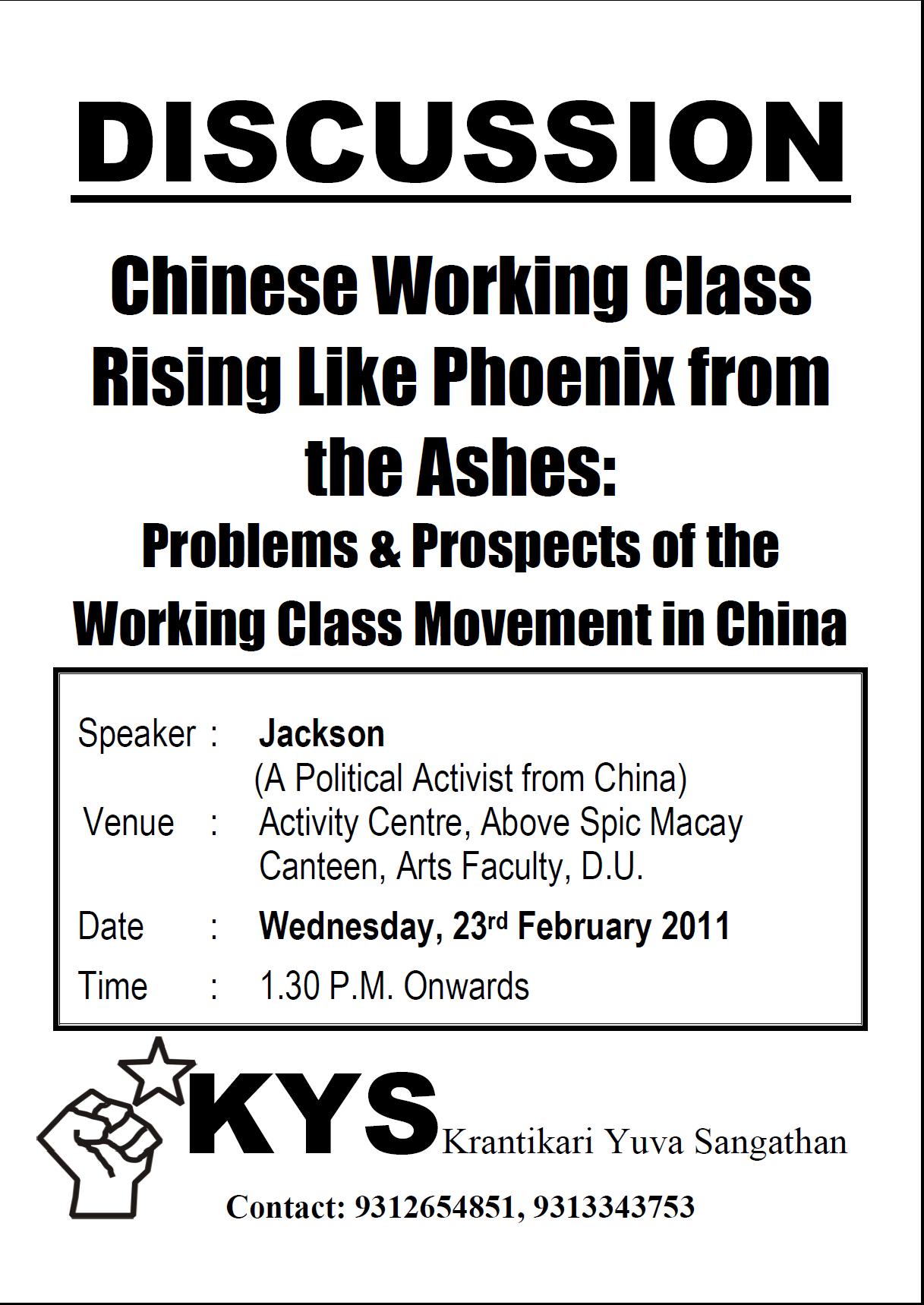
Chinese Working Class Rising Like Phoenix from the Ashes:
Problems & Prospects of the Working Class Movement in China
Speaker : Jackson
(A Political Activist from China)
Venue : Activity Centre, Above Spic Macay Canteen, Arts Faculty, D.U.
Date : Wednesday, 23rd February 2011
Time : 1.30 P.M. Onwards
KYSKrantikari Yuva Sangathan
Contact: 9312654851, 9313343753
A New Threat to Forest Dwellers and Protected Areas
February 11, 2011 by Leave a Comment
Campaign for Survival and Dignity
Having cleared the destructive Chiria mines and the POSCO project in violation of the law, the Environment Ministry has proceeded to grossly violate people’s rights in protected areas – to the detriment of both people and wildlife. On February 8th, it issued new guidelines for the declaration of “critical wildlife habitats” under the Forest Rights Act. These guidelines are in direct violation of the Forest Rights Act and will encourage the kind of brutal forced relocation that harms people, increases conflict with wildlife and leads to more destruction in protected areas. Everyone from the Tiger Task Force through numerous conservationists themselves have pointed out the dangers in the current relocation process.
Once again, we see that the primary interest of this system is not in wildlife, forests, people or even “development”: it is retaining its own power.
The guidelines are in violation of law on the following counts (for a quick summary see table below):
- Identification of CWHs: As is admitted by most wildlife organisations and by the government itself, existing national parks and sanctuaries have often been demarcated arbitrarily without consulting either the people of the area or scientists; as a result many are of limited wildlife significance. Therefore the FRA requires that a consultative and scientific process, “case by case, on the basis of scientific and objective criteria” (s. 2(b)) for identification of critical wildlife habitats should be undertaken in all existing protected areas. In order to ensure that this process is actually sound (and not arbitrary again), it should be done by an Expert Committee including experts from the locality and a Tribal Ministry representative. The new guidelines do not satisfy any of these requirements.
- Scientific basis:The new guidelines say nothing about which “scientific and objective criteria” are to be used. They also ignore the requirement that critical wildlife habitats should only be established where it can be scientifically proven that the presence of forest dwellers is causing irreversible damage to wildlife and that co-existence is not possible. The only reference to any of this is a vague statement that studies on human impact should be carried out – but this is in Annexure 2, a list of points to be taken into account for financial planning, long after identification is over. Finally, the process of identification is to be carried out by the DFO and a “local scientific institution” in the space of a mere 60 days. The result can only be imagined – exactly as occurred in the case of critical tiger habitats, all existing protected areas will simply be sought to be converted into critical wildlife habitats, followed by pressurising people living inside them to relocate. The guidelines also sneak in the intent of extending CWHs to areas “in and around” protected areas (point 5.6.2) thereby leaving room to extend PA boundaries to larger areas. This is a total perversion of the intent of the law.
- Consultation: On consultation, the guidelines are a farce. The identification of the habitat, as said above, will first be carried out by the DFO; whereupon the guidelines say there should be “extensive consultation” with forest dwellers by an Expert Committee. What will happen to the results of this “extensive consultation” and the comments of the people? Nothing. They are never referred to in the guidelines again. Thus this consultation process is actually non-existent.
- No Expert Committee:Indeed, the role of the Expert Committee – which is to identify the critical wildlife habitat – has been reduced to “motivating” villagers for relocation, after the two technical members have on their own decided the area to be demarcated as a CWH. In sum, the guidelines reduce the process of identification to an administrative exercise controlled by the Forest Department.
- Relocation: In addition to the scientific evidence of irreversible damage from people, the law requires that relocation from a critical wildlife habitat requires the free informed consent of the gram sabha (s. 4(2)(e)), must provide a secure livelihood (s. 4(2)(d)), and can only take place after rights are recognised (s.4(2)(a)), and facilities are complete (s. 4(2)(f)). Every one of these conditions is violated:
- Consent of gram sabha: There is no reference in the guidelines to taking the consent of the gram sabha for relocation at any point, except when the section itself is quoted. Instead there is talk of relocating even if “a small number of families agree”, which by implication means that the majority do not do so – and hence the gram sabha could not have consented. This will open the way for individually pressurising families and pushing relocation step by step, once again in violation of the law.
- Secure livelihood: The guidelines again say nothing about providing any livelihood at all, leave alone a secure one acceptable to the people. Instead, they say that two “options” will be offered (based on the Project Tiger package) – Rs. 10 lakhs per family or a vague reference to “rehabilitation by the Forest Department.” In fact, the law does nota allow such provision of mere cash compensation, as this is at the root of all the rehabilitation failures of the past. It is also a total violation of people’s rights, since they lose their livelihoods and access to the forest and only get a sum of cash – which itself often doesn’t reach them.
- Completion of recognition of rights: Once again there is no reference to this except in Annexure 2, where it is irrelevant. Since rights are hardly being recognised in protected areas and the guideline imposes an absurd 60 day time limit, relocation will now proceed without bothering with people’s rights – making harassment and pressure on forest dwellers more likely.
- Completion of facilities: This was intended to protect against hasty relocation without any facilities being provided. In the last year alone, two people have died (in Similipal in Orissa and Achanakmar in Chhattisgarh) after being forcibly relocated from tiger reserves and not provided any proper shelter.There is not a word about this requirement anywhere in the guideline.
Despite some weaknesses and internal inconsistencies, the October 2007 guidelines that this order replaces had covered all these issues. This new set of guidelines completely throws to wind the law and violates all the Act’s provisions on procedures of determining and notification of critical wildlife habitats. Indeed, relocating anyone on the basis of these guidelines would be in direct violation of the law; and hence a criminal offence under section 7 of the Act. Following this policy will only ensure the continuance of the earlier form of forced arbitrary relocation, harming both people and wildlife.
Summary of Violations of Law
| Provision | Requirement of Law | What Guidelines Actually Do |
|---|---|---|
| s. 2(b) | Decide wildlife habitats on basis of scientific and objective criteria | No criteria specified; left to administrative fiat |
| s. 2(b) | On a case by case basis | Left to concerned DFO “in consultation” with “local scientific institution” |
| s. 2(b) | Decide through a process of consultation by an Expert Committee | Identification entirely by DFO and “local scientific institution”, without any consultation; role of Expert Committee is restricted to “sensitising” people to the relocation package after the proposal is sent to MoEF |
| s. 2(b) | Recognition of rights and other pre-conditions to be met prior to any relocation (s.4(1) and 4(2)) | Ignores and therefore violates both |
| s. 4(2)(a) | Rights have to be recognised first | Completely ignored except irrelevant reference in Annexure 2 |
| s. 4(2)(b),(c) | No relocation unless can be shown that human presence causing irreversible damage and co-existence not possible | Completely ignored |
| s. 4(2)(d) | Relocation must provide a secure livelihood | Rs. 10 lakh compensation or vague “rehabilitation” mentioned; no reference to providing a livelihood |
| s. 4(2)(e) | Free informed consent of the gram sabha to be taken in writing | Ignored; no procedure stated, implicitly refers to consent of individual families |
| s. 4(2)(f) | No relocation until facilities at new site (by implication including livelihood) are complete | Completely ignored |
In sum, every provision of the law has been violated.
The Arup Bhuyan Verdict – A Departure?
February 8, 2011 by 1 Comment
Rahul Choudhary
The Supreme Court’s verdict of February 03 in Arup Bhuyan vs State of Assam is significant at the time when the Indian state seems to be on the prowl looking for victims to assert its exceptional sovereignty. On the one hand, it rekindles the ‘liberal’ hope which wanes every time Sen-s are put behind the bars. In fact, by raising this hope, such judicial correctives help, in an inverted manner, in consensual containment of protests that might add up to form a threat to the state’s sovereignty. But on the other hand, they give an opportunity to consolidate critical voices within, strengthening the struggle for showing the limits of the present system and providing a relief to the struggling masses.
In this particular case in review, the appellant disputes the allegation of his association with ULFA, which was made on the basis of his confession before the police, in which he identified the house of a deceased. Such non-judicial confessions are generally not valid because of the involvement of tortures etc, but in TADA cases they are considered admissible. Going with the convention of rejecting such confessional statements before the police, the court has questioned their admissibility even in these ‘exceptional’ cases. It says, “in the absence of corroborative material, the courts must be hesitant before they accept such extra-judicial confessional statements.”
However, the major portion of the verdict is directed against the TADA Court’s conviction of the appellant under Section 3(5) of the TADA which makes mere membership of a banned organisation criminal.
Here, Justices Katju and Misra have simply extended their own arguments presented in another recent case – State of Kerala Vs Raneef, 2011 (1) SCALE 8. The accused was asking for bail in this case where he was booked for giving medical treatment to one of the assailants. The accused person’s association with an Islamic organisation was taken as incriminating evidence. The judges opined that as that particular organisation was not a terrorist organisation, the accused could not be penalised for his membership. However, what makes this verdict consequential for the Feb 3 judgement is its clear opinion against the doctrine of “guilty by association”, which has become the cornerstone of recent criminal legislations and anti-terrorist measures. The judges in the previous verdict concurred with three famous American judgements:
1) Scales vs. United States 367 U.S. 203 where Mr. Justice Harlan of the U.S. Supreme Court observed:
“The clause does not make criminal all association with an organization which has been shown to engage in illegal activity. A person may be foolish, deluded, or perhaps mere optimistic, but he is not by this statute made a criminal. There must be clear proof that the defendant specifically intends to accomplish the aims of the organization by resort to violence.”
2) In Elfbrandt vs. Russell 384 US 17-19 (1966) Justice Douglas of the U.S. Supreme Court observed:
“Those who join an organization but do not share its unlawful purpose and who do not participate in its unlawful activities surely pose no threat, either as citizens or as public employees. A law which applies to membership without the `specific intent’ to further the illegal aims of the organization infringes unnecessarily on protected freedoms. It rests on the doctrine of `guilt by association’ which has no place here.”
3) In Joint Anti-Fascist Refugee Committee vs. McGrath 341 US 123 at 174 (1951) Mr. Justice Douglas of the U.S. Supreme Court observed :
“In days of great tension when feelings run high, it is a temptation to take shortcuts by borrowing from the totalitarian techniques of our opponents. But when we do, we set in motion a subversive influence of our own design that destroys us from within.”
The judges thus summarises their views on the doctrine of ‘guilty by association’ that they presented in State of Kerala Vs. Raneef:
“Mere membership of a banned organisation will not incriminate a person unless he resorts to violence or incites people to violence or does an act intended to create disorder or disturbance of public peace by resort to violence (See : also the Constitution Bench judgment of this Court in Kedar Nath Vs. State of Bihar, AIR 1962 SCC 955 para 26).
In the present Arup Bhuyan judgement, the judges have continued exploring the international cases. The following para is crucial in this regard:
In Clarence Brandenburg Vs. State of Ohio, 395 U.S. 444 (1969) the U.S. Supreme Court went further and held that mere “advocacy or teaching the duty, necessity, or propriety” of violence as a means of accomplishing political or industrial reform, or publishing or circulating or displaying any book or paper containing such advocacy, or justifying the commission of violent acts with intent to exemplify, spread or advocate the propriety of the doctrines of criminal syndicalism, or to voluntarily assemble with a group formed “to teach or advocate the doctrines of criminal syndicalism” is not per se illegal. It will become illegal only if it incites to imminent lawless action. (emphasis mine)
The judges conclude:
“We respectfully agree with the above decisions, and are of the opinion that they apply to India too, as our fundamental rights are similar to the Bill of Rights in the U.S. Constitution. In our opinion, Section 3(5) cannot be read literally otherwise it will violate Articles 19 and 21 of the Constitution. It has to be read in the light of our observations made above. Hence, mere membership of a banned organisation will not make a person a criminal unless he resorts to violence or incites people to violence or creates public disorder by violence or incitement to violence.”
The importance of these two judgements lies in the fact that through them the Supreme Court has initiated a significant departure from the tenor set by the two earlier landmark cases which were fully in consonance with the policing needs of the neoliberal policy makers – Kartar Singh’s case, 1994(3) SCC569 (which upheld the TADA Act) and PUCL Vs Union of India, 2005 SCC(Crl)1905 (which upheld the POTA provisions).
In his book published in 2008, one of the doyens of the Indian judicial system, Justice Chinnappa Reddy wrote:
“The Fundamental Rights guaranteed by the Constitution under Articles 14, 21, and 22 are undoubtedly negated by some of the provisions of the new POTA as well as the provisions of TADA which are capable of much mischief. It is to be hoped that very soon the Supreme Court will take a second view at any new enactment containing similar provisions.”
Considering their views in these two recent cases, Justices Katju and Misra have definitely taken a second view at the old enactments and case laws.
 Radical Notes