SC on Custodial Crimes and Preventive Detention

Rahul Choudhary

Mehoob Batcha & Ors. Vs State Rep. by Supdt of Police (Criminal Appeal No 1511 of 2003) Delivered on March 29, 2011. Rekha vs. State of Tamil Nadu & Anr (Criminal Appeal No. 755 of 2011) Delivered on April 05, 2011

“all three powers are… organs of political hegemony, but in different degrees: 1. Legislature; 2, Judiciary; 3. Executive. It is to be noted how lapses in the administration of justice make an especially disastrous impression on the public: the hegemonic apparatus is more sensitive in this sector, to which arbitrary actions on the part of the police and political administration may also be referred.” (Antonio Gramsci)

It was the police’s “arbitrary actions” that came under Supreme Court Justice Markandey Katju’s scrutiny in Mehoob Batcha & Ors. Vs State Rep. by Supdt of Police (Criminal Appeal No 1511 of 2003). In this case Justice Katju strongly called for death penalty, though not even a case of murder was made out at the charge stage. The reason for not charging the perpetrators for murder is not known but the statement of one of the victims puts forth the barbaric face of the state apparatus as it is experienced at the grassroots level. In this case, the policemen were accused of killing one person in custody and gang-raping his wife in the premises of the police station. And what we are more familiar with, the policemen were not charged with murder, and instead the Trial Court treated the death of the deceased victim as suicide. Custodial deaths are happening more often across the country, some are reported and some remain unnoticed.

Previously, the Supreme Court had passed direction against custodial death, but not much seems to be happening on the ground. In 1997, the Supreme Court in D.K. Basu vs. State of Bengal [(1997)1SCC416] pronounced,

“Custodial violence, including torture and death in the lock-ups, strikes a blow at the rule of law, which demands that power of the executive should not only be derived from law but also that the same should be limited by law. Custodial violence is matter of concern. It is aggravated by the fact that it is committed by persons who are supposed to be the protectors of the citizens…”

In the Mehboob Batcha case, the actions of the policemen were more inhumane and barbaric than any other case. The recorded statement of the rape victim tells the tale that defies any interpretation other than guilty mind(s). The Supreme Court says, “the horrendous manner in which Padmini was treated by policemen was shocking and atrocious, and calls for no mercy”. In the end the court says that the copy of the order of this case be sent to Home Secretary and Director General of all States and Union Territories, who shall circulate the same to all police officers up to the level of SHO with a directive that they must follow the directions given by the Court in D.K.Basu’s case and that custodial violence shall entail harsh punishment.

D.K. Basu Vs. State of West Bengal laid out the guidelines to be followed in case of arrest:

(1) The police personnel carrying out the arrest and handling the interrogation of the arrestee should bear accurate, visible and clear identification and name tags with their designations. The particulars of all such police personnel who handle interrogation of the arrestee must be recorded in a register.

(2) That the police officer carrying out the arrest of the arrestee shall prepare a memo of arrest at the time of arrest and such memo shall be attested by at least one witness, who may either be a member of the family of the arrestee or a respectable person of the locality from where the arrest is made. It shall also be countersigned by the arrestee and shall contain the time and date of arrest.

(3) A person who has been arrested or detained and is being held in custody in a police station or interrogation centre or other lock-up, shall be entitled to have one friend or relative or other person known to him or having interest in his welfare being informed, as soon as practicable, that he has been arrested and is being detained at the particular place, unless the attesting witness of the memo of arrest is himself such a friend or a relative of the arrestee.

(4) The time, place of arrest and venue of custody of an arrestee must be notified by the police where the next friend or relative of the arrestee lives outside the district or town through the Legal Aid Organisation in the District and the police station of the area concerned telegraphically within a period of 8 to 12 hours after the arrest.

(5) The person arrested must be made aware of this right to have someone informed of his arrest or detention as soon as he is put under arrest or is detained.

(6) An entry must be made in the diary at the place of detention regarding the arrest of the person which shall also disclose the name of the nest friend of the person who has been informed of the arrest and the names and particulars of the police officials in whose custody the arrestee is.

(7) The arrestee should, where he so requests, be also examined at the time of his arrest and major and minor injuries, if any present on his/her body, must be recorded at that time. The “Inspection Memo” must be signed both by the arrestee and the police officer effecting the arrest and its copy provided to the arrestee.

(8) The arrestee should be subjected to medical examination by a trained doctor every 48 hours during his detention in custody by a doctor on the panel of approved doctors appointed by Director, Health Services of the State or Union Territory concerned. Director, Health Services should prepare such a panel for all tehsils and districts as well.

(9) Copies of all the documents including the memo of arrest, referred to above, should be sent to the Illaqa Magistrate for his record.

(10) The arrestee may be permitted to meet his lawyer during interrogation, though not through the interrogation.

(11) A police control room should be provided at all district and State headquarters, where information regarding the arrest and the place of custody of the arrestee shall be communicated by the officer causing the arrest, within 12 hours of effecting the arrest and at the police control room it should be displayed on a conspicuous notice board

The Court also stated that failure to comply with the guidelines shall apart from rendering the official concerned liable for departmental action, also render him liable to be punished for contempt of court and the proceedings for contempt of court may be instituted in any High Court of the country, having territorial jurisdiction over the matter.

The requirements, referred above, flow from Articles 21 and 22 (1) of the Constitution and need to be strictly followed. These would apply with equal force to other governmental agencies like Directorate of Revenue Intelligence, Directorate of Enforcement, Costal Guard, central reserve Police Force, Border Security Force, Central Industrial Security Force, the State Armed Police, Intelligence Agencies like Intelligence Bureau, RAW, CBI, CID, Traffic Police, Mounted Police and ITBP.

This strict direction was passed way back in 1997. However, it seemed to have failed to work, which called for its reassertion by the SC.

Another judgement was delivered a few days later once again by Justice Katju which could be read in continuation. The issue in Rekha vs. State of Tamil Nadu & Anr was that of ‘preventive detention’. The detention order was passed under “Tamil Nadu Prevention of Dangerous Activities of Bootleggers, Drug-Offenders, Goondas, Immoral Traffic Offenders, Sand Offenders, and Slum Grabbers and Video Pirates Act, 1982”. This Act popularly known Goondas Act, itself reminds of the legislations which Marx describes as “Bloody Legislation against the Expropriated”.

While Article 21 of the Constitution provides that no person shall be deprived of his life or personal liberty except according to procedure established by law, Article 22(1) and 22(2) provides protection against arrest and detention in certain cases, Article 22 (3) provides for preventive detention as an exception to Article 21 and 22(1) and 22(2).

Article 22(1) of the constitution makes it a fundamental right of a person detained to consult and be defended by a lawyer of his choice. But Article 22(3) specifically excludes the applicability of clause (1) of Article 22 to the cases of preventive detention. In the past, the Supreme Court passed various judgments against ‘preventive detention’.

In the case before the Supreme Court, the issue was the husband of the Petitioner was found selling expired drugs after tampering with the labels and printing fresh labels showing them as non –expired drugs. The ground for detention was that there is a possibility of him coming out on bail and if he comes out on bail he will indulge in further activities, which will be prejudicial to the maintenance of public health and order.

According to Justice Katju, Article 22(3) (b) of the Constitution of India which permits preventive detention is only an exception to Article 21 of the Constitution. An exception is an exception and cannot ordinarily nullify the full force of the main rule, which is the right to liberty in Article 21 of the Constitution. The Court went into details of whether the case for preventive detention was made out or not and also remarked against the very concept of preventive detention.

“…Prevention detention is, by nature, repugnant to democratic ideas and an anathema to the rule of law. No such law exists in the USA and in England (except during war time). Since, however, Article 22(3)(b) of the Constitution of India permits preventive detention, we cannot hold it illegal but we must confine the power of preventive detention within very narrow limits, otherwise we will be taking away the great right to liberty guaranteed by Article 21 of the Constitution of India which was won after long, arduous, historic struggles. It follows, therefore, that if the ordinary law of the land (Indian Penal Code and other penal statutes) can deal with a situation, recourse to a preventive detention law will be illegal…

…It must be remembered that in cases of preventive detention no offence is proved and the justification of such detention is suspicion or reasonable probability, and there is no conviction which can only be warranted by legal evidence.

Personal liberty protected under Article 21 is so sacrosanct and so high in the scale of constitutional values that it is the obligation of the detaining authority to show that the impugned detention meticulously accords with the procedure established by law…”

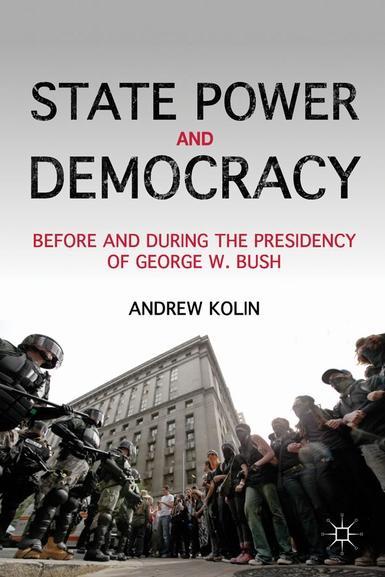
A Review of “State Power and Democracy”

 Paresh Chandra  

Andrew Kolin, State Power and Democracy: Before and During the Presidency of George W. Bush, Palgrave Macmillan, 2010

It is not hard to find texts that defy the lies of the state by presenting facts that contradict them. This method of ‘uncovering’ the status quo, which can be called Chomskyan (the political Chomsky, not the linguistic one), works by trying to shock its reader out of their ideological slumber. Unfortunately, the vast array of ugly facts that these texts bring out usually remains ungrounded in a unified, alternative perception of reality. The attempt is to falsify particular claims of the state, by producing facts to the contrary, without trying to understand the ‘deep structure’ that gives birth to this state of affairs. The reader, not drawn out into a critique of present-day life in its entirety, is able to go back to that life, as if what these books uncover is simply another aspect of reality that s/he need not be concerned with.

The first noticeable merit of Andrew Kolin’s book is that it is able to avoid this Chomskyan pitfall. The main thesis – that the American police state that came toAndrew Kolin's State Power and Democracy full bloom during the Bush regime was the culmination of a history of suppression of democracy – is buttressed by a very detailed account of steps that successive governments took in this direction. A diachronic account invariably suggests causal relations, and the writer in question does not feel the need to shy away from these suggestions. Kolin’s analysis shows that the move toward a police state was a possibility immanent within the American system, and if it did not become a solid, unquestioned presence till now, it was only because of successive people’s movements that broke its advance. The emergence of the ‘military-industrial complex’ during and after World War II on the one hand, and the institution of intelligence bodies like the FBI and CIA on the other, were major steps in the making of a police state. Kolin demonstrates how these bodies worked together, repeatedly sidelining the Congress, to hinder the rights of citizens and foreigners (inside and outside the American border). Even as they played a crucial role in militaristic/expansionistic drives, they also ensured that opposition within the borders of the nation, to the state’s foreign policy, is minimised.
The American state has managed to ensure a permanent state of emergency, declared or undeclared, within its borders. This emergency is based, customarily, on the fear of external threats (till a point communism and later on terrorism). The state of emergency implies that the President has unquestioned primacy over the Congress, that the Intelligence has a free hand, and that democratic rights of citizens are effectively and indefinitely suspended. Any person or organisation that dared to question foreign policy was arbitrarily connected to foreign threats (present or absent) and was hence liable to be prosecuted. Laws like the Patriot Act ensured that ‘suspicion’ was good enough ground to ‘neutralise’ a person.

From the beginning of the 20th century, and especially after WW-II, the US has been the single-most powerful imperialist entity in world politics. “Empires are incompatible with democracy, which has been seen throughout human history. To maintain and expand power, an empire must limit dissent, rolling back democracy; only mass democracy could challenge the authoritarian polices of the US government.” (131) To defend its power and policies the US has had to stay on an offensive not only in territories it has ‘conquered’, but also inside its own borders, where dissent has emerged time and again. Sometimes the combination of aggression abroad and defence within its borders has proved too much, and the outcome has often been visible. For instance, one practical implication of continuous war in Vietnam was that the state was not in a position to control, properly, rising discontent inside its borders. More generally, however, a logical continuum can be traced, on the one hand between the aggression that is perpetrated outside and inside the nation’s border, and on the other the resistance that it has to face on both ‘fronts’.

The foregrounding of this two-faced ‘continuum’ has been, to my mind, the single-most important achievement of Kolin’s book. He has been able to demonstrate, through an analysis of (sensational) realpolitik, as well as more prosaic politico-economic facts, that imperialist aggression, destruction of democracy inside the imperialist nation, resistance, both inside and abroad, and policy at large (both ‘pro-‘ and ‘anti-people’) are inextricable entwined. In a way then, this book is an allegory of politics in a world dominated by the capitalist mode of production.

This final point about policy, or more precisely, the part about ‘pro-people’ policy needs to be explained a bit more. Kolin shows that the meeting of demands raised by protestors does not necessarily (in fact, never) means a systemic improvement – cooption is the word. When the tendency toward militarisation becomes excessive, the chances of an implosion increase (this becomes visible, primarily in peoples’ discontent), and to ‘manage’ this state of affairs the state seems to give in to demands; everything suddenly becomes more democratic. But this improvement is always temporary, and in a way buys time for the capitalist state to reorganise itself for a fresh assault. Obama, for instance, seems to be buying time in precisely this manner – making cosmetic changes, making promises that he does not keep, and so on. The fact is, and this too Kolin brings out, that the state tries its best to destroy movements. When it fails to do that, it meets those demands that do not need a fundamental reorganisation of the social structure. ‘Affirmative action’ was one such demand, which allowed the state to control the furore of the Civil Rights Movement without hurting hegemonic interests too much.

This much said, two more bases are left to be covered, by this essay and by the book. All radical theorists invariably run into a persistent problem in the process of explicating the workings of the system. One does not want to overplay the aspect of agency, nor celebrate the ‘victories’ of movements, without appending a warning about the system’s ability to coopt struggles. If we do this, we risk the pitfall of reformism and the cause of revolutionary transformation may suffer. On the other hand, if we focus upon the system and its ‘largeness’, its ‘perfections’, its capacity to survive and rejuvenate itself, our work may have a pessimistic, anaesthetic effect on the reader, once again defeating our cause. And this is the problem that Kolin’s book runs into. The vast intricacies of the functioning of the state impart to it a sublimity that seems beyond comprehension; and what we cannot comprehend, we surely cannot fight. On top of this, the ability of this state (of affairs) to perpetuate itself by coopting all attempts to subvert it.

But this is where another aspect of the text becomes important: the periodically stated, if somewhat inadequately developed (within the text) centrality of ‘class’.

Usually, the text mentions class when it tries to distinguish between struggles whose demands are easier for the state to meet, because they do not question its foundations, and others, which do just that and are invariably forcefully suppressed. Admittedly the text does not explain why “class-based” struggles are somehow harder to coopt. The detour through political economy that this would entail would have done away with any possibility that may exist, of the reader being too overwhelmed with surface structures to grasp the deep structures that generate them.  I would argue that any attempt at ‘cognitive mapping’ (to use Fredric Jameson’s phrase), any attempt, in other words, to get a handle on the state-of-affairs will need to begin with an understanding of class struggle, understood not as a one-on-one battle between two groups, but as a struggle of tendencies that become visible to us in synchronic force-fields of identity assertions. Though, as has been said, the text does not elaborate upon the process of class struggle, it does manage to give the reader a sense that each synchronic fact that it describes is overdetermined by a complex underlying process that unites it to other such facts. In its detailed description of the pendulum-like movement of the state between greater and lesser democracy, and the relation of this movement to struggles of peoples, it is able to present an image of history as the complex dialectic between autonomy constituted in, as and by the momentary contingencies of a necessarily continuous critique and its equally inevitable and continuous structural determination.

Delhi University: DO WE KNOW WHAT’S BEEN HAPPENING IN OUR DEPARTMENT?

DO WE KNOW WHAT’S BEEN HAPPENING IN OUR DEPARTMENT?
WHAT ARE WE DOING ABOUT IT?

Do we support of the Department becoming a Police State?
NO!

Do we support the presence of Bouncers in Faculty meetings?
NO!

Do we voice our dissent?
NO!

Silence in the face of Totalitarianism is equal to Support for Totalitarianism.

Is this who we want to be?
An apathetic and apolitical body of students?
Do we care?

THE NEED OF THE HOUR is to MEET.
Take time to look beyond busy exam schedules at the big picture,
Recognise the value of having an academic space which allows faculty and students to express opinions.

GET INFORMED. Read http://kafila.org/2011/04/18/is-it-nineteen-eighty-four-already/
SHOW SUPPORT.

hello all,

its time we put an end to this long silence.
what are we doing? what exactly are we doing? an MA? running desperately towards a degree? with as much speed as possible?

the only thing that can really get us into gear is exams! i wished we could do better than that. else, we could do much better in the apathetic corporate sector and science colleges we so critique for their “apoliticalness”. are we, the literature students, who theorise and tear authors and critics apart, better just because we STUDY lit.? for we dont seem to be any more political than the table in my room.

facebook is the platform for our protests. upcoming exams, bad syllabi, lack of chairs in classrooms and unsatisfactory IA – all of it goes on facebook. and of course, we expect our techie teachers to take the hint and sort our problems for us. we, helpless souls are limited to our computer mouses. thats as far as we move our fingers. the only time we draft petitions are when we want exams to be postponed, even when it is a perfectly comfortable date sheet. that’s as far we theory people can delve in practice. of course, we expect some of the practioners to see our protests on face book and demonstrate it physically for us.

and surely we do not waste our time organising seminars or attending the ones which were painstakingly fought for by the “over-enthu” and apparently not-so-studious few for their own fun.

why would the messy MA admission process bother us once we are done with it?

why will the semester system issue for UG level bother us, for we are Post Graduate students!

why should it matter if the dept is in a state of chaos, for we will get going soon enough. and if there are those who want to stay here, its their problem.

and if our teachers and mentors who have helped us through so many different things, why should we feel grateful? after all, its their job?
NO. its not their “job” to deal with our questions outside the class. its not their “job” to push for a better IA mechanism or organise a students seminar, or listen to our personal problems, as a lot of them do.
but we do ‘like’ and ‘comment’ on their plight on FB. and surely, as students, busy preparing for our exams (which probably cant happen if these teachers were not there), we cant be expected to do more! poor, helplessly busy us.

we cant speak for ourselves, we cant speak for anyone else. and of course we are students of English Literature who specialize in being articulate, in making coherent theoretical arguments and speaking for the rights of the “mute” subaltern. well, charity begins at home. start speaking for the rights of the environment you are a part of, even if provisionally.

can we please, for once, get over ourselves, our petty goals, our exam phobias and take responsibility for our political positions. for, inaction and silence does not mean NEUTRAL GROUND. it is very much a position. it is very much a choice!

can we, for once, try to take our grudges beyond our comfortable computer tables and fb groups and actually step out to express the beliefs and critiques we so well write down to get a 60%?

can we for once think of a future beyond exams? we are not half as messed up as we will be in the time to come, if we keep shirking from our political responsibilities, if we are not willing to interfere in the course things take in our work/study places, if we are self-obsessed enough to allow the flow of things to drown us.

we have actually read very little, and perhaps understood even less. for if we had understood, we wouldnt have been in the pitiable shape that we are, letting ourselves down as we have.

So. Do we meet? When?

POSCO: A Lie Repeated Three Times Does Not Become The Truth

POSCO PRATIRODH SANGRAM SAMITI

Odisha Government Repeats the Same Old Lies in “Assurance” to Environment Ministry

Today the Odisha government sent a “categorical” assurance to the Ministry of Environment and Forests, claiming that no one in the proposed POSCO project area is eligible under the Forest Rights Act. The Ministry’s request for a “categorical assurance” came after two Committees had already exposed that the Odisha government had lied on this matter.

The latest “assurance” repeats exactly the same lies that were told and exposed before – as if there had never been any enquiry committees. The Odisha government has also challenged the Ministry’s interpretation of the law as well as the Ministry’s own orders.

For instance:

– The government continues to say that the area was “wasteland” and therefore the people are not forest dwellers. The Odisha government’s own revenue maps of 1928-1929 and the Survey of India in 1929 all clearly show the area marked as “dense jungle” and “miscellaneous jungle.” These were brought out by the POSCO Enquiry Committee. Does the Odisha government believe that its own maps are forgeries?

– The government claims that it “implemented” the Forest Rights Act by calling palli sabha meetings in March 2008; and, in just one meeting in each village, apparently the Act was explained, the forms and records supplied and the people trained. But, as per their own records, the required legal quorum was not met in a single one of those villages, again as exposed by the Enquiry Committee. One of the meeting “records” attached to the assurance – that concerning the village of Govindpur, where a large part of the forest land lies – shows a total of 34 people attending this meeting. Is this what the Odisha government has to show for implementation? A single meeting of 34 people, which is not a valid meeting under any law and certainly not under the Forest Rights Rules?

– Moreover, what has happened to the claims filed since by the people of the area? Who gave the Collector the unilateral power to decide who is eligible in this area? In what sense is this within the law?

– The Odisha government not only has contempt for the law – it also has contempt for the Environment Ministry. Despite being explicitly instructed in the January 31st order that people are not required to be cultivating for 75 years to be eligible, it says they do. It has tried to act as if the Ministry’s own orders and conditions do not exist, saying that FRA implementation and consent of the gram sabhas are not required – when, in addition to being required by law, the Ministry itself made these an explicit condition for this project. Finally, the government has not bothered to reply to a single one of the legal points made in any of the representations forwarded by the Ministry to it, except for disputing the validity of some resolutions.

Every single claim that the Odisha government makes in this assurance has been proven false by us, by political leaders, and by two official Enquiry Committees. There is not a single shred of new evidence in this “assurance”. Moreover, the proof that it is a bunch of lies is already with the Ministry.

The question now before the Environment Ministry is simple. Is it going to continue colluding with a State government that has demonstrated its utter contempt for law, truth and people’s rights? Is it going to grovel before a State government that challenges its interpretation of law and ignores its orders? Is it going to tell the nation that it will ignore lies when they stare it in the face?

Less than a week after claiming that it is going to battle corruption and remove scams, is the UPA government now going to yet again throw the law to the winds for the sake of vested interests and a private company? Is it going to show again that it is just a front for money and muscle power? Whatever the answer may be, the struggle of the people will go on.

Prashant Paikray
Spokesperson, POSCO Pratirodh Sangram Samiti

Forget Corruption, fight bourgeois class rule

Satyabrata

Can “corruption” be seen as a homogeneous practice? Is the corruption of a government evident, say, in the signing of an MoU, and that of a clerk taking bribes the same? The answer is obviously no! A society where money constitutes the primary means by which people satisfy their needs, with needs increasing and relative wages declining, striking a moral stance on corruption amounts to submitting to the ruling hegemony. But to inquire, on the other hand, into the causes of corruption is to take the first step in launching a concerted attack on that hegemony. The power of the system rests, in large measure, on its capacity to prevent people from engaging in the process of critical thinking; to convert them into passive recipients of Ideology. The “Hazare movement” is one such example where hegemony subsumes dissent, and distorts it.

Therefore, a politico-strategic exposition of the Jan Lokpal Bill, which has brought large masses of students, youth, industrialists and politicians out on to the streets, is a necessary condition for engaging with what might be called the “Hazare movement”. In an ideal sense, the Jan Lokpal Bill is a legislative attempt to check corruption. It demands the setting up of a central Lokpal, and state-level Lokayuktas, that will be independent of governments. Members will be selected by judges, citizens and constitutional authorities, and not by politicians, through a completely ‘transparent’ and ‘participatory’ process. Its tasks shall include inquiry into cases of delayed delivery of public services and imposition of penalty on officials found guilty.

Here it becomes necessary to understand the role of representative institutions in a representative democracy as another representative institution is probably about to be set up. Representative bodies are institutions through which political power is wielded. In that sense they are not very different from “management” of industries, especially as far as their task of control over masses is concerned. The difference is they are elected (directly or indirectly) by the people. The cry of the people today against corruption on the streets is the participation of “people” to undo something that hampers their lives. Of course such desire is refracted through shards of ideology but that certainly does not negate its impulse to grapple with the system in order to rid it of its warts. The trouble, however, is the anti-corruption movement is about to be institutionalised by the state, which is seeking to bring it within the realm of its operation. That, in itself, appears to be a welfarist act. That is, if one doesn’t go deeper to understand the logic of the State.

The widespread hue and cry over the Hazare movement is evidence that the ideological apparatuses of the state are at work to include dissent and the idea of mass participation it poses into a re-presentative body. That would, among other things, lead to the institutional inclusion of participatory democracy – an idea posed by the politics of dissent – even as such participation is exteriorised by the masses. It is indicative of the necessity of the existence of the state and civil society as two separate bodies embodying alienation and dissent respectively. The Hazare movement is politico-ideologically bankrupt to grasp how the state is an institution to wield political power. And is not such a movement, therefore, condemned to express impulses of capitalist ‘de-statisation’ which, at the level of political logic, have much in common with the current politico-economic consensus to increasingly privatise the public sphere, delivering significant aspects of life and livelihood into the hands of private players? No state can survive without the support of its people and this has been proved time and time again. But the “powerful state” learns and doesn’t allow its people to learn, if only to exist and exist better. An anti-corruption movement that bases itself merely on the outburst of people’s spontaneous dissent with regard to the system is bound to squander its potential revolutionary impulse because its institutionalisation by liberal politics is its inescapable fate.

Videos: Sanhati panel on “Left Movements in Contemporary India” (New York)

Sanhati organized a panel in the Left Forum 2011 on “Left Movements in Contemporary India” (Pace University, New York City, March 18-20). Prominent Marxist activist from India Gautam Navlakha spoke on the Maoist movement. Along with him was Siddhartha Mitra, who spoke on the internally displaced in Khammam. The event was moderated by Deepankar Basu, who teaches economics at the University of Massachusetts, Amherst. Deepankar analyzed the contemporary political economy of India which gives a background for understanding the left movements in India.

A Public Meeting On “Tamil Eelam Movement: The Contemporary Crisis and Its Significance” (April 1, 2011)

Organized by Coordination Committee for Oppressed Nationalities (CCON)

Speakers: Prof. Bimol akoijam, CSSS/ JNU, Satya Sivaraman, Journalist, Santhosh, Visiting Faculty, SAA/JNU, Someetharan, Jaffna Based Documentary Film Maker.

Followed by Documentary Screening on Mullaitivu Saga, 45 min , a English Documentary on the ‘final’ brutal military operation of the Srilankan army and A Book Release of In the Name Of Peace: The IPKF Massacre of Tamils in Srilanka

Place: Committee Room, SSS I, JNU
Date: 01-04-2011, 2.30 Pm Onwards

Tamil Eelam Movement: The Contemporary Crisis and Its Significance

When the Sri Lankan Government declared on May 19th 2009 that the war against the Tamil Tigers is over, thereby claiming that the Eelam struggle was finished, it received compliments from a curious combination of international forces. India and Pakistan welcomed Sri Lanka’s victory against ‘terrorism’. Israel and Iran congratulated Rajapaksa for upholding democracy. The Turkish government expressed opinions signaling that the PKK would meet a similar fate like the LTTE while quite a few military analysts in India and Colombia considered the possibility of finishing off the armed struggles waged by the Maoists and the FARC respectively in a ‘Sri Lanka style’ solution. The big powers, USA, France, Russia and China also expressed their solidarity with the victorious Lankan government. The pro-US Colombian government and the supposedly anti-imperialist Cuba and Venezuela conveyed their admiration for Rajapaksa’s firmness in dealing with ‘seditionists.’ Most of the above mentioned countries have also directly and indirectly provided material support to Sri Lanka.

INTELLECTUALS AND THE WAR: Indeed, some of the intellectuals who support these so-called anti-US countries, considering them to be truly ‘revolutionary’, have even characterized the Eelam struggle as being funded by imperialist powers. This despite the fact that the LTTE was banned and continues to faces a ban in the US, Canada and the European Union and that quite some Tamils who have been suspected of aiding the Tigers have been arrested by these governments. This despite the fact that the US, Israel and many countries of the West have supplied the Sri Lankan government with economic and military aid. This despite the fact that none of those countries that had no qualms in going to war with undemocratic regimes in Iraq earlier and now in Libya raised a finger while over 50000 civilians were butchered by the Sri Lankan Armed Forces between January and May 2009. Media houses like The Hindu and NDTV that put up a sham liberal facade propagated this blatant lie of ‘terrorism promoted by foreign powers’, besides even positively projecting Sinhalese chauvinist-triumphalism after the massacre of the Tamils. Recent cables released by Wikileaks shows how the Indian Government opposed foreign powers preventing the Sri Lankan state’s war against the Tamils and also how the Sri Lankan government was desperately trying to get greater aid from the US in their war on the Tamils.

While the silence in intellectual circles on the genocide in Sri Lanka is grossly disproportionate to its intensity, the talks and debates on Sri Lanka in the mainstream Indian media and academia focuses on either peace or reconciliation or both. What is conveniently forgotten is the struggle of a people for freedom and justice. The ‘left’ intellectuals affiliated with the CPM and few other parliamentary left parties, who have no qualms in shouting their support for the Palestinian liberation struggle, are happy to denounce the equally genuine demands of the Eelam Tamil people and to distort the truth of their oppression. That they hold similar positions on the other national-liberation struggles in the subcontinent is testimonial to their commitment to the oppressed peoples. Even those who recognize the war-crimes of the Sri Lankan government are rather silent on the political demand for self-determination of the Eelam Tamils and slip into a human-rights discourse instead. The tragedy that befell the Tamils then becomes a ‘soft-story’ discussion for the NGO’s and status quo intellectuals.

The truth is this. The war in Sri Lanka is not about human rights violations alone. It is primarily about political rights of the Tamils as a nation to secede and form an independent state. Unless that is recognized, all appeals for peace and co-existence are just mere shams to cover the naked racist oppression that exists in Sri Lanka, the brutal face of Sinhala majoritarian chauvinism. The Lankan emperor is wearing no clothes – but why do so few have the courage to point that out?

A BRIEF HISTORY OF BLOOD: As soon as Sri Lanka gained independence in 1948, it passed the Citizenship act, which in effect disenfranchised more than 10 lakh plantation Tamil workers in the island. Following the Sirimavo-Shastri pact of 1964, over 5 lakh of them were expatriated – the remaining were to get Sri Lankan citizenship only in 2003. In 1956, the notorious ‘Sinhala Only’ act, that made Sinhalese the sole official language was passed. Tamils staged peaceful protests and the response was state-sponsored riots which led to over a 150 deaths. Large scale riots against the Tamils occurred again in 1958, again as a response to non-violent protests of the Tamils. When the Federal Party declared civil disobedience, emergency was declared in many Tamil areas and the army was deployed to crush protests. Sinhalese academics in this period wrote ‘historical works’ that received official support which sought to obliterate the historical presence of the Tamils in the island. A sample – “The history of Sri Lanka is the history of the Sinhalese race… Buddhism is the golden thread running through the history of the Race and the Land…” (DC Wijewardena, The Revolt in the Temple)

Anti-Tamil riots occurred with varying frequencies in the 60’s and the 70’s. The Republican constitution of 1972, plucked away the few minority rights that the Tamils had. By officially privileging the faith of the majority, it made complete Sinhala-Buddhist supremacy a reality. The Tamils, deeply conscious of the oppression that they faced as a collective, realized that future in an united Sri Lanka would only spell doom for them. The Tamil United Liberation Front, which was formed on 1976, passed the Vaddukkodai resolution under the aegis of S.J.V. Chelvanayakam that year which stated that the struggle for “the Free, Sovereign, Secular, Socialist State of Tamil Eelam, based on the right of self determination inherent to every nation, has become inevitable in order to safeguard the very existence of the Tamil Nation in this Country.” The constitution promised a socialist-democratic state, committed to abolition of casteism and religious discrimination.

THE RISE OF ARMED STRUGGLE: The Tamil youth, who were the worst to be affected by the language policy of the government, and the rural populace who were under constant economic pressures, began losing faith in the peaceful methods of the TULF. The LTTE which was formed in 1976, gained popularity after the assassination of Jaffna mayor Alfred Duriappah. The burning of the Jaffna library, which contained numerous valuable historical manuscripts of the Tamils, by Sinhalese policemen in 1981 convinced the radical youth that the Sinhala chauvinist government was bent on erasing them totally and that armed struggle was the only way to secure justice. The horrible Black July riots of 1983 by Sinhalese mobs, policemen and the army, that was given a free hand by the state and which caused the deaths of over 4000 Tamils and the displacement of hundreds of thousands led to the intensification of Tamil armed resistance and its greater acceptance among the Tamil populace. The LTTE, with its programme for a Socialist Tamil Eelam, consciously promoted the involvement of women, dalits and backward castes in its ranks and reached out to a wider audience than the other parties.

INDIAN INVOLVEMENT: Other militant groups also emerged in this period. The TELO was openly favoured by the Indian government. After its decimation by the LTTE, the RAW chose the EPRLF, who were content to be happy stooges of India. Only the LTTE maintained its independent agenda and refused to be a junior partner of any power. Thus, when following the Indo-Sri Lanka accord the Indian Peace Keeping Force entered Sri Lanka, they launched their brutal assaults on the LTTE and the Tamil people. The IPKF also trained mercenary squads from the EPRLF in the name of ‘Tamil National Army’ to create terror among the local people. Yet, the Tigers were able to secure a decisive victory over the Indian army owing to their mass support and the usage of guerrilla warfare. After that defeat, India has supplied arms to Sri Lanka and also training to its armed forces, albeit covertly, mostly owing to fear of a backlash in Tamil Nadu.

CONSOLIDATION AND CRISIS: After a series of military successes, the LTTE consolidated its rule in the North and Eastern regions of Sri Lanka, having almost 15000 sq km under its control. When it entered into a Ceasefire agreement with Sri Lanka in 2002, it was functioning as a de facto state. It ran schools, hospitals, relief teams, judiciary and police. But by this time, various international powers starting stepping up their covert and overt support to Sri Lanka, especially after the media-generated paranoia on ‘terrorism’ after 9-11. The LTTE was banned in various countries and people suspected to be its members/sympathizers were arrested in India, the USA, France etc. While the movement of men and material for the LTTE was clamped down, the governments of China, Israel, Russia, Pakistan, Libya and Iran gave extensive military support to Sri Lanka.

The defection of Karuna, the Eastern Commander of the LTTE, in 2004 which was partly engineered by the Lankan government came as a major blow to the Tigers. The December 2004 Tsunami also greatly damaged human resources and infrastructure in Tiger controlled areas. With Rajapaksa’s election in 2005 the ceasefire began to deteriorate. On July 2006, the Sri Lankan military started its full scale offensive against the Tamils with blessings from various international powers. Numerous atrocious acts like the Chencholai orphanage bombing of August 2006 which killed 61 Tamil children were committed by the Lankan armed forces with impunity.

Towards the last stages of the military operations in Mullaitivu, the Lankan armed forces violated all established conventions of war. Chemical weapons and cluster bombs were used on civilian populations. Non-combatants were subject to tortures and sexual abuse. Media freedom was curtailed and vigilante groups were propped to violently snuff out any democratic voices. The murders of journalists Taraki Sivaram, Lasantha Wickramatunga and P. Devakumaran are ghastly examples. When the Lankan government declared on May 19th that the war was over and that peace was ahead, it failed to mention the bloody trail that it had left behind.

POST-WAR SRI LANKA: The Permanent People’s Tribunal in a hearing on January 2010 found the Sri Lankan government guilty of war crimes and crimes against humanity. Chomsky compared the Sri Lankan war on the Tamils to the atrocities in Rwanda. Despite claims to champion ‘peaceful co-existence’ the Sri Lankan government has been consistently pursuing militarization and colonization of Tamil areas since May 2009, especially in the absence of an organized resistance from the Tamils. Summary executions by mercenary gangs and the army, abductions, illegal detentions and rape are commonplace. Suicide rates among Tamils are one of the highest in the world and many suffer from psychological traumas.

Demographics of the region are changed by state supported Sinhalese settlements and establishment of army camps in Tamil areas. Many Tamil lands have now been used for foreign projects under the guise of government schemes. The assaults on the cultural level are also happening side by side. Besides wanton destruction of Tamil Churches and Temples, there are attempts to change the names of Tamil localities into Sinhala, thereby denying them their local history. Desecration of statues of Tamil martyrs has been accomplished with systematic efforts. In July 2010, the army demolished the Tamil war heroes cemetery in Thenmaradaachi, Jaffna, in order to build an army base over it. The purpose of this is two fold: one, to show the Tamils once and for all who their superiors are. Two, to erase all memories of resistance from the thoughts of the Tamils. Despite all this, dreams persist, words are spoken and stories are told.

CCON feels that at a stage where various national-liberation struggles are being brutally suppressed and are undergoing strategic and ideological changes, it is imperative for us to learn from various movements. And since the so-called ‘Sri Lanka solution is being upheld by various oppressor countries, we feel it is necessary to discuss how this ‘final solution’ turned out to be and what it signifies for the Tamils and other oppressed nationalities.

OPPRESSED NATIONALITIES OF THE WORLD UNITE!

American Jews for A Just Peace (AJJP) stands up for ‘Miral’

MIRAL, Writer: Rula Jebreal; Director: Julian Schnabel; Cast: Hiam Abbass, Freida Pinto

We, at American Jews For A Just Peace, www.ajjp.org, stand in support of filmmaker Julian Schnabel and Harvey Weinstein in their efforts to distribute Miral, a new film based on the autobiographical novel by Palestinian journalist Rula Jebreal. Miral tells the story of three generations of Palestinian women, and in particular an orphaned Palestinian girl, as they navigate the personal and political landscapes of their times, starting with the creation of the state of Israel in 1948, through the first nonviolent Palestinian uprising against Israel’s occupation of the West Bank and Gaza Strip in 1987, to the signing of the Oslo Accords in 1993. Miral is not a documentary or a polemic; it is a window into the lives of Palestinians, whose voices have gone unheard in the United States for far too long.

We, at American Jews For Just Peace, stand in opposition to the efforts by the American Jewish Congress and the Israeli government’s efforts to block the film’s showing at the United Nations and other venues.

Environment Ministry’s Steps on Bamboo and Forest Act Amendment

Campaign for Survival and Dignity

On March 22nd, the Environment Ministry announced two significant decisions: a letter to State governments on bamboo and Cabinet approval for an amendment to the Indian Forest Act. In both cases, the stated intent does not match what has actually been done; and while the claim is being made that these will protect people’s rights and reduce harassment, the former will have no effect at present and the latter will make the situation worse.

In the case of bamboo, consider the following:

  • As has recently become characteristic of the Environment Ministry, the letter has several welcome statements of principle – which are then essentially nullified by the operational provisions. Thus, for the first time, the letter recognises that the Ministry and the State Forest Departments have been breaking the law by not treating bamboo as a minor forest produce; it talks of democratic management, community planning and gram sabha transit permits; etc. But what it promises is not matched by what it actually provides for.
  • Thus, first, the letter actually does not suggest any change in the status quo in forest lands except in areas where community forest resource rights are recognised. That change is at least mandated in such areas is welcome in principle; but in practice there are hardly any villages in the entire country where such rights have been genuinely recognised. In fact this right is precisely what the governments at both Central and State levels, and particularly the Forest Department, have been ignoring and opposing.
  • In the meantime the letter goes on to reiterate the demand that Joint Forest Management committees be made into standing committees of panchayats, without allowing the panchayats themselves any say, and without addressing the real reason that such committees are anti-democratic – the fact that forest guards are their secretaries and joint account holders, that all the committees’ work is subject to Department working plans, and that their funds are controlled through the Department-controlled Forest Development Agencies. Now that communities have a legal right and power to protect and manage forests, these bodies are both unnecessary and of questionable legality. As we said in an earlier statement, keeping the forest bureaucracy in control, but making JFM committees into panchayat bodies, will not make them democratic – it will subvert actual community forest management and therefore block recognition of community forest resource rights. By advocating JFM and community forest resource rights at the same time, the letter is contradicting itself – and will nullify whatever benefits it is supposed to give while increasing conflict.
  • After acknowledging that bamboo must be treated as an MFP, the letter goes on to ignore what this actually means – namely that under the FRA, in all forest areas (not just community forests), forest dwellers are the owners of bamboo and have the right to use, collect and dispose of it. This right is being violated by all State governments with impunity. By saying that the existing arrangement will continue except in community forest resource areas, the letter is upholding an illegal system. Moreover, it goes on to talk of revenue sharing, when there can be no question of revenue sharing between the owners (the community) and a state regulatory agency (the Forest Department).
  • The sleight of hand is far more blatant in the case of the Indian Forest Act amendments that have now been approved by Cabinet. Consider the following:

  • The Ministry’s press note claims that increasing the amount of money that can be levied as a fine (and hence allowing compounding of more high value offences) will reduce harassment of forest dwellers. What we need is not easier compounding of offences but an overhaul of the offences themselves. The IFA provides penalties for all kinds of things – such as collection of MFP in reserved forests, cutting grass,transporting without a permit, etc. – that are now rights under the Forest Rights Act. It also contains draconian provisions (e.g. arrest without warrant in most cases; presumption that any forest produce found on anyone is actually govt property, meaning the person is guilty until proven innocent, etc). This combination is what makes the law an instrument of harassment. Merely revising the monetary limit on compounding will only increase the power to extract bribes – indeed one might even expect an increase in booking of cases, since now the forest officers also know that they need not go through the rigmarole of courts etc. and can simply extract payment of large sums of money on the spot. As long as the Indian Forest Act continues to be a colonial and autocratic law, this decision will in fact increase harassment.
  • The most egregious perversion of law occurs in the second proposed amendment – for compounding of offences in the Fifth Schedule areas. Both PESA and the FRA empower the gram sabha to manage their forests and community resources in these areas. Now, under this proposed amendment, it will be given the farcical job of “giving views” on how the Department should punish people, i.e. on whether they should be fined or jailed. One should remember that this proposed amendment comes in a context where the gram sabha’s actual legal powers are being ignored when forests are being diverted and destroyed; but now it is to become an an aide for legitimising the Forest Department’s actions. This is an absurdity. The gram sabha is a statutory management authority to which the Department itself is subject, or ought to be subject if the law were being followed, not a sidekick of a colonial institution.
  • Imperialism and the endless war: Military attack on Libya

    Raju Das

    The military assault on Libya which has just started is another bloody, western imperialist war of aggression against a poor country, a former colony.

    Apparently western governments want to protect Libya’s civilians. It is as if other governments are not killing civilians in the region. How hypocritical.

    The war is more about the control over oil and stopping the rebellion of workers and younger people in the region from being more radical and anti-systemic.

    The war is about a regime change: to create a new regime that will be more deferential to oil companies and western imperialist states than the current one.

    Also: what better way to divert attention from western governments’ attack on the political and economic rights of their own people, thousands of whom languish in jails, than to start another war?

    The governments launching the assault on Libya have been saying that they do not have money for education and health care, etc., but how are they finding the money to support a war now. Liars.

    It is being said that the international community has launched the war. What international community? Security Council members, China, Russia, Germany, Brazil and India, all abstained on the vote on the UN resolution on the war engineered by America and its European followers (the second-tier imperialists of the world). The decision to attack Libya does not represent the opinion of millions of citizens of the world.

    Peoples of the imperialized countries must understand that this war, like the wars before in the recent past, just signifies the fact that imperialists can destroy any country they like in their own political and economic interests.

    Real national liberation from imperialist forces including the imperialist companies and institutions is the new national question and is a most important aspect of the democratic revolution that the working class in alliance with the peasants and other democratic forces, in every peripheral country and in the world as a whole, must address as a part of its fight for a world beyond capitalism.

    As long as there is imperialism, this endless war syndrome will not go away. It has to be made to go away through massive anti-imperialist and anti-war democratic mobilization led by the working class.

    Prof Raju Das teaches at York University. He has worked immensely on the political economy of Rural India and South Asia.