A STATEMENT
The Anna Hazare situation invites two common reactions: many dismiss it as a middle class driven “urban picnic”; and others, notably the mainstream media, describe it as just short of a revolutionary movement to establish “people’s power.” The same divide exists among progressives and those concerned with social change. Strategies differ on the basis of where one stands on this divide.The problem, however, is that neither of these reactions fully reflects the reality of what is happening.
We note that our position below is focused on what can be done in this situation, and is not meant to excuse or defend the government. We condemn the brutal, corrupt and anti-democratic actions of the UPA; we also, it must be noted, condemn the actions of the BJP and its State governments in trying to portray themselves as crusaders against corruption. The dangerous Lokpal Bill that has been presented must be withdrawn, and, as said below, a process initiated for effective institutions of people’s control that can be used to defeat corruption. We issue this statement precisely to caution against erroneous tactics that are strengthening the very state that we must fight against.
The Opportunity
It is true that the protests so far have been dominated by middle classes, and that they have been exaggerated by the media. But this does not mean that this process becomes meaningless. Precisely because there is no strong organised movement among the working class at the national level, no alternative media, and no consciously projected alternative to the existing system, a hyped up middle class movement can easily grow into something much larger. We can already see that happening, as protests are spreading and diversifying in terms of their mass base. People’s anger at this system and at the corrupt nature of the Indian state is hardly a middle class phenomenon alone.
For that reason, we cannot and should not dismiss this situation. The more people are willing to see this system for what it is, and to express their anger and disgust with it, the more there is an opportunity to expose it and fight for something new. A crisis is an opportunity for those who are fighting for change.
Therefore we cannot agree with those who look at these protests and hunger strikes and see in them a “blackmailing” of Parliament. Parliamentary democracy in this country has never been more than a very limited space. Even this space has been rendered meaningless in recent decades, by precisely the forces who today are shouting about its virtues.
For instance, the SEZ Act was passed after barely a day’s debate in Parliament. Economic reforms were introduced through stealth, FDI in retail is on the verge of being approved, and the UID project is going ahead – all without a whisper of Parliamentary approval. It is correct to be cynical of neoliberal pro-corporate leaders when they suddenly discover that Parliament is a sacrosanct institution. When people feel that the system is rotten to the core, we should not attempt to dilute that reality by saying that Parliament will deal with the problem.
The danger is not to Parliament; it lies elsewhere.
The Danger
The fact that people are angry is an opportunity. But it is also a risk, because that anger can be channeled in ways that actually strengthen the existing power structure. In this case, consider:
• The message being conveyed about these protests – the tactics of the leadership notwithstanding – is that of support to Anna Hazare and his “Team Anna.” Beyond the concept of “transparency”, the public campaign does not engage at all with the idea of a democratic organisation of the people (as opposed to one “supported” by the people). As such, this raises the question of whether those participating are being asked to fight to build people’s power, or whether they are fighting to increase the power of the “good leader.”
• The demand of the campaign too is not about, even in a minimal sense, democratising the Indian state or society. The Jan Lokpal being sought may address some types of corruption, or it may not do so; but it is not intended to give people any greater control over the state. It is projected as effective not because it will be democratic, but because it will be powerful, because it will stand “above” democracy and politics itself. Just as Anna is a good person who deserves support, so the Jan Lokpal will consist of good people who deserve power, and who will use it to “cleanse” the state.
• Most of those joining these protests are doing so on the basis of media coverage. In practically all areas (with one or two exceptions) the mobilisation lacks any core organisation. At most there are ad hoc groups of urban elites; but in large measure, the place of the organisation has been filled by the mainstream media itself. All the ideas sought to be communicated are therefore seen through the lenses that the media applies to them. As a result, even where elements in the leadership try to talk of popular struggle and democratic principles, they are overridden by an overwhelming focus on attacking the current power holders and replacing them with an even more powerful, more “clean” institution.
The net result of all this is that “corruption” becomes defined very narrowly, as the taking of benefit in violation of the law. The ultimate message of this movement is: trust the rules, trust the state, trust the Lokpal; what matters is finding the right leaders and having faith in them. This is the message that is sent by the mobilising instrument, the media, regardless of what the leaders may actually say.
This is not only not a democratic message, it is an anti-democratic one. At this moment, in India, it is also dangerous. Brutality, injustice and oppression in this country is not a result of violation of the law alone. Indeed, much of it happens because of the law in the first place. We have a state machinery which has brazenly shown itself to be the servant of predatory private capital. This is the biggest reason for the current boom in corruption: the enormous money generated through superprofits that is then used to purchase the state and generate more superprofits. Sometimes this is exposed as violating some law and gets called a “scam”; but at other times, as in most economic reforms, it simply changes the law. The SEZ Act is again a good example. It triggered a wave of land grabbing across the country, which was only slowed by the global economic crisis; but there was nothing “corrupt” in the Lokpal sense about most SEZ-relatedactions. Our people are being crushed by a cycle of intensifying capitalist exploitation and repression. Can this be stopped by good leaders with the right powers?
Many would answer “Obviously not; a Jan Lokpal cannot address everything.” This may be true, but that is not the message actually being sent out. Rather the message is that Lokpal-style solutions and Anna Hazare-style “good leaders” are the answers to people’s anger at injustice. When the leadership, Ramdev-style, starts adding on a laundry list of additional issues to its demands – as land acquisition has recently been added – it reinforces this dangerous message. Thus this movement not only does not weaken the state; implicitly, through the message it sends, it builds people’s support for making the state and its leadership more powerful. This of course the reason that it attracts support from everyone from Jindal Aluminium to the RSS.
What Can Be Done
The mere fact that people are protesting against the government does not mean that they are fighting the state. The Indian state certainly has little to fear – as a state – from a mobilisation whose prime message is that change happens through good leaders. The current power holders are resisting the threat to their position, but the system itself is not under threat. Indeed, the danger is not to the state or its institutions, but to efforts at deeper social change in this society.
The dilemma of the current situation cannot be answered by simply joining wholeheartedly, or by withdrawing in silence.
Some have declared support for the current movement, while seeking to push it to take up other issues. The sympathies of some in the leadership for left and progressive positions is often cited. But the main engines of these protests – the media and urban elite circles – are actively opposed to any such positions. One has simply to imagine what will happen if this mobilisation does begin to turn towards a more radical stance: the media will instantly change its position from “Anna is India” to “Anna is a power crazed megalomaniac”, confusion, slanders and disinformation will start, and the movement will collapse. Given this reality, simply joining at this stage will be counterproductive. People will no longer be able to distinguish between forces who fight for social transformation and those who are upholding the current system; and when the latter fail, they will take down the former with them.
But to remain silent is to be irrelevant at an important time. It is also important not to fall into the trap of those who, in their criticism of the anti-democratic tendencies of this movement, start defending the existing state. In our view parliamentary supremacy is not and cannot be the slogan of those who seek social change.
What is required therefore is an approach built on two realities. The first is that the current explosion of scams is a direct result of neoliberal policies that have converted the state into the arm of a particularly predatory, criminal form of big capital. Today the real face of the state is more apparent then ever before, and corruption is one glaring sign of it. Therefore, to try to fight corruption without fighting for true people’s power over the economy and society is impossible. Therefore, our demands must focus on building such people’s power over the institutions of the state.
The second reality is that the current atmosphere of anger and suspicion of the state offers a chance to raise precisely these issues and to make the link between corruption and the system under which we live. The more political forces, mass organisations and people’s struggles do this, while keeping their identity separate from ‘India Against Corruption’, the more it will be possible to use this opportunity to build and expand radical struggles. If people can see the system is rotten, that can be developed that into an awareness that this rottenness goes far deeper than mere corruption and dishonest leaders. That is the challenge of this moment.
Abhay Shukla, Pune
Arvind Ghosh, Nagpur
Asit Das, POSCO Pratirodh Solidarity, Delhi
Bijay-bhai, Adivasi Mukti Sanghatan
Biju Mathew, Mining Zone People’s Solidarity Group
C.R. Bijoy, Coimbatore
Kiran Shaheen, Journalist
Pothik Ghosh, Radical Notes
Pratyush Chandra, Radical Notes
Ravi Kumar, Dept of Sociology, South Asian University
Shankar Gopalakrishnan, Campaign for Survival and Dignity
Shiraz Bulsara, Kasthakari Sanghatna(all signatures are in individual capacity; additional signatures welcome)
 concepts”, rather it “has endeavoured to go into matters of advanced theory”. It contains seven essays – the first two are foundational, the next four essays “graduate from basic concepts to theoretical discussion and debates”, and the last essay is advanced. What is the function of an introductory reader for a theoretical work, if not to expose the readers to the basic conceptual structure or framework that characterises it? Of course, it need not shy away from taking strong positions on what the author(s) of the ‘reader’ think to be the deficiencies or inconsistencies in the structure. But we do expect them to present the basic formulations underlying the structure honestly and explicitly, giving us a glimpse of the rigorous conceptual edifice that these formulations imply.



 Radical Notes
A Review of “The Politics of Combined and Uneven Development: The Theory of Permanent Revolution”
Bhumika Chauhan
Michael Löwy, The Politics of Combined and Uneven Development: The Theory of Permanent Revolution, Haymarket Books, 2010.
Whenever the inherent contradictions of the capitalist system have developed into an overt crisis, the unevenness of capitalist development has acted as a sort of pressure-release mechanism. In our neoliberal times, the unevenness can be seen on many levels – from the formal labour-informal labour binary to the so called North-South divide. To maintain its rate of profit in the face of proletarian struggle (and/or the tendency of the rate of profit to fall), the capitalist class found, like always, new avenues to exploit. When the accumulation of absolute and relative surplus value became problematic, like it so often does, capitalism turned yet again to its so-called ‘originary moment’ – primitive accumulation. As such, primitive accumulation is still very much a part of our present. For instance, today in India, the capitalist system is turning to those pockets that it had kept in reserve (literally) for so long. In backward, agrarian and/or tribal regions, plans are in motion for the acquisition of resources.
A few centuries ago, when capitalism first took over Western Europe, the whole of India was one such pocket, which the British managed to tap. In coming ou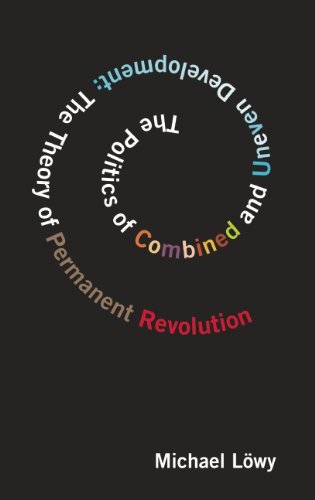 t of colonialism, the bourgeois leadership of the Indian National Movement took the road to capitalism (albeit via a ‘maturing’ period, which we traditionally call the ‘mixed economy, in which the state systematically developed infrastructure that was handed over to private ownership in 1991). That very road has led us here: unevenness of capitalist development within the same country, and the colonisation of one part of the country by another.
Was there any other route that would have possibly evaded the destruction that the chosen path cannot seem to leave behind? Could India have leapfrogged over the ‘capitalist stage’? The various communist parties of India did not seem to think so at the time (most, if not all, do not even now). The ‘iron laws of history’ would not allow any form of a leap over capitalism, and into socialism. This was the view, in fact, of the entire Communist International and its participant parties since the death of Lenin, as we shall see below; and this, despite the success of the Socialist Revolution in Russia in 1917.
Half-a-century before a ‘free’ India took to capitalism, Leon Trotsky was contemplating questions about the possible roads out of feudalism for Russia. Marxist though he was, Trotsky’s conclusions defied what had become common sense in Marxist circles. This common sense believed in the objective necessity of capitalist development before socialism. Against this view, that history progresses through fixed, determined stages, Trotsky, and later Lenin, began to argue for the possibility that Russia might not have the same historical trajectory as the western capitalist countries for which Marx had produced the schema of feudalism-capitalism-socialism. In fact, according to Trotsky, the unevenness of capitalism was a pre-condition for a possible leap towards socialism for Russia.
It is one of the arguments of Michael Löwy’s book, that it was Trotsky’s and Lenin’s dialectical understanding of history, and the consequent direction it provided to the 1917 revolution, that the objective possibility was transformed into an actual socialist revolution. In demonstrating this, the book undertakes the very relevant and important theoretical task of evaluating Trotsky’s theory of permanent revolution in the context of the situation in countries peripheral in the capitalist system. The essence of the argument is that the same unevenness that in times of crises helps capital recuperate is also potentially its grave. If escape routes become enemy camps capital would have nowhere to run.
It is this belief in the possibility of one uninterrupted, combined and permanent revolution from the pre-capitalist to the socialist stage that disappeared somewhere between Trotsky and Lenin, and Stalin. The ‘permanentist’ perspective of the Comintern under Lenin, for revolution in all backward countries, was also replaced by the ‘stagist’ ‘neo-Menshivism’ of Stalin. It was again asserted that capitalist development under bourgeois leadership was a necessity for all countries before a socialist revolution becomes possible. The Indian communist leaders too thought that they should give their complete support to the bourgeoisie in the anti-imperialist struggle. Undoubtedly, this would have had a weakening influence on the working class movement on the ground. And ever since Independence, the mainstream communist parties, as a consequence, have struggled and failed to move beyond social-democratic reformism. That has been on account of their inability, or unwillingness, to pose the question of democratisation, which in India doubtless continues to be the principal political question, as one of overcoming capitalism (see note-1).
Of course, there is no more any question of India or any other country skipping the capitalist stage and entering socialism; we are now completely immersed in it. The relevance of the theory of permanent revolution still holds because the capitalist world continues, as is its wont, to be uneven. Michael Löwy’s book may be considered a first step towards regrounding Trotsky’s theory in the present context.
* * *
Löwy’s exposition of the theory of permanent revolution begins with Marx and Engels. The first chapter discusses their writings with the purpose of determining how much Trotsky really deviated from the essence of the perspective and method of Marx and Engels. In the process, Löwy also attacks those readings and critiques of Marx and Engels that attribute to them a mechanical economism and evolutionism. Löwy convincingly argues for the essentially ‘permanentist’ tenor (which increased with time) of Marx and Engels’ writings. Although many passages can be quoted, without distorting their meaning, that lend support to a stagist understanding of history, in the very same writings as well as others, Marx and Engels do shift towards permanentism.
The concept of permanent revolution appears in their writings mostly in the form of ideas and intuitions, not as a coherent theory. The most coherent statement of their view of permanent revolution is to be found in The Address of the Central Committee to the Communist League. While condemning the alliance with the bourgeoisie, the Address champions the common action between the proletariat and the democratic parties of the petty-bourgeoisie. This alliance too must be made keeping in mind the larger aims of the proletariat: ‘to make the revolution permanent’. The Address already contained three themes that would become fundamental to Trotsky’s theory: ‘(1) the uninterrupted development of the revolution in a semi-feudal country, leading to the conquest of power by the working class; (2) the application by the proletariat in power of explicitly anti-capitalist and socialist measures; (3) the necessarily internationalist character of the revolutionary process and of the new socialist society, without classes or private property’ (15).
After demonstrating that the basic underpinnings of Trotsky’s theory of permanent revolution are in fact to be found in the writings of Marx and Engels, Löwy, in the next two chapters, explores how the theory was developed with the experience of ‘living revolutions’. While doing so, Löwy juxtaposes Trotsky’s perspective with that of his contemporaries (and also later commentators). This helps bring the stagist and permanentist perspectives in stark contrast as these influential thinkers embody one of the perspectives in their deliberations on the revolutions of their age; sometimes this binary emerges as different moments in the political thought of the same person. Löwy identifies Plekhanov, Kautsky and the Mensheviks, and later, Stalin and the Comintern leaders under his leadership (all in theory but not in practice) as giving voice to the stagist perspective. They believed that a semi-feudal and backward country like Russia must first witness a bourgeois revolution to be led by the bourgeois class itself, undergo capitalist development to its ‘exhaustion’, and then finally welcome socialism. It was to be an automatic, step-by-step process. The level of ‘maturity’ for socialism might vary slightly in each conception, but they all agreed that some capitalist development was essential.
Lenin and Luxemburg too had characterised the 1905 revolution as a bourgeois revolution with necessarily bourgeois tasks, again a stagist view of history. They did not, however, believe that the revolution would be led by the bourgeois class, but by the proletariat and the peasants. By 1917, both had begun to agree with Trotsky, that the revolution would be led by the proletariat, with support from the peasantry. More significantly for Löwy, since he puts great effort in countering what he calls Stalinist distortions of Leninism, Lenin had made a permanentist turn after his philosophical engagement with the dialectical method in 1914. Under his leadership (and Trotsky’s, who had joined the Bolsheviks in 1917), the Bolshevik Party led a revolution that let its logical development carry itself towards socialism, not in spite of Russia’s relative backwardness but because of it. To understand what this statement means is to understand the essence of Trotsky’s theory of permanent revolution.
Trotsky’s starting point, Löwy writes, was Labriola’s dialectical and anti-dogmatic Marxism. Labriola’s emphasis on totality and his appreciation of the essentially critical nature of Marxism are evident in Trotsky’s theories and the ease with which he could contradict Marxian orthodoxy. It is his grasp of the dialectical method that sets him apart from the somewhat static and mechanical evolutionism of Plekhanov and Kautsky.
Löwy presents five fundamental features of Trotsky’s method that form the basis of the theory of permanent revolution.
Using the above methodological guidelines, Trotsky’s analysis of Russia and its class structure was quite different from that of the thinkers mentioned above, and so were his strategic conclusions. Parvus, a very important contributor to the development of Trotsky’s thought, had already (in 1904-5) realised the peculiarities of Russian social formation: that early Russian towns and cities were administrative-bureaucratic in function rather than economic, and hence the artisans and petty-bourgeoisie, the base of revolutionary democracy, were weaker than in Western Europe. With capitalist development in the nineteenth century, the factory concentrated the proletariat hugely within urban centers. Trotsky found the Russian bourgeois class to be small in number and mostly of foreign origin, and hence isolated from the people. Therefore, for him, the Russian bourgeoisie, small and weak, and more afraid of the armed proletariat than of the Cossacks, was not revolutionary and would betray the democratic revolution whenever it went beyond its control or against its interests. Compared to the bourgeoisie and the petty bourgeoisie, the socio-political weight of the Russian proletariat was much more. Thus the proletariat was the only true revolutionary class. Hence, Trotsky proposed the following formula in 1905: ‘the dictatorship of the proletariat supported by the peasantry’.
This went against the Menshevik insistence on a bourgeois leadership and revolution, which was based in mechanical economism. It also goes against Lenin’s 1905 formula of the ‘democratic dictatorship’ of the proletariat and peasantry. Trotsky’s objection to this formula was that it might restrict the revolution to the level that the peasantry was comfortable with; it would have remained a bourgeois revolution (35). In Trotsky’s scheme the proletariat was to be decidedly hegemonic, that is, it would not stop short of supporting the workers’ interests in the town and the village. And this alliance, in his scheme, was decidedly transitory. Löwy writes that for Trotsky, the proletariat could count only on the passivity and ignorance of the peasantry to gain its support but that too only till the ‘rich peasants’ realised what the revolution was heading towards. When the proletariat state applies its uncompromisingly socialist policies, just as Trotsky believed it should, it would lose the support of the landed peasantry and a counter-revolution would be inevitable (55-56).
The solution to the problem, Trotsky believed, lay in the international working class movement: the Russian revolution must be extended to the rest of Europe if the proletarian state in Russia is to survive the loss of its allies. The fate of the socialist revolution in Russia was to be decided less by its economic backwardness than by the politics of national and international class struggle.
As has already been indicated, Trotsky did not differ from the Mensheviks and the early Bolsheviks only on the issue of the ‘class nature’ of the revolution; he also differed from most Marxist thinkers of the time over the issue of the ‘historical tasks’ of the revolution (54). Not only did he believe that the proletariat would lead the revolution, he also thought that the revolution could and should combine democratic and socialist tasks into one combined, uninterrupted, permanent revolution. Why? Because by logically extrapolating the dynamics of class struggle in a ‘revolutionary democratic dictatorship’ led by the proletariat, Trotsky concluded that the revolution could transcend bourgeois-democratic limits and take anti-capitalist and socialist measures. Trotsky pointed out that when the proletariat comes to power it would be compelled by the ‘very logic of its position’ to implement ‘collectivist’ measures, unless it were to betray its own class (something the pre-1917 Bolshevik policy would have done). For instance, in meeting even its ‘minimum democratic programme’, if the state supported workers’ strikes, it could lead to widespread lock-outs by the capitalists and the cessation of production. This would necessitate that the proletarian state take over the factories and organise production. Basically, ‘the political domination of the proletariat is incompatible with economic enslavement’ (Trotsky as quoted on p.54). Löwy, at several points in the text, highlights how the political is given its due weight vis-à-vis the economic in Trotsky’s dialectical model.
When 1917 came, Löwy writes, Trotsky’s 1905 predictions came true. The bourgeoisie and their Mensheviks supporters were incapable of completing the national-democratic revolution (see note-2) and satisfying the revolutionary democratic aspirations of the peasant masses. Only the proletarian victory was able to accomplish the crucial tasks of the democratic revolution and emancipate the peasantry from feudalism. Also, once in power the workers’ government of the Bolsheviks, now headed by Lenin and Trotsky, and unwilling to betray its class, could not restrict itself to democratic reform. It was forced by the dynamics of class struggle to undertake socialist measures. Without the dogmas of the Second International, the 1917 Revolution saw two distinct phases of an uninterrupted and combined revolution: ‘from its (unfinished) bourgeois democratic phase in February to its proletarian-socialist phase in October’. For Lenin, the second phase resolved the contradictions of the first phase. ‘With the support of the peasantry, the Soviets combined democratic tasks (the agrarian revolution) with socialist tasks (the expropriation of the bourgeoisie), opening a “non-capitalist road” for transition to socialism’ (63).
* * *
It is on these same lines that Lenin and the Comintern now attempted to frame a general policy for revolution in colonial, semi-colonial, dependent or backward countries: the national liberation movements of the ‘Orient’ must aim for the establishment of soviet-based workers’ and peasants’ power, towards socialism without capitalism. Thus, although specific tactics within each country, especially with respect to alliance with the bourgeoisie, remained controversial, the orientation of the Comintern leadership from 1919 to 1922 to revolutionary movements in the dependent world was in line with the theory of permanent revolution.
It can be seen in Löwy’s exposition how the change in the Comintern’s above orientation was the beginning of the generalization of the theory of permanent revolution to the dependent parts of the world. From 1925 onwards, with the Stalinist doctrine of ‘socialism in one country,’ and the adoption of the ‘four class bloc’ or ‘popular front’ policy for the colonial and semi-colonial world by the Comintern, and the experiences of their repercussions for the Second Chinese Revolution, Trotsky gained certain insights that gave the theory of permanent revolution in countries of peripheral capitalism a very strong dialectical foundation. These insights are scattered in Trotsky’s writings after 1928, The Permanent Revolution and The History of the Russian Revolution being the most important ones. Löwy takes us through a number of these writings, drawing out relevant details from each text to elaborate on Trotsky’s theory of permanent revolution.
The first thing to note is the similarity in the empirical situation of the dependent, colonial and semi-colonial countries with that of Russia and China: the indissoluble dependence of the national bourgeoisie on the imperialists and the landowners, the political weight of the proletariat disproportionate to its numerical strength, the impossibility of an autonomous political role of the peasantry. Also, the very existence of the USSR had its own implications for proletarian revolutionary aspirations and the bourgeois counter-revolutionary tendencies. Having realised these situational factors, Trotsky set out to extrapolate his theoretical understanding of the Russian Revolution to the countries of peripheral capitalism.
The most important historical-theoretical principle for a general theory of permanent revolution however was the law of uneven and combined development, which was fully elaborated in The History of the Russian Revolution (1930). The development of world history becomes qualitatively different once capitalism becomes a world-system. Looking at capitalism as a totality, one will realise that ‘although compelled to follow after the advanced countries, a backward country does not take things in the same order’; it tends to skip and leap over stages that the early capitalist countries went through. ‘The development of historically backward nations leads necessarily to a peculiar combination of different stages in the historic process’ (87). The very existence of unevenness, of advanced and backward countries (and the socio-economic linkages between them), creates a situation in which history progresses through sudden leaps and contradictory fusion.
From this universal law of unevenness derives another law – the law of combined development, a drawing together of the different stages of development. The appearance of modern industry alongside pre-capitalist or semi-capitalist rural conditions creates the objective possibility for the leading role of the proletariat at the head of the rebellious peasant masses. The unevenness of this development becomes the structural foundation for the combination of democratic and socialist tasks in a process of permanent revolution. The advanced capitalist countries solved certain common democratic tasks: abolition of autocracy, liquidation of feudal survivals in agrarian relations of production, establishment of parliamentary democracy based on universal suffrage, and national unification/liberation. Due to uneven development of capitalism, and the existence of imperialism, the democratic tasks of backward countries are similar but not the same. Yet they must be solved through a democratic revolution, or even a bourgeois-democratic revolution since these tasks are quite compatible with bourgeois society. This is not to say, however, that it will have to be led by the bourgeoisie, or that the revolution cannot transcend capitalism.
Uneven development means contradictory combinations of national and international, modern and traditional, ruling classes. Löwy gives the example of China, where at the bottom of the economy, the agrarian capitalists were ‘organically and unbreakably’ linked to feudalism, while at the top, capitalists were similarly linked to world finance. As such they could never have broken these links with landlords and imperialists because they were always more fearful of the proletariat. Hence, the national bourgeoisie could never fully accomplish its democratic tasks. The only condition on which Trotsky would have accepted any (short-term, for long-term alliances were out of the question) alliance with the bourgeoisie was to have no illusions that they would ‘lead a genuine struggle against imperialism and not obstruct the workers and peasants’ (Trotsky quoted on p.92).
In universalizing the theory of permanent revolution Trotsky stressed the role of the peasantry. They were important not only in the fight against feudal productive relations but, as the overwhelming majority in backward countries, they were central to the task of establishing democracy as well. Hence the proletariat had to ally with the peasants to complete the democratic phase of the revolution. Due to their heterogeneous and intermediate character the peasants could not play an independent political role, but had to choose between the bourgeoisie and the proletariat. The incapability of the former to solve the peasantry’s problems made it possible for the proletariat to acquire their support.
According to Löwy, Trotsky’s view of the peasantry contained ‘a very deep political truth’ but if understood in sociological terms, it was contradicted by the course of historical events in many dependent countries. There are instances when Trotsky commits the error of ‘sociologism’ in his understanding of the peasant (93-94). For example, he remained pessimistic about the revolutionary nature of the peasant movements in 1930 China. He also tried to deduce the political nature of the Red Army from its social nature. Since most of them were peasants, Trotsky did not think them to be true communists. Though at some moments he did perceive the anti-capitalist nature of peasant insurgency in China, in general Trotsky does seem to have believed that the peasantry could not acquire a communist consciousness before a proletarian revolution.
Löwy thinks this to be due to the classical Marxist attitude towards the peasantry as a ‘sack of potatoes’. He argues that Trotsky, like other western Marxists, generalised his assessment of European peasantry to the peasantry of dependent countries. Many of them possess very different structural features, such as ‘collectivist village traditions, massive uprootedness resulting from capitalist penetration, very high rates of demographic growth, proletarian or semi-proletarian status of rural laborers on the great plantations’ (96). Thus Trotsky was less perceptive of the specificity of the rural class structure of non-Western countries, and of the revolutionary capacity of their peasantry. Nevertheless, in one of his last works, he wrote:
‘The Narodniks saw in the workers and peasants simply “toilers” and the “exploited” who are equally interested in socialism. Marxists regarded the peasant as a petty bourgeois who is capable of becoming a socialist only to the extent to which he ceases materially and spiritually to be a peasant…It is, of course, possible to raise the question whether or not the classic Marxist view of the peasantry has been proven erroneous…Suffice it to state here that Marxism had never invested its estimate of the peasantry as a non-socialist class with as absolute and static character’ (Trotsky quoted on p.97).
* * *
In the beginning of the fourth chapter, ‘Conclusions’, Löwy presents us with many cases of revolutions strangled due to the stagist and ‘four class bloc’ strategy of the Comintern. The hold that the Comintern and Marxist orthodoxy had on the communist leadership of many such movements, it is contended, restricted them to the bourgeois-democratic phase, and a moderate attitude towards and alliance with the bourgeois class made them vulnerable to coups and attacks. In Spain (1931-1937), Guatamala (1952-4), Chile (1938-47 and 1973), and most starkly in Indonesia (1965) the blind faith in the intentions of their allies, the refusal to arm the proletariat, and the refusal to follow the revolutionary path to its logical conclusion, despite mass support, led to many a bloody defeat.
Furthermore, Löwy adds to his (and Trotsky’s) attack on stagism the fact that no non-European, dependent, peripheral capitalist nation has been able to find stable solutions to national-democratic tasks (see note-2; consider India for instance). Agreeing with Ernest Mandel, Löwy points out that no dependent country has actually become ‘ripe’ for a purely socialist revolution through its process of development like the advanced capitalist countries have; they still have not been able to accomplish the democratic tasks which the advanced countries had completed decades ago. Also, the process of ‘semi-industrialisation’ in the Third World seems to be making it more dependent on imperialism rather than more autonomous. However, Löwy warns against underestimating the ability of bourgeois- and petty bourgeois-led revolutions to accomplish important reforms and establish stable states. To take for granted the instability of these regimes would be to commit the error of political fatalism. Knowing the capabilities of such regimes, the revolutionary, Löwy hopes, would be more determined to prevent their stabilisation, and to struggle for an alternative future.
On the other hand, Trotsky’s theory of permanent revolution has been proven correct by the revolutions in Russia, China, Yugoslavia, Vietnam and Cuba. While three of these were always under proletariat leadership, the Russian and Cuban revolutions started under bourgeois leadership but were soon taken over by the proletariat. All of them had a bourgeois-democratic moment but the democratic tasks in each of them were completed only in the socialist moment of the revolution. This edition of the book does not carry the details of these revolutions that would explain the process of the combined revolution. However, Löwy does discuss the Nicaraguan revolution of the 1960s.
Nicaragua saw a popular insurrection against dictatorship with mass peasant and worker participation. The leadership was largely petty bourgeois but through its struggle, it had developed an anti-imperialist and anti-autocratic programme. Due to the precedent set by the Cuban revolution, and direct support from Cuba, the Nicaraguan revolution developed along communist lines. According to Löwy, the Sandinista National Liberation Front (FSNL) took radical steps: it dissolved the old army and established its own army with soldiers from the guerilla army and the militia, it organised the masses into unions and other organisations, and it enforced its anti-capitalist policies. (Löwy had written this back in 1979. Since then the FSNL has weakened and it would be interesting to know how Löwy explains its trajectory now.)
Löwy, after establishing that Trotsky’s politics passes the test of history, moves on to his ‘sociology’ – his analysis of the roles of the social classes (and social categories). In discussing these – the national bourgeoisie, petty bourgeoisie, intelligentsia, peasantry and the proletariat – Löwy clarifies some of the finer points Trotsky makes on the subject, and tries to make certain amendments in his perspective. It is here that Löwy’s (admittedly slight) departures from Trotsky, some of which we have already come across, become even more clear.
Löwy agrees with Trotsky about the usually moderate nature of the bourgeoisie. Most advanced democratic revolutions, it is asserted, were under petty bourgeois, not bourgeois, leadership. However, he does briefly note that Trotsky, at times, underestimated the indigenous bourgeoisie, especially in the case of India. With respect to the petty bourgeoisie, Löwy agrees with Trotsky that they must eventually choose between the bourgeoisie and the proletariat. On the question of whether the petty bourgeoisie could play a significant role in the revolution, Löwy points out the leading role they played in many Third World countries, at times even going against capitalist interests. Though only for a limited time, petty bourgeois regimes, contrary to Trotsky’s belief, did manage to hold power and forge their own distinctive policies, which Löwy calls a sort of petty bourgeois Bonapartism.
Trotsky had, by and large, ignored the role of the petty bourgeois (and increasingly proletarianised) intelligentsia. Löwy believes the ideology of the petty bourgeois intelligentsia to be a sort of Jacobinism combining ‘plebian democracy and romantic moralism’, like in Rousseau. In peripheral countries, their radicalisation is stronger, compounded by imperialist penetrations, conciliatory position of the national bourgeoisie, and the success of socialist revolutions.
Adding to his disagreements with Trotsky on the question of the revolutionary potential of the peasantry in dependent country which have already been noted, Löwy goes on to highlight the greater uprootedness of the peasantry of the third world due to uneven development and imperialism, which leads to greater radicalisation. Most post-1917 revolutions had the peasants as their main social base. However, here he also complicates the term ‘peasantry’, which tends to conflate a broad and heterogeneous body. The rich or big peasants are usually neutral or hostile to communist revolutions. Borrowing from Hamza Alavi’s analysis of the Hunan struggle (and events in Russia, Cuba, Mexico, Vietnam and Algeria), Löwy argues that in the initial phase of the movement, the greater material security of the middle and small peasantry, allows them to attack the oppressors. Their complete dependence on their overlords holds back the poor peasant and the landless labourer until the struggle has already shaken the local authorities and the landlords. The presence of the Red Army in China, for instance, encouraged the poor and landless peasants to join the struggle. But once they joined, they proved more radical than the middle peasants. This external force that pushes the peasant to rebel and gain a socialist consciousness (even prior to a socialist revolution) still came from the urban intellectual and the proletarian communist vanguard. Without this the peasant struggle may have remained local and ineffective.
However, with increasing industrialisation in the dependent countries, Löwy expects the struggle to shift to the cities, with the working masses playing a more central role, like in the ‘classic’ October revolution. In 1917, the revolution was ‘directly’ proletariat, that is, the Bolshevik Party, was proletariat not only in ideology but also in social composition. In subsequent revolutions, the working class played a seminal part in the initial phases but was largely absent during the seizure of power. In China, Vietnam, Cuba and Yugoslavia, the peasantry was the main social support. To explain this absence, Löwy points to the heavy repression the working class encountered in the early phases of all these revolutions, and also the insistence of communist parties to ally with the bourgeois class. These revolutionary parties were indirectly proletarian, that is they were proletarian in their ideology.
* * *
The last chapter of the book is a 2010 interview of the author with Phil Gasper, which seeks to apply the logic of uneven and combined development and the theory of permanent revolution to the present context. Löwy points out that the capitalist system is still very much characterised by the centre and periphery distinction, and since this is so the theory of permanent revolution remains a topic of central importance. The essence of the theory, its dialectical approach to analysis and the uncompromising praxis that this entails, holds true even though the form of unevenness has changed. When Trotsky first formulated the theory in 1905, Russia had a modern urban industry and a backward rural area. Today we can find advanced and backward elements in both urban and rural regions, as well as among nations (what is figuratively called the North-South divide). This unevenness has given birth to many a movement for autonomy at all levels – local, regional and national. Though there are reactionary tendencies, there are also radical ones whose anti-imperialism has taken international proportions with several nations, in Latin America primarily, combining their efforts for autonomy.
Michael Löwy is quite optimistic about such developments, and also about the so-called global justice movement. Although acknowledging the definite liberal, moderate, and even Keynesian tendencies in the global justice movement, Löwy highlights the stated anti-capitalist goals of the World Social Forum. Although anti-capitalist does not necessarily mean socialist, let alone Marxist-socialist, Löwy enthusiastically claims that many of the participants do indeed hope to create socialism. For Löwy, the kind of international solidarity that is fostered by this movement is not one based on sympathy but more on convergences in the ‘common struggle against a common enemy, neoliberalism’.
The reason for his faith in the global justice movement and the WSF is that he sees it as a forum for combining anti-imperialist, agrarian, democratic and anti-capitalist struggles, none of which can succeed without the others by the logic of the law of uneven and combined development. Whether he is right in his expectations from the global justice movement or the WSF will need further study. However, even if they do not meet the potential that Löwy identifies in them, his general argument would still hold: ‘if movements for national liberation, or agrarian reform, or radical democratisation do not develop, in an “uninterrupted” process, into a socialist revolution, they will sooner or later be defeated’ (154). This is only a ‘conditional’ perspective. But with no Stalinism (read as: restrictions from within the workers’ party), the primary conditions that determine the trajectory of the international movement is the class structure of the participant local movements, an analysis of which is not offered in this book. Without class analysis, the arguments for the possibility that this ‘movement of movements’ could develop into something significant are somewhat hollow.
* * *
The entire length of the book, in delineating the features of Trotsky’s theory, argues for the possibility of permanent revolution in backward, dependent capitalist or non-capitalist nations. In this it primarily uses cases, like of Russia and China, which can no longer be called socialist or post-capitalist. But does the failure of permanent revolution here tell us that the theory is erroneous? It does not. The predictions or hypotheses derived from the theory are, true to its dialectical method, contingent on the political developments in the situation: whether the revolutionary ‘fervour’ can push its leadership (even despite themselves) into following the flow of the process towards an uninterrupted, combined revolution. That is, whether the leadership can see the logical development of a bourgeois-democratic revolution led by the proletarian vanguard into a socialist revolution. But for the various factors pressing on the Soviet leadership (the theoretical and practical Menshevism is the only factor Löwy discusses; there might be others given the spread of the same ideas among most of the Comintern leadership), Trotsky might have been proved right and we might have seen a socialist revolution radiating from Russia. It is characteristic of Trotsky’s dialectical approach to not impose determinist diktats on reality – the political trajectory of a revolution is always too complex and overdetermined for that.
This edition of the book is an abridged version of a much longer book originally published in 1981. What has been reproduced is Part One of the two-part book. Replacing the second part is the 2010 interview of the author that makes for a helpful supplement to the chapters that are republished, though perhaps not a substitute for the chapters that are not. Löwy explains in this interview that Part Two, which contained analyses of events in Russia, China, Vietnam, Yugoslavia and Cuba on the basis of the theory presented in Part One, has become ‘outdated’. Although there still is considerable, albeit scattered, historical analysis in this edition, one cannot help but feel deprived (due, in part, no doubt to references, which were not edited out, to the unpublished chapters that make promises of more in-depth study to come). When historical events are discussed they do sufficiently concretise some of Löwy’s assertions. However, a more detailed study would have demonstrated what is meant, for instance, by the ‘dialectics of totality’ within uneven and combined development and its significance for revolutionary praxis. To better explain how the interests of the peasants are bound to the proletarian revolution, or how the interests of the workers of one nation are bound to those of workers of all nations, and most importantly, how these can be successfully translated into revolutionary praxis, an analysis of the class structure of societies under transformation in the past would have been invaluable.
A great deal of what Löwy has to say on the subject seems to imply that the demise of the Russian and the international working class movement was the result largely of Stalin’s ideological distortions, or at least of the failure of the communist leadership to see what Trotsky and Lenin saw. Would the working class movement have remained strong if it were not for Stalin and the Comintern’s fallacious understanding of history and socialism? The international communist leadership in its entirety might have been convinced that socialism could thrive in one country, while other nations must necessarily embrace capitalism first. But were there really no other factors that worked for the detriment of the working class movement, along with the definite suffocating repercussions of the leadership’s conservatism? The only way to be sure and accurate is to do a detailed class analysis of the conditions in which the proletarian struggle weakened in Russia and other countries where Löwy holds the Comintern leadership directly responsible. One wonders whether the historical analyses in the original edition would have been helpful in this respect as well.
An updated historical analysis would go a long way in not only strengthening the theory of permanent revolution, but also in understanding recent class dynamics, and formulating new revolutionary strategies. For instance, what contingencies created the situations that led to China’s capitalist turn in the ’70s, or even to Cuba’s recent economic ‘reforms’? Would it be right to suggest, as Löwy does for Russia, that the still predominantly stagist and economistic credo of the communist parties is the primary cause?
For us here in India, lessons from Trotsky take on significance in view of the hesitations, on various grounds, of the various communist parties to organise on the basis of proletarian hegemony. Some seem to believe that there is a need to stay with the bourgeoisie until capitalism exhausts itself, while others are still fighting semi-feudalism alongside the rich peasantry, both of them alienating the proletariat in the process. Much of what Löwy says about the inability of the bourgeoisie to fulfill the three national democratic tasks (see note-2) fits the Indian situation like a glove. There is social unrest and mass movements resulting from the failure of the capitalist economy and state on each of these counts. Löwy is also right about the ability of the bourgeoisie to create a more or less stable state despite these failures, if the revolutionary forces do not develop within these locations of unrest and push them towards an alternative.
This book is not only a very helpful introduction to Trotsky’s work but also an important step towards contemporizing the theory of permanent revolution. Löwy limits himself to applying Trotsky to international social (not necessarily socialist) movements. It is obvious that much is still needed. Löwy does not omit the moments of real or apparent contradictions in Trotsky’s work. Attempts to explain these contradictions are convincing on most occasions if not all (perhaps someone more familiar with Trotsky’s texts and his time would be a better judge). But the reader will undoubtedly realise that Löwy’s loyalties, like Trotsky’s, lie with explicating the possibilities of permanent revolution rather than with particular persons or texts.
Notes:
(1) Capitalism, as an ever-expanding social totality, is constitutively contradictory and is thus, in essence, uneven. Such unevenness renders the deficit of democracy (a la primitive accumulation) as much a constitutive part of capitalism as the democracy of competition (a la normal accumulation through market-based economic means and mechanisms). The failure of most Indian communists to grasp this essence of capital is the key reason for their inability to realise that struggles against all forms and kinds of democratic deficit cannot any longer be struggles against feudalism and for the ushering in of capitalism. Instead, such struggles for democratisation must be re-envisaged as movements to unravel capitalism, as a total network of democratic and undemocratic space-times, to go beyond it towards socialism.
(2) A national-democratic revolution according to Trotsky comprises of the following tasks: