Video: Maruti Suzuki’s attempt to suppress workers’ struggle (Subtitled)
Video: On Maruti Workers’ Strike
Pradeep, a leader of Maruti Suzuki Employees Union, talks about the various aspects of Maruti Workers’ agitation. He also notes the designs of the capitalists to use Maruti issues to effect changes in the labour laws.
October 17: Gurgaon Rally in Support of Maruti Suzuki Workers
Appeal from the Maruti Suzuki Employees Union
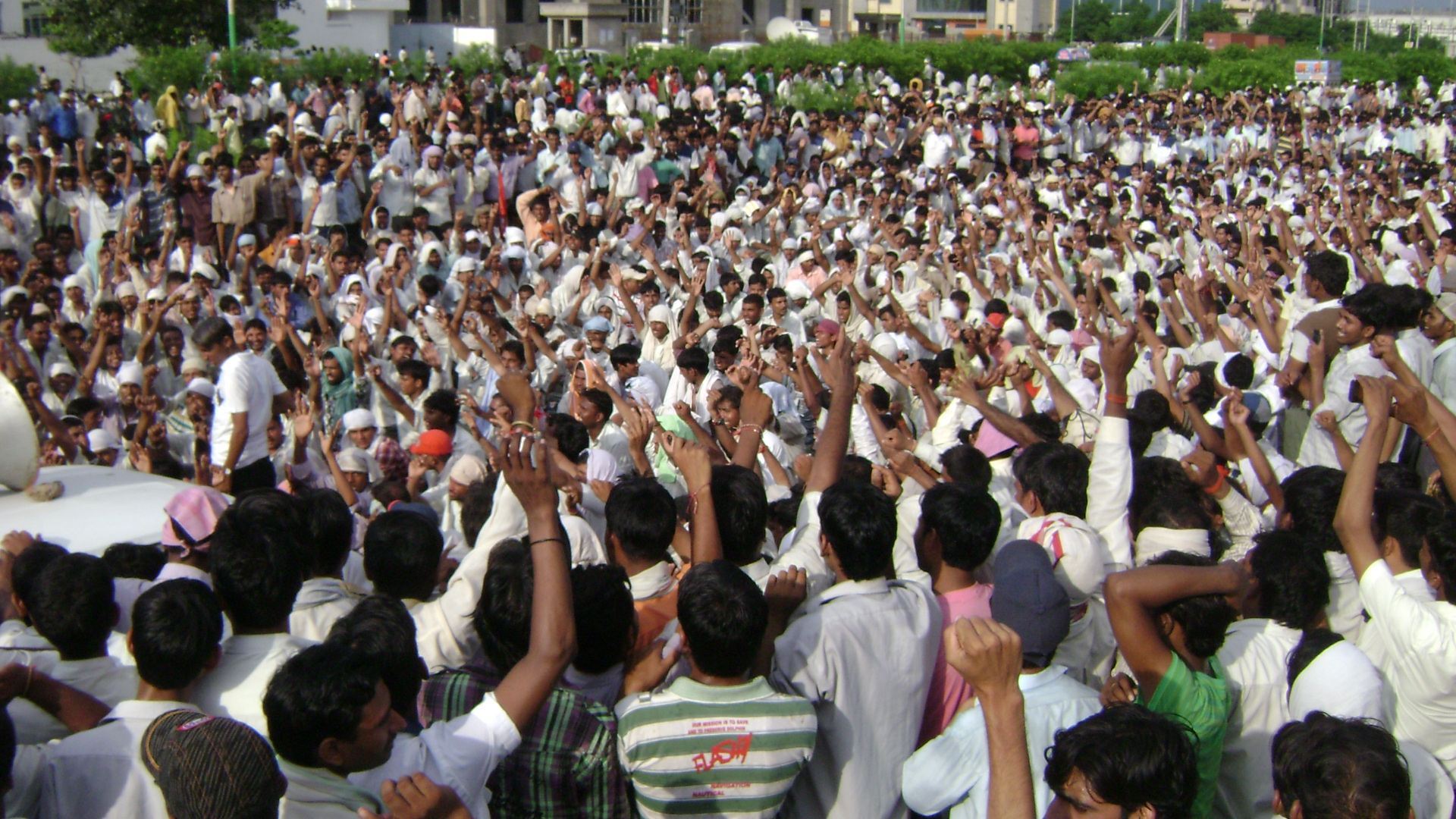
We, the Maruti Suzuki Employees Union (MSEU), Suzuki Powertrain India Employees Union (SPIEU) and Suzuki Motorcycle India Employees Union (SMIEU), have been on strike in our respective plants in Gurgaon-Manesar from the 7th of October, 2011, demanding our right to respectable and non-precarious employment and unionization. Our movement stands at a crucial juncture today, we therefore send this appeal to all the labouring people of the country and beyond, the trade unions and all other sections of society which have stood with us in solidarity to come forward with renewed vigour to take this movement forward. Our struggle is not a struggle for a mere wage-hike of any one section of workers, but is a struggle for our dignity and right to organise. We struggle also more importantly for the contract workers among us, whose insecurity and precarious condition of existence is a burning issue before the entire labouring people of the country today, which puts the very framing of the available labour laws into question.
We, permanent and contract workers, have and do stand united in this struggle.To break our unity and resolve, the management of Maruti Suzuki India Ltd, Manesar is continuing to indulge in anti-worker activities and increasingly harass us with the absolute complicity of the state administration. The management began violating the terms of the last agreement from the very next day of our calling off the 33day long agitation continuing from August 29th till a settlement was reached on the 30th September. Going back on its word of treating the workers with respect, it has on the contrary been acting with vengeance, trying to create divisions among us. On the workers reporting for duty the day after the strike, the management flatly refused to let the over 1,200 contract workers enter the factory, so as to divide the unity between permanent and contract workers that this movement has achieved. It shuffled permanent workers from their workstations so that allegations of ‘production sabotage’ could be put on us. Such a shuffling of skilled workers, accustomed to and specialized at their specific tasks is far from being conducive to optimal production in the factory. Such a move therefore makes evident that fulfilling production targets are not a priority with the management at this point. Rather the point is to break our unity and resolve to struggle. The already inadequate bus service was also stopped to further harass us.
Later contractors on the behest of the management used bouncers who threatened and attacked us recently in front of the factory gate on the morning of 7th Oct, this incident took a more blatant aspect when some goons came and beat us up at the factory gate on the 8th and threatened us for our lives. They even attempted to actualise their threat by coming with guns inside the Suzuki Motorcycle plant on the 9th morning and firing on our comrades there. All legal and illegal means have been used by the management to break our resolve and unity forged during the struggle in June and then again in August-September. The state and central government is acting hand-in-glove with the management. Earlier it merely gave us empty promises after the company broke the spirit of the settlement by acting in antiworker bad faith.
Ever since we have been on strike due to circumstances created by the management, it has been issuing us show-cause notices instead of acting against the company which is habitually reneging on its promises and violating all labour laws, having turned all their instrument to implement justice to break our fight for a just cause. The number of police personnel, stationed in and out of the factory increased first to 1,500 and soon to 2,500. Having tried to push us into starvation by occupying the canteen and dismantling our set-up to cook food for those inside the factories, yesterday 14th October the management blocked our food and water supply and locked up the toilets. Given that it had no problem in arresting our leaders last month on false charges, the attacks on some of our fellow workers and the brutal lathi-charge on the workers of Honda in 2005, we also think that brutal repressive force could be used any time on us. With the company and the state acting together to control and oppress us, we feel the need to make a renewed appeal to all to extend and be part of our collective struggle.
Since our struggle began, all workers, various Trade Unions and other sections of society have stood strongly by us. But now, the struggle in Maruti Suzuki has emerged as the concrete struggle of the around 8000 workers of the four plants of Suzuki group- Maruti Suzuki India Ltd., Suzuki Powertrain India Ltd., Suzuki Castings, Suzuki Motorcycle India Ltd. On 7th October, workers of another eight plants in IMT had also gone on a one day tool down strike in support. WE, Maruti Suzuki Employees Union (MSEU), Suzuki Powertrain India Employees Union(SPIEU) and Suzuki Motorcycle India Employees Union (SMIEU) continue to sit on strike at our factory gates. Our movement has been able to achieve an unprecedented unity among permanent and contract workers, local and migrant workers and workers of all our plants forged in course of struggle by the initiative of all struggling workers; this we consider to be our greatest strength and are resolved to take this strength forward. We shall not relent until our demands are met and all workers are taken back unconditionally. No degree of sacrifice can deter us from seeing this fight to the end.
We appeal to all the workers and Trade Unions to extend concrete support in our struggle with both solidarity actions in their own factories, areas and before their own state governments and by contacting us and fighting this struggle with us. Even if a single worker sticks one poster on the wall facing an oppressive management, we consider it a concrete act of solidarity. The possibility that this strike and these solidarity actions are throwing up can lay the foundation of a new and more advanced phase of workers movement in our country, such that can compel each and every government and arrogant management to think many times before taking any antiworker measure in the future. In face of the brutal hand twisting of the workers sitting-in on strike in the Maruti Suzuki plant, by holding food and water ransom, we are now continuing our struggle outside our respective factory gates. It has now become evident that the Haryana administration is preparing for taking brutal and violent steps to smash our movement and disperse us from here. Such an assault will not just be on us but the right of all working people and we expect that would become the beginning of unprecedented protests in all corners and among all progressive sections of the country.
United in Struggle.
Shiv Kumar
General Secretary, MSEU on behalf of MSEU, SPIEU and SMIEU
Solidarity Strike: Interview with Suzuki Powertrain Workers
Suzuki Powertrain Workers in solidarity with Maruti Suzuki workers. They see this struggle as not company-specific, rather it represents the pain and anger of general workers throughout the country. They find in this struggle a widespread industrial unrest in making.
October 15: Maruti Suzuki Employees Union’s Press Release
WE, the workers of Maruti Suzuki India Ltd., IMT Manesar organized as Maruti Suzuki Employees Union (MSEU) have been on strike since 7th October 2011. Along with us, all the workers of Suzuki Powertrain India Ltd, Suzuki Castings and Suzuki Motorcycle India P. Ltd. have been on strike from the afternoon of 7th Oct. On that day itself, workers from Lumax Auto Technologies Ltd (165, Sector-5), Lumax DK, Satyam Auto Components Limited (26 C, Sector – 3), Endurance Technologies Ltd ( Plot No. 400, Sector 8), Hi-Lex India Pvt Ltd, (Plot No.55 Sector-3), Bajaj Motors and a few more companies had gone on a one day strike. The workers from the four plants of Suzuki group have continued their strike.
From 7th October when we were forced to go on strike, a lot of misinformation campaign has been undertaken by the company blaming us for ‘violence’ on fellow workers and of ‘seizing’ the factory, while the fact was that the management and its contractors have indulged in violence, and employees and company officials have been free to go in and out of the factory.We have been on strike because of our just demands and our struggle for work with dignity.
After the settlement on 30th September post the 33 day long agitation from August 29th, while we have acted in complete good faith, the management began violating the terms of the agreement from the very next day. Going back on its word of treating the workers with respect, it has on the contrary been acting with vengeance. On the workers reporting for duty the day after the strike, the management flatly refused to let the over 1,200 contract workers enter the factory, so as to break our spirit and divide the unity between permanent and contract workers. It shuffled permanent workers from their workstations so that allegations of ‘production sabotage’ and ‘go slow’ could again be put on us and show the workers of having violated the agreement. Such a shuffling of skilled workers, accustomed to and specialized at their specific tasks is far from being conducive to optimal production in the factory. Such a move therefore makes evident that full production targets are not a priority with the management at this point. The already inadequate bus service was also stopped to further harass us.
While ‘violence’ has been blamed on us, it is a fact that contractors on the behest of the management used bouncers who threatened and attacked us recently in front of the factory gate on the morning of 7th Oct, this incident took a more blatant aspect when some goons came and beat us up at the factory gate on the 8th and threatened us for our lives. They even attempted to actualise their threat by coming with guns inside the Suzuki Motorcycle plant on the 9th morning and firing three rounds on our fellow workers there. All legal and illegal means have been used by the management now as in June and then again in August-September to break the legitimate raising of our voices.
Violating the spirit of the agreement by acting with bad faith and vengeance, the over 1200 contract workers have not been allowed entry since the settlement on 30th September. Apart from the 44 suspended, a fresh list of 50 workers to be terminated and suspended has been put up in MSIL after 7th October. 18 workers from Suzuki Powertrain India Ltd have been dismissed yesterday. As of last night after High Court order, we the workers of MSIL are sitting outside the factory gate.
The government earlier gave us empty promises after the company broke the spirit of the settlement by acting in anti-worker bad faith. Ever since we have been on strike due to circumstances created by the management, it has been issuing us show-cause notices instead of acting against the company which is habitually reneging on its promises and violating all labour laws. Our fight is for a just cause but the administration instead sent a show cause notice to Suzuki Powertrain Employees Union which threats the cancellation of registration of this Union.
Since yesterday, the state administration has used intimidation when around 1500 police personnel, now increased to around 2500, have been posted in and around the factory. Yesterday the police arrested MSEU’s body member Sushil, and went to the houses of all the workers who have raised their voices. They entered the factory gate joined by police already occupying the canteen and dismantling our set-up to cook food outside for those inside the factories.
The management yesterday tried to push us into starvation by blocking the entry of food, water supply and locking up the toilets.
Given that it had no problem in arresting our leaders last month on false charges, and knowing the attacks on some of our fellow workers and the brutal lathicharge on the workers of Honda in 2005, and looking at the deployment of police, it has now become evident that the Haryana administration is preparing for taking brutal and violent steps to smash our movement and disperse us from here. Such an assault will not just be on us but the right of all working people.
WE are concerned that the factory runs quality production and we are given our rights. Our struggle is a struggle for our dignity and right to our own Union. We struggle also more importantly for the contract workers among us, whose insecurity and precarious condition of existence is a burning issue before all people of the country today. The struggle in Maruti Suzuki has emerged as the concrete struggle of the around 8000 workers of the four plants of Suzuki group- Maruti Suzuki India Ltd., Suzuki Powertrain India Ltd., Suzuki Castings, Suzuki Motorcycle India Ltd and we have also received support from workers of many other factories all who face similar situation today.
We reiterate our demands:
1. Unconditionally take back on duty all the terminated and suspended workers- permanent, trainee and contract.
2. Immediately revoke all the pending and ongoing charge-sheet imposed on the workers as they are false and only a means to harass us.
3. Recognize our right to form our own Union. The situation that had arisen on 3rd June 2011 due to the management’s refusal to recognise our Union should be resolved.
4. Immediately stop all repressive measures, and stop police action on workers, release our Union members arrested on the morning of 14th October and stop further arrests and detentions. Punish the perpetrators of the case of firing on 9th October morning.
5. Stop management’s ploy to blame ‘industrial sabotage’ and ‘indiscipline’ on us, by various harassment techniques, including changing workstations.
6. Resume the already inadequate bus service.
7. The termination of 18 workers of Suzuki Powertrain India Ltd must be revoked immediately. All the demands of the workers’ Unions of Suzuki Powertrain India Ltd, Suzuki Castings and Suzuki Motorcycle India Ltd. must be met, and the termination and suspension should be withdrawn unconditionally in these plants, and the respective managements’ vindictive attitude should stop immediately.
Shiv Kumar
General Secretary
Maruti Suzuki Employees Union
 Radical Notes
Incarcerating Prafulla Chakraborty and Cooperation Ethic
“The emancipation of the working class
must be the act of the workers themselves.”
– Rules of the First International
On 16th October 2011, the veteran 71-year-old trade union leader, the chief advisor of the Kanoria Jute Mill Shramik Sangrami Union, and exponent of cooperation ethic, Prafulla Chakraborty, was arrested on the trumped up charges of attempting to murder a worker of the Kanoria Jute Mill and disturbing industrial peace. He was remanded in judicial custody for seven days; since then he has been on indefinite hunger strike. My objective in writing this piece is not merely to protest his arrest which many have rightfully done, but to argue that the arrest involves something more sinister, which needs to be scanned and opposed. Specifically, underlying his arrest is an attack on cooperation ethic and the institution of the economic collective (1) which Prafulla Chakraborty has personified for the last few years, most definitely in the case of the Kanoria Jute Mill.
This arrest of Prafulla Chakraborty telescopes an attack on the idea of cooperation ethic and represents a move on part of the state-capital nexus in West Bengal to repress the possibility of its appearance among workers. As such, this arrest-attack is an assault on any possible alternative economic imagination the workers may dare to cultivate and/or experience. Among other conditions, (global) capitalism ideally also requires a docile body of workers who would not only be dependent on capitalists, but would also be unable to imagine any relation other than that of this dependency. It is not just the presence of the common that is the target of the logic of capitalism (via primitive accumulation), but more sinister is the attack on the very idea of the common, especially new institutional forms that the cooperation ethic encapsulates. A challenge to this is typically met with ferocious repression campaigns supported by well-grounded ideological apparatuses, as Maruti Udyog and Kanoria Jute Mill workers, in very different circumstances, found out; they have made their respective struggles visible by articulating their own, at times very innovative, practices of resistance. Evidently, Prafulla Chakraborty and the Kanoria Jute Mill Shramik Sangrami Union have disturbed the consensus by challenging the given order of things and its underlying presuppositions; hence the need to exorcise them. That is also the reason why anybody who shares the politics of challenging this consensus needs to understand and condemn the arrest of Prafulla Chakraborty as a political attack against the cooperation ethic and the economic collective. The point is to not to attack the state government per se, which the Union is not doing anyway (which it cannot afford to do, and is in fact not interested in), but to defend the cause of a possible alternative economy based on the cooperation ethic, in which the collective of workers is in charge of the product it creates and of the wealth that comes consequently. The cause espoused is based not on negativity, but fundamentally, on the positive constructivist terrain of freeing themselves from the clutches of anybody else.
The bone of contention is the 81 years old Kanoria Jute Mill which was re-opened in August 2011 after almost five years of closure and handed back to the old promoter-capitalist. This move was trenchantly opposed by Mr. Chakraborty and the Kanoria Jute Mill Shramik Sangrami Union. It would not be totally inappropriate to remind the readers about the plight of the workers of the Kanoria Jute Mill, which is situated in Uluberia in Hoogly. After a struggle spanning two decades, with recurrent setbacks and betrayals (both from inside and outside), facing trenchant opposition from state governments (the so-called Left as well as the Right), from mainstream political parties and from trade unions with vested interests, putting their faith in the promoter-capitalist and seeing it being dashed time and again (the mill has been closed at least eight times since 1992), the vast majority of the workers have now finally come to the understanding that they must take over and run their mill as a collective. It is a lesson they have learnt through their own bitter experience/struggle. The issue for them, at least as espoused by the Kanoria Jute Mill Shramik Sangrami Union, is not merely to own the enterprise, but to be in a decision-making capacity, especially concerning the process of appropriation and distribution of any surplus that they create.(2) Their goal is not merely to create and maintain workers’ unity, but also to produce the imagination of a creative unity based on cooperation ethic which, by default, is opposed to any dependency relation vis-à-vis the promoter-capitalists (or even the state). Whether they ultimately achieve success or they fail, it cannot undermine the strength of their belief in the virtues of the economic collective. In his capacity as adviser to the Kanoria Jute Mill Shramik Sangrami Union, Prafulla Chakraborty has been in the frontline of this ground level movement, campaigning relentlessly among the (for last five years, unemployed) workers about the virtues of cooperative ethic and its institutional form in the economic collective. Given that the initial movement, inaugurated in 1992, has fragmented into parts, claims of whether the Kanoria Jute Mill Shramik Sangrami Union has majority support often reverberates; the Union has even floated the idea of holding ballot based election among the workers to find out who the real representatives of the workers are, a move supposedly resisted by many other trade unions, some now evidently siding with the promoter-capitalist. Notably, this dedicated cultural movement trying to transform workers’ consciousness in favor of cooperation ethic, and that by taking into account the history of the movement itself in the process, has been conducted in a peaceful and dialogical manner. It is thus evident that the demand for an economic collective has risen organically from within the ranks of the workers of the Kanoria Jute Mill.
After the change in government in West Bengal in 2011, there was hope that things would take a different turn, at least in the case of the Kanoria Jute Mill. However, it seems from the initial moves on the industrial front that the new government is bent on pursuing the politics of class collaboration, which, given the existing defensive position of the workers in West Bengal (a situation to which, unfortunately, the CPI (M) led Left Front government contributed), cannot but further decrease the bargaining capacity of the workers; with their backs to the wall, the industrial workers of West Bengal are now being asked to work peacefully for/with the capitalists, and agree to whatever condition is fixed by the state-capital nexus. For example, the Labour minister retorted, “If a factory closes down, the workers are affected the most. The new government believes in negotiations to keep factory gates open. Kanoria Jute Mills will run on mutual co-operation among the owner, government and the workers. Strikes called on trivial issues will be dealt with strictly,” (The Telegraph August 23, 2011) Paradoxically, on today’s globe, that is fast turning against global capitalism, a turbulence which is engulfing the workers of our country elsewhere too, the West Bengal industrial workers are being asked to pledge a dependency relation with state-capital, which de-facto constitutes a demand for surrender. At best, there seems to be an attempt to ensure that the state represent/take the voice of workers to representatives of capital, and the autonomy of their voice stop mattering. Through class collaboration, the ruse of mediation (state/party/etc. usurping the right of workers to speak) once again seems to be reiterating itself in West Bengal.
Against this changed background, the West Bengal government went into a pact with the existing promoter-capitalist of the Kanoria Jute Mill and helped open the mill; a tiny fraction of the total workforce of over 2000 was taken into confidence in this regard and till now only 300 have been employed. A need was felt on the part of capital/state here to nip at its bud the very idea of cooperation/collective and make it seem an absurd or impractical thought. This is essential to bring the workers to the side of the constructed capital-state consensus. Because he trenchantly opposed this move along with many of the workers (the workers have even written a letter to the chief minister), Prafulla Chakraborty was arrested on the murder charge and sent to jail; notably, along with the murder charge, another pretext used was complaint filed by a promoter-capitalist for disturbing industrial peace. How can we make sense of this move other than to see it as an attempt to defeat and indeed erase the possibility of a worker run collective and re-impose the given consensus of dependency relation so that the owner-capitalist can operate freely? Perhaps it is also a signal to the workers in West Bengal in general not to think along the lines of cooperation/collective and accept the politics of class collaboration.
It is important to highlight and rebut the reasoning being used by the Labour Minister (who coming from a Left background was expected to be more sensitive to the plight of the workers) against the idea of a workers-run collective for the Kanoria Jute Mill. He asserted, “There are some leaders who want to form a cooperative to run the factory. But, closure of the New Central Jute mill that was being run by a cooperative society proved that such a society could not keep a jute mill functional for a long period. I would request these leaders to sit for a discussion instead of creating a situation that would hamper the normal functioning of the mill.” (The Statesman, 16th October 2011) He is partially correct. Indeed a collective enterprise may fail; even the Kanoria Jute Mill if run as a workers collective may fail since failure of an enterprise happens due to multiple internal and/or external reasons (these include even something as uncontrollable as product obsolescence). But other private enterprises fail too and quite regularly. The average life span of a large enterprise is 50 years and that of a medium or small one less than seven years. Even the average life expectancy of a multinational corporation – Fortune 500 or its equivalent – is 40 to 50 years.(3) Why pick up the instance of a failure of one cooperative enterprise to call the whole idea of a collective defunct. What about the current wave of instability across the globe, epitomized by rampant plant closure and labour shedding (to name a few effects) within the system of private capitalist enterprises that are turning communities, even whole nations, into wasteland? Secondly, since 1992, the Kanoria Jute mill has been closed at least eight times by this promoter-capitalist; in other words, it has failed 8 times. What about this recurrent failure? Is it the policy of the state to reward such kinds of tested failures? Thirdly, it is often argued, and the Labour Minister shares this view, that economic collectives, even if favourable on a small-scale, are inadequate for large size enterprises. This argument seems to be stuck in the warped beliefs of the 1960s and 70s. All I can do here is to refer to the cases of, to name only a few, the Mondragon Cooperative Complex (MCC) in Spain which is a federation of workers’ collectives (4), the experiments of Kibbutz in Israel (some successful, others failures), the case of our own Amul (that at least shows how a different organization system tuned to large scale production can be successful), and the recently created or taken over collectives in Latin America; some of these, such as MCC, are totally private while many others (owned and run by the workers or/at least with their active participation) depend on state for support (especially for credit). Instead of the state-capital solution undertaken for the Kanoria Jute Mill, we wonder why the state cannot, for once, take the side of workers, plan with them in detail (meticulous planning in this case is fundamental for its success), handover the mill to a cooperative run by workers, ensure the initial infusion of substantial credit (maybe, as an initial one time grant) that is indispensable for the survival of the enterprise and save a whole community from despondency and decline (for the economy of the entire area is largely dependent on the Mill). As of now, though, this route looks unlikely.
Finally, it is time for many in the Left who are opposed to cooperatives to come out of the 1970s style cliché thinking. The world has changed and is now changing faster. Across the globe, the end of Soviet style centralized planning system, the fast disappearing despotic orders, and the current destruction of social life wrought by capitalism makes it apparent that there is no alternative left for the industrial workers (and the unemployed, retirees and the community they belong to) other than to create and run their own economy. This realization is not only evident in Latin America where the influence of the cooperative movement is widespread (5), but it is now also growing rapidly across the continents including in the USA. And, with this arises the realization that this transformation cannot be enacted merely by opposing capitalism, but must include in that opposition the constructivist idea that would snap the dependency relation with capital and perhaps establish a different relation with the state. It must contain the germ of a new ethical economy it would give rise to. I know of no way this can be done other than by the creative union of workers/participants and hence the importance of cooperation ethic and the institution of economic collective. Prafulla Chakraborty believed in this opposition-construction route and it is also the reason why he was put behind bars. Let us at least realize that the injustice of this arrest is also the injustice of repressing the cooperation ethic, the institution of the economic collective and of an ethical economy based on this ethic and institutional form. The struggle for workers-run economies and the right to think of these must be asserted. It is no less urgent than the task of opposing global capitalism and its networks.
Anjan Chakrabarti is Professor of Economics, Calcutta University. He can be reached at chakanjan@hotmail.com.
Notes:
(1) By cooperation, I mean creative unity, that is, the in-common of individuals, here, the workers. In-common refers to a common which is neither you nor me, but a fusion/creation which contains you and me. Here, the mentioned unity is a creation of you and me and yet is distinct from you and me. Therefore the creative unity is a constantly reiterated outcome of thought-decision-action of otherwise free and active individuals. Importantly, this kind of unity only appears through our practice; that is, through how we exercise it rather than whether we possess it. Institution/structure created on the basis of this ethic of cooperation is what I refer to as collective. So, for example, the collective created by workers to produce goods and services with cooperation ethic is an economic collective. Evidently, given cooperation ethic, decisions concern the enterprise of economic collective must be participatory; the term exclusion here is oxymoron to the meaning of cooperation ethic of creative unity. In the usual jargon, this distinction between cooperation ethic and collective is not maintained leading to all kinds of confusion, which we try to avoid here. This distinction also highlights the need to differentiate between the types of collective; a typical state run collective which operates on principles of excluding the workers from decision making would turn out to be inconsistent with cooperation ethic and hence by that criteria is to be rejected as inappropriate. From what I understand, the Kanoria Jute Mill workers espouse a collective based on cooperation ethic. Notably, the influence and presence of economic collectives in India too has a long history, not merely among Marxists but perhaps more pervasively among Gandhians. Other figures such as Rabindranath Tagore remained a steadfast supporter of cooperation ethic. While these trends may have had differences regarding the path and content of collective, one cannot but be captivated by their commitment to it. Thus, cooperation ethic and economic collective is very much part of the critical tradition of India.
(2) It does not entail that the workers would do all the jobs themselves (especially in case of a large collective); it is recognized that a body of workers at a given time may not have the capability to perform all the tasks. Indeed, depending upon the requirement, the members of the collective, by consultation, may hand over the authority to decide on and operate certain processes inside the enterprises (technical, accounting or otherwise) to one or a group of persons deemed as experts; this partial transfer of decision-making is however neither permanent nor non-scrutinized since whatever decision may be arrived by the expert groups would be subjected to further deliberation by the workers which again is done cooperatively and whose decision-authority is final. Many other possibilities can be envisaged; just as capitalist enterprises has over the years invented and worked upon various methods of organization within its specified paradigm, so would economic collectives. Not even in the capitalist enterprise is the daily decisions done by capitalists (say, board of directors) or top management; they are delegated. However, the minimum condition of economic collective is that no policy conclusion regarding the enterprise can be arrived at without the participation/consent of workers (and maybe even including other stakeholders); moreover, the wealth created would also belong not to any group of individuals such as under capitalist enterprise but the workers as a whole. See Mondragon Cooperation Complex in Spain for an example of a one worker-one vote model that develops the organization of a large economic collective along the mentioned time. Also, see Richard Wolff, “Taking Over the Enterprise: A New Strategy For Labor and the Left” in New Labor Forum 19(1): 8-12, Winter 2010.
(3) See, ‘The Living Company’ in Bloomberg Business Week, www.businessweek.com.
(4) Founded in 1956, MCC by 2008 had around 92000 participants with one worker one vote model, profit sharing and business contact/trade spread across multiple countries. Its operations include high technology, machines, tools, auto parts, co-operative banking, an insurance company, retailing, and even a recent “Electric car/Sustainable mobility” project. MCC displays a long-term resiliency which refutes the claim that workers run collective, especially on a large scale, is a recipe for failure. Of the 103 cooperatives created between 1956-1986, only three were shut down, a remarkable survival rate of 97 per cent of three decades (Whyte, William Foote and Kathleen King Whyte, Making Mondragon: The Growth and Dynamics of the Worker Cooperative Complex. Ithaca, NY: ILR Press, 1988, 3). On the details of workers cooperation, see J-K, Gibson-Graham, “Enabling Ethical Economies: On Cooperativism and Class” in www.communityeconomies.org and the MCC homepage. It is notable that faced with a growing crisis that turned into an assault on the workers, the United Steelworkers (USW)—North America’s largest industrial union—and Mondragón Internacional, S.A. came to an agreement in 2009 to collaborate in establishing Mondragón-style manufacturing collectives in the United States and Canada. These collectives are to be governed by the “one worker, one vote” model of MCC.
(5) See the movie, ‘The Take’ (2004) by Avi Lewis and Naomi Klein on the movement of takeover of closed factories in Argentina by workers through formation of collectives