Migrant Workers Rally in Gurgaon, Haryana (Jan 8, 2012)

• Support the struggling workers’ demands for minimum monthly wages of Rs.11000 in the area of Gurgaon.
• Stop the practice of imposing overtime on single day wages.
• Stop the use of contractors.
• Change conditions inside the factory like the use of harsh words, unequal wages for women, an ever increasing target, delays in payment, misuse of ISIPF money, employment without contracts, ill-treatment of women, imposition of overtime.

These are the demands that the Gurgaon Pravasi Mazdoor Union have taken up at the rally organized on 8th January at Udyog Vihar in Gurgaon. The union hopes to change working conditions in the factory and organize workers of the industrial belt of Gurgaon to fight for a minimum daily wage of Rs. 425 (Rs.11000 per month) as the first step towards a larger struggle against the factory owning class and the state. Workers from all walks of life will be part of the union so that these demands and the struggle to achieve them shall spread to the various sectors of the industrial belt.
ANC Centenary: A Display of Elite Power

Ayanda Kota
Chairperson, Unemployed People’s Movement
Grahamstown,

The centenary celebrations of the African National Congress (ANC) are being used to persuade the people that a movement that has betrayed the people is our government, a government that obeys the people, instead of a government of the elites, for the elites and by the elites. It is a hugely expensive spectacular designed to drug us against our own oppression and disempowerment.

In his Communist Manifesto Karl Marx wrote that “Each step in the development of the bourgeoisie was accompanied by a corresponding political advance of that class…The executive of the modern state is but a committee for managing the affairs of the bourgeoisie”. Here Marx is referring to the ability of the bourgeois to translate economic power into state power, thus reducing our governments to mere managers acting in the interests of capital and not the people. This has happened to governments around the world. But here our politicians are not mere managers. They are, like in Russia or India, a predatory elite with their own class interests and they support capital and repress the people as long as they can get their own share.

Since 1994 there hasn’t been a reorganisation of the economy. The commanding heights of the economy continue to reside in the hands of a tiny elite, most of which is white. Unemployment is sky rocketing. Most young people have never worked. Anyone can see that there is an excessive amount of poverty in South Africa. There are shacks everywhere. In fact poverty reigns supreme in our country. Every year Jacob Zuma promises to create new jobs and every year unemployment grows.

If things were getting better, even if they were getting better slowly, people might be willing to be patient. But things are getting worse every year. Poverty and inequality are getting worse. The government is increasingly criminalising poverty instead of treating it as a political problem. When people try to organise they are always presented as a third force being used to undermine democracy and bring back racism. But it is the ANC that has failed to develop any plans to democratise the economy. It is the ANC that has failed to develop any plans to democratise the media. It is the ANC that disciplines the people for the bourgeoisie. – a role that they are very comfortable to play! It is the ANC that follows the line of the World Bank and the International Monetary Fund. It is our local leaders who taking the leap from their old bosses, stealing from us, treating is with contempt, acting like the former colonial government and oppressing us.

During the struggle our leaders embodied the aspirations of the people. But once they took state power they didn’t need us any more. We were sent home. We are only called out to vote or attend rallies. But all the time our people are evicted from farms, paving way for animals as farms are turned into game reserves under the pretext of tourism. Our people are evicted from cities. Our people are denied decent education. The party has become a mixture of what Marx would call an instrument of power in the hands of bourgeoisie and what Fanon would call a means of private advancement.

Biko wrote that:

“This is one country where it would be possible to create a capitalist black society, if whites were intelligent, if the nationalists were intelligent. And that capitalist black society, black middle class, would be very effective … South Africa could succeed in putting across to the world a pretty convincing, integrated picture, with still 70 % of the population being underdogs.”

We, as the unemployed, belong to the 70% that Biko was talking about. We were happy to see the end of apartheid and we will always fight racism where ever we see it. But we are not free. There has only been freedom for the 30%. How can a person be free with no work, no house and no hope for their life?

R100 million is being spent on the celebration – spent to entertain elites, through playing golf and drinking the most expensive whiskey. Golf players are even receiving massages from young women sponsored by SAB. This is not a people’s celebration. We are absent! How some of us wish that all that money could have been used to build houses, create employment, build sport facilities or schools for kids who continue to learn under trees! Biko was right. As the world celebrates with the ANC today they put across a pretty convincing picture of freedom while everywhere people are broken by the burdens of poverty.

In his Wretched of the Earth, in the chapter called “The Pitfalls of the National Consciousness”, Frantz Fanon wrote:

“The leader pacifies the people. For years on end after independence has been won, we see him, incapable of urging on the people to a concrete task, unable really to open the future to them or of flinging them into the path of national reconstruction, that is to say, of their own reconstruction; we see him reassessing the history of independence and recalling the sacred unity of the struggle for liberation. The leader, because he refuses to break up the national bourgeoisie, asks the people to fall back into the past and to become drunk on the remembrance of the epoch which led up to independence. The leader, seen objectively, brings the people to a halt and persists in either expelling them from history or preventing them from taking root in it. During the struggle for liberation the leader awakened the people and promised them a forward march, heroic and unmitigated. Today, he uses every means to put them to sleep, and three or four times a year asks them to remember the colonial period and to look back on the long way they have come since then.”

I am not opposed to the centenary celebration of the ANC. But if the ANC was a progressive movement they would have organised a celebration in a way that includes the people and supports us to build our power. They could have, for instance, asked people to meet all over the country, discuss how far we have come and far we still have to go, and draw up demands for a new freedom charter for the new era. But this celebration is just a spectacle that we are supposed to watch on TV. It is exactly what Fanon talks about. It is designed to keep us drunk on the memory of the past struggle, so that we must stop struggling and remain in the caves.

In a recent protest in Bloemfontein, police were there in numbers to flush the demonstrators. This has happened in many other demonstrations. The message is very clear: “Go back to your caves!” It is backed up state violence. As Fanon says a party that can’t marry national consciousness with social consciousness will disintegrated; nothing will be left but the shell of a party, the name, the emblem and the motto. He says that:

“The living party, which ought to make possible the free exchange of ideas which have been elaborated according to the real needs of the mass of the people, has been transformed into a trade union of individual interests.”

This is exactly what the party has become. Institution such as parliament and local municipalities have been severely compromised because of individual interests. Corruption is rampant. The Protection of Information Bill (Secrecy Bill), is another illustration of how the selfish interests of individuals ave taken over the party.

A true liberation movement would never have killed Andries Tatane, attacked and jailed activists of social movements. It would never send people to lull – it would encourage people to continue organising and mobilising against injustices and oppression. A progressive leader would know that he or she cannot substitute themselves for the will of the people. A progressive party would never help the government in holding the people down through fascist attacks on the media by the likes of Nceba Faku, Blade Nzimande and Julius Malema to mention but a few. A democratic party would never engage in attacks on protests as we saw most recently with the ANC and ANCYL fascism against the Democratic Left Front in Durban during COP17 Conference.

In the Congo, in Nigeria and across the Arab world people are deserting celebrations of the flag and political leaders as if they really do represent the nation. Some are turning to a politics of religious or ethnic chauvinism. Others are turning to the politics of mass democratic rebellion or a democracy that is truly owned by the people. This is a free exchange of ideas backed up with popular force. We are also seeing this in Europe and North America. Latin America has been in rebellion for many years. Across South Africa more and more people are deserting the party that spends so much money to keep them drunk on the memory of the past struggle, their own struggle, the same struggle that the ruling party has privatised and betrayed. There are occupations, road blockades and protests and the message is loud and clear: Sekwanele! Genoeg! Enough!

The only way to truly honour the struggles of the past is to stand up for what is right now. The struggle continues and will continue until we are all free.

To be consequent as an Internationalist New Year 2012

Ron Ridenour

Expanded speech written for “Message from the Grass Roots” conference held December 10, 2011 at Carpenters Union—TIB—in Valby, Denmark. Herein are many wars and liberation struggles from Afghanistan and Iraq, Pakistan, Palestine, over to Haiti and Honduras, to Sri Lanka-Tamils, to the pro-liberation and anti-capitalist movements in the Arabic world, in Chile, at OWS and spreading throughout the US and into some of Europe, sparking Russians.

“To be internationalist is to pay our debt to humanity”
Says Fidel Castro and this can be read on many billboards in Cuba.

What is internationalism?—cooperation among people and nations, states my dictionary. The book of definitions maintains that internationalism is a principle of communism and socialism. It is the belief of ideological leaders such as Lenin, Fidel and Che.

Che wrote in his essay, “Socialism and Man”, that proletarian internationalism isn’t just a duty but a necessity. If revolutionary leaders forget this, Che wrote, the revolution will lose its inspiration and imperialism will benefit.

Che was also known for having severely criticized Soviet Union leadership for having lost its internationalism with the world’s proletariat and the Third World. Following up on Che’s critique, I find it important to criticize communist and socialist parties, and governments led by these parties, which let down people who are oppressed by or invaded by national or foreign powers.

Internationalism in action

1. Internationalists must support resistance fighters against invasions. Therefore, one must chastise political parties and groups that give political or moral support to those who call themselves the Iraq Communist Party as it is part of the Quisling government the USA terrorist state set in. ICP leaders live side by side the invaders in the Green Zone. That there are organizations in the United States, UK, Denmark and elsewhere, which call themselves communist or socialist parties and that cooperate with the world’s greatest terrorist state is incomprehensible, shameful, immoral and anti-internationalist.

2. The same applies to people who still support the Zionist state of Israel, which commits genocide against the Palestinian people. Millions of decent people have gotten together to support Palestinians in many ways, including Ships to Gaza. In Denmark, four groups of people have challenged the state’s terrorist laws by donating solidarity aid to the secular leftist PFLP which is part of the Palestinian resistance. Rebellion (Denmark), Fighters and Lovers, Horserød-Stuthoff Association (veterans of WWII resistance fighters imprisoned in Horserød and Stuthoff prisons), and TIB’s club (local carpenters near Copenhagen) have aided both PFLP and FARC, Colombian armed liberation movement.

3. Internationalist can not cooperate with US-NATO aggressive wars, which always have the goal of controlling that country’s economy and politics for capitalist profits. It is shameful that many experienced socialists and communists, as well as naïve progressive people, have backed up West’s big capitalist plans to take over Libya, and thus have bombed Libya back to the stone age. Denmark was one of only six countries that dropped tens of thousands of bombs on Libya, destroying much of it infrastructure, school, hospitals…In fact, Denmark dropped more bombs on Libya than it has on any other country in its history, Afghanistan included. And the pilots were cowards as there was no resistance by Libya’s air force, already decimated.

This conflict has little to do with the Arab Spring movement. It is a conflict between internal war lords, with ordinary people involved who wished to increase democracy but who were misled by US-NATO whose forces seek to control Libya’s oil and avoid a gold-based currency that Gaddafi was promoting amongst all African countries. Now, US-NATO has placed a lackey government in Tripoli just as they did in Afghanistan and Iraq.

4. Internationalists must also criticize comrade governments, such as Cuba and ALBA governments in Latin America, when they make big mistakes regarding internationalism. We can’t be true comrades-solidarity activists by keeping our mouths shut when this occurs. Such is the case with their support of the brutal government of Sri Lanka, which practices genocide against the minority Tamil population. Ever since independence from Great Britain, in 1947, the majority Sinhalese governments and chauvinist Buddhist monk system has discriminated against Tamils. They have constantly been treated as second class citizens, their language and religions relegated to secondary status without national recognition. Even pogroms have been employed with the brutal murder of many thousand on various occasions. And since May 2009, following the end of 26-year civil war, ethnic cleansing in the traditional Tamil homeland in the north and eastern areas is the rule of the day.

Cuba and ALBA have spoken only positively of their historic ties with the Non-Aligned Movement (NAM), to which Sri Lanka is a member, but so are 130 other nations. One cannot, in the name of protecting each nation’s sovereignty, avoid critique when one or more of these nations oppresses or conducts pogroms and genocide against part of the population. Nor can we accept as an excuse the immoral geo-political game that nearly all governments of whatever color play.

We shall also criticize Bolivia, Uruguay, Brazil and other Latin American progressive governments for helping the US and France in their ouster of the only decent and only democratically elected people’s president in Haiti’s history, Jean-Bertrand Aristide. These Latin American governments actually assist the US’s 2004 coup d´état against Aristide by placing occupying troops in the small country, seeking to dampen the people’s anger. These progressive governments should, instead, back up the people’s desire to bring their president back to state power, just as they sought to do for President Zelaya in Honduras where national capitalists and generals kicked him out of office, with background support once again by the United States government.

5. On the personal and organizational plain, internationalism operates when workers of a major firm ask people to boycott a product because of the mistreatment of the workers by the firm. This is the case with Coca-Cola who workers in Colombia asked us to stop buying the “drink of the death squad” (David Rovic’s song), because it hires mercenaries to murder workers who seek to organize a union and struggle for collective bargaining. Workers in other countries, such as Guatemala, and farmers in India have asked the same.

It is with joy that I can state that here where we gather (carpenters’ hall in Valby, Denmark), this union is one of the few local unions and political or grass roots groups in Denmark that has boycotted Coca-Cola. This is something any and all individuals can do. It is just a soda drink. So drink something else. Boycotting Coca-Cola is just like boycotting all products from Israel and Sri Lanka. It is a simple act of solidarity, of internationalism.

Charlotte and I have just returned from a six week trip in India where two of my books (“Tamil Nation in Sri Lanka” and “Sounds of Venezuela”) were published by New Century Book House, Tamil Nadu. The Tamil book concerns the history and contemporary life of the Tamil people in that island-nation, and the need to act in solidarity with them. The Venezuela short book concerns this people’s efforts to create a better world for themselves and solidarity with all peoples. When people asked us where we are from we often replied that we are “internationalists”. Interestingly, many Indians understood our meaning and were pleased to think in terms of being brothers and sisters in the world.

This concept, and feeling, of brotherly love, of internationalism has taken off in a bigger way, in 2011, than in many decades. It started in Tunisia, and has expanded to the indignados in Spain, to the anti-capitalists in Wall Street and in hundreds of cities throughout the US and the West.

We have much to criticize and yet much to be glad for as 2012 opens. We must remember and appreciate those who set us off on this new anti-capitalist/anti-imperialist, non-violent and democratic revolution—from the martyr in Tunisia (street vendor Mohammed Bouazizi) and his Iraqi spiritual brother a bit earlier, shoe-thrower Muntazar al-Zaidi, to Occupy Wall Street protestors to Bradley Manning and Julian Assange and co-workers at Wikileaks, who helped spark it all by blowing the whistle on the war criminals. These modern-day Paris Commune resisters without arms—OWS and Occupy the World—are growing and they are presenting a vision and with it a program-in-discussion that must be studied and supported.

Internationalism is an endless struggle, an endless challenge. It does not end even when one or more of our political parties take over the governing reigns. We activists from the streets must always keep our wary eyes pinned on the leaders, regardless of their names, just as our clear eyes cast light upon humanity’s future.

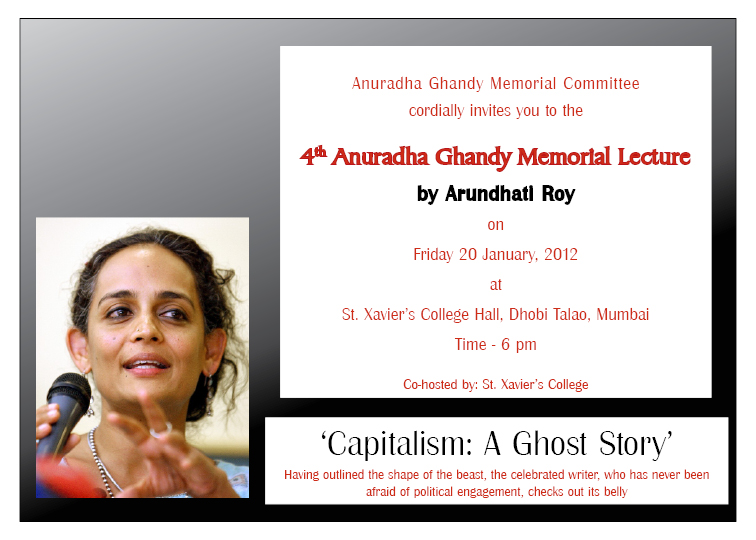
4th Anuradha Ghandy Memorial Lecture (Jan 20, Mumbai)


Anuradha Ghandy Memorial Committee

4th Anuradha Ghandy Memorial Lecture
by Arundhati Roy

“CAPITALISM: A GHOST STORY”

on January 20, 2012
at
St Xavier’s College Hall, Dhobi Talao, Mumbai
at 6.00 pm

Bhubaneswar: Discussion And Reading Team of Socialists (DARTS) – December 30

The second meet of ‘Discussion And Reading Team of Socialists'(DARTS) is to be held on the 30-12-2011 at Xavier Institute of Management (XIMB), Bhubaneswar Room No. 229 from 5p.m to 7p.m. In the first meet Prof. Raju Das from York University, Toronto delivered a short talk on the relevance of Marx’s Capital and on Marx’s Labour Theory of Value followed by discussion among the participants. Marx’s Capital is an essential read for activists and intellectuals alike. The analysis of the commodity in the first chapter ‘Commodities’ is, as Marx claims, the point from where he begins his analysis/critique of capitalism (see Marx’s Introduction to first edition of Capital). It requires more effort understanding this chapter than the rest of Capital. Prof. Das, in the second meet of DARTS will deliver a small talk on the last section of this chapter ‘the fetishism of commodities and the secret thereof’ after revisiting the initial section of the chapter. We request you to be present for discussion.

P.S: In the third meet the discussion team is supposed to meet after reading Chapter I (or a part of it — this shall be decided in the second meet). The date, time and venue will be let known via e-mail.

Please send your suggestions to darts.bhubaneswar@gmail.com

Direct and Indirect Costs of the US Financial Crisis

Deepankar Basu

The global financial crisis that started with the bursting of the housing bubble in the U.S. in 2007 imposed both direct and indirect costs on the working and middle class populations. The direct costs are those associated with the bail-out of financial institutions, which will ultimately be borne by the taxpayers; the indirect costs are those associated with the ensuing economic crisis and the deep and prolonged recession that came in its wake, which, again, will be mostly borne by the working class population. While both costs lead to increasing deficits, and over time accumulating debt, of the federal government, they are of vastly unequal magnitudes. The direct cost (i.e., the costs associated with bailing out the financial institutions immediately after the crisis) is much smaller than the indirect cost (i.e., the cost, in terms of rising unemployment and government deficit if one considers the latter a cost, arising due to the recession); the contribution of the bail-out funds to the build-up of sovereign debt, in the US (and Europe), is minuscule compared to the contribution of the indirect cost (the widening gap between tax receipts and government outlays caused by the recession).

Many people on the left, by emphasizing the cost of bailing out financial institutions (and its contribution to sovereign debt build-up), target the wrong, and smaller, costs. There are two senses in which targeting the bail out funds is incorrect. First, the magnitude of those costs are small compared to the indirect costs. Second, if the direct costs had not been incurred, i.e., if the system continued to be organized around capitalist lines and the financial system had not been bailed out, the ensuing recession would have been deeper and hence the indirect costs, ultimately borne by the working and middle class people, even higher.

It is important to be clear that the workings of the financial sector under capitalism imposes enormous costs on the working and middle class people not only because it needs to be bailed out when the system hits the fan, as happened in 2008. The financial sector imposes much larger costs by the sheer magnitude of the externality of its actions on the working class, by the structural refusal to internalize the costs of its speculative activities, by increasing the financial fragility of the system when the bubble is inflating and ushering in the deep and prolonged recession that inevitably arrives when the bubble bursts. The direct cost of bailing out the financial system when the crisis breaks out is small compared to the indirect cost that comes from the externality of its casino-like activities. In fact, if the financial system had not been bailed out, the indirect costs would have been even higher because the recession would have almost certainly turned into a depression (of the magnitude that the world witnessed during the 1930s).

FIGURE 1: Time series plot of changes in the index of house prices in major US cities


(Source: http://www.project.org/info.php?recordID=445)

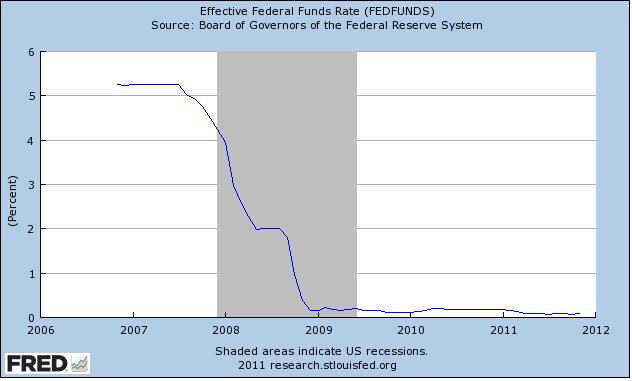
Let us study the US economy and try to understand the difference between the direct and indirect costs of the financial crisis of 2008-09. Recall that the the housing bubble in the US started deflating from around late 2006 (Figure 1). The securitization process that had built itself on the shaky foundations of the housing bubble started unraveling within a year, and the financial crisis broke out in real earnest in 2008. The financial system went into panic, credit markets froze (as banks stopped lending to each other and to nonfinancial firms) and this sent shock-waves through the US government and the Federal Reserve circles. Monetary policy had already kicked in at least an year ago, with the Fed slashing short term interest rates and making liquidity available to the financial system (see Figure 2). But this was clearly not enough.

FIGURE 2: Short term interest rates in the US


(Source: http://research.stlouisfed.org/fred2/graph/?id=FEDFUNDS)

To unfreeze credit markets and deal with the growing panic, the US Treasury department adopted the Troubled Assets Relief Program (TARP) in early October 2008. The conceptualization of the TARP went through two rounds. In the first round, the US Treasury argued that the TARP should buy out the toxic assets (i.e., assets that drew its value from the housing market like mortgage backed securities, the collateraized debt obligations, etc., and were now more or less worthless) from financial institutions to restore confidence in the financial markets and prevent widespread bankruptcies. Very soon it became clear that this strategy would not work because it was impossible to ascertain the “true” value of the toxic assets. In other words, it was not clear at what price the assets should be bought for by the US Treasury. Hence, this strategy was abandoned and in the second round of iteration, TARP was conceptualized as a recapitalization program. This entailed lending money (or other liquid assets like Treasury bills) to financial institutions but in return taking ownership shares of those institutions.

The bail out of the financial institutions that we now talk about is precisely TARP as a method to recapitalize financial institutions, in particular banks, credit market institutions, the automobile industry and the insurance giant AIG, by injecting fresh capital into their balance sheets in lieu of ownership shares. How much money was involved? Initially, TARP was thought to involve $700 billion. But, the Dodd-Frank Wall Street Reform and Consumer Protection Act reduced the maximum authorization for the TARP from $700 billion to $475 billion. The TARP ended on October 3, 2010 and had by then disbursed only a total of $411 billion. Of this, 77%, i.e., $318 billion, has already been recovered through repayments, dividends, interest and other income earnings of the US Treasury.

In fact, the part of TARP funds that was lent to banks has already been recovered with a profit: a total of $245 billion was invested in banks, and it has been recovered with a profit of about $20 billion. It is estimated that the overall cost of TARP, after all recoveries are taken into account, will amount to $70 billion, only about a tenth of the original amount of $700 billion. Hence, it is clear that the overall contribution of the TARP (the bailing-out of the financial system) to the deficit (and outstanding debt) of the US government is not large. The direct cost of the financial crisis, in terms of the funds required to bail out the financial system during the peak of the crisis, is not very large when compared to the indirect cost, to which we now turn.

FIGURE 3: Civilian Unemployment Rate in the US


(Source: Federal Reserve Bank of St Louis, http://research.stlouisfed.org/fred2/)

The indirect cost arose because of the magnification of the effects of a downturn into a deep and prolonged recession, the magnification being caused by the fragility of the financial system. Unemployment rates went through the roof and continues to be at historically high levels despite the official end of the recession in the second quarter of 2009; the labour force participation rates have fallen due to discouraged unemployed workers dropping out of the labour force; the median duration of unemployment has increased to extremely high levels; the share of long term unemployed workers has grown to postwar highs (see Figure 3 and 4 for some details).

FIGURE 4: Civilian Participation Rate in the US


(Source: Federal Reserve Bank of St Louis, http://research.stlouisfed.org/fred2/)

While it might be difficult to accurately quantify these losses, it seems clear that they are far higher than the $70 loss that the taxpayer will be saddled with due to the bail out of the financial sector. For instance, some studies suggest that about 7 million workers have been displaced from long-term employment during the Great Recession, only a subset of all workers who have been adversely hit by job losses. These 7 million workers will experience an income loss of about $774 billion over the next 25 years.

In a similar vein, the contribution of the direct investment from TARP to the growth of the fiscal deficit is small compared to the contribution due to the recession. Figure 5 plots the net outlays (i.e., net of interest payments of its debt) of the federal government, the receipts of the federal government and the difference between the two for the period 2006-2011. It can be seen from Figure 5 that the major jump in the deficit occurred between 2007 and 2009, a period during which it increased by about $1252 billion. This increase was the result of an increase in net outlays (i.e., expenditure) by about $788 billion and a fall in receipts of around $463 billion. Even assuming that the total $411 billion disbursed by the US Treasury for the TARP had occurred during that period (which it clearly did not), it is only about a third of the increase of the federal deficit during that period. Thus, close to (or more than) two-thirds of the increase in the federal government deficit was the result of non-bail out costs.

FIGURE 5: Deficit of the US Federal Government


(Source: Federal Reserve Bank of St Louis, http://research.stlouisfed.org/fred2/)

Looking at the plots of the outlays and receipts of the US federal government in Figure 5, we clearly see that the two series have diverged significantly since the start of the Great Recession. Even though net outlays (i.e., expenditures) have flattened out since 2010, receipts (i.e., tax revenues) have not picked up in any major way. Thus, the gap between the two continues to be big, in excess of $1000 billion every year. This huge gap is what lies behind the deficit and mounting debt of the US government, not the $70 billion that will be the net cost of the TARP. It is more or less certain that a similar account would be accurate for Europe also, i.e., the largest portion of the debt of Eurozone governments would be the result of indirect costs and not the direct cost of bailing out the financial sector during the crisis of 2008.

Conclusion

To conclude, let me summarize the argument. It is important to distinguish between the direct costs (i.e., bail out of the financial sector through the TARP) and indirect costs (rise in unemployment and the growth of the government debt due to the deep and prolonged recession) of the financial crisis and focus on the second rather than the first. This is because the second is much larger in magnitude than the first. In fact, it is not even clear that the first can be considered a cost because without bailing out the financial sector via recapitalization (or temporary and partial nationalization), the recession would certainly have been deeper, increasing the burden on the working people. In addition, concentrating on the second cost allows us to focus on the systemic aspect of the costs that the financial sector, in its speculative avatar, imposes on the working and middle class population of a country. This forces us to conceptualize an alternative that is likewise systemic in nature and goes beyond arguing against bail out of financial sector firms.

Deepankar Basu is an Assistant Professor in the Department of Economics, University of Massachusetts.

Protests and Repression: Struggles Growing in the Forest Areas

Campaign for Survival and Dignity

The last few weeks have seen struggles over forest rights and forest control intensifying across the country. On the one hand there are larger and larger protests taking place, and on the other, the continued use of force by Central and State governments is combined with total silence and apathy on protecting people’s rights.

Campaign member organisations have planned a series of yatras and protests in Rajasthan, Gujarat, Maharashtra, Madhya Pradesh, Chhattisgarh and Orissa in the coming weeks. The Jangal Jameen Jan Andolan has undertaken a yatra in Rajasthan, crossing Udaipur, Dungarpur, Banswada, Sirohi, Pali and Pratapgarh districts between December 20 and 28th. On December 29th demonstrations will be held in all block headquarters that have been covered. The demands are for respect and recognition of community forest rights, a halt to illegal rejections and modifications of titles and respect for people’s democratic resource rights over their lands, forests and minerals. Meanwhile, more than 1,000 people rallied and ten sat on hunger strike in Dahanu, Thane District, Maharashtra on December 7th and 8th against violations of people’s rights under the FRA; the hunger strike was called off after a written commitment from the SDO. A similar mass protest was held in Gadchiroli, Maharashtra on December 19th against the illegal imposition of conditions on titles for community forest rights. Yatras are also planned in western Maharashtra and Gujarat in January; on January 19th and January 26th mass demonstrations will be held in district headquarters in Chhattisgarh and Orissa respectively. These latter protests will also oppose the land acquisition bill and call for democratic control over resources.

Aside from these plans, other protests and mass struggles are underway. On December 15th, a “People’s Forest Rights Rally” was organised at Delhi by a coalition of organisations. In the POSCO area, more than 20 people were injured and one killed in an attack on December 14th by a contractor’s private goondas; unsurprisingly, on that day alone, the police were nowhere to be found. In Assam the Krishak Mukti Sangram Samiti is leading a mass struggle against the illegal and dangerous Lower Subansiri Dam project, in which huge numbers of people have joined; but on the night of December 25th the police arrested more than 200 people in a raid and are continuing their attacks. The KMSS has also been involved in struggles against the ongoing repression and violence around Kaziranga National Park, where forest guards regularly shoot those they accuse of being “poachers.” Brutality and violence continues to mark the situation in Chhattisgarh, where the extremely brutal torture of Soni Sori – and the indifferent response of even the Supreme Court to it – gives the lie to all the tales about respect for the “rule of law” and how it is being enforced by “security forces.” Chhattisgarh has also seen a string of recent illegal evictions from forest land. In north Bengal, an organised effort to take control of community forests is facing opposition and resistance from the Forest Department.

In addition, planning is underway for the declaration of new tiger reserves and relocation of people from them in violation of the law. Mass protests have begun in Kawal Sanctuary to resist the proposed illegal conversion of this sanctuary. In Tadoba Tiger Reserve, Sarang Dhabekar, a Steering Committee member of the National Forum of Forest Peoples and Forest Workers was arrested and slapped with false cases because he had been involved in resistance to illegal relocation efforts.

The Campaign condemns this ever-increasing repression and the brutal use of force against those who are fighting for justice. Once again, we see all talk of “rule of law” and “democracy” being brushed aside in the hideous loot of natural resources by the ruling class of this country.

A Review of Victor Serge’s “Revolution in Danger”

Viplav

Victor Serge, Revolution in Danger: Writings from Russia, 1919-1921 (Translated & edited by Ian Birchall), Haymarket Books, 2011

The pamphlets collected here were written during the Russian Civil War. They were read by Victor Serge’s anarchist comrades as justification for Bolshevik authoritarianism and excess, while his new comrades possibly saw in them an anarchist hangover and germs for future deviation.

Victor Serge has been known mainly for his anti-Stalinism. More recently, his novels have become an attraction for their description of contradictions, bureaucratisation and degeneration of the Russian Revolution. However, he is seldom recognised for the originality of his understanding of revolutionary tasks in general, and their realisation in the Russian scenario. Hopefully, this collection will be an impetus for critical inquiries into his ‘revolutionary theory’.

Specifically, if something survived in Victor Serge throughout his life, it was his commitment to libertarianism. He saw his road to Bolshevism as something borne out of this commitment, rather than as its dilution. Writings from his initial Bolshevik days which have been compiled in this book demonstrate two things. Firstly, they represent Serge’s struggle to explain his involvement in the Russian Revolution, during the turbulent days of the Civil War, to himself and to his anarchist comrades. Serge seeks to show how it entailed the furthering of the revolutionary libertarian cause, not its abandonment. And secondly, the texts provide an important insight into lesser known aspects, or tenets of Bolshevism and the Russian Revolution, which opponents conveniently forget, while supporters in their doctrinaire zeal to draw definite lessons, are incapable of tracing – uncomfortable with the multiplicity, and even contradictory political currents that constituted Bolshevism and the Russian Revolution. Of course, histories of anarchism never forget to show its active presence in the Russian Revolution, especially in initial months. In fact, individual libertarian groups found some representation in the Comintern in its initial days. But an inquiry into Victor Serge’s life and works would go further in tracing the libertarian current in the rebirth of Bolshevism during the Russian Revolution.

The first two pamphlets are reports of specific days in Petrograd in the year 1919. They are about the revolutionary defense of the city against the whites. The significance of Petrograd lay in the fact that its labouring population was in the front ranks of leadership of the Russian Revolution, and when the Provisional Government was dismantled, power came into the hands of the Petrograd Soviet. The Petrograd Soviet was the epitome of the revolutionary transition. Being “a front-line city”, “the city of the revolution”, Petrograd was “permanently in danger” – “The air you breathe there is more vibrant than elsewhere. You can feel the nervous tension and the awakening of a crowd living on permanent alert”. (65)

Like John Reed, Serge wrote these pamphlets in struggles and on the streets. He successfully located the politics of the times in the everydayness of city-life – political ideas and ideals are constituted and reconstituted in day to day happenings, thus shifting their significations radically. This has given the texts, as the translator and editor of the volume, Ian Birchall, rightly, notes, “the freshness of immediacy and, even more, the power of revolutionary enthusiasm… they convey a vivid sense of what it was actually like to experience the first years of the revolution.”(3) However, unlike Reed’s, these texts would be read much more in an ideological manner, as parallel to these narratives runs a continuous and intense self-inquiry into the role of these events in (re)defining the particular politico-ethical legacy, from which the author came. Thus, Serge’s pamphlets are definitely more than mere good or even radical journalism. Serge himself asserts in one of the pamphlets that “his observations and reflections are those of a Communist formed in the libertarian traditions of the Latin countries.” (60)

In fact, it is this legacy of activism that allows him to appreciate the immediate and the spontaneous in the revolution, even in its most difficult phase, when the planned unity of action and thought was considered the greatest virtue, and whose ossification ultimately constituted “the tragedy of a social revolution”. His continuous stress on the “this-time”-ness of “violence, authority and constraint” – of “Red terror”, “dirty jobs”, “sadness”, “draconian measures” dissolves the purported absoluteness and linearity of the revolutionary course in Russia. The Russian situation in Serge’s pamphlets becomes full of possibilities – interplay of necessities, dangers and hope. “Certain necessities of struggle, which it is always difficult to accept in the abstract, stand out clearly just as they followed logically from the events.”(17) After all, “Anarchy is not an ideal formula: it must be life and can be born only from action.”(51)

The grasp of the instantaneous leads him to appreciate the role of the Communist party – its efficiency in organising internal defence – “to mobilize cadres and members, something which was done within a few hours.”(74) He reflects,

“The party at this time is the only organization capable of inspiring, channeling and directing the energies which have just triumphed (and moreover let us note that it maintains its unique situation in dictatorial fashion), but it is nonetheless true that they exist outside it, that they constitute its strength only because it represents them knowingly, because it is, in short, only one of the means of the revolution, in some sense the most powerful lever of the proletariat.”(98, emphases mine)

As clear in this rethinking of the role of the party, Serge’s endeavour was essentially to grasp the revolutionary needs from below – how the situation was building up on the ground, and how specific organs and agencies were appropriated, modified or challenged to suit these needs. It was also an endeavour to explain how an anarchist like himself gravitated towards Bolshevism, despite his continued stress on anti-authoritarianism, direct action, morality and other libertarian motifs. In fact it is this continuity that made Serge capable of capturing those (anomalous) characteristics of the Russian Revolution, which others have generally neglected or could not take account of, usually due to various kinds of ideological baggage. With the examples of Anarchist revolutionaries who were active in the Russian revolution Serge pronounces the same virtue that gathered the Marxists, Blanquists and Anarchists in one fold during the Paris Commune of 1871 – “that in the face of the common enemy, the great revolutionary family – where there are so many enemy brothers – is one; and that at the most critical moments, class instinct wins out over ideological deviations and sectarian spirit. In these times of struggle, the most serious divergences of opinion become secondary; for the very life of the first socialist society is at stake.”(99)

The final pamphlet in this collection is not a narrative of events, but a reconceptualisation of Bolshevism and the lessons of the initial years of the Russian Revolution in a language which can speak to the libertarians. Serge, in 1921, already speaks of “the tragedy of a social revolution being contained within national frontiers… [which] is thus stifled and reduced to playing for time with the enemy within and without.”(118) However, he does not yet consider the situation completely hopeless and perhaps thinks that the mobilisation and integration of anarchists at this juncture will rescue the Russian Revolution from implosion, “elevating, ennobling and enlightening the spirit of the communism of the future”.(119)

Serge was never completely cut off from his Anarchist comrades. Many of them had already written obituaries of the Russian Revolution and wanted to have nothing to do with it, but a section represented by none other than Peter Kropotkin (greatly respected by Lenin) was more self-reflective. Kropotkin found the revolution advancing “in its own way, in the direction of the least resistance, without paying the least attention to our efforts…. That is why it is a revolution and not a peaceful progress, because it is destroying without regarding what it destroys and whither it goes. And we are powerless for the present to direct it into another channel, until such time as it will have played itself out… Then – inevitably will come a reaction.” Kropotkin found even the “governing party” to be powerless, “being carried along by the current which it helped to create but which is now already a thousand times stronger than the party itself”. The only task that he envisaged at that juncture was “to use our energy to lessen the fury and force of the oncoming reaction”, along with the task of gathering “together people who will be capable of undertaking constructive work in each and every party after the revolution has worn itself out.” (Kropotkin, 1920, emphases original)

In one of his letters written in 1920, Kropotkin asked Lenin, “Don’t your comrades realize that you, communists (despite the errors you have committed), are working for the future? And that therefore you must in no case stain your work by acts so close to primitive terror?…I believe that for the best of you, the future of communism is more precious than your own lives. And thoughts about this future must compel you to renounce such measures.”

It is not incidental that Serge’s pamphlet sought to confront exactly those questions that Kropotkin raised in his speeches and writing during the year 1920. Obviously, Serge knew quite well what irked the libertarians most, and it was nobody’s case to present the Russian Revolution and Bolshevism in any triumphalist manner. Hence, at the outset he accepts all the descriptions that Kropotkin and others painted of the Russian scenario as true. Serge speaks of people who “are fighting on the various front lines of Soviet Russia, those who are carrying out the humble, melancholy, dangerous—and sometimes immoral—tasks of the revolution”. He clearly states that it would be unfair to give all credit for the revolution to Bolsheviks – “Social Revolutionary propagandists and terrorists, whose courage was unstinting; anarchists and Mensheviks, whom no persecution could stop” must not be forgotten. It is they “who, before the time of Bolshevism, actually practiced revolution”.(124) Only on the eve of the Russian Revolution did the Bolsheviks come out of their “relative obscurity”, to emerge “as a movement to the left of socialism – which brought it closer to anarchism – inspired by the will to achieve the revolution immediately.”(126)

According to Serge, the Bolsheviks, by calling themselves communists, by declaring the incompatibility of the ideas of communism and the state, by rejecting bourgeois democracy and patriotism, by advocating the immediate expropriation of the possessing classes, by publicly recognising the need to use violence and the principle of terrorism, renounced the traditions of social democracy, and thus came closer to anarchism. Serge’s understanding of new Bolshevism is corroborated by the fact that the same Lenin who talked about the wide gulf between socialism and anarchism, rejecting any unity with anarchists in 1905 was “drawing a parallel between anarchism and Bolshevik views” and admitting that “the concept of anarchism was finally assuming concrete features” in 1918. Lenin further stresses, “When the masses were themselves taking up arms to start an unrelenting struggle against the exploiters, when a new people’s power was being applied that had nothing in common with parliamentary power, it was no longer the old state, outdated in its traditions and forms, that they had before them, but something new, something based on the creative power of the people. And while some anarchists spoke of the Soviets with fear because they were still influenced by obsolete views, the new, fresh trend in anarchism was definitely on the side of the Soviets, because it saw their vitality and their ability to win the sympathy of the working masses and arouse their creative energy.” (Lenin, 1918)

However, for Serge, the new Bolshevism could be understood only by a “new anarchism”, devoid of the “obsolete views” that Lenin spoke about, and which in Serge’s words, were “the notions of yesteryear”, a result of “an incapacity to distinguish words (the old words) and things”, “a sad lack of a sense of reality”. This new anarchism must accept “as a whole the set of conditions necessary for the social revolution: dictatorship of the proletariat, principle of soviets, revolutionary terror, defence of the revolution, strong organizations.” (133) So what remains of libertarianism? Its worth for Serge is precisely in the libertarian critique/struggle through actions and words against crystallisation or institutionalisation.

Serge remained very conscious of “the internal danger of the revolution” building up around the revolutionary government and the power, which is “by its very nature, conservative and hence reactionary.” The crystallisation of the workers’ state and of state communism had to be challenged vehemently. Only this would ensure a continuous movement towards “spontaneous order, to the free association of free workers, to anarchy”. Serge puts the revolutionary attitude towards the state in a typically Leninist style (almost paraphrasing what Lenin said while advocating the independence of trade unions and workers organisations against Trotsky’s proposals):

“Thus as far as the old question of state control, so often disputed between socialists and anarchists, is concerned, the experience of the social revolution in Russia leads us to a twofold conclusion: first of all the necessity of taking hold of the state, a powerful apparatus of coercion; and secondly the necessity of defending ourselves against it, of relentlessly working for its destruction, perhaps at the price of a long and laborious struggle.”(151)

Serge gives a very clear summary of the major problems of the Russian Revolution arising out of statism that were already visible during those early years, which in turn was symptomatic of the crystallisation of the workers’ state. He argued that this statist authoritarianism, taking the form of “the obsession with commanding, prescribing, decreeing, ordering and bullying… has been one of the major causes of the cruelties and of the mistakes of the Russian Revolution.” (157) One of the greatest problems that the revolution faced at that moment was the growing “subordination of the creative apparatus (industry) to the destructive and murderous apparatus (the state)” – this is how Serge characterised the nationalisation drive sans workers’ control (154). However, revolutionary successes, according to Serge, came hardly due to authority or the state – in fact, laws and coercion came across as impotent many a times. “The soviet state is not preserved by its apparatus of compulsion, but by its apparatus of agitation and propaganda, and above all because it is the most basic expression of proletarian interests.”(158)

For Serge, it is in the task of developing a committed critique (in Marx’s sense) of “these conditions” or of the dynamic reality of the revolution that the libertarians could play a major role, because they were equipped with an anarchist philosophy that “proposes a morality”, relatively insulating them from the temptation of power. Ian Birchall in his introduction does well to note that for Serge the concept of morality was a corrective to Second International Marxism and was to be found in his account of the revolutionary defence of Petrograd, as in the following passage:

“One day, when these things are discussed with a concern for justice and truth, when, in the society of the future that we shall ultimately build, where all the wounds of humanity will have been healed, then the revolution will be praised because it never, even in its most tragic days, lost the concern for art; it never neglected rhythms, fine gestures, beautiful voices full of pathos, dream-like settings, poems, anthems played on the organ, the sobbing notes of violins. Never. And I cannot help discovering in this obstinate quest for beauty, at every hour of the civil war, stoicism, strength and confidence. Doubtless it is because the Red city is suffering and fighting so that one day leisure and art shall be the property of all.”(30-31)

Serge’s writings are definitely historical documents that help us in confronting the problems of the Russian Revolution. They at least indicate that the Bolshevik successes did not reside just in the strength and wisdom of personalities, but in their reemergence as a movement that could help realise in the initial years, the spirit of revolution in its wholeness (which unavoidably includes radical contradictions). The Bolsheviks could recognise and unite the various levels of experience and consciousness of the Russian working masses – the various revolutionary traditions are, in fact, “in the last instance” nothing but representations of this diversity of the working class praxis. The cohesive richness of the initial revolutionary experience cannot be explained simply by calling Bolsheviks opportunists, as many libertarians have done, rather it was a realisation of what Serge calls the four-word essence of Bolshevism – “the will for revolution”, which definitely had a libertarian ring to it.

References:

Kropotkin, P. “What is to be done?”, 23 November 1920 & “Letter to Lenin”, 21 December 1920. Reprinted in Peter Kropotkin, The Conquest of Bread & Other Writings (Ed. Marshall S. Shatz), Cambridge University Press, 1995.

Lenin, Third All-Russia Congress of Soviets of Workers’, Soldiers’ and Peasants’ Deputies, January 10-18 (23-31), 1918.

Blind Workers March in Delhi

Sunil Kumar, Blind Workers Union
(A Unit of All India Federation of Blind Workers)
Affiliated to Workers Unity Center of India, WUCI

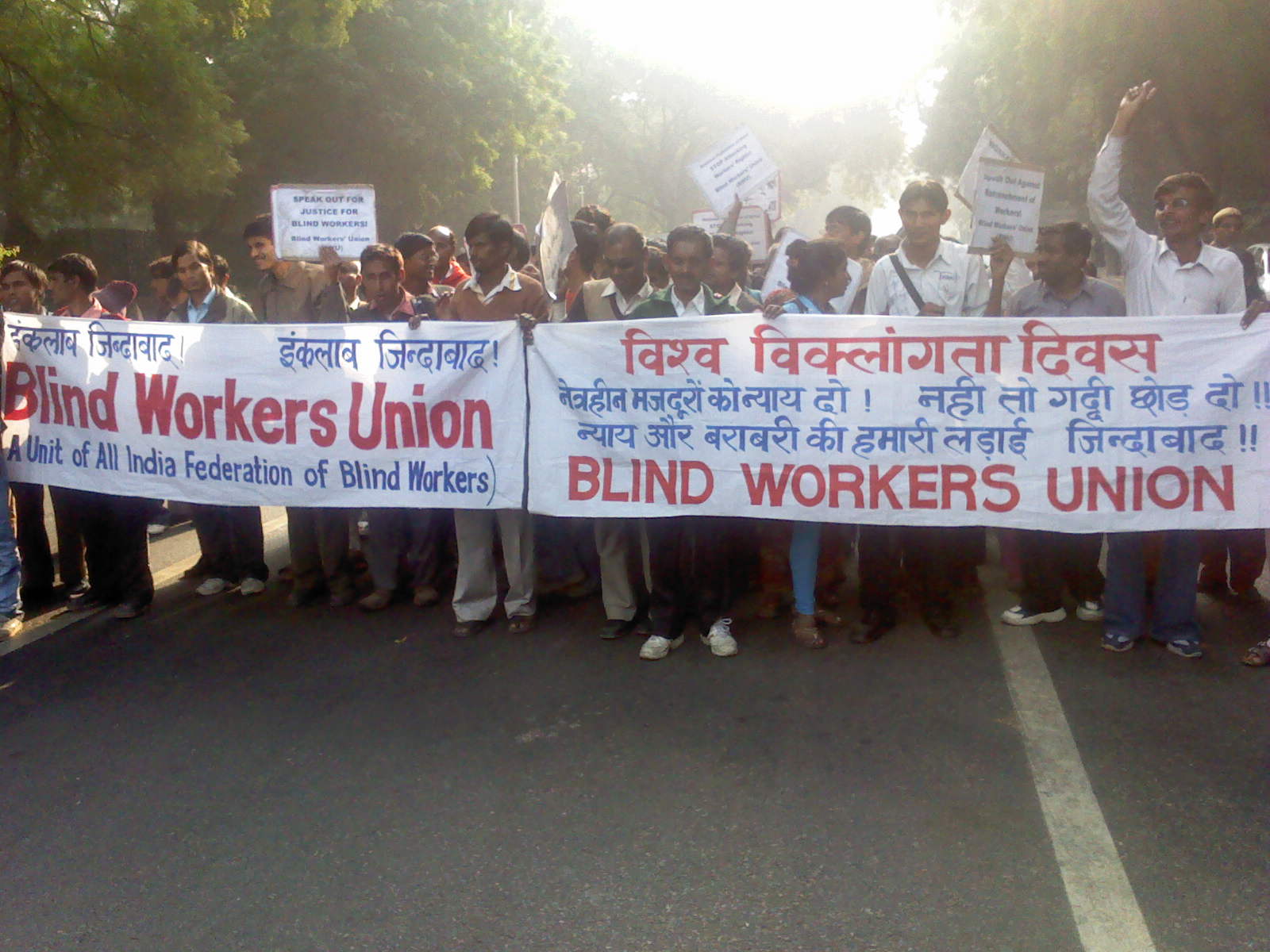
Today, on December 3, 2011, more than a thousand visually challenged workers from Benaras, Nasik, Kanpur, Faridabad, Bahadurgadh and Delhi participated in a massive protest rally on Parliament Street. Their rally was taken out from Jantar Mantar to Parliament Street on the occasion of World Disability Day. It was a culmination of an earlier struggle these blind workers have carried out against a well-known NGO which employs and exploit them, i.e. the National Federation of the Blind (NFB). The rally was an extremely important moment for these workers since they were using World Disability Day to expose how they were still denied many fundamental rights at workplaces. Instead of celebrating this day in the usual festive manner, these blind workers celebrated World Disability Day as a black day, which marked unfulfilled promises of equality.

Initially, the Delhi Police refused to allow the rally to proceed to Parliament Street. However, the agitated workers refused to be held back and broke free of the barricades so as to march onto Parliament Street. Quite expectedly, their fiery spirit did not mellow down, despite being manhandled. Following their protest rally, a delegation of the workers submitted a memorandum to the Hon’ble Minister of the Ministry of Social Justice and Empowerment, Government of India. The delegation met the concerned minister, Shri Mukul Wasnik, and apprised him of plight of blind workers. They drew the minister’s attention to the fact that the government was doing little to prevent the rampant violation of its own laws pertaining to disability. In particular, the workers highlighted the violation of several provisions in the Persons with Disability (Equal Opportunity, Protection of rights and full participation) Act of 1995.

When discussing matters with the Minister, the workers highlighted how section 33 of this Act, which provides 3% reservation in identified posts (1% being earmarked for the blind and low vision persons), is unable to provide sufficient respite to the disabled because of inadequate job creation in the public sector itself. Another important provision in this 1995 Act which is far from being implemented is section 41. It provides incentives to disabled persons so as to ensure that at least 5% jobs of all workforces goes to them.

However, as highlighted by the protesting workers, both the older laws and policies as well as the newest government policies are failing miserably when it comes to ensuring a dignified and productive life to disabled people, in particular, disabled workers. For example, even the recently adopted National Policy for Persons with Disabilities (2006), which provides incentives, awards, tax exemption, etc. is redundant because the private sector which employs a large number of disabled workers, is least interested in implementing such policies, let alone statutory labour laws pertaining to minimum wages and parity at work. In fact, the promise of the National Policy for Persons with Disabilities (2006) to create one lakh jobs is still a mirage today. In this light, the recommendations of the Sudha Kaul Committee which was constituted to help frame a policy on disability, are also flawed. This Committee, for example, has made no recommendations with respect to labour rights relating to safety when assisting in the drafting of the Right of Persons with Disability Bill, 2011.

The gathering of workers on Parliament Street was addressed by aggrieved workers (those employed by National Federation of the Blind) as well as their leaders. Shri Alok Kumar from the All India Federation of the Blind addressed the gathering, and argued how shameful it was that National Federation of the Blind was also commemorating World Disability Day when this NGO itself exploited the impoverished blind workers. He went on to argue how necessary it was for the government to create more jobs opportunities for disabled workers, and how the government should ensure that all statutory labour laws are implemented in production centres run by “social service” organizations (like NFB) as well as other employers. Indeed, almost every blind worker who stood up to speak, emphasized that NGOs like NFB as well as other employers, act as if they are doing the blind workers a favour by employing them. In reality, as employers they earn huge profits from the labour of these workers. NGOs, in particular, also amass huge amounts of funds from the Government/foreign funding agencies by using the face of these poor blind workers.

It is with the express purpose of attaining greater job opportunities for disabled workers as well as parity in work conditions and wages between blind workers and sighted workers that the spirited rally of blind workers marched onto Parliament Street.

Contact: 9313730069
Email: blindworkersunion@gmail.com

Demo to protest Kishanji’s murder (Dec 2)

We strongly condemn the brutal and cold-blooded murder of Mallojula Koteshwara Rao alias Kishanji by the security forces in the Burisole forest area of West Bengal.

Now it is very much clear from various sources that the Maoist leader Kishanji was first captured and severely tortured by security forces and then killed in a planned fake encounter under the connivance of both West Bengal and central governments. Mamata Banerjee government of WB has used almost the same weapon of ‘Peace Talk’ to eliminate the Maoist leader as by the R. S. Reddy government in AP.

It is a known fact that the central and various state governments are jointly conducting a special military operation to suppress Maoist activities. The unjustified and irrational killing of Kishanji is nothing but a part of state terror being unfettered under ‘Operation Green Hunt’, centrally controlled by the UPA government. It is a clear cut violation of not only the guidelines given by Supreme Court and National Human Rights Commission but also by different international institutions.

It is to note that the state is not only killing the Maoists and their supporters but also viciously suppressing all voices of dissent, especially of democratic and revolutionary forces. We strongly feel that Naxalism / Maoism cannot be suppressed by killing its propagators / leaders and organizing massacres of its supporters.

So, we demand that:

1. The central and state governments should immediately stop ‘Operation Green Hunt’ and physical elimination of Naxal /Maoist leaders and cadres.

2. The central government should set up a high level Judicial Enquiry Committee on the killing of Kishanji.

3. The government should register a case of culpable homicide under section 302 of IPC, so that the killers of Kishanji are forced to face the court trial, as directed by Supreme Court and National Human Rights Commission.

We call upon all the progressive, democratic and revolutionary forces to come together and oppose the killing of Kishanji and the suppression of people’s movements.

We, the undersigned have decided to organize a Protest Demonstration before the Bang Bhavan, 3, Hailey Road, New Delhi-110001 on 2nd Dec. 2011 at 12 PM to show our united anger against state oppression. We appeal to all the pro-people forces to make this Protest Demonstration successful by joining it in huge number.

Signed by:
1. Arjun Pd Singh, PDFI
2. P.K. Shahi, CPI(ML)
3. Narender, Peoples Front
4. Thomas Mathew, Bahujan Vam Manch
5. Shieo Mangal Sidhantkar, CPI(ML) New Proletariat
6. Ashish Gupta, PUDR
7. Anil Chamaria, Journalist
8. Amit, krantikari Nawjawan Sabha
9. G.N.Saibaba ,Revolutionary Democratic Front
10. Mrigank, Navajwan Bharat Sabha
11. Harish, Inquilabi Majdur Kendra
12. Alok Kumar. Krantikari Navajawan Sabha
13. Deepak Singh, NDPI
14. Mritunjay, CCON
15. Banojyotsna, Democratic Students Union
16. Kusumlata, Student For Resistance
17. Bijunayek, Lok Raj Sangathan
18. Ambrish Rai, Social Activist
Contact: 9868638682, 8800356565, 9873315447