Eruption of a hundred, million Nonadangas is Dangerous for the Ruling Class!

Krantikari Naujawan Sabha (KNS)

From the filth and dirt of the cities of the present, emerges a shriek of revolt. Liberal society based on inequality squirms, and tries desperately to take contain it and dole out relief. The people asserting their power and dignity of labour persist with the question—who controls access to urban resources and who dictates the quality and organization of daily life. Is it the financiers and developers, or the people?

Nonadanga, in the eastern fringes of Kolkata in West Bengal, has brought this question again starkly to the foreground which is being posed everywhere. In this area, lie several slums with thousands of households, housing a population of few belongings and only their capacity to labour and dignity in hand. The bulldozers of the Kolkata Metropolitan Development Authority (KMDA) with brute Police force burnt and razed the houses in Mazdoor Pally and Shramik Colony to the ground on 30 March 2012 in the name of ’emptying the land’. This prime land including water bodies in and around Nonadanga of 80 acres is to be handed over to developers of ‘star/budget hotels, shopping malls, multiplexes, restaurants, serviced apartments, recreational facilities’. If the 80 acre project materializes, another 1000 odd houses are in line to be demolished. The legal and parliamentary channels had already been close to exhausted before this round of evictions. Peaceful marches by residents under the banner of the local autonomous Ucched Pratirodh Committee (Resistance-to-Eviction Committee) on 1 and 4 April, sit-in demonstration on 8 April and many agitations were organized, appeals were made. The government responded with allusions of Nonadanga being a place where ‘outsiders are inciting’ and ‘stockpiling arms and ammunitions’. Kolkata Police resorted to brutal lathicharge on a protest rally on 4 April, and many suffered severe injuries including children and pregnant women. On 8 April the committe decided to go for a road-side sit-in-demonstration and police was intimated accordingly. But within an hour police force mobilised and picked up 69 residents and activists, later among them 62 were released but seven activists continue to languish under many charges ranging from ‘assaulting public servant in the execution of his duty’ to ‘anti-national activities’ (5 of them were released on bail after about two weeks imprisonment). Then continued series of mass protests and subsequent arrests, and alongwith we witnessed attack on APDR rally by TMC goons. On 28 April, after the confrontation of residents with police over the blocking of the entry-exit points with a boundary wall by the KMDA, 11 residents including 5 women were arrested and slapped with a host of cases, and were put into police custody. The threat of further repression through legal and illegal channels looms large.

Who are the residents of Nonadanga?

An area meant for rehabilitation for evictees from various canal banks and slums across Kolkata, Nonadanga is crowded with single roomed flats of 160 sq ft, which were distributed to these evictees with many anomalies. The ‘rehabilitation’ did not contain schools, health centers or markets. Later more and more evicted and forcedly migrated people from the crisis in the rural areas, majorly from Sunderbans after Aila, started to come here and build their homes as they thought that the land stipulated for rehabilitation would be the last one where jaws of eviction could reach. Having pushed here thus, the people of Nonadanga are employed in various small-scale industries, in petty production and many are unemployed workers. Some in the garment industry, some in the ‘Kasba Industrial Estate’ nearby, some in other small factories of the subcontractors of big industrial houses. A large number of people work as construction workers and contract workers in various places. Many are auto-drivers, rickshaw-pullers, van-pullers, drivers of personal or official cars. Many people are self-employed in small roadside shops of food, tailoring, mobile-recharge, grocery and majority of women are employed as domestic-helps. The question of living wages in such a situation is one of the most important. Linked to that, the quality of living condition is horrible to say the least and the struggle to reproduce everyday life is rife with insecurity. Struggle over shelter and rent, added with worries over water and sanitation constantly plague the people. These insecurities also play out into internal divisions over the struggle for scant resources.

As in each and every urban concentration across India, they bear with them the marks of the violent process of development both in the rural and urban areas. And this pain and their function in the chain of capitalist production is their strength and power. In the villages, they have seen their debts with the landed elite and prices of agricultural inputs soar, the pesticides ruin the nutrition of their soil, even caste related atrocities jump in number, and have been thrown out unceremoniously as companies pounce on their resources. They bear with them the crisis in the urban areas where huge ‘industrial model towns’ have no mention of workers housing even in the grand ‘master plans’, where workers are being pushed daily into selling the endless days and nights of labour even cheaper. With no proper housing, they are pushed into residing in rented dormitories and slums where the state has wilfully withdrawn from all its responsibilities. The working classes are thus ‘legally’ handed over to networks of the local elites and goons (who are hand in glove with the local police, the company owners in the nearby industrial estates, the political party in power or parliamentary opposition) who impose exorbitant rent and user charges on any service that is provided. All this comes under the rubric of ‘illegality’, and the pitching of the people as encroachers. To manage this, the system also has in place several welfare programs and NGOs who act as middlemen, ‘service providers’, ‘consultancy groups’ to delink the struggle in the rural and the urban, the factory/workplace and the household, and push the struggle only into litigation and as a question of lack of rule of law. Integrated in the global networks of capital, cheap labour has to be ensured for the ruling class by constant regulation—by the force of law, by the police and by the ameliorate benevolence of the NGOs.

Exposing the present model of ‘development’

There is nothing surprising about eviction and repression as everywhere in India, and across the world, cities are restructured to suit the needs of capital accumulation, as the attack of neoliberal capital intensifies. In the resistance in Nonadanga is seen an active process of exposing the linkage between exploitation and state repression—both of which defines the fabric of ‘normalcy’ and ‘development’. The residents of Nonadanga formed an independent organization without links to the Trinamool or CPI(M) or any of the standard vote-shops, and asserted their power without relying on the NGOs either. This has been possible, even in the face of their weak economic condition and other insecurities, because of their will and the presence of struggling left revolutionary forces from much before this present agitation started—who are working in coordination during the struggle. Even after all the houses were demolished, the residents refused to budge from the site, put up shelters, ran a community kitchen, and are confronting the might of the police everyday with their bare hands and indomitable will. Since 11 April, 10 comrades under this Ucched Pratirodh Committee persisted with a fast-unto-death in the site for 12 days with undeterred support of the entire slum, and beyond. Fighting the might of the developers and the state, they have reconstructed almost all the burnt and demolished houses, and are preparing to face further assaults from the government, like the boundary wall being constructed by the KMDA and constant threat of further violence by the police, and TMC goons. A local school here, during the present agitation, has been turned into a police camp. However, even in the face of this, some initiatives in education, ecology, health camps are stirring to imagine a different vision of development, even as the state is sought to be held responsible and answerable to their demands. The built makeshift houses stand for now, but so do the demands for proper housing.

The residents continue to demand unconditional dropping of charges against the arrested activists and residents. That without ‘organisational prejudice’, 7 activists of various mass organisations were arrested on 8 April, and then again 11 residents of the area have been arrested on 28 April, shows that whoever raises a voice against the developmental terrorism of capital, without exception, will be crushed. The illusions of justice by the government, police, administration, and judiciary are daily breaking, coming face to face with them in the arena of struggle. The TMC and CPI(M) of the Singurs and Rajarhats have been exposed as lapdogs of the land sharks and company mafia. The state has been forced into retreat after confrontation—the government has been forced to grant bail to the 7 arrested activists (though 2 of them are still in jail) and make promises (albeit temporary) not to go into further evictions. The solidarity campaign by revolutionary left forces and mass organizations in different places also got energized into thinking, debating and linking the ongoing struggles against similar processes in own specific locations. In cases of local resistance, not only did the general process of capitalist restructuring of cities and resistance as the only way to confront it come up again, but thinking around questions of forms of resistance and organization within the struggle are also showing itself.

Beyond anti-Mamata-ism, and the empty discourse of (il)legality

During the ongoing struggle, we have witnessed repeated attempts to not only repress the movement, but at the same time to depoliticize and divert it as an ideological offensive by the ruling class. Even the solidarity campaign when picked up by the civil society, the NGOs, the national media or a organization like SFI focused on (a) anti-Mamata Banerjeeism, (b) depoliticized appeal to push the release of the ‘eminent scientist, harmless national asset’, Partho Sarathi Ray, and (c) relief to the ‘helpless slumdwellers’, without challenging the discourse of (il)legality.

There is at present, a seemingly anti-Mamata Banerjee wave. From the huge uproar over the arrest of a JU professor over a anti-Mamata cartoon to the ‘don’t talk to CPI(M) members diktat’ around the same time, the corporate media is also ‘lovin it’. Nonadanga then becomes merely a question of ‘bad management’ by the Chief Minister. Whereas one opinion argues for an even more virulent form of corporate rule as the answer (it points to the earlier three decades of so-called ‘communist misrule’), the other opinion grants legitimacy to the CPI(M) as better political managers for the capitalist class. After all, the CPI(M) showed its capability to contain revolutionary and mass struggles for a long time, before it faltered over Singur and the Nandigram, and the building mass discontent and shifting class base. What these opinions fail to see is that these Nonadangas show again that whether it be a Mamata or a Buddhababu, they have to take credit for their shops from the same capitalist class. The handing over countless Singurs and Nonadangas to corporate at throwaway prices, the using of brute repression for it on the resisting population is to continue the normalcy of exploitation and accumulation by further demolishing the power of working class. Against this, what must be posited, in continuation from Singur, is that the revolutionary left forces organizing the working class and masses as a power will fight capital and its political executive of whichever variety, who seek to impose the fear over the people.

The hulaboo over Partho Sarathi Ray as the ‘eminent scientist’ divorced from his political positions against the depredations of global capital and state repression reminds us of the decoupling of ‘the good doctor’ Binayak Sen from his politics of demanding universal primary health (the declaration of Alma Ata, the work with Shaheed Hospital) and protest against the Operation Greenhunt. It reminds us of representing Irom Sharmila Chanu as the vaishnavite/Gandhian divorced from her struggle against the AFSPA and the Indian military’s occupation of the Northeast. The question is in this manner sought to be trivialized to mere condemnation of harassment of these ‘national assets’ ignoring their uncomfortable politics or just mentioning it in passing as merely incidental.

The last argument is a desperate attempt to confine the struggle. It raises the question of rehabilitation and livelihood from a NGOist perspective—not going into its causes, and forgetting that most rehabilitation packages are used by neo-liberalism, more often than not, to make yet another assault on the reproduction of labour-power. They thus see this as only a question of shelter for the marginalized, push the struggle into mere litigation and ask for stronger laws or better implementation of existing ones. However law itself and its enforcers create a false sense of equality even as it constitutes its ‘outside’ i.e. the slums as areas of ‘illegal encroachment’. The struggling people and the revolutionary left forces understand that what is law for one class is repression for others—and only a struggle that seeks to question ruling class law itself can shed light into how they came to be ‘illegal encroachers’ in the first place and overturn it; that it is not a question of mere ‘governance’ or more laws or protection from the state of ‘human right violations’. When here, the law of equal exchanges is pointed out, we reiterate Marx of Capital, “between equal rights, force decides”, as has been the history of capitalist production. The people assert—we are not helpless victims of atrocities but we raise the question of housing as a question of class struggle. We demand wages and housing both simultaneously, recognizing that the increase in distance between the place of residence and the source of livelihood that most resettlement and rehabilitation process imposes on the evicted slum-dwellers further devalues our labour-power by lengthening our average labour day. We link the spheres of reproduction and production, we bear the pain of your poriborton, ‘development’ and ‘aid’, and are a force who posits a different imagination. From the Paris Commune to Occupy Wall Street and the London Riots, imaginations of how cities might be reorganized in socially just and ecologically sane ways—and how they can become the focus for anti-capitalist resistance have been posited. Today in India, we find the urban space as increasingly turning into a site of such resistance even as these are still fragmented, localised and disorganized.

As the struggle in urban areas intensifies, the space of operation of NGOs and civil society organisations as only ‘mediators’ between ‘atrocities happening in some remote part’ and ‘corridors of power’ in the cities, is shrinking more and more each day. As class struggle and urban resistance sharpens, the limits of the framework of ‘legality’ and ‘civil liberties’ within which these forces work will become even starker. The shrinkage of democratic space—manifesting with even more brutal assaults by the police state and juridical machinery on the working class is inevitable. While being engaged in the struggle of Nonadanga, we learn from it and those like it that this presents a possibility, and we must seize this.

The Aspirations/Possibilities of Nonadanga

The movemental militancy here is bound not to be confined in the legal and rights discourses only; it asserts its right to the question of housing as a class question. Neo-liberal capital thrives on cheap labour and segmentation. The working class while asking whose city is it, whose space is it, militantly asserts its inalienable right to all resources and to the dignity of its labour. This possibility in Nonadanga is then the potential of the struggle of the working class in urban areas to fight for the cost of its reproduction i.e. of housing and rent, health, education, transportation. These are reflected in some of the present demands—the movement is now proceeding with the demand for proper rehabilitation which is a political demand for a dignified and free life, along with thinking of the practice of alternate forms (however transitory now) of development.

Linked to this, is the possibility of taking this struggle against exploitation to the site of production, to the connected workplaces—asking for higher wages and better working conditions. In attempting to organize domestic workers and the huge informal sector workers and unemployed in the area in these ways, we believe the struggle can take a crucial turn, and this presents a possibility of unearthing and positing through a period of struggle, a form of organized working class power. In organizational terms itself, a process of democratic churning among left revolutionary forces in tune with the movement also is at play, which is also noteworthy. Today, the future of the present struggle is still uncertain, but these possibilities show themselves as the political question that Nonadanga poses. The crisis of capitalism cannot always be managed by governance, more laws and NGOs which seek to isolate and contain these local struggles—this framework will be in danger, and thus the eruption of a hundred million Nonadangas can be a serious anti-capitalist threat in the heart of capitalism as the terrain of struggle is remapped. The state will increasingly act with the repressive and ideological apparatuses at its disposal and this clash can and will only intensify. What is required is to take the movemental militancy and democratic organizational forms in Nonadanga a step further, and in every space where capital thrusts its violent marks. Standing in solidarity with it can only mean intensifying the struggle in our own locations and furthering them to learn from and connect to each other for a proletarian upsurge.

Published by Parag (09804468173) on behalf of
KRANTIKARI NAUJAWAN SABHA (KNS)
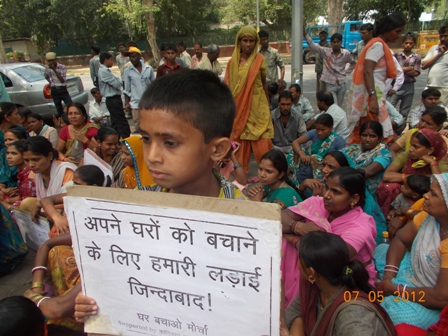
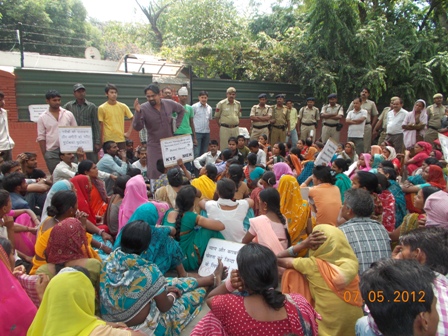
Slum Dwellers protest outside Delhi Chief Minister’s Office

On 7th May 2012, following the renewed threat of massive slum demolition in Gayatri Colony (near Baljeet Nagar/Anand Parbat industrial area) by the Delhi Development Authority (DDA), hundreds of slum dwellers gathered outside the Chief Minister’s residence in protest. Seeing this as a problem that affects slum dwellers across the board, women and children from across different slum/JJ colonies (Pandav Nagar, Hem Nagar, Nehru Nagar, Punjabi Basti, Gayatri Colony, etc.) gathered outside Sheila Dixit’s residence. The agitated slum dwellers sought to bring to the CM’s immediate attention the plight of the thousands of impoverished workers and their families residing in slums. The agitation was carried out under the banner of the Ghar Bachao Morcha, a body formed by the slum dwellers last year itself.

After a day-long protest, the Chief Minister finally met a four member delegation. On hearing the arguments with respect to the arbitrary nature of the 1998 cut-off date, the CM assured that the slum demolition will stop, and that proper discussion on the issue will take place. She assured the slum dwellers’ representatives that her government will further look into the matter of the cut-off date.

Since the beginning of their agitation, the slum dwellers have highlighted how the slum settlements across Delhi house lakhs of poor, working class people. Most of the men in these slums work in factories/sweatshops or as rickshaw-pullers, contract workers in the MCD, vendors, etc. The women work as maid-servants in people’s homes or participate in the informal sector of the economy. However, despite their important role in the socio-economic fabric of this city, slum dwellers are treated with little respect and are made to feel as if their lives have no value. Indeed, rather than recognizing the value of their economic contribution to the city’s economy, the Government’s approach is characterized by slum demolition which is accompanied by minimal relocation and rehabilitation. Whenever slum demolitions take place, most of the families are identified as “ineligible” for rehabilitation due to the cut-off date of 1998. The few families that are considered “eligible” for rehabilitation are moved to underdeveloped settlements in far flung off and poorly connected parts the city, causing massive social and financial dislocation of affected families. Ironically, many a times the land from which slum settlements are razed is left vacant (often with the rubble of the erstwhile slum still lying around)—a fact which indicates that more than providing alternative housing for the poor, ‘hiding of the poor’ is what characterizes the DDA’s policy vis-à-vis squatter settlements.

Activists of Ghar Bachao Morcha claim that the DDA’s own records reveal just how dismissive the urban authorities are with respect to the most vulnerable section of the city’ population. For example, in a study commissioned by the DDA to the Association of Urban Management and Development Authorities in 2003, what is clearly reported is the continuous unwillingness to meet estimated targets for low income housing—a troubling policy approach which has led to a situation where an estimated 3 million people (about 27% of the total urban population) is forced to occupy less than 3% of the residential area in the city! In fact, with the arbitrarily fixed cut-off date of 1998, the urban development authorities find it easy to demolish slums with minimal relocation and rehabilitation plans. On the one hand, the Government and urban development authorities refuse to implement land sealing under the Urban Land (Sealing & Regulation) Act, and on the other hand, they arbitrarily decide that people who come to the city after a certain date are “ineligible” to actually live in the city they work in.

The slum dwellers also pointed to the past record of DDA’s slum-clearance clearly shows that lands from which slum dwellers are evicted are mostly used for construction of malls or high-rise residential complexes which only the rich can afford. This, they argued was most unfortunate, considering that the DDA is supposed to cater to the needs of all strata of society. However, in reality very little of DDA’s finances are spent on housing projects for the poor. Quite expectedly then, the city’s slum dwellers are questioning the rationale of an urban development plan that excludes a very large portion of the city’s working population. The question is can urban authorities even claim that shopping malls and high-rise residential complexes are projects implemented for “larger public interest”, and are hence, projects that legitimately require urgent slum demolition.

It is in this spirit that the city’s slum dwellers are protesting , and have put forward the following set of demands:

    1. Immediate steps should be taken to stop any further demolition and clearance of slums
    2. In-situ development of slums
    3. Abolition of the 1998 cut-off date;
    4. Introduction of land sealing under the Urban Land (Sealing & Regulation) Act;
    5. Immediate action to be taken against all callous officials involved in the arbitrary demolition of our slum
    6. Immediate provision of temporary shelter, drinking water, sanitary facilities to all affected families
    7. Release of compensation to those who have lost property in the process of demolition
    8. Provision of health-care facilities to displaced families
    9. That housing policies for the poor should be prioritized by the DDA, and that the DDA should recommend a feasible and affordable housing policy/plan for the urban poor to the Government of NCT of Delhi and the Central Urban Development Ministry
    10. Before pursuing demolition the DDA should make use of proper consultation mechanisms, and should use all measures to take the slum dwellers into confidence.

Alok Kumar
Convenor, Ghar Bachao Morcha

May Day: Karawal Nagar Workers hold a Workers’ Rights Rally

On May 1, the Karawal Nagar Mazdoor Union, Stree Mazdoor Sangathan and Bigul Mazdoor Dasta organised a ‘Mazdoor Adhikaar Rally’ (Workers’ Rights Rally). The struggle of the unorganised workers of Karawal Nagar Yamuna Pushta started 4 years ago in 2008, when a union of almond workers was formed. In 2009, the Almond Workers Union (Badaam Mazdoor Union) organised a big strike which continued for more than two weeks and compelled the almond factory owners to compromise. This was one of the largest strikes of unorganised workers that Delhi has seen in the recent past. This strike of almond workers saw participation of informal/unorganised workers toiling in diverse occupations, like rickshaw pullers, construction workers, street vendors, etc. Some of them were in fact family members of the women almond workers, while others lived in the same area and came in support of the almond workers strike as a symbol of solidarity. In the next two years, the Badaam Mazdoor Union fought on a number of issues, organised protests against police oppression, and organised movements against the oppression by petty contractors. Most of these issues did not belong particularly to the almond workers, rather they were issues of all the unorganised workers of the area, irrespective of their occupations. The leaders of the Badaam Mazdoor Union realised that de facto, the union has become a union of the informal/unorganised workers of the area. So in 2011, the Badaam Mazdoor Union was transformed into the Karawal Nagar Mazdoor Union (KMU). KMU was formed as the neighbourhood-based union of the workers of Karawal Nagar.

On the May Day 2011, around 2 thousand workers from the Karawal Nagar Yamuna Pushta area gathered on Jantar Mantar under the leadership of KMU, along with thousands of other workers from different parts of Delhi, as well as, UP and Punjab. This protest was organised by different unions and workers’ organisations under the banner of ‘Workers’ Charter Movement’, which is still going on. KMU has been doing an experiment in organising workers in the era of Globalisation, when working class is dispersed or scattered at the shop floor level, while at the same time, it is concentrated in terms of the neighbourhoods where workers live. KMU believes that along with factory-based unions, there is a need to organise workers on the neighbourhood basis. Without strong neighbourhood-based organisation, area-wide organisation across factories, occupations and sectors, even the strong factory-based movements cannot hope to win.

KMU is planning to hold a huge protest march against the non-implementation of government’s policies for unorganised sector workers and different labour laws pertaining to the informal sector workers, oppression by the police and goons of contractors and factory owners, and the non-regularisation of the industrial units functioning in the Karawal Nagar area. The May Day rally ended in a meeting at the office of KMU in Mukund Vihar, Karawal Nagar, in which the plan of this wider march was discussed.

May Day (2012) in Dehradun

Dehradun Update: 12 on hunger strike for last week; no response from government

Shankar Gopalakrishnan

The struggle for justice of the Rockman and Satyam Auto workers continues. Since last Sunday, 12 more workers from both factories have been on hunger strike at the Parade Grounds in Dehradun (and are now on their eighth day). A rally is going to be taken out by the workers shortly.

The original 11 hunger strikers, five of whom had been on hunger strike since April 6th and six from April 9th, and who had been forcibly hospitalised since April 15th, were discharged from hospital at the end of last week. They called off their hunger strike late last week after being severely beaten on the night of April 19th and forcibly put on drips (see photos here), tearing out the drips, and being threatened with further beatings. The workers decided on this after noting that further beatings would probably result in some of their comrades losing their lives.

The strike continues and has now crossed almost six weeks for the Rockman workers and five weeks for the Satyam Auto workers. There is no sign of any negotiation on the part of the government or the companies. No action has been taken against either the police for their brutality or the companies for their gross violations of labour law.

Nothing, not hunger strikes nor protests nor month-long strikes, is enough to move the conscience of the Central and State governments, wedded as they are to brutal exploitation of workers by any means possible. But the workers have refused to give up.

For background on the strike and struggle, see here. For more information please contact Amit, Inquilabi Mazdoor Kendra (09568216305) and/or Trepan Singh Chauhan, Uttarakhand Nav Nirman Mazdoor Sangh (09411143539).

From Nonadanga to Workers’ Power

Pothik Ghosh

तू है मरण, तू है रिक्त, तू है व्यर्थ,
तेरा ध्वंस केवल एक तेरा अर्थ.
(You are death, you are emptiness, you are useless,
In your decimation lies your only meaning.)
– Gajanan Madhav Muktibodh

The resistance of Nonadanga is – for the working-masses of Calcutta, West Bengal and beyond – a shining example of struggle against capitalist repression and exploitation. The Nonadanga movement is a wake-up call for Mamata Banerjee and her Trinamool Congress-led West Bengal government. It is an indication that the popular upsurge, which unseated the 35-year-old CPM-led Left Front regime in West Bengal 10 months ago, was neither meant to clear the way for Mamata’s Trinamool Congress to appropriate state-power by forming a new government in West Bengal nor was it meant, at a more general level, to affirm and consolidate the hegemony of and consensus for competitive electoral politics. The different people’s movements – whether they be in Jangal Mahal or Darjeeling, Dooars or Calcutta city – were all directed against the deviation of the Left Front and its largest constituent, the CPM, from the fundamental ideological principles of Leftist politics.

The determined resistance the Kolkata Metropolitan Development Authority and its slum-eviction drive has come up against at Nonadanga proves the popular upsurge against the Left Front and its then government in West Bengal, not so long ago, was, without doubt, not an instrumentality for effecting a change of guard in the control room of state-power. By the same token, it was also not meant to play a partisan role in determining who would win the competition to usurp the privilege of enforcing and implementing the policies of neo-liberal capital. The Nonadanga struggle proves the working-masses care nothing about which party or electoral coalition gets to enforce the neo-liberal policy-vision by winning electoral and governmental power. Instead, it reveals that the working-masses will persist in their struggle until they have repulsed the neo-liberal assault on their lives and livelihoods, and have decimated capitalism, which is at its root. We hope this message, which rings loud and clear, gets across to Mamata Banerjee, CPM and all those political parties and non-political organisations that consider serving capital and its socio-economic and political system their good fortune and a matter of great honour.

In this context, the Nonadanga movement – which has emerged in less than a year since the change of regime in West Bengal — is an indication that no radical transformation in the material conditions of the working-people as a whole would be possible until and unless they manage to generate a new configuration of social power, based on the working-class logic of self-emancipation and self-activity, by forging a unity among their different struggles even as they keep intensifying those struggles in their separateness. As long as the working people, and the various left and progressive organisations that are part of their different struggles, are unable to accomplish that their dogged but divided struggles will continue to become cannon fodder for electoral competition and capitalist class-power that is the foundation for such bankrupt politics.

That is perhaps why the Nonadanga resistance should also compel the working people of not merely Calcutta and West Bengal, but all of India – together with the various left-democratic forces that are part of their larger struggle – to engage in self-criticism. We ought to view the experiences of our past struggles in West Bengal through the prism of repression and resistance at Nonadanga and the larger socio-political context within which it is situated. This would probably help us understand that as long as different sections of the working-people continue to wage their respective struggles against their particular oppressions in their separateness they would continue to find themselves incapable of constituting the new social configuration of working-class power. That is because capitalist socio-political organisation has the capacity to continually reform itself at its various levels by redressing the problems and demands of some sections of the working class, at times even managing to significantly reduce repression on those sections. But this system, which stands on the ethic of competition for hierarchy and domination, can never extinguish the culture of repression and oppression because without oppression (primitive accumulation) accumulation of capital through extraction of surplus-value (exploitation) is simply not possible. As a matter of fact, capitalism is compelled to continually reduce oppression on certain sections of the working class by transferring the crisis in accumulation, which is embodied by heightening oppression on those sections and the resistance it thereby provokes in them against such oppression, to other sections by simultaneously changing the organic composition of capital and recomposing the working class. It is this that segments and divides the working class and makes it appear as a sectionalised amorphous mass called the working people. In other words, capitalism, as a system of exploitation, is the condition of possibility of oppression and the repressive violence that renders such oppression most clearly evident. In such circumstances, every struggle against oppression must transform itself also into a struggle against exploitation and accumulation of capital.

We must ensure that our respective struggles against oppression do not turn into struggles for the proper enforcement of the rule of law but, instead, get transformed into struggles for the abolition of the very conception of the rule of law that is intrinsic to and constitutive of the unequal sociality of capitalism. “One man’s terrorist is another man’s freedom fighter” is an adage that could well have an analogy: “What is law for one section of society is the exception to law for another.” The legally-protected rights enjoyed by one section of society, more often than not, spell repression for another section. And that is because our unequal capitalist society – which is stratified and thus divided – makes possible through the rule of law, differential legal rights for its different sections or strata, which in turn enable the preservation and protection of their differential identities and thus the reproduction of the entire sociality constitutive of those differential identities. Such an unequal sociality of differential identities is crucial because otherwise competition, which is the diesel of capital accumulation, would be impossible. That is precisely the reason why a law that ensures and protects the rights of one identified section of society comes up as a wall of oppression and repression against another identified section lower than it on the social ladder, and its struggles to level the ground in between them. It would, therefore, not be incorrect to claim that the blanks that exist in between the different laws constitutive of the sociality of differentially included socio-economic identities constitute the happy hunting ground for oppression or primitive accumulation. A bench of the Patna High Court has, in a recent verdict, acquitted all the accused of the infamous Bathani Tola carnage of 1996. This judgement sharply underscores the intimate relationship between the rule of law and so-called illegal repression and oppression like never before.

Needless to say the conception of the rule of law – which reproduces the unequal socio-economic structure of capitalism even as it stands on it as its ground — doesn’t merely generate oppression but also separates and divides the working people and their movement into various identitarian ghettos. That is why this conjuncture of postmodern capitalism – when there is such an unprecedented sharpening of socio-economic inequalities that no section of the working people is unscathed by the experience of suffering and havoc it is wreaking– has yielded a world of undeclared Emergency for us to live in. The ruling class, unlike before, does not now feel the need to officially declare Emergency because the identitarianised sectionalisation and ghettoisation of the working people, and the resultant competitive orientation of their respective struggles vis-à-vis one another, enables state-power to be an expression of the covert dictatorship of capital, concealed by a sheer cloak of democracy, over sellers of labour-power. Italian political thinker Giorgio Agamben’s conception of the “generalised state of exception is meant to explicate precisely such concrete situations. And this generalised state of exception, which has transformed the entire society into a factory if not a large fascist concentration camp, is the appearance of the neo-liberal character of contemporary capitalism.

Hence, in the final analysis, Nonadanga cannot exhaust our politics. Our solidarity with and support for the Nonadanga movement would be effective – as opposed to being merely symbolic like it is now – only if we are able to take it to its right denouement. And this denouement would be the eruption of a larger, cohesive, country-wide movement of urban resistance. If we fail on that score, we will have condemned the Nonadanga movement to the electoral cauldron of the CPM (and its Left Front), which is currently waiting like a stealthy and cunning predator for the right opportunity to pounce on its prey.

The Nonadanga movement has shown the way of unity in struggle to the working-masses of this country. If, on the one hand, the political hitmen of neo-liberal capital are busy dispossessing a section of the working-people from its villages, farms and forests in the name of development, thereby forcing it to flee to cities as a mass of completely pauperised proletarians, the same hounds of capital are also expropriating the urban working-people of their homes and their basic rights by demolishing their slums to further the same project of ‘development’ and ‘beautification’. Worse, this political executive (read chattel-slaves) of capital has turned rehabilitation into an alibi to push these uprooted, homeless people into undeveloped areas outside the city-limits, where they are provided neither with respectable homes fit for human beings to live in nor with clean and safe drinking water. Besides, such bogus rehabilitations are pushing uprooted sections of the urban working people farther and farther away from sources of viable livelihood. The progressive increase in distance between places of residence and sources of employment/livelihood that is being imposed on the urban working-masses by this twin process of eviction and resettlement/rehabilitation is leading to a progressive lengthening of their average labour-day. This entire process – which is enforced and realised through repression carried out by both governmental and non-governmental agents – diminishes the value represented in the wages that the working class receive. It also reconstitutes the urban space in a manner that the vulnerability and precariousness of the proletarianised population is increased – insulating the spaces of production from the erratic reproductive domain, while the latter is increasingly made dependent on the former, i.e., it is more and more subsumed under the logic of capital. Consequently, valorisation of labour-power has rendered socio-economic existence into a biopolitical realm, where determination of social life, even at its bare biological level of the body and its vector, is progressively becoming a matter of centralised systemic control. That is yet another salient feature of our conjuncture of neo-liberal capitalism.

Clearly, repression and legally-sanctioned exploitation complement one another. The two processes in inter-weaving with each other constitute capital, its accumulation and its class-power. In such a situation, when governments and the larger capitalist state-formation are pinning adjectives such as Naxalism on to struggles against repression and expropriation of peasants, Dalits, religious minorities, tribals and sub-nationalities, we have neither any fear nor shame in saying that we are all Naxals. In fact, we insist that this Naxalism-against-repression must now be transformed into a description for a cohesive country-wide urban resistance against capitalist exploitation and its neo-liberal class-power.

Workers of Harsoria Healthcare (Gurgaon) stage a sit-in strike

Shyambir
Santosh Kumar

For the past couple of days (from April 24 onwards) about 450-500 workers of Harsoria Healthcare Pvt. Ltd., Udyog Vihar, Phase-4, Gurgaon have been sitting inside the factory premises in protest. The factory has 250 permanent workers, 300 contract workers and about 50 casual workers. They are protesting against the termination of the services of their three union leaders and the suspension of 10 workers. The services of two of these leaders were terminated in Dec. 2011, while another was fired in February, 2012. The demands of the workers include payment of Deepawali bonus and regularisation of the services of casual and contract workers. The workers are also protesting against the frequent change in their departments, delay in payment of salary, increased work intensity and non-payment of loyalty bonus of about Rs. 1500 per month on completion of 4 years with the company.

There was a strike in April 2011 in this factory when the management dismissed 7 workers out of which 6 of them were taken back following negotiations. The services of three of these workers have been terminated again. There was a lathicharge against the workers during the April 2011 strike and 7 workers were arrested and implicated in a number of cases including one against the hoisting of the union flag at the factory gate. Around 21 workers had been implicated in one case or the other. The workers are demanding the withdrawal of these cases. Meanwhile the company management has ordered the termination of services of 100 more workers. The management has also declared that it does not want to see the permanent workers within the company premises.

Dehradun Update: 33 workers now on hunger strike, 11 for about three weeks

Shankar Gopalakrishnan

The strike by the workers of Rockman and Satyam Auto (both plants in Haridwar), suppliers of Hero Motors, has now crossed a month in length. 11 hunger strikers are still being forcibly detained in hospital. The Rockman workers have been on strike now for five weeks (since March 19th) and the Satyam Auto workers for almost as long (since March 22nd). Six Rockman workers have been on hunger strike since April 6th (19 days); five Satyam workers since April 9th (16 days); and 12 more workers since Sunday. These last 12 hunger strikers have not yet been detained. The workers are still protesting in the Parade Ground at Dehradun after their release from jail last week.

Aside from an expression of regret by the DGP (who has also said he has directed an inquiry into the beating of the hunger strikers in the hospital), the government has taken no action whatosever. Both companies – which grossly violated labour law – are functioning with contract workers and supplying to Hero Motors, which reportedly is accepting substandard and shoddy parts from them just in order to break the strikers.

As earlier, for more details please contact Trepan Singh Chauhan, Uttarakhand Nav Nirman Mazdoor Sangh (09411143539), and/or Amit, Inquilabi Mazdoor Kendra (09568216305.

Delhi: Blind Workers’ day-long protest (April 24)

BLIND WORKERS GHERAO THE RESIDENCE OF THE MINISTER OF SOCIAL JUSTICE & EMPOWERMENT
DAY-LONG PROTEST LEADS TO THE GRANT OF JOBS TO RETRENCHED BLIND WORKERS
WORKERS DEMAND IMMEDIATE DISCUSSION ON THE LANGUISHING 2011 BILL ON RIGHTS OF PERSONS WITH DISABILITY

Today, large numbers of blind workers collected outside the residence of the Minister of Social Justice and Empowerment, Shri Mukul Wasnik. These workers have met the concerned Minister, as well as officials in the Ministry of Social Justice and Empowerment on several occasions since November 2011. However, the deep rooted concerns of blind workers lay un-addressed. Today, when the blind workers initially gheraoed the residence of the Hon’ble Minister, he did not meet them, and left his residence in haste. This response once again convinced the blind workers that the Government is least concerned about providing adequate employment to the blind, as well as protecting the basic labour rights of blind workers employed in the private sector. However, undeterred by the Minister’s initial decision not to entertain a delegation, the blind workers continued to sit outside the Minister’s residence in the scorching April heat. The militant protest finally led to some dialogue as the K.M. Acharya met with the workers’ delegation. Following a lengthy discussion between Shri Mukul Wasnik and officials in the Ministry, the Ministry finally agreed to provide alternative employment at a government-supported institute, to all the blind workers retrenched by the NGO, National Federation of the Blind (NFB).

Since November of last year, the blind workers have been protesting the retrenchment of several blind workers by the NFB. This NGO retrenched the workers because they were speaking out against denial of minimum wages and other basic labour rights in the Training and Rehabilitation Centres (TRCs) run by the NGO. However, the struggle of the workers is not just against the NFB, but also against the overall exploitation of blind workers across the country by private companies and NGOs. In the interest of availing of certain benefits like tax exemption for employing persons with disability, the private sector is known to employ yet brutally exploit disabled persons. The arbitrary hiring and firing practices, unregulated working hours, etc. prevalent in the private sector, amount to a serious breach of social justice, which is why the bind workers have been approaching the Ministry of Social Justice and Empowerment. More importantly, the workers realize that the failure of successive governments to provide adequate employment to the blind community is the main reason why blind workers are dependent on the highly exploitative private sector. Hence, their struggle is based on the fundamental right to a livelihood—a right the Government is to protect and uphold. The three specific demands that the workers sought to discuss with the Minister were:

(i) Inclusion of a special section in the long pending Bill on the Rights of Persons With Disability (2011), which would safeguard the economic rights of blind workers employed in the private sector. For example, the Bill should include provisions to the effect that bodies violating basic labour rights will be penalized to the effect that NGOs indulging in such violation will face the cancellation of their registration.

(ii) That the Ministry of Social Justice and Empowerment tables a concrete plan of greater job creation for blind persons in the public sector. It is only with the provision of more government jobs that the dependence of blind workers on exploitative private companies and corrupt NGOs can be overcome.

(iii) That because the Ministry has failed to curb the blatant violation of labour rights by the National Federation of the Blind (NFB), it should ensure that all the disabled workers employed by NFB be provided alternative employment by the Government.

As the situation stands, the Ministry of Social Justice and Empowerment has conceded the third demand of the blind workers. With respect to the first and second demand, the Ministry has asked the Blind Workers Union (BWU) to provide a concrete plan which can be subsequently discussed and implemented.

Alok Kumar
Ramnath
Blind Workers Union
(A Unit of All India Federation of Blind Workers)
T-44, Panjabi Basti, Near Gopal Dairy, Baljeet Nagar, New Delhi-110008
Contact: 9313730069 Email: blindworkersunion@gmail.com

Delhi Press Release on Nonadanga and Urban Struggles (Protest Demonstration, April 25)

Halt eviction drives of urban slums and colonies!
Uphold the struggle of the toilers for the right to land!
Militant resistance in Nonadanga long live!!

Comrades, we are witnessing today the militant resistance of slum-dwellers of Nonadanga against the eviction drive of the Kolkata Metropolitan Development Authority (KMDA) through brute police force. Nonadanga presents us with the determination of the urban poor and working class to constitute an alternative form of social, political and economic power. The residents of Nonadanga have refused to budge from the site, have put up temporary shelters and a community kitchen, and are confronting the police everyday with their bare hands and their indomitable will, trying to hold on to whatever little they are left with. Since April 11, 5 comrades under Ucched Pratirodh Committee have persisted with a fast-unto-death in the site for 12 days with undeterred support of the entire slum, and beyond. Reconstruction and rebuilding of the demolished houses are being undertaken by them.

Nonadanga is a paradigm of struggle and unity that must be generalised across Kolkata, West Bengal and beyond. For, it’s only through the eruption of a hundred, thousand, million Nonadangas across the country – that the working class will be able to effectively pose its might and vision against the prevailing hegemony of neo-liberalism and its authoritarian political executive. In the absence of such a countrywide generalisation of urban resistance, the working masses of this country, including the residents of Nonadanga, have no hope in hell.

We are witnessing in India today, a ground preparing for a rising tide of urban upsurge. However much the ruling classes seek to dazzle the working people with the shine of their developmentist fables, corporate parks and election promises, they cannot hide from us the violence that is intrinsic to this process of capitalist ‘development’. Even as the agrarian crisis daily pushes the peasantry from villages to the cities as a proletarianised mass, capital is busy robbing this ever-growing population of urban workers of its bare necessities such as living wages, adequate land, decent housing and clean drinking water by putting up ever-heightening enclosures of rent and user-charges. Not just that. The political executive of capital does not flinch from turning the misery it produces into an opportunity for further accumulation. Even the demand for rehabilitation is used by neo-liberalism, more often than not, to carry out yet another assault on the reproduction of labour-power. The increase in distance between the place of residence and the source of livelihood that most resettlement and rehabilitation process imposes on the evicted slum-dwellers further devalues their labour-power by lengthening their average labour-day. Worse, any murmur of dissent against such accumulation by dispossession is brutally crushed by the state in order to ensure that the value of our labour-power can be progressively diminished even as the rate of extraction of surplus value is simultaneously enhanced and capitalist class power is reinforced.

The ongoing struggle against forcible eviction of slum-dwellers in Nonadanga, Kolkata, has revealed precisely that. On March 30, 2012, the KMDA, with the full support of the Trinamool Congress-led West Bengal government and its police force, bulldozed and burnt down the houses of over 200 families in the shantytown of Nonadanga in the name of ‘development’ and ‘beautification’. These people, who have lost their homes and hearths, are those whose cheap labour is ‘legally’ exploited to run the economy of the entire city. They are the toilers of unending nights and days, informal-sector workers and unemployed battling precarious living conditions. Among them are either those who were resettled here after being evicted from various canal banks across the city, or those whom the Cyclone Aila (2009) and the farm crisis uprooted from villages in the Sunderbans and other parts of the state respectively.

The state (and the corporate media), acting on behalf of capitalist land sharks eyeing this prime location in the city, are hell-bent on portraying these people as ‘illegal encroachers’. It has unleashed police and ‘legal’ repression, on an everyday basis, on all those who have been trying to resist this. A march of residents, under the banner of Ucched Pratirodh Committee (Resistance-to-Eviction Committee), was brutally lathicharged by the police on April 4, and again a sit-in demonstration four days later (April 8th) was violently broken up and 67 people arrested. Subsequent meetings and rallies held in solidarity with the movement on April 9 and 12 were attacked by goons and hundreds of activists were arrested by the police. Seven activists of various mass and democratic rights organisations, which stood in support of the Nonadanga movement, are either in jail or in police remand till April 26. Cases under Sections 353, 332, 141, 143, 148 and 149 of the IPC have been slapped on them. One of them, Debolina Chakraborty, has even been charged under the draconian Unlawful Activities Prevention Act (UAPA). During a court hearing on April 12, a prosecution team of 40 lawyers made a concerted bid to implicate them in a slew of false cases and paint them as ‘anti-national’, opening earlier ‘Nandigram cases’, even going so far as to claim that Nonadanga was used for ‘stockpiling arms and ammunition’. We remember that this Mamata Banerjee-led Trinamool government came to power using the anger of the people over the Singurs and Nandigrams of the previous CPI(M) government to its parliamentary ends. It is they who are now using the instruments of repression at their disposal in a hurry to prove themselves as faithful lapdogs of their class masters.

Comrades, Nonadanga has shown us the way. For, the sword of eviction hangs not just on a Nonadanga, or for that matter a Bhalaswa (Delhi). Today in India, 256 lakh people are homeless or live in abject conditions in slums, and this number is progressively on the rise. Forget jobs or providing decent education, the state is retreating from all its responsibilities of providing us with the cost of living and reproduction. Evicting us from our homes has become the norm, as the cities are restructured according to the needs of the ruling classes. In Delhi, Shiela Dixit’s Congress-led government has drawn up a list of 44 colonies to be evicted in the next few months- 33 in the first phase. The criteria for being allotted the meagre government flats is possession of voter identity card, aadhar card and ration card as of 2007, and a capacity to make a down-payment of Rs 80,000. We are thrown into these legalisms even as we suffer the already inadequate housing and water situation. Even in the six resettlement colonies in Delhi, the conditions are horrendous. When one of our comrades from Bhalaswa presented Delhi CM Shiela Dixit with a bottle of water from her area, the CM was at first deceived by the colour of the water to think that she was being offered Pepsi-cola to quench her thirst. People living in slums in various parts of the city are the ones who make the city what it is, who make the super-profits of the capitalists possible. It is these people who become an embarrassment for the government, whichever party is in power, and whatever their false election promises. We remember the spate of demolitions which was the run-up to the Commonwealth games 2010, and how the political managers of capital attempted to hide our ‘dirty’ dwellings and crush our then disunited voices of protest. This continues daily, even today. On 20th April 2012, the DDA with over 2000 police force, attempted to demolish and evict slum-dwellers from Gayatri Colony near Anand Parbat industrial area in Delhi, but were forced to retreat faced with the unity and resistance of the residents.

Even here in Delhi, we have daily struggled on the streets for our rights and demands. We have, however, also been disunited owing to our precarious existence and localised struggles. When in Kolkata, our brothers and sisters are fighting it out not merely for survival but for the right to live a dignified and free life, let us wish it all power and condemn the authoritarian actions of the government of West Bengal. Let us stand with them in solidarity, and also intensify our struggles at our own locations.

We condemn the action of the Trinamool-led West Bengal government and the brutal lathicharge on the Nonadanga residents and their supporters on April 4, and the threat of impending everyday violence. We also condemn the arrest and framing of activists who stand in support of the resistance.

WE DEMAND:

Immediate and unconditional release of all the activists arrested on April 8. Drop charges against all seven of them: Debolina Chakraborty, Samik Chakraborty, Abhijnan Sarkar, Debjani Ghoah, Manas Chatterjee, Siddhartha Gupta and Partha Sarathi Ray.

Drop the draconian UAPA and all charges on Debolina Chakraborty, and release her immediately and unconditionally.

The state must stop further harassment of residents and activists, and apologise to the people for having infringed upon its democratic right to organise and dissent; and take action against the police officers involved in the lathicharge on April 4.

The right to housing and rehabilitation of the slum-dwellers and hawkers in Nonadanga must be immediately ensured in a fair and just manner so that that their labour-power is not further devalued.

All construction in Nonadanga by the KMDA must come to an immediate halt. The eviction drive in the city, and the anti-people programme of neo-liberal capitalist development of which it is an integral part, must be stopped.

The process of slum-eviction in Delhi must be stopped immediately and inhabitants of the jhuggi-jhopri clusters in the city should be provided with adequate land, and respectable housing with clean drinking-water sources and proper sanitation amenities.

Join a protest demonstration outside
Banga Bhavan on 25 April 11.30 am

Sd/-
All India Federation of Trade Unions(New)
All India Students Association
All India Revolutionary Students Organisation
Bigul Mazdoor Dasta
Disha Chatra Sagathan
Inquilabi Mazdoor Kendra
Jamia Teachers Solidarity Association
Krantikari Naujawan Sabha
Krantikari Yuva Sangathan
Mazdoor Patrika
Mehnatkash Mazdoor Morcha
New Socialist Initiative
Peoples’ Democratic Front of India
Progressive Democratic Students Union
People’s Union for Democratic Rights
Posco Pratirodh Solidarity-Delhi
Radical Notes
Sanhati-Delhi
Shramik Sangram Committee
Students For Resistance
Vidyarthi Yuvajan Sabha