Nepal: Revolution’s Restorative Tangle

Pothik Ghosh

“We can be defeated both by dictatorship itself and by being reduced to opposing only dictatorship. Defeat consists as much in losing the war as in losing the choice of which war to wage.” – The Coming Insurrection, The Invisible Committee

The shelf-life of democracy in Nepal is turning out to be rather short. And instead of adhering to its ideological credo of “uninterrupted revolution” (Mao Zedong), the Unified Communist Party of Nepal-Maoist (UCPN-M) has allowed itself to become a party to this brutal interruption of democracy. The dissolution of the Constituent Assembly (CA), after it failed to give the fledgling republic a Constitution in spite of innumerable extensions, has undoubtedly precipitated a constitutional crisis. Such a crisis, needless to say, has been caused because the interim constitution did not foresee that a situation like the one that currently stares the republic in its young but battered face could ever arise. To see the current situation merely in those terms would, however, amount to barely scratching the surface. What, on the face of it, is an intractable constitutional deadlock is at its heart a political calamity. The soul of Nepal – its social cohesion – is suffering from a virtually incurable fracture.

The UCPN-M-led government may believe that in deciding to call for fresh elections to institute a new CA it has done the best for democracy. Nevertheless, it would be delusional on its part to imagine that making what in current circumstances is a necessary procedural gesture would be sufficient condition for enabling the continuance of democracy in the country.

No number of elections will yield the missing social consensus for a genuinely cohesive Nepal. Envisaging the electoral process as the exclusive driver of democratisation would just not do. Not unless a vibrant politics of radical social transformation, which compels the electoral process and the polity it constitutes to reflect and embody its spirit, is in place. Such transformative politics is capable of generating an effective consensus for social cohesion because it seeks to forge a new, egalitarian form of social unity by challenging and dismantling the hierarchised aggregation of socio-economic strata and socio-cultural identities.

The stiff opposition mounted by the Nepali Congress (NC) and the Communist Party of Nepal-United Marxist-Leninist (CPN-UML) not only against the demand for a strong federal polity being championed by the Maoists and their political allies among the Madheshis and Janjatis, but even against the declaration of fresh elections by the UCPN-M-led government, demonstrates the utter hopelessness of the situation. It also serves to reveal the retrograde nature of the prevailing social consensus insofar as it has inspired and enabled forces such as the NC and the CPN-UML to resist the most obviously basic procedure in a republican democracy – declaration of elections – without any fear of taint or loss. In such a situation, elections – even if the socially dominant classes and castes that back the NC and CPN-UML allow them to be held – is unlikely to yield the kind of progressive mandate required to legitimise the framing of a strongly federalist Constitution.

Unless the prevailing hegemony of competitive identity politics – the source of social division and the absence of a consensus for cohesive Nepali society – is shattered, the demand for a strong federalist constitution, incontrovertibly progressive and democratic, will remain a pipe-dream. The fulfillment of political democracy is clearly linked to democratic transformation of a hierarchical and stratified society. And the politics that seeks to accomplish this transformation can do so by establishing unity among subalternised working-class elements across various social blocs or identities in the commonality of their struggles to not only emancipate themselves from the specificities of their respective domination but through such struggles come together to extinguish the general condition of subalternisation per se. (That, in essence, is what the revolutionary politics of working-class solidarity amounts to.) Such a political manoeuvre, in attempting to disaggregate identities and breach their homogeneity, would fundamentally alter the prevailing configuration of social and economic power in Nepal. It would also create an effective consensus for a federalised republican polity. The demand for federalism would gain legitimacy beyond the marginalised and oppressed identities, whose demand it particularly is, due to the cross-identitarian character of working-class solidarity that such transformative politics would accomplish.

Unfortunately, UCPN-M chairman Prachanda’s recent statement bespeaks no such awareness. His assertion that his party would fight polls on the plank of identity-based federalism and would win two-thirds majority in the new CA is not only thoroughly misplaced but is a tragic revelation to boot. It demonstrates how the Maoists have come to vest such complete and exclusive faith in the electoral process as if it were the demi-urge of democracy in Nepal. Electoral politics, in the absence of a larger movement for radical social transformation, is threatening to undermine precisely that which it is meant to establish: democracy. In Nepal today, it is an embodiment of the ethic of competition that underlies the acutely hierarchised, deeply class-divided and sharply fractured society.

Even more appalling is the fact that the importance of establishing the inextricable link between political democracy and radical social transformation should be so completely lost on the leadership of a political force with a recent and glorious revolutionary past. The Maoists should have known the realisation of federalism as a constitutionally enshrined principle is contingent not on sheer electoral mobilisation, but on the capacity of a political force to situate such mobilisation within the matrix of vigorous transformative politics that delegitimises identitarian competition by seeking to level the social hierarchy that fosters it. The objective basis of their politics in the most subalternised sections of the working people, thanks to their participation in and leadership of the two-decade-long People’s War, ought to have ensured at least this much. That it did not proves their subjectivity is no longer fully committed to the objective basis of their politics.

In that context, the responsibility for the current crisis of democratic consensus in Nepal should largely be the Maoists’ burden. And that, contrary to the suggestion of the preponderant anti-Maoist wisdom on the Indian subcontinent, is not because the UCPN-M has failed to sufficiently accommodate the so-called concerns of such reactionary political forces as the NC and CPN-UML. Instead, the crisis has arisen precisely because it has been too accommodating. The Maoists have, for all practical purposes, accepted the dominance of the traditional social elite by submitting to the hegemonic determination of the latter’s republicanist ideology of competitive politics and hierarchised social corporatist aggregation.

It would, however, be analytically misplaced to overstate this criticism. What is needed is to put it in its proper historical perspective. After all, it was the concerted initiative of the Maoists to deepen and democratise Nepal’s republican political process – made inevitable by the 2006 anti-monarchy Jan Andolan of the NC-led seven-party alliance (SPA) and the Maoists – that compelled the post-Gyanendra mainstream polity to concede to their demand for drawing up a more democratic social contract in the form of a new Constitution. It was this that led to the Comprehensive Peace Agreement between the Maoists and the SPA, the abolition of monarchy and the institution of the now-dissolved CA through elections in which the Maoists too participated. When the SPA had accepted the reinstatement of the Nepal House of Representatives by King Gyanendra in April 2006, Baburam Bhattarai had categorically stated that merely restoring parliament would not resolve the problems and that Maoist guerrillas would continue to fight government forces as long as their demands for the formation of a CA and abolition of monarchy were not accepted. Such a statement proves the Maoists had then been doggedly committed to the democratisation of the emergent republican polity.

Such commitment stemmed from the objective basis of their politics in the demands and aspirations of the oppressed sections of Nepali society for greater democratisation. It meant that the hierarchised aggregation of differentially inclusive identitarianised strata become less hierarchical. The demand for a new social contract was meant to accomplish exactly that. But can such a social contract gain widespread popular legitimacy as long as society is irreconcilably divided along hierarchically and thus mutually competitive identitarian lines?

Aspirations that pertain to certain oppressed identities, no matter how democratic, will not find acceptance among dominant identities unless those identities themselves are disaggregated through a process of opening up of struggles between the dominated and the dominant within each of those identities. It is only then that the oppressed identities and the proletarianised sections within the dominant identities can come together in their common condition of oppression and their common struggle against the abolition of that condition per se. Only when that is accomplished can the democratic aspirations of the oppressed identities find wider resonance with the concerns of the subalternised sections within the dominant identities and win popular legitimacy.

This is the full implication of aspirations and demands such as federalism that the Maoists have failed to grasp in spite of having concertedly raised those demands due to the objective location of their politics among the wretched of the earth. It is time, however, they understood that their struggle to deepen republicanism was no more than a moment in the process of the larger political movement to radically transform Nepali society. Had that been their approach all along, their struggle to deepen the republican political process would have morphed into the next moment of struggle for social transformation without interruption. They should now know that democratisation of a republican polity without radical transformation of society would – even if it were to succeed – inevitably lead to the electoral instrumentalisation of the questions and concerns of the working class by different sections of the socially dominant classes and the ruling elite in their mutually competitive quest for political power. Such instrumentalisation would strengthen homogeneous identities and thus reinforce the hegemony of a hierarchical society and competitive identity politics.

The UCPN-M, so far, has given no sign that it has started comprehending its demand for a constitutionally-ordained federal polity in those terms. As a consequence, what was meant to be the means by which a wide-ranging political movement for social transformation could be waged and energised continues to be reduced to a shibboleth by the party for bolstering its case in a competitive struggle for political power. Something that rather than challenge has only served to reinforce the unequal social basis of such power. Clearly, the Maoists appear to have conflated and confused their politics of radical social transformation with the tactics of the republican moment of such politics. That has, in an ironic twist, rendered republicanism the strategic goal of a political force that professes to stand for revolutionary working-class politics.

The fatal flaw of the Maoist leadership on that score had become evident in 2005-06 itself when the party had begun diverting its political resources and energy from the People’s War campaign in rural Nepal to an urban mass movement that was erupting in the form of an anti-monarchy Jan Andolan. The problem is not that Maoist politics came out of the bush into the cities to become open. Nor can the decision of the Maoists to participate in the mainstream electoral process be faulted as such. At that moment, those were absolutely the right things to do by way of tactics. The real problem lay in the way they went about doing all that.

Whatever critical assessment the Maoists might have had of the Jan Andolan, the politics of their participation in it revealed nothing more than the acceptance of massification that was the dominant ideological and political tendency of the movement. The 2006 Jan Andolan was a movement constituted through an aggregation of different strata of Nepali society against disparate forms of domination inflicted and imposed on them by their common enemy – the monarchy – that nevertheless left the relationships of domination, power and mutual competition among its constituents intact.

The Maoist participation in that movement should have been based on a continuous questioning and practical critique of the concrete forms in which the movement engendered social relations of hierarchy and concomitant ideologies of competition even while the party fought the common battle against the monarchy without yielding an inch. In other words, the Maoists should have been the principal proponents of a revolution within revolution. Instead, blinded by their tactical paradigm of republicanism, they ended up elevating the problem of Jan Andolan into a virtue.

The hierarchised mass, shaped and guided by ideologies of mutual competition among its various constituent strata and/or identities, was assumed by them to be a repository of social unity in its apparently common struggle against Gyanendra’s monarchy. Naturally, they thought that questioning the hierarchies and segmentations internal to that mass would weaken the movement. This was probably also partly prompted by their desire to quickly seize state-power. They probably lost the nerve to undertake the protracted and arduous political odyssey needed for making such seizure contingent on altering the social relations and structure from which emanates the oppressive state-formation of Nepal. But as Maoists they should have known that “revolution is not a dinner party”, or a piece of cake for that matter.

What was required of them was to sustain the movement on the streets of urban Nepal through unceasing political activity driven by independent working-class initiative. Such a movement, if it went on in tandem with the task of framing the Constitution, would have ensured the CA debates successfully culminated in the framing of a new Constitution. More importantly, the debates and the Constitution yielded by them would have been what they ought to be in a substantively democratic socio-political formation: the legislative and institutional reflection of the popular will, which is the unceasing movement on the street towards a higher form of unity and a new order of social cohesion. The Maoists, in choosing to uncritically submerge themselves in the massified zeitgeist of the 2006 Jan Andolan, frittered that opportunity away. The republican political subjectivity they have acquired as a result is borne out by the ease with which they have continually submitted to the demands of the Indian state.

New Delhi, like a watchful big brother in the neighbourhood seeking to protect the purportedly fragile republican balance of power in Nepal, has time and again compelled the Maoists and their government to control and check the advance of their working-class base in the farms, factories and streets of Nepal. The UCPN-M-led government has, at the Indian government’s behest, repeatedly curbed the activities and democratic assertions of such movement-based oganisations as its Young Communist League and labour unions. It has also dissolved the various organs of people’s power it had developed between 1996 and 2006. For the sake of this so-called republican integrity, the Maoist-led government during Prachanda’s premiership even went to the extent of deciding to return the land it had seized from landowning classes in the People’s War phase.

The big-brotherly protection of Nepal’s fragile republican balance of power by India essentially amounts to New Delhi acting as the political executive of Nepal’s Marwari mercantile/industrial capitalists and Bihari rich peasants (of Terai) – connected to the Indian mainland by kinship ties – to safeguard their ill-gotten privilege and socio-economic power. If this is not imperialism, what is? Clearly, the republican distortions of Maoist politics is as much a consequence as cause of India’s imperialistic meddling in Nepal. Of course, the Maoists themselves are primarily responsible for having adopted a republican political subjectivity that has now not only ceased to be radical but is enabling a socio-political project that is downright restorative. But the sustained level and nature of India’s imperialistic interference in Nepal has created conditions that do not leave radical political forces with too many other options.

It, therefore, follows that unless a radical Left-democratic movement is able to gather enough mass and power in India to shatter the settled nationalist consensus from which this country’s ruling class derives the legitimacy to indulge in imperialistic interference in its subcontinental neighbourhood, the future of radical democracy in Nepal is doomed. And damned. The Indian Left would do well to understand that it needs to do much more for the revolution in Nepal than instructing and advising the Maoists and other radical forces there on how to go about their business.

That is, however, not meant to exculpate the Nepali Maoists and discharge them from the responsibility of effecting a revolutionary transformation of socio-economic and political power in Nepal. It is only to tell them that if they do not mend their ways and continue to walk the path they have been walking since 2006, the best they will be able to deliver is a messed-up passive revolution.

A shorter version of the article is published in The Economic Times (June 2, 2012)

Greece: Vote for Antarsya and a Transitional Programme

Dave Hill

In this paper I argue that Antarsya should not join Syriza in an electoral coalition or joint list, but that Antarsya should fight the elections and continue to stick with and advance its Transitional Programme.

Antarsya should announce, in advance of the June 17 parliamentary elections that it will support a Left government and hold it to its programme, while pushing for a more socialist programme such as repudiation (rather than negotiation) of the debt, nationalisations of privatised industries and the banks.

For Antarsya to continue with its Transitional Programme.

1. Programme and Strategy

The type of Programme demand by revolutionary Marxists and by Parties (such as Socialist Resistance in Britain, and OKDE in Greece) within the Fourth International is related to Strategy, i.e., whether to support the
(1) Broad Party concept strategy or
(2) the Revolutionary Unity strategy or (I guess)
(3) a revolutionary sectarian/ us alone policy

The implications can be seen in, for example
France (whether in the first round of the 2012 Presidential elections to support the (left social democrat) Front de la Gauche of Jean-Luc Melenchon, or whether to support the NPA)

The UK (what to do about the Manchester Central and other parliamentary by-elections) and more widely, to work in broad parties such as Respect, to work in broader coalitions such as the Coalition of Resistance (with, for example, the Green Left, other Greens?, Left Labour MPs and supporters), or whether to work with avowedly Marxist parties and individuals in organisations such as TUSC

In Greece, whether to support Syriza or Antarsya in the upcoming elections of 17 June and what advice we should give to OKDE, the Greek section of the FI, regarding whether Antarsya should (i) fight the elections alone, or (ii) as part of Syriza, or (iii) alone but saying we will support (and join? or support and not join) a Syriza led government (which, if it happens, will likely be in government coalition with the Democratic Left (of Fotis Kouvelis).

2. Minimum, Maximum and Transitional Demands (how to get from minimum to maximum)

The Death Agony of Capitalism: and the Tasks of the Fourth International

The Mobilization of the Masses around Transitional Demands to Prepare the Conquest of Power (1938). Trotsky explains,

The strategic task of the next period – prerevolutionary period of agitation, propaganda and organization – consists in overcoming the contradiction between the maturity of the objective revolutionary conditions and the immaturity of the proletariat and its vanguard (the confusion and disappointment of the older generation, the inexperience of the younger generation. It is necessary to help the masses in the process of the daily struggle to find the bridge between present demand and the socialist program of the revolution. This bridge should include a system of transitional demands, stemming from today’s conditions and from today’s consciousness of wide layers of the working class and unalterably leading to one final conclusion: the conquest of power by the proletariat.

Classical Social Democracy, functioning in an epoch of progressive capitalism, divided its program into two parts independent of each other: the minimum program which limited itself to reforms within the framework of bourgeois society, and the maximum program which promised substitution of socialism for capitalism in the indefinite future. Between the minimum and the maximum program no bridge existed. And indeed Social Democracy has no need of such a bridge, since the word socialism is used only for holiday speechifying. The Comintern has set out to follow the path of Social Democracy in an epoch of decaying capitalism: when, in general, there can be no discussion of systematic social reforms and the raising of he masses’ living standards; when every serious demand of the proletariat and even every serious demand of the petty bourgeoisie inevitably reaches beyond the limits of capitalist property relations and of the bourgeois state.

The strategic task of the Fourth International lies not in reforming capitalism but in its overthrow. Its political aim is the conquest of power by the proletariat for the purpose of expropriating the bourgeoisie. However, the achievement of this strategic task is unthinkable without the most considered attention to all, even small and partial, questions of tactics. All sections of the proletariat, all its layers, occupations and groups should be drawn into the revolutionary movement. The present epoch is distinguished not for the fact that it frees the revolutionary party from day-to-day work but because it permits this work to be carried on indissolubly with the actual tasks of the revolution.

The Fourth International does not discard the program of the old “minimal” demands to the degree to which these have preserved at least part of their vital forcefulness. Indefatigably, it defends the democratic rights and social conquests of the workers. But it carries on this day-to-day work within the framework of the correct actual, that is, revolutionary perspective. Insofar as the old, partial, “minimal” demands of the masses clash with the destructive and degrading tendencies of decadent capitalism – and this occurs at each step – the Fourth International advances a system of transitional demands, the essence of which is contained in the fact that ever more openly and decisively they will be directed against the very bases of the bourgeois regime. The old “minimal program” is superseded by the transitional program, the task of which lies in systematic mobilization of the masses for the proletarian revolution.

Alistair Mitchell (1985) has a good enough summary of the three different types of programme

Marx and Engels didn’t just call for the introduction of a socialist society (the maximum programme) without charting the way of getting there. Neither did they merely advocate reforms which fell way short of breaking from capitalism (the minimum programme). The key to their method lies in the extract quoted above with its steps which are by themselves inadequate, but through the workers’ struggle for them lead to other attacks on capitalism. These further measures become possible and necessary as the workers gain in confidence and rally others to their side, learn the next steps required and challenge a weakened and retreating ruling class. The method of Marx and Engels is to connect the present situation and immediate aspirations of the proletariat with the task of the socialist revolution. The minimum and maximum programmes are linked in a transitional programme’.

As Wikipedia summarises,

It is necessary to help the masses in the process of the daily struggle to find the bridge between present demand and the socialist program of the revolution. This bridge should include a system of transitional demands, stemming from today’s conditions and from today’s consciousness of wide layers of the working class and unalterably leading to one final conclusion: the conquest of power by the proletariat.

Trotsky urges that transitional demands should include the call for the expropriation of various groups of capitalists – sometimes translated in modern terms into the nationalisation of various sectors – under the control and management of the workers. Transitional demands should include opposition to imperialist war. Such demands intend to challenge the capitalist class’s right to rule.

By fighting for these “transitional” demands, in the opinion of the Trotskyists, the workers will come to realize that capitalism cannot meet their needs, and they will then embrace the full program of the Fourth International.

3. Antarsya, Syriza and Greece and the elections of 17 June 2012

Now let’s apply this to Greece

Syriza Programme following the May 6 elections (taken from the Coalition of resistance website, 9 May)

* The immediate cancellation of all impending measures that will impoverish Greeks further, such as cuts to pensions and salaries.

* The immediate cancellation of all impending measures that undermine fundamental workers’ rights, such as the abolition of collective labor agreements.

* The immediate abolition of a law granting MPs immunity from prosecution, reform of the electoral law and a general overhaul of the political system.

* An investigation into Greek banks, and the immediate publication of the audit performed on the Greek banking sector by BlackRock.

* The setting up of an international auditing committee to investigate the causes of Greece’s public deficit, with a moratorium on all debt servicing until the findings of the audit are published.

Or in the words of Andrew Burgin and Kate Hudson on the Socialist Unity website, 12 May,

• Cancelling the bailout terms, notably laws that further cut wages and pensions
• Scrapping laws that abolish workers’ rights, particularly a law abolishing collective labour agreements due to come into effect on 15 May
• Demanding proportional representation and the end to the 50 seat bonus to the first party
• Investigating Greece’s banking system which received almost 200bn euros of public money and posing the need for some kind of state control over the banks
• Setting up an international committee to find out the causes of Greece’s public deficit and putting on hold all debt servicing.

Analysis: What type of Programme is Syriza’s

I thought the 5 point plan put out for negotiation by Syriza serves well as a socialist minimum, defensive, programme.

In other countries such a plan would (currently, with existing states of political and class consciousness) be considered more than a minimum programme, but such is the state of political and class consciousness in Greece currently that this can be regarded as a minimum programme. However, it can also be analysed as a left social democratic programme, and this is my view of what it is. A huge advance on neoliberal, neo-conservative pro-austerity programmes of ND and PASOK for example, but Syriza says, essentially, overall… `no more cuts’… it does not say,` reverse the cuts! Restore the wages and pensions’.

The View of By Christos Kefalis, May 10, 2012 – Links International Journal of Socialist Renewal

SYRIZA aims to rescind the “Memorandum” and renegotiate the debt, which will include cancelling a large part of it as odious. It also demands a three-year suspension of debt obligations, which would provide important relief, if achieved. SYRIZA’s aims include nationalising a number of banks, heavier taxation of the rich and restoring the people’s living standards. SYRIZA leader Tsipras has proposed a five-point program which concretises this.

Paul Mason:

`When I interviewed a SYRIZA spokesman earlier this year I explored the problem of a far-left party, which is anti-NATO etc, taking power in a country whose riot police have been regularly clashing with that party’s youth since 2008. The message was that they would be purposefully limited in aim, and that the core of any programme would be a debtor-led partial default – that is, the suspension of interest payments on the remaining debt and a repudiation of the terms of both Troika-brokered bailouts. What SYRIZA shares with the Dem Left and PASOK it its commitment to the EU social model: they are left globalists’

… the resulting government may, in effect, be little more than a left-social democratic government, despite its symbology and the radicalism of some of its voters..

The Antarsya programme

The anti-capitalist Left, ANTARSYA, is the only tendency of the Left that openly called for an immediate annulment of debt payments and exit from the Eurozone (Sotiris)

1. Immediately terminate the loan agreement, any memoranda and all related measures.

2. Do not recognize the debt, debt cancellation and suspension of payments.

3. Break with the system and with the euro/EU.

4. Nationalize the banks and corporations without compensation under workers’ control.

5. Immediately increase wages and pensions! Cancel the poll tax and increase the taxation of capital.

6. Prohibit layoffs and fully protect the unemployed. Shorten working hours and reduce the retirement age.

7. Expropriate hundreds of closed factories and re-commission them controlled by the employees themselves.

8. Provide cheap and good quality food through agricultural cooperatives, poor and middle farmers—without middlemen and large producers.

9. The solution is a strong Left struggling for a break with the system and the anti-capitalist revolution!

The Antarsya statement continues

The parliamentary parties of the Left do not meet their historical responsibilities. SYRIZA suggests a “leftist government,” but does not dare to say anything against the euro and the EU. It is increasingly in search of “solutions” to the debt problem through agreements with the creditors! The Communist Party (KKE) now rejects the recognition of the debt and takes a stand against the EU position, but points to the metaphysical presence of “peoples’ power” that should come into existence through parliamentary channels and through the conquest of the parliamentary majority in the election. This party avoids any overt political conflict and still refuses to participate in a united front for a workers and popular uprising. Such an approach is a barrier to the struggles. Joint action is more necessary than ever!

What is needed is the mobilization and organization of goals and demands, put today on the agenda by reality itself (cancellation of debt, leaving the euro zone and the EU, nationalization and workers’ control). This can be achieved by a united front of all those who want a break with the system and revolution, by the escalation of the workers’ and popular uprising combined with strikes, occupations, demonstrations, also by the organization and coordination of struggles at the level of the rank and file on the basis of an anti-capitalist program. This is the way to achieve the power of working people, true democracy combined with a socialist and communist perspective.

This is the left ????RS?? is struggling to create. We are committed to ensuring that this left—one which will break with the system and aim for the insurrection, the anti-capitalist revolutionary left—will come out stronger from the national parliamentary elections.

In the elections we give our voice and support to ????RS??!

Analysis: What type of Programme is Antarsya’s

This is a revolutionary Marxist programme that would lead to the expropriation of Capital/ism and its replacement by a Socialist state. It can be regarded as a Transitional programme.

4. The Ways Forward for Antarsya: a) Support/ Coalition with/ Join in with Syriza/ Become, or at least Support, `the Broad’ (Left) Party

Socialist Resistance, together with Costas Lapavitsas, Andrew Burgin and Kate Hudson, various socialist and Marxist groups nationally and internationally (such as the ISO in the USA) and the SP in Britain argue for various versions of Left Unity. SR’s position (to be voted on at an NC meeting on 26 May 2012 (the fuller extract from the policy statement is below) states:

In fact the strategy of building broad parties (either anti-capitalist parties like Syriza or radical left reformist formations in other situations) capable of uniting the left and radical trade unions across the political spectrum, from revolutionary socialists to those who have not reached such conclusions, is designed for exactly this kind of situation – when no single current or tradition can meet the challenge alone.

Socialist Resistance in Britain:

In a Socialist Resistance Editorial statement of 13 May, SR stated,

We therefore make the strongest possible appeal to all sections of the Greek left to unite behind Syriza in the upcoming elections and to unite behind a Syriza-led anti-austerity government if it is elected. This is exactly the reason for building broad organisations like Syriza – in order to unite the working class in this kind of situation.

In a further statement, SR’s position is very clear, in its title for the statement: `Unite behind Syriza’s anti-austerity programme’

Editorial statement by Socialist Resistance, Britain

There is, however, a serious problem, in the face of another election, which cannot be avoided. That is the issue of the unity of the Greek left. Before the election Syriza was the only organisation to call for the most obvious thing – a united anti-austerity platform and for a united anti-austerity government if the left won. Now the situation is even worse. In the upcoming election both the KKE and Antarsya (though the KKE more stridently) have already said that they will not only stand their own candidates but will give no support to, or would ‘not prop up’ a Syriza-led government if it were elected! This, they say, is because Syriza’s platform is not a full revolutionary programme. But a more extensive programme is something that must be discussed and developed as the struggle advances and should not to be counterposed to the immediate needs of the struggle as it unfolds today.

This is a very dangerous situation. We could see an anti-austerity government either denied office – and the austerity continue with all its consequences – or opposed once taking office by other sections of the left! We therefore make the strongest possible appeal to all sections of the Greek left to unite behind Syriza in the upcoming elections and to unite behind a Syriza-led anti-austerity government if it is elected. This is exactly the reason for building broad organisations like Syriza – in order to unite the working class in this kind of situation.

The SR EC statement (sent to SR NC members, to be voted on as a statement of policyto be voted on at the SR National Council meeting of 26 May 2012) states

The most appalling sectarianism comes from the KKE, which, in pure third period style Stalinism, which declared Syriza not only to be reformist, but that reformists are the main enemy! Antarsya rejected the appeal in favour of a call for mass action against the cuts and declared that they would not ‘prop-up’ a Syriza led government! With the Greek SWP section the main force in Antarsya this approach is reflected in the SWP in Britain. An article by Alex Callinicos in SW has nothing to say about the governmental situation in Greece, or of left unity, but accuses Syriza of ambiguity, of refusing to break with social liberalism, and of seeking to contain the situation within the framework of capitalism. This he says, “underlines the necessity of building a revolutionary left that is part of this great movement sweeping Europe but maintains its own political identity”. We can agree with the last sentence but that must be as an active part of the Syriza coalition and with a united front method.

This is a dangerous situation. A victory for the left is not guaranteed, but we could see an anti-austerity government with a radical anti-capitalist action programme either denied office – and the austerity continue with all its consequences – or be opposed once taking office by other sections of the left! We therefore make the strongest possible appeal to all sections of the Greek left to unite behind Syriza in the upcoming elections and to unite behind a Syriza-led anti-austerity government if it is elected. Of course the movement must be vigilant, but in the concrete situation that exists in Greece today, building a broad anti capitalist organisation like Syriza – that can unite the working class – is what is needed, and what revolutionary Marxist currents should be engaged in.

We should call on the KKE and Antarsya to break from sectarianism to become part of such a movement and a possible left government. If Syriza carries out its programme, and there will be massive pressures against it doing this, it would be a true Workers Government, leading to the first major political battle in Europe against austerity and the capitalist crisis. The Marxist left should do everything in its power to ensure this succeeds, not stand aside in sectarian purity and isolation.

To conclude, the new elections, in which Syriza stands every chance of becoming the largest party, or winning, could lead to a coalition government of the anti-bailout, anti austerity forces. The task of revolutionaries is to fully support the formation of such a government, but with vigilance against any compromise on Syriza’s action programme. This is particularly important if the reformist Democratic Left holds the balance of power and according to opinion polls two thirds of Syriza’s voter in the first round were in favour of a political compromise to form a government. However it is important to recognise that Tsipras has shown no signs of any political compromise on Syriza’s programme. He states time and again that the “memorandum of understanding must be revoked.”

If at the end of this remarkable opportunity the Greek left and workers movement fails through internal divisions to form a government when the opportunity had been there and the right-wing take control as a result the organisations which opted for sectarian isolation will have a great deal to answer for, and not just in Greece. In fact the strategy of building broad parties (either anti-capitalist parties like Syriza or radical left reformist formations in other situations) capable of uniting the left and radical trade unions across the political spectrum, from revolutionary socialists to those who have not reached such conclusions, is designed for exactly this kind of situation – when no single current or tradition can meet the challenge alone. (my italics)

In this analysis of the Greek political situation and necessary strategy, SR stands alongside The Socialist Party/ Committee for a Workers’ International (or at least, its Greek section, Xekinima), which on 16 May stated:

In this situation, what should the Greek Left do? Xekinima welcomes Syriza’s public call for left unity. Syriza should open up and develop its structures as a broad left alliance, so that fresh layers of workers and youth can join and decide party policy democratically. Xekinima supports united action of the left parties ahead of the next elections and for working people to vote for Syriza.

This should be done concretely, with the convening of mass assemblies at local, workplace, regional and national levels to discuss and agree programme, demands and electoral tactics, to campaign for a left government and to strive to ensure that such a government pursues anti-austerity and pro-working class policies.

The communist party (KKE) and Antarsya (the Anti-capitalist Left Cooperation) both took a sectarian attitude before the last elections and rejected Syriza’s ‘left unity’ proposal, with the result that their votes remain stagnant. To the amazement of many millions of workers, the KKE leadership still continues to refuse to form a block with Syriza.

But under growing pressure from their rank and file, and the working class in general, a section of Antarsya has indicated that it is prepared to have joint collaboration with Syriza.

Michael Karadjis in an article for Links International Journal of Socialist Renewal on May 16 (republished by Socialist Resistance)made a clear call for a United Front, the article is entitled `Greece: SYRIZA, the Communist Party and the desperate need for a united front’

Karadjis concludes,

All the smaller parties of SYRIZA and Antarsya need to take the lead in ensuring continual mobilisation, alongside the ranks of Synaspismos and the KKE, as well as the trade unions and even the traditional base of PASOK, in demanding a left united front to smash the austerity as a minimum program and sustain such mobilisation through the intensification of the crisis that will inevitably result from the collapse of the Memorandum, the exit from the Eurozone and the cut-off of EU cash.

The KKE’s idea that it will gain from a “second wind” when the masses see the failure of SYRIZA is almost beyond comprehension in its sectarian reasoning. In a situation that is revolutionary, that is life and death for the masses, the nettle needs to be grasped. More likely a failure of the left to unite at such a crucial moment for Greek society will open the door to fascism as a section of the masses swing right to find an “alternative” to the crisis. The massive 7% vote for the neo-Nazi, immigrant-bashing criminal gang Golden Dawn on May 6, alongside the 10% vote for a right-wing nationalist split from ND, may end up being a signal of the future direction if the left cannot offer an alternative. Those leftists who pave the way for this will be, and ought to be, judged harshly by history.

Andrew Burgin and Kate Hudson in Socialist Unity website (12 May) states:

What is necessary in Greece is a united front of all workers’ parties. The situation is so grave that historical and programmatic differences must be set aside in the interests of the working class. Parties can maintain their own organisational independence and slogans whilst the government centres on concrete political and economic issues for the benefit of working people.

The current position of the KKE is a tragedy both for itself and the people of Greece. At the next election its vote is expected to fall and many KKE supporters will switch to Syriza – but even then it is unlikely that Syriza will be able to form a government without the support of the KKE.

The same support for a united front should come from all sections of the left in Greece. Whilst it does not have the same political weight as the KKE, the far left anti-capitalist coalition Antarsya should also back a Syriza-led government. But as a leader of the British Socialist Workers’ Party – its British sister organisation – tweeted ‘Anti-capitalist left Antarsya will not prop up SYRIZA govt but is calling for joint-action to beat austerity in strikes, occupations’.

Antarsya is not in a position to prop up any government – they got 1.2% of the vote and polled 75,000 which is down on their result in the 2010 local elections when they polled 97,000. However, Antarsya contains many good activists and they have been at the forefront of anti-fascist activity and the call that they make for united action on the streets is important. On some demonstrations in Greece this is beginning to happen in practice, notably in February when cadre from the KKE opened their lines to protect Syriza supporters from the riot police in Syntagma Square.

This view is supported by Costas Lapavitsas:

It is important to seek unity at all times, avoiding both gloating and the ancient factionalism of the Greek left. Syriza will need the active co-operation of the rest of the left if it is to muster sufficient forces to deal with the storm ahead.

As is the view of the ISO in the USA

5. The Way Forward for Antarsya: Stand separately at the elections, not joining in Broad Party, but by standing as a Revolutionary Party with a Transitional

A variety of commentators, Marxist groups and individuals nationally and internationally support this analysis, including the OKDE itself, the SWP in Britain and its sister party in Greece, which is part of the Antarsya coalition.

Alex Callinicos suggests that `Over-simplifying a little, it (Syriza) is essentially some version or other of left reformism.
Andreas Kloke (a member of OKDE, writing in International Viewpoint, 16 May)

ANTARSYA had not a sensationally good, but solid election result gaining 1.2%. It was the main force on the left that placed the importance of social resistance through strikes, occupations and mass protests, the self-organization of all victims of the memoranda policies, of the workers, young people, pensioners and of the partially “illegal“ immigrants at the center of its election campaign. ANTARSYA has shown the way how social resistance may be victorious through the propagation of a program of actual transitional solutions that are geared to the real needs of the vast majority of the population and aimed at the self-organization of these people, and by adhering to the perspective of the anti-capitalist revolutionary overthrow of the existing political and social system.

In his commentary on Syriza, Kloke argues,

The SYRIZA leadership is coming under attack because of the ambiguities of its election promises from two sides: first, the forces of the establishment can harass SYRIZA to do everything to ensure that Greece remains in the euro-zone, or make SYRIZA also responsible for a possible failure of this intention and expose it; on the other hand, there are critics on the left, pointing out quite rightly that the various promises of SYRIZA leadership are inconsistent and contradictory. It is virtually inconceivable that a Greek left-wing government, if it came about, could accomplish a revocation of the memoranda policies and thus of the credit agreements agreed with the Troika, that are leading to a strangulation of the Greek society, without Greece’s exit or expulsion from the euro-zone.

My own view is as follows.

I am a supporter of OKDE, indeed, speak at OKDE and Anratsya meetings in Greece. In Britain I am a supporter of TUSC, the Trade Unionist and Socialist Coalition, and stand for them at local, national and Euro-elections -while recognising its faults of democratic deficit/ top-down control and its gate closed policy to Marxist/ Socialist national parties other than the SP / CWI and the SWP.It has, though, welcomed, local groups and has an individual membership facility group, and an embryonic branch structure. I am a member of SR, though not in sympathy with the Broad Parties policy.

Dave Hill response (17 May)
Joining Syriza is the strategy of Socialist Resistance and the large majority of the Fourth International, the USFI, as part of its `Broad Parties’ strategy. Incidentally, yet another Broad Left party, Die Linke in North Rhine Westphalia, was punished at the polls this week for supporting big cuts. A number of other commentators have noted how broad parties swallow or eject Marxist revolutionary currents, and often end up voting for neoliberal programmes.

Dave Hill response 23 May
The view of OKDE, the Greek section of the Fourth International, is, like the view of the Irish section, opposed to the `Broad Parties’ line of SR and (most of) the FI. I happen to agree with, for example, the critique of Broad Parties put forward by John McAnulty (20 Jan 2012) in his Book Review and with the FI Discussion Document prepared by Jette Kroman in December 2011, ‘A class answer to the capitalist crises: A transitional Program of action for Europe’

My own view, like that of OKDE, and the large majority of Antarsya, is that Marxists should seek revolutionary Left unity, putting forward a Transitional, Socialist, programme. (Kokkino, which has observer status at the FI/USFI, is in Syriza, and would disagree with this view of mine and of OKDE and Antarsya more widely). This is in fact what Antarsya has decided. Different from the Syriza programme (which itself is far to the left of anything New Labour, the PS in France, European social democracy is considering).

But if Syriza can form an anti-austerity government, then my analysis is that the KKE and Antarsya should not oppose it in Parliament, should vote for those proposals that are socialist, should oppose any measures that retain any cuts, while campaigning for taxing the billionnaires, and pushing / organising the involvement of working class organs/ organisations to defend any gains by means such as nationalisations, workers control, using local assemblies as parallel systems of power.
For Antarsya, In a nutshell, not to join Syriza, but announcing in advance of the elections that it will support a Left government, hold it to its programme, while pushing for a more socialist programme such as repudiation (rather than negotiation) of the debt, nationalisations of privatised industries and the banks.

For Antarsya to continue with its Transitional Programme.
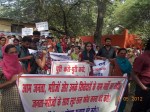
KMSS Hunger Strike in Assam, Akhil Gogoi Arrested

Campaign for Survival and Dignity

After sending the below, we received information that Akhil Gogoi was arrested at around 3 am this morning from the site of the hunger strike and many KMSS supporters were lathi charged. He has been forcibly hospitalised but is resisting forcefeeding. Meanwhile when KMSS members protesting in Guwahati were lathi charged, and more than 20 people have been seriously injured. Road blockades and other protests are now taking place across the state.

Today, in Assam, the indefinite hunger strike of Krishak Mukti Sangram Samiti leader Akhil Gogoi entered its fifth day. This marks a key moment in one of the largest mass struggles for people’s rights in the country today. Till date there is no reaction whatsoever from the government to the KMSS’ democratic demand for a halt to the construction of dams in the State and to atrocities on those protesting against them. Most of these dams are coming up in total violation of law, without compliance with the procedures for forest clearance, environmental clearance and without respecting people’s rights over forest land. The dams threaten the livelihoods of lakhs of people and pose a serious risk of future natural disasters that could claim the lives of tens of thousands more. When people have opposed the construction of these dams, they have faced beatings, tear gas and police firings. The KMSS’ decision to call the indefinite hunger strike was also driven by opposition to these atrocities.

The KMSS’ peaceful struggle for people’s resource rights has mobilised lakhs of people. In the last few years their protests have engulfed the entire State. But for our state machinery these things matter little. Indeed, in Maharashtra, the same system and the same forest officials who (among others) broke the law in Assam have now given themselves the power to kill people with impunity (in the name of “shoot on sight orders” against “poachers”). This blatantly unconstitutional order will lead to killings of local adivasis and forest dwellers, who will never even be given the basic right to a trial. Whether it is in the name of sham “development” or in the name of dictatorial “conservation”, the same bureaucracy and ruling class seizes power and resources, trampling roughshod over the rights of the people. The struggle is on for real democracy in this country.

Contact: forestcampaign@gmail.com, www.forestrightsact.com

CDRO Fact-finding: Saranda, Poraiyahat (Jharkhand)

Interim report/Press release
23rd May 2012

Jharkhand is fast becoming a military state. Similar to operation green hunt which was started three years ago in mineral rich forest areas resided by adivasis, brutal operations are being carried out continuously in Jharkhand as well. ‘Operation Anaconda’ was launched as a special operation in August 2011 in Saranda forest area of West Singhbhum district of Jharkhand. Reasons for speeding up of such military operations by the state can be viewed in a twofold context. One the one hand mining activity in Saranda has been on the rise. Saranda is Asia’s largest mineral reserve and holds immense economic importance. On the other hand, contrary to the government claim that the area has been cleared of Maoist activity, infact it is far from being crushed.

In order to gather first hand details of the manner in which the state has reacted to the changing conditions on ground, an all-India team from the Coordination for Democratic Rights Organisations(CDRO) was set up constituting members from human rights organisations of Andhra Pradesh, Delhi, Punjab, Jharkhand, Maharashtra, Uttar Pradesh, Uttarakhand. The team conducted an investigation in Saranda and the adjoining areas between 20th and 22rd May 2012.

What follows is a brief summary of the observations made by the team. In Puraiyahaat, in January 2011, hundreds security forces entered Kamaay village. They beat up people and arrested four of them called Marshall Bhuiyaan, Nelson Bhuiyaan, Premanad Bhuiyaan and Pinky Bhuiyaan. The first two are still imprisoned while the other two have to appear regularly at the Thana. They are all falsely implicated in helping the Maoists. The CRPF also destroyed property, and mixed food grains in this village.

On the 20th of May itself, a security operation was conducted in Pandua village. Around 500 jawans entered the village at around 5.30 in the morning. Hallan Huttar was taken away blindfolded and handcuffed by the forces. Villagers now fear his death. Abraham Munda’s property was destroyed, and 3500 rupees were taken away. 15 year old Mithun Bhuiyaan was beaten black and blue. Munda’s wife and her year and half old son were also beaten up by a high rank police official. One villager was looted of Rs. 10,000 which she had kept aside for buying ox for her fields. Also, a para-doctor here is frequently oppressed with the accusation of treating Maoists. According to the villagers this destruction continued in the village for almost three hours during which the forces also consumed liquor and marijuana. Few villagers were even forced to flee from their village on that day. In the same village, on the 10th of this month when the forces attacked the village, they also misbehaved with the women here. It was shocking to know that there were no women in the force while women were tortured brutally.

The team also visited 4 villages of Manoharpur block: Tirilposi, Raatamaati, Deegha, Tholkobaad. In all of these villages, forces converted whole villages into their base camp for an entire month. Villagers had to hide in the jungles and many ran away to their relatives in nearby villages to escape oppression. Of those who were left in the village, men were held captive separating them from the women. They were tortured and even had to relieve themselves wherever they were locked up. Old people who couldn’t run away were beaten up so badly that some of them even died. Houses were burnt and people jailed. Most of them are still in Chaybaasa jail, and according to their families they are not even sure of the offense of which they are accused. In Tirilposi alone 17 people have been imprisoned. Economically dented, these villagers are totally unable to follow legal proceedings to get relief. In one of the copies of charge sheets observed by the team, a villager was implicated in UAPA, CLA, and in addition also blamed of sedition and waging war against the state.

Additionally, it was observed that under the IAP, contractors from outside were given work which is against the rules of IAP.

Right after operation Anaconda was completed, the government started a development project in the name of Saranda Action Plan(SAP) under which villagers have been given solar panels, clothes, utensils, and sewing machines as short term trust building measures. The government also plans to introduce long term measures like livelihood options, building of check dams, and training for employment among others. Simultaneously, in and around these villages security forces are also in the process of constructing permanent camps. Saranda will be home to 20-25 camps soon.

Certain questions come to the fore. How has the state suddenly woken up to the development needs of the tribals here after so long? Is it only a coincidence that Operation Anaconda, the SAP, and private mining project leases are falling in line together here in Saranda? Why has the government cracked down so hard all of a sudden on the people of Saranda?

A trajectory can be spotted in the actions of the government in Saranda. It is clear that the government has failed to estimate the real needs of the people. And with the maoist activity refusing to fade away, the government with the fear of losing ground has reacted frantically by launching brutal operations on the people. By terrorizing the tribals, the state is simply trying alternatives to sustain a larger foothold over them.

It is therefore that we demand, the following:

1. All CRPF, military and para-military camps be removed from the state
2. In the context of mining and SAP implementation, PESA and the 5th Schedule be implemented according to which decision making rests on the tribal communities.
3. All private mining activity be stopped immediately.
4. Justice for those who have been beaten up and exploited, and release of all those people who have been imprisoned and implicated in false cases. The perpetrators, the CRPF instead must be booked for the oppression meted out by them.
5. After this attack on their identity and existence, the autonomy of tribals should be left unaffected.

Members:
Shashi Bhushan Pathak, Aloka Kujur, Mithilesh Kumar, Santosh (PUCL Jharkhand); Puneet, Social Activist, Naushad, Journalist (Jharkhand)
Gautum Navalakha, Shruti Jain, Megha Bahl(PUDR, Delhi)
Chandrashekhar, Narayan Rao, Rajavindam, APCLC, Andhra Pradesh)
Pritpal Singh, Narbhinder (AFDR, Punjab)
Rajeev Yadav, Shahnawaz Alam (PUCL, Uttar Pradesh)
Chandrika, Prashant Rahi (Independent journalists)

Faridabad Update: Striking nurses block roads as negotiations fail

AS NEGOTIATIONS FAIL, STRIKING NURSES TAKE OUT MASSIVE PROTEST RALLY IN FARIDABAD & BLOCK B.K. CHOWK
HOSPITAL MANAGEMENT INSTALLS PHONE JAMMERS INSIDE THE HOSTEL TO INTIMIDATE STRIKING NURSES
PATIENTS HEALTH IN PERIL AS UNTRAINED NURING STAFF & NURSING STUDENTS ARE BROUGHT IN AS REPLACEMENTS

The nurses of Asian Institute of Medical Sciences (AIMS), Faridabad and QRG Central Hospital continue to sit on strike for the NINTH consecutive day. Since the management of AIMS hospital is determined not to increase the pay of the nurses, and not to reduce their work load by removing compulsory double duty, negotiations held with the AIMS management on 14.05.2012 failed. While the next round of negotiations is still pending in the case of QRG Central hospital, the chances of the QRG management conceding some of the main demands of the nurses’ is doubtful.

In order to build larger public pressure on the hospitals’ management as well as the district administration of Faridabad, the striking nurses of both hospitals took out a big rally from BT Chowk. There they blocked the roads surrounding the Chowk for nearly two hours till they were given the assurance that the District Commissioner will meet them in person on the 16th. The nurses’ rally was supported by trade unions in Faridabad, women’s organizations, welfare associations, several civil rights groups, and democratic and progressive individuals. Meanwhile, the two hospitals concerned kept up the façade of “normal” functioning by replacing the striking nurses with untrained nursing staff and nursing students—a measure which is putting patients at serious risk.

The striking nurses have continuously complained about the uncooperative approach of the district and labour administration. They argue that the district administration and labour office was intervening in a manner which reflects their connivance with the hospitals’ management. In the case of QRG Central, the civil court ordered that the peaceful demonstration of the striking nurses be shifted to a distance of 200 meters to an inconspicuous and distant location. Interestingly, the law allows for only 100 meters distance. In the case of both hospitals, the local officials are preventing the nurses from putting up a tent structure to protect themselves from the heat.

As expected, with each day the harassment by the hospitals’ management escalates. On the night of 14.05.2012 when AIMS nurses returned to their hostel after their ninth day of strike, they found jammers installed inside their hostel. Because of the device the nurses could not make or receive calls for several hours. Suspecting foul play they called the police and pushed for an inspection of a vacant, locked room where the felt the jammer was installed. Initially, the police was reluctant to remove the device due to pressure from the management, but then finally because all the nurses pressed for action, the jammer was finally removed at 10pm,” said an agitated nurse of AIMS hospital. Today (15.05.2012), the security staff of the hospital removed the water cooler installed in the hostel, hence, depriving the nurses of drinking water. Security personnel/bouncers hired by the hospitals are continuously entering the women’s hostels, and coercing individual nurses to join back. “A nurse who was recuperating from an attack of serious illness was continuously mentally pressurized by the hospital’s nursing supervisor who kept calling her on the phone—something which worsened her condition,” said another agitated nurse.

Considering the hostile atmosphere, the nurses of both AIMS and QRG Central hospitals have decided to form a Joint Action Committee (JAC) so as to unite nurses of all the different hospitals in Faridabad. Considering that conditions continue to be grave, the nurses resorted to a larger public campaign. During their rally they distributed pamphlets explaining to the general public how their strike was in favour of better patient care.

Thankamma Ravindran
Delhi Nurses Welfare Association

Alok Kumar
Workers Unity Centre

Maya John
Centre For Struggling Women
Ph: 9350272637

Faridabad Update: Impact of nurses’ strike spreads despite intimidation and threats

DESPITE SEVERE HARASSMENT AND BEING MANHANDLED BY BOUNCERS, NURSES CONTINUE TO SIT ON STRIKE
WATER & ELECTRICITY SUPPLY CUT OFF IN THE NURSES’ HOSTEL ACCOMMODATION
IMPACT OF STRIKE SPREADS TO OTHER HOSPITALS

The nurses of Asian Institute of Medical Sciences (AIMS), Faridabad and QRG Central Hospital continue to sit on strike for the eighth consecutive day. With each day the harassment by the hospitals’ management escalates. Nevertheless, the nurses continue to sit on strike. Today, bouncers hired by the AIMS management manhandled nurses who were passing by the hospital on the way to their hostel accommodation. When activists from the women’s organization, Centre for Struggling Women (CSW) and Workers’ Unity Centre of India (WUCI) intervened, the bouncers tried to manhandle them too and used filthy, abusive language in order to intimidate the nurses. The local police initially intervened in favour of the bouncers but when accosted with the fact that the road outside the hospital is public property and cannot be regulated by the bouncers, the police accepted the bouncers were harassing the nurses.

Similar tactics of intimidation are being used in the hostels where the nurses reside. Water and electricity supply in the hostels are often cut off, and the nurses are threatened every day to vacate their rooms. Despite the fact that the management of both AIMS and QRG Central have called for negotiation today, intimidation and threats continue in order to force the striking nurses to settle fast. These acts are, hence, in complete violation of the spirit of amicable negotiation and the spirit of collective bargaining.

Unfortunately, even the district administration and labour office is intervening in a manner which reflects their connivance with the hospitals’ management. In the case of QRG Central, the civil court ordered that the peaceful demonstration of the striking nurses be shifted to a distance of 200 meters to an inconspicuous and distant location. Interestingly, the law allows for only 100 meters distance. And in the case of both hospitals, the local officials are preventing the nurses from putting up a tent structure to protect themselves from the heat.

Considering the hostile atmosphere, the nurses of both AIMS and QRG Central hospitals have decided to form a Joint Action Committee (JAC) so as to unite nurses of all the different hospitals in Faridabad. Considering that conditions continue to be grave, the nurses are also considering holding a JOINT PROTEST outside the office of the Deputy Labour Commissioner in Faridabad, and the Union Health Minister. “If the negotiations will not go in favour of the striking nurses then the nurses are thinking of taking out a big rally in Faridabad, and uniting nurses across the board. After all, negotiation doesn’t mean settle for less,” said CSW activist, Maya John. Interestingly, the nurses’ strikes in Faridabad are already impacting the functioning of other private hospitals in the NCR. For example, nurses of Sharda Hospital in Greater Noida have also gone on strike with respect to demands for pay hike, regulated work hours, etc.

Thankamma Ravindran
Delhi Nurses Welfare Association

Alok Kumar
Workers Unity Centre

Maya John
Centre For Struggling Women
Ph: 9350272637

Repeal ‘AFSPA, 1958’ for a Humane, Internationalist Future

Gilbert Sebastian

“Sharmila Irom … has not eaten for almost 10 [now, 12] years.
She is too angry to eat ….
She is hungry for justice, not for food.”

– Andrew Buncombe (The Independent, 5 May 2010)

Armed Forces (Special Powers) Act, 1958 (henceforth, AFSPA) in India provides total legal immunity to officers of the armed forces (down to the level of a havildar) in the “disturbed areas” to shoot and kill anyone without attracting punishment, to arrest using violence and without warrant and allows unhindered entry into any premise. There cannot even be a First Information Report (FIR) filed in case of such killings except through prior sanction of the Union government; only a simple complaint can be filed. AFSPA, is by far, the most draconian Act in the country because the Act contravenes the spirit (although it adheres to the letter) of the Fundamental Right to Life as guaranteed under Article 21 of the Indian Constitution which says, ‘No person shall be deprived of his life or personal liberty except according to procedure established by law.’ Notably, AFSPA is operational in the frontier regions where militant nationality movements go on against the Indian State, i.e., in Kashmir and parts of the north-east of India. The footages from real life on the reels of the documentary film, ‘AFSPA, 1958’ in the context of Manipur shocks the consciousness of any democratically-minded person. As Asit Das (2011) says, the Act is clearly used as an instrument of war and is, by no means, used for enhancing conviction rate. The operation of this single Act has led to thousands of murders, enforced disappearances (as in the case of the unmarked graves in Kashmir), tortures, rapes, etc.

AFSPA is an example of a ‘permanent’ law that was justified at the time of its enactment as merely shifting, under logistical compulsions, powers of ordinary policing to the army (Ujjwal Singh 2011). It may be borne in mind that police forces dealing with civilians are usually instructed to use the least amount of force whereas the military is trained to inflict the maximum lethal force. The term, ‘extraordinary law’ loses the meaning it denotes for a law that has been permanently operational in the country since 1958 except as a law which gives extraordinary powers to the armed forces. Initially enacted for use in the seven sister states of the north-east of India, the scope of the Act was extended to Jammu & Kashmir since 1990.

The empowering Supreme Court judgment in Naga Peoples’ Movement for Human Rights vs. Union of India, 1998 defined a “disturbed area” wherein the Act would be applicable. However, the basic structure of the draconian Act remains unaltered as yet. The judgment held that AFSPA, 1958, Section 3, does not confer any arbitrary or misguided power for declaring an area as a “disturbed area” for which there must exist a grave or dangerous situation of law and order on the basis of which the Governor of the State or Administrator of the Union Territory can form an opinion as such.

It has also been pointed out that AFSPA constitutes a clear violation of international law and of the United Nations International Covenant on Civil and Political Rights, 1966, ratified by India in 1979.

De-facto partial citizenship

The notion of universalism was somewhat absent under the caste-based feudal moral/legal order in India. The legal system was heavily at odds against the underprivileged castes and women. Even the formal – not substantive – notion of universalism in India was typically a contribution of the colonial rule. The Panchamas, the outcastes/untouchables (self-named as Dalits today) hardly enjoyed any of the benefits of citizenship. As part of the Hindu identity formation under the influence of colonial modernity, there has been a half-hearted attempt at their incorporation into the Hindu fold. The exclusionary process continues even today in a different manner whereby certain social sections are not permitted to enjoy full-fledged citizenship in the country. Today, AFSPA is used against the nationalities of Kashmir and parts of the north-east of India like Manipur, Nagaland and Assam. Especially with the rise of fascistic communalism, recurrent communal violence has taken place against Muslims and they find themselves overrepresented only in the Indian jails. Similarly, tribals have faced systematic eviction from their traditional habitats with the expansion of capitalist accumulation since colonial times. It may be argued that these social sections and others like migrant workers, fisher people, etc. enjoy only ‘partial citizenship de facto’ in our polity.

Distinction between Mainland and the Frontier

In order to understand the continued prevalence of AFSPA, 1958 in some parts of the country today, we need to draw a geo-political distinction between mainland and frontier. The frontier consists of whole geo-political regions, whose citizens are de-facto recognised as only incomplete citizens. There are ethnic/religious differences that mark them out from the mainland. What we refer to, in particular, are the national formations in Kashmir and large parts of the north-east of India. Both mainland and frontier are politically constructed geographical categories. The people of the mainland are considered as complete citizens of India in geo-political terms although there are gross aberrations which are not primarily of a geographical character in the case of social categories such as religious minorities, Dalits, Adivasis, migrant workers, etc. We also need to bear in mind that there is a possibility of interchange between parts of the mainland and parts of the frontier and so these are dynamic categories although stability rather than change is the primary characteristic of these geo-political categories.(1) To use the expression of Amartya Sen and Jean Dreze (2002), India is a “bastion of disparity”. The disparity between mainland and the frontier is a crucial one among these disparities.

It is true that the construction of a dominant Hindi nationality has been an ongoing hegemonic project of the Indian State in north India where Indo-Aryan dialects like Bhojpuri, Maithili, Braj bhasha, Haryanvi, Rajasthani, etc. are spoken. However, the acute class division and the extremely low levels of human development, by far, the lowest in the country, in several of these states (particularly, BIMARU states – Bihar, Madhya Pradesh, Rajasthan, Uttar Pradesh) remain significant barriers to this project.

An instructive example of the mainland-frontier distinction can be had in the case of the discussions in the media during 2009-10 whether the army and the air force should be deployed in the fight against the Maoists. Both the Chief of Army Staff, Mr. V. K. Singh and the Chief of Air Staff, Mr. P. V. Naik were against the idea of such a deployment on grounds that ‘they are our own citizens’. This draws a sharp contrast with the case of nationality movements in the frontier regions against whom army has been used and continues to be used. Moreover, AFSPA, the most draconian Act in the country and also the most hated Act in the frontiers, has been operational in these regions.

Over the decades after the transfer of power in 1947, untold atrocities have been committed by the armed forces of the Indian Union and State-sponsored militias on the peoples of the struggling nationalities on the frontiers of India. But opposition to such atrocities from the mainland India have been few and far between.(2) This is a far cry from Lenin’s advice to Communists and democrats from the dominant nationality (in this case, those from the mainland) that they should be categorical in their opposition to national oppression towards the subject nationalities. Even in India today, in fact, it is easy to distinguish democratic intellectuals from the others on the basis of their standpoint on the question of national oppression.

‘A Generalised State of Exception’

There is a substantial portion of the geographical/demographic terrain of India wherein there is, to use the concept used by Italian legal theorist, Georgio Agamben, ‘a generalised state of exception’ to the liberal democracy prevailing in the rest of the country. In government terminology, these are either the ‘backward regions’ (such as the central forest region) which are ‘Maoist-infested’, well within the mainland India or ‘frontier states’ meaning, states bordering the neighbouring countries where there are, often, insurgencies demanding self-determination. As the Maoist literature does, movements designate these as ‘struggle areas’ – arena of class struggles or nationality movements. The liberal democratic discourse of the ‘rule of law’ (nomos) is largely non-functional in these vast regions. The Fundamental Rights as guaranteed in the Constitution of India face blatant violation in these regions, where even the most basic one, the right to life, is violated with impunity on a large scale on a day to day basis. This “undemocratic exception” (Pothik Ghosh 2010) is not merely an exception or aberration but a generalised phenomenon. Crucially, anyone concerned about the future of democracy, human rights and the question of social transformation in this country, cannot overlook this phenomenon.

‘Rule of law’, Impunity and a Selectively Repressive State

Speaking of the system at large, unlike in most of the liberal democracies of the west, there is a vast terrain of exception to the rule of law in India. As Hannah Arendt (1951) says, the sought after goal here is ‘order’, rather than ‘law’. A patent example is the case of hundreds of extra-judicial killings of detenues that happen in the police lock-ups in India every year. In the heavily militarized regions of the country i.e., in regions where there are nationality movements or Maoist insurgency, ‘fake encounters’ by the Indian security forces are a rather common phenomenon. Counter-insurgency operations by the State, such as the Salwa Judum, have been carried out in blatant violation of all Constitutional and legal norms.

Despite the legal universalism formally prevailing, the rich and the powerful continue to enjoy impunity. The instances have been far too many: The high profile perpetrators of Gujarat carnage of 2002; the leader who opened up the pandora’s box of communal polarization in contemporary India and has been instrumental in the post-rath yatra riots in 1990; the leaders accused in the demolition of the Babri Masjid; the architects of the Salwa Judum in Chhattisgarh; those responsible for clandestine killing and cremating hundreds of young persons at Tarn Taran in the Punjab during the early 1990s; those responsible for the violent suppression Adivasi landless at Muthanga in Wayanad district in Kerala state, and of those who resisted corporate land grabs at Kalinga Nagar, Nandigram, Singur, etc.; those responsible for the trafficking of vulnerable sections of people which is a rising trend today; those employing children in hazardous occupations; etc.

It also needs mention that the Indian State has been selectively repressive against its adversaries who violate its canons. While being heavily repressive against Islamist extremists, nationality movements, and the Maoist movement, the Indian State has been quite lenient towards the criminal activities of the Shiv Sena and the Sangh Parivar.

Frontier Peoples in an Intersectional Analysis of the Indian State

Given the experience of AFSPA, how do we understand the Indian State under neo-liberal globalisation? Liberals of diverse shades have argued that with globalisation, the State had ‘retreated’ and the world had become ‘borderless’. However, it is apparent that the role of the State has heightened in India under neo-liberal globalisation in terms of its functions as an agency that is regulatory, repressive and a facilitator of unhindered accumulation (T.J. Byres 1997).

Marxists usually speak about the Class character of the State but it should be borne in mind that Class formations are not merely about class in the narrow sense of the term. There is need to reveal the broader Social character of the State in India. In the Indian context, Class needs to be viewed substantively in relation mainly to space, caste and gender. In this respect, intersectional analysis could be a very valuable analytical tool. Intersectional analysis as expounded by Nancy Fraser, et al has its origins in gender studies in the West since late 1960s that sought to understand experiences beyond gender alone. This approach has to do with how forms of oppression interrelate or intersect in multiple ways to create a system of oppression manifesting itself as exploitation, discrimination, violence, marginalisation, etc. It links various kinds of oppression which have to do with interrelated/overlapping/intersecting social categories. Speaking of the class/social character of the State, from the angle of intersectional analysis, could we not as well speak of the Indian State not only as pro-corporates and pro-landlords but also as [pro-mainlanders], pro-men, pro-upper castes, pro-non-tribals, pro-Hindus, etc.? (3) The deployment of military and the operation of AFSPA reveals the bias of the Indian State against frontier peoples.

Erosion of State Legitimacy and Repressive Legislations

How do we understand an apparently contradictory character of the legislative process in India whereby there is a co-existence of empowering and disempowering legislations? There have been a number of apparently pro-people legislations during the very period of neo-liberal reforms: National Rural Employment Guarantee Act (NREGA), 2005; Forest Rights Act, 2006; the Panchayats (Extension to Scheduled Areas) Act (PESA), 1996; the Right to Information Act 2005; the Prevention of Domestic Violence Act, 2005; Unorganised Sector Workers’ Social Security Act, 2005; The Constitution (108th Amendment) Bill, 2008 which seeks to grant 33 per cent reservation to women in parliament and elected assemblies; etc. These may be viewed as having been necessitated by the need for the neo-liberal State to generate popular consent or secure legitimacy, particularly from deprived classes and social identities and thereby maintain the hegemony of the ruling classes. Maintaining ‘hegemony’ in the Gramscian sense involves sustaining the moral and intellectual leadership of the dominant classes through generating consent rather than through coercion or force. As Bob Jessop (1982) says, it involves taking systematic account of popular interests and demands, making compromises on secondary issues, without sacrificing the fundamental long-run interests of the dominant group.

On the other hand, ‘the limited nature of consent’ leads to a weak basis for a political order, which comes to rely increasingly on force (A. S. Sassoon 1991). The gearing up of the repressive apparatus of the State under neo-liberalism through draconian legislations like Chhattisgarh Public Security Act, 2005 and Unlawful Activities (Prevention) Act, 2008 is worth mentioning in this context. Notably, however, AFSPA has continued to be the most draconian legislation among all these and has been prevailing in the country from the first decade of the existence of the Republic as a testimony of the distinction between the mainland and the frontiers. These draconian Acts have been operational especially in areas of militant struggles against the Indian State. The increasing ascendancy of the Hindutva fascist movement in India also should be seen in conjunction with the deepening crisis of legitimacy of the Indian State under neo-liberalism.

An insightful statement from the film, The Spiderman says, ‘The cunning warrior attacks neither the body, nor the mind but the heart.’ But how about the peoples living under the terror of AFSPA? If they are citizens, why are they treated this way? Apparently, the cynical and hawkish strategic analysts in the corridors of power in the Indian State have no long-term perspective for the integration of the frontier regions.

Self-determination and People’s Rights

A clarification on the notion of ‘People’s Rights’ by Manoranjan Mohanty (2011) can be useful in this context. The conventional discourse of ‘human rights’ has laid exclusive emphasis on civil liberties of individuals in particular, mostly as recognized by the State. The notion of ‘people’s rights’, on the other hand, entails a comprehensive notion of rights. It includes both civil liberties on the one hand and political, social, economic and cultural rights on the other. Rights are understood as “political affirmations in course of struggle”, irrespective of whether or not they have gained recognition from the State. Moreover, besides individual rights, people’s rights include the rights of collectivities and regions. [Regions, here, refers to the question of spatial equity and could include the notion of centre and periphery on the worldscale and also the nationalities question. One might recall Mao’s slogan, ‘Countries want independence, nations want liberation, people want revolution.’ It refers to independence from imperialism, liberation from national oppression and revolution by the broad masses of people and not certain deprived classes.]

On the contrary, the State in India, apparently, has no long-term policy vis-à-vis the frontier: It is basically a policy of ‘catch ‘em and hold ‘em’ as long as possible, for geo-political gains, for markets and resources. If, however, we want a lasting integration of the nationalities in India, South Asia and the world at large, it cannot be a vertical integration but a horizontal integration. An enduring unity cannot be a forced unity at the point of the gun but a voluntary union of states. As a Malayalam saying goes: ‘If you have a nose that would fly away when you sneeze, you should rather let it go!’

The right to self-determination of nationalities, including secession, was upheld by Marxist-Leninists since 1914 and ‘a person’s right to nationality’ by most liberals soon after the Second World War. Article 15 of the Universal Declaration of Human Rights of the United Nations in 1948 had upheld the individual’s ‘right to a nationality’ and the ‘right to change his nationality’. In India, the mainstream Marxists have given up on the right of nations to self-determination. Most liberals all across the world have given up on it, except in cases where they were granted under genocidal situations in little nationalities as in East Timor and South Sudan. Moreover, it is the experience of the 20th century that most nationalities that waged successful anti-colonial struggles succumbed to the indirect exploitation by neo-colonialism and thus the substantive content of self-determination was hollowed out. In spite of all these, rightly do the democrats uphold the right to self-determination, through means of a referendum, as the most democratic right on the question of the nationalities.

By distinction, ‘Repeal AFSPA’ is no revolutionary demand, no secessionist demand but a demand for basic human rights, a legitimate democratic demand against the undue privileges enjoyed by the Indian armed forces in the frontier regions, a demand for a democratic integration of the country, if it all, it could be made possible. But no doubt, it is a little step, but a significant one, for a long-lasting, durable unity, for the internationalist future of humanity. We salute the iron will of Ms. Irom Sharmila, the Manipuri poet in the 12th year of her hunger strike against AFSPA, the most draconian Act in the country and bow our heads in our respect for the struggling peoples in the frontiers of India.

Gilbert Sebastian (gilbertseb@gmail.com) is a post-doctoral researcher based at Centre for Development Studies, Thiruvananthapuram.

Notes:

(1) Remember that Tamil Nadu and Punjab, which were parts of the mainland had secessionist movements whereas Mizoram, which used to be part of the frontier, has been somewhat incorporated into the mainland.
(2) One important reason for this is the retraction of the mainstream left parties, CPI and CPI-M from the Leninist principle of self-determination of nationalities.
(3) Manoranjan Mohanty (personal communication). I have added what is in square brackets.

‘Arab Spring is part of the General Strike of the South’: An Interview with Vijay Prashad

Vijay Prashad‘s new book, Arab Spring, Libyan Winter (AK Press, 2012) captures the complexity of the Arab revolts – by bringing out the history and historical forces behind them. The book exposes the West’s imperial anxieties and their fear of the organic – the mass character of these uprisings. It demonstrates the resoluteness of the “rebels from below”, that they will not allow the Arab lands to “be the same again”, that they are dissatisfied with the Present and they want something more than the “21st century delusions” that neoliberalism delivers. Most importantly, Prashad’s book reconfirms that “the rebellion from below has its own radical imagination.” The following discussion with the author is an attempt to read the book with him to understand the implications of his analysis of the Arab revolts.

Pratyush Chandra (PC): Even the title of the book suggests you are not comfortable with the euphoric homogenisation of the recent upsurges in the Arab Arab Springworld. In fact, it seems you consider this discursive seasoning/colouring of Arab struggles to be highly ideological, not allowing us to comprehend the struggles in terms of their “deeper roots and grievances”. Do you think this impression about your book is valid? However, as the spatio-temporal interconnections are quite evident and cannot be denied, how do you assess the contextual commonality of these upsurges, and what are the limits of using this commonality as the only key to understand them?

Vijay Prashad (VP): The Arab Spring, or Arab Revolt, or whatever History shall call it, is party to a long-wave of struggle which we can call the General Strike of the Global South. It begins around the late 1980s, perhaps with the Caracazo, the uprising in Caracas, Venezuela, in 1989. Immense pressure on the lifeworld of the ordinary people in the South intensified with the debt crisis of the 1980s. The mandarins of the Global North used the debt crisis as a lever to extract massive concessions from the states of the South, mostly under the name of Structural Adjustment Programs. These included a roll-back in State intervention for social welfare, a selling off at bargain prices of the essential sectors of the economy and the welcoming of private, mostly foreign, capital into all aspects of social life that had not before been governed by the laws of capitalism (such as water delivery, electricity delivery and food delivery, notably bread delivery). This assault on the life of the ordinary people sharply increased deprivation in the South. But the totality of the society was not damaged by deprivation. Small but considerable sections were able to make quite a lot of money as sub-contractors in this phase of neo-liberalism –- they were able to collect a greater share of the rent or were able to operate as the local face of transnational firms. In many of the countries of the South, these sub-contractors were the relatives of the political class (such as Gamal Mubarak, son of Egyptian president Hosni Mubarak) or else they were special elites who had very close ties to the political class (for kin reasons or through extensive bribery or patron-client relations, the latter a familiar story in India). This links the risings in Tunisia and Egypt not just to an Arab context, or an African context, but to one of Global South.

About the discomfort with the homogeneity, this is of course true. The “Spring” does not come evenly. In some places, there was a deep freeze, such as in the Arabian Peninsula. No such opening was to be considered. Neither Yemen nor Bahrain, nor indeed Saudi Arabia, could be permitted to have a democratic opening. In Yemen, it was a “managed transition”, so that Salehism could continue under the tutelage of Hadi, who was the sole candidate in an election (Saleh’s family and regime remain in power, with open door to the US to operate its drones to kill at will in Yemen). In Bahrain, all eyes remained averted as the Saudis and then the Bahrainis smashed the demonstrations. There was no Spring here.

There was no Spring as well in Libya, which had a genuine uprising against a deeply unpopular leader (an unpopularity that Qaddafi earned; his coup in 1969 was very popular, with his policies from the mid-1980s sharply alienating him from his people). How did NATO become a force in the Arab world? This is one of themes in the second half of my book. How did NATO become Arab?

PC: Many left commentators have asserted the democratic revolutionary character of the Arab spring. However, classically a democratic revolution has come to mean (at least in the 20th century) radical social transformations at various levels. It was never merely related to the formation of representational democratic institutions or the recognition of a few formal rights, unless they become vehicles for larger changes in the political economy. What is your assessment of the development in the Arab world in this regard? Do you find the analogies of 1848, 1905, 1968 and 1989 of any use in describing the events today?

VP: The task of a revolutionary regime is not clear-cut. The Arab states of Tunisia, Egypt, Libya, Syria, and others, had and have been governed by a form of state-craft that combines neo-liberal policies and national security regimes. The jail and the private sector are hand-in-glove to dispossess and encage the ordinary people. To cut back on such a complex apparatus that reproduces deprivation and indignity is not easy. We cannot underestimate the power of dignity in these revolts. It was dignity as much as bread that pushed people to take such enormous risks (even in Egypt between a thousand and two thousand people gave their lives for the revolution). The first phase of this uprising was to set aside the culture of fear created by the national security regimes. That has been done. The task that has now come before the people is to reject the authoritarian structures and create new constitutional processes that allow their voices to be central to the formation of national policy. In this phase, the question of economic and social policy will assert itself. The workers of Mahallah, the Independent Union of General Tax Authority Workers: they played central roles in the Tahrir dynamic. Indeed, in May 2012 the Tax workers (the largest union of state government employees) were on strike for better wages, better working conditions and so on. Their demands have not evaporated before the important question of elections and more representative parliamentary institutions. Much the same in Libya, where the workers and unemployed youth have occupied the front gate of the Arabian Gulf Oil Company. They have refused to budge.

The revolts you mention – 1848 to 1989 – are explosive in their impact, but their great impact also took time to germinate. I end my book with a brief assessment of these…how 1968 might not look like it amounted to much, but on the other hand it delegitimised sexism and racism, and a kind of aristocratic idea of culture. No straight lines for revolts; everything is tangled.

PC: As is clear from your analyses the heterogeneity of class and political interests mark the Arab resistances. Taking into account this heterogeneity, the political forces that will emerge victorious will finally depend on the class(es) that hegemonise the movement. Apparently, the political alternatives that are emerging from various resistances right now do not seem to be revolutionary. In fact, most of them are residues of the old regimes. So in what sense, can we take these resistances to be a ‘stage’ in the revolutionary process? Where do we place the working class in the overall resistance?

VP: In each of the North African cases (Tunisia, Egypt, Libya), the working class will play an important role in the near future. If the military does not suffocate the short-term (a genuine concern for Egypt), it is clear that thanks to funds from the Saudis and the Qataris, and a nod and a wink from the US, the various formations of political Islam will probably have an upper hand for now. In Egypt and Tunisia, they have worked hard to build up their organisational capacity (in some ways they were also tolerated. In the 2005 elections in Egypt, the regime most likely allowed them to win to terrify the West into backing off from calls for democracy and so on.). But the forces of political Islam have no agenda for the social and economic demands of the people. They will govern, and if pushed by a vitalised working-class movement, they will fail. When they fail, if the working-class is not organised and vital, it is likely that there is a threat of restoration. That is why the historical task of the Arab revolt now is for the working class organisations and its allies to be prepared for when the moment comes. That is why the concerted strikes and struggles that have been going on are so important: they build the will of the working class not only for the present, which are often struggles over reforms and survival, but for the next great battle, which is for the working-class to become hegemonic over society in tandem with the failure of political Islam to make its mark. Political Islam is fated to fail. It has so little to offer the people. It played an important role in these struggles, with many of its disciplined cadre willing to die, to stand against the neoliberal security state. But that role is going to diminish as it begins to govern, like Hezbollah in Lebanon, as a populist force committed to neo-liberal policies.

PC: The ideological and cultural formation of the earlier ‘social-democratic’ upsurges – whether Baathist or Nasserite – was very clearly secular Pan-Arabism. Are the current movements in West Asia different on that score? Do they even have a cohesive ideological and cultural formation, if not as a totality, then at least in individual terms? Could you please elaborate upon the cultural and ideological formation of the current upsurges in terms of their social content and the materiality of their history/histories?

VP: Well, the Muslim Brotherhood and other forces of political Islam certainly have a cohesive ideological orientation. There are also the liberal platforms, such as the Egyptian Hizb El-Ghad or Tomorrow Party, which are committed to parliamentary or representative democracy and have a modest program on the economy. They are social democratic and secular in their orientation. In Libya, there is less of a basis for such a platform, which is why it is governed by the neo-liberal Diasporics who are beholden to the West rather than to a mass political constituency on the ground; they win their elections in Washington and Paris, not in Tripoli and Misrata. In Egypt, the constituency for this kind of secular social democracy is the middle class, which is substantial and was smothered by neo-liberalism’s characteristic nepotism. The working-class in Tunisia, Egypt and even in Libya, has a focused class dynamic. It is most highly developed in Egypt and Tunisia, where working-class organisations operated despite the authoritarian state, and these organisations have moved from defensive agendas to making much more substantial demands on the transforming states. It is in this process of demand escalation and general organisation of the working-class (and perhaps the peasantry in Egypt) that a clearer alignment will emerge. By the way, in Egypt, the nostalgia for secular Nasserism is not passe. There is an undercurrent that holds that standard aloft. In Tahrir Square, posters with Nasser’s picture could be seen here and there. But nostalgic Nasserism is not what North Africa needs. New ideological coordinates are needed that build a new set of policies to counter both neo-liberalism and the habits of the security state apparatus. Nasserism was a sufficient bulwark against neo-colonialism; it is not going to be enough to tackle neo-liberalism and authoritarianism.

PC: Who knows better than you that some of the states/regimes that have been under attack recently emerged as part of the larger progressive and democratic “third world project”. In fact, the term democratic revolution was often used to characterise their emergence, because they triggered significant political-economic changes (even if with a statist tenor) centred on the post-colonial national interests –- at least in the form of land reforms, the “democracies of bread”, and the constitution and empowerment of the national bourgeoisie. What is it that has happened in due course that we are once again witnessing another series of democratic revolutions, if we may legitimately call them so?

VP: It is my view that the left-leaning movements of the past century -– the socialists, the communists, the Third World nationalists -– all failed to recognise the fundamental aspiration of the people to have a say in their societies and in their state structures. They wanted bread, sure, but they also wanted dignity. You cannot get dignity by having no voice in your society, and being directed by your state. If you do not build a State apparatus that is able to harness the dignity of the population, whatever good policies you have in mind will come to nothing. Socialism cannot be administered from above nor can it come in a hurry. We learn this from the examples of Tanzania and Afghanistan. Both Nyerere and the Afghan Communists saw that the principal matter is to draw people to their agenda, not to set in place the best policies. The confidence of the people must be earned, and people must be drawn into the decision-making and state-building processes. If they are alienated from the State, the entire project is liable to failure. Nasserism was the Arab franchise of the Third World Project. It suffered from all the problems I lay out in The Darker Nations.

The arrival of Bolivarianism is in many ways a critique of the Third World Project’s demise and the rise of neo-liberal states in its place (in Venezuela, in Chile, in Argentina, in Bolivia). The Arab Spring is in line with that upsurge.

PC: You have shown the importance of Qaddafi’s Revolution of 1969, and how it transformed the Libyan society. However, you also detail the insufficiency and degeneration of the transformation. What were the socio-political forces that the 1969 revolution and subsequent changes unleashed that contributed to the overthrow of Qaddafi, or is it simply that those who were ousted by the 1969 revolution, or those who were left out from power, led the current upsurge that displaced Qaddafi?

VP: Qaddafi’s 1969 revolution was remarkable for the ease with which the Colonel’s coup took place. Not a shot was fired against it. The totality of the population, with the exception of the clique around King Idris, was with Qaddafi. I detail how for the first 15 years, Qaddafi followed a massive social policy of transferring assets to the people, and building up a modern state structure, including a national university system. This was a huge advance. But Qaddafi walked into an obvious contradiction: his regime did not diversify the Libyan economy out of dependence on sale of oil to the West, at the same time he made erratic political gestures against the West. Libya was punished by an oil embargo, which crippled the social welfare part of his regime. That led Qaddafi to a reassessment of his policies. Rather than move toward diversification (for which he now had little investible capital), he shifted to make an accommodation with the West. The Qaddafi of the 1980s onwards was in many ways the opposite of the earlier Qaddafi. I detail this story. It takes up the major portion of the book, showing how the class character of the Libyan regime shifts by the 1990s, for instance.

PC: The Libyan winter changed the season for the Atlantic powers. According to you, for them, “Libya provided a unique opportunity”. How is that? You have stressed on the uniqueness of the Libyan situation, as the Atlantic powers always seemed ready to intervene there. But how do you see the recent developments regarding Syria?

VP: Libya allowed for many things. First, it allowed the West to brush off their tainted relationship with Ben Ali of Tunisia and Mubarak of Egypt, not to speak of Qaddafi (it was Blair, Sarkozy and US Congressmen McCain and Lieberman who courted him in the 2000s). Second, it allowed the Saudis to enter Bahrain and crush that uprising. I show how the linkage between Libya and Bahrain works in my book. Third, it allowed NATO to become a force in North Africa, becoming the “mass base” of the Libyan Diasporic leaders, the neoliberals such as Jibril and el-Keib, to assert their position against those who had a genuine mass base, such as Belhaj (the political Islamists). This was the unique opportunity.

On Syria the story is not complex. On February 18, 2012, I asked the Indian ambassador to the United Nations, Hardeep Singh Puri, why there was no appetite for a strong UN resolution on Syria. After all, the violence in Syria seemed to have already exceeded that in Libya. If the UN could pass Resolution 1973 (on Libya), why was it reticent to pass a similar resolution on Syria? Puri pointed his finger directly at the North Atlantic Treaty Organization states. They had exceeded the mandate of Resolution 1973, moving for regime change using immense violence. All attempts to find a peaceful solution were blocked. The African Union’s high-level panel was prevented from entering Libya as the NATO barrage began. Any UN resolution that was sharply worded and that was not explicitly against a humanitarian intervention would open the door to a NATO-style attack. That seems to be the fear. If there is a sense that NATO exceeded the mandate of 1973, I asked, would the UN now consider an evaluation of how it was used in the Libya war? Puri told me that Russia asked the UN Security Council to evaluate Resolution 1973, which means NATO action in Libya. NATO has blocked this. They are reticent to allow any open evaluation as a result of what they see as an exceeded mandate in Libya, and of course the question of civilian casualties (Human Rights Watch released a report on May 14 on civilian casualties by NATO that underlines this question).

PC: While dealing with the attitudes of various international institutions and alliances towards the Arab revolts, you have analysed the BRICS’s position too. As you have shown in your brilliant book, The Darker Nations, there was a unity of purpose, at least initially, among the regimes that came with significant popular legitimacy that constituted the Third World. However, such unity of purpose seems absent behind the emergence of the BRICS and other international alliances among specific “third world” countries. Rather they are multi-level institutionalisation of opportunistic cooperation among competitive forces. How much do you think consistency, multipolarity and polycentricity that we demand from the BRICS are justified? Do you find in this demand an element of nostalgia for the Third World project, for statist anti-imperialism and non-alignment?

VP: The full answer to your question will be found in a book that I am now finishing up, The Poorer Nations: A Possible History of the Global South (Verso and LeftWord). It tells the story of the emergence of the G7, the fight to establish a renewed South after the debt crisis, the emergence of the BRICS, and of a potential South from below. That book has an argument that is hinted at here and there in the Libya book, although the latter is not theoretical and so the argument is only as I say hinted at. The BRICS have afforded an opening, they have moved us out of the suffocation of the Washington Consensus and on unipolarity. They have not created ideological or institutional alternatives to the previous dispensation. That is why they seem to simply ask for entry for themselves rather than an exit from this system. Their ambitions are not great, largely because their ruling elites are wrapped up in neo-liberal ideology and they seek space for themselves alone. In this challenge, they have, as I say, dented the privileges of the North Atlantic. I see their move as simply this, nothing more.

PC: You have succinctly shown throughout the book how neo-liberal forces are attempting internal coups in the ‘democracy movements’. When US diplomat David Mack complains about the Libyans not understanding the meaning of democracy –- that it is not about “housing, food, work and health”, but about elections and the rule of law, it seems the imperialist forces are trying hard to clinch the separation of the economic and the political which neo-liberal globalisation arguably seeks to achieve, thus reducing the political’s capacity to obstruct international capitalist interests. A section of the international left too stresses that the revolts are a step forward from the undemocratic past even if they are able to institutionalise only a few ‘democratic political’ rights. Don’t you think any such gradualism or limitation will be an eventual complete regression to neo-liberal counter-revolution, a betrayal of what you term the radical imaginations of the rebellion from below?

VP: You raise the core point. Will the emergent regimes build a Chinese wall between the Economic and the Political? Will they allow the great sacrifices to provide modest electoral reforms, and not touch the base? It is of course the case that there will be elements within the new political actors that will want only this small advance. Others are not going to be satisfied with it. They tasted the feeling of revolution, and already want more. That is how we must account for the ongoing strikes in Egypt, Tunisia and Libya. These strikes are a portent of the greater social dreams than simply the right to vote. When Tripoli airport was seized in May 2012, those who took it wanted their social and economic wants at the centre of the regime’s concern, not simply the June elections. The latter are important, but not singular. Elections yes, but these do not define the desire for a voice.

It is also true that the old guard will want to minimise both the democratic political and democratic economic openings. They will be backed by the US on the latter, because the US and the NATO states would like to reduce the victory to the political domain, and even there to manage the political so that the more radical Islamists are kept out of office. Moderate Islam will be allowed (we are back to Mahmood Mamdani’s “good Muslim, bad Muslim” formulation). If the rate of strikes intensifies, it is unlikely that the old guard and NATO states will get their way. As with South America, revolution moves from questions of inflation and livelihood to questions of democracy and back again to questions of food and fuel, jobs and cultural expression. Democracy cannot be sequestered to elections alone. It is a much wider concept.

PC: It is clear that the left in the West is quite impressed by the Arab Spring. What do you think is its overall political impact in a movemental sense?

VP: The Arab Spring provided a fillip out of hopelessness in the United States. There is no doubt that the Arab Spring inspired the Occupy movement. The idea of a manifestation, of taking up space in public, came to the streets of New York explicitly from Cairo. But these are all mutually reinforcing events. On a conjunctural level, these are all reactions to the contractions as a result of the Global Recession from 2007, and the Strike of the Bankers. No doubt that the movements in both the Arab lands and in southern Europe excited those in the North Atlantic to act against their own governments and their cousins in the banks. The first impact, therefore, is the end of the Left’s torpor. Where will this head, who knows? It has to be built upon, just as the North Africans are building on their revolts. They have not rested, making t-shirts of Tahrir Square and happy for the experience of the manifestations. Their demonstrations continue. That lesson, that revolts are permanent and endless, has not yet been fully grasped in the North Atlantic. It is the most important lesson.

PC: What are the implications of changes in the Arab World for the Indian subcontinent?  What lessons should the left in India draw in this regard?

VP: The General Strike of the South is yet to come to India. There have been many protests from below, and of course the anti-Corruption development. But India is a complex story. The state allows some space for democratic action, which is to say that it has not fully closed off the electoral space from the people. It is not a one-party domain, where it is easy to say, “Mubarak must go”. In that way, India is similar to the US. Even though one regime might govern for decades (say, Reaganism in the US from 1981 to the present; or Rajiv Gandhiism in India from 1991 to the present), the changes in the actual ruler seems to imply democratic possibilities…. Manmohan Singh is honest, he is not Vajpayee, or Rao; Obama is well-spoken, he is not Bush. One of the tasks of the Left has to be to demonstrate that even though the governments change and prime ministers or presidents change, the regime remains intact, and it is in the character of the regime that the problems reside, not in the personalities of this or that leader. This is a very hard task. So much easier to personify the problem with Assad, for instance, than with Manmohan Singh.

Like Egypt in the 2000s or even Chile in the 1990s and 2000s, there is a diverse Left in India. But unlike Egypt and Chile, the Left in India has not been forced to work together on campaigns. Unity of the Left, even in action, is very limited. Hostility among the Left forces is debilitating in the long run. In Egypt and Chile because of the state repression, the various factions of the Left had to work together. This meant that they forged close bonds despite the differences in their strategic and tactical outlook. These bonds, forged in action, meant that after the repression ended, there was a moment of time when the Left could build a unified approach to governance. The story is the same in Brazil, where despite the great limitation of the PT, the Workers’ Party, the Movement of the Landless and the Communist Party and so on, remain in fractious alliance. Their solidarity in action during the years of the dictatorship created a bedrock of unity, even as they disagree greatly over policy and style.

Finally, the Arab Spring might create space for India to reassess its newfound alliances with Israel and the Gulf Arab states. Would India, the so-called largest democracy in the world, like to pledge its allegiance to a power (Israel) that flagrantly violates international laws in its occupation of the Palestinians and to a set of powers (Gulf Arabs) that believe that democracy is a poison that must be handled with a prophylaxis of repression? This alignment needs to be reconsidered at the very highest levels, and at the ground level. The way the US has tried to break India’s ties to Iran and reinforce its links with Saudi Arabia is illustrative. That is why it is essential, not marginal, to fight the idea of India becoming the “subordinate ally” of the United States. This is a central fight. To say that imperialism is not as important a battle as, say, food prices, is to miss the integral relationship between the political and economic domains, something that has been revived by the Arab Spring and the General Strike in the South. That is its nature, to renew the idea that there can be no economic reforms without a simultaneous general transformation of the political will.

Faridabad Update: Nurses on Hunger Strike on International Nurses’ Day

NURSES OF PRIVATE HOSPITALS IN FARIDABAD ON WAR PATH, & TAKE OUT A RALLY AROUND FARIDABAD
NURSES of ASIAN HOSPITAL SIT ON HUNGER STRIKE ON THE OCCASION OF INTERNATIONAL NURSES’ DAY

The nurses of Asian Institute of Medical Sciences (AIMS), Faridabad and QRG Central Hospital continue to sit on strike for the sixth consecutive day. Since 6 days have passed and no fruitful negotiation seems in sight, the nurses of Asian Institute of Medical Sciences (AIMS) decided to commemorate International Nurses’ Day by sitting on hunger strike, rather than celebrating the most important day of their profession with fanfare. The striking nurses of AIMS also took out a large rally from outside the hospital to Badhkal Chowk and HUDA Market. By going on hunger strike and taking out such a rally, the nurses’ have tried to expose how the nursing profession is treated in the medical community and society at large. On the hand, the management of both hospitals refuse to negotiate on the nurses’ just demands, although patients are vacating the hostel in panic, leading to huge financial loss. Following their meeting on Nurses’ Day, the nurses of both AIMS and QRG Central hospitals have decided to form a Joint Action Committee (JAC) so as to unite nurses of all the different hospitals in Faridabad. Considering that conditions continue to be grave, the nurses have also started to think along the lines of holding a JOINT PROTEST outside the office of the Deputy Labour Commissioner in Faridabad.

As of now the nurses of AIMS are paid a paltry sum of Rs. 11,000 from which the hospital management cuts PF, etc. Due to this the nurses get only some Rs. 9000 in hand—an amount which is way below the Rs. 42,000 earned by government hospital nurses. In the case of QRG Central hospital, many nurses are getting even less than their colleagues in AIMS (Faridabad). In both hospitals the nurses’ salaries are inflated on paper by including a vague category called Company Total Cost/CTC (which includes PF, gratuity, ESI health-card fee, etc.). The actual salary received in hand/basic salary is, of course, much lower than what is officially declared by the management on paper. In fact, the hospitals conveniently fool hapless nurses into work contracts by projecting higher salaries on paper. When asked to explain the exact functioning of the CTC, management of private hospitals across the board deny any proper explanation.

In Delhi and NCR region where rents are high, such salaries hardly enable the nurses to make ends meet. It is shocking that hospitals which earn huge profits on a yearly basis are unwilling to reward their nursing staff a fair wage and regular salary increments. While addressing the striking nurses, activists from the women’s organization, Centre For Struggling Women (CSW), Workers’ Unity Centre (WUCI), and Nurses Welfare Association encouraged the nurses to stand by their genuine demands like hiking the basic salary released, and paying the nurses salaries which hare in parity with those of government hospital nurses. CSW member also encouraged the nurses to unite the larger nursing community on the demand for a wage-board. The wage board would ensure some regulation of the salaries paid in private hospitals.

The other grave problem highlighted by the striking nurses is the manner in which they are assigned extra duties for which they are not paid adequately. For example, after performing eight hours of duty, the nurses are often forced to perform another 8 hours of duty. Furthermore, the aforementioned private hospitals exercise a skewed nurse-to-patient ratio. In violation of the World Health Organization’s norms, the nurses in Asian Hospital (AIMS) are assigned up to 3 to 4 ICU patients (the WHO recommended ratio being 1 nurse to 1 or 2 ICU patients). And after performing double duties back to back, the nurses do not receive compensation based on given rules on overtime payment. The nurses of QRG Central hospital explained how, in violation with laws pertaining to overtime payment, the management pays them even less than the normal duty’s rate for the additional 6-8 hours shift performed by them.

What is most disturbing is the way in which the issue of the striking nurses are being skirted continuously. For example, despite being intimated of the nurses’ issues, the Deputy Labour Commissioner and Labour Office have failed to intervene. Even after communicating their demands to the Chief Minister, no intervention or probe by the CM’s office has followed, thereby once again exposing the pro-management stance of the Haryana Government. As expected, the local thana has been actively involved in harassing the young nurses, and has forcefully pushed the strikers to from putting up a tent even at a distance of the stipulated 100 meters issued via a court order. Of course, seeing the nurses’ determination to continue their struggle, the Deputy Labour Commissioner’s (DL) office has suddenly swung into force. However, the nurses have complained that the DL has only been verbally threatening them than amicably trying to arbitrate between the two parties. The connivance between the Deputy Labour Commissioner and the management of QRG Central hospital has, in fact, ensured that the striking nurses are forced to sit far away (200 meters distance) from the hospital whereas the rule is generally 100 meters only. This reflects both the state administration and hospital management’s desire to conceal the genuine issues of the nurses from the patients and larger public.

Furthermore, the management of AIMS and QRG Hospital has resorted to several illegal practices like replacing the striking nurses with nursing students who are not qualified to practice, and by making ward attendants perform certain nursing duties like applying injections to sick patients. This measure is not only illegal but also detrimental to the interests of the admitted patients. In addition to this the hospital management of AIMS has also indulged in filthy practices like sending bouncers late at night to the nurses’ hostel on 8th May. Today on 11th morning, again certain senior hospital staff in AIMS forcefully dragged three nurses into the hospital. The three nurses, however, refused to stay and left the hospital shortly to join their striking colleagues. In the evening bouncers hired by the hospital kept encircling the striking nurses in their vehicle. Four of the bouncers again entered the nurses’ hostel on 11th evening and took photographs of the nurses inside the hostel. Worried about their safety and unsure of the extent to which the bouncers will go, the nurses submitted a written complaint at the local police station.

Standing up to the various intimidation tactics of the hospitals’ management, the nurses of both hospitals have decided to continue their strike till all the striking nurses are re-employed. With nothing to lose, the nurses are standing together in unity.

Thankamma Ravindran
Delhi Nurses Welfare Association

Lailamma Peter
Delhi Nurses Welfare Association

Alok Kumar
Workers Unity Centre

Maya John
Centre For Struggling Women
Ph: 9350272637

Note: This is an updated version of the release that was published earlier.

Nurses of Faridabad on War Path

NURSES OF FARIDABAD ON WAR PATH
RAMPANT EXPOITATION OF MALYALI NURSES
PRIVATE HOSPITALS INDULGE IN A RANGE OF ILLEGAL PRACTICES

Following a 14 day strike notice, 300 nurses of Asian Institute of Medical Sciences (AIMS), Faridabad have been sitting on strike since 7th May. Down the road, 140 nurses of another private hospital, QRG Central Hospital are also on strike. The majority of these nurses are from far flung parts of Kerela, and have joined the super-speciality hospital in the hope of earning salaries which will help them survive in the city, and also assist them in paying back education loans they have taken to pursue their nursing degrees. Unfortunately, like other private hospitals, Asian Hospital and QRG Central are misusing the nurses’ compulsion to pay off student loans to employ them on the basis of extremely low wages.

As of now the nurses of AIMS are paid a paltry sum of Rs. 11,000 from which the hospital management cuts PF, etc. Due to this the nurses get only some Rs. 9000 in hand—an amount which is way below the Rs. 42,000 earned by government hospital nurses. Ironically, this salary package has been in force since the inception of the hospital, i.e. for two and a half years. The nurses, hence, complained that despite putting in loyal service from the time of the hospital’s inception, their experience and hard work has not led to any pay hike. In the case of QRG Central hospital, many nurses are getting even less than their colleagues in AIMS (Faridabad).

In Delhi and NCR region where rents are high, such salaries hardly enable the nurses to make ends meet. It is shocking that hospitals which earn huge profits on a yearly basis are unwilling to reward their nursing staff a fair wage and regular salary increments. In fact, several private hospitals like AIMS have gone to the extent of deliberately forcing a section of the nurses to join as trainees from the first date of their service. The trainees are then conveniently paid wages as low as Rs 5000, despite the fact that they are fully qualified nurses who do not need to undergo any sort of “apprenticeship/training”. While addressing the striking nurses, activists from the women’s organization, Centre For Struggling Women (CSW), Workers’ Unity Centre (WUCI), and Nurses Welfare Association congratulated the nurses for risking everything and coming out to fight on their demands. The CSW member argued that the nurses’ salaries should be increased regularly on the basis of the hospital’s profit margin, and that a wage-board should be constituted for the nursing occupation. The wage board would ensure some regulation of the salaries paid in private hospitals.

The other grave problem highlighted by the striking nurses is the manner in which they are assigned extra duties for which they are not paid adequately. For example, after performing eight hours of duty, the nurses are often forced to perform another 8 hours of duty. “Imagine what kind of patient-care we can do when we are on our feet for 16 hours straight”, explained one of the striking nurses (who requested anonymity). The management of private hospitals find it easy to arm-twist the nurses for double duties due to the simple fact that nurses are desperate to pay off student loans, and because of the sheer clout private capital exercises in the health sector. With private hospitals outnumbering government ones, the managements of private hospitals find it easy to keep wages low across the board, and to overwork the nurses in the absence of government regulation. With little difference in the wage scales prevalent in private hospitals, most nurses are unable to challenge the adverse conditions of their employment. Furthermore, the aforementioned private hospitals exercise a skewed nurse-to-patient ratio. In violation of the World Health Organization’s norms, the nurses in Asian Hospital (AIMS) are assigned up to 3 to 4 ICU patients (the WHO recommended ratio being 1 nurse to 1 or 2 ICU patients). “And even after performing double duties back to back, we don’t receive adequate compensation,” said another AIMS nurse.

What is most disturbing is the way in which the issue of the striking nurses are being skirted continuously. For example, despite being intimated of the nurses’ issues, the Deputy Labour Commissioner and Labour Office have failed to intervene. Even after communicating their demands to the Chief Minister, no intervention or probe by the CM’s office has followed, thereby once again exposing the pro-management stance of the Haryana Government. As expected, the local thana has been actively involved in harassing the young nurses, and has forcefully pushed the strikers to a distance beyond the stipulated 100 meters issued via a court order. As usual the state machinery is quick to respond to the calls and communiques of the hospitals’ management, and lethargic, if not, aggressively anti the worker when contacted by affected workers.

Furthermore, the management of AIMS has resorted to several illegal practices like replacing the striking nurses with nursing students who are not qualified to practice. This measure is not only illegal but also detrimental to the interests of the admitted patients. In addition to this the hospital management has also indulged in filthy practices like sending bouncers late at night to the nurses’ hostel on 8th May. The authorities have also put up notices with the names of some 70 nurses who are supposed to vacate the hostel with immediate effect. The management has so far suspended 16 nurses and terminated the services of 12. While the management has given a verbal assurance of reinstating the nurses who have been suspended and terminated, it has categorically refused to reemploy 5 nurses on whom they have slapped legal cases. These 5 nurses have been the more active and vocal participants of the struggle. Clearly then, rather than negotiating with the nurses, the Asian Hospital management seems adamant in crushing the legitimate voice of the young Malyali nurses. Meanwhile, the Director of the QRG Central Hospital continues to scoff at the demands for a pay hike by his nursing staff. He has gone on record stating that the nurses behave “like cattle and don’t use their brains” when deciding about whether to sit on strike! As usual he overplayed the role of “outsiders”, whom he claims “misguide the nurses to agitate”.

Standing up to the various intimidation tactics of the hospitals’ management, the nurses of both hospitals have decided to continue their strike till all the striking nurses are re-employed. With nothing to lose, the nurses are standing together in unity.

Thankamma Ravindran
Delhi Nurses Welfare Association

Lailamma Peter
Delhi Nurses Welfare Association

Alok Kumar
Workers Unity Centre

Maya John
Centre For Struggling Women
Ph: 9350272637