The Practical and Impractical

Faridabad Majdoor Samachar, September 2012
(Translated from Hindi)


Practicality in these Times:

* Waking up a three/four/five-year-old at 5/6/7’o clock in the morning. Forcing the child to clear its bowels when neither body nor soul is willing. Forcing the child eat even if s/he is unwilling. Washing the sleepy child’s face. Forcing the unwilling child into a uniform. To be practical, parents suppress their own desires and their child’s childhood. In order to keep them practical, schools teach children how to sit still – they destroy childhood.

* To be practical in our times one has to accept a habitation made of cement, steel and paint. Practicality demands roads outside and electricity within. Children long for mud and sand. They long to run and jump around.  To bring up a child properly, 50 people of varying ages are required but only one or two or three or four are available. So practicality requires a child be checked at each step, at all times. Practicality is transforming each child into a bomb.

* For a bright future practicality requires the child be sent to school. A good school is one whose students fetch a good price on the market. A good school is an expensive school. Practicality compels us to choose between a good and a not-so-good school. Whether it be a better or a worse school, post-school tuitions are an accepted practice. The child is able to spend little time with grandparents. It is in the nature of schools to break down relations between generations. Practicality requires the mushrooming of old-age homes, and the elderly waiting to meet their death.

* A society characterised by hierarchy, market and money, and wage-slavery requires everybody to be both cunning and intelligent. Especially when one is young, practicality requires the ability to sell oneself –to hide anger behind an ever smiling face. The intense and turbulent reality of market and money shapes the practicality of everyday relations. To live up to our images, constantly trying to hide our reality produces shallow, superficial, temporary relationships.

Can there be a practice of life different from such a practical life of hierarchical, commericalised, monetised, wage-labour-based society?

# Straight-forward, simple, truthful behaviour is impractical in our times. Deep, long-term relationships are today impractical. What one does to become a wage-worker, to remain a wage-worker is practical; but not to have any wage-worker, i.e. end of wage-slavery is impractical. To challenge hierarchy, market-and-money, and wage-slavery is definitely impractical; however, it is an expression of the force, of life itself. The growing impracticalities throughout the world today are increasingly challenging the practicalities. As an example, let us take a look at a beautiful expression of impracticality in the activities of the Maruti Suzuki workers from June 2011 to July 18, 2012:

* On June 4, 2011, the workers of the A & B shifts got together to remove the company’s and the state’s control over the factory. Forming networks and chains the workers established their own control. Production stopped, and permanent workers, trainees, apprentices, contract workers associated among themselves with a new intensity. The company got cold feet and the government stood aghast at the workers’ impracticality. The practical people in support of the company and the state were joined by the pro-workers’ practical people to call for normalising the situation. The normal situation meant resuming production, making cars. To be practical means exchange, measurement and bargaining. The workers continued to remain impractical; they remained so for 13 days. The workers were treading an unfamiliar path. The practical side became dominant because this unfamiliar path could not acquire a definite form and production restarted in the factory after the negotiations.

* The management is very practical, while among workers the presence of impracticality is always felt. Standing up for contract workers, the permanent workers gave another proof of their impracticality in the month of July. The company made preparations and wove a net to force practicality down the workers’ throats. They surreptitiously brought new recruits. On the night of August 28, which was a Sunday, 400 policemen and management staff were sent in to fire the brahmastra of expulsion, suspension and signing of a good-conduct bond on the workers who would turn up the next morning. Workers were outside the factory. The police, management staff and new workers were inside. If, on the one hand, there were attempts to restart production in the factory, on the other, the association between permanent workers, contract workers, trainees and apprentices was strengthened. Three thousand workers organised themselves. Whenever the impracticality of workers manifests itself, pro-worker, yet practical, people and organisations become hyperactive, trying to teach workers practicality. The Company was overconfident because it was playing a tactic that has been tested many times in Mumbai, Faridabad, Gurgaon, etc. Remaining limited to the Maruti Suzuki factory in Manesar was weakening them, yet the young workers seemed capable of prolonging the conflict for quite some time – this once again brought in the practical people from both sides to exert their pressure. In order to make workers relearn the lessons of practicality, a new agreement was signed on September 30.

* The new workers recruited in the month of September continued to remain in the factory. After the agreement, all workers (permanent, trainee and apprentice), save the 44 expelled, re-entered the factory, but 1,200-1,500 contract workers were not allowed inside by the company. The management was ready to break the networks that had formed among workers and to replicate a strategy that had worked successfully in 2005 in the Honda Motorcycle and Scooters Company – the permanent, trainee and contract workers had waged a united struggle in Honda, yet the management took back the permanent workers, but retrenched all the existing contract workers, employing new ones in their place, and stopped keeping trainees altogether.

* The impracticality of the workers reasserted itself on October 7. Including the Maruti Suzuki plants, workers liberated 11 factories in the Industrial Model Town of Manesar from the control of the management and the state. The forces of practicality pushed themselves in through all kinds of measures and on October 8, workers loosened their control over seven factories, which the companies recaptured. October 8 onwards, with the struggle limited now to four factories of the Suzuki group, the workers’ control started acceding to practicality. Yet in the words of a worker: “The time we spent in the Maruti Suzuki factory between October 7 and 14 was very good. No stress regarding work or commuting to work. No anxiety to catch a bus. No worries about cooking. No more trouble about when to eat our meals. No need to count days in the week or to keep track of the date. There were many intimate conversations. We had never been as close to each other as we came in those seven days.”

* The practicality of the state and management took a step back and made concessions to the impracticality of the workers. A third agreement was signed on October 19. Contract workers returned to the factory. And also, the time for assembling a car was increased from 45 seconds to a minute.

* Practicality started designing a new ploy. Three workers of Suzuki Powertrain had played a key role in forming links with the workers of Maruti Suzuki Manesar in the month of October. Because these three workers had taken a strong stand against the state and the company, and the October 19 Maruti Suzuki agreements, they had to be sidelined to clinch the agreement in Powertrain on October 21. The three protesting workers were suspended, and in order to establish the ones who had put down their signatures, a three-year agreement was reached between the Powertrain management and the union. Regaining confidence in their control, the management finally fired these three workers on April 17, 2012, while those who were involved in the agreements maintained order among the workers. Then the bosses decided to merge Suzuki Powertrain and the Maruti Suzuki companies – this was done in order to weaken the rebellious workers. By keeping those who were brought into the factory in September 2011 and by starting a B-plant, the bosses had by now weakened the strength of these workers. By registering and recognising the union, the management had already made a solid arrangement to create a rift between the permanent and other workers. The bosses were on the way to re-establish practicality among workers by provoking and fomenting managed explosions.

* Of course, the concessions gave some reliefs too, but nothing much really changed in their lives; however, Maruti Suzuki Manesar workers had the determination to change their lives, make them better.   Despite concessions on the company’s part, lives of Maruti Suzuki Manesar workers remained lives of workers, unbearable as ever. And so on July 18, 2012, the workers targeted two symbols of the status quo – the factory and its management.

* The impracticality of past generations brought many significant junctures in the social process. If one were to speak of workers, then in 1871, in France, workers established the Paris Commune – the army, police and judiciary were dissolved, the jails were torn down, and the workers were up in arms. The supporters of hierarchy, market-and-money, and wage-slavery did destroy the Paris Commune by massacring thousands of workers, yet the Paris Commune continues to show the way today. In 1905, in Russia, impractical workers did step forward on the path shown by the Paris Commune by constituting the Soviets, and suffered much violence. The Soviets emerged once again in 1917. In October 1917, dissolving the army, the police, the courts and the jails, general workers took up arms and the Soviets became the harbingers of a new society. But due to adverse conditions, practicality reared its head once again and a standing army by the name of the “Red Army” was re-established in 1918. The establishment of an army and an increase in its strength implied a decline in the power of the workers’ soviets. Instead of being destroyed altogether, the Soviets were made powerless; they existed as a smokescreen that contributed to the maintenance of hierarchy, market-and-money and the system of wages.

We find ourselves increasingly being surrounded by circumstances similar to those of July 18 at Maruti Suzuki Manesar. Such a situation is increasingly being obtained to the world over. Can there be anything more satisfying for us in our struggle against hierarchy, market-and-money and wage-slavery, and for a new social order? We are face to face with destruction, the end, and a new beginning – can there be a better present, a better near future for humanity?
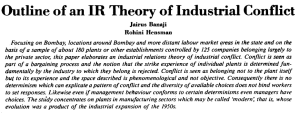
Banaji and Hensman on multinationals and industrial conflicts in Bombay (1956-84)

Courtesy: Economic & Political Weekly

Maruti: A moment in workers’ self-organisation in India

Pratyush Chandra

The Chairman of Maruti Suzuki, R.C. Bhargava, himself described the July 18 incident as a “class attack”. The management, which learnt from the Japanese how to instrumentalise unions as tools to educate and regulate workers in work discipline, are now learning a new lesson from their own Manesar workers – they want their own voice, which is in their control not in the control of the masters, whosoever they may be. They will tear away every interface if that obstructs their organic collectivity to emerge – then they will speak in their own voice, which will definitely be harsh and brutal, as it will be organic to the very core. They will speak in their own language, without any creative translation into a language that has systemic legitimacy.

The lesson that the Indian corporate sector learnt from the Japanese is graphically retold by Bhargava himself in his recent book, The Maruti Story. It is not just revolutionaries who called trade unions a school, even the Maruti management found them to be so – a necessary means for “continuous training of workers…if their attitude towards work, the company and its management was to be changed…. We understood the logic of their [the Japanese] system and so wanted to completely reverse the traditional culture and bring about a mutually beneficial relationship between workers, the union and the management.”(302) So the management “promoted a trade union at Maruti, before political parties and outsiders could establish”. The founder-Chairman of Maruti Udyog, V Krishnamurthy, “brought” even a union leader from BHEL. “The importance of the union was highlighted by ensuring that the president and general secretary of the union were seated on the dais at every Maruti function. They would, along with the top management of Maruti, receive all VVIP guests and garland them.”

Time and again, the Maruti workers have tried to build their unity beyond promoted, brought, bought unionism and its ritualism. Each time such unity has been institutionalised into a legal form, the management has either destroyed or bought it over, and promoted enterprise unionism. Since the last year, however, things have drastically changed. Maruti workers have understood the meaning of legitimacy, its functions and limits. This remarkable understanding is evident in what a Maruti worker expressed just after the worker-leaders were ‘bought’ and sidelined in 2011:

“Sahibs don’t understand the situation…. In these past few months, a handful of workers had risen to the position where they could control the workers…. By dismissing exactly those men, the management has thrown away a valuable tool.” (Aman Sethi, “Down and out on India’s shop floor”, The Hindu, July 29, 2012)

And again after the July 18 incident, in an interview recorded by a mainline news channel, a worker said:

“Our workers did not have faith in the union body. They were apprehensive about the union cheating them again…. [Yet they wanted that] the management should at least value and listen to the union body.” (NDTV, August 11, 2012)

They understood the limits and dangers of legality and representation, and the need to have extra-legal vigilance of their institutionalised body. Something the workers ensured by evolving shop-floor networks of line and departmental coordinators, and by frequent assertion of the general body. While the representative trade union, in accordance with the legal regulations and norms, included only the permanent workers, this organisational form was organic to the daily shop-floor coexistence of all segments of workers.

Defying every attempt to fragment and subalternise their collective consciousness, the Maruti workers forged a youthful (in a literal sense) unity among themselves beyond all kinds of regulatory and identitarian divides (including the caste and regional), demonstrating their uselessness, except for the purpose of regulating workers in favour of capital. This unity was remarkably visible during the 2011 strikes. They defied every agreement and manipulation from above that tried to break that unity, and they struck three times against them, and surprised the unions and their legitimate sense. Hence, even the need to form a sectionalist union (of permanent workers) – which the legalese and the prevailing industrial political culture compelled them to adopt for negotiations with the management – was continuously overwhelmed by the unity below that questioned the very basis for such unionist sectarianism and economism.

It was this collectivity that could not be destroyed by the management’s union busting, and it did form another union. But its easy registration and semi-recognition by the management made the workers evermore apprehensive, and they enforced constant vigilance on the representatives. However, the management misconstrued this collective apprehension as a distance between the general workers and the union, not understanding that its collective nature in fact tightens the workers’ grip over the union leadership. It is unlike the generalised yet fragmented weariness that leads to helplessness. The management miscalculated and thought its intransigence in dealing with the union will increase the distance and delegitimise the union in the eyes of the general workers. It could not anticipate that such an act was thinning the legal shield that protected it. And, so, what could have passed for the time being as another “class action” got transformed into a “class attack”, as Bhargava calls it. The management should not complain that it didn’t get the warning – workers themselves gave out sufficient signals.

However, one must grant that not just the Maruti management, the suddenness of the July 18 incident at Maruti astounded everybody – where was this anger among workers residing for the past one year? Nothing similar happened during the remarkable “non-violent” strikes in 2011. And prior to the incident nothing happened that could give a hint towards it. Therefore, a plethora of explanations and conspiracy theories has come up.

Interestingly, we can easily identify a basic logic behind the catalogue of ex-, post-facto explanations that various institutional and non-institutional bodies – the state, management, media, unions and radicals – are putting forward. A central thesis runs through all of them, which is that workers as a mass cannot have any coherent plan. Hence, those who see incoherence in the incident, either blame it on reactive spontaneity in the absence of (correct) leaders (radicals), or mob-like nature of the workers action (media elites). For many of these responses, there is some kind of pre-planning that must have come from outside (from Maoists/political unions, as the state and management maintain, or provocation from the side of management through their intransigence or by employing ‘bouncers’, as all the pro-workers institutions or groups opine). However, in the end no one is willing to concede general workers a coherent critical subjectivity that reasons them into taking things (read law) into their own hands, because for all the groups mentioned above, a rational subjectivity can emerge only through the repression of the inner nature (in the present case that of the mass).

All that even the pro-worker forces are willing to grant, and at most, is if the workers were accomplices in the July 18 incident, they were merely reacting to something the management wrongfully did that day (by calling the bouncers or by not resolving the issue of the suspension of a fellow worker) or have been doing lately (by not going for a speedy wage settlement or union recognition). All these self-actions by the workers are arrogantly clubbed together as spontaneity or spontaneous actions, which are generally considered to be reactive, and can have a political meaning only if harnessed by the organised political forces. It is interesting to note how these competitive forces, doing organisational shopkeeping, or at least advertising, among workers, have found workers’ direct actions erratic and even anarchic. They find the workers sensible and tractable only in those moments when they are led or when the consciousness of defeat and victimhood dawns over the workers – when “victim” workers are looking for respite and rights, and for experts who can represent them in the courts of law and negotiations.

These so-called political forces have a notion of politics that comes directly from the civics classes of the (post)modern schools that define politics in terms of institutions (or tangible forms of organisation) and their activities. Even the movements must be located among these activities, or else they are apolitical and even mere riots. Class struggle is reduced to the interplay of these institutions, ideologies and activities. They are unable to locate this representative interplay and their own activity as (re)originating in a continuous class struggle between capital and labour – in the daily imposition and subversion of the process by which capital acquires and incorporates living labour as merely an agency for its self-valorization. They are unable to see that recent unrests on the labour front in India have been largely political – i.e., they are related to a constant recomposition of class collectivity that short-circuits the re-segmentation of labour – the ever real-ising subsumption of labour by capital. In other words, this collective urge is not simply a wont to vocalise the aggregate demands of individual or sectional workers, as in a demand charter. Rather, it relates to their concern to transcend the segmentation on which the capitalist industrial polity thrives – the division between permanent, contractual, casual and interns. It is a marvelous experience to hear from general workers about these real divisions made on false premises. It is this open vocalisation that constitutes workers politics today. The Maruti workers’ struggle clearly is a finest example in this regard.

In one of the discussions that we had with workers in other industrial regions about the Maruti ‘violence’, a worker expressed how they work for the fear of the daily hunger and for feeding their family. Otherwise who would like to work under iron discipline and invisible eyes constantly watching over you, reprimanding you for every small mistake? Workers continuously look for every small opportunity that would enable them to dodge and abuse this system of surveillance.

The (more-or-less) open violence of primitive accumulation that joins the fate of labour to capital readies it for the inherent violence in the active imposition of work that capital as social power with its various apparatuses seeks to ensure. There is nothing reactive about workers’ actions to break out of this panoptic circuit which is now expanded throughout the society. The diverse immediate forms that these actions take are meant to surprise capital.

It is not the question of defeat or success of these forms or agitations that should concern us. In fact, our every success makes our actions predictable, increasing the reproductive resilience of the hegemonic system. Who knew this fact better than Karl Marx? He stressed on the need to watch out for opportunities to stage sudden radical leaps away from the guerrilla forms of daily resistance against the encroachments of capital, or else workers will be evermore entrenched within the system of wage slavery despite – and because of – frequent achievements in their everyday negotiations with capital. Those radicals suffer from the same Second International reformism and co-option politics, of which they accuse everybody, when they visualise class maturation as a linear succession of successes and achievements, not in the increased activity of the working class to catch capital off-guard by its volatile, yet collective thrust.

Today, the dynamism of this workers politics poses a crisis not just for capitalist strategies but also for itself as it constantly outmodes its own forms. The significance of the Maruti struggle and the July 18th incident lies in this process – they demonstrate the increasing inability of the legal regulatory mechanisms and existing political forms to ensure “industrial peace”. This means:

1) For capital, every crisis is an opportunity to restructure labour relations for its own advantage. Many times, it carefully shapes an industrial conflict to seek such restructuring. The recent conflicts have shown the limitation of the legal framework to generate industrial consent/peace, which has time and again forced capital to resort to coercion.

2) The automotive sector has been central to capitalist accumulation, so the needs of this sector have time and again restructured the industrial polity and economic regime globally. In India too, this sector has been in the leadership of pushing economic reforms in a pro-capitalist direction. The high-handedness and intransigence of the managements of Maruti and other automotive companies in recent conflicts is representative of the determination of Indian capitalists to force pro-capital labour reforms.

3) Legal unionism and existing organisational practices to compose and regulate working class assertion are becoming increasingly redundant. The labour movement must look out for new incipient forms in this self-assertion, as older forms are unable to lead working class consciousness, which is much more advanced than these forms, to its political end. The direct action of Maruti workers last year and this time cannot be simply explained by the crude notion of unorganised spontaneity, rather it shows their political will to transcend the segmentation perpetuated by the capitalist industrial polity.

Maruti Suzuki: Workers’ Side of the Story

Workers of the Maruti Suzuki Manesar plant speak up about the events of 18th July 2012, and the repression that they have been facing since then. These workers were amongst the 500 permanent workers who were terminated in the aftermath of the fire.

The workers addressed a convention on 7th September organised by AICCTU and AISA.

Possibilities beyond the Maruti Struggle: Nationalisation and Workers Control – Alok, KYS

Alok Kumar, leader of Krantikari Yuva Sangathan addressing a gathering at the Maruti Suzuki Headquarters on August 27, 2012.

Blind workers demonstrate for their rights

BLIND WORKERS GHERAO MINISTRY OF SOCIAL JUSTICE & EMPOWERMENT
WORKERS PRESS MINISTRY TO HONOUR ITS APRIL 2012 ASSURANCE OF PROVIDING ALTERNATIVE EMPLOYMENT

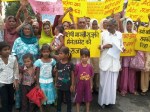
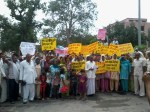
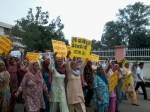
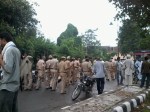
Today, a large number of blind workers collected outside the residence of the Minister of Social Justice and Empowerment, Shri Mukul Wasnik. These workers have been meeting the concerned Minister, as well as officials in the Ministry of Social Justice and Empowerment on several occasions since November 2011. On April 24, 2012, the troubled workers were given an assurance by the Minister that all the blind workers retrenched by the National Federation of the Blind (NFB) in 2011 will be provided alternative employment at the government sponsored NGO, Arunim. However, more than four months down the line, the Minister and Social Justice Ministry are still to honour their assurances. Due to the absence of the minister the blind workers were unable to meet the Minister and took out a march to the Ministry of Social Justice and Empowerment here at Shastri Bhawan.

It is to be noted that since November of 2011, the blind workers have been protesting the retrenchment of several blind workers by the NFB. This NGO retrenched the workers because they were speaking out against denial of minimum wages and other basic labour rights in the Training and Rehabilitation Centres (TRCs) run by the NGO. However, the struggle of the workers is not just against the NFB, but also against the overall exploitation of blind workers across the country by private companies and NGOs. Blind workers have been arguing that in the interest of availing of certain benefits like tax exemption the private sector employs persons with disability, but goes on to exploit them brutally. Arbitrary hiring and firing practices, unregulated working hours, payment of wages which are often below the minimum wage rate, etc. are some of the exploitative practices which prevail in the private sector. All these amount to a serious breach of social justice, which is why the bind workers have been continuously approaching the Ministry of Social Justice and Empowerment.

More importantly, the workers realize that the failure of successive governments to provide adequate employment to the blind community is the main reason why blind workers are dependent on the highly exploitative private sector. For disabled working class persons who are either unemployed or stuck in highly exploitative private sector jobs, the Government’s decision to sub-let its responsibilities of providing tangible livelihood to NGOs, private companies, etc. is an extremely skewed policy approach. Thus, the blind workers’ struggle is based on the fundamental right to a livelihood—a right the Government is to protect and uphold.

During their Dharna at Ministry of Social Justice and Empowerment a delegation met Mr. Pankaj Joshi, Joint Secretary, Disability Department and apprised him of their concerns. A memorandum was submitted to him for his consideration. The three specific demands that the workers are raised with the Ministry of Social Justice and Empowerment include:

(i) That since the Ministry has failed to curb the blatant violation of labour rights by the National Federation of the Blind (NFB), it should ensure that all the disabled workers employed by NFB be provided alternative employment by the Government with immediate effect.
(ii) Inclusion of a special section in the long pending Bill on the Rights of Persons With Disability (2011), which would safeguard the economic rights of blind workers employed in the private sector. For example, the Bill should include provisions to the effect that bodies violating basic labour rights will be penalized to the effect that NGOs indulging in such violation will face the cancellation of their registration.
(iii) That the Ministry of Social Justice and Empowerment tables a concrete plan of greater job creation for blind persons in the public sector. It is only with the provision of more government jobs that the dependence of blind workers on exploitative private companies and corrupt NGOs can be overcome.

After listening to their demands Mr. Pankaj Joshi assured that they will be given employment through some government agency or the Ministry will help in establishment of a cooperative society. Another major victory for the movement is that the Ministry has also conceded inclusion of a provision in the Bill on the Rights of Persons With Disability (2011) where NGOs employing disabled persons will be penalized if they violate the labour laws and the grants to such NGOs from Ministry will also be stopped.

Not taking it as their final victory the blind workers resolved to fight till the government does not take its responsibility of providing employment to all disabled persons so that they do not remain exploited and harassed by “welfare” NGOs and private sector.

Alok Kumar
Ramnath

Blind Workers Union
(A Unit of All India Federation of Blind Workers)
T-44, Panjabi Basti, Near Gopal Dairy, Baljeet Nagar, New Delhi-110008
Contact: 9313730069 Email: blindworkersunion@gmail.com

Sep 2 – Relatives and families of Maruti Suzuki workers demonstrate in Rohtak

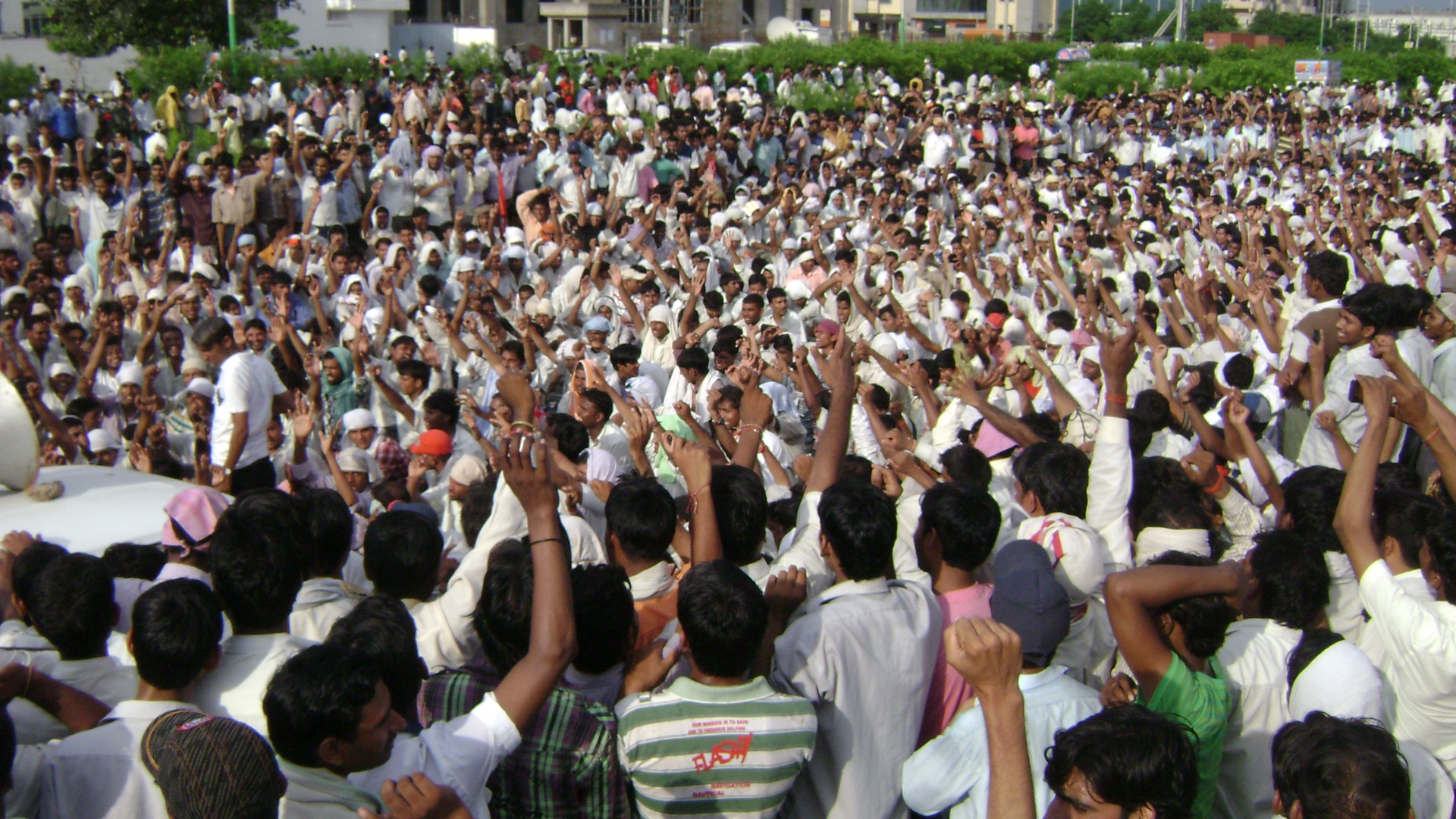
On 2nd September 2012, over 400 relatives and families of workers of Maruti Suzuki protested against the arrests, torture and termination of workers, and demanded immediate release and work for all workers. The families and relatives who came from all across Harayana- Hisar, Rohtak, Jind, Kaithal, Narwana, Gurgaon, Yamunanagar, Kurukshetra, Karnal, as well as from U.P., Punjab, Himachal, Rajasthan wanted to meet Chief Minister Bhupinder Singh Hooda, but were dissapointed when the Police Commissioner and a huge contingent of Haryana Police blocked and disallowed us our right to do so. It became clear to all that the government and police is continuing to act against the interests of common people and workers and their families, and acting in complete favour of the Suzuki management. The families gave a memorandum to the Chief Minister through the D.C. Rohtak after demonstrating in front of his office.


In the meeting, workers relatives put across their view. Suresh’s brother said that police torture was meted out to the workers on direction of the management, and asked why the government is acting in the management’s favour. Ramvilas’s uncle Ramesh said even the family members were not spared. Sushma said proper investigation should be done about the management’s role in the incident. Jagbir said how his son was awarded ‘best worker’ twice by the company itself, and now has put him in jail and all workers are being called criminals even when investigation has not taken place. That the government is not giving any respect to workers or their families came out of all the protestors.

In the demonstration, banners of ‘Maruti Suzuki workers Union’s families and solidarity committee were there. Posters and slogans like ‘All workers are innocent, immediately release all workers’, ‘Company-Government-police stop harassment of workers’, ‘Hooda government answer us, respect workers families’, ‘punish the guilty managament of maruti suzuki’ were made.

The demands put forward are-
1. Immediately release all workers arrested from the night of 18th July on.
2. Register cases of conspiracy and death on the management of Maruti Suzuki.
3. Take back to work all 546 terminated workers.
4. Punish the police officials who are harassing and torturing workers and their families.
5. Take action against factory management who are fluting labour laws.

Signed/- Avtar Singh, Kurukshetra and Pramod kr, Sonepat, Haryana

An interview with workers at FIAT, 1970

Three Workers from FIAT Mirafiori describe the experiences of the Southern immigrant coming to work in the industrial cities of the North. The conversation was recorded in Turin during December 1970.

Q. It was only after the summer of 1969 that people in Britain began to hear of the struggles at FIAT. Was there a tradition of struggle before the middle of 1969, or were these clashes the beginning of the revolutionary movement of FIAT?

LUIGI: You mean was it that they broke the lethargy of the last 20 years here? ‘Yes, it was. Of course, there were struggles before this time, but all were dominated by the Unions. And they were struggles that came around at fixed intervals when the unions set them. So every two or three years, when the contracts were about to expire, we would have the classic sort of struggle you know, two or three days of strikes, all kept within union channels, and then the boss’s repression would begin all over again. And the little politicization achieved through those two or three days would be blocked for the next three years of boss’s rule.

But then, in about 1966, the immigrants from the South began to arrive. And the whole social situation in Turin blew up, what with (the shortage of housing, lightning price increases, building speculation and so on, All of a sudden there were l0 to 15 thousand people arriving in the city, and quite apart from the way the Prices rocketed. there were not the facilities to cope with them.

Q. When did the three of you arrive in FIAT?

LUIGI: These two are young. For my part, I’ve been at FIAT for twenty years. This lot is the new generation who’ve broken with everything that we’ve become used to.

TONI: I’ve been here for two years and I joined FIAT right at the time that the struggles started.

Q. When you two arrived in Turin, what was it like for you?

N1NO: I’ve been here for a couple of years now. For most of the time I’ve worked in small places you know, sweatshops, always inside Turin, and then I was taken on at FIAT, in the beginning I didn’t know anything about anything. But the political work there was already well underway, and there were students doing leafleting at the factory, explaining a few things to people, like what the union was all about. Then we had that whole big explosion during 1969. Everything went up. Boom!

TONI: I’d never seen anything like this in all my life. Because, as you know, I come from Calabria and my town’s a pretty small place. It’s ruled by God, you might say: Three or four priests, who were all a bunch of shits, brought us up to be boy scouts and the like, and told us all about what they thought democracy was. Then there were the four or five Communists and the seven or eight fascists, and that’s it. Really Calabria is still a region that’s in the hands of the counts and barons that ran the place in the time of Mussolini, and who did very well out of him, what with their power, their villas, and so on. That’s the way Calabria is.

Anyway, down there, even if I only had 50 lire I could always buy myself a cheese roll or something. But I come up to Turin and fuck it: I find I’m paying out 200! It was all crazy to me. Then I began to pick up on the politics that Lotta Continua were into. At first, you know, I really didn’t understand too much, I used to read their leaflets, but only in a sort of informative way, so as to know what they were saying. One day one of the student comrades from Lotta Continua hunted me out and began talking to me. He really attacked me because I was still in the union. Before I worked at FIAT I’d worked for a few months at other little factories, and all that I’d heard was that the unions were there to defend the workers. Of course, down in Calabria we don’t even know what a union is; people don’t know that they exist! But gradually I began to understand what they really are. There are so many things I’ve learned that I didn’t know before, and I hope to be able to pass them on to all my workmates in the factory, and help them understand for themselves what I’ve learned.

At the beginning, when we were few, we started our struggles going round the factory in huge processions that you would think were never going to end. We used to call them “Snakes”. One time there were three hours of official union strike called. This was about the time that all the big strikes were happening, in autumn 1969. A few of us got together with other militants and asked ourselves what we were going to do. We decided that the best thing would be to have a Snake a big march round the factory, pulling out everyone we could. So there we were, with the three-hour union strike, and the two of us got together with five or six other comrades and contacted a few people from Lotta Continua. Then we set off; just the seven of us. And by the time we got to the head offices where all the staff hung out, there were about seven thousand of us! Bloody beautiful it was. The staff were all looking out of the windows, and saw us down below. They didn’t know what to do. And the few guards on the doors were terrified. It was beautiful .Now when the next lot of contracts comes along, well, this year we started with seven of us and ended up with seven thousand. Next time we’ll start with seven thousand and end up with seventy thousand, and that’ll be the end of FIAT. Goodbye, Agnelli.

There’s another time that I remember was really fine. We’d been in and out on strikes for a couple of days, and then we were having one of those marches inside the factory. And people started saying: ‘Let’s kick out the supervisors, they’ve been around giving orders for about a hundred years now, and we’ve had enough!” So we went down and started muting them out. People were looking at them, jeering, spitting on them, and they looked back as if they wanted to kill us, but there wasn’t a thing they could do. They just didn’t know what was happening. There’s them who’ve worked their asses off to become supervisors, and there we were treating them like shit.

LUIGI: It was these young people who began the fight, spontaneously and we logically found that this was a sort of alternative to the usual Union struggles, an alternative which went along with the contacts growing at the same time with the students. As you know, from 1967 the university movement joined up with the struggles of the workers.

Q. What has been the relationship between the revolutionary workers and the militants from the student movement?

LUIGI: It’s been a sort of team effort really, them outside and us inside. At the start we would work on all the antagonisms inside the factory, using them as a lever. For example, say FIAT hadn’t provided some work clothes. We would kick up a fuss, and the students would support us from the outside with loud hailers, gate meetings, leaflets, big posters, and so on.

Usually what we do is find out the facts of the situation, write them out in rough form, and give them to the external militants to print because they’re good at that sort of thing and they have more time than we do to work right through the night. We hope that later on we shall begin to do the leaflets ourselves, and already we are starting to do more of the work like typing and so on, as well as some of the distribution outside the gates. Once upon a time it was the ex-students that held the leading role in Lotta Continua, and we were the ones that carried out programs. Now we are beginning to take the leadership. There’s a bit of confusion about this at the present, as to whether we should have the leadership of the organization, because they still control a lot of the apparatus, like the national newspaper, the duplicators, poster printing facilities, and so on. However I’d say that by now there’s really joint leadership.

Q. So you can really say that the new wave of struggle arrived with the immigrants and the students?

LUIGI: Yes. Italian students understood very early on, first with the Movimento Studentesco (Student Movement), and then with the ultra-left groups, that the only way they could expect to have any life at all was by allying themselves with the struggles of the workers. So that was really how it all started. Apart from very early factory leafleting in isolated areas, like Pisa from 1964, it was in 1967 that the really massive work began in front of the factory gates. And this was exactly when all the new workers began to be signed on, all the workers from the South, cut off from their own roots who had burned their bridges behind them and come here to Turin to find themselves without houses fit to live in, with sky-high prices and so on. Add to that the students outside, who were focusing on these problems, pushing them toward eruption, and of course everything exploded. But it exploded in ways that were sometimes very disorganized, very unconnected, sometimes a real mess.

Now the spontaneous struggles are over. I’m convinced of it. Now, when the struggles start again, they’re going to have to be struggles for organization. Last year we were fighting seven or eight at a time, limited to single shops, all of us at Mirafiori linked through Lotta Continua because we’d had enough of the unions. But now we’re moving toward a situation in which we’ll have the factory coordinated shop by shop. When we decide at a certain point to launch a strike, we’ll start with an assembly in one shop, say Shop 55. Then we’ll begin the roundup, setting off in a Snake toward, say, the Varnish Shop, before we used to waste two or three hours getting everyone together. And by that time, as we were going round collecting the comrades, the anger would somehow melt away. To coordinate the struggle inside the factory means that when we decide on a Snake, it no longer takes half an hour to get it moving. Every group, every shop moves together. And when we start, we can come to a certain point where we can decide on what objective we are going to be heading for. We can decide to leave the factory grounds and tie up with other area factories, radicalizing the struggle outside the factory so as to involve other places.

Q. What has been the role of the unions during these struggles?

LUIGI: The unions are there to make sure that workers are kept inside the system, and have less possibility of beginning to challenge it. The unions are the political extensions of the sicknesses that exist inside the government; the “long arm inside the factories” of political parties. Every group, every political party has a little hand inside the factory. The Christian Democrats have CISL, the Communists have the CGIL, SIDA are the Fascists, UIL is the Social Democrats, even some Republicans. . . every one of them has a certain presence inside the factory to control the situation. Now a lot of workers understand this. However they don’t as yet have an alternative. Inside FIAT the unions don’t count for anything, and everyone’s well aware of where they stand. But at the moment they are the only organization with a voice, they are the only ones that can say anything when it comes to dealing with management. So what’s really necessary at the moment is that we begin to create inside the factory agitational nuclei, or revolutionary committees, that are so strong and so well-rooted among the workers that they are an alternative to the internal commissions and the delegates that the unions have set up. Thus we can begin to create a point of reference in the factory to which the less politicized workers can look, so that they can escape from the control of the unions, can talk together, and can politicize themselves further. That is exactly what we’re engaged in at the moment: to form nuclei, to come to some agreement among ourselves, to study and understand the situation, and to provide inside the factory a focal point. These agitational nuclei are composed of normal workers inside the factory, but the best of them, the activists. It must be said that these nuclei are being formed not only from members of Lotta Continua, but also from workers who are not members but who have understood this need and who come along with us because of that.

Q. What are your aims with these agitational nuclei inside of the factories?

LUIGI: With the nuclei and with the revolutionary committees if we manage to create them, we are trying, not to be another union, but to provide a political, revolutionary perspective for the workers. We must not fall into economism, into parochialism. We must not say “Look, we must fight for five lire more, or for ten lire more, or to work one or two hours less.” We are fighting and of course we are not going to achieve it tomorrow, for power, because the working class without power isn’t worth a thing. Of course we won’t dissociate ourselves from the economic struggles, because for most workers the economic struggles are the beginning. However, the economic struggles must go hand in hand with a revolutionary development of understanding, of politicization, of awareness on the part of the mass of workers. Only then can we hope for the taking of power, because that’s what we’re aiming at. The point is to take the factory, because it’s the factory that creates value, and it’s us that should have it, and not them.

Courtesy: RADICAL AMERICA, Vol 5 No 5, Sep-Oct 1971

August 9: In solidarity with Maruti Suzuki Workers

A joint demonstration was organized at the Labour Ministry headquarters of the Indian government in Delhi by over 20 organizations on August 9, 2012 to protest the repression and arrest of Maruti Suzuki workers of Manesar plant (Haryana), and against the violent work regime that exists in the industrial sector in the country which do not even grant minimum labour rights allowed under the existing labour laws. Around 60 activists were forcibly detained at the Parliament Street Police Station, where they organised a meeting (see the videos below):

Com Alok (Krantikari Yuva Sangathan)

Com Sanjay (Inquilabi Mazdoor Kendra)

Cultural Activists

FIAT has branded me (An interview with a Fiat Worker, 1979)

Giampaolo Pansa
Translated by Lawrence Venuti

Giampaola Pansa, well-known for his interviews with Italian workers, talks here to a Fiat worker from the Mirafiori plant In Torino who was among the group of 61 workers fired on Tuesday October 9, 1979. This interview appeared in La Republica 3 days later. It was first published in English in Autonomia: Post-Political Politics, New York (1980), edited by Sylvère Lotringer and Christian Marazzi. We find this interview relevant for the ongoing discussions on growing working class militancy in India, especially in the context of recent workers struggles in Maruti Suzuki.

You have heard a foreman from Mirafiori vent himself. Now listen to me. I too come from Mirafiori and I am among the sixty-one workers fired by Fiat. Until Tuesday I worked in the painting department. I was a general worker at the third level. According to Fiat, I was also a violent worker, a quasi-terrorist, one who assists the Red Brigades: this is the mark that Agnelli is trying to brand on my forehead.

I must start at the beginning so you can understand the situation. I shall be 29 in November. I am from the province of Catanzaro, from a small village that offers no opportunities. We emigrate from there in droves. Before leaving, I attended secondary school and then took a technical course. But school was not for me. I subsequently decided to go and look for work in the north, at Turin.

I left my village In January of ’69, having just turned 18. I had never been outside it. Turin frightened me – its huge size, its ugliness, the clouds and the snow. I asked myself: where have you come? I found a job in a real hole, a small factory, but I lasted only 10 days there, I couldn’t take it much longer. Then I found another job. Things were going better there, yet I thought only of Fiat. I said to myself: Fiat Is a big company, you’ll be secure there; If you get into Fiat, you’ll never wind up out on your ass.

I entered Fiat on 28 May 1969 as an apprentice in the painting department. The apprenticeship was supposed to last 6 months, but it ended much sooner. The trouble in July of ’69 had already erupted; Fiat needed people who could start working at once, in order to fill the gaps left by those who were on strike or who sympathized with them. And so I went right on the assembly line immediately after the vacations.

At the beginning the painting department was horrible. I worked as if in the middle of a cloud, amid strange odors and terrible smells of every kind. It was an infernal scenario. Yet after a little while, even with these noxious fumes, I started to like the job. Painting cars is not a monotonous task. What I was learning could help later on. And then I always tried to work with my head too: I tried to do my job well. But also preserve my health. In short, I was rather satisfied.

It was autumn and still hot outside. I didn’t pay attention to it. I didn’t know anything about what was happening around me and then there was my mother’s advice: think about work and keep to yourself. Only in 1970 did I start to get a little involved. No, it wasn’t political activity at all, and it didn’t even have anything to do with the union. I concerned myself with the problem of the working conditions in the painting department. The situation was disastrous and I even felt the effects of it. I lost eight teeth. And then there was the nausea, the duodenal ulcer, the impaired hearing.

In a word, I was provoked when I saw that I was paying for my job at Fiat with my skin. But it was not an individual rebellion, nor was I interested in raising hell for its own sake. It was a collective rebellion by nearly the entire shop. We asked Fiat to alter the situation and Fiat answered no.

Anyhow, in that year I joined the union and then I had an important encounter with Lotta Continua. I had been fined since I had not completed the assigned work precisely because of the working conditions. I went out through the gates and showed these conditions to some of the people who were always there with newspapers and flyers. They told me: Come with us and we’ll talk about it.

Now Lotta Continua no longer exists as a group. And I am nostalgic for it, even if I do not feel that I am a former member. For me it was a great experience, political and human. I learned about things, I met exceptional people whom I would have never met otherwise. Lotta Continua had one great merit: it made you intellectually open to other people, it let them speak, it let them discuss…

I am not a popular leader. I’m a quiet man. You know what they call me in the painting department? “The priest,” “the good guy.” But from the first moment of my involvement with that political group, Fiat must have classified me as “a lottacontinua” and that was it. In my opinion, they have put me out because of that label, because of my political activity when the group existed. But this is a chapter to which we shall return later.

Now I want to say that in those first eight to nine months I was a Fiat worker like the others, and I was occasionally better than the others. My absences were few. In short, I have always done my share, as an electrical technician until 1977 and then in preventive overhaul, where the car is prepared for painting. I considered myself good on the job and my foremen have always considered me so.

In the meantime, the working conditions had improved and my duties became less oppressive and repetitive. Nonetheless, I had also grown bored. Lotta Continua was no longer there and Turin haunted me. The huge city never pleased me, but now I was really aching and I wanted to leave it. My dream was to go and work for Fiat abroad. And for two months they did send me away, to a branch office in Germany. When I returned, I renewed my request. In fact, I had recently done so with Varetto, the manager shot by the Red Brigades. And when the foreman brought me to the front office on Tuesday, I believed that they had heard my request. Instead they dealt me the letter of dismissal.

That letter brands me as violent. But I deny it! Of course, my strikes for a change in working conditions made them do it. And I have given some trouble to Fiat, but so have many others. Between ’74 and ’75, I was a union delegate and I did what was within my power. And even if I am not at all an orator, I have never laid back when there was some working method to be discussed with the foremen.

Take note of this: I said working method, not work. I do not refuse work. I am a born worker, and I must work, but not as a slave. And I am also convinced that it is necessary to work well; if you don’t do your job well, you make more work for the people who come after you on the chain. I have never swerved from this position with those of my co-workers who act badly. I say: if you do only a little work, at least do it well. And do a little work so it’ll all get done. This is one of the Fiat workers’ slogans.

What does a little work mean? Today we work for seven and a half hours a day. It’s too much. It must be seven hours a day, five days a week, or thirty-five hours. No more, if the working hours are not changed, the unemployed will stay that way. I have always maintained this point of view. I have always tried to put it into practice. I have even discussed it with my foremen, but without ever being reprimanded or quarrelling or resorting to violence.

Yes, there is much talk about violence against the foremen, I would like for the newspapers also to speak of the violence of the assembly line, which moves much too quickly. And isn’t it violence when certain foremen put their hands on the asses of the newly hired boys? Where, at any rate, are these acts of violence against the foremen? Of course, there have been moments of tension during contract negotiations. And many workers see the foreman as their immediate opponent. Sometimes the men are short-tempered: to be in a factory is hard on everyone.

Still, I have never done any violence. I have always been in the same work group. My foreman thinks highly of me. He gave me a pen as a gift. He has even invited me to his home. Do you invite to your home a violent man who threatens you? Tuesday, he was the first one to be struck with amazement. Ever since Lotta Continua dissolved, I have become completely peaceful. Moreover, someone who tries to raise hell for its own sake or who acts as the terrorist’s assistant doesn’t ask to go abroad; he stays here to threaten and to play the violent man.

Why then have they fired me? This is my answer. Fiat knows everything about its workers – their lives, deaths, miracles. I am a politicized worker. I have always tried to involve my co-workers in labor problems, with working conditions and rhythms. I used to go to contract negotiations, to talk, discuss. In a word, I used to make trouble. So they’ve pulled out their old lists: there I was on the list for Lotta Continua and so they’ve thrown me out.

I am evidence that Fiat is a terrorist organization. By eliminating people like me, Fiat wants to eliminate those who can speak on behalf of the others, those who do not bow their heads. And then there must be a grander design: once the “ball breakers” are eliminated, it will be easier to return to the past, to increase production more and more, to make people understand that only Fiat controls Mirafiori and that the workers must give up the idea of getting their rights.

But since the bosses at Fiat cannot say this, they make us pass for para-terrorists. It’s a lie. I do not agree with the Red Brigades, they are not the kind of people who can protect our interests. I have never considered delegating my representation to those who use weapons. And I do not believe that in Italy things can be changed by shooting people.

Yet I am also convinced that there is much too little discussion of terrorism among the workers. There is great indifference at Fiat. When they killed Ghiglieno, there was hardly any reaction in the shops. The other incidents have been received in the same way. The workers consider them material for the newspapers at this point. On the contrary, it is necessary to discuss and ask oneself why the Red Brigades shoot certain people and not others.

Of course, the Red Brigades don’t shoot only foremen. You remind me of Rossa, a worker like myself. What do I think of him? Well, I don’t know… What if I discovered that one of my co-workers was a brigatista? That’s a difficult question! It’s a big problem. No I wouldn’t say anything. I don’t want to play spy on anyone’s account… In any case, the Red Brigades are inside Fiat, but I don’t know them and I’m not one of them…

You say that my answers show it’s a little hard for me to talk about terrorism. It will be so, but there’s a reason for it. I have always been distrustful. Now that I’ve been fired by Fiat, I’m even more so. Your questions about terrorism, about denunciations, and so forth, seem to me a little provocatory….

However, I’m not the only one who talks about terrorism in this way. It’s a thorny problem, too thorny. Everyone has become distrustful. Take a short walk through the streets of Turin, ask people the questions you’ve asked me, and you’ll see disbanded, I no longer want to take part in anything. I’m only concerned about my ass. I hoped to go abroad, to decide whether I would marry or not, and instead this thing happened to me…

I’m disheartened and I feel persecuted. And then there’s one last thing I want to say to you. Just as I am nostalgic for Lotta Continua, so am I nostalgic for Fiat. I’m an emigrant; Fiat was my home for ten years. It seems unjust to me that they should chase me from my home. I have only one hope: that the unions, that all those who call themselves democratic, don’t give in.

I don’t hope this only to save my job. There is also a political reason for it, if the unions weaken, the Red Brigades and Front Line (Prima Linea) will be able to say: Do you see? No one protects the working class any more. The only ones left are we and our guns.