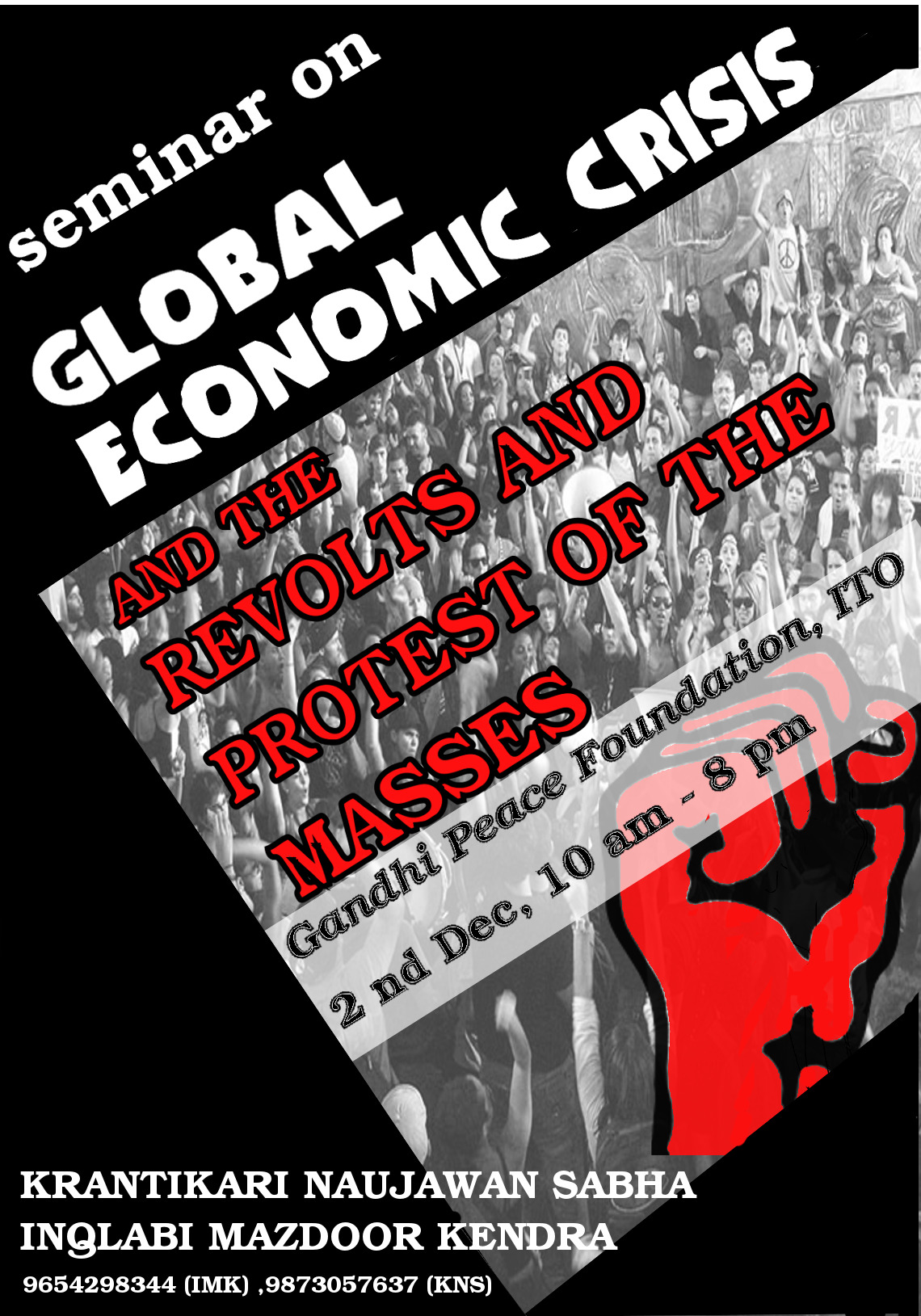
Seminar: Global Economic Crisis and Revolts and Protests of the Masses (Delhi, Dec 2)

on 2nd December 2012
Time : 10 AM to 8 PM

at Gandhi Peace Foundation, Deen Dayal Upadhya Marg, near ITO, New Delhi

The last five years have seen a Global Economic Crisis which is most severe in its scope and depth since the Great Depression. While the United States’ economic situation enters this prolonged slump, the European Union project flounders on the shoals of debt and various kinds of ‘austerity measures’. The turmoil still goes on, notwithstanding the over thirty trillion dollars that have been spent on various recovery efforts. While the ruling class tries to pass the burden of the crisis on the working class, the toiling masses are rising in revolt. 2011 and 2012 have witnessed increasingly widespread eruption of mass rage, particularly across Europe, US and even toppling long standing dictatorial regimes in West Asia/North Africa.
It is of immense importance in this situation, especially for those placed in and concerned with the revolutionary transformation of society, to ponder over the emerging political economic scenario, so as to equip ourselves to face the challenges of these tumultuous insurgent times.

Towards this, Inqlabi Mazdoor Kendra and Krantikari Naujawan Sabha are jointly organizing a day-long seminar on the implications and import of the Global Economic Crisis and the nature, constraints and possibilities of these mass popular struggles. A number of political organisations and individuals reflecting different political tendencies in the left revolutionary camp in India will participate and discuss their points of view, to deepen the understanding of these recent mass popular movements across the world, and sharpening our own practices while we do so.

Download the Concept Note
On the Organisational Question of the Working Class

Arvind Ghosh

“I have tried to dispel the misunderstanding arising out of the impression that by ‘party’, I meant a ‘League’ that expired eight years ago, or an editorial board that was disbanded twelve years ago. By ‘party’, I mean party in the broad historical sense.” (Karl Marx, Letter to Ferdinand Freiligrath, February 29, 1860)

“All previous historical movements were movements of minorities, or in the interest of minorities. The proletarian movement is the self conscious, independent movement of the immense majority, in the interest of the immense majority. The proletariat, the lowest stratum of our present society, cannot stir, cannot raise itself up, without the whole superincumbent strata of official society being sprung into the air.” (Karl Marx & Friedrich Engels, The Manifesto of the Communist Party, 1848)

(1)          Within certain parameters, Marx was practical and impartial on the question of the form of organisation. Marx emphasised the concept of working class as an active, conscious SUBJECT, along with the forms, concepts and activities created by it. According to Marx, the organisational form is not pre-determined, but is created from within the real movement of the conscious and creative working class.

(2)          The most important historical process, for Marx, is the one through which the working class establishes itself as an independent, conscious revolutionary subject. It is this viewpoint of self-emancipation of the proletariat, which forms the content of the socialist revolution, and it is from this viewpoint that we ought to consider the question of organisational forms.

(3)          The positive aspect of this viewpoint is that it avoids fetishism of organisational forms as well as the tendency of these organisational forms to get ossified. It is open and flexible in accordance with the needs of the ever changing special conditions of the transforming agencies. Historically, it has been noted that the working class achieved maximum success when it succeeded in developing new forms of collective activity that challenged the established relations. Similarly, the working class experienced disastrous failures when in spite of the existing forms of collective activity getting degenerated and ossified, the working class continued to defend them instead of building new ones. In order to protect the forms of collective activity from degeneration, it is necessary that these organisations are developed continuously through a process of regeneration and reorganisation, and preserved in their changing forms.

(4)          Marx recognises the working class as the revolutionary agency. The basis for this recognition is that the working class is capable of independently determining its political-organisational forms. Although Marx’s theory of proletarian revolution is intimately connected with the organisational activity of the working class, Marx never attempted to theorise a proletarian organisation. In fact, any attempt to develop a theory of organisation from the point of view of the self-emancipation of the working class is contradictory, since such attempt would amount to declaring independence from the conscious activities of the working class and thus reject the creative powers of the working class.

(5)          For Marx, Subject plays the most important role in the process of revolution. Subject is the one responsible for both theory as well as practice, and also for uniting the two. Therefore, it is dialectically incorrect to say that the subject must unite with its theory, or there has to be a fusion of socialist theory with the advanced workers (for the birth of a communist organisation), as if socialist theory exists independently, outside the class struggle of the proletariat with which its advanced section must unite. “The long-prevalent conception of revolutionary theory – the science of society and revolution, as elaborated by specialists and introduced into the proletariat by the party is in direct contradiction to the very idea of a socialist revolution being the autonomous activity of the masses” (Cornelius Castoriadis, ‘The Proletariat and Organisation’, 1959). In fact, the working class while assimilating and developing socialist theory through its praxis moves towards its goal of destroying capitalist mode of production (CMP) and establishing  a new mode of production which Marx calls associated mode of production (AMP). This process is what constitutes working class self-emancipation.

(6)          From the dialectical viewpoint of Marx, means and aims are inextricably interconnected. From this viewpoint, means are the socialist end in the process of becoming. Means advancing towards communist revolution prefigures the communist society. Since organisation is the most important means to achieve a communist society, it is essential that its form is in complete accord with this objective and in no way does it contradict this objective. In other words, the journey of self-emancipation of the proletariat begins with self-activity and self-organisation capable of achieving the goal of a socialist society.

(7)          A socialist revolution can become a reality, according to Marx, only through conscious, active participation of the working class. A proletarian organisational form is a pre-condition for this revolution, which the working class itself creates through class struggle. This task cannot be done by representing class interests of the proletariat in an abstract manner. An organisational form established independently of this process of self-development of the working class forestalls this process midway, as a result of which the working class comes under the control of an agency outside or above it. Thus through a separation of the organisational form from the class, the division between leaders and the led existing within the bourgeois society is reinforced. Here the organisational form becomes an abstraction with an inherent possibility of incomplete development of the proletariat and its political alienation.

(8)          Marx had advocated a range of organisational forms suited to different politico-economic situations – from workers councils, workers clubs and committees to unions, general assemblies and even parties. But Marx’s argument that the working class needs to organise itself into a party did not amount to working-class party-building. For Marx, organising itself into a party meant getting organised as a revolutionary subject. By ‘party’ Marx had meant a party in an ‘eminently historical sense.’

In ‘The Fourth Annual Report of the General Council‘ (1868) of the International Working Men’s Association (IWMA), Marx had written: “That Association has not been hatched by a sect or a theory. It is the spontaneous growth of the proletarian movement, which itself is the offspring of the natural and irrepressible tendencies of modern society.”

(9)          To declare any specific form of organisation as the only appropriate form means that the working class is not the revolutionary subject, but rather this specific form of organisation is the subject. It means that the proletarian revolution can be determined beforehand and that the development of the working class is not a creative process but a pre-determined process. To come out of this illusion, it would be necessary to establish the creative aspects of socialist revolution and to clarify how the free and conscious activities of the working class (expressed in whatever form) can create new communist social relations.

(10)      The existing communist movement defines power as a thing which might be captured (seized), monopolised and made more powerful (knowingly or unknowingly), whereas, from Marx’s standpoint, power should be defined on the basis of social relations. Instead of concentrating our entire energy on the seizure of power as a thing, the communist movement ought to be directed towards the transformation of social relations. Thus we conceive revolution not as an event but as a process.

(11)      The most important reason for the crisis in which socialism finds itself today (which is also the real tragedy of established Marxism) is that it has abandoned the concept of proletarian self-emancipation, whereas this concept is the essence and specificity of Marx’s Marxism. As a result, the existing communist movement has been alienated from its class as well as social roots. The established communist movement considers socialism to be a product of organisational activities. From this standpoint, it is the Party and not the class which acts. From this perspective, organisational form has been considered to be of crucial importance, while the conscious role of the class is neglected and even negated.

(12)      From his early critique of Hegel’s political philosophy Marx had initiated a new type of political discourse which goes beyond the division between economy and politics existing in the bourgeois society towards transition to a non-ruling class and stateless society. According to Marx, political activities should be subordinated towards the goal of social revolution. This principle is clearly stated in the provisional rules of the International Working Men’s Association thus: “The economic emancipation of the working class is the great end to which every political movement ought to be subordinate as a means.”

(13)      As has been pointed out by Anton Pannekoek in his essay ‘Party and the Working-class’, “in relation to the proletarian revolution, a ‘revolutionary party’ is a contradiction in terms. This could also be expressed by saying that the term ‘revolutionary’ in the expression ‘revolutionary party’ necessarily designates a bourgeois revolution. On every occasion, indeed, that the masses have intervened to overthrow a government and have then handed power to a new party, it was a bourgeois revolution that took place — a substitution of a new dominant category for an old one. So it was in Paris when, in 1830, the commercial bourgeoisie took over from the big landed proprietors; and again, in 1848, when the industrial bourgeoisie succeeded the financial bourgeoisie; and again in 1871 when the whole body of the bourgeoisie came to power.” For Pannekoek, the Russian revolution of 1917 was no exception to this rule when party-bureaucracy monopolised over state power, and as we all know, what was established in Russia through this party-state was not socialism but state-capitalism.

Thus, we find that the party-form of organisation, although appropriate for a bourgeois revolution, is hardly adequate to the needs of a proletarian revolution. In a proletarian revolution, the working class has to seize power as a class. In this revolution, the proletarian class power is established through the destruction of the bourgeois state. But the workers’ state thus formed is not a ‘state’ in the conventional sense of the term since it is not an institution separated from the masses. Workers’ power is direct power of workers organised in the spheres of production. The specificity of the working class regime lies in the fact that in this regime the spheres of politics is not separated from the sphere of economics (i.e., production) but is integrated into one entity. In a workers’ regime, the working class takes control of the means of production, makes plans and executes them collectively. Thus a new mode of production is born designated by Marx as the ‘associated mode of production’ (AMP). In this new socialist society, time spent on ‘necessary labour’ (‘socially necessary labour time’) would be progressively reduced and humanity will have more ‘free time’ at its disposal geared to the development of creative powers of human beings.

However, the abstract representation of the working class through ‘Party Power’ contradicts the very concept of working class power. In spite of all the good intentions of the theoreticians in suggesting the new ‘revolutionary working class party’, party power can only be an elitist power, since this party will be an organisation of the so-called advanced sections of the working class frequented by the ‘socialist theoreticians’ from the bourgeois as well as middle class intelligentsia, presenting themselves as the ‘teachers’ of the working class. Marx’s philosophical dictum that ‘the educator must himself be educated’ is perfectly applicable in the context of these ‘teachers’. These elements from outside the working class naturally occupy the upper echelons – the “superincumbent strata” – of this hierarchical organisation. In its due course of development, this organisation begins to rule over the masses by bringing them under its control and trying to regulate their lives through the directives of their highest committees. Thus, the so-called ‘revolutionary party’, instead of helping the struggles of the working class, becomes an obstacle in the creative activities of the class. But, as we know through our experience of the failed revolutions of the 20th century, Socialism cannot be built through directives from above but is possible only through creative participation of the productive classes.

(14)      In order to grasp which form of organisation is most suitable for the working class, it is necessary to correctly define the aims and objectives of the working class movement, since organisation is only a means to achieve these aims and objectives.

The working class not only needs to destroy capitalism but simultaneously needs to create a new communist society which would be qualitatively different from capitalism. The task before this revolution is to go beyond capitalism by completely transforming this mode of production and establishing a new society based on this transformation.

The working class in accordance with its class objectives must create an organisational form and provide a political content adequate to these revolutionary socialist objectives. Historically, the Soviets and the Workers’ Councils – i.e., the organisations created and directed by the workers themselves during their attempts to act as a conscious, creative class – have proved themselves to be the most appropriate organisational forms to accomplish the socialist revolution and for the purpose of functioning of the socialist society. It is through these Workers’ Councils/Soviets that workers directly establish their political-economic power and organise a new socialist system of production. These organisations are inherently democratic, composed of delegates, not representatives, mandated by those who elect them and subject to recall at any time.

The basis of representation in Workers’ Councils is not abstract, since they represent workers engaged in revolutionary struggles. Based in the spheres of production and distribution, there is no place in them for either bourgeois interests or bourgeois representation. Thus, they represent exclusively the working class interests. During the revolution when the working class is faced with the responsibility of reorganising society economically, politically and socially, it becomes possible only through workers’ councils/ soviets and factory councils. In other words, these organisations are the instruments of proletarian dictatorship – the most complete democracy of the working class.

(15)      Socialism is not possible without the management of production, economy and the society by workers themselves. The experience of the Russian Revolution teaches us that the destruction of economic domination as well as of the state power of the bourgeoisie is not enough. The proletariat can achieve the objectives of its revolution only if it builds up its own power in every sphere. This implies that the power in post-revolutionary society has to be solely and directly in the hands of the organisations created by them, like the soviets, factory committees and councils. For a special organisation like the party to take on the function of governance or exercise power means perpetuating the existing separation between producers and the controllers of the conditions of production, the division between the rulers and the ruled.  However, this proposition necessitates a reconsideration of all the theoretical and practical problems facing the revolutionary movement today.

(16)      The question of organisation is not merely a technical question or a question of its form; rather, it is a philosophical question. Marx’s philosophy of revolution is not only about working class emancipation, but is primarily a philosophy of human liberation. According to Marx, working class cannot emancipate itself without simultaneously emancipating the entire oppressed humanity. The final goal of the proletarian revolution is to create a new human society free from all forms of exploitation and oppression. Thus the proletarian revolution is integrated with the women’s liberation movement (WLM), the movement of the oppressed castes, races and nationalities for Freedom. The proletarian revolution is also about redefining humanity’s relationship with Nature, the degradation of which has reached its limit today (to the point of a total extinction of the human as well as other species on the planet) due to the very existence of the capitalist mode of production.

Hence, while forming any proletarian organisation today it should be our endeavour to construct them in accordance with Marx’s vision of a new human society which takes care of all these concerns. This means first of all posing a direct challenge to the existing alienation between Organisation and Philosophy (which is also an expression of the separation between physical and mental labour existing in today’s bourgeois society), through the very functioning of the Organisation.

In other words, any proletarian organisation we build today ought to be free from Vanguardism, Hierarchy and separation of mental and physical labour. The organisation should operate on the principle of democracy from below. We may call it centralised democracy where the emphasis is more on democracy than on centralism to distinguish it from democratic centralism which amounts to control from above in practice.

Workshop on Organisation and the Self-Emancipation of the Working Class (Sewagram, Jan. 13-15, 2013)

A three day workshop is being organised with comrades from Mouvement Communiste, a communist organisation in France and Belgium belonging to the Autonomist Marxist tradition. The workshop will be held on 13th, 14th and 15th January 2013 at Sewagram Gandhi Ashram (Wardha, Maharashtra). Discussions would be held within the framework of the following topics.

1. Role of organisation in the self –emancipation of the working class
2. Necessity of an international working class organisation

The workshop would start on 13th January at 10 am with self- introduction of the participants followed by an introduction of the subject of discussion by any volunteer. On the first day the French comrades would be asked to present their political position followed by an open discussion. 14 January would be a day of paper presentations on the above topics by other participants followed by an open discussion. On 15th January discussions would be held on the second topic: Necessity of an international working class organisation. The workshop would conclude at 4.30 pm on 15th January. The medium of discussion would be Hindi as well as English. Comrades knowing French are requested to facilitate the discussion whenever required.

All participants will have to bear their own travelling expenses in addition to a contribution of Rs 1000 towards expenses for stay, food and other arrangements in the Ashram for three days. Those who wish to present papers on the above mentioned topics are requested to send their papers (or abstracts) by 15th December in order to facilitate translation in Hindi/English if necessary.

All participants are requested to book their tickets for Wardha/Sewagram at their earliest in order to reach either of these stations by 13th morning. Those who wish to travel by flight should book for Nagpur Airport accordingly.

Comrades willing to participate may contact the organisers.

CONTACTS

E-Mails: Arvind Ghosh <arvind_ghosh@ymail.com>, Dharmendra Kumar <monad96@gmail.com>, Radical Notes <radicalnotes@radicalnotes.com>

Telephones: Arvind Ghosh: 09921336289, Dharmendra Kumar: 09827609604, Prakash Raut ( All India Workers Council – AIWC)): 09096089231, Rajendra Singh (AIWC): 09271288269, Rahul Gaurkhede (AIWC): 09423603629, Nainatai Dhaval (AIWC): 09881713382, Chandrapal Singh (Revolutionary Proletarian Platform, RPP): 08928510997,  Ranjeet Singh (RPP): 07875858539

Postal Address:

1. Arvind Ghosh, 314 A, Sonegaon, Nagpur, 440025

2. Revolutionary Proletarian Platform office, 28, Kalmegh Nagar, Nagpur 440016

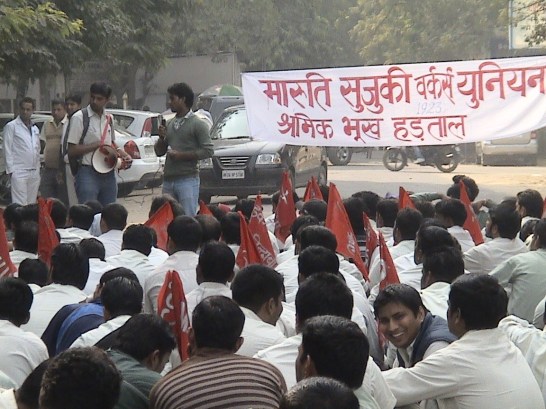
Maruti Suzuki Workers Union: The First Day of the Hunger Strike

The terminated workers of Maruti Suzuki, Manesar plant launched their mass hunger strike today in front of the District Magistrate Office, Gurgaon demanding an impartial inquiry into the incident of 18th July, immediate release of all arrested workers and the withdrawal of all the false charges put on them, immediate reinstatement of all terminated workers, including the contract workers.

The 149 workers in Bhondsi jail, arrested after the July 18 incident also embarked on a parallel hunger strike despite repeated threats of torture by the jail authorities since yesterday. They were threatened to be beaten up, separated and removed to different jails across the state, but have continued their hunger strike since early morning, even boycotting the early morning tea.

Majority of workers in the Manesar plant were also planning a solidarity action of lunch boycott. But just as they embarked on the solidarity action, immense pressure was put by the management and a heavy deployment of around 1000 police was brought in, in the already fortified company premises, to ‘dissuade’ them. The Union President and workers from Gurgaon plant also joined in solidarity with the workers in front of the DC Office, Gurgaon.

From the very beginning, the police and the administration vehemently displayed their anti-worker attitude. In gross violation of the democratic right to protest, the police dismantled the tent and other amenities (eg. Water tanker and sound system) that the workers had set up for the peaceful sit-in event in front of the mini-secretariat. The workers remained determined and vowed to continue the protest as planned in assertion of their rights. In response, the police continued its attack on the workers and detained about 40-50 workers who were packed off to Bhondsi thana. It is only after continued pressure from the workers and the unions present did the police release the detained workers. However, 2 members of the Provisional Working Committee, O.P.Jat and Ramnivas, have been illegally detained inside the police station for so-called further questioning and enquiry. We fear that, as the Haryana police on orders from the company has done, will again put false cases on the workers.

However, despite all these attempts at disruption and intimidation by the police, the first day of the dharna has proved a success and the hunger strike was continued at the decided venue. Representatives from different trade unions and other organizations across India came in solidarity to the protest and spoke at length about the immense injustice faced by terminated/jailed Maruti workers, the highly exploitative working conditions of workers across the country and committed themselves to taking this struggle forward. The speakers emphasized how the united struggle of the Maruti workers is very crucial and that it has served as an inspiration to workers across the country. The assembly was addressed by leaders of various factory unions in the Gurgaon-Dharuhera-Bawal industrial belt, including Rajkumar of RICO Employees Union (Dharuhera), Jaspal Rana of HMS, Anil of AITUC, Satbir of CITU, Animesh of IFTU and Shivmangal Sidhankar of ICTU. Workers’ Rpresentatives from Pragatisheel Cement Shramik Sangh, Chattisgarh (like Kaladas) and Sangrami Shramik Karmachari Union, Hindustan Motors, West Bengal (Amitava Bhattacharyya), as well workers from Ghaziabad, Noida, Delhi, and Uttarakhand also spoke in solidarity.

The hunger strike will continue throughout the night, and tomorrow. There is a massive rally planned for 4pm tomorrow that will culminate at the local minister’s house, which is expected to be attended in large numbers by students, teachers, other members of the civil society and workers from across the industrial belt.

Maruti Suzuki Workers’ Union: A two-day hunger strike (Nov 7-8)

The Maruti Suzuki Workers Union (MSWU: Reg. no. 1923) has decided to hold a protest dharna in the form of a two-day hunger strike on 7th and 8th November 2012. Our family members, relatives and well-wishers and organizations have staged regular protests across Haryana and given memorandum to all the ministers in the state but to no avail. We were not allowed to unite and express our side of the story and our indignation at being falsely implicated in the unfortunate incident of 18th July 2012.

So we are doing a united protest action of the 149 workers languishing in Gurgaon Central Jail for the last three-and-a-half months, and the 546 permanent workers who have been terminated from their jobs. We have all the solidarity of the around 2000 contract and casual workers who have also been unceremoniously thrown out of their jobs. All 149 workers will be on hunger strike inside the jail, and over 500 workers will sit in front of the Gurgaon Court/D.C. Office in Gurgaon from 10am on 7th November till 4pm on 8thNovember 2012, after which we will take out a rally to submit a memorandum to the local minister.

When this protest program was declared the day-before on 4th November, police intimidation, which we have already witnessed these three months, has increased manifold. The jail authorities of Gurgaon Central Jail have threatened to ‘beat up’ and increase the torture on our 149 fellow workers who go on hunger strike. All our elected Union representatives are lodged in jail – Among those in Gurgaon Central Jail include the entire leadership of our MARUTI SUZUKI WORKERS UNION bodywho are portrayed as ‘killers’ even without any due impartial investigation, and having a complete silence on the role played by the company management in the incident of violence on 18 July 2012.

The Maurti Suzuki company, IMT Manesar currently operates under police cover and the condition of the few workers who work there are fear and overwork. The Manesar police summoned each worker inside the company to the police station and has threatened all of them of ‘dire consequences’ and termination if found to be even remotely in touch with any of the terminated workers and having found to be attending any meeting or dharna. This is complete violation of all democratic norms in the country.

We will however go ahead with our scheduled program and call upon all sections of workers, unions and common people to come in our support and join us on 7th and 8th November in front of the D.C. Office, Gurgaon, to bring out our side of the story which has been buried in the heap of company-driven misinformation and pro-company government actions. We have and will stand for our legitimate rights, the unity of all the workers against the exploitation by the Maruti management and its continuous attempts to ‘divide and rule’ over us, by segmenting us into permanent and contract, and now into jailed, terminated and working in intimidation. We appeal to all to join us and strengthen our struggle!

We demand:

  1. Institute an independent impartial probe into the incident of 18th July 2012, and into the role of the management in it.
  2. Immediately release all the arrested workers. Stop all repressive measures by the police on workers-inside the jail, inside the company and outside- and on their family members and relatives.
  3. Immediately reinstate all the 546 terminated workers and also give priority to reinstate temporary workers as permanents.


Inquilab Zindabad!

Imaan Khan, Ram Niwas, O. P. Jat, Katar Singh, Yogesh, Raj Pal, Mahabir

Provisional Working Committee,

MARUTI SUZUKI WORKERS UNION (MSWU)

Why must social science be critical, and why must doing social science be difficult?

Raju J Das

Now-a-days, we hear the word ‘critical’ everywhere. It is there even in business schools: there is indeed such a thing as critical business or management studies. Conscious (=conscientious) capitalism, capitalism with a humane face, is presumably born out of such things as critical business studies. If business schools can be critical, can others be far behind? There is critical sociology. There is critical human geography? There is critical anthropology, and so on. Not to be critical almost means stupidity.

What does ‘critical’ really mean? It means being critical of the world, i.e. its social relations and inequalities. It means critical of ideas about the world, the ideas that sustain those inequalities and the ideas that do not conform to (conceptually-laden) empirical evidence. If one says that the place of women is in the kitchen or that people have a natural tendency to be only selfish and to buy and sell for a profit, there is clearly something here to be critical of, because these false ideas have an influence on people’s actual behavior. One must be critical because one cannot assume that what exists = what can exist. Uncritical work, as Alex Callinicos has said, equates what can exist with what does exist, and thus becomes status quo-ist. We must be critical because as Marx says, what appears to be true may not be true, so we need to dig underneath the surface appearances which represent inadequately partial truth and we must be critical of ideas which reflect the surface appearances.

Marx said that one should be ruthlessly critical of everything that exists, of the existing order, ruthless in that one will not be scared of the results of one’s research, nor of the powerful people.

Intellectually speaking, one can become critical of existing ideas about society by asking a series of questions of a piece of work. For example:

  1. Does a piece of work merely describe an event/process or does it explain it as necessarily caused by specific processes?
  2. Does a piece of work give more powers to things/processes than they can possibly bear/have?
  3. Does a piece of work naturalize a phenomenon by treating it as universal when it is in fact historically and geographically specific?
  4. Does a piece of work stress the cultural/ideational at the expense of the material/economic?
  5. Does a piece of work distinguish between necessary causes/conditions from contingent causes/conditions for something to happen?
  6. Does a piece of work treat an event/process as a mass of contingencies or does it treat it as a manifestation/expression/effect of a more general process?
  7. Does a piece of work conceptualize/treat/ analyze an event/process in terms of its necessary conditions and necessary effects (which may change over time)?
  8. Does a piece of work stress harmony and stability at the expense of tension and contradiction?
  9. Does a piece of work ignore connections between things and how their connections form a system which influence the parts or does it stress the difference and disconnection between things at the expense of the connections and similarities?
  10. Does a piece of work stress the individual thoughts and actions as being more important than structural conditions of individual actions/thoughts?

But what is the practical point of being critical? What happens if a professorial colleague makes criticisms of another colleague? One could say that by making (polite) criticisms of the existing ideas of scholars, we can change their viewpoints.  Many people hold the idea that: there are interstices of capitalism which can be used in the interest of ordinary people, and that is a way of fighting against the system and that, more particularly, things such as co-ops, labour unions, NGOs, identity politics, and social-democratic type parties can be used to significantly mitigate or eradicate humanity’s problems. Now: one can critique this idea hoping that the person in question will change her/his existing idea into a more radical idea, and that this will have an impact on radical social change in the world itself.

But this assumption is, more or less, wrong, for the idea underlying the assumption is that radical social change depends on merely change of ideas and that the change of ideas of the professoriate is crucial to radical social change (=transcendence of global capitalism and installment of global economic and political democracy = socialism).

My several years in academia now tell me that it is very difficult to radically change the ideas of colleagues (and most students), although one tries! It is very difficult to make them understand that, for example, the global capitalist class relation is at the root of major social-ecological problems in different localities and in the world at large, and it must therefore be gotten rid of.

A few of these individuals may change their ideas. However, the academic stratum as such will not. As the ideological representative of the petty bourgeois and bourgeois forces, this stratum cannot relinquish its job of defending and protecting the sanctity of private property and capitalist private property. The places the academia occupies within the bourgeois ideological system define their class-role. This or that capitalist can support the cause of socialism by changing her/his side. Engels did. But the capitalist class as a whole cannot commit mass suicide. This applies to the professoriate as well. Consciously or not, they stick to their roles. Their being critical stops at the door of capitalism. At best, they may be critical of the time- and place-specific excesses of the system, of its anti-democratic nature, but not the system as such. They are critical of e-m-c (everything minus capitalism). Besides, for a large part of the professorate (the movers and shakers of the academic world, who are also often the gatekeepers of knowledge), the ideas are material because they have gripped the minds of the professoriate masses: that is, they have invested in their ideas and have made a career out of their existing ideas (e.g. professor X says that ‘labourers – and not just businesses – have an agency in making changes happen in society’ and has a large following with which come many material-cultural benefits), so why will they so easily change their ideas?

And, even if one is able to change their views, the fate of radical social change does not critically depend on what views are held by professors, although their views are not entirely immaterial. The reason is that: they are not the revolutionary class. Only the working class is that class, given proper ideological and political preparation. This is the class which must sell its ability to work for some compensation and which has very little power to decide the conditions of work and how regularly it will be employed. This class produces the source of profit, rent and interest and this class can stop its production. Genuine Marxists critique the capitalist world and ideas about capitalism which the academia holds, from the standpoint of the material suffering and political power of this class, which is an international class. A more correct understanding of society than it has is in line with its class-instinct, its material life situation, both what it is and what it can be.

The main – rather ultimate – practical reason why Marxists should be critical of existing ideas is to contribute to the raising of consciousness of this class, and not the raising of consciousness of professors. The working class (I am including the semi-proletarians in this category) is constantly being ‘deceived’: its thinking is characterized by partial truths and sometimes complete falsehood. This is a most important reason – apart from blatant coercion – why capitalism still continues. The working class takes capitalism as a natural form in which life has to be lived. This class does suffer from false consciousness, bourgeois consciousness. This is why the working class remains politically weak and the capitalist class, strong.

False consciousness is constantly being produced. It is produced for many reasons. These have got to do with two aspects of one mechanism: ‘control’. It is produced because the objective reality of the capitalist society creates falsehood (as Marx indicates in chapter 1 of Capital vol 1). Let us call it the Capital 1 Model. Because of the absence of direct control by working-subjects, over the way in which useful things are produced, because people are having to exchange the things they need for what they have, because they are having to enter market relations to satisfy their need for food and other things, they therefore think that these things by nature have a price tag, that we must always buy the things that are produced for profit in order to satisfy their need. Every person needs food. That is a universal and natural fact. But that food has to be produced capitalistically, by agribusiness or capitalist farmers, is not natural. People think it is. This idea of naturalizing something that is not natural needs critique.

False consciousness is also produced because of the presence of control of the ruling class over the working subjects’ ideas (as Marx explains in German Ideology). Let us call it the German Ideology Model. The ruling class, directly or indirectly, through the state or through civil society agencies (which are the darling of ex-Marxists dressed up as post-Marxists), controls the ideas of ordinary people and makes them believe that, for example, austerity is good, user-fees increase the quality of service, and so on. That this mechanism of control does not always work is a different matter. It is a different matter that coercion is often used to put people in their place, if after having correctly understood the reality they take action to remedy it. Force was used against even mildly anti-capitalist Wall Street occupiers in New York.

False consciousness is also produced because all kinds of petty bourgeois forces and their academic spokespersons come up with strategies which bind the working class with the bourgeois and petty bourgeois forces (e.g. join bourgeois trade unions; vote for social-democratic and even liberal type parties). The working class thinks that following these forces will bring lasting benefits. Let us call this the Lenin model (which insists on the independent political mobilization of the working class).

Because false consciousness is constantly created, there is a need for critiquing the ways in which this is created, who furthers its creation, and who disseminates it. The professors, even when they espouse some critical thought, are, at best, speaking the language of the petty bourgeoisie and left factions of the bourgeoisie (e.g. the enlightened elite who can think about the long-term and are willing to make short-term or localized and reversible sacrifices). The petty bourgeoisie has some hatred for capitalism because large producers crush them but they do not like the property-less workers either. Ideas do not hang in the air. Ideas are ultimately, if not immediately, ideas of classes and class-fractions. Critique of ideas is ultimately a critique of class and class-fractional interests therefore. Since the academia have a class-role to play – defend capitalist property with or without some reforms—their ideas reflect that function and therefore the interests of the class which they defend.

When one critiques the ideas of the academia, one really critiques the class interests they defend. Since their role is to defend these interests, whether by choice or not (and usually a combination of choice and coercion), any amount of criticism of their ideas is not going to bear much fruit. Therefore, the aim of criticism is not to change these people. The aim should be to clarify to the working class the true nature of the society and of the forces that stop the society from being changed. The point is to remove the layers of misconception from the working class which reflect bourgeois and petty bourgeois (including union bureaucracy) interests, which are ideologically produced by the academia, and which are disseminated through media (new and old), and through family, friends, and sometimes even by professors themselves. Consider the professors selling micro-credit, co-ops, ethical trade, unions, democratic revolution, or even ‘socialism in one country’, as solutions to problems of the humanity; and some of them also win prizes and grant money for knowledge mobilization and community engagements. A genuine critique of the ideas held by the academia will therefore be – can only be – from the standpoint of the interests of the proletarians. Capitalism is critiqued by many people. A proletarian critique is a different critique. It is a ‘critique of everything that exists’ type that Marx had advocated. By critiquing the ideas of the academia, genuine Marxists create conditions for the self-realization of the working class as a class, the realization of its own power and of what needs to be changed and how.

If what is said above is true and to the extent that this is true, this has implications not only for what topic one researches but how one researches it. The implication is quite precisely this: research has to be difficult labor. This is so because research has to be critical. It has to be critical for the reasons discussed at the outset (namely: it must uncover things which are not easily seen or felt; it has to be critical of various forms of exploitation and inequality, which are causes of many events/processes we observe, and so on). And, to critique – the labour of critique – is not easy – this is indicated by the 10 questions earlier provided as a sample of questions one must ask in order to be critical.

There is another reason, which is related to what is just said, why research must be difficult. Consider the following five statements.

  1. We research existing conditions (generally speaking).
  2. Existing conditions are present because forces to fight these conditions are absent.
  3. These forces are absent because it is not easy for these forces (e.g. revolutionary leadership; revolutionary ideas, etc.) to be present.
  4. So: our research presupposes difficult conditions, the difficulty of conditions. Difficulty can be thought of as an ontological condition: x wants to be but x cannot be, because of barriers to x’s existence. The current conditions exist because the future conditions cannot exist. Researching the presence of the current conditions is indirectly researching the absence of the future conditions (= the opposite of the current conditions), the absence which is caused by difficult factors.
  5. Therefore: research must be difficult. Dialectics demands this.

The vast majority of the global population, the working men, women and children, live in conditions of barbarism, the barbarism, which is described by the massive un- and under-employment, peasant dispossession, food insecurity, ecological devastation, constant threat of war, aggression and violence, and so on.  If transcending the present conditions of barbarism is a difficult affair, if intellectual and political preparation for this transcendence is a difficult affair, then researching the current conditions need to be – must be – a difficult affair. After all ideas more or less reflect the conditions which ideas purport to describe. Research must ask: why are the current conditions present? What forces support these conditions? What forces are undermining – and can completely undermine – the current conditions? Clearly, the cause of the current conditions and of their reproduction has deep roots. Ideas have to help us grasp the matter (=barbarism) by its roots. And when these ideas catch the imagination of the masses, then these ideas act like a piece of iron. Ideas do indeed matter, if we want to replace barbarism with civilization and sanity. But the ideas, not of any group or class, but of the class which potentially has the power to transcend the present barbaric condition.

Raju J Das teaches at York University, Toronto.

The Charge of Neoliberal Brigade and Higher Education in India

Ravi Kumar

This paper looks at the state of higher education in India – in terms of policies and the trajectory that it has taken in the aftermath of neoliberalisation of the economy. Through studying the discourses that  construct the edifice of the educational complex in the country, it unravels the dynamics of how economy, politics and education interact. Lastly, it explores the possibilities of countering the neoliberal offensive of capital and create a more egalitarian higher education system. Download:

Courtesy: The Journal for Critical Education Policy Studies

The Faltering Miracle Story of India

Anjan Chakrabarti

Last time Indian economy ran into a major systemic crisis was in the late 1980s; it was a result of and also the final nail in the coffin of state sponsored planned economy. Along with the collapse of Soviet style command economies, it signalled the unsustainability of economic system built on absolute or near total control of state over the economy. That crisis helped spread the philosophy of neoliberalism in India which led to this lesson from the experience of centralized planning: for the goals of rapid economic growth and poverty reduction, state control over the market economy does not work and hence should be abandoned. Since then, structural adjustment program evolved in a gradual process of two decades, giving rise to a competitive market economy that is integrated into the global economy; as against the privileged position of planners, this new paradigm also protracted the supremacy of the mass of homoeconomicus (optimizing economic man, whether as consumers or producers) whose decision making transpiring in and through this global competitive market regime are supposed to generate the economy wide outcomes that are efficient. A connection between macroeconomics and microeconomics is thus made whereby the macroeconomic outcomes were seen as result of microeconomic behaviour in a competitive market economy1; it was believed that such a connection will produce high growth rate regime, stable and reasonable inflation and rapid employment in the industrialized sector (inclusive of manufacturing and services). Among the microeconomic decision makers were, of course, the global capitalist enterprises which, like the homoeconomicus as consumers, were taken as privileged for they were seen as essential instruments of generating high value and hence growth. Evidently, this competitive market economy helped create and facilitate global capitalism in the Indian economy. It is to this structural change that we move next.

Problem over Sharing the Indian Growth Miracle

As it has evolved gradually through an assortment of reforms, this paradigm shift produced a structural remapping of Indian economy taking the shape of circuits-camp of global capital qua global capitalism and its outside world of the third2. This changing map of Indian economy was driven by, among other things, the primacy accorded to global capitalist performance, appropriation and distribution of surplus which, via high growth rate, resulted in the expansion of the circuits-camp of global capitalism; this expansion, not surprisingly, meant a war on, or primitive accumulation of, world of the third3. In other words, process of primitive accumulation ensured that growth has been exclusionary (that is, devoid of trickle down effects), where the exclusion has taken two forms: one, by excluding a vast section of the population from the benefits of rising income growth, a phenomenon symbolized by worsening Gini coefficient, and two, further exacerbating existing social inequities (based on caste, ethnicity, gender, etc.). In fact, the dual phenomena of income equality and social inequity compensated, complemented and reinforced one another to exclude a large section of Indian population (residing in the margins of the circuits-camp of global capital and world of the third) from the benefits of economic growth; while due to measurement problems there is some controversy over the exact trend of income poverty, there is a strong indication that non-income factors of poverty (captured by the statistics of malnutrition, health, education, etc.) may have stagnated or worsened. The overall picture is that of a country of increased prosperity (concentrated in the hub of the circuits-camp of global capital) but growing divide as well.

The event of exclusionary growth was acknowledged and internalized by the policy circle and many economists after the disaster of ‘Shining India’ in the 2004 elections; it was agreed that exclusionary growth must be tempered by an attempt to include the left out population through redistribution of benefits of economic growth; inclusive development aspires to become the new national trope supposedly uniting Indians, notwithstanding their other differences, into a single national project of development in which all are participants and beneficiaries4. Rather than being in conflict, this imagery sees growth and redistribution as complementarity; high growth (that is, a bigger pie) sustains greater redistribution and greater redistribution in the form of more productive investment among the poor is supposed to secure and propel further growth. Global capitalism (circuits-camp of global capital), working via the competitive market economy, is thus not only good in itself because it rapidly expands growth. It also has instrumental value by delivering direct benefits of growth (the trickle-down effect) and indirect benefit of growth (through redistribution) to reduce poverty; the former will function through market (which, in Indian case, even the policy makers agree is weak) and latter through the intervention of the state. At another level we can interpret this imagery and its underlying policy paradigm as trying to combine the capitalist performance, appropriation, distribution and surplus in a global setting that is fundamentally private-centric and the domain of redistribution which is fundamentally state-centric. Thus, Indian state now encapsulates two rationales, one liberal (minimal interference in the competitive market economy, that is, in the circuits-camp of global capital) and the other dirigiste (directly intervening and controlling the redistribution process to world of the third); it combines these to secure the modernization process via the expansion of global capitalism (or, circuits-camp of global capital). This is projected as a truly win-win situation which is a result of the gift of globalization and the benefits derived from it in the form of enhanced wealth creation that the integration of Indian economy into a globalized world has enabled. Not only has the Indian growth miracle permanently arrived, but inclusive development enables the entire country – all population – to share and be a partner in this miracle. It is of course another matter that rulers at different times spare no effort in producing and disseminating pictures (in which nothing can seemingly go wrong) that in the end turn out to be delusional; previously, the picture of ‘Garibi Hatao’ and ‘Shining India’ were two such pictures. As in all case of delusional pictures that promise everything to everybody, this imagery is now in a state of crisis in more than one ways. We discuss one axis of that crisis here.

Microfoundation of Macroeconomics: A recipe to end depression or to begin one

Critical to this imagery is the assumption of high growth; an assumption bolstered no doubt by the actual realization of high growth rate regime which in turn is traced to the creation of a competitive market economy. This in turn has led to a sacrosanct belief and robust defence of the competitive market economy as against state intervention/control, and global capitalism as against national capitalism. However, since 2007, that growth story is in serious danger which in turn forces our attention to areas taken thus far as immune from discussion. In fact, Indian economy’s trouble expands well beyond the faltering growth story. In the last five years, Indian economy has slowly moved into a terrain of a deep crisis, perhaps in the same scale as the earlier one; in the sense that it is threatening to take the semblance of a systemic crisis. This time though, with a drastically truncated role of state vis a vis market and weak trade union opposition, the blame for this crisis can only fall on the combined effects of neoliberal globalization and global capitalism or the mechanism of global capitalist centred production, distribution and consumption of goods and services functioning through the conduit of competitive market economy. Is it then the case that the source of the systemic crisis resides in the illness of competitive market economy? This though is not the accepted position; nor is it yet the point of debate in India.

The Prime Minister Manmohan Singh insists that Indian economy’s fundamentals are robust, and hence its growth story, while faltering in the short run, is protected in the long run. If we accept Keynes’ dictum that ‘in the long run we are all dead’ (by the way, five years is not a very short period either) which in no small part is substantiated by the overdetermined and contradictory processes pulling and pushing the Indian economy into who knows where, then a question crops up. What is meant by saying that the fundamentals of the economy are strong?

Now, surely the Prime Minister is not referring to the macroeconomic fundamentals. A cursory glance at the basic indicators tells a sorry story in that front: growth rate is falling, inflation rate is resiliently high (transpiring, says RBI, mostly from supply side factors which keeps accumulating the problem), falling private saving and investment, growing current account deficit driven mainly by worsening trade deficit, pressure on capital account, declining rupee value and at times volatile exchange rate movement, and increasing fiscal deficit. This is indeed a case of fundamentals gone haywire and, as we are witness to, seem to be resiliently invariant to policy changes (pertaining to fiscal, monetary and exchange rate regimes), that are transpiring rapidly, being fired from all possible directions; this trouble is in fact finding further fodder through the global inter-linkages that is exporting the global problems into India in plentiful forms (the deleterious effects from Europe being the latest addition) thereby aggravating an already difficult situation. The trouble is not merely that the economy is faltering, but that the process is transpiring in a dynamic environment that is private (competitive market economy) and global, in which many processes/variables are not under the control of the policy makers if they are at all known to them in the first place. So much has been talked about the benefits India has garnered from its integration into the global economy; our mainstream friends would like us to be held captive by that picture. Yet, the last five years have shown that there is a cost of this integration too which now can hardly be left unquestioned. A lesson: there is no win-win harvesting from globalization. Like all other entities, the process of globalization is beset with overdetermination and contradiction, throwing up unpredictable outcomes and harbouring unknown possibilities, and for a competitive market economy integrated into a globalized world thus suggests the existence and the need to not only accept the possibility of business cycles, but also of breakdowns.5

If not macroeconomics, it then appeals to reason that the Prime Minister must be referring to the strong fundamentals pertaining to microeconomic environment; this can only mean the competitive market economy materializing from the liberalization policies of the last two decades. The suggestion here is that creating such an economy has succeeded in producing a level effect meaning that the minimum bar on the growth rate has been permanently raised as compared to that of the planning era. As a justification of this position, the high growth rate in the previous decade is presented as a proof. If this is accepted then it follows that the neoliberal policies by creating this competitive market economy have done a service to India. Because of the level of high growth rate, India stands a better chance not only to become richer but also reduce its poverty sharply.6 But then, if we are to accept this, how do we reconcile a sound microeconomic environment with a disturbing macroeconomic picture? How could the two set of fundamentals be moving in opposite directions? Can they in the first place do so? This leads to a deeper issue as the following argues. Let us begin by positing the position of neoliberal economics.

That sound microeconomic picture can co-exist with a systemic failure at the macro level is contrary to the neoliberal dictum which theorizes a picture of macro economy emanating from microeconomics; this is now the consensus of mainstream neo-classical economics. In addition to this frame as being methodologically robust in the sense of capturing the concrete reality, it is further held that a competitive market economy functioning with a supporting but non-intervening state7 will produce better macroeconomic outcomes than otherwise. And, to cap it all, such an economic system rules out systemic failures such as depression; any state interference here will produce an inferior outcome or worse; the role of state is only to ensure that competitive market economy is created, facilitated and secured from outside interference (such as anti-competitive practices, trade union activities, expropriation, etc.) and its own discretionary behaviour (following rules is better than discretionary policies). The confidence entrusted in this new paradigm can be gauged from the following quote in a Nobel Prize acceptable speech by Robert Lucas.

Macroeconomics was born as a distinct field in the 1940’s, as part of the intellectual response to the Great Depression. The term then referred to the body of knowledge and expertise that we hoped would prevent the recurrence of that economic disaster. My thesis in this lecture is that macroeconomics in this original sense has succeeded: Its central problem of depression prevention has been solved, for all practical purposes, and has in fact been solved for many decades. There remain important gains in welfare from better fiscal policies, but I argue that these are gains from providing people with better incentives to work and save, not from better fine-tuning of spending flows. Taking U.S. performance over the past 50 years as a benchmark, the potential for welfare gains from between long-run, supply-side policies exceeds by far the potential from further improvements in short-run demand management. (Robert E. Lucas, JR. 2003)

Coming from arguably the chief architect of modern macroeconomics and the economist principally responsible for demolishing Keynesian macroeconomics, the claim that depression – the term mainstream economics uses to signify economic breakdown as opposed to business cycle or fluctuations around trend which is regular – is over was a colossal claim8; colossal but also one which fell flat with the appearance of the global economic crisis. It showed that macroeconomics has still not solved its self-proclaimed central problem of depression and by corollary that what some such as Paul Krugman calls the ‘voodoo’ economics of supply-side is, to put it mildly, deeply problematical. Paraphrasing Lucas from our vantage point it appears that Marx’s observation of capitalist economic system containing the seeds of its breakdown was true in 1940s as it is now. The trouble is that the ‘voodoo’ economics continue to be the dominant economics, whereby its influence is deeply rooted in the currently policy making circles; even as depression can no longer be denied, the theoretical consensus that had resulted from the anti-Keynesian revolution enacted by supply side macroeconomics continue to hold considerable sway. And this theoretical consensus presents a deeper trouble. It lies in the inherent claim that a global capitalist regime under the conditions of free agents functioning in a competitive market economy with minimal state interference will lead to the disappearance of systemic failure such as that epitomized by depression.

If evidence is any proof (and economists revel in it), then we can conclude that there must be something fundamentally wrong with the axiom of Cartesian methodological individualism in a competitive market economy producing a depression free system. This hypothesis evidently rules out any autonomy to the economic structure which is specified in neoclassical economics as general equilibrium economy. If autonomy of structure is granted then that could carry the possibility of effects and outcomes irreducible exclusively to the optimizing behaviour of the agents interacting through market.9 However, unless we agree that this autonomy exists, it becomes difficult to locate and explain the appearance of the current economic crisis that is now global. That being the case, one of the central hypotheses of neoliberal economics – if individuals are free decision-makers, markets are self-regulating and hence sufficient for the system – becomes moot. Markets do have unique features and effects, but to enable a depression free economy is certainly not its forte. In short, the framework of neo-liberalism or its economic discipline of neoclassical economics cannot explain systemic collapse. In contrast, Keynes and Marx, in their own different ways, insisted on the relative autonomy of the structure, a relative autonomy that can be traced to the structure and, at times, the non-optimizing behaviour of the agents. It has also been suggested by others that parts do not add up to the whole; that the whole also needs to be specified and analysed in terms of its unique features and effects.10 This is not to say that individual decisions and market do not influence the structure (we believe that they certain do), but that structure cannot be seen as mere sum total of individual decisions.

If, in contrast, we accept that indeed microeconomic foundations produce macro economy or even go with our milder proposition that microeconomics do partially, but not totally, influence macroeconomics, then one must confer some quarter of blame (and if we are to follow the framework of neoclassical economics) to the kind of basic economy that constitutes microeconomics. Merely blaming the Indian economic crisis on the global economic crisis (a common refrain among Indian policy makers now) sidesteps the issue we are raising here.11 Since the 1980s, the neo-liberalization of global economy has produced a transformation towards a competitive market economy, a move that was propelled by developed countries (Harvey 2007). But it is precisely in the latter that the globalness of the current crisis originated and spread.12 If indeed we accept that macroeconomic outcomes are a result of agents’ decision-action in a competitive market economy, then surely it is that economy which must be held accountable for the outcome. In other words, instead of the fundamentals of microeconomics being good, they must be seen as deeply problematical and could be held as containing seeds of instability and destruction at a broader level.

The above underscores that microeconomic environment constituted by the competitive market economy populated by free agents can and does produce economic and social disasters, as it has; far from being self-regulating, markets may produce, as it has, self-annihilation leaving people, regions and even nations struggling to survive. Therefore, not only do we get the insufficiency of the neoliberal qua neoclassical framework in locating and explaining depression (as we argued earlier), but we additionally also find its chief logical conduit of explaining the functioning of economic system faltering. Surely, there is something wrong with this microeconomic environment which in turn calls for a rethinking of the basic economic system itself, the way production, distribution and consumption of goods and services materialize under capitalist form. One the other hand, if one still maintains that microeconomic fundamentals are sound, then one will have to concede that there is a dissonance between micro and macro, that macro economy has relative autonomy including possibilities of structural failure. This realization entails the role of state including active policy ones pertaining to control of the economy, if prevention of economic crisis or disaster (or, what Lucas called depression) is considered as desirable objective. Perhaps, the current economic crisis in India shows that both the aspects are true: there is a problem with the basic economic system produced by global capitalism functioning through a competitive market economy and that a role of the state as an active and intervening player in the economy is necessitated. The importance of the first was argued for by Marx whereby he related the macroeconomic crisis (the crisis of capitalism as such) to the contradiction, convulsion and failure of the competitive market economy functioning through capitalist organization of surplus and suggested the abortion of capitalism as a recipe for resolving the macro crisis. He thus favoured a systemic transformation. The second issue was taken up by Keynes when he suggested the role of the state in overcoming recession and ensuring smoothening of business cycles by actively intervening in and influencing the market economic outcomes, a point we saw was fiercely opposed by Lucas and his acolytes. This also shows that while both Marx and Keynes appreciated the relation between macro and micro (albeit in very different ways), Marx argued that systemic instability and disaster cannot be averted except by replacing capitalism as a system and Keynes suggested that the same can be averted, that is, capitalism saved with the active role of state preventing business cycles from turning into possible depression. Not surprising, neoliberalism as an economic-politico philosophy is not just hostile to Marxism, but also to Keynesianism (even as Keynes’ objective was to save capitalism).  Leaving aside their differences, it is perhaps more pertinent to realize that the current economic crisis has demonstrated that the suggestions of both Marx and Keynes, in tandem, need to be taken seriously. Notwithstanding the Prime Minister’s allusion to strong microeconomic fundamentals which is tantamount to taking the competitive market economy as sacrosanct that in turn demands a thin role of state, it is perhaps time to seriously question this conjecture and begin a debate on both the nature of economic system and state; to debate them not distinctly, but in tandem as in overdetermination. It is my position that in the current climate of India, this is not happening, either from the Right or Left.

Conclusion

Policy paralysis appears in a different way here. The policy paralysis is a paralysis of thinking that shuts out any solution other than what is the ‘consensus.’ Competitive market economy with capitalist appropriation and distribution of surplus in a global setting is the consensus in this historical episode that, however, also continues to burden us with a growing set of changes or ‘reforms’ that deepen the very processes and system which are responsible for this crisis. How and in what manner these so-called ‘reforms’ are going to put the Indian economy back on track are issues not touched upon? How they are going to put some sanity into our present unstable and volatile systemic regime is left untouched? Indeed, in a scenario where the malaise is systemic encompassing both the micro and macro, it is hardly surprisingly that the policies are not working. The debate from the radical side is disturbing too, being stuck on the need for the enhanced role of state which is, at times, combined with the nationalist trope of self-reliance. There is hardly any questioning of, and debate on, the issue of systemic transformation and the politics of producing it. Well, we have moved from a state sponsored development paradigm to a private market economy driven paradigm, and found both to be wanting. Changing the role of state (say moving towards a strong state) without challenging the economic system is unsustainable as history has shown us; in fact, both must be addressed together. To put it somewhat differently, both the micro and macro, in tandem, must be made the object of questioning and transformation.

Anjan Chakrabarti is Professor of Economics, Calcutta University. He can be reached at chakanjan@hotmail.com.


References

Chakrabarti, A and Dhar, A. 2009. Dislocation and Resettlement in Development: From Third World to World of the Third. Routledge: London.

Chakrabarti, A and A.K. Dhar. 2012. “Gravel in the Shoe: Nationalism and World of the Third,” Rethinking Marxism, 24 (1).

Chakrabarti A, A.K. Dhar and Cullenberg, S. 2012. Global Capitalism and World of the Third. World View Press: New Delhi.

Harvey, D. 2007. A Brief History of Neoliberalism. Oxford University Press, USA

Lucas, Robert, JR. 1976. “Econometric policy evaluation: A critique”. Carnegie-Rochester Conference Series on Public Policy 1 (1): 19-46.

Lucas, Robert, JR. 2003. “Macroeconomics Priorities”, American Economic Review, Vol. 93, No.1.

Resnick, S. and R, Wolff. 2010. “The Economic Crisis: A Marxian Interpretation”, Rethinking Marxism, 22(2).


NOTES


[1] Under mainstream economics, Microeconomics is the study of choices of individual decision-makers (not matter how large) to fulfil their wants (satisfaction or profit) in the face of scarcity of resources, while Macroeconomics is the study of economic aggregates intending to capture the overall health and behaviour of entire economy (no matter how small). In the former, the emphasis moves to resource allocation and income distribution which in case of the latter is on economic growth, inflation and unemployment.

[2] Our usage of the terms such as circuits or camp of global capital and world of the third follows the theoretical insights of Chakrabarti, Dhar and Cullenberg (2012) and Chakrabarti and Dhar (2009, 2012) who produce a unique frame to analyse the historical phenomenon of modernization in the Southern setting. In the context of our current issue, these terms can be roughly put in the following way. Following liberalization policies in India, spurred by its wide industrial base (paradoxically, a gift of its previous import substitution policy) and fairly advanced higher education system (also paradoxically courtesy of its erstwhile planning system), Indian industries, particularly the big business houses, gradually adjusted to the rules and demands of global competition and, along with new enterprises, mutated into global capitalist enterprises. Through outsourcing and sub-contracting, they forged relation with local enterprises procreating and circumscribed within a nation’s border (the local market) and with enterprises outside the nation’s border (the global market); it is the symbiotic relation through local-global market that allowed the formation of circuits. Specifically, via the local-global market, global capital was linked to the ancillary local enterprises (big and small scale, local capitalist and non-capitalist) and other institutions (banking enterprise, trading enterprise, transport enterprise, etc.) and together they formed the circuits of global capital. Rapid growth of Indian economy propelled by the expansion of the circuits of global capital (inclusive of manufacturing and services) is feeding an explosive process of urbanization, and producing along the way a culture of individualization and consumerism. It is being complemented by new-fangled notions of success, entrepreneurship and consumerism, of ways of judging performance and conduct, of changing gender and caste relations, customs and mores, etc. Resultantly, what appears is a social cluster of practices, activities and relationships capturing literally the production of an encampment: we name it as the camp of global capital. This camp, especially its hub, is becoming the nursery ground of a new nationalist culture bent on dismantling extant meanings of good life in India and replacing it with the tooth and claw model that emphasizes competition, possession and accumulation. We refer to circuits-camp of global capital as global capitalism. Evidently, in the formation, global capital is taken as the privileged centre.

World of the third, on the other hand, is conceptualized as an overdetermined space of capitalist and non-capitalist class processes that procreate outside the circuits of global capital. A large number of these ‘non-capitalist’ class processes are independent, feudal, communitic, slave and communist as also capitalist class enterprises of simple reproduction type. World of the third is thus a space that is conceptually never part of global negotiations; it is outside, if we may borrow a term from Gayatri Spivak Chakravarty, the Empire-Nation exchange, which refers to exchanges within the local-global market connected to the circuits of global capital. In short, world of the third embrace an overdetermined cluster of class and non-class processes procreating outside the circuits of global capital and are knotted to markets as well as to non-market exchanges. Social cluster of practices, activities and relationships connected to the language-experience-logic-ethos of this space constitutes the camp of world of the third. It may be recalled that what for us is world of the third is for modernist discourses (like colonialism, development, and so on) third world: this is the Orientalist moment through which the modern emerges as the privileged centre. Third world supposedly contains inefficient practices and activities; as nurturing excess labour, labour that is presumed to be unproductive and hence a burden on society; as harbouring a large reserve army of the unemployed/underemployed. In short, it is re-presented as a figure of lack. The foregrounding of category of third world then provides an angularity to world of the third thereby foreclosing its language-experience-ethos-logic and discursively producing a deformation of its practices, activities and relationships. One does not get to appreciate the possibility of an outside to the circuits of global capital; one thus loses sight of the world of the third. Instead, what awaits us is a devalued space, a lacking underside – third world – that needs to be transgressed–transformed–mutilated-included. Thus, world of the third is brought into the discursive register and worked upon, but without taking cognizance of its language-logic-experience-ethos. Critically, this foreclosure of world of the third through the foregrounding of third world (or, by substitute signifiers such as social capital, community, etc.) helps secure and facilitate the hegemony of (global) capital and modernity over world of the third. Taken together, a knowledge formation emerges in which global capital and modern emerges as the privileged centres. Chakrabarti et al unravels and critiques this knowledge formation and through the return of the foreclosed world of the third lays down the contour of a contesting way to theorize the Southern context.     

[3] Chakrabarti and Dhar (2009).

[4] Chakrabarti and Dhar (2012).

[5] On being quizzed as to whether India’s integration into global economy has made it more prone to shocks and instabilities, a friend of mine holding a senior position in a financial institution suggested a few years back that one reason why competitive market economy is good is because it enhances the ability of the economic system to absorb and internalize shocks; this is by no means a very uncommon refrain, at least till a few years ago. In short, breakdowns can never happen. I wonder what he has to say now.

[6] Of course, as we have seen, the question of ‘who is exactly becoming richer or becoming richer much faster than others’ has raised a few hackles and is on its own a question of some importance.

[7] Unlike a robust state (of command economies or welfare capitalism) which believes in ‘more governance is good governance’, neoliberalism believes in, at the level of political philosophy at least, ‘less governance is good governance.’ Of course, given the astonishing quantum of plunder, violence and destruction produced in the name of ‘freedom’ that is neoliberal in nature, one must take this refrain with a grain of salt. But then we are discussing its logical conduit here.

[8] It is notable that macroeconomics not only originated in the West, but its central problem is fundamentally that of the modern market economy as well. USA and Europe have been the theatre of macroeconomics and developments there influenced the macroeconomics discipline and the policy paradigm of state not only in Europe but all over the world. In this sense, macroeconomics has been imperial in nature or should we say it is an indispensable component of any imperialist policies bent on modernization. Interestingly, three episodes of systemic breakdown or depression produced three turns in macroeconomics in the West that in turn enforced a switch in macroeconomic understanding and management across the world. The first was the depression of the 1930s that saw the collapse of the classical paradigm (emphasizing the dichotomy between nominal variables such as money and real variables such as output) which disparaged state intervention; this collapse saw the concurrent rise of Keynesianism (emphasizing that the classical dichotomy is wrong, at least in the short run) which maintained that state intervention and active stabilization policy is necessary to prevent depression and this could be done since there is a tradeoff between inflation rate and unemployment and between unemployment and output. The second episode of depression was marked by stagflation in USA (high inflation and stagnating output) in the late 1960s which even in the face of active stabilization policy to exploit the mentioned trade off failed to get the economy out of depression; this failure of stabilization policies saw the collapse of Keynesian economics and the rise of supply side or new classical economics that once again reiterated the classical dichotomy and the inherent inability of the state to improve welfare in the face of active and enterprising individuals. It was shown that not only did the state led stabilization policy fail to improve the welfare, but also that such interventions created inefficiencies of all kinds. Important in this attack was the paper of Lucas (1976) that showed that there is something methodologically wrong in the way Keynesianism poses its own macroeconomic structure; it does so, he claims, by treating the individuals as docile, passive who would not react to changes in the stabilization policies, precisely what the liberals have condemned as contravening the principle of freedom. Arguing that it is fundamentally wrong to treat the individuals as bereft of agency, he showed that with the introduction of stabilization policies, rather than being passive to the changes brought about by the state, the agents will internalize that information and change their behaviour which in totally will produce an outcome very different from (and inferior to) the case in which it is presumed (as under Keynesianism) that individuals behaviour will remain invariant to change in policies. The Keynesians, contrary to what the liberals would emphasize, took the structure as primary and tried to fit in the individual to this structure (the attempt of what came to known as Keynesian-neoclassical synthesis) when the liberal economists such as Lucas and Edward Prescott were emphasizing the method to be the other way round: individual was to be the primary unit from which the structure is to be derived; not surprisingly then, for the neoliberal economists (the new classical/real business cycle school) the neoclassical micro structure became that fundamental ground and (macro)economy was the derived general equilibrium structure over which macroeconomic analysis and policies are to be examined. The invariance principle and inability to posit the microfoundation of macroeconomics constituted the basis on which Keynesian macroeconomics was attacked and the stabilization role of state found wanting; the macroeconomics that developed through this attack and reconstruction via microfoundation become the missile head of neoliberalism in the field of economics and policy making. The third episode of systemic crisis or depression is the global economic crash since 2007 which has turned the table on neoliberal macroeconomics which has claimed that it has solved the problem of depression by legitimizing the creation of a competitive market economy made of private players and in which stabilization policy of state is not encouraged; a systemic crisis that rose not because of state or any third party intervention (since, in the last three decades they were heavily discouraged) but through the very mechanics of the private competitive market economy certainly did not do the reputation of neoliberal macroeconomics any good. What will come out of this crisis in the field of macroeconomics is yet to be seen though no doubt it has exploded the myth of the fundamental proposition of neo-liberal macroeconomics. As it stands now, macroeconomics lie in tatters.

[9] In modern macroeconomics, general equilibrium is after all the point of reference and departure (even in case of New Keynesian economics where markets are shown to be failing to clear as a result of the behaviour of agents in a free market environment).

[10] Micro and Macro divisions are typical of mainstream economics and not of Marx or Marxism. Accepting the importance of not reading or writing on Marx by reducing him to this structure, in this presentation at least, we invoke Marx with reference to this division of micro and macro for the sake of organization that includes an encounter with neoclassical economics. Rather than reducing Marx to neoclassical economics, it is to highlight the uniqueness of Marx’s contribution.

[11] This comes on top of the fact that this blaming is hardly stopping the policy makers from taking ‘reform’ policies that deepen India’s integration into the global economy and hence, by their own confession, must be taken as increasing the possibilities of transporting global crisis into Indian economy. In other words, the ammunition that they are supplying with the intent to overcome the crisis may end up deepening it. At least, the policy makers need to spell out clearly as to why this would not happen.

[12] For a superb analysis of US economic crisis, see Resnick and Wolff (2010).

Seminar: Challenges facing the labour movement in India (Oct 20, 2012)

Seminar organised by various workers organisations in New Delhi (Oct 20, 2012) to assess the challenge before the workers movement in India in the context of the Maruti Struggle.

A Review of “The Socialist Alternative”

Ankit Sharma

Michael A Lebowitz, The Socialist Alternative: Real Human Development, Monthly Review Press & Aakar Books, 2010

This book is part of Michael Lebowitz’s larger project of demonstrating the ever-existing necessity of a socialist transformation as the revolutionary resolution of class struggle in capitalism. It builds a theoretical foundation for such revolutionary praxis in the specific objectivity of the 21st century. Lebowitz’s previous book, Build it Now, captured and described the specificities of socialist praxis and possibilities in the Bolivarian experience of Venezuela. The Socialist Alternative can be seen as building a coherent model of an alternative by gathering and arranging the elements that are found scattered in that experience.

Like the previous one, this book too is a result of Lebowitz’s rigorous and critical engagement with the ‘socialist’ experiences/experiments of the 20th century. The author clearly critiques the stagist and statist conception of socialism that was based on an ‘uncritical’ takeover of the State and the subservience of the self-activities of the labouring classes to the purpose of strengthening the State. It was this statism that defined the socialist praxes of the 20th century.

Lebowitz also critiques the dwarfish (yet important) experiments of cooperatives and the Yugoslavian practice of workers’ self-management – where, apparently, we find an inversion of the top-bottom approach, and also a kind of workers’ control. Yet this managerial structure failed to develop a “solidarian society” that countered the segmentation and competition among workers, as the logics of commodity production and profiteering continued at the base of those experiments.

The socialist alternative that Lebowitz posits is a process – it is “the path to Human Development” constituted through self-organisational and self-emancipatory practices of the working class. The democratic, participatory and protagonistic activities would reconstitute our everyday lives in this process. “Through revolutionary practice in our communities, our workplaces, and in all our social institutions, we produce ourselves as other than the impoverished and crippled human beings that capitalism produces.” (22) After all, “revolutionary practice” is nothing but “the coincidence of the changing of circumstances and of the human activity or self-change”, as Marx defined it in one of his theses on Feuerbach. Thus, even though ownership over the means of production still remains critical for building socialism, social solidarity and active participation of every human being based upon “the elementary triangle” of social property, social production and satisfaction of social needs are central to Lebowitz’s socialist imagination. It is this centrality of solidarian revolutionary practice that emancipates socialism from its relegation to statism and productivistic technocracy. This is the vision of the “good society”, which put simply is an association where “the free development of each is the condition for the free development of all”.

——————

In Part I, The Socialist Triangle, Lebowitz begins with an analysis of the “wealth of people”, through which he arrives at the first side in the socialist triangle – the concept of social property. He locates the critical centrality of accumulated past labour (the accumulation of tools/instruments of labour and knowledge/skill) and the combination of labour in determining the level of productivity. The “free service of past labour” and the “free gift” of cooperation determine the social productive power. Further, it is the combination of labour that generates the social character of human labour, and thus constitutes even accumulated past labour as “social inheritance” or “social heritage”.

Class struggle in a sense is a contest over this social heritage – “to whom does it belong”? In fact, capitalism rests upon the alienation of social heritage, its mystification as capital and its institution as “an alien power opposed to [man], which enslaves him instead of being controlled by him” (Marx). This normalisation of expropriated social heritage and its mystification as capital is possible because of the wage-form of labour that defines capitalist production. Under this form a capitalist and worker seem to confront each other as equals and workers are projected as sellers of labour who are fully remunerated. Only when the sale of labour(-power) is differentiated from the expenditure of labour-power (labour) that we are able to understand the genesis of surplus value and thus, the nature of capitalist exploitation. Otherwise, in the mystified system, profits and productivity gains are contributed by capitalists and are results of capitalist investments, rather than the products of “the combination of living social labour and of past social labour.”

Social heritage can assert its full sociality only when this mystification is destroyed. Only when it comes under social ownership that it can serve humanity rather than individuals. Thus, is derived the first cornerstone of the elementary socialist triangle. However, the notion of social ownership, for Lebowitz, is not so given, rather it is grounded in the dynamic praxis of socialism – it implies a profound democracy from below that involves everybody in decision-making, who are affected by those decisions. Hence, it cannot be relegated to state ownership, as happened with the 20th century socialist ‘victories’ (or defeats). Also, limitation of ownership to decision-makers allows differential and privileged access to means of production on the basis of one’s location in the productive economy and thus perverts social ownership. Displacing capital by things does not destroy mystification – as its essential element, reification is still prevalent. What is important for socialism is to bring human beings to the centre of production and distribution, and to understand “the development of human capacity” as real wealth, the goal to which the “objective wealth” must become subservient. “This is the real wealth of people – rich human beings.”

Lebowitz differentiates the Marxist conception of human capacities from that of Human Development Reports, which are based on Amartya Sen’s capabilities approach. The understanding of human development in HDRs is circumscribed within a liberal framework that seeks to integrate people on the margins into the so-called mainstream – to make the capitalist system more inclusive. It seeks to remove barriers in the broadening of opportunities (capabilities in this framework are equivalent to opportunities). It certainly questions neoliberal market fetishism, but it empowers the state to complement the market.

In the Marxist framework, on the other hand, the relationship between human development and self-activity or practice, and thus simultaneous changing of circumstances and human activity or self-change is central. “The Production of People” is the process of self-creation of man. From outside to inside the formal or direct production process, every labour process is a production of human capacity. This continuum is clearly visible when popular self-development is the goal. However, even when this goal is not preconceived, as in a bourgeois economy, where labour processes are abstracted from one another (as work from leisure, whereas in fact it is the latter that readies a worker for work), the struggle of workers against capital “transforms ‘circumstances and men,’ expanding their capabilities and making them fit to create a new world.”(51)

Of course, capitalism destroyed the barriers to human development that pre-capitalist societies posed and created the conditions for the development of the rich individuality. But capitalism in order to reproduce itself generates mystifications that cognitively impoverishes workers – “they distort the worker into a fragment of a man”, who is overwhelmed by the creative power of his own labour projected as an alien power, as the power of capital.

Lebowitz here shows how to read Capital to obtain Marx’s conception of socialism – “Read Capital with the purpose of identifying the inversions and distortions that produce truncated human beings in capitalism and we can get a sense of Marx’s idea of what is ‘peculiar to and characteristic of’ production in that ‘inverse situation,’ socialism.” Most importantly, we must not be trapped by capital’s definition of production, since it is here that alienation, distortions, mystifications and fetishism are generated. It is important to reestablish human beings as both the subject and object of production, where “specific use-values … are mere moment in a process of producing human beings, the real result of social production.”(59) It is social production in this sense that is identified as the second element of the socialist triangle. In this production process, the “systematic and hierarchic divisions of labour” that create caste-like segmentations do not have any place. And, “every aspect of production must be a site for the collective decision making and variety of activity that develops human capacities and builds solidarity among the particular associated producers.”(60) It is in this light, Lebowitz critiques the experiments in “real socialism” and foregrounds the Solidarian Society – a new social form based on “protagonism and conscious cooperation by producers”.

Capitalism is based on separation and not association – where “the community of human beings is at its core a relationship of separate property owners”(66) and human development is a result of the competition of self-interests in the market. While Marx considered the experience of cooperatives in the nineteenth century important, but he viewed them as new form still reproducing “all the defects of the existing system” – not going beyond profit-seeking and competition, beyond market and self-interest. The cooperatives must themselves cooperate and become the basis for a “harmonious system of associated labour” where “many different forms of labour-power” are expended “in full self-awareness as one single social labour force.” Lebowitz, rereading Marx’s Critique of the Gotha Programme, finds the continuation of exchange relations (and thus of bourgeois right) as the chief defect of socialism. It is a defect related to the relation of distribution, which conserves inequality (on the basis of relative contributions or work). Each producer, like in capitalism, continues to be the “owners of the personal condition of production, of labour-power” and he has self-interest in maximising his income. The Yugoslav model that the chapter discusses illustrates the problems of the self-managed enterprises that “functioned in the market and were driven by one thing – self-interest. In every enterprise, the goal was to maximise income per member of the individual enterprise.”(74)

Lebowitz considers self-interest as “an infection in socialism”. It “undermines the development of socialism as an organic system”. If this infection is not fought against, it will infect “all sides of the socialist triangle”. Enterprises in order to be profit-maximisers will rely increasingly upon experts and expertise (as happened in the case of Yugoslavia), thus diluting workers management. Labour-power as property would perpetuate inequality leading to a break in solidarity. Resultant differential possession or differential development of capacities combined with self-interest would destroy the common ownership of the means of production. It is only by a conscious and continuous building of the solidarian society, thus fighting self-interest, that socialism as an organic system can emerge. In this new society, “man’s need has become a human need”, there is “communal activity and communal enjoyment”, and “the other person as a person has become for him a need – the extent to which he in his individual existence is at the same time a social being”. Further, “there is an exchange not of exchange values but of ‘activities, determined by communal needs and communal purposes’.”(79)

——————

The second part of the book deals with “the becoming of socialism as an organic system.”(85) Lebowitz considers it important to differentiate between the Being and Becoming of an Organic System – historically viewed a social system grows out of the old system, whose traces persist as defects in the new system, while any system as an organic whole “produces its own premises and thus rests upon its own foundations.”(88) Hence, the three sides in the socialist triangle in their mutual interdependence found socialism as an organic, completed system. However, this organicity of a system is a product of the historical process of “[subordination of] all elements of society to itself and [creation of] the organs it still lack in order to rest upon its own foundations”.(92) Lebowitz brings out a lucid Marxist understanding of this historico-logical process with regard to the emergence of the capitalist system by a rereading of Capital from this angle. He concludes that a capitalist mode of regulation is needed for capitalism to stand on its own foundations. There is no universal mode of such regulation; its constitution is relative to geo-historical specificities. Similarly, in the process of the becoming of socialism a socialist mode of regulation is needed, which will reproduce socialist relations and subordinate all the elements (inherited from the past) to the needs of this reproduction.

In his elucidation of The Concept of a Socialist Transition, Lebowitz begins with a critique of the stagist conception of socialism/communism which distorts Marx’s understanding of socialism/communism as a single organic system in the process of becoming. Under this scheme, a defect inherited from the past that was to be subordinated in the process of becoming was transformed into the foundational principle of the stage of socialism. Human beings were continued to be seen as private owners of labour power, and a right of inequality based upon unequal work capacity was sanctified. Still entitlements were not based upon an individual’s “capacity as a member of society”. Thus, individual material self-interest remained the lever, instead of being considered as a defect that must be fought against and subordinated.

Lebowitz recognises that in the process of their confrontation with capital workers change their circumstances and themselves – they come to understand the limits of economic action and extend their solidarian praxis to subvert capitalist class power. Through their political or class movement they win the battle of democracy and begin to rupture the logic of capital – and thus the process of the becoming of socialism based on the logic of human development emerges. It begins with a “critical rupture in property rights”, with the expropriation of the capitalists by the state in the name of the associated producers. However, such expropriation cannot have socialistic orientation unless there is a transformation of the state itself – i.e., its transformation “from an organ superimposed upon society into one completely subordinate to it”. But such transformation is imaginable only when the associated producers become possessors of production and reproduction – these would be socialist relations of production. In a sense, there must be simultaneous sustained attack on class despotism, on the “systematic and hierarchic division of labour” at both levels – the workplace and the state. And thus in this struggle, will emerge a new socialist mode of production, subordinating “all elements of society to itself”, creating organs specific to it and developing productive forces that reflect new relations of production. But to realise this the midwifery of a socialist mode of regulation is needed. Lebowitz is unequivocal in asserting that this will not be a despotic hierarchical state, but “the political form for the social emancipation of workers”, which will assert workers’ protagonism, not substitute it. It will be “the power of decentralised, democratic, ‘self-working and self-governing communes’ – a state of the Paris Commune type.”(119) Lebowitz cautions that there is no linear irreversibility in this process of socialist transition”: – every step is contested – “the logic of the old system weighs like a nightmare on the brains of the living”:

“Two paths – one going back toward capitalism and one advancing toward socialism. We come, then, to Lenin’s famous question, ‘Who will win?’ There is nothing inevitable about the answer.”(123)

There is no universal path to socialism. Different paths confronting diverse contingencies are directed toward the common goal of the full development of human potential. Lebowitz once again attacks stagism that dismantles the socialist triangle into some sort of universal historical sequence, asserting that such perception does not understand the organic character of socialism – the interdependence of the three sides. Only the recognition of the simultaneity of these elements can help us confront capitalism, which too is an organic system – “To change a structure in which all relations coexist simultaneously and support one another, you have to do more than try to change a few element in that structure; you must stress at all times the hub of these relations – human beings as subjects and products of their own activity.” Lebowitz stresses the conception of revolution as a process – “a process of contested reproduction.”(129)

There is a continuous need to subordinate capitalist relations and create new socialist elements. For this, social force is required in the form of state power. Some concrete proposals, like taxing the surplus value, ensuring transparency, transforming the workday to incorporate time for education for worker management, reorganisation of production at the base involving workers and community assemblies etc are discussed in the book. These are required for facilitating socialist transition in the societies where “the battle of democracy has been fought but not yet won” and where despite workers governments “the balance of forces favors capital”. These seemingly reformist socialist conditionalities put capital on defensive, they constitute despotic inroads on capitalist rights. However, they must encourage class protagonism of the workers or revolutionary practice, or else they would be reduced to statism and eventually help in the re-consolidation of capitalist class power. Workers and neighbourhood councils that foster cooperation and solidarity can act as “the elemental cells of the new socialist state”, as forms of popular protagonism. But for them to stand as viable foundations for a socialist alternative, linkages between them – interconnections among workplaces, within and between communities must be drawn. And ultimately producers must connect directly with their counterparts, the final consumers – i.e., needs and their knowledge must be liberated from “the tyranny of exchange value.” This liberation will eventually lead to continuous expansion of the commons.

The last chapter, Developing a Socialist Mode of Regulation, deals with the conception of the mode of regulation that would facilitate the inroads the new socialist society would make into capitalist sociality by ensuring the reproduction of socialist relations by strictly subordinating the vestiges of the older system. For Lebowitz, this mode is, first, an ideological fight that exposes capitalist perversions, while stressing the cooperative and solidarian practices. Secondly, it involves the creation of institutions that facilitate these practices, like workers’ and community councils. And, thirdly, it means an emergence of a kind of dual state power – the old state despotically dealing with capital and facilitating its own demise, and the new state emerging from below on the basis of the new institutions of popular power and practice. These two states complement one another, yet remain contradictory; so there is a continuous danger of the old consolidating itself, unless the new state expands and develops its elements by normalising and institutionalising socialist accountancy and rationality that focus on human development and needs.

Lebowitz finally asserts that a socialist mode of regulation requires a political leadership and even “a party of a different type” in order “to mediate among the parts of the collective worker, provide the welcoming space for where popular movements can learn from each other and develop the unity necessary to defeat capital.” This party must facilitate (not supersede) the popular initiatives from below. It must be the propagator of revolutionary practice as “the coincidence of the changing of circumstances and of the human activity or self-change” – as the self-emancipation of the working class.