Delhi Gang Rape and the Feminism of Proletarian Militancy

Pothik Ghosh

Demands for harsh and summary punishment for rapists, or for that matter, stringent laws to deal with  rape – fuelled as they are by moral outrage – do little else than reinforce the capitalist structure of patriarchy that thrives on gendered division of labour between waged productive work and unwaged reproductive work. For, any such legal-juridical demand or move is willy-nilly grounded in the assumption that the capitalist-patriarchal structuring of social relations need not be transformed to protect women from sexual violence. In fact, such self-righteous moral outrage underpinned by the lust for inquisitorial-gladiatorial spectacle is, at the systemic-structural level, nothing but an ideology that legitimises the capitalist-patriarchal structure. It tends to reinforce the general consensus – precisely by marshalling the crises of the system it can no longer conceal – that the only matrix capable of protecting women against violence is one that is normatively capable of instituting stringent laws against perpetrators of such sexual and/or gender violence, ensures their strict enforcement and delivers harsh punishment to offenders. The reinforcement of such a consensus does no more or less than preserve and reproduce the structure of gendered division of labour, and sexual inequality.

Moral Outrage and Capitalist Juridicality

The legal-juridical approach to protect women not only denies them autonomous agency, as it serves to interpellate them as unequal subjects of a gendered socio-economic system, but also masks the implication of the agency of all its citizen-subjects in that gender-unequal structure of social power. Meanwhile, those citizen-subjects, who turn agents of such legal-juridical approach to anti-systemic politics, live in the neurotic comfort of condemning rape and baying for the blood of rapists even as they perpetuate the gender-unequal structure of social power through their agency as citizen-subjects of civil society and its constitutive unit: the family. This structure of social power is the very condition of possibility for such gruesome acts of sexual and gendered violence, which are, therefore, its cultural and ideological embodiments or mediations. Hence, such moral outrage of citizen-subjects ties up neatly with the legal-juridical approach that serves to sidestep the fundamental question of socio-economic transformation by sweeping the collective consciousness clean of it, thus enabling the system to manage its structural crisis by transferring it, either fully or partially, from one location to another. As a consequence, the system is not only preserved but it also reproduces itself through the further extension of its panoptic web of biopower and the political-economic logic that inheres in it. Clearly, morally outraged demands for fixing gruesome acts of sexual violence such as rape in their sheer immediacy is the political language constitutive of a subjective agency of opposition that is integral precisely to the extended reproduction of the very system it seeks to oppose in one of its many determinate moments. That, needless to say, reinforces the legal-juridical approach even as it precludes the transformation of the capitalist-patriarchal structuring of socio-economic power through its decimation.

The immediate fight against sexual violence such as rape must grasp such despicable violence not as a problem of sheer lawlessness that, therefore, can be eliminated through the enforcement of the law and the reinforcement of its concomitant system, but as a crisis of the very system and its structure that, therefore, needs to be destroyed in order to abolish such crises integral to it. Rape is not an aberration of the system that the latter can eradicate by asserting – instituting/enforcing – the law that holds the system together as its raison d’ etre. Rather, it is one of the many forms of heinously oppressive violence that is integral to regimes of class domination that is enshrined in and as the systemic rule of law. Hence, the eradication of rape and other such forms of coercive patriarchal oppression, which make for the constitutive exception of the law, is contingent not on extending the remit of the legal. Instead, it lies precisely in the abolition of the law and the capitalist socio-economic structure coeval with the legal and, which to reiterate the earlier point, is the condition of possibility of patriarchy and all its forms of control and coercion.

It is no accident that moral outrage against gruesome acts of rape and sexual violence, which fuel demands for either more stringent anti-rape laws or harsh punishment for rapists, or both, is inseparable from disciplinary control over the vector of women’s bodies and lifeworlds. All for their safety and security. The social, if not the individual, subject that articulates both those discourses is indivisible.

This argument does in no way, however, preclude the question of politically fighting rape in its immediacy. Rather, what it insists on is the inescapable need for such a struggle to figure how the general strategy of fighting capital in order to overcome it should articulate its tactics in their immediacy, and not be conflated with it to be hypostatised. The legal-juridical fight against rape is a tactical position that ought not to be blinded by the affect of moral outrage that animates it to the strategy of decimating the capitalist-patriarchal structure. A strategy that ought to inform, articulate and orientate the social subject waging the immediate, tactical struggle for legal-juridical measures against rape. As for the question about whether or not moral outrage about rape is necessarily inseparable from patriarchy, the need is clearly to deal with it at its two different levels of determination: one of individual subjectivity and the other of social subjecthood. In the first instance, the correlation is not necessary, while in the second case, if the morally outraged social subject is interpellated by the legal-juridical approach and is thus rendered incapable and/or unwilling to pose the fundamental structural (or mediated) question then moral outrage is doubtless coeval with patriarchal power. It is actually no less than the ideology of capital in this, its late conjuncture. Of course, there is no duality between the two subject-positions as they are in a dialectic. And precisely, therefore, there can be no unidirectional determination. That is, an individual subjectivity of moral outrage, even if it is informed by a conception of social subject for structural transformation, cannot, merely by claiming to be informed by such radical subjectivity, stand in as such for the actuality of the radical, system-transforming social subject. That social subject, which is incipiently present in the subjectivity of a radical individual, has to be generalised beyond that incipience for it to be sustained in its actuality. Politics is what politics does. Not what it says it does.

Class Struggle on the Woman Question

Therefore, the woman question should not be reduced to a question of juridical identity and that it should, in its tactical determinateness, articulate the generalised strategy of class antagonism. This is not to say that rape becomes a secondary question from the vantage point of revolutionary working-class politics. And that, therefore, the struggle of the hour is for socialism, whose coming would automatically take care of gender inequality and sexual oppression. Instead, there is an urgent need to stake out a revolutionary working-class position with regard to intervention in gruesome instances of sexual violence where the public consensus is single-mindedly focused on meting out harsh punishments – death by hanging, castration, etc – while remaining incapable of or unwilling to question how gender-insensitive laws and law-enforcement are integral to the capitalist-patriarchal structuring of social relations, or social power.

However, what must at this juncture be openly acknowledged, and admitted – without a shred of ideological sophistry – is that the dominant current of movements, which have based themselves on the conceptual centrality of the class question, have been paradigmatically blind to how, among other things, capital has engendered class. In other words, the working-class movement should recognise that its dominant tendencies have failed to foreground how the structure of capital has divided labour and thus segmented the working class through the political-economic specification, re-inscription and re-articulation of the pre-capitalist gendered power relations. The capitalist structure has specified pre-capitalist patriarchy to effect gendered hierarchisation of the domains of productive and reproductive work to enable transfer of value to preserve and perpetuate a system constitutive of differential rates of exploitation (extraction of surplus value). Not just that. The capitalist-patriarchal ideology of ‘legitimate’ sexual inequality generated by this gendered privileging of productive over reproductive work has been instrumental in the gendered segmentation of labour – through unspoken custom if not enshrined contract – in the productive sphere itself as also the larger sphere of so-called non-work socialisation. The working-class movement would, therefore, do well to realise that the paradigmatic blindness of its dominant tendencies to this dimension of our political-economic reality has yielded a conception of working-class unity that is nothing but the instrumentalisation of the everydayness of working-class women by the politics of the male proletariat. That has rendered the latter the oppressive intermediaries of capital and dominant petty-bourgeois agencies of property-forms vis-à-vis the former. In short, such ‘working-class unity’ has been integral to the restoration of capitalist class power.

The women’s movement would, meanwhile, do well not to repeat such a paradigmatic error. The specification, and rearticulation, of the gendered relations of power by the capitalist structure cuts both ways. Capital does not merely engender class but also, in the same movement, classi-fies gender. It marshals gender inequality to segment the working-class even as the homogeneity of gender is itself subjected to a class-based internal differentiation based on a hierarchically relational gradation of property-form and labour-dimension. In such circumstances, to target only patriarchy as the root of such gender oppression and sexual violence as honour killings, rape and so on is to attack only the ideological form – culture if you will – of gender oppression and violence while leaving the capitalist structure that animates or articulates it intact. A structure that is capable of coopting anti-patriarchal women’s  movements by articulating them in a manner that enables such movements to raise the perfectly just demands for the abolition of various unfreedoms that shackle womankind in its gendered entirety even while bringing emancipation from such gendered unfreedoms to certain locationally select segments and sections of women to the exclusion of the rest, and thereby neutralising the movements by weakening the strength and/or energy of the mass that drives such movements by accentuating the segmentation within it.

Towards the Feminism of Proletarian Militancy

The point here is certainly not to join the chorus of status-quoist cynics, who are seeking to diminish the current anti-rape mass upsurge on the streets of Delhi as a middle-class fad. Such cynicism is insidious to say the least. Sexual violence and gender oppression cannot, by any stretch of imagination, qualify as a middle-class or petty-bourgeois concern. Insofar as gender inequality, which is a form of class domination, is co-constitutive of such violent oppression, sexual violence is a working-class question at its core. Rather, the point of the argument really is that the mass upsurge should recognise its objectively incipient working-class character so that it can be generalised. In short, this movement against sexual violence must not only challenge the dominant culture of patriarchy – which it is doing in large measure, thanks to the participation of various communist-left mass organisations and other radical women’s groups – but must also simultaneously become a struggle against segmentations and divisions within the gendered class of women proletarians if its battle against patriarchy has to really succeed. In other words, an effective struggle against patriarchy can only be a revolutionary working-class struggle. One that doesn’t evade the gender question in the name of some larger, beyond-gender working-class unity, but focuses on the gender question in its specificity in terms of rearticulation of the culture (ideology) of patriarchy within and by the materiality of capital. To do merely the former is the path of radical feminism while an approach that dialectically articulates the former with the latter is the feminism of proletarian militancy.

What would the adoption of such an approach mean in the concrete specificity of the current anti-rape mass movement in Delhi, though? For starters, it would not only mean stoutly resisting calls for capital punishment for or emasculation of the perpetrators of sexual violence but even steering clear of such juridical-legal demands as improving the abysmally low rate of conviction  in rape cases, making rape investigations less patriarchally prejudiced and strengthening our frail and ineffectual anti-rape laws. Such demands – which are currently emanating from the more politically progressive tendencies in the movement – presuppose that the current system is capable of delivering on them and that such delivery is contingent merely on some disembodied, spiritualised will of the system. In other words, the socio-political subject that articulates such demands is a subject of reformist politics interpellated by the juridical-legal ideology and the concomitant hope that the system is structurally capable of reform. It is, therefore, unwittingly or not, complicit in the perpetuation of the capitalist systemic structure that is the necessary, if not sufficient, condition for the generation of cultures of gender oppression and sexual violence. Clearly, the stress of radical politics cannot, for that reason, lie on mobilising the street to berate and condemn the patriarchal mindset of the administrators either. Such an approach to the state of affairs dovetails nicely with the juridical-legal mode of reformist politics because such condemnation implies that it can shake a patriarchally callous and prejudiced administration from its anti-woman mindset by the sheer force of its intensity, and that therefore there is no structural constraint on the latter to transform itself for the better. Nothing, as we have seen, is farther from the truth. Worse, the discourse of such politics, thanks to its reformist modality, is inevitably populist that can (often has) dangerously veer to the right in the course of the mass movement. For, registers and idioms have a way of taking a life of their own, not least because they are inscribed within systemically operational structures.

Radical political intervention should learn to shun the discourse of crime and punishment to relearn its classical language of oppression and resistance. A language that disentangles the question of justice from that of law by freeing the former from the hypostatized prison of the latter. It should pose the very same systemic problems – low conviction rate, weak laws, culturally biased investigation and custom-based, communitarian subjugation of bodies and lives of women – with regard to gender oppression and sexual violence such as rape to expose the structural incapacity of the system to reform itself and remedy the situation. And through such exposure conscientise – orientate if you will – the mass upsurge triggered by perception of such ‘crimes’ to demand the impossible of the system: that its administration, police and, eventually, its private and public corporations, must cede their governmentalised control over and determination of every aspect of the lifeworld of the working masses to the popular subjectivity of the mass movement. A politics based on demanding the impossible is needed in this case not only because the system is structurally incapable of riding itself of gender-inequality and the patriarchal ideology co-constitutive of it but also because the juridical-legal approach legitimizes the politics of demands the system can possibly deliver on and, in the process, articulates a subject that reproduces the logic of duality and determination – which is constitutive of the capitalist law of value and phallocentric patriarchy, both embodied by the state.

Only when the current mass upsurge comes to be animated by this radically (im)possibility will it have begun actualising its revolutionary incipience by struggling to not merely occupy Delhi but seeking to take control of that occupied urban spatio-temporality by re-organising the social relations constitutive of it through the general assembly-driven mode of popular vigilance into a free associational or solidaristic sociality. The actualisation of such a radical subjectivity by the movement in question would enable it to see and envisage its struggle against the system in its dialectical indivisibility with the task of re-organising the given social and production relations. Something the class power constitutive of the system in question tends to render impossible, thus making the deployment of popular force by those who struggle indispensable for their task of generating counter-power through such re-organisation of the given socio-economic relations. That would, inter-alia, put an end to the false and grossly counter-productive binary between violent and peaceful protests that we have seen emanating from within the movement over the past few days. One that threatens to sap the movement of its unity and energy, what with the clear and present danger of the movement being hijacked from within – either by the reformists or the petty-bourgeois right – staring it in the face.

That this is no flight of fancy is more than evident in what the anti-rape mass movement itself has thrown up. Some radical students and youth organisations and individuals of Delhi have imagined into being a campaign, as part of the ongoing protest movement, to “reclaim the nights of the city”. The carnivalesque spontaneity of this reclamation campaign posits – of course, in a rather nascent form – the possibility of an insurrectionary sociality of people’s militias that wrest Delhi and its streets from all oppressors – the rapists, as much as the police and administration that is structurally complicit in such oppression – for popular vigilance and control. That possibility must, however, be recognised if the campaign is not to get caught in its carnivalesque spontaneity and degenerate into another festival of the anarcho-desiring petty-bourgeois youth. Only through such recognition can the politically conscious elements of the revolutionary left that is part of the campaign seriously strive towards building wider solidarity networks with the larger sections of the working people of the city, beyond the student-youth axis of the current campaign. Such wide-ranging solidarity networks are, needless to say, indispensable and integral to the process of occupation of a city and the simultaneous subordination of the socio-economic process constitutive of it to popular vigilance and control. Ironically, it is only by organising the carnivalesque spontaneity of the so-called reclamation campaign into a mode of popular control and vigilance of the sociality that are the nights, as also the days, of Delhi can this carnival preserve itself by obviating its day-after to become, in Ernst Bloch’s words, a “concrete utopia” of uninterrupted insurrection.

Instead, what we have so far  from the radicals in the anti-rape mass movement, the communist left groups included,  is, at best, a version of the juridical-legal approach tinged with the rhetoric of radical feminism. This approach has given their politics, even though they raise precisely the very same set of pertinently concrete questions they ought to have raised in order to radicalize the situation, a disagreeably unradical populist odour. It even risks reversing the good faith of such politics into bad. Such juridical-legal demands, regardless of the nobility of intent of the subject of such politics, can only serve to further securitise and thus governmentalise the political discourse and enable the extension and intensification of repressive state apparatuses and biopolitical instrumentalities such as the police force, and CCTV cameras and global positioning systems in public spaces respectively. And that is because the nobility of its intent does little to change the fact that such politics is wholly geared towards eliciting governmental – executive, legislative and judicial – responses from the system. Those are not merely the only responses the system can possibly come up with but ones it must come up with in order to extend its dominion and thereby reproduce itself.

In a more general sense, the communist left must remember that a revolutionary subjectivity is not one that evades certain immediate questions that history/capital throws at it. Rather, that every such question is a ground for leap against capital and its history, and that such a leap can concretely, as opposed to abstractly, come about only if it is able to understand and plot its interventions with regard to the concreteness of those immediate or determinate questions in terms of two mutually related characteristic features of our responses as subjects situated within and informed by capitalism and its history: one, commonsense is ideological and two, our struggle against any immediate domination must in the same determinate instance also articulate a struggle against the generalised hegemony within whose structure both immediate domination and the struggle against it are situated. A social subject of opposition that is not orientated by such knowledge runs the grave and virtually imminent risk of falling prey to the cunning of capital in precisely the same moment when it puts up its most spirited fight against it.

Centre for Struggling Women: Appeal and Demand Charter on growing sexual violence

The recent brutal gang-rape of a 23-year old woman in Delhi has left the entire nation shocked and outraged. The fact that the woman was picked up along with a male companion from a crowded bus stand and then raped in the moving bus has left the public stunned. The sheer brutality with which the rape was committed has fuelled large scale protest. This widespread agitation by women and general masses all over the country reflects not just shock, but is also an expression of tremendous anger against continuous and growing violence on women. After all, the recent case of gang-rape is not an anomaly but a latest manifestation of a deeply ingrained rot that corrodes our lives, now overtly and at other times covertly.

Unfortunately, while there has been massive public outrage and a long dormant anger has spilled onto the roads, there has been little effort to tackle this issue in a rational manner. Spontaneous anger and symbolic violence have given vent to our frustration, but also carry the danger of being co-opted by the vested interests of the ruling class and its decadent culture. Therefore, this is an opportune (and imperative) moment for us to envisage ways in which to prevent such incidents from recurring in the future, and to ensure that the agitation against violence on women is not misused by vigilante groups (and other dubious social forces). We have to keep our autonomy of action, as well as the independence of our will intact. Thus, we must consciously deliberate upon the direction and content of the ongoing struggle.

It is important to remember that we are not fighting against only one brutal incident of rape, but against an entrenched phenomenon. It is a fact that women in this country have and are facing sexual exploitation and oppression in diverse forms. Recently cases of rapes have been reported from Haryana, Gujarat, UP and other states but the media has made the current case a city specific issue. Clearly, not all incidents of rape have met with the same quantum of media coverage and public outcry (at least at the level of the capital and its corridors of power). This is not to say that there have been no movements or agitation against sexual violence on women. Indeed, the ongoing protests should be seen in continuation with and connected to other protests against similar violence on women. Hence, the current protests should not be de-linked from, or stand unaware of the ground prepared by preceding struggles like those of the stone pelting spirited masses in Kashmir, the naked protest by Manipuri women against the sexual offences committed by army personnel, the protest against the rape and murder of Dalit women in Khairlanji (Maharashtra), etc.

Of course, for many, the current protests in Delhi might be a belated response to all these equally spine-chilling incidents of rape and brutality. However, for many others, it is the (uncomfortable) proximity of the incident (the feeling that the rape took place in the capital itself and could happen to anyone) which might be propelling the response. Moreover, some are troubled by the fact that political opportunists have increasingly taken hold of the spontaneous mass reactions. From the unfortunately named Bhagat Singh Kranti Sena (which has absolutely no relationship with the progressive ideology of Bhagat Singh, nor any connection with kranti), Shiv Sena activists, misogynist ‘babas’, funded ‘anti’-corruption crusaders, cadre from a Party of rapist-rioters to all kinds of agent provocateurs have high jacked the reactions of common masses. Some have rightly pointed to the hypocrisy of the media which has been ‘earnestly’ covering the current protests. Indeed, the very media which talks about reform measures to curb such incidents also projects women as objects of sexual fulfillment through advertisements, promotion of nudity through newspapers, etc.

In this light, we must realize that we need to assert our autonomy from such elements, and recognize who are the genuine and authentic fighters. We must also plan and prepare for the long run so that the next time, instead of them outnumbering us, we overpower them with, both, our ideological preparation and organizational resilience.

We need to realize that in no movement or mass reaction of such kind can we find a pure constituency, i.e. people who want to genuinely fight against women’s oppression because in the safety and freedom of all women they see the liberation of women they know.  Of course, the general male chauvinist response is to protect ones’ own womenfolk, but to do the same to others. This is precisely why at various venues of the ongoing protests, many male ‘agitators’ were seen harassing (ogling, touching inappropriately, etc.) women protestors. Even the recent rape of a factory woman worker by a rapist whose own daughter was raped earlier (19 December 2012 newspaper reports from Welcome area in northeast Delhi) points to the hypocrisy with which male chauvinism functions.

This then brings us to the question of the mentality and conditionswhich perpetuate inequality and violence. While we need to continue our struggle against all odds like Article 66A of the IT Act which prevents us from protesting on the internet, road blocks, tear gas, water cannons, metro blocks, Article 144, etc. which prevent our expressions of discontent from spilling onto the streets, and hence to become visiblethe need of the hour is to make a level headed analysis of the concrete situation and to put forward a set of concrete demands that are rational and desirable. Such an approach also demands that we look beyond the immediate event which is but a mere symptom of several grave problems, and focus our eyes on the disease itself—a disease that will outlive the current event and short-term remedial measures tabled in the name of ‘providing justice’. It is with this objective of fighting the actual malaise and to uproot it as a whole that we are putting forward this set of concrete demands, though without forgetting the old wisdom “without changing everything, we do not change anything”.

Without a doubt, our most formidable weapon against sexual violence is a sustained mass movement. Of course, a list of demands, as the one below, will only see the light of day until women across the country organize themselves under women organizations, and launch a multi-pronged and consistent movement on the issue of women’s exploitation and oppression. We, thus, appeal to all women and men to become part of progressive and democratic organisations so that even after these protests ebb we don’t just go back to leading our existing lives, but continue to aspire and struggle for a more just and equitable society for all. It is in this light, that our demands below are not just demands from the state but also stand for our claims on society.

DEMAND CHARTER

  1. Provide safe and adequate public means of transport. In Delhi itself there is a shortage of more than 5000 buses. This creates overcrowding and scope for sexual harassment of women commuters.
  2. All public means of transport (buses and autos) should be monitored. Every vehicle must be connected with a Global Positioning System (GPS) device so that its movement is monitored by the Traffic Police.
  3. All employees working in DTC, Cluster buses, BEST, city and state transport buses, auto rickshaws, Grameen Sewa must wear the public service vehicle (PSV) badge.
  4. In future recruitment of BUS conductors, priority should be given to women.
  5. No unregistered tourist/travel agencies must be allowed to ply their private vehicles. Further, there should be proper monitoring of personnel working in these private tourist agencies.
  6. Banning of unsafe private transport.
  7. Increase frequency of Delhi Metro trains so that overcrowding and scope for sexual harassment can be checked. Metro trains should ply throughout the night.
  8. Severe punishment for violation of traffic rules, especially tinted glasses, unclear/small-lettered number plates, use of loud music, and loud honking aimed at harassing women commuters.
  9. Vehicles plying at night should be properly scanned.
  10. Increase the number of ladies’ special buses, including their night services.
  11. No auto or taxis should be allowed to refuse passengers. License fees and other charges levied on these modes of transportation must be kept at minimum so as to keep the fare low. Majority of autos and taxis are owned by a handful of cartels-mafias. Such cartels must be busted, and instead, recognition must be given to auto workers’ own unions.
  12. Special women protection cells should be formed in Railways. All compartments in trains should have emergency alarm and other provisions for security of women commuters.
  13. Provision of separate school buses for government school students so that there is no overcrowding on certain routes.
  14. Proper and adequate street lighting.
  15. Women employees working in night and early morning shifts should be provided company transport facility.
  16. Increase the number of affordable working-women’s hostels to ensure safe accommodation for single working women.
  17. All out-station girl students studying in colleges must be provided cheap and safe accommodation by their respective institutions so as to hinder harassment by private landlords.
  18. There should be a clear distinction in the degree of punishment between rape and rape-brutality-murder; the latter should be punished more severely than the former. The quantum of punishment between the two types of rapes should be clearly separated. Death penalty is not a rational option because it would create the danger of every rapist considering murdering the victim so as to efface evidence and escape death penalty. There should be a legislation which recognizes the graded nature of sexual assault/violence based upon the concepts of hurt, harm, injury, humiliation, and degradation. The logic of awarding death penalty to a rapist is based on the male chauvinist belief that rape is a fate worse than death. In this context, the most important deterrent is the certainty of punishment, rather than the severity of its form.
  19. Separate fast track courts for cases of violence on women should be constituted. 25,000 more courts are required in addition to the existing 16,000. All pending cases of rape (All India-100,000, Delhi 1000) should be solved by specially constituted courts within 100 days.
  20. Medical examination of rape victims should be conducted by lady doctors wherever possible and no intrusive or archaic methods for medical examination should be conducted against the will of the rape victim.
  21. All districts in the country must be equipped with facilities for forensic test.
  22. All rape victims must be provided the needful psychological counseling.
  23. All requisite steps should be taken for the rehabilitation of the victims including adequate employment opportunities.
  24. The onus of proving oneself not-guilty should lie on the accused.
  25. Cross-examination of rape victims must not be allowed to become a cause for harassment.
  26. All those persons whose charge sheets have been filed for rape cases by the Election Commission must be barred from contesting elections for public bodies.
  27. Fill up all vacancies in various subordinate and higher courts. A law should be passed ensuring trial by an elected jury in all courts
  28. Proper protection must be provided for victims and witnesses in the cases of sexual offences.
  29. Rape-trials must be held in-camera and should be presided over by women judges.
  30. Women helpline and other emergency services should be provided round the clock and should be well advertised.
  31. Creation of a special vigilance team to monitor PCR vans.
  32. CCTV cameras should be set in all police stations, and swift action must be taken against errant police personnel. This is in the light of cases like Soni Sori who was tortured and raped in police custody. Shockingly, she is still languishing in a prison in Chhattisgarh.
  33. Increase the proportion of women in the police force. Currently there are less than 6.5 per cent women in the Delhi Police.
  34. Introduce compulsory courses on gender sensitivity in the training module of the Police Force instead of a few token workshops for a handful of Police Officers. Around 80,000 human rights violation complaints are lodged every year against the Police force of which a large number pertain to sexual offence against women.
  35. No male Police personnel should be designated to deal with victims of sexual offences, i.e. for enquiry and for escorting the victims to the court for trial. Instead, lady Police personnel in plain clothes should be deployed for the purpose.
  36. There should be proper distribution of Police between common masses and VIPs. A whopping 50,059 are guarding VIPs, which is 20,000 more than the sanctioned number. These Police personnel should be employed to serve the common masses and not for the security of VIPs and for curbing democratic movements of the masses.
  37. The role and functioning of National Commission for Women (NCW) should be audited annually and made public. There has been a tendency among the ruling Parties to distribute posts in this office as favors to its henchmen! This practice should be discontinued and free and fare elections should happen for all the posts so that individuals with credibility and standing in the women’s movement may be able to make their way to this important office.
  38. Gender sensitization to be included in school and higher education curriculum.
  39. Religious texts and practices/rituals which degrade women and create misogynist culture should be debated, boycotted and banned.
  40. Ban on the sale of liquor after 8pm.
  41. Unauthorized selling of liquor must be stopped and the culprits responsible for the same should be severely punished. Concerned authorities should be reprimanded for their negligence.
  42. Severe punishment for consumption of liquor at public places.
  43. Movement of inebriated groups of men late at night must be monitored and they should be fined/detained if they are perceived to be a threat to the safety of women. Drunken brawls, hooliganism, rowdyism by individuals and particularly groups of men are a major hazard for women travelling late at night. Adequate laws must be passed and efficiently implemented so as to ensure that women may be able to commute safely and free from fears.
  44. Serving of liquor in bars and pubs till late must be banned.
  45. Prompt registration of FIRs must be ensured. If the same is not accepted a written explanation must be provided by the concerned Police Station. Refusal to lodge FIRs filed by Dalits, minorities and tribals should be punished. As per the National Crime Records Bureau Report of 2011, out of the total 14618802 complaints of crime received by Delhi Police only 59249, i.e., less than 0.5 per cent, were registered as FIRs. This shows the general apathy of the Delhi Police towards all crimes in Delhi. As per Delhi Police Annual Report of 2010, only 11.88 per cent of all complaints received by the Crimes Against Women (CAW) Cells in Delhi were converted into FIRs. This criminal apathy is responsible for the confidence enjoyed by criminals in the state. Needless to say here that if the situation is so dismal in Delhi then it must be much worse in the rest of the country.
  46. All necessary steps should be taken to ensure that speedy and efficient investigation is done in rape cases.Currently, a larger proportion of those charged with rape and other crimes against women go scot free. The conviction rate in crimes against women has fallen in the country from a meager 27.8% in 2010 to 26.9% in 2011. As per studies conducted in Delhi, rape convicts imprisoned at the Tihar Jail of Delhi have committed an average of four rapes before conviction! This betrays the failure of the entire criminal-justice system.
  47. Conduct periodic audit on women’s safety in the city. Local women’s organizations and women’s hostel unions must be involved in this process.
  48. Police should be made accountable to women in all urban and rural localities and for this purpose regular Police-woman interactions must be conducted.
  49. Women under no circumstances should be detained at Police Stations during night time. Every Police Station must have women personnel.
  50. A special ‘crime against women’ cell should be constituted within the army to prevent sexual harassment of lady army personnel, to check misogynist culture and to prevent sexual offences against civilian women by army personnel.
  51. Scrap Armed Forces Special Powers Act and Public Safety Act which are being used by the army and Police, respectively, to commit atrocities upon women. Even some of the particularly atrocious cases like Kunan-Pushpor incident (February, 23 1991) in which least 53 women were raped in a single night by the soldiers of the 4th Rajputana Rifles; abduction, gang rape and murder of Neelofar Jaan and Aasiya Jaan of Shopian (Kashmir) on May 2009 by CRPF personnel; and torture, rape and murder of Thangjam Manorama by 17th Assam Rifles in Manipur 2004 are yet to be creditably dealt with as a result of the protection provided to the armed forces through the aforementioned Acts.
  52. The C. Upendra Commission Enquiry (2004) Report regarding the Manorama rape case should be made public.
  53. An independent enquiry commission should be constituted to look into the matter of crimes on women committed by army/paramilitary force/police personnel.
  54. All kinds of custodial (prison, police stations, convent, temples, mental asylums, NGOs and hospitals) rapes must be considered as aggravated sexual offences warranting more severe penalty.
  55. Constitute a ‘Children’s Safety Task Force’ and ensure its periodic inspection-visits of schools, orphanages, etc.
  56. All play schools should be properly regulated and monitored.
  57. Selling of dangerous substances like acid, which are used to commit violence on women, should be banned immediately.
  58. Agencies which provide domestic workers (maid servants) should be banned and the agencies should be taken over by the employment exchange department run by the local government.
  59. Depiction of women as sex-objects in advertisements, newspapers, magazines and all other forms of media should be banned and punished.
  60. Complete ban on pornography and on the screening of movies in theaters and songs which portray women in a misogynist manner.
  61. Ban on fashion shows, beauty contests which objectify women’s bodies as sex objects.
  62. Festivals related hooliganism should be severely punished and preventive measures like banning of balloon-selling before Holi should be strictly implemented.
  63. Ensure proper safety of women at all workplaces. Constitute ‘Crime Against Women’ cells in Police Stations of industrial areas, and constitute anti-sexual harassment committees within factories which have trade union representation within them.
  64. Forcing women employees to wear skimpy clothes at airports, pubs, auto expo, restaurant chains, etc. must be banned. Any change of uniform should be done only through consultation and approval of the workers’ union, or representative body of the employees in cases where no union exists.
  65. Make marital rape a punishable offence.
  66. Paid-rapes (prostitution) should be abolished along with proper rehabilitation of victims of prostitution. Complaints of sexual violence perpetrated on prostitutes should be immediately filed.
  67. Trafficking of women and children must be prohibited in all forms and severely punished.
  68. Since in many cases women and children are sexually exploited within the four walls of their home by people known to them, the government should develop an alternative system of accommodation, financial assistance and job opportunities for those women who feel inclined to leave their homes and live independently. Special attention should be paid to the difficulties and needs of disabled women.
  69. All women should be provided job opportunities by the government so that they become independent from their male family members and in situations of conflict may be able to lead their lives independently.
  70. Khap Panchayats, casteist-communal organizations and other kinds of vigilante groups responsible for spreading and normalizing misogyny must be banned.
  71. Severe punishment for the perpetrators of honour-killings, including those who abet this brutal crime.

Released By: MAYA JOHN on behalf of Centre for Struggling Women (CSW)-Sangharshil Mahila Kendra

Contact: cswdelhi@gmail.com

SUPPORTED BY:

Mazdoor Ekta Kendra (MEK), Blind Workers Union (BWU), Anand Parbat Industrial Area Mazdoor Sangharsh Samiti, Krantikari Yuva Sangathan (KYS)-Delhi, Krantikari Yuva Sangathan (KYS)-Haryana, Nirman Mazdoor Sangharsh Samiti (NMSS), Ghar Bachao Morcha-Baljeet Nagar, Mahila Panchayat-Punjabi Basti, ITI Students Solidarity 

Thinking/Writing Theoretically about Society

Raju J Das

Changing society presupposes studying it. And, studying society (critically) is not an easy task, although some people may believe that this is an ‘amateurish act’. Studying society is difficult for many reasons, some of which I have briefly discussed in a previous article (‘Why must social science be critical and why must doing social science be difficult?’).

Representing ideas about the world

A study of any aspect of society requires a scholar to critically engage with the existing ideas about that aspect of society. This work is often called a ‘literature review’ or goes in the name of ‘writing theory’. Many younger scholars resist doing it; they want to jump to the field and see what is out there. They also get some encouragement from their professors to do this: that is to jump to the field without prior theoretical preparation. They forget that without concepts one will know nothing by just seeing and hearing, and that developing concepts requires hard intellectual labour, including a critical engagement with existing ideas.

When one reviews the existing literature about a topic, one addresses three questions:

  1. what does the literature say? (this constitutes the review of the literature in a narrow sense);
  2. what is wrong with what the existing literature says? (this will constitute one’s critique: it can be epistemological, ontological and methodological plus theoretical, e.g. political-economic, and empirical); and
  3. how must the topic be (re)examined, including what new questions need to be asked and how these questions must be addressed such that one’s work will be better than the existing literature in certain respects? (here one provides an alternative framework for understanding a given topic).
    These three points are elaborated below.

In terms of 1 (review of the literature in the narrow sense): one needs to think about what the literature says about the following, among other issues:

a)      what the object of analysis is, and how it is different from other things (in other words, how does the existing literature conceptualize the object of analysis?)

b)      why the object of analysis (e.g. non-farm employment; contract farming; food insecurity, GM crops; child labour; strikes in Gurgaon; corruption; class differentiation; state repression; portrayal of violence in Bollywood movies; poverty; rape in Delhi; SEZ, etc.) exists/happens/changes/develops, and

c)      what are its effects (what are the effects of poverty or of non-farm employment or of contract farming on other aspects of society?).

Why is a thorough familiarity with the existing literature necessary? The answer is the social character of knowledge production, the idea that we always build on others’ shoulders. Knowledge production is a social activity. One should know what has been said about a topic so that one does not say exactly what has already been said. One also learns something from what has been said and seeks to go beyond the existing literature. The more we know, the more we do not know. The more we know about the existing literature, the more we find out that there are areas that are still worth exploring (and in new ways).

One could use the three broad categories (a, b, and above) around which to organize the existing views in the literature. Or one can keep these categories in mind and invent other categories around which one may discuss the literature. One may use both these strategies. Often the difficulty is: how will one identify common issues? These are the issues which usually come up again and again, the issues which several scholars emphasize, if differently. In the identification of issues, one’s own tacit/implicit/semi-developed theory (or pre-existing ideas), of course, plays a role.

In doing a thorough literature review on a topic, one should read as much as one can on the topic and on some of the topics that are very closely related to the topic at hand. As just mentioned, one may group the different things one reads about a topic and identify 3-5 issues around which the existing literature can be discussed. Identification/analysis of major issues is one. Their  presentation is different. Discussing the literature author-wise is, in most cases, not that interesting. An author-wise discussion often leads to repetition. However, when a given issue is being discussed, one may turn to an author-wise discussion of the separate aspects of the issue. Let us say that one is writing about poverty and that one has identified three broad aspects of this topic (e.g. how poverty is caused by agrarian differentiation; how it is caused by pro-ruling class government policies, and how poverty has an impact on electoral politics). In this case, one may conduct an author-wise discussion while discussing each aspect of poverty as long as authors’ views are different one from another.

The act of thinking and presenting critique:

In terms of the critique part of theoretical thinking and writing: in ‘Why must social science be critical’, I pose a list of questions. That list does not exhaust all the questions one can ask of the existing literature, but using these may be a small starting point.

Critique is an important productive activity in the sphere of intellectual production. This is in two senses: critique itself produces ideas (criticisms), and these ideas create a space for further production of ideas, both conceptual and empirical.

Criticisms are, at least, of five types. Criticisms are philosophical (ontological and epistemological) and methodological (concerning, for example, the method of collection of information). In making philosophical criticisms, one seeks to undermine the philosophical assumptions which underlie the specific substantive assertions being made in the existing literature. Marxist critics wanting to launch philosophical criticisms can accuse a piece of work as being: idealistic/social-constructionist (reducing what exists to what is thought to exist), empiristic/a-theoretical; relativistic (i.e. failing to assign causal primacy to certain processes); a-historical (considering what is historically specific as universal), a spatial (being blind to the fact that attributes of an object may exhibit spatial unevenness); un-dialectical (this can be in many ways including in terms of the laws of dialectics and theory of relations), and so on.

Criticisms are theoretical (theoretical in the substantive-scientific sense). Theoretical criticisms, above all else, raise the issue of causality. A person says that K causes T. A critic says: does K necessarily cause T?; why must K cause T?; what is the logic of the assertion that K causes T? Here refuting the logic one uses one’s power of theory in political economy (e.g. content of Marx’s discussion in Capital), state theory (see Lenin’s State and Revolution), etc.

Criticisms are also empirical. A person says that y happens in place z, but a critic says that y happens in place p, and provides evidence to this effect. Empirical criticisms are usually weaker, epistemologically speaking. One may say that the state acts in the ruling class interests because ruling class people directly control the state, sitting in the parliaments and controlling the commissions of enquiry. In response, a critic may say that in such and such case, the parliament is not dominated by people belonging to the ruling class and yet the state, more or less, serves the interest of the ruling class.

Then criticisms are practical/political. A Marxist can be critical of reformist political implication of a given assertion. Commenting on the mainstream research, Bertell Ollman says:  ‘the age-old link between knowledge and action has been severed, so that scholars can deny all responsibility for their wares while taking pride in knowing more and more about less and less’ (in his Dance of the Dialectic). One has to be a little careful in making political criticisms though. On the one hand, given an intellectual assertion (e.g., x causes y), more than one political conclusion (i.e. an assertion about what is to be done) can be made. In other words, our view of what happens and why it happens does not entirely determine our view of what can be done. On the other hand, in practice, I have often seen that reformist political conclusions can be traced to certain kinds of faulty theoretical assertions (e.g., those who rubbish the labour theory of value or think about  class as merely income inequality or a matter of attitude tend to be reformists). In practice, also, it is very difficult to separate intellectual criticisms from political criticisms, whether or not the latter are made. Usually, non-Marxists hide their political/normative views and claim that their knowledge-claims are politically neutral when in fact they are not. Marxists are often more candid about their political views. For a Marxist (I am not saying revolutionary Marxist, for the word ‘revolutionary’ is redundant here, and you will just see why): class relations, and most importantly capitalist class relations, are the most fundamental cause of the most fundamental problems of the humanity and therefore the abolition of the class system through independent political mobilization of proletarians and semi-proletarians against the class system and its supporting political-ideological mechanisms (e.g., state) is the most fundamental solution to the problems of the humanity. One sees that one’s theory of class is immediately intellectual and political.

Note that often substantive criticisms – theoretical and empirical criticisms – are the only type of criticisms that are made but these are informed by philosophical and political criticisms. One does not criticize everything one is reading. In developing a critique, one presents a selected number of major criticisms, which may include sub-criticisms (part of a major criticism). Note also that one must try to avoid making the mistakes which one accuses one’s opponents of.

The labour of theorizing?

Often a scholar can stop at the criticisms, and in the light of these criticisms, may carry on her/his own empirical investigation (Lenin’s The Development of Capitalism in Russia is almost an example of this). Some make an attempt to offer an alternative theoretical framework, which will inform one’s own empirical study. In the latter case, the framework informing her/his own original research is explicit. In the former case, it is implicit.

One can see that doing conceptual work, including literature review in the narrow sense (in the sense of saying who has said what about a topic) is not easy. Doing conceptual work involves not just reading and thinking but dialectically organizing one’s thinking.

Let us now return to the whole act, the act of theoretical thinking. One way of organizing the theoretical thinking, including the discussion of the existing literature may be as follows:

Issue 1 Issue 2 Issue 3
X group of writers[1]

X1 X2 X3
Y group of writers who are critical of X group


Y1 Y2 Y3
The author’s critical assessment of the Y group (agreement and
disagreement)


V1 V2 V3
The author’s own views laid out
in the form of an alternative
framework
A1 A2 A3


The above framework suggests that one has at least ‘12 bits of knowledge’, 12 categories of views. This would make one’s conceptual work very thorough, critical and synthetic. An advantage of doing this is that one cannot be accused of painting everything with the same brush because one has split the existing literature into two parts: a thesis and an anti-thesis, which lays the foundation for one’s own critical synthesis (I know this way of saying things is a little clichéd). Following this method, one produces a differentiated view of the existing knowledge, and one tries to create a new way of looking at the things.

Now, what does offering an alternative theoretical framework consist of? It is about theorizing. It is about saying three things:

  1. what an object is?[2]
  2. what are the necessary and contingent conditions for its existence?;
  3. what are its necessary and contingent effects?; and how do conditions and effects reciprocally impact each other?

Here an understanding of the dialectical theory of the multiple relations that exist in the world will be useful (e.g. relations in the world are substantive and formal, relations are necessary and contingent; relations are of similarity vs difference; relations are of contradiction, and so on).

In wanting to offer an alternative way of knowing an object one is offering an alternative way of conceptualizing the object (e.g., what does X mean, socially, subconsciously, emotionally, etc.[3] and how is it different from other objects), and one is offering an alternative way of explaining the object?

How do we explain an object, an event E? One way is to think that: certain structures of relations (S) which give rise to certain mechanisms (M1, M2, etc.), which under certain contingent conditions (C1, C2), will cause an event (E). This is based on critical realist philosophy as popularized by Andrew Collier, Andrew Sayer and others. One’s theory must include all the four elements: structures of relations; mechanisms; contingent conditions, and effects/consequences.

For example, capitalist social relations will cause mechanisms of technological change to exist which in turn will cause low wages, under conditions of strict control over migration and other relevant government policies.

Whether these empirical conditions exist and how effective they are and whether their effectivity varies over space and so on, this is an empirical question which can only be ascertained through a concrete study.

Whether the power of the mechanisms being posited in theory is activated/counteracted is also empirical. We are just saying, given such and such things, x and y will happen. If people are dispossessed of their means of production, they are going to have to work for a wage, other things constant. If a person is working for a wage, one is going to be subjected to domination and exploitation in the work-place. But there is no guarantee that this will happen to a given person or a group of persons: they have to find wage-work in the first place.

One has to think about the entire society of which a given object of analysis (e.g. poverty or non-farm employment or contract farming) is a part. The society is constituted by social relations of class (as well as other relations). These relations give rise to certain other things (mechanisms and processes). One’s object of analysis is connected to, and are rooted in, these.

As mentioned, one begins theorizing by conceptualizing and re-conceptualizing an object in the world, whose image is reflected in our mind, which is interpreted in our mind. An object can exist at different levels, in more or less abstract forms. Consider technology (as used in farming) as an object of analysis. Here are the different levels at which technology can exist (or can be seen as existing):

Productive force of which technology is an example; Technology; capitalist technology; technology used in capitalist agriculture or agrarian capitalism; biological technology in capitalist agriculture; and genetically modified seeds as an example of the latter.

In theorizing, at each level (ideally at each level), technology has to be seen in terms of its necessary and contingent preconditions/causes and necessary and contingent its effects, and in terms of their reciprocal relations (relations between effects and conditions). In theorizing one has to bear in mind the relation between what is technology and other aspects of society.

There are many other aspects of theorizing. It is not possible to write an algorithm for how to theorize. But what is certain is that, theorizing requires familiarity with: philosophy including ontological and epistemological views as well as views about human nature; and general theory of society or social theory (relation between individual and society; view of how a society changes vis changes in contradictory relations between its productive forces and class relations and via struggle; relations between the economic and the non-economic within a system in which the economic has a certain primacy, and so on). One also needs familiarity with more specific theories, theories of the most important ‘parts’/’aspects’ of society (see Plekhanov’s Fundamental Problems of Marxism as well asMarx’s famous Preface to A Contribution to The Critique of Political Economy): political economy and class theory, state theory, theory of culture and meaning, and theory of the relation between society and environment/space. One still needs even more specific theory, given stratification of the reality, given that the reality happens and exists at different levels of generality: theory of technology or theory of agrarian change as a part of the theory of political economy, or theory of state bureaucracy as a part of the state theory.

To develop theoretical knowledge, knowledge about necessity in the world, knowledge about how the world really works, one needs to bathe in practice. All Marxists, including Marx (see the Theses on Feuerbach) and Mao (see his On Practice) stress the relation between knowledge and practice. ‘The question whether objective truth can be attributed to human thinking is not a question of theory but is a practical question’, says Marx. Mao, whose other views on society and revolution I do not endorse, however, says something that is interesting. This is about the practical character of knowledge. Our social practice, on which our knowledge depends,

‘is not confined to activity in production, but takes many other forms – class struggle, political life, scientific and artistic pursuits; in short, as a social being, man participates in all spheres of the practical life of society. Thus man, in varying degrees, comes to know the different relations between man and man, not only through his material life but also through his political and cultural life (both of which are intimately bound up with material life). Of these other types of social practice, class struggle in particular, in all its various forms, exerts a profound influence on the development of man’s knowledge. In class society everyone lives as a member of a particular class, and every kind of thinking, without exception, is stamped with the brand of a class.

Scholars must observe the act of production, including production of ideas (how are ideas produced in the universities and how this is influenced by generalized commodity production and need for order). Then there is the issue of political practice. Marx’s and Engels and Lenin’s, Trotsky’s and Luxemburg’s and others’ practical engagement with the world – their involvement in class struggle from the standpoint of proletarians and semi-proletarians – was a source of their theoretical – and not just theoretical – knowledge, which continues to evolve as new developments in the world are constantly reinterpreted and as one’s views at a point in time prove to be less effective than originally thought. It is also the case that over a period of time, one’s actual degree of practical engagement and its form will vary. Sometimes, it may take the form of the creation of ideas to help a developing movement. Just the revolutionary intent, the act of breathing and dreaming revolution, the intent which is rooted in and in turn informs one’s intellectual views of the world, becomes a form of practical activity. This is just as: radical ideas become a material force when they grip the minds of the masses, as Marx asserted. At other times, one’s political practice may be less ‘speculative’.

One also needs to be familiar with empirical trends, with what is going on in the world at different scales, in different areas and in different time-periods, including via government and NGOs reports, social media, online radical and mainstream magazines, newspapers, etc. One needs to find out, for example: is inequality rising or falling; is farming going out of business and to what extent, and how does it vary from place to place, and so on. One’s theoretical ideas must be constantly rubbed against empirical developments which exist independently of one’s contemplation of these developments by a researcher as against ideas produced by other researchers.

Let us turn to Marx’s intellectual practice for a moment. He spent an enormous amount of time reading and writing about Adam Smith, Ricardo, Feuerbach, and so on. See his long footnotes in Capital or discussion in Theories of Surplus Value or his review of Proudhon. He read these scholars, appreciated what was positive and developed his criticisms of these scholars. These criticisms along with his more ‘practical work’ – which included not just his political engagement of different forms but also his deep familiarity with government reports, work of history, etc. – fed into his own alternative way of understanding the society, both at more concrete and more abstract levels.

Like Marx or Lenin, one combines all these different inputs (philosophy, theory at different levels, political practice, and empirical knowledge) in a critical and empirically sensitive way, and one begins the journey of theory-making, without which the project of remaking the world in a revolutionary way is an impossible task.

But ‘Every beginning is difficult’, Marx says. Thinking theoretically and critically is difficult at the beginning, in the middle and in the end! However, Marx hopes that although ‘There is no royal road to science’, it is the case that ‘those who do not dread the fatiguing climb of its steep paths have a chance of gaining its luminous summits.’

The certainty of the joy of theoretical thinking which produces an ‘artistic whole’ and the inevitability of the ‘fatiguing climb’ are dialectically connected.


Raju J Das teaches at York University, Toronto.


NOTES


[1]
Here one says what a group of writers is saying about the different aspects of a given topic represented as Issue 1, 2, 3, etc.


[2]
Here one re-conceptualizes an object; one asks: what does the scope of the concept which refers to an object cover? And one changes the boundary/scope of the concept depending on the situation at hand; this is what reconceptualization is.


[3]
Note here that the concept, what it refers to, and the word which is used to refer to the concept are different.

Maruti Suzuki Workers Union: Dharna (December 19 2012), Delhi

Friends and Comrades,

We from Maruti Suzuki Workers Union, appeal to you to strengthen our struggle, by joining us in our day-long protest demonstration in Jantar Mantar from 10am on 19th December 2012. While the management of the Maruti Suzuki India Ltd. and the government of Haryana, continues in its joint offensive against us, we reaffirm our commitment to carry forward our legitimate struggle.

As you know, 149 of our fellow workers continue to languish in Gurgaon Central Jail. The bail plea of 15 contract workers among them was rejected by the Sessions Court, Gurgaon on 4th December even when no substantial proof of indictment could be provided by the state counsel, which points to the sham in the name of legal process that is being inflicted on us. 546 regular workers and more than 1800 contract workers have been terminated from service since 18th July, and five months on, we only face the arrogant attitude of the management and the government adamant to crush our struggle and the questions that it has raised- against the exploitative working and living conditions, for the right to Unionize and demands of justice. We have organized number of protest rallies and deputations to ministers of ruling and opposition electoral parties but have been only been faced by a management and government which leaves nothing undone in their attempts to weaken and divide us further into jailed, terminated, those working inside the factory, as also between contract and permanent workers.

We have shown our resolve to forge unity among us workers across these divides put up by the company and the government. We successfully organized the Automobile Workers Convention on 9th December 2012, where we raised the common issues of workers across the auto sector in Gurgaon-Manesar-Dharuhera-Bawal-Faridabad-Noida-Ghaziabad industrial belts, recognizing that we workers face the same conditions of exploitation in the entire NCR industrial belt. We are organizing a protest demonstration in Jantar Mantar on 19th December which is also the martyrdom day of our beloved Asfaqulla Khan and Ramprasad Bismil, who gave their lives in 1927 in the anti-colonial struggle for freedom. When today we again struggle against present conditions of unfreedom, we appeal to all to join us on the day of the dharna.

Imaan Khan, Ramnivas, Omprakash, Mahavir, Yogesh, Katar Singh, Rajpal

Provisional Working Committee

MARUTI SUZUKI WORKERS UNION

Self-organisation is the first act of the revolution; it then becomes an obstacle…

Logo

Autonomy, as a revolutionary perspective realising itself through self-organisation, is paradoxically inseparable from a stable working class, easily discernable at the very surface of the reproduction of capital, comfortable within its limits and its definition by this reproduction and recognised within it as a legitimate interlocutor. Autonomy is the practice, the theory and the revolutionary project of the epoch of “fordism”. Its subject is the worker and it supposes that the communist revolution is his liberation, i.e. the liberation of productive labour. It supposes that struggles over immediate demands [1] are stepping stones to the revolution, and that capital reproduces and confirms a workers’ identity within the relation of exploitation. All this has lost any foundation.

In fact it is just the opposite: in each of its struggles, the proletariat sees how its existence as a class is objectified in the reproduction of capital as something foreign to it and which in its struggle it can be led to put into question. In the activity of the proletariat, being a class becomes an exterior constraint objectified in capital. Being a class becomes the obstacle which its struggle as a class has to overcome; this obstacle possesses a reality which is clear and easily identifiable, it is self-organisation and autonomy.

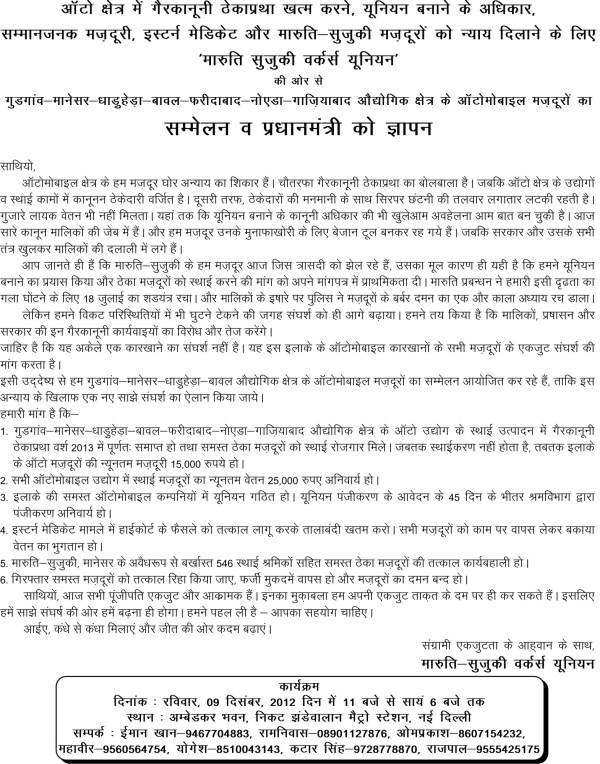
MSWU: DILLI CHALO!!! Against Police Repression on Auto Workers Convention

As you know, we from Maruti Suzuki Workers Union (MSWU) have called for an Auto Workers CONVENTION on 9th December 2012 in Ambedkar Bhavan, Jhandewalan, New Delhi with common demands of auto workers in NCR industrial belt.

This program with our legitimate demands has been declared one week back, for which we have given due information for permission to the PMO and the Paharganj police station and have received copies of the same. But Haryana and Delhi government administration through the use of Police of both the states, along with CID Haryana has come down heavily on us for raising our legal and legitimate demands. They have denied us permission to hold the Convention in the evening today with the imagined reason that this will disrupt peace in the area. And since last two days, Haryana Police and CID has been calling on us and our parents and relatives to strongly threaten against holding this program and any such program in the future, or force will be used against us.

We condemn this direct attack on our democratic right guaranteed under the Indian Constitution by the joint forces of Haryana and Delhi government administration through the naked use of force in the service of the Maruti Suzuki management. And with what we have seen in the last four months, this is nothing new to us now, as the police and government administration have nakedly sided with the company management in their attempt to crush our voice of truth.

We appeal to all concerned with democratic rights and our just struggle to stand by us as we will go ahead with the declared program tomorrow and similar programs in the near future.Our fellow workers from across Gurgaon-Manesar-Dharuhera-Bawal-Noida-Faridabad-Ghaziabad industrial belt will join us and strengthen our struggle.

Condemning the police and administrative action against us, we reiterate our demands:

1. In the permanent nature of work in the auto sector in Gurgaon-Manesar-Dharuhera-Bawal-Faridabad-Noida-Ghaziabad industrial region, completely abolish the illegal contract worker system by the year 2013. Till they are not made permanent, all workers in the auto sector in this region should be given minimum wage of Rs.15,000.

2. All permanent workers in the auto sector must be given minimum wage of Rs.25000.

3. Unions must be formed in the auto belt industrial region. Within 45 days of application for registration of Trade Union, the concerned labour department must ensure the registration of the Trade Union with due process.

4. The High Court order in favour of workers of Eastern Medikit must be immediately implemented and the illegal lockout be ended. Take back all the workers of Eastern Medkit and ensure payment of due wages.

5. Along with all the 546 illegally terminated workers of Maruti Suzuki Manesar, all the contract workers must be immediately taken back to work.

6. All the arrested workers of Maruti Suzuki Manesar must be immediately released, the false cases withdrawn and stop the repression and torture of workers.

Sincere Regards,

Provisional Working Committee
MARUTI SUZUKI WORKERS UNION

 Program details:

Date: 9 December 2012; 11am to 6pm.
Place: Ambedkar Bhavan, Panchkuiyan Road, near Jhandewalan Metro Station, New Delhi

Contact: Imaan Khan-             09467704883      , Ramnivas- 08901127876, Omprakash-08607154232, Mahavir-09560564754,Yogesh-             08510043143      , Katar Singh-09728778870, Rajpal-             09555425175

Caution and Excitement in Early Modern Studies

Prasanta Chakravarty

Who would have thought that Stanley Fish’s most prescient pronouncement about discourses of theory would emerge not in a fat tome but in the form of an essay in the Chronicle of Higher Education. In July 2005, Fish had proposed rather accurately that following the death of Jacques Derrida, religion would be “where the action is”. Fish’s speculations were based on his observations of how certain variants of poststructuralism and new historicism were working rearward against disenchantment and the critical secularisation thesis. But more prophetically, he foresaw how religion was supplanting “the triumvirate of race, gender and class”. All kinds of sceptics seemed to him to be on one side — and a resurgent fideism on the other.

The map of early modern western cultural criticism is indeed being recast. The struggle between the historicising and textual scholars of early modernity that marked much of the later decades of the twentieth century is getting reshaped again. Some of the developments are very exciting and innovative.  Even as we are living through these stages, it would not be a bad idea to take stock of the theoretical predicament. A stock-taking is also necessary in order to assess what it means if we indeed depose/supplant (or radically modify) certain motifs, themes and framings so that we may think afresh. Most importantly, a survey of the current engagements with the early modern world gives us some vital clues about our own times.

Much of what is new in early modern English studies actually overlaps. So, it is not wise to generalise too quickly about their discursive frameworks in isolation.  For instance, post-phenomenology and affect often work in tandem with animal theory or ecocriticism. Likewise, new ways of looking into subject formation relates to radical communicative theories.  Then there are breakthroughs in genre theory, aesthetics and poetics: no doubt the return of philology (in considering early modern texts, editorial practices, translation and new media) remains an important mode of scholarship. The spectacular rise and consolidation of a whole field called the ‘history of the book’ shows how resilient and robust philology (with able assistance from New Historicism) has been in the bastions of early modern establishment. But it is also being confronted.

The Transcendental Turn

Let me continue with religion, however. Because since, paradoxically, framing a text or a problem through religion also challenges philology and the agonistic world of studia humanitatis along with Enlightenment projects like Marxism, race theory and other historicist ventures, it is important to understand its underpinnings.  When one questions the secularisation of our worldview (with Gadamer or Charles Taylor), or addresses ethics (with Levinas and Eagleton), considers poetics (with Hawkes and Schwartz) or theologises politics (Zizek, Agamben or Kantorowicz) — one brings in certain concerns that would fundamentally unsettle Edward Said’s powerful distinction between secular and religious criticism. When he made that distinction, Said was not only questioning the dangers of getting into fideism, but was making a crucial methodological point: that secular philology is rigorous, diligent, open and invested in its subject matter the way religious criticism is not. Religious criticism seeks premature closure, supplication and always operates contingently and schematically. If we note carefully, we see that all the above thinkers are contravening this very claim of Said, putting his neat binary to test. They are saying in their collective weight: look, do not convert the struggle against what the Enlightenment designates as ‘fanaticism’ into a project of moralisation. Secular criticism can never understand possibilities of radical communitas, sublimity, trauma, radical risk, quiescent anarchism, spirits, fortuitousness and so on — numinous ruptures all. This is because secular criticism condemns fanaticism in the name of practical-ethical consequences, not in the name of any definitive falsity of its contents. They are saying that scholarship is not about mastering this techne or that archive. It is not about turning oneself into Chaucer’s gaunt clerk — like a Friar in the Lent. It is rather about generosity and relatedness to life. To learn to think beyond texts and evidences if you are to appreciate the texture of the early modern sensibility. Most of all — to abandon scepticism (also known as criticality).

One of the better secular humanist responses to this challenge is that humanism has always considered the irrational element without assuring its retrieval and recovery; that the secular world itself is a product of the religious cosmos: saecula and salvation go hand in hand. The sacred and the profane are experienced in historical time with neither side getting any logical priority. Humanists would put the issue differently: that since it was impossible to think outside of religion in early modernity, the philologists concentrated on recovering the pagan, secular and ancient texts. Such scholars gave attention to the specificities of the ancient world. In a beautiful passage, William N. West has recently summed up the humanist response thus:

Divinitio is something like the philologist’s last resort, a best guess at a reading of a text in the absence of decisive evidence. It is also, despite its name and because it proceeds ‘not by the authority of antiquity but by conjecture’, something like the mixed art of philology at its purest…where certain knowledge cannot proceed, the philologist makes a choice based on whatever signs he can. But unlike the revelatory promise that marks the advent of the religious, these signs originate within the horizons of the text. Philological divinitio relies on human intuition rather than on divine intervention…”.

The secular endeavour then comes to the aid of the sacred in order to restore the text. Religion stands beside the recorded and interpretative texts and not beyond them. Humanism, in spite of its many debts to the religious, does not venture into the revelatory and the incommunicative.  It continues to tread scholarship with the likes of Said and Gentile.

What philological humanism resists is the acknowledgement of the tremendous power and force created — often deeply conceptual — when historicism and the theological temperament come together. Consequently it does not confront religious fundamentalism or theological radicalism.  Since they pay lip service to divinitio proper, the motivations behind evangelism and forms of radical heresy — so central to understanding the early modern world — completely evade them or are at best filtered through the safe and detached world of textual parsing. There have been some fine studies of core and canonical Renaissance texts (even if we leave aside pamphlets, broadsides, history and modes of prophecy) taking head-on the questions of the revelatory, the intangible or the divinely authoritarian. The historically positioned studies are also deeply invested in the close study of the texts themselves and other cultural artefacts, but not ever in a disinterested manner. Cynthia Marshall, David Norbrook, Ken Jackson, Julia Lupton, Sarah Beckwith — to name a few, have come out of the humanist shell and have confronted the religious questions squarely. With religion, other intangibles have again become part of scholarship: imagination, sublimity, or wrath, for example.

For the theoretical world, this creates a curious problem. On the one hand, it seems vitally important to confront religion afresh in order to have a surer handle on the period, while on the other if religion assumes a certain genetic persistence, a name for totalising the early modern world, it becomes a high-fidelity replicator unto itself. In other words, its historicising and analytical potential gets engulfed by its own fervour.  It will then tend to replace the very historicity that it espouses — contra textual criticism. The core question is whether as interpreters we can and ought to transcend modern forms of scepticism and evade the anthropologist’s gaze while getting into things theological? As long as we remain professional and detached even as we cultivate a faux theological sensibility, intangibles like love or religion are perhaps better left alone. On the other hand, if we are able to traverse the ground of realising the temperament of the evangelical, the fanatic, the communal or the radical heretic in actuality even as we delve into the early modern cosmos, we run the risk/potential of turning our institutions into seminaries or secret societies, into hotbeds of non-secular experiments; our research projects into single-minded programmes of conversion, fanatical and/or radical. Perhaps that risk is worth taking, without compromising on scholarly rigour. But let there be no mistake: the price has to be paid too — the price of principled partisanship.

Mind, Matter, Metaphors

In some ways a very contrary spirit suffuses the conceptual world of the early modern, one that is actually bridging the two-culture debate: the challenge of cognitive and functionalist science on the claims of social constructivism. Steven Pinker says that culture is a part of human phenotype — a distinct design that permits us to survive and perpetuate our lineages. Are we returning to behaviourism or social Darwinism? Not really. Far more sophisticated variations are making the rounds.

One argument is that in order to do good cultural studies one must consider the aggregate creativity of minds that gives rise to the cultural contexts. Only by understanding such detailed patterning can one more minutely observe trade histories, rise and fall of literacy, economic changes and art production and circulation. The smarter cognitive theorists are trying to combine the realist (say Marxist) and the relativist (say postmodernist) positions: reality exists but humans can access it contingently because experience is mediated through bodies, brains, minds. An aggregate of minds means society or culture. The important change from old-school behaviourism or pure memetic studies (which believes cultural broadcast expresses genetic transmission) is an acknowledegment that forms emerge from the subject’s material situatedness. But only if such situatedness is mediated through a dynamic semantic system, which germinates from within the human conceptual apparatus.  This approach in early modern scholarship has been christened the dual-inheritance theory.

A typical manoeuvre to enact such cognitive patterns in literary criticism is to choose a conceptual metaphor from a text and instead of going into a formalistic, new-critical exposition of that metaphor, to find the motives of the ‘embodied mind’ in forming the metaphoricity of that textual utterance. Such cognitive metaphors then become image schemas. For example, suppose you zero in on the metaphor — “Love is Money” from The Merchant of Venice and then instead of the typical new historicist move of perorating on the semantics of usury, contractual bonds, credit system or accounting practices, you simply concentrate on the elisions of ‘love’ and ‘flesh’ in that metaphor and work on these two different aspects of human experience — modes of affection and financial obligations. By doing this, you avoid the projection of such metaphors into the cultural field and yet keep clear of philological preoccupations and hermeneutic questions of intentionality. Instead, what you bring together is a curious coupling of semantic frameworks and cognitive science terminologies in deciphering the text. I am using the word text (or author) in the singular because there is often an inherent Kantian-individualist bias in these critical moves. The critics working in these areas like to believe that characterological  and textual unity was as important to early modern writers as they ought to be to us — and that this should inform our textual theory. Here is Gabriel Egan, a familiar voice in Shakespearean scholarship, taking on New Historicism:

“It is true that we do not possess a manuscript recipe for Shakespeare’s Hamlet, only three copies of it that differ markedly. But we are entitled to treat these at three approximations of one thing, the Platonic Ideal of Hamlet as it existed (in material form, as configurations of neurons) in the mind of Shakespeare. If, over time, Shakespeare changed his mind about Hamlet, it is still conceptually Hamlet even if a text closely representing the conceptual state of time T1 is quite different from a text closely representing the conceptual state of time T2.”

The philologist will have to decide what to make of such a claim. While it gives intentionality, a key philological concern, a positive tack (though coming from genetics rather than hermeneutics), the approach squarely seems to challenge some key motives behind the whole enterprise of book history and archiving as it has developed — another major preoccupation with the philologist. The historicist — realist or radical — on the other hand has much to worry about with this new phenomenon.

The Mood: Anti Historicist

At one level, this new-found interest in matter (sometimes drawing justification from the likes of Democritus, Lucretius and Epicurus) is hardly new. The scientific and sensory empiricism of Gassendi, Bacon, Hartlib and later Hobbes had strongly contested varieties of Platonic idealism and Puritanical forms of Christianity. Mandeville, Ricardo and Adam Smith gradually gave the same tendency a more rational economic dimension. Darwin and Gregor Mendel gave the impulse an evolutionary imprint. These are the most powerful scientific essentialists in the rational sense. Matter is a given to them, timeless and ever present in order to help maximise our inherent economic and biological hierarchies.

It is in this context that radical historicists and cultural materialists brought a gauchiste historicism into the picture and politicised the field. Matter meant paying attention to class, gender, race, colonialism and sexuality. They were/are interested in social relations. The spectacular rise of sociology as discipline that took on diachronic philological-historical concerns reflected a shift in studying early modern materialism: the works of Keith Wrightson or David Underdown, for instance, opened before us the world of sociological stratification and power struggles in the English society. Important and powerful historians of the Catholic world like Eamon Duffy or John Bossy had to tackle this left liberal historicism. But even they were not arguing for any surpassing transcendence; they were historicising the domain too in their own way, looking closely at the lay popular culture. The inheritors of Lawrence Stone and Christopher Hill took many hues, but the debates were richly contextual, analysing textual claims minutely. Never in a speculative vacuum. Forces of disorder always vied with disciplining possibilities — even in the most inward genres like the psalm or meditative poetry. One glance at the works of some of the most defining non-ideological early modern scholarship in late twentieth century authenticates to this rumbunctious rough and tumble, the attention paid to the difficult give and take between the public and the private realms: reflected, say, in the oeuvre of Nigel Smith or Catherine Belsey or Peter Lake. Postcolonial studies too had an oblique impact on this area—for instance, one was forced to acknowledge that John Milton and Andrew Marvell had little positive to say about the Irish struggle and viewpoints during the English Civil War. Republicanism did have a strong imperialistic side to it.

Mainstream liberals finished that job. That mood has now given way to the more ameliorating travel technologies and experiences — say, in the contemporary works of Allison Games. This agonistic reaching-out gesture is a top-down and faux cosmopolitan globalising venture — something that reminds us of the old commonwealth in new disguise. To merely highlight maritime and navigational advances and leave it all hanging is to suppress the blood and grime of the early modern world, its conflicts and contestations.

The fact of the matter is that the benefits of cultural or left-wing radicalism in early modern studies were derived not from materialism, but rather from historicism. Idealist history could also locate its objects of study within their contingent circumstances, as could materialist history. But such idealism was not festishising matter for its own sake or championing evolutionary psychology. It had an old-world political agenda. What has altered right now in discussions on cognition, matter or objects is the philosophic underpinning of what constitutes matter.  Matter is dehistoricised in most accounts now. And therefore, formulations on matter now seem closer to disinterested rationalism and finally suspiciously chummy with newer modes of capitalism. No wonder there is next to nothing from the new materialists on early modern underground prose, sermons, pamphleteering, news-books — the whole public sphere, so to say. It is simply impossible to get into the civic and underground world of urban polemics and itinerant preaching without getting into the ‘old’ cultural questions of class, gender, colonialism and sexuality.

Some variations of cognitive studies of early modernity do wish to reconceive the study of the mind within a relational, dynamic nature of culture but that is mostly an afterthought. It does not really work. Even the most powerful of the philosophical new (speculative) materialists — like Quentin Meillassoux, who has truly and successfully taken on an earlier generation of French theorists — have not been able to historicise his project or rather does not wish to do so. He argues instead for the timelessness of materiality. And it is here that the most regressive potential of the new conceptual moves lies: transcendental piety and matter/mind are being essentialised and ossified in new forms. They are apparently the perfect antagonists — spirit and matter — but scholars in both areas are getting into speculative tropisms in their own ways. The antagonists seem to have a strange affinity as only antagonists can have.

So also with theorists of object like Michel Serres or Levi Bryant. Objects are made incandescent. They are often aestheticised beautifully. But what next? Disinterested scholarship? To highlight the subject/object division afresh? It is a sort of revenge on half a century of realism and relativism in the world of ideas. True, sometimes such materialists make the radical Spinozian/Bergsonian move, a position that might sit well with heresy studies, for instance, if historicised properly. But if scholars carry on arguing for heterogeneous temporalities within material objects and use Bergson and Nietzsche for actually driving home a Kantian cosmopolitan mobile network in the early modern context, it loses zing. Such framing does serious disservice to the spirit and politics of the robust and hedonistic Nietzschean imagination.

The resurgent schools of thought — theological transcendental, cognitive metaphorical or object-oriented rematerialisms – are significant new developments in the conceptual world of early modernity. They have to be noted. With due caution. In other words, in our romance with faith and matter or any such ‘hot topic’ — let us not, ever, abandon the excitement and rigour of the sceptical spirit.


Select Bibliography:

Fish, Stanley, ‘One University, Under God?’, Chronicle of Higher Education, 1 July, 2005

Jackson, Ken and Arthur F. Marotti, ‘The Turn to Religion in Early Modern Studies’, Criticism 46 (2004), 167-190.

Lupton, Julia R. ‘The Religious Turn (to Theory) in Shakespeare Studies’, English Language Notes 44:1 (2006), 145-149.

West, William N., ‘Humanism and the Resistance to Theology’, The Return of Theory in Early Modern English Studies: Tarrying with the Subjunctive (ed. Paul Cefalu and Bryan Reynolds, Hampshire and NY: Palgrave Macmillan, 2011).

Victoria Kahn, ‘Early Modern Secularism: Introduction’, Representations, Special Issue, Winter 2009.

Pinker, Steven, The Blank State: The Modern Denial of Human Nature (New York: Penguin Books, 2002).

Blackmore, Susan, The Meme Machine (Oxford: Oxford University Press, 1999).

Lakoff, George and Marc Johnson, Metaphors We Live By (Chicago: University of Chicago Press, 1980).

Jowett, John, Shakespeare and Text (Oxford, UK: Oxford University Press, 2007).

Reynolds, Bryan and William West (eds), Rematerializing Shakespeare: Authority and Representation on the Early Modern Stage (Basingstoke: Palgrave Macmillan, 2005).

Carroll, Joseph, ‘Evolution and Literary Theory’, Human Nature 6 (1995), 119.

Hawkes, David, ‘Against Materialism in Literary Theory’, The Return of Theory in Early Modern English Studies: Tarrying with the Subjunctive (ed. Paul Cefalu and Bryan Reynolds, Hampshire and NY: Palgrave Macmillan, 2011).

Smith, Nigel, Perfection Proclaimed: Language and Literature in English Radical Religion 1640-1660 (Oxford: Oxford University Press, 1989).

Games, Allison, The Web of Empire: English Cosmopolitanism in an Age of Expansion 1560-1660 (New York: Oxford University Press, 2008).

Meillassoux , Quentin, After Finitude: An Essay on the Necessity of Contingency (London: Continuum, 2008).

Prasanta Chakravarty is the author of Like Parchment in the Fire: Literature and Radicalism in the English Civil War (London and New York: Routledge, 2006). He teaches early modern literature and culture at the University of Delhi.

Maruti Suzuki Workers Union: On the Automobile Workers Convention (December 9)

This convention is being organized to express the legitimacy of the struggle waged by the workers of Maruti Suzuki, Manesar in the last one and a half years under the leadership of Maruti Suzuki Workers Union, for which we have come under constant attack, conspiracy and misinformation campaign by the management aided by the government and administration of Haryana.

As you all know, our struggle in Maruti Suzuki Manesar started with our demands for our legitimate trade union and constitutional rights. But just when we raised our voice in demanding our right to Union formation, and also raised the question mark on the illegal practice of contract worker system in the factory, the management started a full-fledged attack on us workers, and as we learnt during our struggle, the company management will go to any lengths to crush our legitimate voices.

In the space of these one and a half years, we have closely seen the real anti-worker face of those in power. We have seen how the government of Haryana and its administration has openly colluded with the management of Maruti Suzuki to safeguard the interests of Maruti Suzuki company-like big capitalists, to wage a battle, nay a war, against the workers. We have no doubt now, after having seen all this, that the incident of 18th July has been orchestrated to serve this war against the workers.

Not satisfied with this, the government machinery has for the last 4 months after 18th July 2012, ensured full cooperation with the management of Maruti Suzuki and made sure that we are given no space at all to raise our voice any further, first with police torture and even shrinking all legal avenues open to us. The 149 workers languishing in Gurgaon Central Jail for more than 4 months now have all the legal right to getting bail, but the state has put all its weight to ensure that they are denied bail and continue to be treated as criminals. On 4th December 2012, all 15 workers (mostly contract workers, who do not even have their names in the original FIR) were denied bail, when all evidence suggested otherwise. But this kind of arrogant and corrupt attitude of the management and the government has only made our resolve to wage our legitimate struggle even stronger.

During the entire phase of our struggle, we have learnt that this kind of corrupt antidemocratic worker attitude and open flouting of all labour laws is not only limited to our Maruti Suzuki but this is the general condition of all workers in the entire auto sector of industry. So to raise the demand of Union formation and to point out the illegal practice of contract workers system under which contract workers in the entire industrial belt in the NCR region are exploited, all of us workers must be united and highlight the legitimacy of our struggle in society. We know that this is a difficult road, full of challenges, but having seen and suffered the inhuman and illegal attack and suppression of our voices and demands, we are accepting this challenge and take a vow to take our ideas and to all the workers of the entire NCR industrial belt.

We once again reiterate our demand to immediately take back all terminated workers and release all 149 arrested workers of Maruti Suzuki Manesar. We want to return a healthy working atmosphere to the company through negotiation and dialogue, but on respectable and dignified terms and not on the conditions of slavery that is being imposed on us. Along with this, we are also raising our voice against the open loot by capitalists in Haryana and flouting of labour laws, and resolve to wage our legitimate struggle by uniting all auto workers of the region. As part of this, we are organizing a
Convention to make manifest our resolve, and call upon all members of the press to this Convention.

We demand that:

1. In the permanent nature of work in the auto sector in Gurgaon-Manesar- Dharuhera-Bawal-Faridabad-Noida-Ghaziabad industrial region, completely abolish the illegal contract worker system by the year 2013. Till they are not
made permanent, all workers in the auto sector in this region should be given minimum wage of Rs.15,000.

2. All permanent workers in the auto sector must be given minimum wage of Rs.25000.

3. Unions must be formed in the auto belt industrial region. Within 45 days of application for registration of Trade Union, the concerned labour department must ensure the registration of the Trade Union with due process.

4. The High Court order in favour of workers of Eastern Medikit must be immediately implemented and the illegal lockout be ended. Take back all the workers of Eastern Medkit and ensure payment of due wages.

5. Along with all the 546 illegally terminated workers of Maruti Suzuki Manesar, all the contract workers must be immediately taken back to work.

6. All the arrested workers of Maruti Suzuki Manesar must be immediately released, the false cases withdrawn and stop the repression and torture of workers.

Provisional Working Committee
MARUTI SUZUKI WORKERS UNION

Program details

Date: 9 December 2012; 11am to 6pm.
Place: Ambedkar Bhavan, Panchkuiyan Road,
near Jhandewalan Metro Station,
New Delhi

Contact: Imaan Khan- 09467704883, Ramnivas- 08901127876, Omprakash-
08607154232, Mahavir-09560564754, Yogesh- 08510043143, Katar Singh-
09728778870, Rajpal- 0955542517

Automobile Workers’ Convention (December 9, New Delhi)

Maruti Suzuki Workers Union has called a convention of automobile workers in the Gurgaon-Manesar-Dharuhera-Bawal-Faridabad-Noida-Ghaziabad industrial belt to demand organising rights,  respectable wages and working conditions, to oppose repression of workers and the contract labour system.

December 9, 2012
11 am-6 pm

Ambedkar Bhawan (Near Jhandewalan Metro Station),
New Delhi

maruti-suzuki-trade-union3

Blind Workers rally against labour rights violation by “welfare NGOs”

On the occasion of the World Disabled Day Blind Workers took out a huge rally at the Parliament Street against violation of labour rights by NGOs and Government connivance.

Ministry of Social Justice and Empowerment warned of intensified agitation and struggle if it does not provides employment at the earliest.

On the occasion of World Disability Day, blind workers under the banner of the Blind Workers’ Union took out a huge rally of blind workers regarding the entrenched problems faced by the disabled in the labour market, and towards the unfulfilled promises of the Social Justice Ministry to provide alternative employment to the disabled (in particular, the retrenched workers of National Federation of the Blind) in government undertakings. It is to be noted that since November of 2011, the blind workers have been protesting the retrenchment of several blind workers by the National Federation of the Blind (NFB). This NGO retrenched the workers because they were speaking out against denial of minimum wages and other basic labour rights in the Training and Rehabilitation Centres (TRCs) run by the NGO. The blind workers have highlighted again and again how the Federation has been violating all statutory labour laws at its different production units. In fact, rather than minimum wages, the workers employed across NFB production units were being forced to work on the basis of a production-wage structure, which provides them barely Rs. 2600/- per month. This was way below the rate of minimum wages. The protest also raised the need for the Government to provide alternative employment for the disabled. A delegation of blind workers also submitted a memorandum of demands to the Ministry of Social Justice.

In the memorandum we raised the concerns of the blind workers and how they have been forced to become beggars in the absence of any employment. Also it is deeply disturbing that despite making several representations to the ministry these blind workers still await justice. For example, the Ministry has yet to take stern action against the National Federation of the Blind (NFB), which has entrenched large number of blind workers from its various Training and Rehabilitation Centres (TRCs) in October 2011. Neither has the concerned Ministry fulfilled its assurances of providing alternative employment to all the blind workers retrenched by the National Federation of the Blind at the government sponsored NGO, Arunim. Furthermore, discussion on and clauses in the pending Bill on the Rights of Persons with Disability (2011) continues to lack any serious engagement on the question of protecting the labour and economic rights of disabled persons employed in the private sector (i.e. by NGOs and private businesses). For us, such failure of intervention by the Government amounts to reducing World Disability Day to a day of pomp and show with no actual commitment towards upliftment of disabled workers through protection of their basic labour and economic rights like the right to gainful employment, right to equal remuneration, right to daily minimum wage, right to the eight hour work day, etc.

We also pointed out during the rally that our struggle is not just against the NFB, but against the overall exploitation of blind workers across the country by private companies and NGOs. It is an undeniable fact that in the interest of availing of certain benefits like tax exemption for employing persons with disability, the private sector is known to employ yet brutally exploit disabled persons. The arbitrary hiring and firing practices, unregulated working hours, etc. prevalent in the private sector, amount to a serious breach of social justice, which is why the blind workers have been approaching the Ministry of Social Justice and Empowerment. More importantly, the workers realize that the failure of successive governments to provide adequate employment to the blind community is the main reason why blind workers are dependent on the highly exploitative private sector.Hence, our struggle is based on the fundamental right to a livelihood—a right the Government is to protect and uphold. The specific demands that the blind workers put forth in the memorandum include the following:

(i)                 Inclusion of a special section in the long pending Bill on the Rights of Persons With Disability (2011), which would safeguard the economic rights of blind workers employed in the private sector. For example, the Bill should include provisions to the effect that bodies violating basic labour rights will be penalized to the effect that NGOs indulging in such violation will face the cancellation of their registration;

(ii)               That the Ministry of Social Justice and Empowerment tables a concrete plan of greater job creation for blind persons in the public sector. It is only with the provision of more government jobs that the dependence of blind workers on exploitative private companies and corrupt NGOs can be overcome;

(iii)              That the central government stops funding NGOs who fail to comply with the country’s statutory labour laws while employing people;

(iv)             That the central government ensures that blind workers are given parity at workplaces and are paid minimum wages;

(v)                That the central government ensures all statutory labour laws are implemented in production units run by “social service” organizations like the NFB, as well as in workplaces run by other employers;

(vi)              That the central government takes over the production units run by NGOs like NFB, in consequence of such NGOs repetitively failing to provide proper employment and conducive work conditions for physically handicapped workers;

(vii)           That the retrenched workers of NFB be provided immediate employment either in Arunim or any other government-funded institution/workshop.

The blind workers have warned that the ministry must take immediate steps to provide employment. The inaction of the ministry will compel us to intensify our agitation and movement to expose the Government’s lack of commitment towards protecting disabled workers’ statutory rights.

Thanking you,

Alok Kumar                                                                                                         Ramnath

(On Behalf of Blind Workers Union)                                                       (On Behalf of Blind Workers Union)