Maruti Struggle: National Protest Day (February 5)

As you are well aware, we workers in Maruti Suzuki India Ltd., Manesar, Gurgaon are waging a struggle against the exploitation and injustice heaped on us by the company management, state administration and the government. Our only crime has been that we have dared to raise our voice for the demand of formation of Union and against the illegal practice of contract workers system.

Since 18th July 2012, after the unfortunate incident in the factory premises as part of a management-woven conspiracy, we workers have been continually facing the brunt of repression. The company-management has at once terminated the jobs of over 1500 contract workers along with 546 permanent workers. They have, with the help of the state administration, heaped fabricated cases ranging from arson to murder on 211 of our fellow workers, while 149 workers, including our entire Union leadership, continue to languish in Jail for the last 6 months. Keeping aside all legality, workers and our families have continuously faced brute police atrocities.

We have chosen the path of struggle against this repression and injustice. In the past 6 months, even when faced with various state administrative blockades and repression, our spirits are unfazed and our movement is raging on. One of the reasons that we are able to sustain this struggle is also the solidarity and support that we have continued to receive from various workers organisations-trade unions and pro-people forces. But to take the struggle forward, we require more support and solidarity from your side.

In this stage of the struggle, we have decided that on 5th February 2013, Tuesday, there be a all-India day of solidarity action, demonstrations in our support and on that day itself, a memorandum also be sent addressed to Chief Minister of Haryana. We not only hope but trust that we will get your full solidarity once again. Against the nexus of company-management and state power, the protest of our pro-justice and class unity shall reach the deaf ears of those in power.

With revolutionary greetings,
Imaan Khan, Ramnivas, Omprakash, Mahaveer, Yogesh, Katar Singh, Rajpal
Provisional working Committee
Maruti Suzuki Workers Union

For the memorandum on 5th February 2013:
Address/Ph. No./Fax No. of Sh. Bhupinder Singh Hooda
Sh. Bhupinder Singh Hooda
Chief Minister, Haryana
Office: Room No. 45, 4th floor, Civil Sectt., Chandigarh, Haryana.
Ph No. 0172-2749396/2749409 (O); 2749394/2749395 (R)
Fax: 2740596; EPBAX Ext. 2401, 2402
Residence: Kothi No. 1, Sector 3, Chandigarh
MARUTI SUZUKI WORKERS UNION: Condemn state repression on Justice Rally

Friends,

We from the Maruti Suzuki Workers Union (MSWU) and our families continue to face not only an exploitative company management but also continous state repression since we started our agitation demanding justice and legitimate rights of workers.

This morning, Imaan Khan, one of the members of the Provisional Working Committee, MSWU, was picked up by the Haryana police while a Press Conference was underway, from outside the union office of Sarva Karmachari Sangh in Civil Lines, Gurgaon near Puspanjali Hospital.

This press conference and other such programs are being organized as part of the week-long ‘JUSTICE RALLY’ through the villages and cities across Haryana from 21st January 2012 to culminate in a Dharna in Rohtak on 27th January.

Also today morning, one of the teams of the state-wide jattha which started from Rewari yesterday and were starting from Dharuhera today, was also harassed, intimidated and finally forcibly picked up by the police from Bilaspur- all 20 workers’ cycles were dumped into police vehicles and dropped off to a village in Jhajjhar. When the workers valiantly resisted these repressive tactics by laying on the ground and holding on to each each, the police used force to remove us and gave threat of arrests and torture if we enter Gurgaon.

Before this, on 22nd and 23rd January, police tried raiding our Union Office and threatened workers and their families of further arrests and torture if we dare to continue with our agitation. Besides our 149 fellow workers who continue to languish in jail for the last seven months, non-bailable arrest warrants against 66 more workers have been slapped on whom police repression is continuous. 546 permanent and 1800 contract workers have been terminated from our jobs.

We strongly condemn this continuous use of brute police force on workers and our families and anti-worker stance of our elected representatives, which is showing how nakedly the state is working to maintain the injustice and exploitation by the management of Maruti Suzuki company. It is our democratic right to protest, and we demand the immediate release of Imaan Khan, MSWU Provisional Working Committee member, and stop to further harassment by the police on our justice rally for Rohtak 27th January.

Ramnivas, Omprakash, Mahavir, Yogesh, Katar Singh, Rajpal

on behalf of Provisional Working Committee

MARUTI SUZUKI WORKERS UNION

Two Films on Antonio Gramsci

GRAMSCI: EVERYTHING THAT CONCERNS PEOPLE (1987)

The film Gramsci: Everything that Concerns People (1987) is now available on YouTube. The film was made for Channel 4 (Scotland) by Mike Alexander and Douglas Eadie, with Tom Nairn and Hamish Henderson as consultants.


Giorgio Baratta’s NEW YORK AND THE MYSTERY OF NAPLES: A JOURNEY THROUGH GRAMSCI’S WORLD

Correspondence (Distance Education) Students’ Rights Rally (Jan 21 @10 am, Delhi University)

Protest Rally (from Arts Faculty to VC Office),

Delhi University 

Jan 21 (Tomorrow, Monday), 10.00 am

We, the students of distance learning mode (Delhi University) have come together and launched a campaign that presses for equality of opportunity and dignity. For a long time we have been treated like an underclass in the very institutions of learning that are run through public money raised by our parents’ contribution to the coffers of the state, that is, through the sweat of their brows. We are the children of factory workers, farm hands, office orderlies, coolies, truck drivers, etc. who labour hard through most of the day and all the year round so that our society may prosper. We, the children of the wretched of the world, constitute the majority of every society in the world and yet we are the ones who are denied basic human comforts and dignity.

As we grew we soon realized that we are ruled by a state which demands every sacrifice from us but does not grant us any of our claims. From the early days of our childhood we have learnt the meaning of and are informed by the simple dignity which comes from a day’s toil and hardship. We have grown up watching children of our age play while we worked in their houses; we watched them pay more money as school fees than our parents make in a year. We went to schools run by the government for our ‘welfare’ but found teachers missing. We realized that life is not fair (to some) but that it shines benevolently upon some. Chubby princes and spoilt sweethearts are nurtured to be leaders of our (society?) and us, while we are conditioned to serve them.

It did not take long for us to realize that the world is not fair, but we did not let hope die, mainly because our parents believed in us. We have and continue to watch them sacrifice every small comfort to send us to school, (though it was not always possible). We have watched their eyes brim with dreams and hopes that one day we too would be able to join the ranks of the ‘born’ leaders. Though it was not always easy, we have kept the hope alive, only to see it shatter on passing out from our schools. There is a cut-off, we realized, meant to keep us from gate crashing into the ranks of those ‘born to lead’ and from spoiling their party. We realized that there is no way we could compete with the ‘bright ones’ who paid a fortune to enter the hallowed campuses of well known private schools of Delhi. Their teachers spoke fluent English, they had the latest e-gadgets to educate them, air-conditioned class rooms (and buses), home tutors and above all full stomachs. We were never meant to win for their parents and the state through its dual education policy had caused them to become ‘destined’ to win even before the race could begin.

Naturally, very few of our friends managed to cross the iron curtain of the cut-off marks—it remains to be seen, how long they would survive. But most of us were left out in the cold, hapless and teary-eyed, our tears draining away our parents’ dreams. It was then that we got to know from our benevolent rulers that there was some hope still. We could still be a part of the distinguished Delhi University through the distance learning program. The syllabus would be the same and teachers from DU would teach us. We cheered up and told ourselves (and our parents) that there is hope indeed—if Ekalavya could do it in Mahabharat, we could do it too. But alas, in hoping against hope, we forgot the eventual fate of Ekalavya, it dawned upon us gradually. We were being given classes once in a week and that too if we were lucky. Our teachers were mostly the ones who had missed the bus, and were teaching us as a compromise. The officials barked orders at us, talked to us as one would talk to somebody who is dimwitted; the security staff scoffed at our presence on campus on Sundays (the only day of the week we are allowed to ‘defile’ these hallowed shrines of learning). We were chased out of the campus as soon as our classes got over. The University did and does everything that it could/can, to convince us that we do not belong here. We were given the message that we were here only at the sufferance and burden of the University, and that we ought to consider ourselves lucky for the crumbs thrown at us in the name of ‘public welfare’. We could only seethe in anger and clench our fists, because we were alone in the crowd, we were just individuals trying to make the best of whatever little we had.

But now this is going to change. With our dreams shattered, dignities lost and our parents disillusioned, we have got little to lose. We have come together to put up a fight and with the intent of winning it at all costs. We, the children of India’s labouring class, the underclass of the University system and the pariahs to the ‘fashionable’ and ‘sensitive’ University community, hereby declare that from now on we are going to do everything within our capacity to shatter your peace of mind, your ‘solemn’ gravity and your vacuous sensitivity. We will not allow you, the ‘born leaders’ and your enlightened mentors to pity us, sympathize with us, or cast your benevolent glance at us. We want none of it, though we stretch out our arms to anybody who is willing to join us as an equal and to make a common cause with us. This is just our first step, a long journey lies ahead of us but we are prepared.

Prithvi

Convenor

Correspondence Students’ Rights Campaign

Contact: 9312654851

Supported and Organized by

Krantikari Yuva Sangathan (KYS)

For Amendments to Laws in Order to Create Safe Workplaces

As one month passed since the young physiotherapist was brutally raped in Delhi while traveling in a private chartered bus, working women who are frequently at risk on Delhi’s roads as well as in their workplaces, have been consciously raising the issue of how much more needs to be done to ensure safe and conducive work atmosphere for women. Nurses from across big hospitals in Delhi such as AIIMS (Delhi) held a peaceful protest rally in order to keep alive the issue of safety for women.  

Anxious about the daily risks they face while commuting to work as well as when at work in hospitals, women nurses strongly believe that existing laws regulating workplaces need to be re-assessed. Many of these nurses complain of harassment by patients’ visitors, as well as male hospital staffers. However, they felt that such sexual harassment was made worse by the fact that most of them were in highly exploitative work contracts. The simple fact that many private hospitals force their nursing staff to work extra shifts, do overtime, etc. and do not at the same time provide for something as basic as transportation to their women employees, is indicative of the conscious ways in which hospital managements’ are putting their women work force at continuous risk.

Many nurses employed across Delhi-NCR hospitals also complain that hospital bouncers are often used to physically and verbally intimidate nurses who speak out about unsafe and exploitative work conditions. In recent strikes in hospitals like Asian Institute of Medical Sciences (Faridabad) and Sharda Hospital (G. Noida), such private (male) security guards entered the nurses’ hostel attached to the hospital and physically threatened many nurses who were on strike. In such cases, the local administration and local police station have proved to be very lax in their response and are, more often than not, seen washing their hands off dangerous situations where the safety of working women is constantly at risk.

In this light, nurses and other working women are pressing the Government to properly regulate, or basically, to conduct a regular safety audit of workplaces across the city. Regulation of work hours/shifts given, creation of a safe atmosphere in and around the workplace, provision of written work contracts for all (even contractual and daily-wage) employees including women etc., are the need of the hour. It is through regular safety audits that the Government can assess whether such essential work conditions exist in workplaces or not. Moreover, in the light of how unregulated private transportation is in the Delhi-NCR region, working women across the city strongly feel that it should be made mandatory for all employers (private offices, hospitals, factories, etc.) and not just for owners of call centres to provide company transport. It is also necessary that better managed and more accountable public transport is brought in so as to replace various modes of private transport—a measure which will go a long way in ensuring safety of women commuters.

Lastly, the issue of regulating the functioning of police stations is also of major concern to women across the city. It is necessary that lodging of FIRs and placing of police stations under CCTV surveillance becomes a non-negotiable demand. It is extremely troubling that many women (including those who face sexual harassment at home and/or workplaces on a daily basis) are still afraid to file complaints with the Police, or have been turned away by police stations. Such negligence is a serious problem that has to be addressed immediately.

Maya John                                                                                       Ms. Tangama

Convenor, Centre for Struggling Women (CSW)               Vice President, Nurses’ Welfare Association

Contact: 9540716048, 9350272637 

A Review of Alf Gunvald Nilsen’s “Dispossession and Resistance in India”

Bhumika Chauhan

Alf Gunvald Nilsen, Dispossession and Resistance in India: The River and the Rage, Routledge, 2010

The book seeks to explore the processes of dispossession and the accompanying resistance within the context of post-colonial India, and more specifically that located in and around the NarmadaValley. Nilsen hopes to build this understanding on the basis of a perspective on social movements and struggles that is very different from those conventionally applied in the social sciences, and by most who have studied the movement around the Narmada, i.e. the Narmada Bachao Andolan (henceforth, NBA).

I

Developed out of his doctoral thesis, Nilsen’s book offers a vast and critical survey of much that has been said about the NBA along with ample information on the course of the two main and most controversial projects, the Sardar Sarovar Project (SSP) and the Maheshwar Hydroelectric Project (MHP). Supplemented with his own field notes, Nilsen is able to provide a picture in which one does not see only the costs and benefits of the projects, but also the class nature of the distribution of these costs and benefits, or what he calls the distributional bias of the post-colonial development project. Nilsen’s attempt considerably helps place the NBA and similar movements within the new social movements of India as well as within neoliberal restructuring.

dispossession-and-resistance-in-india

The main contribution of the book is perhaps the perspective it introduces into the social scientific discourse over social movements, particularly (and hopefully) into Indian social sciences. Nilsen rejects those perspectives that posit a social movement as a “fixed institutional entity” with a set of demands and means (p.4). Rather he looks at it as a collective action that gradually developed in “activist skills, practices, forms of consciousness and knowledge” (p.5). It is asserted that movements have internal processes of learning that are involved in initial mobilisation and further radicalisation. He also rejects the popular idea that social movements are organisations engaging in extra-parliamentary collective action within a more or less stable and given socio-economic background in favour of a broader and more dynamic view. For Nilsen:

“A social movement is the organisation of multiple forms of materially grounded and locally generated skilled activity around a rationality expressed and organized by (would-be) hegemonic actors, and against the hegemonic projects articulated by other such actors to change or maintain a dominant structure of entrenched needs and capacities and the social formation in which it inheres, in part or in whole.” (p.14)

It is asserted that sociality of praxis for the satisfaction of needs under the given level of capacity produces dynamic structures, which are reproduced over extended periods of time in accordance with extant relations of power between the “dominant and subaltern groups” within a social formation. Furthermore, praxis within this “structuration of need and capacities” (mode of production?) involves a constant contention between the dominant and subaltern social groups that embody the internal contradictions of the structures (classes?). These contentions may bring about changes in the dominant “structure of needs and capacities” and/or within the overarching social formation, therefore both groups are forever on the move, so to speak. This implies that social movements may happen from above or below. The author means to stress the fact that not only the subaltern groups but also the dominant groups engage in collective actions based on the dominant rationality to maintain or strengthen the dominant structure. It is the central argument of this book that the post-colonial development project and the ongoing accumulation by dispossession are part of a social movement from above, a result of collective action of the dominant social groups (p.13-14).

Significantly, the movement process is seen to start from the “common sense” of “concrete lifeworld in which people are situated”, the “particular as opposed to the universal” (p.193), and works outwards to the “good sense”, “local rationalities” and “militant particularisms” which transform the concrete lifeworld into a “locale or resistance”. The social movement project per se is said to emerge when a common ground is found between different militant particularisms through a “campaign”. This social movement project addresses the totality, the universal. Nilsen’s engagement then with the NBA starts from its constituent local mobilisations, their coming together and divergences, the formation of the NBA as a pan-state, anti-dam movement, its eventual questioning of the post-colonial development project. However, the project is not complete here (and here lies one of the key problems of the NBA according to Nilsen). Nilsen suggests that the few activists[1] who make the connection between the local conflicts and the universal structures that reproduce them – that is, they who have a political agenda against the totality – will have to convince others to come along. This can be accomplished only by grounding the social movement project again in militant particularism and local rationalities from whence it originated. This dialectic of the particular and universal that Nilsen tries to demonstrate in the, admittedly incomplete, trajectory of the NBA may provide some practical insights worth heeding.

II

An interesting, even brave, aspect of this work is its attempt to bring back concepts of class and class conflict in the analysis of the NBA, and other such movements in India. Nilsen takes note of the distributional bias of the SSP and MHP that constitutes accumulation by dispossession. It is precisely by situating this displacement within class relations that Nilsen demonstrates its nature as accumulation by dispossession and as a “social movement from above” (p.14). The distributional bias expresses a “dual transformation” where (a) property rights in water and electricity, as well as profitable investment opportunities are concentrated into the hands of regional, national and global propertied elite, and (b) the displacement of peasant producers from their land without adequate resettlement and rehabilitation generates pressures towards proletarianisation (p.20).

This thesis is substantiated in the case of SSP by first tracing the class formation of the agroindustrial capitalist patidar elites of south and central Gujarat, as well as the expropriation of the subsistence peasants (Bhil and Bhilal adivasis of Alirajpur) and petty commodity producers (caste Hindu peasants of Nimad) of Madhya Pradesh. While the former, after mobilising themselves to push the project (from Vallabhbhai Patel to the recent chief ministers of Gujarat have all had their support base in these patidars), accumulate the benefit of irrigation and electricity in the farms and factories, the latter are proletarianised and are expected to join the migrant labour force of south and central Gujarat.

In the case of the MHP, the petty commodity producers of Nimad bear the costs of the project, but the support for the project does not come from local elites but private corporations and national and transnational financial institutions that seek investment opportunities. The MHP, Nilsen argues, needs to be viewed in the context of the privatisation of the power sector and the liberalisation of the finance sector. The “structural inefficiencies” of the power sector led to the consensus on privatisation. But when S. Kumar, the private corporation took up the MHP, it had trouble acquiring foreign equity due to the resistance of the NBA. The solution came from the liberalising Indian finance institutions – LIC, SBI, IDBI, PFC, PNB and many others. Other than the MHP, it is a general trend that many transnational finance institutions are financing the restructuring of the power sector. Nilsen refers to David Harvey’s remarks about privatisation and about the management of fiscal crises, like the one that initiated the 1991 reform, being intimately linked to accumulation by dispossession as it creates opportunities both for devaluing public assets and for releasing them onto the market where capital may seize them.

Nilsen argues that the aforementioned distributional bias is not a glitch particular to big dams; it is part of India’s passive revolution (p.41). At Independence, capital was not singularly dominant, nor would universal suffrage allow forcible expropriation, and moreover, a counter-check was needed against the growing radicalisation and socialist tendencies. The Bombay Plan was to offer the solution: capitalist planning. Instead of a total assault, capitalist development was to, and did, progress gradually on the basis of the fragile coalition of “industrial bourgeoisie, the landed elites and rich farmers, and the politico-bureaucratic elites”.  And instead of forceful dispossession, developmental planning, with its big dams and the like, was instituted. The elite support for state intervention was strong, though only for state protection and not so much for regulation. This untenable position eventually led to the fiscal crisis of 1990s. Also, new business groups emerged to support the neoliberal reform that saw state controls as impediments to their growth. All in all, Nilsen argues following Harvey, that “Through the management and manipulation of a fiscal crisis, dominant proprietary classes have managed to push ahead reforms centered on privatisation, liberalisation and financialisation.” And with this accumulation by dispossession has also been facilitated.

III

The other way in which class enters his analysis is when Nilsen explores the “movement process” of resistance struggles. He asserts that subaltern groups experience constraints of their needs and capacities in their concrete, everyday lives. Collective experiences like in movements can combine and extend the individual “fragmented knowledges” to develop a better view of the underlying structures and relationships. Nilsen calls it a movement process when a social movement from below expands its collective oppositional action beyond specific, local, particular experience, scope and aim to a more “encompassing counter-hegemonic project” and a conception of a universal alternative to the social system (p.15).

In his study of the NBA, Nilsen exposes the appearance of homogeneity of the NBA as well as that of the local communities that constituted it, as is characteristic of all populist struggles. The discourses of the movement came to be hegemonised by the local elites, the rich farmers (p.161-8). Class, gender and caste, posed a challenge to the NBA mobilisation that the latter could not in the end surpass. “Oppositional populism”, Nilsen argues, has been responsible for obfuscating relations of oppression and exploitation within this and other such movements. For instance, the ‘farmer-worker’ organisation within the Nimad region that arose in response to the hike in electricity prices, were undeniably more for the farmer and less for the worker.

The stratified nature of seemingly homogenous identities and communities becomes evident, Nilsen notes, when we look at the various kinds of views of alternative development that emerge when one digs beneath surface discourses. Relatively marginalised groups within these communities are obviously unable to develop or express their position. The subaltern groups of women, dalits and landless labourers fail to expand their “fragmented knowledges” of the social structures. The cause, Nilsen points out, is firstly the “differential appropriation” of the discourse of resistance by the different groups, and secondly the “limited dissemination” of the discourse to the mass base of the movement.

IV

Strangely, it is at this point, where Nilsen’s understanding of the internal segmentation of communities comes out most clearly, that we espy a possible problem in his argument. The solution that Nilsen proposes for the abovementioned issues of discourse dissemination and appropriation is the development of methods for collective and participatory learning, to “deepen processes of conscientization” (p.187). From his thorough analysis of the political economy of accumulation by dispossession, we now seem to have arrived at a vague statement that in this notion of “collective learning” once again ends up positing the “collective” that he just deconstructed. Evidently what he is suggesting is that such learning can allow the collective to overcome its internal divisions, so that it could begin its attack on totality. What Nilsen seems to have forgotten is precisely the materiality of this segmentation, that he brought out so well, and which is not suitably addressed by a concept like “collective learning”. What is this collective learning? Who learns? Do all segments of the collectivity learn from the same experiences, forgetting, one would assume all they have learnt from experiences that vary according to socio-economic positions?

When the traditional, the “orthodox” Marxist stresses the importance of a working class for-itself perspective, or the importance of the leading role that the working class must play in the attack on totality, the idea is to take cognisance of precisely this class-ified nature of experience, that subjectivises individuals and groups differently, in keeping with the unequal apportionment of value and power in society. To be clear, one is not saying that Nilsen ignores the social inequalities – that would contradict much of what was said in the preceding paragraphs – but only that he ignores the leading role that the downtrodden must necessarily play, owing precisely to their history of being downtrodden. While it is hard to miss the author’s clear attribution of post-colonial development project to the capitalist class, it is surprising to find that the working-class is completely absent from this narrative of resistance and change.

Another possible way of addressing the problems of addressing the limits of movements like NBA also emerges, though it never gets spelt out explicitly, from Nilsen’s own work. A movement against displacement can easily stagnate and take on a petty bourgeois character unless it generalises its proletarian moment and builds “alliances” with (in Nilsen’s terms) other movements that are articulating that same moment. Nilsen quotes an essay published in Radical Notes:

“Understanding all these diverse processes in the framework of primitive accumulation has several strategic implications. Perhaps, most urgently, this can provide a unified framework to locate the numerous struggles going on in the country…”(Chandra and Basu 2007 cited in p.201)

If we read beyond the segment he quotes, we could understand better what this “generalisation,” that could allow movements to transcend their own internal limits means:

“… right from the ‘new’ social movements, like landless workers movements, Narmada Bachao Andolan and other local mobilisations of ‘development-victims’, to anti-privatisation movements of public sector workers, all the way to the revolutionary movements led by the Maoists. This unified framework can then possibly facilitate dialogue among these movements, something that is more than essential at this juncture if the movement of labour against capital is to be strengthened.” (Chandra and Basu 2007)

Although an understanding of the contradiction between capital and labour is implicit in most of Nilsen’s analysis, in the end he either remains blind to, or sidesteps the implications of the centrality of this contradiction. In a famous review of Raymond Williams’s The Long Revolution, EP Thompson observed Williams’ unwillingness to use Marxian terms. He noted that though sometimes it is not entirely clear whether Williams is merely steering clear of using that language for the sake of wider intelligibility, or is he also trying to move in a non/anti-Marxist direction with his conclusions. The same can be said about Nilsen’s work. Though his analysis is usually spot on, the attempt to stay away from the register of a Marxian analysis has to be explained. Either he is out to, despite the validity (from a Marxian perspective) of his analysis, find non-Marxist answers to anti-Marxist questions, or his is an attempt to appease the vulgar anti-materialists who rule the academia today – a Gramsci like self-censoring to fool the fascist prison-guards.

Note:


[1] However, there is reason for concern about what it is that Nilsen means by “activist”. On several occasions he uses the term to refer to the external agents that provided a much needed perspective and impetus to the oppressed communities within the Narmada Valley. In fact, on most occasions, it seems Nilsen is addressing such external agents, and only on rare occasions does it seem possible that he might be referring to agents from the militant communities themselves as activists.

Global protests against Vedanta (January 11): A Report

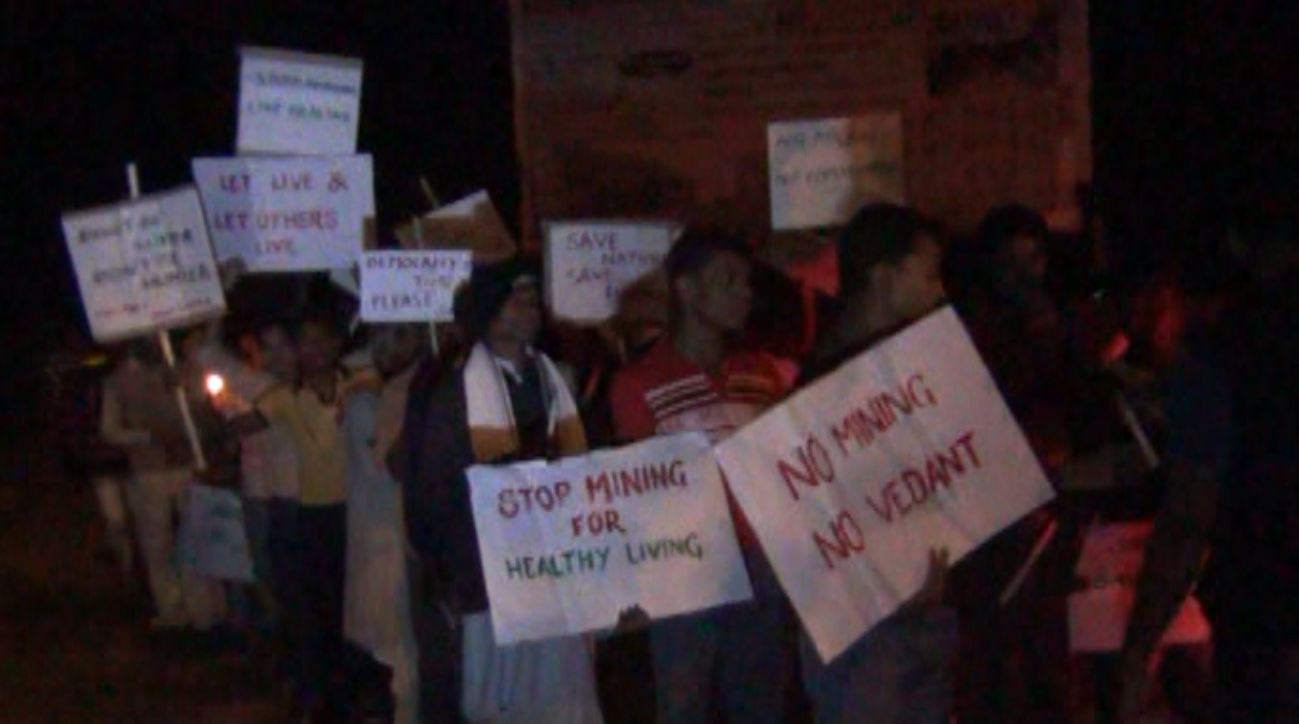
People across the globe have registered their protests against Vedanta once again. On January 11, parallel demonstrations took place in Orissa, London and New York where activists in hundreds raised slogans and upheld placards to denounce the corporate annexations of  indigenous peoples’ lands.

From Niyamgiri hills, more than 500 people turned up at a rally which covered about two kilometers in the Bhawanipatna town. Resistance movements in Lanjigarh have also inspired tribal representatives of Karlapat region whose mountains are now being targeted by the mining companies. In this rally, several people who were cheated of their lands narrated the atrocities and tortures they faced from Vedanta highhandedness in Lanjigarh. They also gave an account of how the company goons and the local police routinely harass the women in the afflicted areas.

Orissa

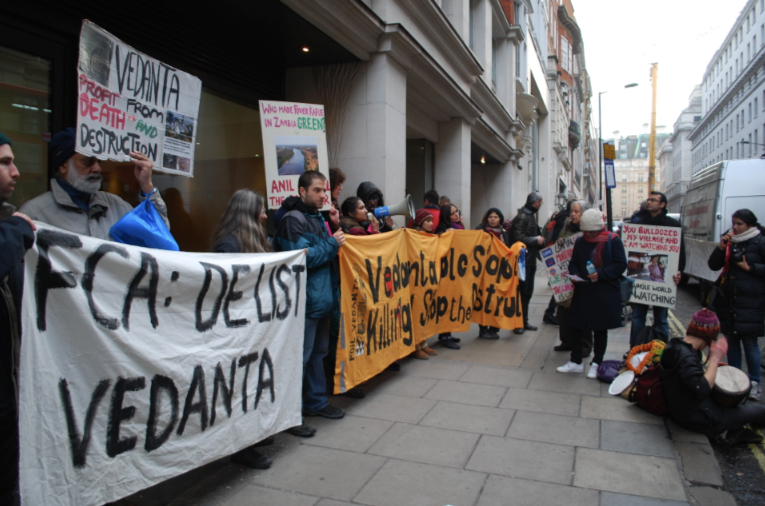
In solidarity with the indigenous peoples of Orissa, a loud group of protesters from Foil Vedanta and other grassroots groups mobbed the company’s Mayfair headquarters in London the same day. Holding a banner that read “FCA: de-list Vedanta”, the demonstrators called for the Financial Conduct Authority to remove Vedanta from the London Stock Exchange for poor corporate governance and human rights crimes.

London

Likewise, in New York City, protesters gathered outside the United Nations headquarters to highlight the company’s human rights crimes, displaying placards that read: “Our Mountain! Our Rights! Vedanta: Give Up!” and “Dongria Kond’s Niyamgiri: Hands Off!”

New York

Simultaneously, the Supreme Court of India has deferred its final verdict on Vedanta’s planned mega-mine until 21st January. If permission to mine is denied Vedanta is likely to close its Lanjigarh refinery due to lack of bauxite costing them billions. On Sunday the Minister for Rural Development Jairam Ramesh plans to visit the threatened mountain to visit the Dongria Kond.

Various grassroots groups including Phulbari Solidarity Group, Japan Against Nuclear, Tamil Solidarity and London Mining Network, along with Foil Vedanta gathered at Vedanta’s London headquarters to add their voice to recent pressure for Vedanta to be de-listed from the London Stock Exchange for its poor corporate governance, illegal operations and major human rights violations. They shouted ‘Vedanta out of London’ and blew horns and whistles. Several parliamentarians and the former CBI Director Richard LambertLondon have highlighted how Vedanta’s listing is used for legal immunity to hide their corporate crimes.

At the Supreme Court in Delhi today lawyers for Vedanta dwelled on the ongoing demonstrations in London, asking why people are protesting there, and claiming that India is suffering because of this. Judges noted that this is not relevant to the case and pointed out that people have a right to protest. Foil Vedanta’s spokesperson reacted:

“Vedanta is a London listed company and profits from this affiliation. It is typical of Vedanta to assume they are above the law and above public accountability. We will continue to draw attention to their corporate crimes here in London”.

Activists at the rally in Bhawanipatna chanted “Vedanta go back: water, land and forest ours. We are Supreme people of the supreme court” while dalit leader Surendra Nag spoke about the loss of land and livelihood for local people, some of whom have ended up as beggars. One man spoke of how his whole family had been tortured by company goons and they had lost 6 acres of land to the company without compensation.

The project has been racked with controversy from the start, as a spate of recent coverage points out: The Lanjigarh refinery built to process the bauxite from the hills was illegally constructed, the court case presided over by a judge with shares in the company, and the refinery should never have been given permission without including the associated mega mine in impact assessments. The Delhi High Court is also currently investigating the large donations from Vedanta to India’s two main political parties which could be deemed illegal as Vedanta is a foreign (British) company.

A cover story in major Indian glossy Open Magazine in December details evidence of corruption and collusion between Vedanta and the Orissa state government, local officials, judges and the police to force the project through. Meanwhile Vedanta’s chairman and 56.7% owner Anil Agarwal has launched a rare PR crusade claiming that Vedanta ‘have not cut one tree’ and respects and preserves the rights of the protesting indigenous tribe living on the threatened mountain. He sets out his extractive philosophy for India – suggesting that exploration should be drastically increased and regulation decreased to provide for the domestic market for metals and oil.

If Vedanta loses the case to allow state owned company Orissa Mining Corporation to mine the mountain on their behalf they may have to close the dependent Lanjigarh refinery costing them billions. Under enormous pressure from Vedanta the Orissa government has suggested alternative bauxite supplies from a deposit located in a major wildlife sanctuary and tribal area at Karlapat arousing anger and opposition from grassroots groups.

The court’s decision rests on whether the Green Bench of India’s Supreme Court rules the rights of forest dwellers to be ‘inalienable or compensatory’. In view of this, India’s Tribal Affairs Minister V Kishore Chandra Deo has asked the Environment Minister to ensure the rights of forest dwellers is protected in the spirit of the Forest Dwellers Act.

Speaking about the verdict, Dongria Kond activist Lado Sikaka states: “We will continue our fight even if Vedanta gets permission. Are these Judges above the Law? In effect, they act as if they are. Niyamgiri belongs to us. We are fighting because We are part of it. Our women are harassed and we are called by the police and threatened not to go to rallies. Last month they have been working like Vedanta’s servants.”

Foil Vedanta’s Samarendra Das says:

“Vedanta is not the only mining company that should be de-listed for their corporate crimes. Infamous London listed offenders Lonmin in South Africa, Monterrico in Peru, GCM in Phulbari and Bumi in Indonesia should also be investigated for extensive human rights atrocities.”

Video: Union Maids (1976)

Courtesy: LibCom.org