Gurgaon Workers News
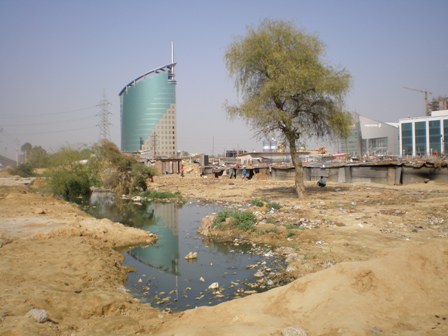
Gurgaon, a satellite town in the south of Delhi has become a symbol of the ‘Shining India’. People are dazzled by the glass-fronts of shopping-malls and corporate towers and fail to see the development of a massive industrial working-class that lies behind this ‘post-Fordist’ display of consumerism. Together with other industrial centres like the Pearl River Delta in China and the Maquiladoras in Northern Mexico the Delhi industrial belt has become a focal point of the formation of the global working class.

A local form of the global working class
The industrial areas of Gurgaon have seen the emergence of a specific form of class composition – hundreds of thousands of (migrant) garment workers work side by side with similar numbers of automobile workers (working in the assembly lines of India’s biggest automobile hub) and young call-centre workers, sweating under head-sets. We are forced to re-think our traditional understandings of who ‘workers’ are, how they struggle and how this struggle can become a process of self-empowerment, moving towards self-emancipation.

Specific structures of industries and the nature of the composition of work-force push us, first of all, beyond regional and national frameworks. At the most obvious level this happens because of the global market. In the spring of 2008 the Rupee reached its peak value in relation to the US-Dollar, and caused bad export conditions. The garment industry in Gurgaon dismissed thousands of workers and shifted orders to ‘low currency’ countries like Vietnam and Bangladesh. In autumn, the same year the Rupee plummeted; with it crashed American and European markets, sending shock-waves into the industrial areas of Gurgaon: credit crunch for real estate, cutting down of garment orders, slump in US-banking services. Workers belonging to certain locations, who might have otherwise thought that they had little in common with chai stall owners, faced a situation very similar to these owners – cut in bonuses and piece-rates, end of free company meals and transport and threat of job cuts. The potential for a socially explosive tea-party of English-speaking youth working night-shifts at call centres, migrant garment and construction workers and young skilled workers in car-part plants emerged in the Industrial Model Town – a mass base for an actual ‘internal threat’.
There is a second level at which the ‘collective work-force’ needs to be understood beyond the boundaries of factory walls or and units. This level is shaped by local, regional and global divisions of labour. Maruti Suzuki connects its assembly lines and welding-robots with production units of hundreds of outsourced suppliers via transport chains, these networks reach the work-shop slum-villages of Faridabad and the green-field industrial areas along the National Highway. Assembly plants around the globe depend on parts manufactured in Gurgaon by companies like Rico and Delphi. IT and BPO offices cooperate closely with branches overseas, while production in the huge garment factories is supplied via supervisor middlemen with piece-work from working (wo)men stitching ‘at home’.
At a third level, the nature of the work-force cannot be grasped in localized forms. The majority of workers migrate into the area, moving back and forth between urban industrial life and the village. Wages are too low to reproduce a nuclear family in Gurgaon and most workers leave their families in the villages. Similarly it is almost impossible to survive a long period of unemployment, or for that matter, a long period of strike in Gurgaon. Though disintegrating, the village still functions as the main backup in times of unemployment. The introduction of the National Rural Employment Guarantee Act (NREGA) or the general development of the agricultural market reverberates in the working conditions in Gurgaon. Workers arrive in Gurgaon with hopes, which in most cases are dead soon. They survive 16-hours shifts by keeping in mind village misery and paradoxically, also by glorifying it. Their hope of ‘not having to be a worker anymore’ expresses itself in plans to open a shop back home. Reality forces us to find a collective and social expression of this urge to abolish our existence as ‘workers’.
A major element of this ‘worker’ existence is the casualisation of work-force. In winter 2000/2001 Maruti Suzuki used a minor labour dispute to lock-out the permanent work-force, and replaced it through compulsory ‘Voluntary Retirement Schemes’ with temporary workers. This has also happened in other companies, to the point that 70 to 80 per cent of the average factory work-force is nowadays hired through contractors. Due to their mobility (or lack of stability) these workers are less interested in struggles for long running wage agreements and company pension schemes. They have ‘short-term’ desires and their anger too is directed at the immediate. The remaining casual and permanent workers are often young workers trained in various ITI-campuses all over India, employed with much less job security and at lower wages than the old permanent work-force. In the garment factories the skilled tailors working at piece-rate, producing ‘full-piece’ garments are increasingly being put under pressure by chain-systems employing 20 less ‘skilled’ workers to produce the same garment using a greater division of labour based on CNC-cutting and embroidery machines. In Kapashera, a workers’ dormitory ‘village’ where about 200,000 textile workers and families live close to the main industrial area, dozens of ‘CNC-courses’ and six week basic tailoring courses are offered by small-scale informal schools.
In this complex scenario the majority of workers do not face a single ‘company boss’ in a formal way; they face a multiplicity of bosses. Due to the real estate boom which catapulted local farmers out of their fields into landlordism and business, a specific coalition of the local political class, landlords, labour contractors, police and company-hired goons became a repressive front ready to quell expressions of workers’ unrest. This local front of the ruling class is complemented by a faceless front of multi-national investment and central government policies.
Old Type of Struggles: Locked-Out in Dead-Ends
Under these general conditions, struggles which remain within the boundaries of the classical company/trade-union structure normally end in defeats and/or institutionalisation. There have been many ‘union’ struggles in Gurgaon in the last few years and they seem to follow a certain pattern.(1)
There is discontent among permanent workers as well as workers hired through contractors. In most cases some ‘under-the-surface’ struggles pre-date the ‘official conflict.’ For instance, at Honda HMSI ‘spontaneous’ canteen occupations took place before the ‘official’ struggle for union recognition began. In this phase certain sections of workers get in touch with union officials hoping that registration of a union will strengthen their position. Representatives emerge; member-lists are required for the application. The company tries to put pressure on the emerging ‘leadership’ and in many cases provokes a situation where suspension of ‘outstanding’ workers can be declared. In many cases companies ask the remaining work-force to sign individual letters of ‘good conduct’, trying to single out the supporters of the struggle. Unions, interested only in their self-propagation ask the workers not to sign: a struggle within the classical framework is easier to organise once workers are victimised, although their actual power might be greater once they are back inside the factory. An unofficial lock-out takes place; often workers hired through contractors, who expect little gains from a company union, either enter the factory or additional workers are hired to keep up production. Often these new workers are hired from the local population of the surrounding villages – another division between them and the mainly migrant, original work-force. Companies are usually prepared for the lock-out and subsequent problems in production, either by piling-up extra-stock or by getting parts from other suppliers. ‘Unofficial unrests’ get structured into classical forms, often managed by the main union advisors; protests in front of the factory gate, demonstrations, meetings with political leaders – the martyrdom of workers becomes an opportunity for leaders to stage themselves. In most cases the conflict gets limited to a single company, and attempts to connect to the wider struggle are not made. The state and companies are easily able to deal with these ritualistic forms of struggle, either through repression or through entangling it in a long legal dispute. The results of these disputes usually exclude the workers hired through contractors who were also part of the initial struggle. Furthermore, the cases for re-instatement of victimised workers often run for years. The recognition of a company union is followed by silence.(2)
Once in the trap of a lock-out workers can do little more than wait for the next symbolic show of solidarity. In the case of the recent lock-out at the Maruti fuel-pump supplier Denso, in Manesar, thirty-six union members were suspended on 17th February 2010 and about 500 workers refused to sign papers of ‘good conduct’. Since mid-February they have been sitting outside the factory while newly hired workers are kept inside around the clock. Even before the lock-out Denso had already ordered additional parts from its Thailand plant; they were prepared. In nearby Faridabad, workers of another Maruti supplier, AC manufacturer Sanden Vikas, were ‘locked-out’ at the same time. The union did not facilitate direct links between these two work-forces. The suggestion came up to write a common letter to the Maruti Suzuki management – admittedly only symbolic of workers’ coordination, which could nonetheless have had some impact. Another idea which came up was to go in small numbers and stand with placards in front of Maruti or other local factories. Denso runs factories around the globe and some effort to let workers and managements in these factories know about the situation in Manesar could have been made (3); small steps which could help spread the word and perhaps create direct links between workers of the supply-chain. This did not happen; instead we saw one or two union demonstrations and bored young workers sitting and playing cards. According to a Denso worker, on 22nd March 2010, the company took back 23 of the 36 suspended union representatives and sent all Denso workers for a one week training to a local ‘World Spiritual University’ ashram, to find mental peace. When they returned to the factory most of the workers were shifted to new jobs in different departments, at new machines, with new work-mates.
A New Generation of Workers and their Struggles
There is a need to discuss with workers the shortcomings of traditional forms of waging struggles, and need to consider the possibility of the emergence of a new form in the light of the actual experiences of wildcat strikes and factory occupations in Gurgaon in the last few years. These struggles have largely remained unknown to the ‘wider public’. Unfortunately, left activists usually get to know of workers’ struggles only when they have gained a sort of ‘official’ status, which generally means when they are repressed. The lathi-charge at the Honda factory in 2005 mobilised the left, as did the murder of a worker at Rico; by and large the left took a ‘civil rights’ position on these incidents and no attempt to analyse the basis of workers’ power and self-activity was made. The struggles of a new generation of workers already provide some answers and ask many questions relevant for the future; for instance they raise questions about how struggles are to be extended from the factory base, avoiding ‘unnecessary’ direct confrontation with the state forces, and show us the pitfalls of formal representation.

In April 2006 more than 4,500 temporary workers occupied Hero Honda’s Gurgaon plant for several days, demanding higher wages and better conditions. The company cut water and electricity, but asked the police not to enter the factory. No support came from outside the plant. The workers sent a small delegation to negotiate, and the delegation was bought off. The delegates returned promising fulfilment of all major demands once production is restarted and they then disappeared. Only some demands were actually met by the management. When the factory occupation ended, workers at the Hero Honda supplier, Shivam Autotech, occupied their plant which was close by and raised similar demands. Workers at the KDR press-shop in Faridabad, who supply Shivam Autotech with metal parts, worked reduced hours during these days.

In September 2006, after temporary workers at Honda HMSI, Manesar were not included in a union deal, they occupied the canteen of the plant, supported from the outside by the next arriving shift. The company reacted by cutting water supply. The company and the union asked them to go back to work.
In January 2007 2,500 temporary workers working at the car-parts manufacturer Delphi, in Gurgaon, went on a wildcat strike, blockading the main gate. The company threatened to shut-down and relocate the factory and asked the union of the 250 permanent workers to get the temps back to work. After two days the blockade was lifted. In August 2007 the temps at Delphi struck again, this time for few hours and without prior notice, demanding the payment of the increased minimum wage and succeeded. Many of the workers live together in back-yards of nearby villages, sharing food, mobile phones and information about jobs.
In August 2007, after the Haryana government had increased the minimum wage, over a dozen companies in Faridabad and Gurgaon faced spontaneous short strikes mainly by casual workers, demanding the payment of the new wage. In most cases these actions were successful (4).
In May 2008 after not having been accepted as members by the permanent workers’ union the temporary and casual workers at Hero Honda in Dharuhera went on a wildcat strike and occupied the plant for two days. The management and the permanent workers’ union promised betterment in their situation. The temporary and casual workers then tried to register their own union – a process which ended in suspension of leaders and a mass lock-out in October 2008.

It would be reductive to label these struggles ‘spontaneous’. We need spaces to meet in the industrial areas to analyse the process of social production and the already existing day-to-day experiences of organisation and subversion within factories, along supply chains, in the back-yard living quarters, and in villages – spaces for self-inquiry. If there is to be a communist party it should celebrate the collective worker that discovers itself by turning its social cooperation against its proclaimed precondition: capital. A part of this proletarian self-reflection must be the development of a structure of mutual aid, practical support and coordination.(5)
Notes
(1) The list of examples is way too long. Just to mention a few in Gurgaon: Maruti lock-out in 2000, Honda HMSI in 2005, Amtek in 2006, Automax in 2008, Mushashi and Rico in 2009, Denso and Sanden Vikas in 2010.
(2) After recognition of the union at Honda HMSI the number of workers hired through contractors and the general productivity increased.
(3) It is difficult to rely on the classical union structure for these kinds of international links. When the dispute at Rico stopped GM and Ford assembly lines in the US and Canada due to missing parts the comment of a United Automobile Workers official in Michigan was: “We are experiencing the effects of outsourced suppliers, and we hope they would be able to resume production as quickly as possible so we can in turn resume production” Interestingly enough this comment was made after the UAW had signed an agreement to lower wages to ‘save jobs’, which were being disputed by many workers on the shop-floor. While Denso workers in Manesar were locked-out, Denso workers in Tychy, Poland, organised protests for wage hikes matching the wage increases for FIAT workers.
(4) Today the situation seems even more explosive, given that the April 2010 ‘minimum wage hike’ of 30 per cent for Delhi workers does not compensate for the enormous inflation in food and transport prices.
(5) Comrades of Faridabad Majdoor Talmel are about to open some physical spaces for workers’ meetings in Faridabad, Okhla, Gurgaon and Manesar. For more information, visit Gurgaon Workers News and Faridabad Majdoor Samachar.


 Radical Notes
Democracy and the Marxian Political: Beyond ‘Statism’ and the ‘Dictatorship of the Proletariat’
Anjan Chakrabarti and Anup Dhar
A spectre is haunting India, the spectre of Maoism. It represents the Gandhian counterpart in the field of state-centred Marxism in so far as it cultivates extra-parliamentary politics. The similarity however ends there; since (i) even Maoist politics remains ‘in the last instance’ state-centric; capture of state power remains its ultimate goal and (ii) its political practice is circumscribed by the barrel of the gun, which has increasingly become its customised mode of communication. In Marxian parlance, it seeks to establish a self-reliant economy through the capture of state power using violence without much ambivalence or self-reflexivity. While its chosen means is violent revolution, the content of its politics is to overthrow the “class of comprador bureaucrat capitalists” that consists of “a nexus of top politicians, top bureaucrats and the big business house” who are in direct alliance with semi-feudal forces in the countryside and indirect alliance with the imperialists particularly the USA (Arvind 2002; also see Indian Maoists 2009).
Without entering into the debate of whether or not there can be anything called Maoism, it is important to highlight the effects of Maoism on politics in India. While the current debate at times gets reduced to a discursive field situated in terms of the State versus the Maoists, the fact that arguments concerning numerous other aspects (rights of Adivasis and locals, capitalist plunder of resources [minerals to be more precise], development, violence, right to conduct movements [including non-violent movements against exploitation and oppression, and the inordinately violent response of the state to such pacifist movements]) are also coming to the surface is a testimony to the lasting effects of this insurgency. Maoism has forced upon us some serious social questions. Despite the unprecedented campaign by the ‘ideological apparatuses’ against Maoism and the latter’s own repertoire of almost never-ending (and at times reckless) violence that many consider counterproductive and inimical to its own credibility, some questions rather than disappearing keep on exploding in the face of the body politic. Notwithstanding the massive deployment of repressive apparatuses, the ruling elite leading the charge against Maoism is fully aware that this is no ordinary military campaign. The modes of repression must be conjoined with ideological apparatuses to turn the war against the Maoists into also a war of benevolence waged to liberate the Adivasis from their decrepitude state of life. Hence the military campaign is conjoined with and in fact being turned into a campaign for development of Adivasis. Of course, the possibility is always there that, in an insurgency, the line between the Maoists and Adivasis may get blurred, a blurring which leads us to wonder: is this a war against Maoism or against the locals or against both telescoped into one? Even if Maoism as a movement may be incarcerated, contained and/or even destroyed, the larger social questions with their ‘political’ predicaments will not wither away soon. This indicates that in some form Maoism is encapsulating concerns and issues rooted in the forms of life of ordinary Indians, at least of marginalised sections of the populace big enough to make it, in the words of the Prime Minister of India, the biggest internal threat. However, Maoism is not just an internal threat; more potent perhaps is the social wind of discontent and desire it is attempting to telescope which makes it a bigger and lasting threat transcending mere security concerns.
The ‘civil war’ will take its own course in a scenario when both sides are fighting the war to the finish. If this is one side of the story then the other, crucial from a Marxian perspective, is the philosophy of Maoist politics, constituting its own challenge to Indian Marxism, at least to the dominant form steeped in the ethos and practice of parliamentary democracy. It is on this ‘other story’ that we focus in this essay.
For reasons unknown, this challenge has been sidestepped within the field of Marxism and even now the response is mostly in the realm of turf war (for example, over territories as in West Bengal) rather than that of the political; this has typically involved evacuating a particular territory of all oppositional philosophy or idea of the political; territorial battle is paradoxically considered won with the capture over the process of political voices. At times, attack on Maoism has taken the form of the defence of a particular party position, which is of course welcome if it is enriching the Marxian tradition. However, it has rarely led to a self-reflexive questioning of the manner in which Marxism is practised in India. What we mean to say is that Maoism throws some questions to the way Marxism in general is conceived, practised and symbolised; on some such questions, leaving aside rare attempts that now have thankfully started appearing (including in Radical Notes), conventional Marxists have not sufficiently responded. Or, should we say, a gloom of confusion reigns in Marxist circles currently. The result is that the response of conventional Marxists in the debate with Maoists remains bereft of dealing with fundamental questions on Marxism itself. Under the present situation, engaging with such questions is no longer an option. It is a necessity. Not that any position, even the one we forward here, would answer all the questions, but the field made turbulent by the events surrounding Maoism beckons us to take the debate into the heart of Marxism in India, throwing light not just on a rethinking of Marxism but perhaps also in the way we practise Marxism in India. This is crucial because, as is evident today, the critics are subsuming Marx within Marxism and Marxism within Maoism (for example, Mamata Banerjee has represented Marx and Mao as two sides of the same coin). This ‘external’ threat to the Marxian imagination (whether in parliamentary or in an extra-parliamentary form) takes an ominous proportion if internal problems regarding the veracity of its politics threaten its imagination too setting off ‘Marxists’ against ‘Marxists’ as is the case today. The task is not to insulate or close debates and changes within Marxism, but to make it relevant in the Indian context, without which the future of Marxism is bleak. At present, let us concede that there is a crisis in (Indian) Marxism; the crisis is not merely one of practice; it is also one of theory.
In accordance with this spirit, we take up one concept which has really spelled trouble for Marxists and Maoists. It is the concept of democracy. What is the relation between Marxism and democracy? Is there a relation; or are they non-compatible bedfellows? If one exists, what then is the nature of the relation? What happens to the known nature of the democratic ideal as it engages with a radical idea: Marxism? Does it become different? Does the nature of Marxism also change because it is engaging with a liberal ideal: democracy? Further, what is the relation between Marxian democracy and parliamentary democracy? Can the two meet?
Instead of dealing with all the questions and engaging with all Marxian positions concerning democracy, we pick one area: possible theorisation of the relation following Marx’s own take on state that is splattered across his writings with intermittent references to democracy.(1) We ask: was Marx suggesting an inalienable relation between the Marxian political and democracy? Is democracy an internal component of his imagined political? Have then twentieth century Marxisms (of the Maoist and the non-Maoist kind) purloined much of Marx’s imagination of the political? If so, have parliamentary Marxism and extra-parliamentary Maoism (the two variants of twentieth century Marxism in India) lost contact with the Marxian political in the process of engagement with the bourgeois discourses, its institutions, laws and norms? Doesn’t the language of Marxists espousing parliamentary democracy use the tune of liberalism (with its own art of governmentality as Foucault would say) it opposes, at least programme-wise, so trenchantly? Doesn’t Maoism dance to the rhythm of the repressive state apparatus it seeks to oppose? Are both forms (the parliamentary Marxist form and the Maoist form) lost in statism, an aspect Marx critiqued and wanted to move away from in drawing his route towards social transformation?
In this scenario one can make a case for rescuing Marxism from statism and resituating it in a different political register that will allow us to describe reality in terms different from what is proposed in the bourgeois discourses. A need to return to Marx is crucial in this context: while we do recognise that ideas of state, civil society and modes of power have changed substantially since Marx’s time, what needs to be appreciated is that he dealt with this triad at their moments of birth and offered a new methodology for imagining the political. Disdainful of mediated rule, Marx would settle for nothing other than the direct rule of the people; and by people Marx meant the mass of the exploited – whether in the industrial space (as in the Communist Manifesto) or in the agrarian space (as in the writings of Late Marx) – proletariat.(2) No state, no party, no dictator, no broker of power; the social must be reconfigured to facilitate the unmediated rule of the masses which is where Marx’s idea of democracy can be located. Everything else, including the idea of organisation, must be rethought to facilitate the direct and unmediated implementation of this democratic imperative. Because of the connection of democracy with the unmediated rule of people, let us call it people-centric democracy.(3)
In this context, Marx was fully aware of the need to articulate the idea of the political in a manner that would move beyond the liberal idea of democracy and statecraft. This was required because the liberal ruse of mediation intervened in the materialisation of a people-centric democracy. The state was the proof of this unfulfilled project of democracy; the bourgeois state not just truncated the possibility of democracy; it throttled the emancipation of the masses from exploitation, inequity and oppression. For Marx then, a challenge to capitalism was intimately connected with the realisation of people-centric democracy. Following Marx, and contrary to the history of twentieth century Marxism, the idea of the political cannot but contain an engagement with democracy; however it is democracy not of the liberal kind. This shifts the current debate to a totally new ground and makes the struggle for communism and people-centric democracy coterminous.
A word of caution: this essay should not be taken as suggesting that Marx’s take is final, total or even something to be copied; instead Marx keeps moving for the Marxist as the word moves; it is God who remains unmoved and unchanged by the process of creation; Marx was no God.(4) Politics that proceeds like a copycat is uncreative, comical and hollow; politics that moves by learning, engaging with the other, displacing one’s own terrain is creative, sensitive (to the past, present and future) and responsible (or should we say cautious). The gaze of the former is on the outside while the latter is self-reflexive.
Self-reflexive as he was, Marx was rethinking the concept of democracy in a different light. In so far as our essay reflects on Marx we seek to renew our engagement with democracy in the direction proposed by Marx which though, as with all works, must pass through series of displacements and why not, conceptual sharpening. There is a need to rethink the relation of democracy with the Marxian political and in that light seek new models of engaging with the context called ‘India’ and the experience called ‘Indian’; all the more because our intellectual and political history is replete with such engagements, albeit at times in radically different ways by to name a few, Gandhi, Tagore and Shankar Guha Niyogi. Marx arguably provided the most extensive and incisive ‘internal critique’ of the modern west’s form of life and philosophy; while the latter three provide an ‘external critique’ of the modern west and which is no less incisive; and rethinking the political in the context of India requires a dialogue between the two strands of critique (with all the differences and contradictions within and between them). It also paves the way for a critique of the hegemonicphilosophemes of the modern west – ‘capitalocentrism’, ‘orientalism’ and ‘andro-centrism’ (to name a few). To a great extent, the future of Marxism in India depends on this dialogue and a rewriting of the script of its practice in light of the critique.
Parliamentary Democracy versus Marxian Political:
A Schism that Haunts Marxism in India Today
Theory becomes a material force as soon as it has gripped the masses.
– Marx, Introduction to the Critique of Hegel’s Philosophy of Right.
What was Marx’s relation with democracy? There has been a lot of controversy regarding Marx’s intermittent usage of the term “dictatorship of the proletariat” (according to Thomas (1994), eleven times in total) which was subsequently popularised by Lenin so much so that it ended up acquiring a cult status among official Marxists. This however left a trace/trail of a troublesome and uncomfortable relation with democracy, and indeed played an instrumental role in tarnishing the image of Marxism as an anti-democratic philosophy. The popular version of official Marxism, which took centre-stage in the twentieth century, held the view that democracy is a bourgeois charade that must be abolished and replaced by state sponsored Communist Party rule, an understanding that was put to deadly effect by twentieth century Marxism with equally deadly consequences. The term “dictatorship of the proletariat” became a ruse for relationalities of enslavement, giving a fillip as also a legitimisation to the violence, often state sponsored, enacted by conventional communist parties worldwide.
This issue is topical because of what we believe is a failure of Indian Marxists to confront headlong their troubled relationship with democracy; not even the collapse of the ‘dictatorship of the proletariat’ in the erstwhile ‘socialist’ countries could shake this state of slumber. This problem leads to another troublesome choice: revolution or democracy (as if both are mutually exclusive; as if both cannot go together; as if one cannot be the condition of the other; can revolution be the condition of democratisation? Can democratisation be the condition of revolution?). While both are present in some form in almost every party programme, the programmes lack a clear understanding of their relation leading inevitability to a sequential ordering of the two – revolution after democracy or democracy after revolution. This structure of choice (choose one, because you can’t have both together) amounts to a trade-off between the two ruling out any imagining of the political that seeks a conjoining of the two. As we shall argue, in contradistinction to the above, Marx conceived of revolution with(in) an unmediated praxis of democracy; because, for Marx, revolution is the realisation of people-centric democracy.
The Maoists however reject representative democracy and propagate ‘capture of state power through armed struggle’ (purportedly proposed by Mao Zedong). In the Maoist frame, violence is not the means to an end but also the end of communication. This follows from the understanding of the state apparatus as being singularly repressive (this misses out the point that the state functions as both repressive and ideological even in its most repressive manifestation) and as being exclusively at the disposal of the ruling class; the ideological apparatuses are seen as a mere supplement to repressive apparatuses and hence do not warrant much engagement. In the Maoist imagination, the idea of the state has remained predominantly ‘pre-modern’; the state is, as if, organised around the whims of the ‘sovereign’ (with its shield of bureaucrats, police, military and court). This sovereign telescopes the aspiration of the ruling class comprising “a nexus of top politicians, top bureaucrats and the big business house” in direct alliance with semi-feudal forces in the countryside and indirect alliance with the imperialists particularly the USA. The state is thus both the strongest and the weakest link in the Indian context. Revolution is, therefore, state-centred; and the struggle to finish the ruling order must telescope a violent revolution against the state; by overcoming the ruling order through the capture of the state, the state can be reclaimed for the exploited and the oppressed; only after such a re-capture can true social change be ushered in. Not only does Maoist politics become state-centred, it privileges in its political philosophy and practice expressions of violence as the exclusive mode of communication. This follows from its thesis that the sovereign/state must be countered in its own language: repression must be countered with repression, force with force. It has to be understood that urging/asking Maoists to give up violence is tantamount to asking them to give up their worldview; its position on violence is inalienably connected with its view of the state as exclusively repressive and as representative of exclusively, the ruling class. Just like Gandhi’s position on non-violence is inalienably tied to his worldview, so is the case with the Maoists. One cannot deal with Gandhian and Maoist fetishisms of non-violence and violence respectively without addressing their respective worldviews.
Seeking to move beyond the dualism of violence/non-violence, our issue is precisely with the Maoist worldview. As we see, at the heart of the Maoist worldview is its understanding of the state. One can start with an engagement with state. While we do tangentially attend to the state, it is not our focus here. Instead, we begin with what has given the state legitimacy in our times: democracy or more precisely parliamentary democracy. We ask: do the Maoists have any position regarding democracy? In so far as the Maoists are concerned, they reject parliamentary democracy just as they reject its predicate – the pre-modern state. However, even as they reject parliamentary democracy as a sham, they extol ‘democracy’. While taking forward a violent revolution by erasing all spaces of dissent, the Maoists seek to “democratise the social fabric of the country by smashing the backward and retrogressive semi-feudal relations in the countryside…build a new democratic culture…build a democratic modern India” (Arvind 2002). Evidently, this democracy is conceptually distinct; also, capturing state power through armed struggle or insurrection is one thing and democratising the social fabric is quite another. One cannot be reduced to the other; one does not necessarily follow the other, a lesson we thought had been learnt by Marxists; democracy remains conspicuous by its absence in the Maoist political. The result: the Maoist model of Jacobin terror sits uncomfortably with its slogan of ‘true’ democracy. The faltering nature of democracy overdetermines its adopted political practice. Any effort to forward democracy by the Maoists (say, through Janatar Sarkar – peoples’ government) is subsumed within the logic of armed struggle.
Because everything is reducible to the logic of armed struggle, social movements that tend to expand the democratic potential at the ground level, are, by definition, incompatible with this logic. By expanding on the potential of democracy towards people-centric democracy, the logic of social movements tends to overflow and overpower the discipline and boundary of armed struggle and hence, not surprisingly, from a Maoist perspective, it becomes important to incarcerate the social movements within the logic of armed struggle. This requires a disciplining of social movements which claims its usual price: the process of people-centric democracy. That explains why Maoist politics has an ambivalent position vis a vis social movements. Social movements offer it the space of discontent which it wishes to cultivate for future armed struggle; however, because social movements also challenge the logic of the elimination of dissent/difference, a logic that drives the framework of class annihilation, they need to be contained. Battle-zones are thus transformed into ‘free zones’ – free of dissent/difference and worldviews other than the Maoist one; free/liberated zones are turned into the ‘base’ of opposition to the state. By literally creating a ‘parallel state’ grounded on contesting repressive apparatuses to fight the bourgeois-democratic state, it purloins the cultivation of people-centric democratisation as a path towards socialism/communism. The Maoist strategy may indeed be relevant and in fact may even have relative success if there is no scope for social movements (that is when the state becomes fundamentally repressive as in operation Green Hunt). However, if the space for alternative social movements exist then Maoism becomes a suspect political imagination.
Finally, armed struggle as an end-in-itself presupposes a homogenous representation of the Indian condition. What it thus lacks (and indeed fails to internalise in its worldview) is an understanding of the complex nature of the Indian social. In contrast, people-centric democracy can only be comprehended within a disaggregated understanding of social reality; different situations give rise to different kind of problems and demand a variety of interventions. Social movements and people-centric democracy can only thrive within a disaggregated understanding of reality; armed struggle with its tendency to homogenise the otherwise disaggregated reality defies and obfuscates differences. Collateral damages occur as a result of glossing over these differences; situations that could be handled without violence are subjected to violence; once section of the people of India are turned into an enemy of another section of the people of India; where everybody is potentially a (class) enemy; where villagers and neighbours begin to be looked at with suspicion as possible agents of state. In this rather reductive approach built on a homogenisation of the otherwise disaggregated social space, not only is democracy the casualty but the concerned social field often turns into a battlefield between the poor and the poor. The war between the Indian State and the Maoists is threatening to become a war between the rural poor of the country and in being mediated through armed struggle against the state, the importance of class struggle ironically gets demoted and is at times obfuscated. This illusion of ‘class struggle’ (where ‘armed struggle’ is taking the place of class struggle) renders secondary the element of actual class divisions and struggles over class processes (performance, appropriation, distribution and receipt of surplus) materialising in society; which evidently takes numerous forms and thus calls for a variety of class struggles with differentiated methods instead of reducing them to a singular kind of struggle namely armed struggle. Maoists with their emphasis on the latter demote the former which shows up at certain times in their ‘tactic’ to ally with ruling classes at the local level if it is envisaged to benefit the logic of armed struggle. They do not participate in elections, but may have no qualms in supporting the local dominant classes for tactical purposes, with purposes of securing control over territories; the issue of class struggle is evidently not the central concern of their struggle and neither is the question of articulating class struggles through ground level democratic struggles (the realm of social movements) any issue for them.
From a different angle, for the same reasons that make Maoists suspicious of social movements, Indian Maoism cannot but remain at odds with alternative social constructions which promote non-exploitative organisations of surplus and seek to relate it to the process of community building. Such alternatives, as exemplified in the work of Shankar Guha Niyogi, do not just present a challenge to capitalism and its liberal order, but to the Maoists as well. They offer us alternative paths, paths different from the path to capitalism and its associated developmental logic without any necessary pre-commitment to armed struggle. In such struggles for an alternative, capture of state power is evidently not the preset objective. The language of such struggle is constructionist, that is, Nirman, and whose very manner of re-representing social life encapsulates a struggle, Sangharsh, where Sangharsh is for Nirman. This model is not one of Nirman andSangharsh, but rather one where Nirman is also Sangharsh. Moreover, the location of its politics is not in arms, but in the exploited and oppressed mass; its content is people-centric democracy for it builds its project through expression of opinions, forming associations of humanity and creating bonding; its ethic is not individualism, competition and enslavement, but cooperation, sharing and solidarity. Nirman-Sangharshforwards the point that it is the mass and not arms that make history. Notwithstanding its strength or weakness, our argument is that Maoism is inherently incapable of facing, let alone accommodating, such models that are clearly and openly fostering non-capitalist alternatives. Not only can Maoism not comprehend dis-aggregation/difference, it cannot even embrace a differentiated field of non-capitalist experiences; ‘dictatorship of the proletariat’ becomes ‘Maoist dictatorship over the proletariat’. In short, in the Maoist imagination, democracy stands un-theorised; not only has Maoism no place for parliamentary democracy, but none whatsoever for people-centric democracy as well.
In contrast, most other conventional Communist Parties in India participate in parliamentary democracy. For them, this participation though sits uncomfortably with an inadequate theorisation regarding the place of democracy in their proposed political horizon that they claim is purportedly revolutionary. There is a tendency to espouse Jacobin-style revolution in their party programme and at the same time increasingly accept the possibility of entering given corridors of state power through elections. Such an ambivalent position partly results from an inability to have a clear stance on either state or democracy. If they accept parliamentary democracy that reduces democracy to (bourgeois) statecraft, what remains unaddressed, at the minimum, is the issue of its repressive and ideological apparatuses that are conjoined with the exploitative organisation of surplus in the ‘civil space’. If, as Marx argued, the content of modern state lies in ensuring that the (class) division within (civil) society is perpetuated in the name of liberty, equality, freedom and utility then what about the rationale of this state. In this context, how the practice of representative democracy gets related to its ‘Marxian’ political practice remains unclear? In other words, here too, an unresolved schism appears: how to reconcile the democratic political (rooted in liberalism) with its professed Marxian political (rooted in the Jacobin imperative). The result: the other Communist Parties practise parliamentary democracy with the Jacobin rhetoric of revolution.
The result of this ambiguous existence is inevitable. Communist Parties position their participation in parliamentary democracy in terms of strategy and tactics (in the spirit of Leninism) even as they propose a different political model. This is no realisation of radical philosophy in practice or practice of radical philosophy. This begs the question of their stance on the forms of democracy. If these parties have doubts about parliamentary democracy, then does this doubt translate into a rejection of democracy as such? Or are they proposing other visions of democracy? If so, what are they? And, how are these other visions of democracy being integrated into their current political practice? Answers to these questions remain suspended. It begs the question of how such a Marxian practice of state and democracy is distinct from the modernist-bourgeois model of state and democracy. The increasingly unbridled and unquestioned use of the repressive and ideological apparatuses of the modernist-bourgeois state by Marxists guided by an equally un-problematised acceptance of ‘reality’ as spelled by the bourgeois discourses as the true and only reality speaks volumes about the confusion that reigns in this circle. After all, to think, conceptualise and act in distinctly different ways on the same issues, we understand, is the Marxian imperative and the distinctness of its politics; Marxists must contest the reality of the bourgeois discourses by producing a distinctly different knowledge of reality and of its components – state, civil society, democracy, etc. For Marxists to be Marxists, one will have to produce a different account of what the world is and what the world ought to be.
Taking a cue from their advocated rejection or doubt or confusion concerning parliamentary democracy, bourgeois critics straightway question the democratic credentials of the Indian Communist Parties, Maoist or otherwise. Scepticism on Indian Marxists’ hidden love for dictatorial/anti-democratic values is not a fanciful imagination in light of their reluctance to confront the issue of democracy in the context of the political they propose. The idea of democracy is after all not a strategic or tactical matter. The central question is: Is the ‘Marxian political’ democratic or not? If so, what kind of democracy does the ‘Marxian political’ propose and is it distinct from the liberal notion of democracy? This is a question Marx faced and answered affirmatively paving the way for us to open up a distinctly different continent of understanding democracy. In our reading, Marx wanted to take the mask off the illusion of state-sponsored democracy with its horizon of bourgeois rule meant to secure capitalist exploitation, distribution and plunder, and re-establish the political to where it is supposed to belong – the mass of people. It was this process of re-establishing the political life in peoples’ social register where, following Marx, we locate the domain of democracy. Seen in this way, democracy could be viewed as an expression of peoples’ unmediated active participation to control their social existence and govern it. Marxian ‘struggle’ has to be tuned towards directly producing and realising this democratic process.
This is also because, under Marx, democracy, as with other aspects of ‘reality’, underwent a fundamental change in meaning in comparison to what became known as parliamentary democracy under the modernist-bourgeois model. De-familiarising the latter on grounds of democracy itself and criticising it for producing an abstract and alien concept of democracy that is centred on state and not the corporeal existence of people, Marx paved the way to imagine a unique theory of democracy that is not only different from but also opposed to both the modernist-bourgeois model as also what official Marxism in the twentieth century offered. In a way, official Marxism turned the clock back on Marx to embrace the Jacobin model (the Leninist form) that is built on terror. On the other hand, Marx’s problem was not the Jacobin model (which he saw as passé), but the liberal model of democracy (which he saw as shaping the present).
In the modernist-bourgeois conception of democracy, the political is inalienably tied to the state. Evacuating the political of ‘social life’ including the economy meant that capitalist organisation of surplus with its relationality of enslavement would become depoliticised even as the state now seen as the representative of the people could do its utmost to facilitate such organisation. It was this inalienable tie between democracy and capitalism that Marx questioned; he criticised it for (i) disconnecting democracy from the social life of people including their economic life, and through that, (ii) securing and facilitating an exploitative/capitalist organisation of surplus. Marx wanted to overcome this with a different vision of democracy. For him, locating politics in the state was problematical because it guaranteed the absence of the political qua democracy in the social life of people. He searched for avenues that would re-establish the political in the social life of people, establish a connection between the economy and the political by doing away with exploitative existences and its associated injustices. True democracy, a la people-centric democracy, is achieved through the conjoining of political and economic democracy into one: that is the methodological break Marx envisaged in his idea of the political.
Dictatorship of Proletariat: Marx versus Lenin
The standpoint of the old materialism is civil society;
the standpoint of the new is human society, or social humanity.
Marx in “Theses on Feurbach, XI”
We begin with a fundamental distortion of Marx’s usage of the term “dictatorship of the proletariat” which, Thomas (1994) pointed out, “as Marx had contemplated, is defined by the way it applies democracy, and not by the way it abolished democracy” (121).
Dictatorship to Marx, forever the classicist, carried not so much its later, twentieth-century connotation of despotism and authoritarianism but its Roman meaning: an emergency, transitional assumption of power for a limited period and for the sake of carrying through determinate tasks that were to be specified in advance. This is not at all what Lenin had in mind. (Thomas 1994, 122-123)
In the Leninist imagination, the term ‘dictatorship’ acquired a stable/permanent character and became tied to the vanguard party. Taking a life of its own, it gave the vanguard party divine right over or moral ownership of the rest of society, and, when in power, the right to rule through the apparatuses of the party/state. Under official Marxism of the twentieth century, the term ‘dictatorship of the proletariat’ became a defence for the suppression of democracy that tragically ended up legitimising processes of enslavement and violence over even the so-called natural constituents of the vanguard party – the industrial and agrarian proletariat. Far from restoring the political in the social life of people, the Leninist model turned out to be a programme of evacuating the political from social life. This assigned place of democracy (in the dustbin of history, as our official Marxist friends would like to say) is a far cry from what was visualised by Marx; so too was the unprecedented statism that took its place.
Marx with his commitment to the ethic of sharing, cooperation and solidarity remained determined to usher in democracy in its true, participatory sense. Participation in the sense of association formed through the ethic of cooperation and not compulsion. Participation in the sense of self-rule and self-governance would imply a direct control over decisions and actions concerning the reproduction of the social life of people. Marx argued that this found fruition through the commune, which in turn would form the bedrock of a communist society (at least in its initial stage). Rather than envisage commune as a given or static entity, commune was seen by Marx as the product of the creative being-in-common through which subjects, via cooperation, form a collective. For Marx, the commune was the preferred institutional form through which communist society would be organised. There is another aspect to the commune that needs emphasis.
The commune is neither a political nor an economic entity. It is not even an exclusively cultural entity. It is a formation that conjoins the three into one in a bundle of overdetermined and contradictory processes. It is a non-exploitative economic institution involved in production activities and decisions regarding the flow of surplus and use values to itself and to other components of society. The commune is, at the same time, an active and contested site of collective deliberation and decision making concerning what kind of non-exploitative economic institution would appear as also what kind of relation the commune would have vis a visthe rest of the society through its distributive decisions or otherwise. In both the sense of politicising the economy and relating economic institutions to the rest of society, the commune acquires a political character. The commune is also a site of the culture of sharing, cooperation and solidarity as against an environment of individualism that celebrates income/commodity fetishism and unbridled competition (the hallmark of the bourgeois horizon of right). The social struggles over and within commune are thus also over cultural processes involving subjects in chains of meaning production that espouses love and not enslavement, that celebrates bonding and not bondage. The “subjects’ relation to the (nodal) signifier” must change such that they now relate themselves to the ethico-political of non-exploitation, fair distribution and democracy. In the process, subjects become, through their social struggles against capitalism and through their everyday practices within the ethico-political environment of the commune, communist subjects. In this sense, instead of the state, people-centric democracy built on the difficult relationality of being-in-common would find release through the commune. In referring to the commune, it is
Taking off essentially from Engels (along with, what Thomas called discriminatory lifting from Marx’s work that was far removed from the context of his intervention), Lenin and particularly later Marxists gave a twist to ‘dictatorship of the proletariat’ that decisively mired the ‘political’ meaning of commune. This turn took a life of its own under the statism of official Marxism that ended up practically reducing commune to an economic institution; currently, discussions on cooperatives often tend to focus exclusively on the economic content forgetting that, like commune, cooperatives could be seen as sites of economic, political and cultural processes (Chakrabarti and Dhar 2008). Finally, the universalising of state enterprises as beacon of socialist institution buried the idea of commune dead. This, in turn, ultimately led to a purloining of the commune from the lexicon of Marxian practice; it was not really the disappearance of the commune that is the issue, but of the idea of democracy it was supposed to harbour. Marxism deluded itself into a search for seeking changes in structures – essentially economic structures – trivialising in the process the importance of social struggles over political and cultural processes. It was also an unpardonable misunderstanding of the context in which Marx was reflecting on the relationship of state, civil society and democracy and a serious misrepresentation of the direction of communism he was professing.
The State’s Usurping of Democracy
The rights of man as such are distinguished from the rights of the citizen. Who is this man who is distinct from the citizen? None other than the member of civil society. Why is the member of civil society simply called ‘man’ and why are his rights called the rights of man? How can we explain this fact? By the relation of the political state to civil society, by the nature of political emancipation.
– Marx in The Jewish Question
Marx left his imprint on ideas of state, civil society and democracy in his debate with Hegel and Bruno Bauer. Hegel in Philosophy of Right described the division between state and civil society, and offered a precursor to what we now know as modernist-bourgeois state theory. Because Hegel and Marx focused on foundational aspects governing the relationship between state and other aspects that in all these years have not undergone any fundamental change, this encounter between the two remains topical in the current setting and perhaps more so with the neo-liberal turn that has seen a sharpening of the dualism of state and civil society.
First though, there were liberals down from Smith, Hobbes, Locke, to John Stuart Mill who believed that the state is an ‘accidental evil’ which is needed to ensure that the horizon of bourgeois right – positioned as the ‘natural laws of life’ – works among individuals conceptualised as isolated, atomised and self-seeking. It would be ideal if, left to their respective selves the individuals could work on their own in civil society and reproduce the natural laws of society. But alas, the basket of humans has some rotten apples whose pernicious influence needs to be curbed since they threaten the natural laws of human life. How will the natural laws of human life then be protected? The answer was sought, quite reluctantly, in the state. The state thus emerges as alien to civil society in order to restrain the liberty of a few so that there can be liberty for many. The fact that it is paradoxically also a force that encroaches on civil society to ensure that the natural laws work makes it evil albeit a necessary evil.
Hegel did not question the dualism of state and civil society, but turned it on its head. Instead of visualising state and civil society as compartmentalised or as unrelated domains, he conceptualised the state as the universal/community that holds the plural particularity of civil society together. The different members of civil society see the unification of their diverse interests(/welfare) materialising in the state; the state represents an abstract universal so that the concrete rights of members of civil society – still, the horizon of bourgeois rights of atomised individuals – can find fruition. Rather than being accidental, the state emerges in Hegel as essential. It is evident that Hegel did not reject the conceptual division between state and civil society nor did he fundamentally question the understanding of individuals as isolated, atomised, homo economicus. He was at one with, as Marx would say, the ‘horizon of bourgeois right’. If anything, Hegel secured the position of modern state and, for our current interest, left us to contend with a location of the political that in the course of time had far reaching consequences. What interests us here is this location of the political and the kind of democracy it gives rise to.
Through his concept of Beamtenpolitik, Hegel defined the state as an embodiment of collective/universal rationality that telescopes a set of actions and forms of consciousness in line with the pre-given idea of the state. The site of state as a universal is personified by bureaucrats or experts who can rationally take decisions on matters of public concern without being vitiated by noises from the public opinion that is ‘accidental,’ ‘negligible’, ‘caprice’ and ‘uninformed’. The public made up of isolated, atomised individuals in turn forms the domain of civil society and their plural interests come to be mediated through the state. The state thus emerges as the universal/community that while deemed as containing the particularity of individuals is in effect external to the individuals; the state has relative autonomy. With matters of public concern resituated firmly in the domain of the state, the Hegelian model reconfigures the political and takes it away from the people; it additionally produces in the realm of the political a relationship of subordination of civil society to the state.
Marx, of course, took the state and civil society division as weaning away the issue of class division and of social intervention from the people; for him, this was one way of locating the political away from the people which he squarely rejected. He refused to accept any notion of the political that works by excluding the vast majority from collective deliberation and action with the underlying effect of securing and facilitating the class organisation of exploitation and hence perpetuate class division. In this context, Marx remained highly critical of the bureaucracy. His search for an alternative imagination of the political made him look for a ‘collective’ not in the realm of the state, but in what this conception of state excludes in the process of becoming an abstract universal. In the process, he fixes the meaning of his political in terms of what has been alienated from public life. And, what has been alienated from social life is, yes, democracy. This is analogous to what the process of the very formation of the capitalist class has to exclude as a concentrated mass – the mass of the proletariat, industrial and agrarian. Not surprisingly, for Marx, the relation between the state and the capitalists shaped through the bourgeois horizon of the rights of men is in direct opposition to any relation between the proletariat and people-centric democracy; the formation and stability of the former relation requires an undermining and an undercutting of the later. The loss of the relation between the proletariat and people-centric democracy is a crucial condition for the depoliticisation of the economy and the securing of the political within the state; the disintegration of the proletariat into atomised individuals is also crucial for maintaining capitalist/exploitation organisation of surplus; in tandem, they don’t allow the formation of the association of the proletariat. From Marx’s perspective, it demonstrates the necessity of class struggle in his imagination of democracy since it is only by the formation of such an association making possible the condition of expropriating the expropriators that a relation between the proletariat and democracy can materialise. This also meant, following Marx, that a movement towards the register of what Jean-Luc Nancy calls being-in-common (not a given collective but the coming together of a collective or association) demands sharing, cooperation and solidarity that is to be reached through collective deliberation (amidst contending positions and differences that ensure an active body of individuals), which in turn calls for a model of participation, akin to people-centric democracy. The political form of being-in-common defines a state where the economic emancipation of workers a la end of exploitation transpires. The movement from the proletariat to the being-in-common means that the former is not to be seen as a hypostasised or as an abstract entity at the disposal of the Other (State, Party, etc.); but rather becomes a ‘creative contingent universal’ in motion and flux and that is at the same time realisable in concrete terms; realisable in the sense that both individual members and the mass constituting the proletariat are able to practically cultivate their freedom on their own and in association with others; which is why, the proletariat is active-enough to take the form of (or give way to the)being-in-common: where the “free development of each is the condition of the free development of all”. It seems twentieth century official Marxism has reversed the above-mentioned ethical leash: the proletariat continues to be an abstract ruse for proposing the ‘dictatorship of the proletariat’ leading in turn to the suppression of the freedom and the free development of none other than the proletariat; dictatorship in the name of the ‘proletariat’ usurps the democracy of the actual proletariat. Even while the consequence of all of this is so evident in the fall and demise of the ‘socialist’ promise, we are not sure as to whether the various strands of Indian Marxism quite understand this crucial relation between proletariat and being-in-common, between emancipation of proletariat from exploitation and people-centric democracy; the latter is a condition for the emancipation of the former; the freedom of each individual is a condition for the freedom of the proletariat as such; achieving this freedom demands freedom from the state of exploitation; that is why freedom of the individual requires the freedom to form associations; and associations (from proletariat to commune/cooperative) are formed not merely to end exploitation (the scenario of Sangharsh) but to make possible a non-exploitative future (Nirman). Marx’s opposition to the liberal horizon of the individual rights of men was not an opposition to individuality as such. Instead, it was precisely the location of this horizon of right in the dual frame of state and civil society that was deemed problematic by Marx.
Marx saw state not as a simple reflection of class or bourgeois rule as had transpired under much of official Marxism. Instead, his analysis of the Eighteenth Brumaire of Louis Bonaparte combined the repressive apparatuses that Lenin was to emphasise later with hints of the cultural/ideological construction of subjects to be expanded later on by Gramsci, Althusser and Foucault. It not only takes us far off from an understanding of the state as singularly repressive, but also signals the breakdown of a purported boundary between state and civil society.
In fact, in situations with especially strong ‘civil society’ actors, as in the current era, the bourgeoisie would not want to be seen as taking over and ruling the state. Marx contends,
The appearance of the modern-bourgeois state as the ‘universal’ becomes clear in this passage.
Marx was emphasising the need to understand the state in terms of its practice; rather than reduce the state to the machinations of capital, perhaps a more open-ended analysis in terms of and in the practice of state is being suggested here. This, however, does not mean that state (the political) and capitalism (the economic) are unrelated. Rather, capitalist organisation of surplus is secured by, paradoxically, excluding the economic from the domain of the state by making it a private affair. The very formation of modern state (and civil society) institutionalises this exclusion of the functioning of capitalism and its (class) divisions and injustices. Even the laws and rules that the state lays down, as universal rights of the individual man, ensure and secure the conduct of capitalist organisation of surplus.
Bonapartism, as described by Marx in the Eighteenth Brumaire, shifts focus on the state apparatuses; it is as if the apparatuses – created, refined and perfected in a continual process – acquire a life and purpose of their own in line with the contingencies and challenges that arise. In other words, as a machine, it is increasingly perfected to be made to rule and dominate. As Thomas (1994 104) argues,
Following Marx, the problem with state extends to the very apparatuses, repressive and ideological, which makes a state-centred understanding of the political complicit with relationalities of enslavement, oppression and exploitation. Recourse to a simple-minded usage of state is problematical because one “cannot simply lay hold of the ready-made state machinery and wield it for its own purposes”; overthrowing the ‘bourgeois’ state by the ‘Marxian’ state may well have been the Leninist imperative, but it certainly was not that of Marx; Marx was positioning the idea of political on a totally different register. The problem for Marx was not simply that of this or that state but state (as a concept) itself and more particularly its modern-bourgeois version that de-linked the political and the economic; also the reduction of the political to statism would entail a surrender of the democratic release Marx was determined to introduce into the realm of the political; such surrender would take us miles away from the political Marx was contemplating in terms of being-in-common. Like Tagore and Gandhi, Marx’s political was firmly grounded on the need to move beyond the ‘horizon of (individual) rights’ (the register of state and citizenship) into the ‘horizon of freedom and emancipation’ (the register of people-centric democracy), though we must not confuse or demote the differences that may and do exist between the three.
Marx emphasised the need to move beyond the horizon of individual rights because while capital faces labour on a social plane, it tries to deal with labour on an individualised plane, as individual citizens, who sell labour power of their own free will. Its fear and despise for organised labour (a political force) is not accidental, but connected to the securing of the capitalist organisation of surplus; where the de-linking of the organisation of capitalist exploitation from the social marks an important moment in the liberal order. This moment of ‘de-linking’ has to be internalised in whatever conception of ‘democracy’ the modernist-bourgeois model forwards. In this model, the dispersion of organised labour is achieved if the workers see themselves as individualised; a bloodless coup occurs, if we may say, producing the homo economicus as the political imperative of liberalism.
The modernist-bourgeois model thus marks a separation of the economic and the political; the economic, now banished from the domain of the state, become subjected to the decision making and activities of isolated, atomised individuals. Consequently, the processes of capitalist exploitation and distribution of surplus, as also their conditions of existence such as (private) property, commodity and market, etc, are taken beyond the political register. These are now essentially private matters and have nothing to do with the political; any conflict therein is mediated by law and the sanctity of their existence, such as private property or right to appropriate surplus value, is now comprehended as an individual exercise of liberty marked by the universal right of all men. In the process, the phenomenon of exploitation is foreclosed. This inaugurates the moment of the capitalist’s right to organise and manage the process of performance, appropriation and distribution of surplus value and via that legitimise its presence as the acceptable appropriator of the wealth of society.
The foreclosure of exploitation (and indeed of class process of surplus labour since exploitation arises in the context of class process (5)) depoliticises the domain of the economic and makes it the site of individual interactions where the horizon of bourgeois rights – Freedom, Equality, Property and Bentham – is secured. There is thus no political to be claimed in the domain of the economic except in what can be legitimately claimed at an individualised level – the (neo) liberal idea of the freedom to exchange (the freedom to buy and sell labour power as also buy and sell private property). The modernist-bourgeois state is thus an indispensable condition for capitalism not only in the sense of invoking repressive apparatuses against any opposition to bourgeois rights and capitalist exploitation. It is also so because, along with other institutions (academia, media, corporations, etc.), it helps secure the de-politicisation of the economic. It is this twin register (marked by ideological subjectivation and repressive subjection) that makes the state’s relation with ‘civil society’ so intricate and inextricable.
In the context of parliamentary democracy, the issue is not one of having or not having universal suffrage (Marx was an early defender of universal suffrage when the liberals were busy denying it to part of their own population and of course the colonies), but of appreciating how the mode of oppression (suspension of people-centric democracy) and the mode of exploitation (looting of the wealth created by workers by a small set of appropriators), rather than disparate, are connected. This dis-connect is secured by the compartmentalisation of a certain kind of state-sponsored democracy from the (neo)liberal economy enmeshed in civil society. Marx was clearly opposed to that kind of democracy which took the ‘political’ away from the people and in the words of Tagore “becomes like an elephant whose one purpose in life is to give joy rides to the clever and to the rich” (2006, 32). As Tagore so perceptively argued, such a system of governance “…cannot be called a government of the people, by the people, for the people” (1963, 18).
Turning Back on Marx and Democracy: The Leninist Turn
It is one thing to draw up fantastic plans for building socialism through all sorts of workers’ association, and quite another to learn to build socialism in practice in such a way that every small peasant could take part in it.
– Lenin, “On Cooperation”
The nature of the political proposed by Marx was missed by twentieth century official Marxism that again envisaged restoration of the political within the realm of the state. This was particularly true for the Leninist conception of the state. While Lenin’s ‘State and Revolution’ (1968b) does de-fetishise the state, he was perhaps overzealous of the repressive character of the state which can probably be understood in the Russian context then, which lacked a ‘civil society.’ As Gramsci (1971, 236) noted:
Lenin analysed capitalism as dovetailing into the state and acquiring the form of state monopoly capitalism.
With this linkage between mode of production and state, state monopoly capitalism had prepared the ground for “a complete material preparation for socialism, the threshold of socialism.” But, has the development of capitalist mode of production materialising through the state fulfilled its potential? Here, Thomas (1994) reasoned that Lenin changed the meaning of socialism/communism by arguing that the “principal task of the dictatorship of the proletariat” must be the “the creation of a proletariat in the place and in the proportion needed by the state, imbued with attitudes favourable to the maximisation of productivity and free from defensive autonomous organisations that might have frustrated these goals.” Socialism becomes “that system of social ownership that best conducted to maximum economic efficiency and productivity.” Lenin would argue that capitalism has exhausted its potential to achieve greater economic efficiency and productivity, and the imperialist wars are a reflection of that crisis. Consequently, the stage was set for the Bolshevik Party to “capture the new means of control” which “have been created not by us, but by capitalism in its military-imperialist stage.” Thomas argues, resulting from Lenin’s intervention, “socialism is seen in the first instance as a solution to capitalist problems (production, organisation, efficiency) rather than as a rise of a new humanity, a new civilisation, and the supersession of domination.” (Lenin in Thomas 1994, 131) That there is a case for Thomas’s interpretation of Lenin is borne out by Lenin himself when late in his life (1923 to be precise) he backtracked from this understanding of state and meaning of socialism.
Notwithstanding his revisions, Lenin’s original state theory giving way to Leninist state theory gathered its own momentum, got deified, and dominated the Marxist understanding of the state. The state came to be defined as mirroring class rule and class struggle and hence the work of socialism came to be formalised in terms of the capture of state power which in turn is to be deployed to repress and control the multitude so as to create maximum economic efficiency and productivity in order to out-compete the so-called capitalist economies. One aspect needs to be reiterated. Not only was the state seen as the sponsor of socialism, this belief led to a celebration of state apparatuses. In Lenin’s State and Revolution:
This goes against the grain of Marx’s warning that “the working class cannot simply lay hold of the ready-made state machinery and wield it for its own purposes.” Since these apparatuses were perfected to control and suppress, Marx warned that the state machinery will turn against the working class, which indeed can be seen as having come prophetically true. Notwithstanding Lenin’s warning against the danger of bureaucratising the socialist agenda through the bureaucratisation of the party apparatchik as it takes control of extant state apparatuses, the Leninist model with its statist approach could not but end up precisely with that outcome. In a way, such an embracing of statism is reflective of a different understanding of socialism and emancipation than what Marx envisaged. Under the scanner of state sponsored socialism, “the dictatorship of the proletariat” literally took the permanent form of dictatorship of the party operating through the state. Here, the term ‘dictatorship’ acquired its current meaning of despotism and authoritarianism in abstraction from the democratic release that Marx was emphasising. Politics centred on ‘dictatorship of proletariat’ not only became an instrument against the modern-bourgeois ideal of democracy but equally tellingly against the more relevant ideal of people-centric democracy; thus Leninist politics around ‘dictatorship of proletariat’ turns against the political imagination of Marx. Evidently, our analysis is pointing to the problematical nature of the Maoist vision of Jacobin-style revolutionary upsurge based on a dated conception of state. It is also arguing against the naïve pragmatism of conventional communists who would want to use the ready-made state machinery through the parliamentary set up without rethinking the elementary relation between state and democracy from a perspective opened up by Marx. In the case of Soviet Union, China and elsewhere, the result was disastrous but predictable. It ended up replacing one group of capitalist exploiters – the private ones – with the bureaucratised party apparatchik who ended up appropriating the surplus of the workers creating what following Milovan Djilas we may call the new class of ‘state capitalists’. In the case of the Soviet Union, while Lenin himself became alarmed at such statist possibilities late in his life and tried to recover the socialist spirit of the Bolshevik revolution, the interpretation he had let loose by then carried a momentum that took the Soviet Union towards a new class divided society split between the new class of exploiting state capitalists and the exploited workers.
Democracy a la Commune
Where the state organism is purely formal, the democratic element can enter into it only as a formal element. If…it (democracy) enters the organism or formalism of the state as a ‘particular’ element, its ‘rational form’ will be nothing more than an emasculation, an accommodation, denying its own particular nature, i.e. it will function purely as a formal principle.
– Marx in Critique of Hegel’s Doctrine of the State
Marx was opposed to the ‘horizon of bourgeois right’ that took away peoples’ right to be politically active in the sense of cultivating association, and practising, via cooperation, collective demands and goals respectively; he was opposed to an a-political economy that was based on the utility maximisation of atomistic and self-centred individuals; he was opposed to a state-centric meaning of the political; he was opposed to formal democracy rooted through citizenship. He was opposed to all these because, they, in combination, produce an order-normativity that secure the enslavement of the multitude, that secure capitalist organisation of surplus, and prevent the cooperative realisation of the being-in-common. In this context, the commune signifies:
Commune as the institutional form of the being-in-common is simultaneously the political anti-thesis of the state through which the emancipatory project of communism materialises and people-centric democracy is reached. One can imagine different non-exploitative arrangements epitomised by varied class organisations of surplus that co-exist in their overdetermined relation with economic and cultural processes. This helps us view and analyse the institution of commune or communist/communitic organisations from different angles. There is no one model of commune; it takes various forms. Referring to the ‘Communal Constitution’ of the Paris Communards, Marx lays down his imagination of the commune.
If Marx was looking at the workers commune in the The Civil War in France, late in life Marx while contemplating on the ‘Russian Road’ was proposing a peasant commune. That Marx was deeply concerned with a possibility in which the commune would be subjected to the rule of external force – state, monarchy or even party – was clearly laid down in his analysis of the Russian commune. In words worth quoting, Marx noted:
Elsewhere, Marx argues that, no matter its microcosmic form, the commune by replacing the state does not immediately imply the disappearance of the nation; it only constitutes the nation differently.
Universal suffrage – voting – is not to be decried, but must be turned into a means people can use to exercise their right to collective deliberation on matters that affect their daily procreation. The issue is not to do away or dilute universal suffrage but to prize open the social space to increasingly open the possibility of its application to its deepest level. In a scenario where the state sponsored governance structure tends to rule from above, the aspect of universal suffrage can be a ‘weapon’ against such governance through the realisation of a bottom-up form of democracy. Thus as against the political emancipation of the liberal/bourgeoisie, Marx forwards his own revolutionary thesis on human emancipation:
Following Marx, this form of human emancipation must usher in people-centric democracy and abolish exploitation, a process that appears in tandem. Evidently, a people-centric democracy that strives to achieve this is fundamentally different from parliamentary democracy that is devoid of any permanent engagement with concerns that affect people’s social life including the class effects procreating therein. The former type of democracy would politicise the economic and hence make capitalist organisation of surplus (and the issue of its governance) a matter of public debate; the latter form in contrast helps to keep the question of capitalist organisation of surplus beyond the political register. Why not situate the political within a struggle overdemocracy? Why not make the issue of exploitation and of mal-distribution, inequity and plunder also a matter of democratic engagement? Why not make the issue of the democratising of economic life the political goal? Instead of taking defensive positions, why not take the battle into the territory where the bourgeois feels most secure – the realm of democracy?
A Few Related Observations
(i) By the end of his life, Marx had done away with any prioritisation between ‘land commune’ and ‘workers commune’ at the ethico-political level. The commune is to be inaugurated in the distinct corners of social life where classes (processes of performance, appropriation, distribution and receipt of surplus labour) exist. Given the nature of his political organised around communism, this is understandable. In a decentred and disaggregated reality of class existences, the commune subjected to specific sets of overdetermined and contradictory effects encapsulates the possibility of appearing in various forms. Consequently, rather than imagining the commune to be a given, pre-determined model, it is more perceptive to look at it as contingent and in a state of flux, as being open to effects from contesting political, cultural, natural and economic processes.
(ii) The commune would become as if the institutional face through which the political life of the populace would take shape, through which an embodied and not an abstract form of citizenship finds fruition. Here, Marx was warning against the possibility of a distant power overseeing the commune. This was a situation unacceptable to Marx because the political dimension of commune would be shaped by the democratic release of the multitude. The Rules of the International (with which Marx was associated) said: “The emancipation of the working class must be the act of the workers themselves.” It is in the appearance of this act which inaugurates the field of democratic practices. The ‘value’ of democracy is self-governance and self-determination and not governance from top down and/or outside whether that being the state or party. The party organisation must be tuned to facilitate this field of democratic practice and not usurp this field in the name of democratic practice under the guise of dictatorship of the proletariat. Self-governance and self-determination does not mean turning inwards or being parochial. They also do not mean not engaging with the outside and not adopting modern techniques and organisations of production, distribution and consumption. They only refer to a refusal to be governed by external forces and from above, to be excluded from the governance of their own social life. The external resides not just in the far away imperialist but also concerns what exists amidst us – the party, the state, the modern-bourgeois institutions, and so on. It is such an ethico-political commitment to democracy, which made it impossible for Marx to accede to any rule concerning the commune other than the rule of the commune itself. Any other possibility, such as a rule of commune through state/party, as Marx remarkably foresaw, would jeopardise the very democratic release by once again distancing democracy from the people. In that case, “free development of each” as the condition of the “free development of all” will continue to remain a distant dream.
(iii) Taking off from Marx, the communes at the ground level would culminate in a ‘national council’ that would be responsible for dealing with the more macro issues. This national council though is a collective arrived at through elections at the level of commune (which, as we are emphasising are also political institutions) that includes not only the workers but the members of the broader community as well. Importantly, following our analysis, the national council cannot be deemed as ‘independent’ from the social life of the people (such that it would be practically impossible for the national council to enact a scenario such as in Kalinganagar, Nandigram, Singur and Lalgarh). For, in a democracy, “nobody transfers his natural right [that is, his or her freedom] to another so completely that thereafter he is not to be consulted; he transfers it to the majority of the entire community of which he is a part” (Spinoza 2001, 179). The violation of this principle is possible in the ‘modern-bourgeois’ state because the political is attached to the state and its apparatuses (including the party in power) is considered to be representing the will of the people; the representative/parliamentary form of ‘modern-bourgeois’ democracy delivers a rather alien form of democracy. It is a democracy in which the will of the people is mediated by the bureaucracy/parties through the state. In people’s democracy, as Marx was attempting to envisage, parliament in the form of national council would be forever subjected to the scrutiny of the people emanating from their continual engagement at the level of and/or surrounding the commune. People’s decisions and actions have immediate effects on the questions of governance, wealth, power and policy; it fundamentally changes each one by subjecting them to the decisions and actions of the multitude. It is close to a somewhat unmediated rule of the people where the distance between the state and civil society as also the distance between the political and economic blurs.
Conclusion
Arbitrary reduction of multiple and potentially conflicting principles to one solitary survivor, guillotining all the other evaluative criteria, is not, in fact, a prerequisite for getting useful and robust conclusions on what [is] to be done.
Amartya Sen in The Idea of Justice
It is stunning to see how official Marxism of the twentieth century with its state sponsored socialism (under the guardianship of a vanguard party promoting dictatorship of the proletariat) had precisely done the opposite of what Marx had proposed. In one of the tragic ironies of history, official Marxists re-established the abstract and formal rule of the state and successfully reinstated the division between the political (now attached to the state/party) and the economic (now pinned down to aspects like productivity, efficiency, etc.) that, as Resnick and Wolff (2002) so convincingly demonstrated, reinstated capitalism albeit in its state capitalist form in the so-called socialist countries. The de-politicisation of the economic and the farce of the political that was conjured by official Marxists through their statism lead to a purloining of Marx’s insights by Marxists. What was forgotten in the process was that Marx’s take on democracy would sit equally uncomfortably with the modern-bourgeois theories of state. For Marx, as for us, the template of bourgeois right is problematical because it takes away the political from the life of the multitude. The reduction of the political to statism in turn reduces questions of ethics and justice to legality. From civil society to association of humanity – that was the journey Marx was seeking; it is a journey that probably, like Marx’s other interventions, fundamentally seeks to read history and politics from the perspective of the masses and one which is remarkably pertinent in what is fast becoming a flash point of confrontation in the twenty first century.
Marx opened for us a new continent of rethinking politics by problematising the very strength of liberalism – democracy. The problem was and is that democracy as it exists is paradoxically conditioned to secure social divisions including the perpetuation of capitalist organisations of exploitation and its associated injustices. Democracy must be reclaimed, an event that is coterminous with the eradication of exploitation and its associated mechanics of enslavement and oppression. This re-turn of democracy would of course seek a change in the very meaning of democracy and that is what Marx was explicating, an exploration in which the conception of alternative institutions, for him the commune (for others it could be the Tagorean cooperativeor the Gandhian swaraj-satyagraha or Niyogi’s Chattisgarh Mukti Morcha or some other form), would play a major role. The issue is over the kind of questions that Marx was trying to put forward and whether those questions are relevant in current times and whether they should and can be brought back. We believe that they are (not least because the basic framework of the modern-bourgeois paradigm remains intact amidst an expansion of the capitalist organisation of surplus and of its development across the global landscape), but because such a return would also demand a deconstructive embrace with the Marxian of the political. What is also urgent is to comprehend that valuing democracy in its fullest and real sense cannot but make us turn to Marx; if not to wholly embrace his position then at least to lend a patient ear to his ideas. The question is: what do we make of it? Are we ready to enact a transition within Marxian theory and Marxian practice itself?
Anjan Chakrabarti is Professor in the Department of Economics, Calcutta University. Anup Dhar is Fellow, Centre for Studies in Culture and Society (CSCS), Bangalore. Recently they authored Dislocation and Resettlement in Development: From Third World to World of the Third (Routledge, London).
Notes:
(1) We have used the texts of Marx as given in the bibliography.
(2) However, this is not to say that the category ‘people’ is exhausted by the ‘class of the exploited’. The category people has been extended and expanded in a number of directions and ways in recent times, especially with the inauguration of feminist, postcolonial, sexuality and disability-related critiques. Of late, Marxist theory has also extended its examination of class as processes pertaining to surplus labour to the space of the household and has shown that diverse kinds of organisation of exploitation operate and function within households as well (see Fraad, Resnick and Wolff 1994). Evidently, the idea of the ‘proletariat’ or ‘working class’ needs revision. Some, such as Hardt and Negri (2000), have called for the replacement of the category proletariat with the idea of multitude, multitude as the global force of revolution. Without entering into these important developments, in this essay, let us stick to Marx’s original understanding of people to take a close look at his take on democracy.
(3) The details of people-centric democracy in the context of capitalist development are analysed in Chakrabarti and Dhar (2009).
(4) This quote/slogan is from Gayatri Chakrabarty Spivak’s (1999) book A Critique of Postcolonial Reason. We posit this quote/slogan against a singularly atrocious poster put up by the ‘official left’ – the ‘left’ whichofficially runs Bengal – in fact, runs over the ‘spirit’ of Bengal – and whose poster runs thus in Bengali:Marxbaad Sharbashaktiman Karon Ehaa Satya – Marxism is all powerful because it is True. We juxtapose the two slogans because it is also through slogans that we learn Marxism – slogan dite giye ami chinte shikhi notun manushjon – slogan dite giye ami bujhte shikhi ke bhai ke dushman – it is through slogans that we come to know who/what Marx is – what the bhindeshi errant perhaps stands for.
(5) See Resnick and Wolff (1987) and Chakrabarti and Cullenberg (2003) for an understanding class as process of surplus labor.
Bibliography
Arvind. 2002. Globalisation: An Attack on India’s Soveireignty. New Vistas Publication, New Delhi.
Althusser, L.2002 (1978). “Ideology and Ideological State Apparatuses: Notes Towards an Investigation” in Anand Prakash (ed.) Marxism: Approaches in Literary Theory. Worldview, New Delhi.
Badiou, A. 2005. Infinite Thought. Translated and introduced by Oliver Feltham and Justin Clemens. Continuum, London and New York.
Basu. P. K. 2008. Globalisation An Anti-Text: A Local View. Aakar Books: New Delhi.
Chakrabarti, A. and Cullenberg, S. 2003. Transition and Development in India. Routledge, New York and London.
Chakrabarti, A and Dhar, A. 2009. Dislocation and Resettlement in Development: From Third World to World of the Third. Routledge, London.
Chakrabarti, A., Cullenberg, S. & Dhar, A. 2010. Global Capitalism and World of the Third. Worldview Press, New Delhi. (forthcoming)
Fraad H, Resnick, S and R Wolff. 1994. Bringing It All Back Home: Class, Gender & Power in the Modern Household. Pluto Press, London and Boulder, CO.
Hardt, M. and Negri, A. 2000. Empire. Harvard University Press, Cambridge.
Indian Maoists: A Brief History of the CPI (Maoist). 2009. Radical Publications, Kolkata.
Lenin. 1968a. Imperialism: The Highest Stage of Capitalism. Progress Publishers, Moscow.
Lenin. 1968b. The State and Revolution. Progress Publishers, Moscow.
Lenin. 1968c. On Co-operation. Progress Publishers, Moscow.
Gramsci, A. 1971. Selections from Prison Notebooks. Lawrence and Wishart, London.
Harding, N. 1984. The State in Socialist Society. Macmillan, London.
Marx, K. 1968. The Civil War in France: The Paris Commune. International Publishers, New York.
Marx, K. 1969. The Eighteenth Brumaire of Louis Bonaparte. Progress Publishers, Moscow.
Marx, K. 1967. Capital. Vols. 1-3. International Publishers, New York.
Marx, K. 1969. Theories of Surplus Value, Part I, II and III. Progress Publishers, Moscow.
Marx, K. 1970. “First Draft of the Reply to V.I. Zasulich’s Letter” in Karl Marx and Fredrick Engels, Selected Works, volume three. Progress Publishers, Moscow.
Marx, K. 1975. “Letter to Otechestvenniye Zapiski.” In S Ryazanskaya (ed.) Marx-Engels Selected Correspondence. Progress Publishers, Moscow.
Marx, K. 1973. Grundrisse. Trans. M.Nicolaus. Vintage, New York.
Marx, K. 1975. “Critique of Hegel’s Doctrine of the State” (1843) in Karl Marx, Early Writings. Penguin Books.
Marx, K. 1975. “On the Jewish Question” (1843) in Karl Marx, Early Writings. Penguin Books.
Marx, K. 1975. “Contribution to the Critique of Hegel’s Philosophy of Right” (1843-44)in Karl Marx, Early Writings. Penguin Books.
Marx, K. 1975. “Critical Notes on the Article ‘The King of Prussia and Social reform.’ By a Prussian” in Karl Marx, Early Writings. Penguin Books.
Marx, K. 1977. “The Critique of the Gotha Programme.” In Karl Marx, Selected Writings, McLennan, D (ed.). Oxford University Press, New York.
Marx, K. 1983.”Marx-Zasulich Correspondence: Letters and Drafts.” In T. Shanin (ed.) Late Road and the Russian Road: Marx and ‘the Peripheries of Capitalism’. Monthly Review Press, New York.
Resnick, S. and Wolff, R. 1987. Knowledge and Class. University of Chicago Press, Chicago.
Resnick, S. and R. Wolff. 2002. Class Theory and History: Capitalism and Communism in the USSR. Routledge, New York.
The Bhagavad Gita. 1992. Translated by Juan Mascaro. Penguin Group: New Delhi
Shanin, T. 1983. Late Marx and the Russian Road; Marx and ‘the Peripheries of Capitalism’. Routledge and Kegan, London, Melbourne and Henley.
Spinoza, B. 2001. The Theological-Political Treatise. Trans. S. Shirley. Hackett, Indianapolis.
Spivak, G.C. 1999. A Critique of Postcolonial Reason: Toward a History of Vanishing Present. Seagull Books, Kolkata.
Tagore, R. 1963. The Co-operative Principle. Visva-Bharati, Kolkata.
Tagore, R. . [1963b] 2006. The Robbery of the Soil. Compiled by S. Bandopadhyay. Muktomon, Kolkata.
Thomas, P. 1994. Alien Politics: Marxist State Theory Relieved. Routledge, New York.