Tetley’s Tata Tea Starving Indian Tea Workers into Submission

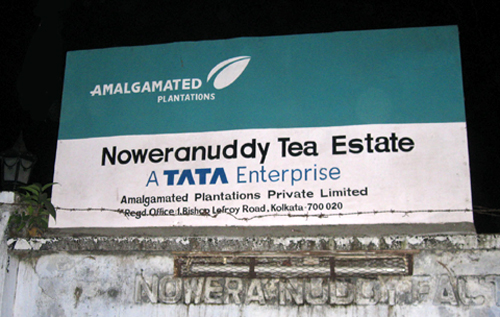
Tata, the transnational Indian conglomerate whose Tetley Group makes the world famous Tetley teas, has taken 6,500 people hostage through hunger. The hostages are nearly 1,000 tea plantation workers and their families on the Nowera Nuddy Tea Estate in West Bengal, India. Permanently living on the edge of hunger, the workers and their dependants are being pushed to the edge of starvation through an extended lock out which has deprived them of wages for all but two days since the beginning of August. The goal of this collective punishment is to starve the workers into renouncing their elementary human rights, including the right to protest extreme abuse and exploitation.
The hostage-taking began with a first lockout on August 10, when workers protested the abusive treatment of a 22 year-old tea garden worker who was denied maternity leave and forced to continue work as a tea plucker despite being 8 months pregnant. On August 9, Mrs Arti Oraon collapsed in the field and was brought to the hospital, on a tractor normally used for garbage, after the medical officer refused to make an ambulance available (he had proposed she be brought by bicycle). She was initially refused treatment, and only after her co-workers protested did she receive minimal care. Her treatment was inadequate and she had to be taken, in the same garbage tractor, to the local government hospital one hour away.

As news of her treatment spread, some 500 mostly female estate workers gathered in protest at the medical facility, demanding sanctions against the medical officer. Local management promised to meet with the workers, but on August 11 the management, along with the medical officer, left the estate and declared a lockout.

On August 27 an agreement was signed with three trade unions, representing some workers on the estate but not a majority, on reopening the garden. In the agreement, all workers’ wages for the lockout period were withheld. The agreement included a clause that a “domestic inquiry” (an internal, company-controlled investigation) would be conducted. The agreement was written in English, a language few if any of the workers understand.

The garden was reopened the following day, although workers were not informed of the conditions of the reopening. On September 8, management issued letters of suspension and ordered a domestic inquiry against eight workers.

None of the eight workers received a letter of notification. None of the eight had committed any act of violence or were involved in any illegal practice. These eight workers have been targeted because they are active in the garden campaigning for workers’ rights.

At a September 10 meeting, management told the workers that suspension letters had been issued in accordance with the August 27 agreement and that opening the garden depended on compliance with that agreement. In other words: agree to the suspensions or you’ll be locked-out again. Workers requested six days to respond to this ultimatum.

The ultimatum was a powerful one: tea garden wages are just 62.50 Indian rupees per day – the equivalent of USD 1.35 daily. One kilogram of the cheapest, poorest quality rice in the local market costs 20% of a worker’s daily wage. Tea workers permanently live on the edge of hunger. The loss of wages for even a few weeks can tip them into starvation.

Although wielding the weapon of hunger – with workers’ lives in the balance and the deadline to respond not yet expired – management on September 14 again left the plantation and implemented a lockout. This was the day workers were meant to receive their annual festival bonus, amounting to roughly two months wages. No bonus payments were made. Prior to the lockout, since the beginning of August workers have only received a wage payment amounting to two days work.

Following the closure, workers have sought to communicate with the management, requesting it to reopen the garden. The company has insisted that the garden will not be reopened and wages paid unless all workers accept the September 10 ultimatum to effectively sign off their right to protest abuses.

Tata Tea is a powerful global company; it’s wholly owned Tetley Tea is one of the world’s biggest-selling tea brands. Nowera Nuddy Tea Estate is owned by Amalgamated Plantations Private Limited, a company 49.98% owned by Tata Tea. Tata and Amalgamated share the same office in Kolkata, the capital of West Bengal. According to the Tata Tea 2009 annual report, Tata Tea Managing Director Percy T. Siganporia earns in a single day roughly 1,000 times the daily wage of a Nowera Nuddy worker – assuming that worker is paid .

Tea from Amalgamated Plantations’ tea estates goes into the famous Tetley Tea bags.

Tetley Tea is a member of the Ethical Tea Partnership (ETP), whose standard commits member companies to, among other requirements, ensure that there is no “harsh or inhumane treatment” of plantation workers and that “Workers should be paid at least monthly and should receive their pay on time.” The actual conditions on the Nowera Nuddy estate, where workers are being subjected to brutal collective punishment, could not be more remote from this CSR wish list.

Workers at the Nowera Nuddy Tea Estate have formed an Action Committee which has called for the immediate reopening of the garden, the withdrawal of the suspension letters and no recriminations against workers, back payment of wages and rations since 14 September, immediate payment of the annual festival bonus and a management apology to Mrs Arti Oraon.

You can support their struggle – CLICK HERE to tell Tata and Tetley Tea to stop starving workers now! You can also use the features provided on the Tetley Tea website to send the company a message, or use the freephone number provided to give them a call!

Courtesy: IUF-Uniting Food, Farm and Hotel Workers World-Wide

“America’s Head Servant?”

An article in the recent issue of New Left Review (Nov-Dec) authored by Hung Ho-Fung demonstrates the fragility of the Chinese rise. The author singles out two major factors that fuelled this rise:

1) Stagnant industrial (especially manufacturing) wages for the last three decades;

Wages

2) An urban-biased approach to development leading to a “prolonged ‘limitless’ supply of labour”.

By bankrupting the rural economy, China has pumped up its urban industrial growth, trade surplus and financial capital.

ruraltourban

This is how China lured global capital, even from other East Asian economies, which consequently put China at the helm of East Asian capitalism. But the same strategy has made China dependent on the ups and downs of the global (esp., American) economy. Cheap labour and rural bankruptcy, which constitute the basis of Chinese growth, cannot provide a viable domestic demand structure for the growth to sustain during a global recession. Further, the rise of the Coastal bourgeoisie and their cohorts within the Communist Party will not allow demand stimulus which brings about structural changes challenging their political-economic hegemony.

The “capitalist roaders” in China are fully entrenched within the State and Party, so “class struggle within the party” will not be enough, a new full-fledged Chinese Revolution is what is called for.

How can the U.S. Unemployment be solved?

10.2% of Americans are unemployed. Another 5.3% are underemployed. Now President Obama faces criticism that he lost focus on creating and saving jobs.

Courtesy: newsy

Conference on “Region Formation in Contemporary South Asia”

25-27 November 2009
Room No. 22, Arts Faculty, North Campus
The University of Delhi,
Delhi (India)

Day One, 25th November 2009

Inaugural Address: 9.00 am to 9.40 am

Dr. Salvatore Engel-Di Mauro : On Not Confusing Regions with the Product of Ideological Confrontations between Opposing Ruling Classes.

Requiem: 9.40 am to 10.10 am

Mr. N. Babaiah: K Balagopal: A Portrait of An Activist.

Tea Break: 10.10 am to 10.25 am

The ‘National Question’, Communist Party and South India: 10.25 am to 1.00 pm

Mr. Vijay Singh: THE COMMUNIST PARTY OF INDIA AND THE NATIONAL QUESTION 1942-1955.
Mr. A. Bhoomaiah: “STRUGGLE FOR TELANGANA STATE HOOD” AS A PART OF NATIONALITIES AND DEMOCRATIC MOVEMENTS.
Dr. V S Shreedara: Kannada Daughter and the Indian Mother: the question of Kannada Nationality.
Prof. A Marx: Tamil Nadu: The Inclusive Tradition.

Lunch Break: 1.00 pm to 1.30 pm

Constituents of a Region: The South Indian Case: 1.30 pm to 4.30 pm

Mr. Simon Chilvers: Social Formation and Articulation of Modes of Production in Karnataka.
Ms. Pranjali Bandhu: The Adivasi Situation in The Nilgiris With Special Focus On Their Educational Status.
Mr. Sachin N: Muthanga-Manvelimantam: A Dialectic between dystopic region in History and utopian space in Literature.
Ms. Yemuna Sunny: Kuttanada: The Making And Unmaking Of A Region.
Ms. Terah Sportel: Labour Market Change, Plucking Nuts: Exploring Regional Trajectories of the Kerala Coconut Sector, India.

Tea Break: 4.30 pm to 4.45 pm

SAARC 4.45 pm

Ms. Ipsita Sengupta: SAARC: Is human rights on the agenda?
Dr. Pawan Kumar Jha: Region Formation: The Perspective for New South Asia.
Mr. Sashi Kumar: Regional Protection of Rights: Emerging Concern.
Ms. Shveta Dhaliwal: Regional Human Rights Mechanism: A Pre- Requisite for Contemporary South Asia.

Day two, 26th November 2009.

Keynote Address: 9.00 am to 9.40 am

Prof. K M Shrimali: Title not submitted

Cultural/Ideological (Re)Production of Region: Northeast 9.40 to 11.30 am

Dr.Jae-Eun Shin: Pragjyotish – Kamrupa: Imagined Boundaries and Imposed Historicity.
Dr. Manjeet Baruah: Guerrilla Space as Literary Plot in Aulingar Zui (Spring of Ash): Space/Culture and Ideological Explorations.
Dr. Joy L. Pachuau: Death and locality in the creation of an identity: the Mizo case.

Tea break: 11.30 am to 11.45 am

Mapping the North east 11.45 am to 1.30 pm

Dr. Chandan Sharma: Reclaiming the Foothills from Colonial Discourse: Space, Settlement and Strategy in Northeast India.
Dr. Sarah Hilaly: Trajectory of Region Formation In The Margins: Arunachal Pradesh In Colonial and Post-Colonial Period.
Mr. Thingnam Sanjeev: Recasting Space: Strategies and Politics of Frontier Making.

Lunch Break: 1.30 pm to 2.00 pm

Situating Region and Politics in the North east: 2.00 pm to 3.45 pm.

Messrs. Asok Kr. Ray and Gorky Chakroborty: Contextualizing India’s North East vis-a-vis South Asia: The Realities and Imaginaries.
Mr. Kundan Hazarika: Uneven Development and Formation of Regionalism: A Study of The Assam Movement.
Mr. Pankaj Jyoti Gogoi: Nationalist Discourse and Regional Consciousness: The Retrospect and Prospect of Regional Uprising in North-East India With Special Reference to Assam.

Tea Break: 3.45 pm to 4.00 pm

Region and Politics in the North and Western India: 4.00 pm

Messrs. R. Venugopalan Nair and Varadrajan N: Defining a Region: Palimpsest of Identities and Politics of Dismemberment.
Dr. Vedpal Rana: Language or Geo-cultural zones? A case study of Partition of Punjab-1966.
Mr. Yogesh Snehi: Politics of Language, Identity or Ecology: Reorganisation, State and the Emergence of Himachal Pradesh.
Prof. Hameedah Naeem: (Title not submitted)

Day Three, 27th November 2009.

Morphogeny of a Region 9.00 am to 11.00 am

Dr. Ryosuke Furui: Sub-regional Identities and Cultural Hegemony in Early Medieval Bengal.
Mr. Kundan Kumar: Reconstructing The Historical Landscape of The Kosi River.
Mr. Pradeep Kumar Nath: The Identity of Western Orissa.

Tea Break: 11.00 am to 11.15 am

Imagining the Region/Regional Imagination: 11.15 am to 1.15 am

Ms. Radhika Borde: The Sarna Movement: Adivasi Religious Bioregionalism.
Mr. Sachida Nand Jha: Rethinking the representations of Maithili Identity in print.
Mr. Sadan Jha: Representing a Region: History, Memory and Literature in the Construction of Purnea (North Bihar) as a Cul De Sac.

Lunch Break: 1.15 pm to 1.45 pm

Prometheus Bound: Region and/in the Nation States: 1.45 pm to 4.15 pm

Mr. Swatahsiddha Sarkar: Formation of Region and Regional Identity in Darjeeling Hills.
Mr. Delwar Hussain: Re- arranging the regions- The coal villages on Bangladesh/India Border.
Dr. Nasir Uddin: Between Peace and Conflict: A Study on Conflict Management and Peace Building in Chittagong Hill Tracts of Bangladesh.
Mr. Fraser Sugden: Understanding spatial subordination: the evolution of modes of production on the Nepal terai.

Tea Break: 4.15 pm to 4.30 pm

Region and Politics in Central India: 4.30 pm to 5.45 pm

Mr. Yogesh Diwan: Adivasi Identity and Regional Politics.
Mr. Kumar Sanjay Singh: Madhya Pradesh: A Geographical Entity With Split Personalities.

Valedictory Session 5.45 pm to 6.30 pm

Prof. James Petras: Separatism and Class Politics in Latin America.

Public Meeting Against War on Citizens

Date: 13th November 2009
Venue: Vivekananda Statue, Arts Faculty, North Campus, Delhi University
Time: 12.00 pm onward

Tens of thousands soldiers of paramilitary and special police forces are directed towards central and eatern parts of India, including Chattisgarh, Orissa, Jharkand, areas of Maharastra and Western Bengal. Previously too, the state has deployed armed forces against civilians and within civilian areas with disastrous consequences. Kashmir and North-Eastern states have been facing this onslaught for decades now.

The Campaign against War on People is organizing a Public Meeting on Friday 13th November on this issue. The meeting will address the current state offensive against citizens in Eastern and Central India, and the larger issue of the use of armed forces in civilian areas.

We invite all organisations and individuals who are concerned about the use of armed forces in civilian areas to attend and participate in this Meeting.

Speakers:
Madan Kashyap, Journalist
Prashant Bhushan, Civil liberties lawyer
Saroj Giri, Department of Political Science, University of Delhi
Gautam Navlakha, Civil liberties activist
Harish Dhawan, PUDR
Poonam, Pragatisheel Mahila Sangathan
Representative of Peoples organisations form North Eastern states
Representative of New Socialist Initiative,
Representative of Progressive Students’ Union,
Dr. N. Bhattacharya, Jan Hastakshep
Representative of JNU Forum Against War on People
Abhinav, Disha
Sandeep Singh, AISA
Banjyotsna, DSU

Campaign Against War on People
Contact: opposethehunters@gmail.com, stopwaroncitizens@gmail.com
Ph: 9899523722, 9910455993, 9718259201, 9818728298

Nov 3 Protest Video (II): SAR Geelani

Nov 3 Protest Video (I): Gautam Navlakha

How a hotel burnt its fingers

C. Gopinath

In an advertisement on its pages, the US business daily, The Wall Street Journal, proudly proclaimed ‘Hyatt has great news’. The paper was pleased to announce that copies of the paper would henceforth be available for our reading pleasure if we stayed at a Hyatt hotel.

Unfortunately, at about the same time last month, the news about Hyatt was anything but great. The international hotel chain was being accused of treating its cleaning staff unfairly, and the company was doing a poor job defending its actions.

ADDING TO JOBLESSNESS

It all began as a simple decision to outsource. The company decided that, as of end August, it would lay off about 100 of its housekeeping staff from three of its hotels in Boston and give the cleaning contract to a firm in Atlanta, called Hospitality Staffing Solutions. The objective, of course, was to cut costs. Hyatt’s corporate revenues had fallen by about 18 per cent during the first half of the year. Its Boston hotels had also experienced revenue shortfalls, with the recession forcing people to cut back on their travel. So the company, faced with “these unprecedented economic challenges” (in the words of its manager), took the efficient managerial decision of handing over the cleaning contract to an outside firm and laying off its employees.

Early September, the news started leaking out. It turns out that the employees who had been laid off were paid about $15 (Rs 705) an hour while the cleaning contractor’s employees were going to be paid $8 (Rs 376) an hour. That made sense, right? Cutting cleaning costs by almost 50 per cent!

But when you put paper and pencil together, knowing that an employee is expected to clean about 20 rooms in an eight-hour work day, you would quickly figure that Hyatt was looking to save about $3 (Rs 141) per day in cleaning costs for a room that it probably charges its guest about $175 (Rs 8,225) to sleep in. Well, any saving is a saving in these hard times, you would say.

But these were fairly low-level staff, some of whom had been working at the hotel for close to 20 years. At a time when the nation’s unemployment was touching 10 per cent it was not going to be easy for them to find another job. But that wasn’t all. The local paper also reported that these employees had been asked to train some other persons to do their job and were told that those being trained would fill in during vacations. Only later did they realise that they were training their replacement.

SYMPATHY FOR EMPLOYEES

That seemed to touch a raw nerve and the local reaction was swift and bitter. The Governor of the state said he planned to direct state employees to boycott the hotel unless it took the employees back.

A couple of professional groups which were planning to host seminars or conferences at the hotel cancelled plans. Although the laid-off employees were not members of a union, a local union that normally represents hotel workers announced that it would rally in their support and picketed the properties.

The hotel chain was clearly caught off-guard. It first announced that it would help the dismissed workers find other jobs, retrain them if necessary, and extended their health care for three months.

It vehemently denied that the training of the replacements was done secretly. But you must wonder about a company’s well-paid human resources personnel who would think of a scheme as this. Meanwhile, the public indignation spread and even the city taxi union announced a boycott and refused to service the chain’s locations.

Something else started happening. The company announced that the laid-off employees would be offered work with another Hyatt contractor, a Chicago-based firm called United Service Cos. And they will be paid the wage they received at Hyatt till the end of the year.

The contractor was confident that the employees would almost surely be able to find some other job after that. (In other words, quieten down and everything would be forgotten in a few months.)

MISJUDGING PUBLIC MOOD

Clearly, Hyatt was completely missing the point. The company believed that if it found work (at least temporarily) for those who had been laid off, everything would be back to normal.

On the other hand, the public reaction to the cleaning staff being replaced by contract labour at lower wages was only the event on which was riding a whole lot that was perceived as wrong with modern management. Any lay-off, and especially due to outsourcing, is a sore subject, especially at a time when unemployment is rising, even while everyone is claiming that recession is over.

A lot of mid-level management personnel, currently laid off and looking for work in corporate America see their work being given to cheaper personnel, within the company or outside, and can empathise with the Hyatt employees. Yet, corporations that are penny-pinching seem to be able to find enough money to continue to pay lavish top-management salaries and bonuses.

Newspapers crow that productivity is at an all-time high — what that essentially means is that fewer people are being used to produce the same or more output.

There must be something fundamentally wrong with a measure that undermines human capital. On top of it all, when Hyatt (allegedly) made those employees train their replacements, it just seemed morally wrong.

To compound its misfortune, Hyatt’s reluctance to meet with the press to present its side of the story, and its tendency to hide behind corporate press releases did not go down well. Even when the company sensed that its response to the situation was less than exemplary, it did not know how to say it.

Look at this: “Contrary to the way our actions have been characterised by many, we did attempt to implement this staffing change in a respectful manner and many of the assertions that have been made are false. We do, however, recognise and regret that we did not handle all parts of the transition in a way that reflects our organisation’s values.”

And the final irony: Business Week, a US business magazine recognised Hyatt as among “the best places to launch a career” about the same time as the layoffs. Of course, the magazine was referring to entry-level workers in the company’s corporate training programme, not entry level housekeepers.

Courtesy: Business Line

US Economy from a Working Class Perspective

Deepankar Basu

Rising continuously for the last 30 months, the official unemployment rate in the US economy crossed over to double-digit territory in October 2009. According to figures released recently by the US Bureau of Labour Statistics, the official unemployment rate in the US was 10.2 percent in October 2009; this is the first time in 26 years that the official unemployment rate has crossed 10 percent in the US. But the official measure is a gross underestimation of the reality of joblessness in the US. A more sensible measure, which takes into account the “discouraged” and part-time workers, stood at 17.5 percent!

The November 6, 2009 Fact Sheet from the Economic Policy Institute, a progressive think tank in the US provides more interesting facts about the US economy, especially relevant for working-class people; below I provide some of the entries from the above fact sheet as a summary of important facts about several neglected dimensions of the US economy:

Historical context
• Current unemployment rate (October 2009): 10.2%
• Current underemployment rate, including people who have been unable to find full-time work and are working either
part time or not at all: 17.5%
• Number of consecutive months of job loss during this recession: 22
• Last time the United States saw 10.2% unemployment: April 1983
• Number of months double-digit unemployment lasted during the 1980s recession: 10
• Peak rate of unemployment during the recession in 2001: 5.5%
• Number of months that passed after the 2001 recession had officially ended before unemployment peaked, at 6.3%: 19

Current recession
• Ratio of job seekers to job openings when the current recession began: 1.7 to 1
• Ratio of job seekers to job openings today: 6.3 to 1
• Total number of jobs lost during the current recession: 8.1 million
• Number of people who have been unemployed for more than six months: 5.6 million
• Jobs needed to return to pre-recession employment levels when population growth is factored in: 10.9 million

Demographic data
• Current unemployment rate for black workers: 15.7%
• Current unemployment rate for Hispanic workers: 13.1%
• Current unemployment rate for white workers: 9.5%
• Current unemployment rate for men: 11.4%
• Current unemployment rate for women: 8.8%
• State with the highest unemployment: Michigan, 15.3%
• State with the lowest unemployment: North Dakota, 4.2%
• State showing the largest portion of job loss during this recession: Arizona, 10%
• Unemployment rate among black workers in Michigan: 23.9%
• Unemployment rate among white workers in Michigan: 13.7%
• Unemployment rate for college-educated workers: 4.7%
• Unemployment rate for workers who did not complete high school: 15.5%

Related economic data
• Number of Americans with no health insurance in 2008: 46.3 million
• Number of Americans projected to have no health insurance by 2010: more than 50 million
• Percent of U.S. population living in poverty in 2008: 13.2%
• Percent of U.S. children living in poverty in 2008: 19%
• Percent of African American children living in poverty in 2008: 34.7%
• Portion of African American children expected to be living in poverty in the coming years, as a result of higher unemployment: more than half

Campaign against War on People

The Indian government intends to deploy 100,000 troops – ostensibly against Maoist insurgents – in 7 states in central and eastern India, including Maharashtra, Chhattisgarh, Orissa, Jharkhand and Andhra Pradesh, a vast area inhabited by tribal groups. Forces withdrawn from Jammu and Kashmir (e.g. Rashtriya Rifles) and the Northeast are joining battalions of CRPF commandos, the ITBP, the CoBRA and the BSF, equipped with bomb trucks, bomb blankets, bomb baskets, and sophisticated new weaponry. Six IAF Mi-17 helicopters will provide air support to these ground forces, in which the IAF’s own special force, the Garuds, will participate. The actual strength of the intended targets of this massive action – the Maoist cadre – is believed to be no more than 20,000. Besides the dangers of any state offensive against any section of the people, the scale of the offensive suggests that the state is unable to distinguish the millions of tribals in this area from the Maoists, and has chosen the quick solution of war on the entire region. Several groups which are not Maoist – like the Vanvasi Chetna Ashram in Dantewada – have been clubbed with them and are being targeted. The basic question is, why is the state planning war against its most deprived, oppressed and impoverished populations?

Central India is rich in mineral wealth that is already being auctioned: Till September 2009, Rs 6,69,388 crore of investment had been pledged toward industry in the troubled areas—14 per cent of the total pledged investments in the country. All that stands between politicians/ big money bags and this wealth is the tribal people and their refusal to consent to their designs. Even constituent bodies of Indian state machinery acknowledge the gross failure of state in the tribal areas of the country in no uncertain terms. The Planning Commission Report on Social Discontent and Extremism, has clearly identified equity and justice issues relating to land, forced displacement and evictions, extreme poverty and social oppression, livelihood, malgovernance and police brutality as widespread in the region. The Approach Paper for the 11th Plan states:

Our practices regarding rehabilitation of those displaced from their land because of development projects are seriously deficient and are responsible for a growing perception of exclusion and marginalisation. The costs of displacement borne by our tribal population have been unduly high, and compensation has been tardy and inadequate, leading to serious unrest in many tribal regions. This discontent is likely to grow exponentially if the benefits from enforced land acquisition are seen accruing to private interests, or even to the state, at the cost of those displaced.

The Fifth Schedule of the Constitution grants tribals complete rights over their traditional land and forests and prohibits private companies from mining on their land. In spite of all this, in the name of fighting the Maoists the state – in blatant violation of Constitutional rights and against the recommendations of its own committees – is all set to evacuate the entire area of the tribals and ghettoise them by forcing them into ‘relief camps’, to allow free rein to big business. Instead of addressing the basic rights and needs of the tribals, the impatience of the state/big business in the face of the stiff resistance from them, is leading it to a full-scale war on people who are already fighting an everyday battle for livelihood and survival.

In the past as well the state has tried to crush all popular resistance, armed or not. It has repeatedly ignored and/or suppressed non-violent resistance, be it in Bhopal gas-victims or the ‘Narmada Bachao’ Andolan. Various human rights activists who have spoken out against its policies have also been targeted through draconian instruments like the Chhatisgarh Special Public Safety Act, 2005. It has also brutally assaulted protesters in Singur, Nandigram, Lalgarh and Khammam and conducted military offensives in Chhattisgarh, Jharkhand, Orissa, West Bengal and Andhra Pradesh that have been seriously questioned. Now, along with an increasingly uncritical, elitist and complicit media, it is set on drumming up war hysteria to legitimise its own extra-Constitutional programs. The fact that it has either rejected or dismissed offers of talks and mediations – while hypocritically calling for them – indicates the extent to which it is invested in this war. The Central Government’s military offensive further dilutes the federal character of Indian democracy as it covertly shifts the maintenance of law and order off the state onto the centre list.

This war on the people also entails a further shrinking of already limited spaces for democratic dissent and articulation of pro people development paradigms. It opens the way for the state to act with force against any form of dissent or struggle. Any individual or organization protesting against the policies of the state can be labelled as a threat to ‘internal security’. To understand the politics and economics of the current state offensive, we urge people to look beyond the current hype being built by the government and pliable sections of the media. This indicates the emergence of a dangerous consensus towards a police state that will render the people and resources pliable to the demands of global capitalism and authoritarianism.

We call upon all progressive forces – students, teachers and workers – to resist the latest plan of the Indian government. Stop state violence against people.

Join our demand for a peaceful, egalitarian and secular society.

Contact:opposethehunters@gmail.com, stopwaroncitizens@gmail.com
Ph: 9899523722, 9910455993, 9718259201, 9818728298